CS344 : Introduction to Artificial
Intelligence
Pushpak Bhattacharyya
CSE Dept.,
IIT Bombay
Lecture 11- Resolution; Robotic
Knowledge Representation
Predicate Calculus
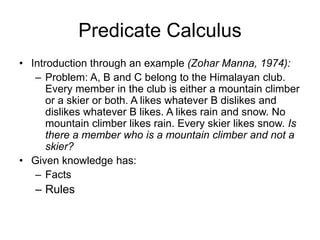
• Introduction through an example (Zohar Manna, 1974):
– Problem: A, B and C belong to the Himalayan club.
Every member in the club is either a mountain climber
or a skier or both. A likes whatever B dislikes and
dislikes whatever B likes. A likes rain and snow. No
mountain climber likes rain. Every skier likes snow. Is
there a member who is a mountain climber and not a
skier?
• Given knowledge has:
– Facts
– Rules
Predicate Calculus: Example
contd.
• Let mc denote mountain climber and sk denotes skier. Knowledge
representation in the given problem is as follows:
1. member(A)
2. member(B)
3. member(C)
4. ∀x[member(x) → (mc(x) ∨ sk(x))]
5. ∀x[mc(x) → ~like(x,rain)]
6. ∀x[sk(x) → like(x, snow)]
7. ∀x[like(B, x) → ~like(A, x)]
8. ∀x[~like(B, x) → like(A, x)]
9. like(A, rain)
10. like(A, snow)
11. Question: ∃x[member(x) ∧ mc(x) ∧ ~sk(x)]
• We have to infer the 11th expression from the given 10.
• Done through Resolution Refutation.
Inferencing in Predicate Calculus
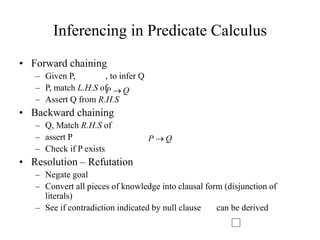
• Forward chaining
– Given P, , to infer Q
– P, match L.H.S of
– Assert Q from R.H.S
• Backward chaining
– Q, Match R.H.S of
– assert P
– Check if P exists
• Resolution – Refutation
– Negate goal
– Convert all pieces of knowledge into clausal form (disjunction of
literals)
– See if contradiction indicated by null clause can be derived
Q
P 
Q
P 
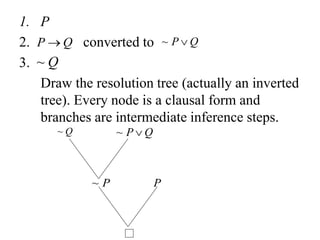
1. P
2. converted to
3.
Draw the resolution tree (actually an inverted
tree). Every node is a clausal form and
branches are intermediate inference steps.
Q
P  Q
P 
~
Q
~
Q
~
Q
P 
~
P
~ P
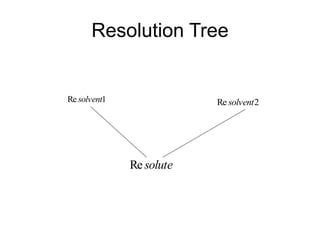
Terminology
• Pair of clauses being resolved is called the
Resolvents. The resulting clause is called the
Resolute.
• Choosing the correct pair of resolvents is a
matter of search.
Club example revisited
1. member(A)
2. member(B)
3. member(C)
4.
– Can be written as
–
5.
–
6.
–
7.
–
))]
(
)
(
(
)
(
[ x
sk
x
mc
x
member
x 


))]
(
)
(
(
)
(
[ x
sk
x
mc
x
member 

)
(
)
(
)
(
~ x
sk
x
mc
x
member 

)]
,
(
)
(
[ snow
x
lk
x
sk
x 

)
,
(
)
(
~ snow
x
lk
x
sk 
)]
,
(
~
)
(
[ rain
x
lk
x
mc
x 

)
,
(
~
)
(
~ rain
x
lk
x
mc 
)]
,
(
~
)
,
(
[ x
B
lk
x
A
like
x 

)
,
(
~
)
,
(
~ x
B
lk
x
A
like 
8.
–
9.
10.
11.
– Negate–
)]
,
(
)
,
(
[~ x
B
lk
x
A
lk
x 

)
,
(
)
,
( x
B
lk
x
A
lk 
)
,
( rain
A
lk
)
,
( snow
A
lk
)]
(
~
)
(
)
(
[ x
sk
x
mc
x
member
x 


)]
(
)
(
~
)
(
[~ x
sk
x
mc
x
member
x 


• Now standardize the variables apart which
results in the following
1. member(A)
2. member(B)
3. member(C)
4.
5.
6.
7.
8.
9.
10.
11.
)
(
)
(
)
(
~ 1
1
1 x
sk
x
mc
x
member 

)
,
(
)
(
~ 2
2 snow
x
lk
x
sk 
)
,
(
~
)
(
~ 3
3 rain
x
lk
x
mc 
)
,
(
~
)
,
(
~ 4
4 x
B
lk
x
A
like 
)
,
(
)
,
( 5
5 x
B
lk
x
A
lk 
)
,
( rain
A
lk
)
,
( snow
A
lk
)]
(
)
(
~
)
(
[~ 6
6
6 x
sk
x
mc
x
member
x 


)
,
(
~
)
,
(
~ 4
4 x
B
lk
x
A
like  )
,
( snow
A
lk
)
,
(
~ snow
B
lk )
,
(
)
(
~ 2
2 snow
x
lk
x
sk 
)
(
)
(
)
(
~ 1
1
1 x
sk
x
mc
x
member 

)
(
~ B
sk
)
(
)
(
~ B
mc
B
member  )
(B
member
)
(B
mc
)]
(
)
(
~
)
(
[~ 6
6
6 x
sk
x
mc
x
member
x 


)
(
)
(
~ B
sk
B
member  )
(
~ B
sk
)
(
~ B
member )
(B
member
7
10
12 5
13 4
14 2
11
15
16 13
17 2
Robotic Knowledge
Representation and inferencing
A planning agent
• An agent interacts with the world via perception and actions
• Perception involves sensing the world and assessing the situation
– creating some internal representation of the world
• Actions are what the agent does in the domain. Planning involves
reasoning about actions that the agent intends to carry out
• Planning is the reasoning side of acting
• This reasoning involves the representation of the world that the
agent has, as also the representation of its actions.
• Hard constraints where the objectives have to be achieved
completely for success
• The objectives could also be soft constraints, or preferences, to be
achieved as much as possible
Interaction with static domain
• The agent has complete information of the domain
(perception is perfect), actions are instantaneous and
their effects are deterministic.
• The agent knows the world completely, and it can take
all facts into account while planning.
• The fact that actions are instantaneous implies that there
is no notion of time, but only of sequencing of actions.
• The effects of actions are deterministic, and therefore
the agent knows what the world will be like after each
action.
Two kinds of planning
• Projection into the future
– The planner searches through the possible
combination of actions to find the plan that will
work
• Memory based planning
– looking into the past
– The agent can retrieve a plan from its memory
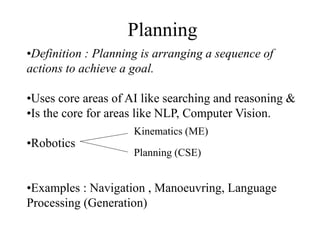
Planning
•Definition : Planning is arranging a sequence of
actions to achieve a goal.
•Uses core areas of AI like searching and reasoning &
•Is the core for areas like NLP, Computer Vision.
•Robotics
•Examples : Navigation , Manoeuvring, Language
Processing (Generation)
Kinematics (ME)
Planning (CSE)
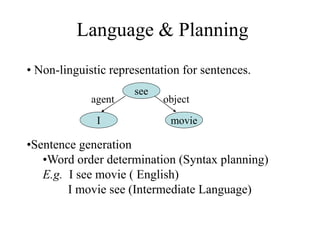
Language & Planning
• Non-linguistic representation for sentences.
•Sentence generation
•Word order determination (Syntax planning)
E.g. I see movie ( English)
I movie see (Intermediate Language)
see
I movie
agent object
STRIPS
•Stanford Research Institute Problem Solver (1970s)
•Planning system for a robotics project : SHAKEY (by
Nilsson et.al.)
•Knowledge Representation : First Order Logic.
•Algorithm : Forward chaining on rules.
•Any search procedure : Finds a path from start to goal.
•Forward Chaining : Data-driven inferencing
•Backward Chaining : Goal-driven
Forward & Backward Chaining
•Rule : man(x)  mortal(x)
•Data : man(Shakespeare)
To prove : mortal(Shakespeare)
•Forward Chaining:
man(Shakespeare) matches LHS of Rule.
X = Shakespeare
 mortal( Shakespeare) added
-Forward Chaining used by design expert systems
•Backward Chaining: uses RHS matching
- Used by diagnostic expert systems
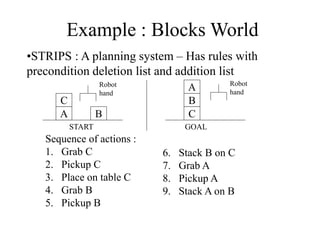
Example : Blocks World
•STRIPS : A planning system – Has rules with
precondition deletion list and addition list
A
C
A
C
B
B
START GOAL
Robot
hand
Robot
hand
Sequence of actions :
1. Grab C
2. Pickup C
3. Place on table C
4. Grab B
5. Pickup B
6. Stack B on C
7. Grab A
8. Pickup A
9. Stack A on B
Example : Blocks World
•Fundamental Problem :
The frame problem in AI is concerned with the question
of what piece of knowledge is relevant to the situation.
•Fundamental Assumption : Closed world assumption
If something is not asserted in the knowledge base, it is
assumed to be false.
(Also called “Negation by failure”)
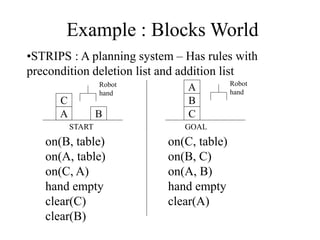
Example : Blocks World
•STRIPS : A planning system – Has rules with
precondition deletion list and addition list
on(B, table)
on(A, table)
on(C, A)
hand empty
clear(C)
clear(B)
on(C, table)
on(B, C)
on(A, B)
hand empty
clear(A)
A
C
A
C
B
B
START GOAL
Robot
hand
Robot
hand
Rules
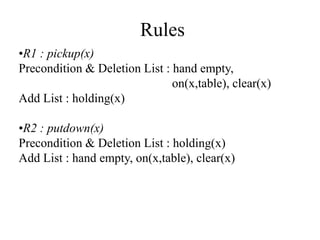
•R1 : pickup(x)
Precondition & Deletion List : hand empty,
on(x,table), clear(x)
Add List : holding(x)
•R2 : putdown(x)
Precondition & Deletion List : holding(x)
Add List : hand empty, on(x,table), clear(x)
Rules
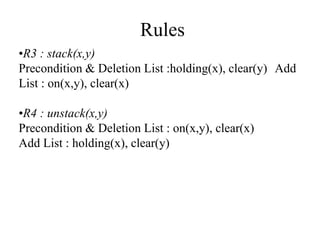
•R3 : stack(x,y)
Precondition & Deletion List :holding(x), clear(y) Add
List : on(x,y), clear(x)
•R4 : unstack(x,y)
Precondition & Deletion List : on(x,y), clear(x)
Add List : holding(x), clear(y)
Plan for the block world problem
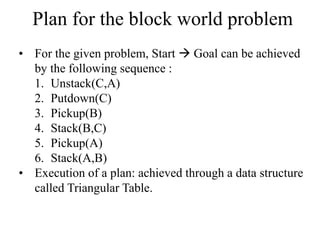
• For the given problem, Start  Goal can be achieved
by the following sequence :
1. Unstack(C,A)
2. Putdown(C)
3. Pickup(B)
4. Stack(B,C)
5. Pickup(A)
6. Stack(A,B)
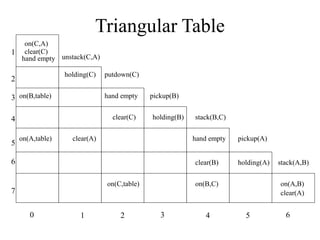
• Execution of a plan: achieved through a data structure
called Triangular Table.
Triangular Table
holding(C)
unstack(C,A)
putdown(C)
hand empty
on(B,table) pickup(B)
clear(C) holding(B) stack(B,C)
on(A,table) clear(A) hand empty pickup(A)
clear(B) holding(A) stack(A,B)
on(C,table) on(B,C) on(A,B)
clear(A)
clear(C)
on(C,A)
hand empty
0 1 2 3 4 5 6
1
2
3
4
5
6
7
Triangular Table
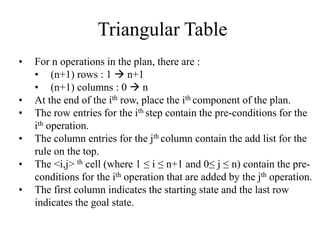
• For n operations in the plan, there are :
• (n+1) rows : 1  n+1
• (n+1) columns : 0  n
• At the end of the ith row, place the ith component of the plan.
• The row entries for the ith step contain the pre-conditions for the
ith operation.
• The column entries for the jth column contain the add list for the
rule on the top.
• The <i,j> th cell (where 1 ≤ i ≤ n+1 and 0≤ j ≤ n) contain the pre-
conditions for the ith operation that are added by the jth operation.
• The first column indicates the starting state and the last row
indicates the goal state.
Search in case of planning
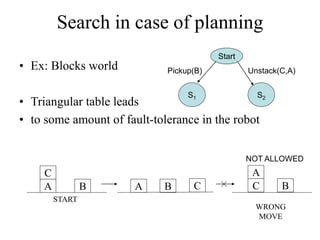
• Ex: Blocks world
• Triangular table leads
• to some amount of fault-tolerance in the robot
Start
S1 S2
Pickup(B) Unstack(C,A)
A
C
B
START
A C
B
A
C B
WRONG
MOVE
NOT ALLOWED
Resilience in Planning
• After a wrong operation, can the robot come back to
the right path ?
• i.e. after performing a wrong operation, if the system
again goes towards the goal, then it has resilience
w.r.t. that operation
• Advanced planning strategies
– Hierarchical planning
– Probabilistic planning
– Constraint satisfaction
Predicate Calculus
• Well Known Example:
– Man is mortal : rule
∀x[man(x) → mortal(x)]
– shakespeare is a man
man(shakespeare)
– To infer shakespeare is mortal
mortal(shakespeare)
Forward Chaining/ Inferencing
• man(x) → mortal(x)
– Dropping the quantifier, implicitly Universal
quantification assumed
– man(shakespeare)
• Goal mortal(shakespeare)
– Found in one step
– x = shakespeare, unification
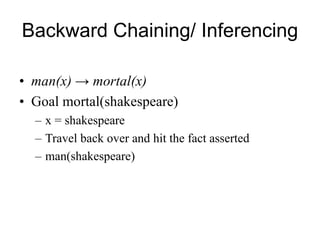
Backward Chaining/ Inferencing
• man(x) → mortal(x)
• Goal mortal(shakespeare)
– x = shakespeare
– Travel back over and hit the fact asserted
– man(shakespeare)
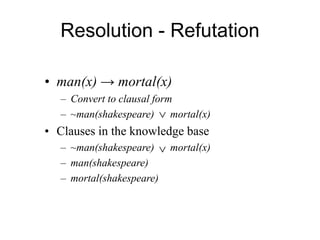
Resolution - Refutation
• man(x) → mortal(x)
– Convert to clausal form
– ~man(shakespeare) mortal(x)
• Clauses in the knowledge base
– ~man(shakespeare) mortal(x)
– man(shakespeare)
– mortal(shakespeare)


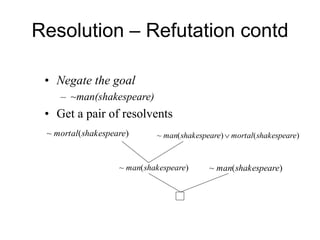
Resolution – Refutation contd
• Negate the goal
– ~man(shakespeare)
• Get a pair of resolvents
)
(
~ e
shakespear
mortal )
(
)
(
~ e
shakespear
mortal
e
shakespear
man 
)
(
~ e
shakespear
man )
(
~ e
shakespear
man
Resolution Tree
1
Re solvent 2
Re solvent
solute
Re
Search in resolution
• Heuristics for Resolution Search
– Goal Supported Strategy
• Always start with the negated goal
– Set of support strategy
• Always one of the resolvents is the most recently
produced resolute
Assignment
• Prove the inferencing in the himalayan club
example with different starting points,
producing different resolution trees.
• Think of a Prolog implementation of the
problem
• Prolog Reference (Prolog by Chocksin &
Melish)

cs344-lect11-resolution-robotic-knowledge-representation-29jan08.ppt

  • 1.
    CS344 : Introductionto Artificial Intelligence Pushpak Bhattacharyya CSE Dept., IIT Bombay Lecture 11- Resolution; Robotic Knowledge Representation
  • 2.
    Predicate Calculus • Introductionthrough an example (Zohar Manna, 1974): – Problem: A, B and C belong to the Himalayan club. Every member in the club is either a mountain climber or a skier or both. A likes whatever B dislikes and dislikes whatever B likes. A likes rain and snow. No mountain climber likes rain. Every skier likes snow. Is there a member who is a mountain climber and not a skier? • Given knowledge has: – Facts – Rules
  • 3.
    Predicate Calculus: Example contd. •Let mc denote mountain climber and sk denotes skier. Knowledge representation in the given problem is as follows: 1. member(A) 2. member(B) 3. member(C) 4. ∀x[member(x) → (mc(x) ∨ sk(x))] 5. ∀x[mc(x) → ~like(x,rain)] 6. ∀x[sk(x) → like(x, snow)] 7. ∀x[like(B, x) → ~like(A, x)] 8. ∀x[~like(B, x) → like(A, x)] 9. like(A, rain) 10. like(A, snow) 11. Question: ∃x[member(x) ∧ mc(x) ∧ ~sk(x)] • We have to infer the 11th expression from the given 10. • Done through Resolution Refutation.
  • 4.
    Inferencing in PredicateCalculus • Forward chaining – Given P, , to infer Q – P, match L.H.S of – Assert Q from R.H.S • Backward chaining – Q, Match R.H.S of – assert P – Check if P exists • Resolution – Refutation – Negate goal – Convert all pieces of knowledge into clausal form (disjunction of literals) – See if contradiction indicated by null clause can be derived Q P  Q P 
  • 5.
    1. P 2. convertedto 3. Draw the resolution tree (actually an inverted tree). Every node is a clausal form and branches are intermediate inference steps. Q P  Q P  ~ Q ~ Q ~ Q P  ~ P ~ P
  • 6.
    Terminology • Pair ofclauses being resolved is called the Resolvents. The resulting clause is called the Resolute. • Choosing the correct pair of resolvents is a matter of search.
  • 7.
    Club example revisited 1.member(A) 2. member(B) 3. member(C) 4. – Can be written as – 5. – 6. – 7. – ))] ( ) ( ( ) ( [ x sk x mc x member x    ))] ( ) ( ( ) ( [ x sk x mc x member   ) ( ) ( ) ( ~ x sk x mc x member   )] , ( ) ( [ snow x lk x sk x   ) , ( ) ( ~ snow x lk x sk  )] , ( ~ ) ( [ rain x lk x mc x   ) , ( ~ ) ( ~ rain x lk x mc  )] , ( ~ ) , ( [ x B lk x A like x   ) , ( ~ ) , ( ~ x B lk x A like 
  • 8.
    8. – 9. 10. 11. – Negate– )] , ( ) , ( [~ x B lk x A lk x  ) , ( ) , ( x B lk x A lk  ) , ( rain A lk ) , ( snow A lk )] ( ~ ) ( ) ( [ x sk x mc x member x    )] ( ) ( ~ ) ( [~ x sk x mc x member x   
  • 9.
    • Now standardizethe variables apart which results in the following 1. member(A) 2. member(B) 3. member(C) 4. 5. 6. 7. 8. 9. 10. 11. ) ( ) ( ) ( ~ 1 1 1 x sk x mc x member   ) , ( ) ( ~ 2 2 snow x lk x sk  ) , ( ~ ) ( ~ 3 3 rain x lk x mc  ) , ( ~ ) , ( ~ 4 4 x B lk x A like  ) , ( ) , ( 5 5 x B lk x A lk  ) , ( rain A lk ) , ( snow A lk )] ( ) ( ~ ) ( [~ 6 6 6 x sk x mc x member x   
  • 10.
    ) , ( ~ ) , ( ~ 4 4 x B lk x A like ) , ( snow A lk ) , ( ~ snow B lk ) , ( ) ( ~ 2 2 snow x lk x sk  ) ( ) ( ) ( ~ 1 1 1 x sk x mc x member   ) ( ~ B sk ) ( ) ( ~ B mc B member  ) (B member ) (B mc )] ( ) ( ~ ) ( [~ 6 6 6 x sk x mc x member x    ) ( ) ( ~ B sk B member  ) ( ~ B sk ) ( ~ B member ) (B member 7 10 12 5 13 4 14 2 11 15 16 13 17 2
  • 11.
  • 12.
    A planning agent •An agent interacts with the world via perception and actions • Perception involves sensing the world and assessing the situation – creating some internal representation of the world • Actions are what the agent does in the domain. Planning involves reasoning about actions that the agent intends to carry out • Planning is the reasoning side of acting • This reasoning involves the representation of the world that the agent has, as also the representation of its actions. • Hard constraints where the objectives have to be achieved completely for success • The objectives could also be soft constraints, or preferences, to be achieved as much as possible
  • 13.
    Interaction with staticdomain • The agent has complete information of the domain (perception is perfect), actions are instantaneous and their effects are deterministic. • The agent knows the world completely, and it can take all facts into account while planning. • The fact that actions are instantaneous implies that there is no notion of time, but only of sequencing of actions. • The effects of actions are deterministic, and therefore the agent knows what the world will be like after each action.
  • 14.
    Two kinds ofplanning • Projection into the future – The planner searches through the possible combination of actions to find the plan that will work • Memory based planning – looking into the past – The agent can retrieve a plan from its memory
  • 15.
    Planning •Definition : Planningis arranging a sequence of actions to achieve a goal. •Uses core areas of AI like searching and reasoning & •Is the core for areas like NLP, Computer Vision. •Robotics •Examples : Navigation , Manoeuvring, Language Processing (Generation) Kinematics (ME) Planning (CSE)
  • 16.
    Language & Planning •Non-linguistic representation for sentences. •Sentence generation •Word order determination (Syntax planning) E.g. I see movie ( English) I movie see (Intermediate Language) see I movie agent object
  • 17.
    STRIPS •Stanford Research InstituteProblem Solver (1970s) •Planning system for a robotics project : SHAKEY (by Nilsson et.al.) •Knowledge Representation : First Order Logic. •Algorithm : Forward chaining on rules. •Any search procedure : Finds a path from start to goal. •Forward Chaining : Data-driven inferencing •Backward Chaining : Goal-driven
  • 18.
    Forward & BackwardChaining •Rule : man(x)  mortal(x) •Data : man(Shakespeare) To prove : mortal(Shakespeare) •Forward Chaining: man(Shakespeare) matches LHS of Rule. X = Shakespeare  mortal( Shakespeare) added -Forward Chaining used by design expert systems •Backward Chaining: uses RHS matching - Used by diagnostic expert systems
  • 19.
    Example : BlocksWorld •STRIPS : A planning system – Has rules with precondition deletion list and addition list A C A C B B START GOAL Robot hand Robot hand Sequence of actions : 1. Grab C 2. Pickup C 3. Place on table C 4. Grab B 5. Pickup B 6. Stack B on C 7. Grab A 8. Pickup A 9. Stack A on B
  • 20.
    Example : BlocksWorld •Fundamental Problem : The frame problem in AI is concerned with the question of what piece of knowledge is relevant to the situation. •Fundamental Assumption : Closed world assumption If something is not asserted in the knowledge base, it is assumed to be false. (Also called “Negation by failure”)
  • 21.
    Example : BlocksWorld •STRIPS : A planning system – Has rules with precondition deletion list and addition list on(B, table) on(A, table) on(C, A) hand empty clear(C) clear(B) on(C, table) on(B, C) on(A, B) hand empty clear(A) A C A C B B START GOAL Robot hand Robot hand
  • 22.
    Rules •R1 : pickup(x) Precondition& Deletion List : hand empty, on(x,table), clear(x) Add List : holding(x) •R2 : putdown(x) Precondition & Deletion List : holding(x) Add List : hand empty, on(x,table), clear(x)
  • 23.
    Rules •R3 : stack(x,y) Precondition& Deletion List :holding(x), clear(y) Add List : on(x,y), clear(x) •R4 : unstack(x,y) Precondition & Deletion List : on(x,y), clear(x) Add List : holding(x), clear(y)
  • 24.
    Plan for theblock world problem • For the given problem, Start  Goal can be achieved by the following sequence : 1. Unstack(C,A) 2. Putdown(C) 3. Pickup(B) 4. Stack(B,C) 5. Pickup(A) 6. Stack(A,B) • Execution of a plan: achieved through a data structure called Triangular Table.
  • 25.
    Triangular Table holding(C) unstack(C,A) putdown(C) hand empty on(B,table)pickup(B) clear(C) holding(B) stack(B,C) on(A,table) clear(A) hand empty pickup(A) clear(B) holding(A) stack(A,B) on(C,table) on(B,C) on(A,B) clear(A) clear(C) on(C,A) hand empty 0 1 2 3 4 5 6 1 2 3 4 5 6 7
  • 26.
    Triangular Table • Forn operations in the plan, there are : • (n+1) rows : 1  n+1 • (n+1) columns : 0  n • At the end of the ith row, place the ith component of the plan. • The row entries for the ith step contain the pre-conditions for the ith operation. • The column entries for the jth column contain the add list for the rule on the top. • The <i,j> th cell (where 1 ≤ i ≤ n+1 and 0≤ j ≤ n) contain the pre- conditions for the ith operation that are added by the jth operation. • The first column indicates the starting state and the last row indicates the goal state.
  • 27.
    Search in caseof planning • Ex: Blocks world • Triangular table leads • to some amount of fault-tolerance in the robot Start S1 S2 Pickup(B) Unstack(C,A) A C B START A C B A C B WRONG MOVE NOT ALLOWED
  • 28.
    Resilience in Planning •After a wrong operation, can the robot come back to the right path ? • i.e. after performing a wrong operation, if the system again goes towards the goal, then it has resilience w.r.t. that operation • Advanced planning strategies – Hierarchical planning – Probabilistic planning – Constraint satisfaction
  • 29.
    Predicate Calculus • WellKnown Example: – Man is mortal : rule ∀x[man(x) → mortal(x)] – shakespeare is a man man(shakespeare) – To infer shakespeare is mortal mortal(shakespeare)
  • 30.
    Forward Chaining/ Inferencing •man(x) → mortal(x) – Dropping the quantifier, implicitly Universal quantification assumed – man(shakespeare) • Goal mortal(shakespeare) – Found in one step – x = shakespeare, unification
  • 31.
    Backward Chaining/ Inferencing •man(x) → mortal(x) • Goal mortal(shakespeare) – x = shakespeare – Travel back over and hit the fact asserted – man(shakespeare)
  • 32.
    Resolution - Refutation •man(x) → mortal(x) – Convert to clausal form – ~man(shakespeare) mortal(x) • Clauses in the knowledge base – ~man(shakespeare) mortal(x) – man(shakespeare) – mortal(shakespeare)  
  • 33.
    Resolution – Refutationcontd • Negate the goal – ~man(shakespeare) • Get a pair of resolvents ) ( ~ e shakespear mortal ) ( ) ( ~ e shakespear mortal e shakespear man  ) ( ~ e shakespear man ) ( ~ e shakespear man
  • 34.
    Resolution Tree 1 Re solvent2 Re solvent solute Re
  • 35.
    Search in resolution •Heuristics for Resolution Search – Goal Supported Strategy • Always start with the negated goal – Set of support strategy • Always one of the resolvents is the most recently produced resolute
  • 36.
    Assignment • Prove theinferencing in the himalayan club example with different starting points, producing different resolution trees. • Think of a Prolog implementation of the problem • Prolog Reference (Prolog by Chocksin & Melish)