Aadil Ahmad, Mohd. Parvez / International Journal of Engineering Research and Applications
(IJERA) ISSN: 2248-9622 www.ijera.com
Vol. 3, Issue 4, Jul-Aug 2013, pp.1196-1201
1196 | P a g e
Effect of Design Parameter on the Performance of Lithium Ion
Battery
Aadil Ahmad1
, Mohd. Parvez2
1
(Department of mechanical engineering, AFSET, dhauj Faridabad Haryana(india)
2
(prof. & HOD Department of mechanical engineering, AFSET, dhauj Faridabad Haryana(india)
Abstract
The demand of alternative energy sources
increasing because gasoline reserve in world is
depleting day by day. Various alternative energy
resources is being used to meet out the
requirement of the human beings. Battery are also
a kind of alternative energy source. Due to
limitation of fuel reserves researchers have
focused towards the lithium ion batteries to power
automotive vehicles. Such as electric vehicle (EV),
hybrid electric vehicle and plug-in hybrid electric
vehicles. Apart from that lithium ion battery are
being used in various small electronic portable
devices. In this work we have simulated
mathematical model for lithium ion battery to see
the effect of kee parameter such as porosity of
positive electrode, porosity of negative electrode
and radius of solid particle in negative electrode
and radius of solid particle in positive electrode. I
have seen that increasing the particle radius and
porosity in negative electrode greatly affect the
charge and discharge behaviour of the battery
apart from that effect of increasing particle radius
and porosity of positive electrode has minute
effect over the battery behaviour.
I. Introduction
The capacity or power to do work, such as
the capacity to move an object (of a given mass) by
the application of force. Everything what happened in
the world is the expression of flow of energy from
one form to other form. energy is a key input in
economic growth. there is a close link between the
availability of energy and future growth of a nation .
However in a developing country like India greater
the availability of energy more is its shortage.
A battery is defined as a combination of
individual cells .In electricity , a battery is a device
consisting of one or more electrochemical cell that
convert stored chemical energy into electrical energy.
A battery can also be thought of as black box into
which electrical energy is put stored electro
chemically and later recovered as electrical energy.
A lithium‐ion battery consists of two
electrodes with a separator in between. The total
thickness of the assembly is approximately 70‐200
μm, depending on the type of application the cell is
intended for. Battery cells are assembled by winding
or stacking the layers of the electrodes and the
separator into cylindrical or prismatic shapes. The
electrode with the highest electrode potential is called
the positive electrode. It usually consists of a
transition metal material, which can host lithium ions.
The other electrode is usually made of graphite and it
is called the negative electrode. Both the electrodes
and the separator are porous. An electrolyte fills up
the pores to create electrolytic contact between the
electrodes. The electrolyte is a lithium salt dissolved
in a mixture of solvents, polymers or ionic liquids.
The process is represented by the reactions below,
where X represents the transition metal material in
the positive electrode and C6 the graphite in the
negative electrode.
II. Objective
Effect of design parameter on the
performance of lithium ion battery (1)Effect of
varying particle radius of cathode and anode on
battery capacity. (2) Effect of varying porosity or
volume fraction on battery capacity.
III. Methodology
A schematic of a lithium ion battery is
shown in fig 1. Generally, a lithium ion battery
consists of the current collector, the positive
electrode, the separator and the negative electrode. A
lithiated organic solution fills the porous components
and serves as the electrolyte. The material balance for
the Li ions in an active solid material particle is
governed by Fick’s second law in spherical
coordinates:
Aadil Ahmad, Mohd. Parvez / International Journal of Engineering Research and Applications
(IJERA) ISSN: 2248-9622 www.ijera.com
Vol. 3, Issue 4, Jul-Aug 2013, pp.
1197 | P a g e
Figure 1: working model of lithium ion battery
Material balance in the electrolyte
ja
F
t
F
ti
cD
t
c
s
e
e
effe
e
e
00
1
).(
)(  




 
(1)
Ohm’s law in the solid phase
0).(  jass
eff
s  (2)
Ohm’s law in the electrolyte phase
0ln
ln
)ln(
1)1(
2
).( 0














 
 jac
cd
fd
t
F
RT
se
e
eff
e
e
eff
e


(3)
Where
intjj  (4)
Li-ion intercalation current density intj is given by
Butler-Volmer kinetics
      

















 





RT
F
RT
F
ccccFj ca
ssse
caa
expexpmax,int
(5)
Over-potential for intercalation reaction is given by
frefes jRU   (6)
0fR For cathode
and anode (7)
Diffusion of Li+
into the anode particle is given by
Fick’s second law of diffusion













r
c
r
rr
D
t
c s
s
s
2
2
1
(8)
Where i = p for the positive electrode and i = n for
the negative electrode.
By use of these equation we analysis the
different parameter of lithium ion battery such that
Effect of varying particle radius of cathode and
anode on battery capacity. And effect of varying
porosity or volume fraction on battery capacity by
the comsol software.
IV. Result and discussion
Aadil Ahmad, Mohd. Parvez / International Journal of Engineering Research and Applications
(IJERA) ISSN: 2248-9622 www.ijera.com
Vol. 3, Issue 4, Jul-Aug 2013, pp.
1198 | P a g e
figure 2: Applied current density during discharge and charge (A/m2
)
Fig 2 shows the applied current density
during discharge and charge of the battery .
8.75A/m2
is applied for 3600 second to discharge
the battery subsequently the battery is kept at zero
current for
3000 seconds and charge upto3600 second the
again kept at zero current for 300 second
Figure 3: Variation of cell potential for various porosity of negative electrode during discharge and charge
Aadil Ahmad, Mohd. Parvez / International Journal of Engineering Research and Applications
(IJERA) ISSN: 2248-9622 www.ijera.com
Vol. 3, Issue 4, Jul-Aug 2013, pp.
1199 | P a g e
Fig 3 shows variation of cell potential
during discharge and charge for different porosity
of the negative electrode. During discharge
8.75A/m2
current for 3600 seconds is applied so
that cell potential decreases and during rest period
all the gradients relaxes, then potential increases
upto a certain value After that battery charges for
3600 seconds with 8.75 A/m2
so that cell potential
increases then cell is kept at open circuit condition
for 300 seconds. Fig10 shows that increasing the
porosity of negative electrode decreases the cell
potential i.e. capacity. Capacity decreases due to
decrease in primary active material with increasing
porosity of the negative electron.
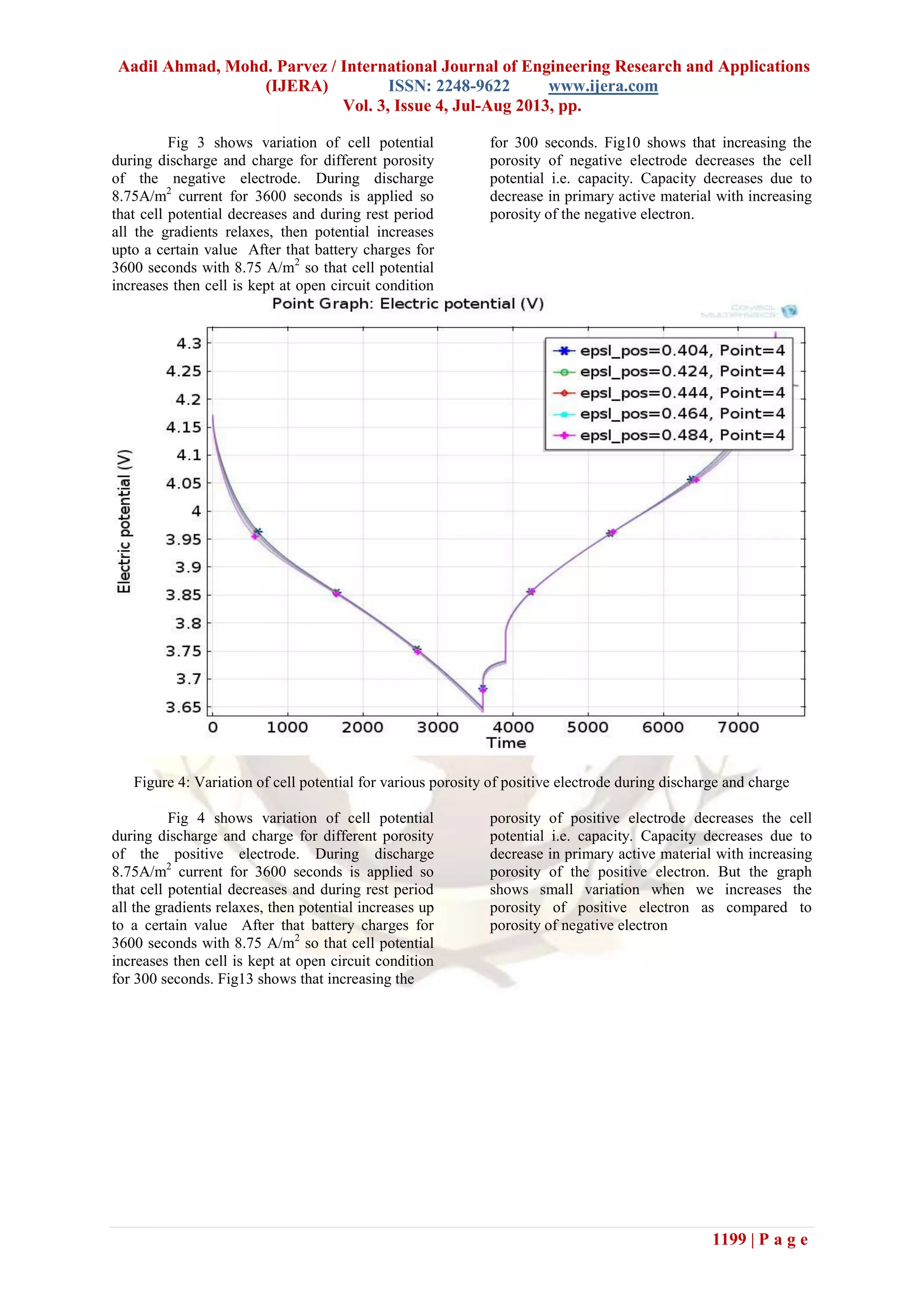
Figure 4: Variation of cell potential for various porosity of positive electrode during discharge and charge
Fig 4 shows variation of cell potential
during discharge and charge for different porosity
of the positive electrode. During discharge
8.75A/m2
current for 3600 seconds is applied so
that cell potential decreases and during rest period
all the gradients relaxes, then potential increases up
to a certain value After that battery charges for
3600 seconds with 8.75 A/m2
so that cell potential
increases then cell is kept at open circuit condition
for 300 seconds. Fig13 shows that increasing the
porosity of positive electrode decreases the cell
potential i.e. capacity. Capacity decreases due to
decrease in primary active material with increasing
porosity of the positive electron. But the graph
shows small variation when we increases the
porosity of positive electron as compared to
porosity of negative electron
Aadil Ahmad, Mohd. Parvez / International Journal of Engineering Research and Applications
(IJERA) ISSN: 2248-9622 www.ijera.com
Vol. 3, Issue 4, Jul-Aug 2013, pp.
1200 | P a g e
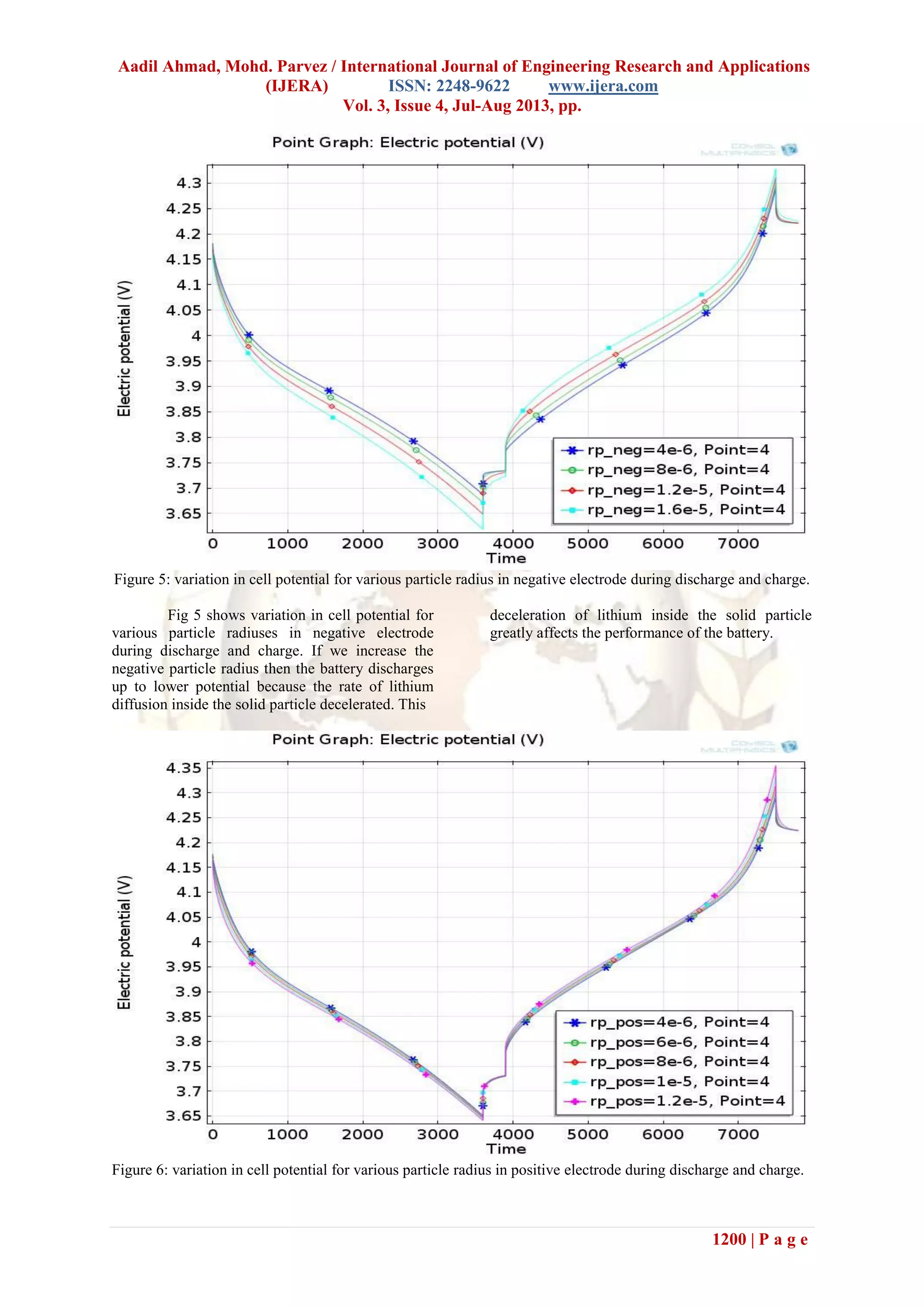
Figure 5: variation in cell potential for various particle radius in negative electrode during discharge and charge.
Fig 5 shows variation in cell potential for
various particle radiuses in negative electrode
during discharge and charge. If we increase the
negative particle radius then the battery discharges
up to lower potential because the rate of lithium
diffusion inside the solid particle decelerated. This
deceleration of lithium inside the solid particle
greatly affects the performance of the battery.
Figure 6: variation in cell potential for various particle radius in positive electrode during discharge and charge.
Aadil Ahmad, Mohd. Parvez / International Journal of Engineering Research and Applications
(IJERA) ISSN: 2248-9622 www.ijera.com
Vol. 3, Issue 4, Jul-Aug 2013, pp.
1201 | P a g e
Fig 6 shows variation in cell potential for
various particle radiuses in positive electrode during
discharge and charge. If we increase the positive
particle radius then the battery discharges up to
lower potential because the rate of lithium diffusion
inside the solid particle decelerated. This
deceleration of lithium inside the solid particle
greatly affects the performance of the battery. But if
we see the graph of battery capacity for positive and
negative electrode then the variation for positive
electrode radius shows small variation in battery
performance.
V. Conclusion and future scope
VI. Conclusion
The result obtained by the plotting the
graph between battery potential with time for
discharging and charging are different. These graph
shows the battery capacity variation more when we
change the negative radius particle of lithium ion
and or negative porosity . While the graph obtained
by changing the positive electrode or positive
porosity is less.
So these graph shows that if we increase
the positive lithium ion radius or porosity then it
performance does not vary more.
VII. Future scope
These result obtained by the plotting the
graph between battery potential with respect to time
by the comsol multyphysics software. Here the only
two parameter that can vary lithium ion particle
radius and porosity and keeping other thing constant
. These result are obtained by software and need
practical scope. I have done this by software if i
acquire financial aid then I can validate these result
experimentally. Using experimental setup we can
also investigate the effect of varying electrode
thickness, electrode and electrolyte material,
conductivity additives and binders over the
performance and behavior of lithium ion battery
Reference
[1] I. M. Development, “Micro-Macroscopic
Coupled Modeling of Batteries and Fuel
Cells,” vol. 145, no. 10, pp. 3407–3417,
1998.
[2] S. Santhanagopalan, Q. Guo, and R. E.
White, “Parameter Estimation and Model
Discrimination for a Lithium-Ion Cell,”
Journal of The Electrochemical Society,
vol. 154, no. 3, p. A198, 2007.
[3] G.-H. Kim, K. Smith, K.-J. Lee, S.
Santhanagopalan, and A. Pesaran, “Multi-
Domain Modeling of Lithium -Ion
Batteries Encompassing Multi-Physics in
Varied Length Scales,” Journal of The
Electrochemical Society, vol. 158, no. 8, p.
A955, 2011.
[4] N. Taniguchi, K. Hatoh, J. Niikura, T.
Gamo, M. Doyle, and J. Newman,
“Comparison of Modeling Predictions with
Experimental Data from Plastic Lithium
Ion Cells,” vol. 143, no. 6, pp. 1890–1903,
1996.
[5] L. Cai and R. E. White, “Mathematical
modeling of a lithium ion battery with
thermal effects in COMSOL Inc.
Multiphysics (MP) software,” Journal of
Power Sources, vol. 196, no. 14, pp. 5985–
5989, Jul. 2011.
[6] J. Yan, B.-J. Xia, Y.-C. Su, X.-Z. Zhou, J.
Zhang, and X.-G. Zhang,
“Phenomenologically modeling the
formation and evolution of the solid
electrolyte interface on the graphite
electrode for lithium-ion batteries,”
Electrochimica Acta, vol. 53, no. 24, pp.
7069–7078, Oct. 2008.
[7] S. Biallozor, “Modeling Side Reactions in
Composite LiMn2O4 Electrodes,” vol. 145,
no. 3, pp. 990–998, 1998.
. [8] G. G. Botte, V. R. Subramanian, and R. E.
White, “Mathematical modeling of
secondary lithium batteries,”
Electrochimica Acta, vol. 45, no. 15–16,
pp. 2595–2609, May 2000.
[9] M. Doyle, T. F. Fuller, and J. Newman,
“Modeling of Galvanostatic Charge and
Discharge of the Lithium / Polymer /
Insertion Cell,” vol. 140, no. 6, pp. 1526–
1533, 1993.
[10] T. F. Fuller, M. Doyle, and J. Newman,
“TECHNICAL PAPERS
ELECTROCHEMICAL SCIENCE AND
TECHNOLOGY Simulation and
Optimization of the Dual Lithium Ion
Insertion Cell,” vol. 141, no. 1, 1994.

Go3411961201

  • 1.
    Aadil Ahmad, Mohd.Parvez / International Journal of Engineering Research and Applications (IJERA) ISSN: 2248-9622 www.ijera.com Vol. 3, Issue 4, Jul-Aug 2013, pp.1196-1201 1196 | P a g e Effect of Design Parameter on the Performance of Lithium Ion Battery Aadil Ahmad1 , Mohd. Parvez2 1 (Department of mechanical engineering, AFSET, dhauj Faridabad Haryana(india) 2 (prof. & HOD Department of mechanical engineering, AFSET, dhauj Faridabad Haryana(india) Abstract The demand of alternative energy sources increasing because gasoline reserve in world is depleting day by day. Various alternative energy resources is being used to meet out the requirement of the human beings. Battery are also a kind of alternative energy source. Due to limitation of fuel reserves researchers have focused towards the lithium ion batteries to power automotive vehicles. Such as electric vehicle (EV), hybrid electric vehicle and plug-in hybrid electric vehicles. Apart from that lithium ion battery are being used in various small electronic portable devices. In this work we have simulated mathematical model for lithium ion battery to see the effect of kee parameter such as porosity of positive electrode, porosity of negative electrode and radius of solid particle in negative electrode and radius of solid particle in positive electrode. I have seen that increasing the particle radius and porosity in negative electrode greatly affect the charge and discharge behaviour of the battery apart from that effect of increasing particle radius and porosity of positive electrode has minute effect over the battery behaviour. I. Introduction The capacity or power to do work, such as the capacity to move an object (of a given mass) by the application of force. Everything what happened in the world is the expression of flow of energy from one form to other form. energy is a key input in economic growth. there is a close link between the availability of energy and future growth of a nation . However in a developing country like India greater the availability of energy more is its shortage. A battery is defined as a combination of individual cells .In electricity , a battery is a device consisting of one or more electrochemical cell that convert stored chemical energy into electrical energy. A battery can also be thought of as black box into which electrical energy is put stored electro chemically and later recovered as electrical energy. A lithium‐ion battery consists of two electrodes with a separator in between. The total thickness of the assembly is approximately 70‐200 μm, depending on the type of application the cell is intended for. Battery cells are assembled by winding or stacking the layers of the electrodes and the separator into cylindrical or prismatic shapes. The electrode with the highest electrode potential is called the positive electrode. It usually consists of a transition metal material, which can host lithium ions. The other electrode is usually made of graphite and it is called the negative electrode. Both the electrodes and the separator are porous. An electrolyte fills up the pores to create electrolytic contact between the electrodes. The electrolyte is a lithium salt dissolved in a mixture of solvents, polymers or ionic liquids. The process is represented by the reactions below, where X represents the transition metal material in the positive electrode and C6 the graphite in the negative electrode. II. Objective Effect of design parameter on the performance of lithium ion battery (1)Effect of varying particle radius of cathode and anode on battery capacity. (2) Effect of varying porosity or volume fraction on battery capacity. III. Methodology A schematic of a lithium ion battery is shown in fig 1. Generally, a lithium ion battery consists of the current collector, the positive electrode, the separator and the negative electrode. A lithiated organic solution fills the porous components and serves as the electrolyte. The material balance for the Li ions in an active solid material particle is governed by Fick’s second law in spherical coordinates:
  • 2.
    Aadil Ahmad, Mohd.Parvez / International Journal of Engineering Research and Applications (IJERA) ISSN: 2248-9622 www.ijera.com Vol. 3, Issue 4, Jul-Aug 2013, pp. 1197 | P a g e Figure 1: working model of lithium ion battery Material balance in the electrolyte ja F t F ti cD t c s e e effe e e 00 1 ).( )(         (1) Ohm’s law in the solid phase 0).(  jass eff s  (2) Ohm’s law in the electrolyte phase 0ln ln )ln( 1)1( 2 ).( 0                  jac cd fd t F RT se e eff e e eff e   (3) Where intjj  (4) Li-ion intercalation current density intj is given by Butler-Volmer kinetics                                RT F RT F ccccFj ca ssse caa expexpmax,int (5) Over-potential for intercalation reaction is given by frefes jRU   (6) 0fR For cathode and anode (7) Diffusion of Li+ into the anode particle is given by Fick’s second law of diffusion              r c r rr D t c s s s 2 2 1 (8) Where i = p for the positive electrode and i = n for the negative electrode. By use of these equation we analysis the different parameter of lithium ion battery such that Effect of varying particle radius of cathode and anode on battery capacity. And effect of varying porosity or volume fraction on battery capacity by the comsol software. IV. Result and discussion
  • 3.
    Aadil Ahmad, Mohd.Parvez / International Journal of Engineering Research and Applications (IJERA) ISSN: 2248-9622 www.ijera.com Vol. 3, Issue 4, Jul-Aug 2013, pp. 1198 | P a g e figure 2: Applied current density during discharge and charge (A/m2 ) Fig 2 shows the applied current density during discharge and charge of the battery . 8.75A/m2 is applied for 3600 second to discharge the battery subsequently the battery is kept at zero current for 3000 seconds and charge upto3600 second the again kept at zero current for 300 second Figure 3: Variation of cell potential for various porosity of negative electrode during discharge and charge
  • 4.
    Aadil Ahmad, Mohd.Parvez / International Journal of Engineering Research and Applications (IJERA) ISSN: 2248-9622 www.ijera.com Vol. 3, Issue 4, Jul-Aug 2013, pp. 1199 | P a g e Fig 3 shows variation of cell potential during discharge and charge for different porosity of the negative electrode. During discharge 8.75A/m2 current for 3600 seconds is applied so that cell potential decreases and during rest period all the gradients relaxes, then potential increases upto a certain value After that battery charges for 3600 seconds with 8.75 A/m2 so that cell potential increases then cell is kept at open circuit condition for 300 seconds. Fig10 shows that increasing the porosity of negative electrode decreases the cell potential i.e. capacity. Capacity decreases due to decrease in primary active material with increasing porosity of the negative electron. Figure 4: Variation of cell potential for various porosity of positive electrode during discharge and charge Fig 4 shows variation of cell potential during discharge and charge for different porosity of the positive electrode. During discharge 8.75A/m2 current for 3600 seconds is applied so that cell potential decreases and during rest period all the gradients relaxes, then potential increases up to a certain value After that battery charges for 3600 seconds with 8.75 A/m2 so that cell potential increases then cell is kept at open circuit condition for 300 seconds. Fig13 shows that increasing the porosity of positive electrode decreases the cell potential i.e. capacity. Capacity decreases due to decrease in primary active material with increasing porosity of the positive electron. But the graph shows small variation when we increases the porosity of positive electron as compared to porosity of negative electron
  • 5.
    Aadil Ahmad, Mohd.Parvez / International Journal of Engineering Research and Applications (IJERA) ISSN: 2248-9622 www.ijera.com Vol. 3, Issue 4, Jul-Aug 2013, pp. 1200 | P a g e Figure 5: variation in cell potential for various particle radius in negative electrode during discharge and charge. Fig 5 shows variation in cell potential for various particle radiuses in negative electrode during discharge and charge. If we increase the negative particle radius then the battery discharges up to lower potential because the rate of lithium diffusion inside the solid particle decelerated. This deceleration of lithium inside the solid particle greatly affects the performance of the battery. Figure 6: variation in cell potential for various particle radius in positive electrode during discharge and charge.
  • 6.
    Aadil Ahmad, Mohd.Parvez / International Journal of Engineering Research and Applications (IJERA) ISSN: 2248-9622 www.ijera.com Vol. 3, Issue 4, Jul-Aug 2013, pp. 1201 | P a g e Fig 6 shows variation in cell potential for various particle radiuses in positive electrode during discharge and charge. If we increase the positive particle radius then the battery discharges up to lower potential because the rate of lithium diffusion inside the solid particle decelerated. This deceleration of lithium inside the solid particle greatly affects the performance of the battery. But if we see the graph of battery capacity for positive and negative electrode then the variation for positive electrode radius shows small variation in battery performance. V. Conclusion and future scope VI. Conclusion The result obtained by the plotting the graph between battery potential with time for discharging and charging are different. These graph shows the battery capacity variation more when we change the negative radius particle of lithium ion and or negative porosity . While the graph obtained by changing the positive electrode or positive porosity is less. So these graph shows that if we increase the positive lithium ion radius or porosity then it performance does not vary more. VII. Future scope These result obtained by the plotting the graph between battery potential with respect to time by the comsol multyphysics software. Here the only two parameter that can vary lithium ion particle radius and porosity and keeping other thing constant . These result are obtained by software and need practical scope. I have done this by software if i acquire financial aid then I can validate these result experimentally. Using experimental setup we can also investigate the effect of varying electrode thickness, electrode and electrolyte material, conductivity additives and binders over the performance and behavior of lithium ion battery Reference [1] I. M. Development, “Micro-Macroscopic Coupled Modeling of Batteries and Fuel Cells,” vol. 145, no. 10, pp. 3407–3417, 1998. [2] S. Santhanagopalan, Q. Guo, and R. E. White, “Parameter Estimation and Model Discrimination for a Lithium-Ion Cell,” Journal of The Electrochemical Society, vol. 154, no. 3, p. A198, 2007. [3] G.-H. Kim, K. Smith, K.-J. Lee, S. Santhanagopalan, and A. Pesaran, “Multi- Domain Modeling of Lithium -Ion Batteries Encompassing Multi-Physics in Varied Length Scales,” Journal of The Electrochemical Society, vol. 158, no. 8, p. A955, 2011. [4] N. Taniguchi, K. Hatoh, J. Niikura, T. Gamo, M. Doyle, and J. Newman, “Comparison of Modeling Predictions with Experimental Data from Plastic Lithium Ion Cells,” vol. 143, no. 6, pp. 1890–1903, 1996. [5] L. Cai and R. E. White, “Mathematical modeling of a lithium ion battery with thermal effects in COMSOL Inc. Multiphysics (MP) software,” Journal of Power Sources, vol. 196, no. 14, pp. 5985– 5989, Jul. 2011. [6] J. Yan, B.-J. Xia, Y.-C. Su, X.-Z. Zhou, J. Zhang, and X.-G. Zhang, “Phenomenologically modeling the formation and evolution of the solid electrolyte interface on the graphite electrode for lithium-ion batteries,” Electrochimica Acta, vol. 53, no. 24, pp. 7069–7078, Oct. 2008. [7] S. Biallozor, “Modeling Side Reactions in Composite LiMn2O4 Electrodes,” vol. 145, no. 3, pp. 990–998, 1998. . [8] G. G. Botte, V. R. Subramanian, and R. E. White, “Mathematical modeling of secondary lithium batteries,” Electrochimica Acta, vol. 45, no. 15–16, pp. 2595–2609, May 2000. [9] M. Doyle, T. F. Fuller, and J. Newman, “Modeling of Galvanostatic Charge and Discharge of the Lithium / Polymer / Insertion Cell,” vol. 140, no. 6, pp. 1526– 1533, 1993. [10] T. F. Fuller, M. Doyle, and J. Newman, “TECHNICAL PAPERS ELECTROCHEMICAL SCIENCE AND TECHNOLOGY Simulation and Optimization of the Dual Lithium Ion Insertion Cell,” vol. 141, no. 1, 1994.