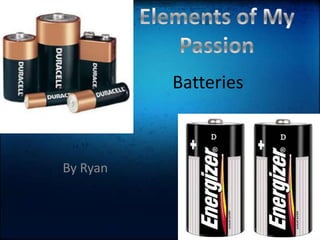
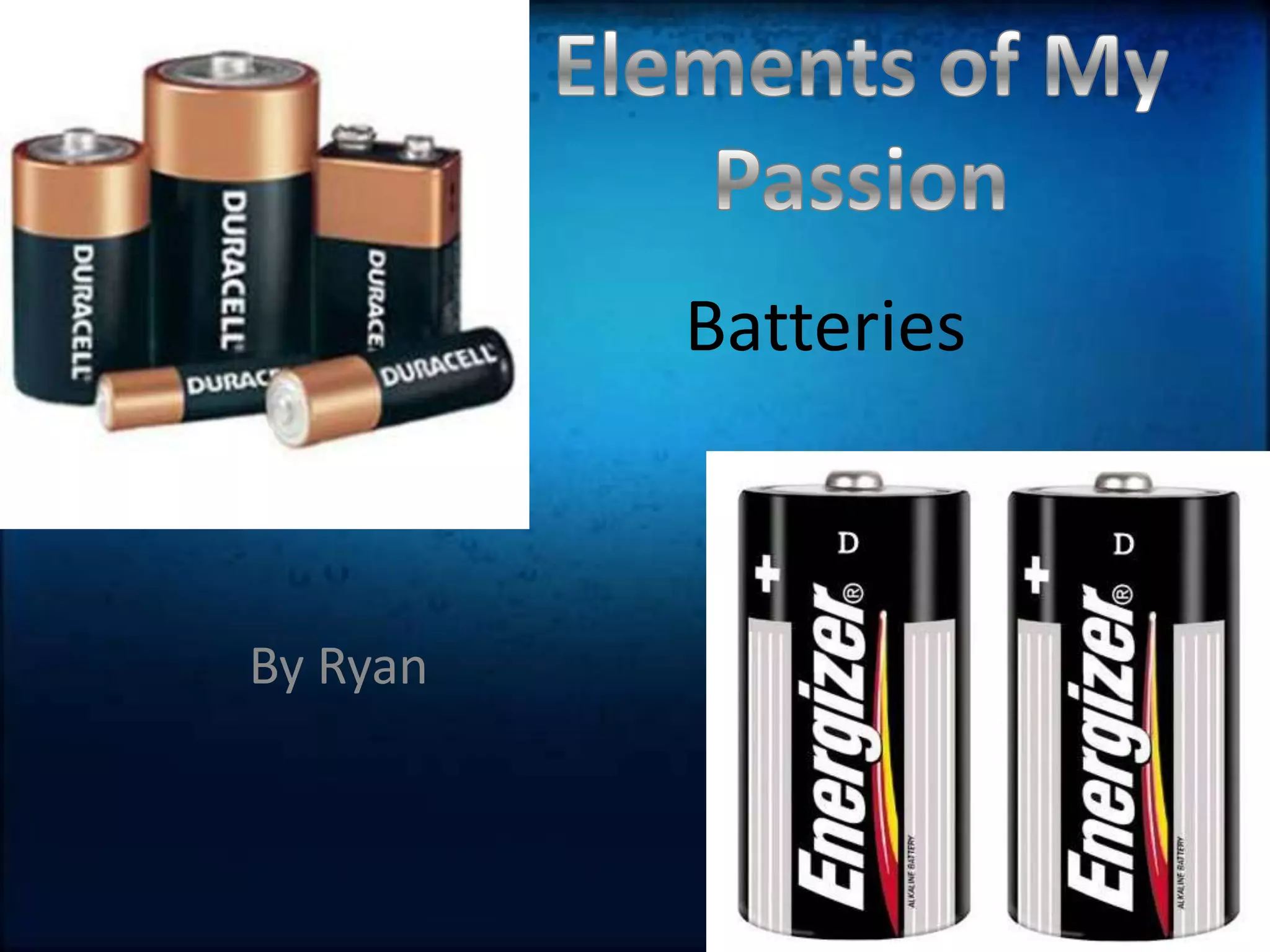
Elements of My PassionBatteriesBy Ryan
IntroductionEverybody has a special interest that involves the use of electronics. For example, some people like to play video games, use the computer, talk on the phone, or listen to their iPods.However, none of these could be used if it weren’t for batteries.But how do batteries actually work?
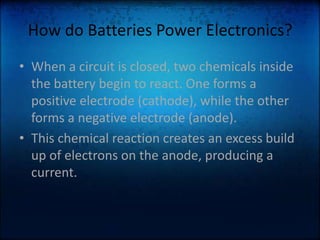
How do Batteries Power Electronics?When a circuit is closed, two chemicals inside the battery begin to react. One forms a positive electrode (cathode), while the other forms a negative electrode (anode).This chemical reaction creates an excess build up of electrons on the anode, producing a current.
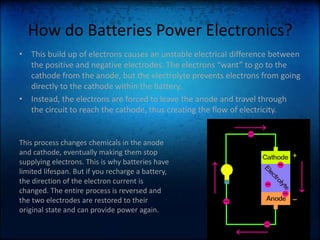
How do Batteries Power Electronics?This build up of electrons causes an unstable electrical difference between the positive and negative electrodes. The electrons “want” to go to the cathode from the anode, but the electrolyte prevents electrons from going directly to the cathode within the battery.Instead, the electrons are forced to leave the anode and travel through the circuit to reach the cathode, thus creating the flow of electricity.This process changes chemicals in the anode and cathode, eventually making them stop supplying electrons. This is why batteries have limited lifespan. But if you recharge a battery, the direction of the electron current is changed. The entire process is reversed and the two electrodes are restored to their original state and can provide power again.
Inside the BatteryBatteries have three parts: Cathode, Anode, and Electrolyte.The cathode is a positive electrode. It is generally made of a lithium cobalite composite (LiCoO2). Its job is to receive the electrons that have left the anode, supplying the current.The anode is the negative electrode. It is generally made of a carbon-graphite composite (LiC6). Its job is to distribute electrons through a closed circuit to the cathode.The electrolyte is a chemical solution made of sulfuric acid and a water solution. Its job is to create a chemical reaction that produces electrons.
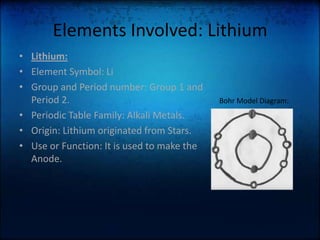
Elements Involved: LithiumLithium:Element Symbol: LiGroup and Period number: Group 1 and Period 2.Periodic Table Family: Alkali Metals.Origin: Lithium originated from Stars.Use or Function: It is used to make the Anode.Bohr Model Diagram:
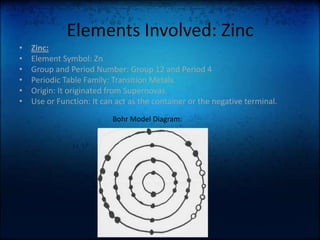
Elements Involved: ZincZinc:Element Symbol: ZnGroup and Period Number: Group 12 and Period 4Periodic Table Family: Transition Metals.Origin: It originated from Supernovas.Use or Function: It can act as the container or the negative terminal.Bohr Model Diagram:
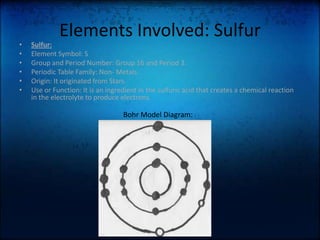
Elements Involved: SulfurSulfur:Element Symbol: SGroup and Period Number: Group 16 and Period 3.Periodic Table Family: Non- Metals.Origin: It originated from Stars.Use or Function: It is an ingredient in the sulfuric acid that creates a chemical reaction in the electrolyte to produce electrons.Bohr Model Diagram:
What’s Next?Toyota plans to develop new magnesium-sulfur batteries for electric cars. These batteries have the potential to hold twice as much power as the best lithium-ion battery cells. In addition, Toyota is experimenting with other advanced battery types, including batteries with aluminum and calcium components. They are hoping to find a formula that has a consumer-friendly range and quick recharge times.
ConclusionIn conclusion, batteries are very important because they power electronic devices that are commonly used. The main elements in the battery are Sulfur, Zinc, and Lithium.These elements are used to create an electric current.
Bibliographyhttp://www.batteryeducation.com/2006/09/the_battery_cat_1.html   -January 20, 2011http://www.qrg.northwestern.edu/projects/vss/docs/power/2-how-do-batteries-work.html-January 21, 2011John Fardon, Biggest Ever Book of Questions & Answers, Parragon Books Ltd, 2006http://en.wikipedia.org/wiki/Zinc_chloride   -January 10, 2011Robert Friedhoffer, Magnetism and Electricity, Library of Congress Cataloging-in-Publication Data, 1992http://en.wikipedia.org/wiki/Battery_%28electricity%29  -January 10, 2011http://en.wikipedia.org/wiki/Sulfuric_acid    -January 10, 2011 http://rumors.automobilemag.com/toyota-looking-magnesium-batteries-hybrids-electrics-13411.html     -January 21, 2011http://www.batterystuff.com/tutorial_battery.html     -January 21, 2011http://en.wikipedia.org/wiki/Lithium_batteries    -January 15, 2011http://en.wikipedia.org/wiki/Zinc–carbon_battery     -January 15, 2011http://myzerowaste.com/wp-content/uploads/2009/12/batteries.jpg   -January 22, 2011http://zedomax.com/blog/wp-content/uploads/2007/12/batteries.jpg   -January 22, 2011http://en.wikipedia.org/wiki/Lithium-ion_battery

Battery presentation final

  • 1.
    Elements of MyPassionBatteriesBy Ryan
  • 2.
    IntroductionEverybody has aspecial interest that involves the use of electronics. For example, some people like to play video games, use the computer, talk on the phone, or listen to their iPods.However, none of these could be used if it weren’t for batteries.But how do batteries actually work?
  • 3.
    How do BatteriesPower Electronics?When a circuit is closed, two chemicals inside the battery begin to react. One forms a positive electrode (cathode), while the other forms a negative electrode (anode).This chemical reaction creates an excess build up of electrons on the anode, producing a current.
  • 4.
    How do BatteriesPower Electronics?This build up of electrons causes an unstable electrical difference between the positive and negative electrodes. The electrons “want” to go to the cathode from the anode, but the electrolyte prevents electrons from going directly to the cathode within the battery.Instead, the electrons are forced to leave the anode and travel through the circuit to reach the cathode, thus creating the flow of electricity.This process changes chemicals in the anode and cathode, eventually making them stop supplying electrons. This is why batteries have limited lifespan. But if you recharge a battery, the direction of the electron current is changed. The entire process is reversed and the two electrodes are restored to their original state and can provide power again.
  • 5.
    Inside the BatteryBatterieshave three parts: Cathode, Anode, and Electrolyte.The cathode is a positive electrode. It is generally made of a lithium cobalite composite (LiCoO2). Its job is to receive the electrons that have left the anode, supplying the current.The anode is the negative electrode. It is generally made of a carbon-graphite composite (LiC6). Its job is to distribute electrons through a closed circuit to the cathode.The electrolyte is a chemical solution made of sulfuric acid and a water solution. Its job is to create a chemical reaction that produces electrons.
  • 6.
    Elements Involved: LithiumLithium:ElementSymbol: LiGroup and Period number: Group 1 and Period 2.Periodic Table Family: Alkali Metals.Origin: Lithium originated from Stars.Use or Function: It is used to make the Anode.Bohr Model Diagram:
  • 7.
    Elements Involved: ZincZinc:ElementSymbol: ZnGroup and Period Number: Group 12 and Period 4Periodic Table Family: Transition Metals.Origin: It originated from Supernovas.Use or Function: It can act as the container or the negative terminal.Bohr Model Diagram:
  • 8.
    Elements Involved: SulfurSulfur:ElementSymbol: SGroup and Period Number: Group 16 and Period 3.Periodic Table Family: Non- Metals.Origin: It originated from Stars.Use or Function: It is an ingredient in the sulfuric acid that creates a chemical reaction in the electrolyte to produce electrons.Bohr Model Diagram:
  • 9.
    What’s Next?Toyota plansto develop new magnesium-sulfur batteries for electric cars. These batteries have the potential to hold twice as much power as the best lithium-ion battery cells. In addition, Toyota is experimenting with other advanced battery types, including batteries with aluminum and calcium components. They are hoping to find a formula that has a consumer-friendly range and quick recharge times.
  • 10.
    ConclusionIn conclusion, batteriesare very important because they power electronic devices that are commonly used. The main elements in the battery are Sulfur, Zinc, and Lithium.These elements are used to create an electric current.
  • 11.
    Bibliographyhttp://www.batteryeducation.com/2006/09/the_battery_cat_1.html -January 20, 2011http://www.qrg.northwestern.edu/projects/vss/docs/power/2-how-do-batteries-work.html-January 21, 2011John Fardon, Biggest Ever Book of Questions & Answers, Parragon Books Ltd, 2006http://en.wikipedia.org/wiki/Zinc_chloride -January 10, 2011Robert Friedhoffer, Magnetism and Electricity, Library of Congress Cataloging-in-Publication Data, 1992http://en.wikipedia.org/wiki/Battery_%28electricity%29 -January 10, 2011http://en.wikipedia.org/wiki/Sulfuric_acid -January 10, 2011 http://rumors.automobilemag.com/toyota-looking-magnesium-batteries-hybrids-electrics-13411.html -January 21, 2011http://www.batterystuff.com/tutorial_battery.html -January 21, 2011http://en.wikipedia.org/wiki/Lithium_batteries -January 15, 2011http://en.wikipedia.org/wiki/Zinc–carbon_battery -January 15, 2011http://myzerowaste.com/wp-content/uploads/2009/12/batteries.jpg -January 22, 2011http://zedomax.com/blog/wp-content/uploads/2007/12/batteries.jpg -January 22, 2011http://en.wikipedia.org/wiki/Lithium-ion_battery