B Y
M R. YOGESH U RDU K HE
DEPA RT M ENT OF B OT A NY,
JES, COLLEGE JALNA
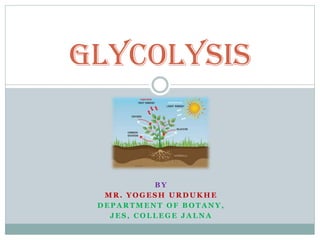
Glycolysis
OBJECTIVES
ļ‚— After reading this unit students will be able to-
ļ‚” Understand the significance and mechanism of respiration.
ļ‚” Learn the mechanism of aerobic and anaerobic respiration.
ļ‚” Understand Krebs's cycle and electron transport mechanism and
fermentation mechanism.
ļ‚” Explain how actually energy is released and stored in the form of ATP in
the cell.
ļ‚” Account for 38 ATP molecules that are released during aerobic
respiration.
7/22/2021
2
Mr. Yogesh, Dept. of Botany JES college Jalna
INTRODUCTION
ļ‚— Respiration is one of the many processes needed for survival. It is
the process by which energy is released from food by oxidizing the
organic molecules.
ļ‚— Respiration may occur in the presence of oxygen, in which case it is
called aerobic respiration or it may occur in the absence of oxygen
and is called anaerobic respiration.
ļ‚— The main organic molecules used in respiration are carbohydrates,
such as the monosaccharide glucose and fructose, and fats.
ļ‚— Proteins may also be oxidized however it is a secondary source as
protein is needed for other things such as cell growth and repair.
7/22/2021
3
Mr. Yogesh, Dept. of Botany JES college Jalna
TYPES OF RESPIRATION
ļ‚— Respiration starts with glucose (usually). In aerobic and
anaerobic respiration initial reactions are common as a result
of which pyruvic acid is formed by breakdown of glucose.
ļ‚— The process is called Glycolysis or EMP Pathway (Embden-
Meyerhof-Parnas Pathway).
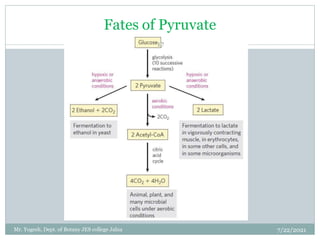
ļ‚— This process does not require O2 although this can take place
in the presence of oxygen. After this stage, the fate of pyruvic
acid is different depending upon the presence or absence of
oxygen.
7/22/2021
4
Mr. Yogesh, Dept. of Botany JES college Jalna
ļ‚— If oxygen is present there is complete oxidation of
pyruvic acid into H2O and CO2 and chemical reactions
through which this occurs is called Tri-Carboxylic Acid
cycle (TCA Cycle) or Krebs Cycle.
ļ‚— This cycle occurs in mitochondria. If oxygen is absent,
pyruvic acid forms ethyl alcohol (C2H5OH) and CO2
without the help of any cell organelle. This process is
called anaerobic respiration.
7/22/2021
5
Mr. Yogesh, Dept. of Botany JES college Jalna
7/22/2021
6
Mr. Yogesh, Dept. of Botany JES college Jalna
AEROBIC RESPIRATION
ļ‚— Aerobic respiration is an enzymatically controlled release of
energy in a stepwise catabolic process of complete oxidation of
organic food into carbon dioxide and water with oxygen acting
as terminal oxidant.
ļ‚— The common mechanism of aerobic respiration is also called
common pathway because its first step, called glycolysis, is
common to both aerobic and anaerobic modes of respiration.
ļ‚— The common aerobic respiration consists of three steps—
glycolysis, Krebs cycle and terminal oxidation.
7/22/2021
7
Mr. Yogesh, Dept. of Botany JES college Jalna
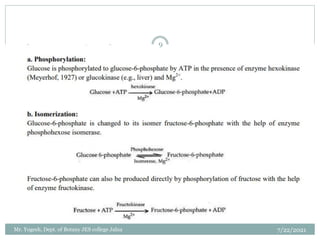
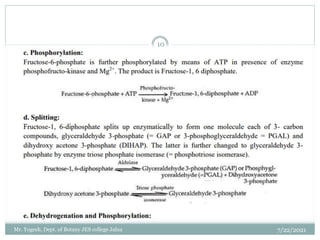
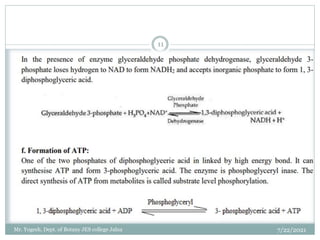
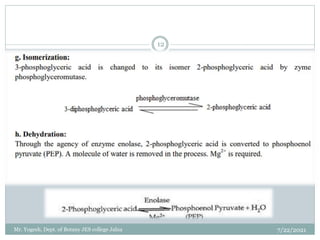
GLYCOLYSIS
ļ‚— It is also called EMP pathway because it was discovered
by three German scientists Embden, Meyerhof and
Parnas.
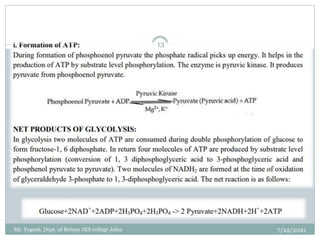
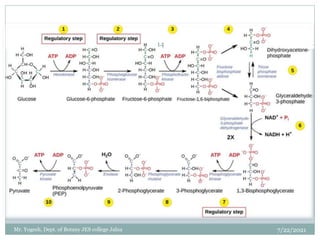
ļ‚— Glycolysis is the process of breakdown of glucose or
similar hexose sugar to molecules of pyruvic acid through
a series of enzyme mediated reactions releasing some
energy (as ATP) and reducing power (as NADH2) It
occurs in the cytoplasm. It takes place in the following
sub steps.
7/22/2021
8
Mr. Yogesh, Dept. of Botany JES college Jalna
7/22/2021
9
Mr. Yogesh, Dept. of Botany JES college Jalna
7/22/2021
10
Mr. Yogesh, Dept. of Botany JES college Jalna
7/22/2021
11
Mr. Yogesh, Dept. of Botany JES college Jalna
7/22/2021
12
Mr. Yogesh, Dept. of Botany JES college Jalna
7/22/2021
13
Mr. Yogesh, Dept. of Botany JES college Jalna
7/22/2021
14
Mr. Yogesh, Dept. of Botany JES college Jalna
Glycolysis enzymes
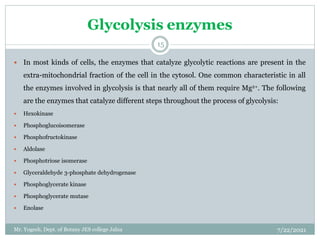
ļ‚— In most kinds of cells, the enzymes that catalyze glycolytic reactions are present in the
extra-mitochondrial fraction of the cell in the cytosol. One common characteristic in all
the enzymes involved in glycolysis is that nearly all of them require Mg2+. The following
are the enzymes that catalyze different steps throughout the process of glycolysis:
ļ‚— Hexokinase
ļ‚— Phosphoglucoisomerase
ļ‚— Phosphofructokinase
ļ‚— Aldolase
ļ‚— Phosphotriose isomerase
ļ‚— Glyceraldehyde 3-phosphate dehydrogenase
ļ‚— Phosphoglycerate kinase
ļ‚— Phosphoglycerate mutase
ļ‚— Enolase
7/22/2021
15
Mr. Yogesh, Dept. of Botany JES college Jalna
Result of Glycolysis
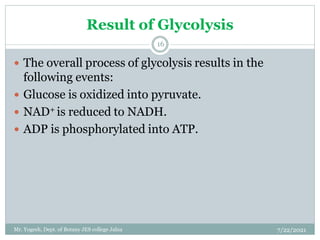
ļ‚— The overall process of glycolysis results in the
following events:
ļ‚— Glucose is oxidized into pyruvate.
ļ‚— NAD+ is reduced to NADH.
ļ‚— ADP is phosphorylated into ATP.
7/22/2021
16
Mr. Yogesh, Dept. of Botany JES college Jalna
Fates of Pyruvate
7/22/2021
17
Mr. Yogesh, Dept. of Botany JES college Jalna
References
ļ‚— Jain JL, Jain S, and Jain N (2005). Fundamentals of
Biochemistry. S. Chand and Company.
ļ‚— Nelson DL and Cox MM. Lehninger Principles of
Biochemistry. Fourth Edition.
ļ‚— Berg JM et al. (2012) Biochemistry. Seventh Edition.
W. H Freeman and Company.
ļ‚— Madigan MT et al. (2012). Brock Biology of
Microorganisms. Thirteenth Edition. Pearson
Education, Inc.
7/22/2021
18
Mr. Yogesh, Dept. of Botany JES college Jalna

Glycolysis

  • 1.
    B Y M R.YOGESH U RDU K HE DEPA RT M ENT OF B OT A NY, JES, COLLEGE JALNA Glycolysis
  • 2.
    OBJECTIVES ļ‚— After readingthis unit students will be able to- ļ‚” Understand the significance and mechanism of respiration. ļ‚” Learn the mechanism of aerobic and anaerobic respiration. ļ‚” Understand Krebs's cycle and electron transport mechanism and fermentation mechanism. ļ‚” Explain how actually energy is released and stored in the form of ATP in the cell. ļ‚” Account for 38 ATP molecules that are released during aerobic respiration. 7/22/2021 2 Mr. Yogesh, Dept. of Botany JES college Jalna
  • 3.
    INTRODUCTION ļ‚— Respiration isone of the many processes needed for survival. It is the process by which energy is released from food by oxidizing the organic molecules. ļ‚— Respiration may occur in the presence of oxygen, in which case it is called aerobic respiration or it may occur in the absence of oxygen and is called anaerobic respiration. ļ‚— The main organic molecules used in respiration are carbohydrates, such as the monosaccharide glucose and fructose, and fats. ļ‚— Proteins may also be oxidized however it is a secondary source as protein is needed for other things such as cell growth and repair. 7/22/2021 3 Mr. Yogesh, Dept. of Botany JES college Jalna
  • 4.
    TYPES OF RESPIRATION ļ‚—Respiration starts with glucose (usually). In aerobic and anaerobic respiration initial reactions are common as a result of which pyruvic acid is formed by breakdown of glucose. ļ‚— The process is called Glycolysis or EMP Pathway (Embden- Meyerhof-Parnas Pathway). ļ‚— This process does not require O2 although this can take place in the presence of oxygen. After this stage, the fate of pyruvic acid is different depending upon the presence or absence of oxygen. 7/22/2021 4 Mr. Yogesh, Dept. of Botany JES college Jalna
  • 5.
    ļ‚— If oxygenis present there is complete oxidation of pyruvic acid into H2O and CO2 and chemical reactions through which this occurs is called Tri-Carboxylic Acid cycle (TCA Cycle) or Krebs Cycle. ļ‚— This cycle occurs in mitochondria. If oxygen is absent, pyruvic acid forms ethyl alcohol (C2H5OH) and CO2 without the help of any cell organelle. This process is called anaerobic respiration. 7/22/2021 5 Mr. Yogesh, Dept. of Botany JES college Jalna
  • 6.
    7/22/2021 6 Mr. Yogesh, Dept.of Botany JES college Jalna
  • 7.
    AEROBIC RESPIRATION ļ‚— Aerobicrespiration is an enzymatically controlled release of energy in a stepwise catabolic process of complete oxidation of organic food into carbon dioxide and water with oxygen acting as terminal oxidant. ļ‚— The common mechanism of aerobic respiration is also called common pathway because its first step, called glycolysis, is common to both aerobic and anaerobic modes of respiration. ļ‚— The common aerobic respiration consists of three steps— glycolysis, Krebs cycle and terminal oxidation. 7/22/2021 7 Mr. Yogesh, Dept. of Botany JES college Jalna
  • 8.
    GLYCOLYSIS ļ‚— It isalso called EMP pathway because it was discovered by three German scientists Embden, Meyerhof and Parnas. ļ‚— Glycolysis is the process of breakdown of glucose or similar hexose sugar to molecules of pyruvic acid through a series of enzyme mediated reactions releasing some energy (as ATP) and reducing power (as NADH2) It occurs in the cytoplasm. It takes place in the following sub steps. 7/22/2021 8 Mr. Yogesh, Dept. of Botany JES college Jalna
  • 9.
    7/22/2021 9 Mr. Yogesh, Dept.of Botany JES college Jalna
  • 10.
    7/22/2021 10 Mr. Yogesh, Dept.of Botany JES college Jalna
  • 11.
    7/22/2021 11 Mr. Yogesh, Dept.of Botany JES college Jalna
  • 12.
    7/22/2021 12 Mr. Yogesh, Dept.of Botany JES college Jalna
  • 13.
    7/22/2021 13 Mr. Yogesh, Dept.of Botany JES college Jalna
  • 14.
    7/22/2021 14 Mr. Yogesh, Dept.of Botany JES college Jalna
  • 15.
    Glycolysis enzymes ļ‚— Inmost kinds of cells, the enzymes that catalyze glycolytic reactions are present in the extra-mitochondrial fraction of the cell in the cytosol. One common characteristic in all the enzymes involved in glycolysis is that nearly all of them require Mg2+. The following are the enzymes that catalyze different steps throughout the process of glycolysis: ļ‚— Hexokinase ļ‚— Phosphoglucoisomerase ļ‚— Phosphofructokinase ļ‚— Aldolase ļ‚— Phosphotriose isomerase ļ‚— Glyceraldehyde 3-phosphate dehydrogenase ļ‚— Phosphoglycerate kinase ļ‚— Phosphoglycerate mutase ļ‚— Enolase 7/22/2021 15 Mr. Yogesh, Dept. of Botany JES college Jalna
  • 16.
    Result of Glycolysis ļ‚—The overall process of glycolysis results in the following events: ļ‚— Glucose is oxidized into pyruvate. ļ‚— NAD+ is reduced to NADH. ļ‚— ADP is phosphorylated into ATP. 7/22/2021 16 Mr. Yogesh, Dept. of Botany JES college Jalna
  • 17.
    Fates of Pyruvate 7/22/2021 17 Mr.Yogesh, Dept. of Botany JES college Jalna
  • 18.
    References ļ‚— Jain JL,Jain S, and Jain N (2005). Fundamentals of Biochemistry. S. Chand and Company. ļ‚— Nelson DL and Cox MM. Lehninger Principles of Biochemistry. Fourth Edition. ļ‚— Berg JM et al. (2012) Biochemistry. Seventh Edition. W. H Freeman and Company. ļ‚— Madigan MT et al. (2012). Brock Biology of Microorganisms. Thirteenth Edition. Pearson Education, Inc. 7/22/2021 18 Mr. Yogesh, Dept. of Botany JES college Jalna