Build Operate Transfer and private sector led 
hydropower development: assessing benefits and risks 
Dr. Nathanial Matthews 
Research Coordinator 
Water, Land and Ecosystems 
Uniting agriculture and nature for poverty reduction
Models of PPP 
• BOT – Build Operate Transfer 
• DBFO – Design Build Finance 
Operate 
• Concession Lease 
• Corporatization 
• BTO – Build Transfer Operate 
• Lease 
• BOO – Build Own Operate 
Uniting agriculture and nature for poverty reduction
Characteristics of BOTs 
• Typically involves private sector handling all the 
financing, design, construction and operation of an 
infrastructure project for a concessionary period of 
usually 20-50 years. 
• The private operator runs the infrastructure at a rate 
of return high enough to service debts and afterwards 
to generate a profit of approximately 15% or more. 
• BOT structures tend to be complex. Within the BOT 
contract there are dozens of fees, guarantees, loans 
and contracts needed between each actor 
• BOT projects restrict investors from removing their 
equity when they please, so large consortium are 
generally formed to spread exposure. 
Uniting agriculture and nature for poverty reduction
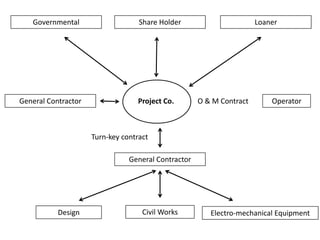
Share Holder Loaner 
Project Co. 
Turn-key contract 
General Contractor 
Governmental 
General Contractor 
Operator 
O & M Contract 
Design Civil Works Electro-mechanical Equipment
A Brief History of BOT and privatized infrastructure 
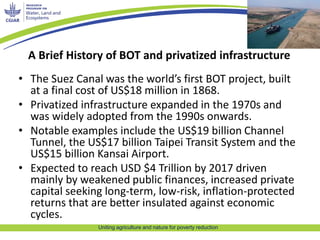
• The Suez Canal was the world’s first BOT project, built 
at a final cost of US$18 million in 1868. 
• Privatized infrastructure expanded in the 1970s and 
was widely adopted from the 1990s onwards. 
• Notable examples include the US$19 billion Channel 
Tunnel, the US$17 billion Taipei Transit System and the 
US$15 billion Kansai Airport. 
• Expected to reach USD $4 Trillion by 2017 driven 
mainly by weakened public finances, increased private 
capital seeking long-term, low-risk, inflation-protected 
returns that are better insulated against economic 
cycles. 
Uniting agriculture and nature for poverty reduction
Benefits 
• Harness new investment 
• Not total privatization 
• Transfer risk 
• Innovate 
• Find efficiencies 
• Public control maintained 
• Provide a vehicle to open markets to 
international and regional investment and 
development 
• Can allows funding outside of political economies 
Uniting agriculture and nature for poverty reduction
Challenges 
• Opportunities for investors to profit through 
construction or service supply may incentivize 
investments with weak returns. 
• Governments with weak capacity may absorb risks 
and provide private sector guarantees such as 
supplying security, water flows, fuel, or electricity. 
• Complexity can result in a range of environmental, 
socio-economic, financial, and political risks being 
undervalued, overlooked, or misidentified. 
• Business norms tend to impede project 
transparency and participatory processes. 
Uniting agriculture and nature for poverty reduction
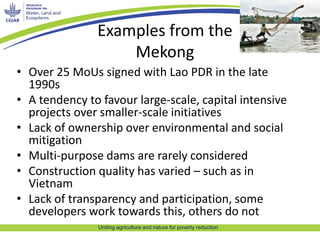
Examples from the 
Mekong 
• Over 25 MoUs signed with Lao PDR in the late 
1990s 
• A tendency to favour large-scale, capital intensive 
projects over smaller-scale initiatives 
• Lack of ownership over environmental and social 
mitigation 
• Multi-purpose dams are rarely considered 
• Construction quality has varied – such as in 
Vietnam 
• Lack of transparency and participation, some 
developers work towards this, others do not 
Uniting agriculture and nature for poverty reduction
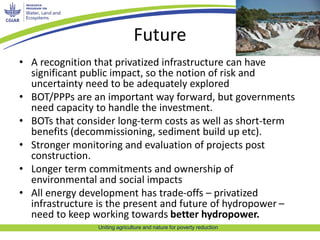
Future 
• A recognition that privatized infrastructure can have 
significant public impact, so the notion of risk and 
uncertainty need to be adequately explored 
• BOT/PPPs are an important way forward, but governments 
need capacity to handle the investment. 
• BOTs that consider long-term costs as well as short-term 
benefits (decommissioning, sediment build up etc). 
• Stronger monitoring and evaluation of projects post 
Uniting agriculture and nature for poverty reduction 
construction. 
• Longer term commitments and ownership of 
environmental and social impacts 
• All energy development has trade-offs – privatized 
infrastructure is the present and future of hydropower – 
need to keep working towards better hydropower.

Build Operate Transfer and private sector led hydropower development

  • 1.
    Build Operate Transferand private sector led hydropower development: assessing benefits and risks Dr. Nathanial Matthews Research Coordinator Water, Land and Ecosystems Uniting agriculture and nature for poverty reduction
  • 2.
    Models of PPP • BOT – Build Operate Transfer • DBFO – Design Build Finance Operate • Concession Lease • Corporatization • BTO – Build Transfer Operate • Lease • BOO – Build Own Operate Uniting agriculture and nature for poverty reduction
  • 3.
    Characteristics of BOTs • Typically involves private sector handling all the financing, design, construction and operation of an infrastructure project for a concessionary period of usually 20-50 years. • The private operator runs the infrastructure at a rate of return high enough to service debts and afterwards to generate a profit of approximately 15% or more. • BOT structures tend to be complex. Within the BOT contract there are dozens of fees, guarantees, loans and contracts needed between each actor • BOT projects restrict investors from removing their equity when they please, so large consortium are generally formed to spread exposure. Uniting agriculture and nature for poverty reduction
  • 4.
    Share Holder Loaner Project Co. Turn-key contract General Contractor Governmental General Contractor Operator O & M Contract Design Civil Works Electro-mechanical Equipment
  • 5.
    A Brief Historyof BOT and privatized infrastructure • The Suez Canal was the world’s first BOT project, built at a final cost of US$18 million in 1868. • Privatized infrastructure expanded in the 1970s and was widely adopted from the 1990s onwards. • Notable examples include the US$19 billion Channel Tunnel, the US$17 billion Taipei Transit System and the US$15 billion Kansai Airport. • Expected to reach USD $4 Trillion by 2017 driven mainly by weakened public finances, increased private capital seeking long-term, low-risk, inflation-protected returns that are better insulated against economic cycles. Uniting agriculture and nature for poverty reduction
  • 6.
    Benefits • Harnessnew investment • Not total privatization • Transfer risk • Innovate • Find efficiencies • Public control maintained • Provide a vehicle to open markets to international and regional investment and development • Can allows funding outside of political economies Uniting agriculture and nature for poverty reduction
  • 7.
    Challenges • Opportunitiesfor investors to profit through construction or service supply may incentivize investments with weak returns. • Governments with weak capacity may absorb risks and provide private sector guarantees such as supplying security, water flows, fuel, or electricity. • Complexity can result in a range of environmental, socio-economic, financial, and political risks being undervalued, overlooked, or misidentified. • Business norms tend to impede project transparency and participatory processes. Uniting agriculture and nature for poverty reduction
  • 8.
    Examples from the Mekong • Over 25 MoUs signed with Lao PDR in the late 1990s • A tendency to favour large-scale, capital intensive projects over smaller-scale initiatives • Lack of ownership over environmental and social mitigation • Multi-purpose dams are rarely considered • Construction quality has varied – such as in Vietnam • Lack of transparency and participation, some developers work towards this, others do not Uniting agriculture and nature for poverty reduction
  • 9.
    Future • Arecognition that privatized infrastructure can have significant public impact, so the notion of risk and uncertainty need to be adequately explored • BOT/PPPs are an important way forward, but governments need capacity to handle the investment. • BOTs that consider long-term costs as well as short-term benefits (decommissioning, sediment build up etc). • Stronger monitoring and evaluation of projects post Uniting agriculture and nature for poverty reduction construction. • Longer term commitments and ownership of environmental and social impacts • All energy development has trade-offs – privatized infrastructure is the present and future of hydropower – need to keep working towards better hydropower.

Editor's Notes

  • #6 Expanded with deregulation and liberalisation of market economies A WB report states that from 1990 to 1997 global private annual investments in developing country infrastructure rose from $19 billion to approximately $120 billion
  • #8 While BOT projects should encourage careful investments because of the substantial risks involved, opportunities for investors to profit through construction or service supply may incentivize investments with weak returns. Governments, particularly from developing countries, have been encouraged to absorb risks and provide private sector guarantees such as supplying security, water flows, fuel, or electricity. The complexity of projects results in the possibility of a range of environmental, socio-economic, financial, and political risks being undervalued, overlooked, or misidentified. Business norms impede project transparency and participation in the process.
  • #9 Risks particularly high because of the env. And soc. Impacts
  • #10 While the BOT/ IPP model has the potential to lever financing that is difficult for governments to access, it poses a unique water governance challenge between state and non-state actors. The notion of risk and uncertainty need to be further explored and shared by actors in a way that commonly held goals of development – economic, social and environmental – are considered, and legitimate right to access natural resources and social justice ensured.