Energy Management Conference 
Renewable Energy and Project 
Finance
Presentation 
1. Introduction to Viability Africa 
2. Project Components for Success 
3. Energy Finance Sources 
4. Venture Components for Success
Our Vision 
Viability Africa, LLC’s overriding objective is to operate as the 
leading development and financial advisory firm for clean 
technology projects and ventures across East Africa. Viability Africa 
will support investments that exhibit economic, technical, 
environmental, and social viability and sustainability. The growth of 
our team will focus on the recruitment and development of East 
Africans seeking to become the future business and political leaders 
of their country and region. Our Founders have committed to 
reinvesting a significant portion of the company’s earnings to ensure 
the company will have long-term sustainability and impact, and to 
solidify Viability Africa as a resource available to the market for 
years to come as the clean technology sector grows in relevance 
and impact across East Africa.
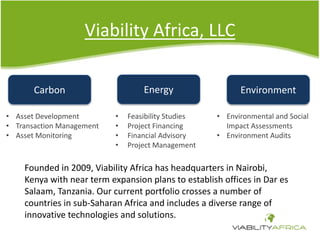
Viability Africa, LLC 
Carbon Energy Environment 
• Asset Development 
• Transaction Management 
• Asset Monitoring 
• Feasibility Studies 
• Project Financing 
• Financial Advisory 
• Project Management 
• Environmental and Social 
Impact Assessments 
• Environment Audits 
Founded in 2009, Viability Africa has headquarters in Nairobi, 
Kenya with near term expansion plans to establish offices in Dar es 
Salaam, Tanzania. Our current portfolio crosses a number of 
countries in sub-Saharan Africa and includes a diverse range of 
innovative technologies and solutions.
Presentation 
1. Introduction to Viability Africa 
2. Project Components for Success 
3. Energy Finance Sources 
4. Venture Components for Success
Clean Technology Project Finance in 
sub-Saharan Africa 
• Fundamentals 
• Project Company 
• High leverage (60-80%) 
• Debt service dependent on future cash flows, not necessarily 
assets 
• Non-recourse Financing 
• Main security in project contracts 
• Investors 
• Equity 
• Lender 
• Developer
Project Finance Characteristics 
• Special purpose vehicle (SPV), “ring fenced” project 
• Finite life 
• Often formed in later stages of development and assets 
are transferred (not recommended if can be avoided) 
• Appealing as it keeps financing exposure limited to the 
project 
• Traditional for infrastructure projects such as power 
plants, toll roads, etc but also can be applied to 
agriculture projects and innovative distribution 
programs (financing against fixed service or product 
delivery contracts)
Project Documents 
• Traditional Required Documentation 
• Feasibility Study 
• EPC Contract 
• Off-take (PPA) 
• Land Agreements 
• Environmental Requirements (EIA, Licenses, Water 
Permit, etc) 
• Input Supply (Biomass Project) 
• Operations and Maintenance Contract 
• Government Support Agreement
Project Example 
• 5 MW Hydro Project Documents 
• EIA Approved 
• Feasibility Study 
• EPC Draft 
• ERPA Signed 
• PPA Executed 
• However… 
• Timeline 
• “Delays” that should have been anticipated 
• Trust your partners (lender, adviser, sponsor) 
• Government Negotiations
Lessons from Project Finance Transaction 
in sub-Saharan Africa 
• Bring a lender into conversations on PPA and other 
project documents (EPC) before execution 
• Ensure land is acquired/rights secured early 
• Do not underestimate importance of EIA 
• Be prepared to review and revise almost every document 
to meet satisfaction of financiers 
• Accept that as a developer with limited funding you will 
have to give up majority ownership 
• Do not get greedy!
Project Finance: Recommendations 
• As a Developer 
– Make a “checklist” and be realistic in what you will 
need to develop a project and what you will 
ultimately receive when it is fully financed 
• Many developers spend all of their money, fall short of 
getting the project to a “bankable” state, and ultimately 
make nothing 
• As a Lender/Investor 
– Diligence, diligence, diligence… 
• Land, PPA, EPC, Developer Capabilities, Developer 
Attitude
Presentation 
1. Introduction to Viability Africa 
2. Project Components for Success 
3. Energy Finance Sources 
4. Venture Components for Success
Energy Finance Sources 
1. Focused Equity Funds 
2. Commercial Banks 
3. Carbon Markets 
4. Grants 
5. Other
Focused Equity Funds 
• Impact Equity Investors 
– Social Metrics 
– Environmental Metrics 
– Financial Returns 
• Additional Focus 
– Renewable Energy 
– Clean Technology 
– Climate Innovation 
• Most investors are cautious to base investments on 
returns from carbon markets, so underlying 
investment must provide viable returns and 
sustainability
Focused Equity Funds 
• Jacana East Africa Climate Venture Fund 
– $10-20 million in size 
– Focus on early stage investments in promising 
climate friendly projects and ventures 
– Average initial investment size $200,000 
– Average investment size $1,000,000 
– Experienced team in investing locally and in clean 
technology space
Energy Finance Sources 
1. Focused Equity Funds 
2. Commercial Banks 
3. Carbon Markets 
4. Grants 
5. Other
Commercial Banks – Energy Finance 
• New Space/Lack of Capacity at Institutional 
Level 
• Development Finance Institutions 
– Acting as Catalyst 
• AfD Facility (CfC Stanbic Bank and Co-Operative Bank 
of Kenya) 
• Uganda Global Energy Transfer Feed in Tariff (GET FiT) 
Program 
– Allow Banks to Build Capabilities
Commercial Banks – Energy Finance 
• Strong Level of Interest 
– Nearly ever local commercial bank in the market 
has an interest in exploring energy transactions 
• Key Variables 
– Insurance 
– Guarantees 
– Equity Sponsors 
• Balancing act between market and lender 
requirements
Energy Finance Sources 
1. Focused Equity Funds 
2. Commercial Banks 
3. Carbon Markets 
4. Grants 
5. Other
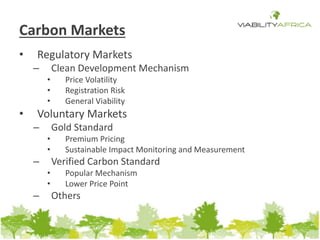
Carbon Markets 
• Regulatory Markets 
– Clean Development Mechanism 
• Price Volatility 
• Registration Risk 
• General Viability 
• Voluntary Markets 
– Gold Standard 
• Premium Pricing 
• Sustainable Impact Monitoring and Measurement 
– Verified Carbon Standard 
• Popular Mechanism 
• Lower Price Point 
– Others
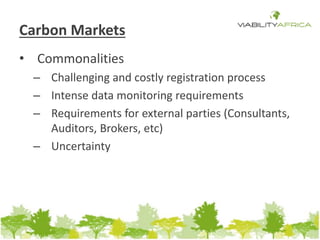
Carbon Markets 
• Commonalities 
– Challenging and costly registration process 
– Intense data monitoring requirements 
– Requirements for external parties (Consultants, 
Auditors, Brokers, etc) 
– Uncertainty
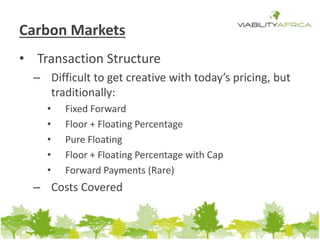
Carbon Markets 
• Transaction Structure 
– Difficult to get creative with today’s pricing, but 
traditionally: 
• Fixed Forward 
• Floor + Floating Percentage 
• Pure Floating 
• Floor + Floating Percentage with Cap 
• Forward Payments (Rare) 
– Costs Covered
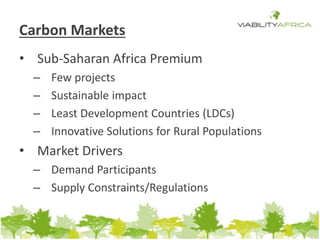
Carbon Markets 
• Sub-Saharan Africa Premium 
– Few projects 
– Sustainable impact 
– Least Development Countries (LDCs) 
– Innovative Solutions for Rural Populations 
• Market Drivers 
– Demand Participants 
– Supply Constraints/Regulations
Energy Finance Sources 
1. Focused Equity Funds 
2. Commercial Banks 
3. Carbon Markets 
4. Grants 
5. Other
Grants 
• Number of programs, large and small 
– USTDA (United States Trade Development 
Agency) 
– AECF (Africa Enterprise Challenge Fund) 
• Typical Characteristics of Grant Programs 
– “Free” money, so many bidders/applicants 
– Timely process for review 
• Are subsidies sustainable? 
– For the right projects
Energy Finance Sources 
1. Focused Equity Funds 
2. Commercial Banks 
3. Carbon Markets 
4. Grants 
5. Other
Other Clean Energy Finance Mechanisms 
• High Net Worth Individual Donations 
• Foundation Support 
• Direct Corporate Support 
• Intergovernmental Financing 
• Micro-finance Climate Programs 
• Crowd Funding 
• New Mechanisms on the Rise
Presentation 
1. Introduction to Viability Africa 
2. Project Components for Success 
3. Energy Finance Sources 
4. Venture Components for Success
Small and Medium Size Businesses in 
sub-Saharan Africa 
• Investment Criteria 
o Quality of Management Team 
o Business Case 
o Growth Potential 
o Unique Competitive Advantages 
o Exit Potential
Small and Medium Size Businesses in 
sub-Saharan Africa 
• Barriers to Access to Finance 
o Unclear Vision/Strategy 
o Lack of Competitive Advantage 
o Incomplete Business Plan and Model 
o Unprofessional 
o Recommend Consultant 
o Proof of Concept
Small and Medium Size Businesses in 
sub-Saharan Africa 
• Funding Options 
o High Net Worth Individual/Angel Investor 
o Venture Capital 
o Private Equity/Growth 
o Debt 
• Groups 
o InReturn Capital 
o GroFin 
o Invested Development 
o Many options emerging in the market…
Small and Medium Size Businesses in 
sub-Saharan Africa 
• Negotiation Tips 
o Seek a “Fair” Deal for both Parties 
o Accept Help 
o Consultants and Investors 
o Weigh Options 
o Give Yourself Time 
o The more in a rush you are, the more you will 
either agree to terms that are not in your favor or 
scare away the investor 
o Be Prepared from the Start
Questions? 
Kyle Denning 
Managing Director 
Viability Africa, LLC 
www.ViabilityAfrica.com 
Kyle.Denning@ViabilityAfrica.com

Renewable Energy Project Financing

  • 1.
    Energy Management Conference Renewable Energy and Project Finance
  • 2.
    Presentation 1. Introductionto Viability Africa 2. Project Components for Success 3. Energy Finance Sources 4. Venture Components for Success
  • 3.
    Our Vision ViabilityAfrica, LLC’s overriding objective is to operate as the leading development and financial advisory firm for clean technology projects and ventures across East Africa. Viability Africa will support investments that exhibit economic, technical, environmental, and social viability and sustainability. The growth of our team will focus on the recruitment and development of East Africans seeking to become the future business and political leaders of their country and region. Our Founders have committed to reinvesting a significant portion of the company’s earnings to ensure the company will have long-term sustainability and impact, and to solidify Viability Africa as a resource available to the market for years to come as the clean technology sector grows in relevance and impact across East Africa.
  • 4.
    Viability Africa, LLC Carbon Energy Environment • Asset Development • Transaction Management • Asset Monitoring • Feasibility Studies • Project Financing • Financial Advisory • Project Management • Environmental and Social Impact Assessments • Environment Audits Founded in 2009, Viability Africa has headquarters in Nairobi, Kenya with near term expansion plans to establish offices in Dar es Salaam, Tanzania. Our current portfolio crosses a number of countries in sub-Saharan Africa and includes a diverse range of innovative technologies and solutions.
  • 5.
    Presentation 1. Introductionto Viability Africa 2. Project Components for Success 3. Energy Finance Sources 4. Venture Components for Success
  • 6.
    Clean Technology ProjectFinance in sub-Saharan Africa • Fundamentals • Project Company • High leverage (60-80%) • Debt service dependent on future cash flows, not necessarily assets • Non-recourse Financing • Main security in project contracts • Investors • Equity • Lender • Developer
  • 7.
    Project Finance Characteristics • Special purpose vehicle (SPV), “ring fenced” project • Finite life • Often formed in later stages of development and assets are transferred (not recommended if can be avoided) • Appealing as it keeps financing exposure limited to the project • Traditional for infrastructure projects such as power plants, toll roads, etc but also can be applied to agriculture projects and innovative distribution programs (financing against fixed service or product delivery contracts)
  • 8.
    Project Documents •Traditional Required Documentation • Feasibility Study • EPC Contract • Off-take (PPA) • Land Agreements • Environmental Requirements (EIA, Licenses, Water Permit, etc) • Input Supply (Biomass Project) • Operations and Maintenance Contract • Government Support Agreement
  • 9.
    Project Example •5 MW Hydro Project Documents • EIA Approved • Feasibility Study • EPC Draft • ERPA Signed • PPA Executed • However… • Timeline • “Delays” that should have been anticipated • Trust your partners (lender, adviser, sponsor) • Government Negotiations
  • 10.
    Lessons from ProjectFinance Transaction in sub-Saharan Africa • Bring a lender into conversations on PPA and other project documents (EPC) before execution • Ensure land is acquired/rights secured early • Do not underestimate importance of EIA • Be prepared to review and revise almost every document to meet satisfaction of financiers • Accept that as a developer with limited funding you will have to give up majority ownership • Do not get greedy!
  • 11.
    Project Finance: Recommendations • As a Developer – Make a “checklist” and be realistic in what you will need to develop a project and what you will ultimately receive when it is fully financed • Many developers spend all of their money, fall short of getting the project to a “bankable” state, and ultimately make nothing • As a Lender/Investor – Diligence, diligence, diligence… • Land, PPA, EPC, Developer Capabilities, Developer Attitude
  • 12.
    Presentation 1. Introductionto Viability Africa 2. Project Components for Success 3. Energy Finance Sources 4. Venture Components for Success
  • 13.
    Energy Finance Sources 1. Focused Equity Funds 2. Commercial Banks 3. Carbon Markets 4. Grants 5. Other
  • 14.
    Focused Equity Funds • Impact Equity Investors – Social Metrics – Environmental Metrics – Financial Returns • Additional Focus – Renewable Energy – Clean Technology – Climate Innovation • Most investors are cautious to base investments on returns from carbon markets, so underlying investment must provide viable returns and sustainability
  • 15.
    Focused Equity Funds • Jacana East Africa Climate Venture Fund – $10-20 million in size – Focus on early stage investments in promising climate friendly projects and ventures – Average initial investment size $200,000 – Average investment size $1,000,000 – Experienced team in investing locally and in clean technology space
  • 16.
    Energy Finance Sources 1. Focused Equity Funds 2. Commercial Banks 3. Carbon Markets 4. Grants 5. Other
  • 17.
    Commercial Banks –Energy Finance • New Space/Lack of Capacity at Institutional Level • Development Finance Institutions – Acting as Catalyst • AfD Facility (CfC Stanbic Bank and Co-Operative Bank of Kenya) • Uganda Global Energy Transfer Feed in Tariff (GET FiT) Program – Allow Banks to Build Capabilities
  • 18.
    Commercial Banks –Energy Finance • Strong Level of Interest – Nearly ever local commercial bank in the market has an interest in exploring energy transactions • Key Variables – Insurance – Guarantees – Equity Sponsors • Balancing act between market and lender requirements
  • 19.
    Energy Finance Sources 1. Focused Equity Funds 2. Commercial Banks 3. Carbon Markets 4. Grants 5. Other
  • 20.
    Carbon Markets •Regulatory Markets – Clean Development Mechanism • Price Volatility • Registration Risk • General Viability • Voluntary Markets – Gold Standard • Premium Pricing • Sustainable Impact Monitoring and Measurement – Verified Carbon Standard • Popular Mechanism • Lower Price Point – Others
  • 21.
    Carbon Markets •Commonalities – Challenging and costly registration process – Intense data monitoring requirements – Requirements for external parties (Consultants, Auditors, Brokers, etc) – Uncertainty
  • 22.
    Carbon Markets •Transaction Structure – Difficult to get creative with today’s pricing, but traditionally: • Fixed Forward • Floor + Floating Percentage • Pure Floating • Floor + Floating Percentage with Cap • Forward Payments (Rare) – Costs Covered
  • 23.
    Carbon Markets •Sub-Saharan Africa Premium – Few projects – Sustainable impact – Least Development Countries (LDCs) – Innovative Solutions for Rural Populations • Market Drivers – Demand Participants – Supply Constraints/Regulations
  • 24.
    Energy Finance Sources 1. Focused Equity Funds 2. Commercial Banks 3. Carbon Markets 4. Grants 5. Other
  • 25.
    Grants • Numberof programs, large and small – USTDA (United States Trade Development Agency) – AECF (Africa Enterprise Challenge Fund) • Typical Characteristics of Grant Programs – “Free” money, so many bidders/applicants – Timely process for review • Are subsidies sustainable? – For the right projects
  • 26.
    Energy Finance Sources 1. Focused Equity Funds 2. Commercial Banks 3. Carbon Markets 4. Grants 5. Other
  • 27.
    Other Clean EnergyFinance Mechanisms • High Net Worth Individual Donations • Foundation Support • Direct Corporate Support • Intergovernmental Financing • Micro-finance Climate Programs • Crowd Funding • New Mechanisms on the Rise
  • 28.
    Presentation 1. Introductionto Viability Africa 2. Project Components for Success 3. Energy Finance Sources 4. Venture Components for Success
  • 29.
    Small and MediumSize Businesses in sub-Saharan Africa • Investment Criteria o Quality of Management Team o Business Case o Growth Potential o Unique Competitive Advantages o Exit Potential
  • 30.
    Small and MediumSize Businesses in sub-Saharan Africa • Barriers to Access to Finance o Unclear Vision/Strategy o Lack of Competitive Advantage o Incomplete Business Plan and Model o Unprofessional o Recommend Consultant o Proof of Concept
  • 31.
    Small and MediumSize Businesses in sub-Saharan Africa • Funding Options o High Net Worth Individual/Angel Investor o Venture Capital o Private Equity/Growth o Debt • Groups o InReturn Capital o GroFin o Invested Development o Many options emerging in the market…
  • 32.
    Small and MediumSize Businesses in sub-Saharan Africa • Negotiation Tips o Seek a “Fair” Deal for both Parties o Accept Help o Consultants and Investors o Weigh Options o Give Yourself Time o The more in a rush you are, the more you will either agree to terms that are not in your favor or scare away the investor o Be Prepared from the Start
  • 33.
    Questions? Kyle Denning Managing Director Viability Africa, LLC www.ViabilityAfrica.com Kyle.Denning@ViabilityAfrica.com