Derisking energy efficiency finance
Dr. Steven Fawkes
EnergyPro Ltd
To achieve “66% 2oC” scenario
requires average investment into
energy efficiency > USD 1 trillion a
year between 2016 and 2050
i.e. circa 5 x current level
• Small projects
• Lack of well developed bankable projects
• Lack of standardisation
• Hard to measure
• Uncertain results – the design gap
• Hard to meter
• Hard to monetize
• Complex contract forms
• Lack of capacity in the financial sector / demand side / supply side
• Split incentives
• Low energy prices
• Institutional barriers
• etc etc.
These apply to all sources of finance including balance sheet self-funding
Challenges to financing energy efficiency
Underwriting
Period
Performance
Period
Development
Period
Invest
Development finance
- Equity
- Grant (PDA)
Implementation finance
- Debt
Low Risk
High Risk
The project life cycle
Scarce Abundant
Provide
finance
Develop
pipeline
Standardisation
Build
capacity
To scale up we need to assemble the jigsaw of energy efficiency
finance
Project development
finance e.g. equity
Long term project finance
e.g. debt
Standardised development &
documentation through Investor
Confidence Project
Standardized systems &
Underwriting
Aggregate projects through
procurement frameworks or
Super ESCOs
Build capacity in demand
side (end users)
Build capacity on supply
side (supply chain)
Build capacity in finance
industry
Mechanisms for financing EE
• Own capital
• Loans/mortgages – residential/commercial buildings
• Leasing
• Specialised energy efficiency Funds
• Property funds specialising in energy efficient buildings
• Financing of energy service contracts through ESCOs and Super ESCOs
• EPC / Chauffage / ESA / MESA / MEETS / LaaS / P4P
• On Bill Recovery (OBR)
• Property Assessed Clean Energy (PACE)
• Guarantee funds
• Forfaiting funds
• Green bonds
• YieldCos
Provide
financeProvide
finance
Provide
finance
Greater performance risk
Uncertainty limiting demand
Higher transaction costs
Difficult to build capacity
Difficult to aggregate
Standardisation
Lack of standardisation results in:
The Investor Confidence Project: a route to standardisation
Investor Ready Energy Efficiency™ is the
quality mark like BREEAM or LEED but for an
ENERGY EFFICIENCY RETROFIT PROJECT
An international framework for reducing owner and
investor risk, lowering due diligence costs, increasing
certainty of savings achievement and enabling
aggregation.
Ensures transparency, consistency and trust-worthiness through
best practice and independent verification.
Available across EU for buildings, industry, street lighting and
district energy projects.
These projects have received funding from the European Union’s Horizon 2020 research and innovation programme under grant agreements No 649836 and No. 754056.
The sole responsibilityfor the content of this presentation lies with the authors. It does not necessarily reflectthe opinion of the European Union. Neither the EASME nor the European Commission are responsible for any use that may be made of the informationcontained therein.
Standardisation
Underwriting
Period
Development
Period
Invest Performance
Period
The Investor Ready Energy EfficiencyTM process
Industry
Buildings
- Apartment blocks
- Tertiary
District energy systems
Street lighting upgrades
Under
development
for EU2
2 Supported by Horizon 2020 grant Number: 754056
Available for
US & all EU1
countries
1 Supported by Horizon 2020 grant Number: 649836
Available for
EU2
What types of projects can be certified as IREETM?
Standardisation
“HSB does provide improved terms for energy efficiency projects
that are ICP credentialed. The Asset Performance Insurance element
of our cover (covering a shortfall in achieved savings) incorporates
a “confidence factor” within the rating model. The highest
confidence level is applicable to ICP credentialed projects. This
contracts the performance parameters and reduces the
premium. The exact reduction in premium depends on the nature of
the project to start with.”
Paul Cullum
Alternative Distribution Manager, HSB Engineering Insurance Limited
ICP reduces performance risk and transaction costs
Standardisation
valueandrisk.eefig.eu
The EEFIG Underwriting Toolkit
Value and risk appraisal – the EEFIG underwriting toolkit
Build
capacity Standardisation
Value and risk appraisal
Count all the sources of value
• Energy
• Non-energy
Non-energy benefits are often much
more strategic and attractive to decision
makers than energy cost savings
Financial appraisal needs to identify and
value all benefits
Acknowledge and understand all the risks
• Very little data on risks (DEEP)
• Better understanding of risk can bring
more capital and product innovation
Performance risk has been neglected but
is critical - even if you don’t think you are
taking performance risk you are
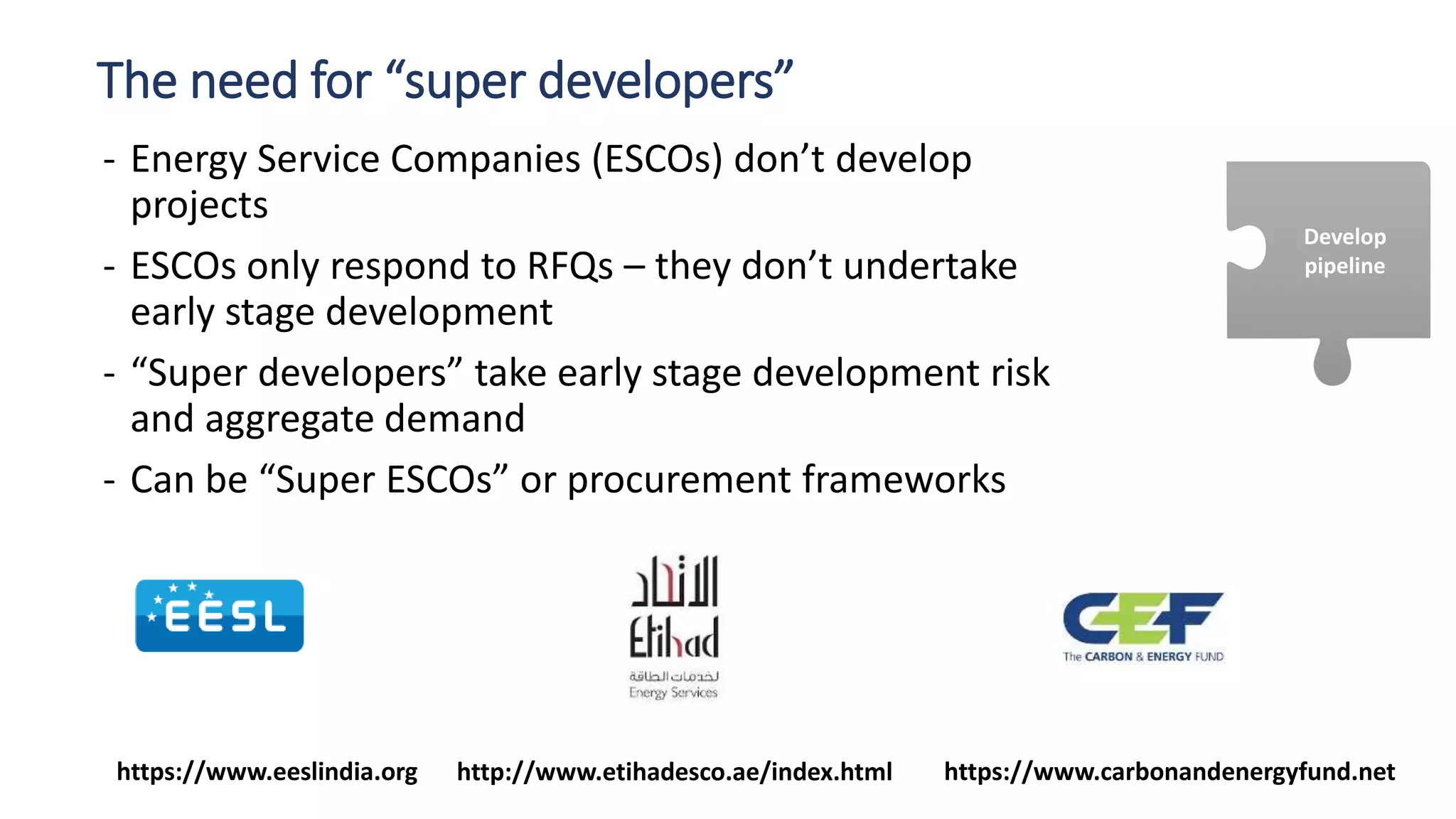
- Energy Service Companies (ESCOs) don’t develop
projects
- ESCOs only respond to RFQs – they don’t undertake
early stage development
- “Super developers” take early stage development risk
and aggregate demand
- Can be “Super ESCOs” or procurement frameworks
The need for “super developers”
https://www.eeslindia.org http://www.etihadesco.ae/index.html https://www.carbonandenergyfund.net
Develop
pipeline
Wherever there is scale all the pieces are there
Provide
finance
Develop
pipeline
Standardisation
Build
capacity
- It is not just about the money
- Need Finance, Pipeline, Standardisation & Capacity building to come
together – the EE financing jigsaw
- Distinguish between development finance and project finance
- Development finance = high risk = scarce
- Implementation finance = low risk = abundant
- Many different types of mechanism to finance EE
- Optimum will depend on market segment being addressed
- Derisk energy efficiency through
- Standardisation through the ICP’s Investor Ready Energy EfficiencyTM
- Use tools like the EEFIG Underwriting Toolkit
- Super developers can
- Develop and aggregate projects
- Standardise
- Access capital at scale
- Build capacity
Derisking energy efficiency
Provide
finance
Develop
pipeline
Standardisation
Build
capacity
steven.fawkes@energyproltd.com
www.energyproltd.com
www.onlyelevenpercent.com
@DrSteveFawkes
+44 77 0223 1995
© Steven Fawkes 2018

Derisking EE finance steven fawkes 26 Apr 2018

  • 1.
    Derisking energy efficiencyfinance Dr. Steven Fawkes EnergyPro Ltd
  • 2.
    To achieve “66%2oC” scenario requires average investment into energy efficiency > USD 1 trillion a year between 2016 and 2050 i.e. circa 5 x current level
  • 3.
    • Small projects •Lack of well developed bankable projects • Lack of standardisation • Hard to measure • Uncertain results – the design gap • Hard to meter • Hard to monetize • Complex contract forms • Lack of capacity in the financial sector / demand side / supply side • Split incentives • Low energy prices • Institutional barriers • etc etc. These apply to all sources of finance including balance sheet self-funding Challenges to financing energy efficiency
  • 4.
    Underwriting Period Performance Period Development Period Invest Development finance - Equity -Grant (PDA) Implementation finance - Debt Low Risk High Risk The project life cycle Scarce Abundant
  • 5.
    Provide finance Develop pipeline Standardisation Build capacity To scale upwe need to assemble the jigsaw of energy efficiency finance Project development finance e.g. equity Long term project finance e.g. debt Standardised development & documentation through Investor Confidence Project Standardized systems & Underwriting Aggregate projects through procurement frameworks or Super ESCOs Build capacity in demand side (end users) Build capacity on supply side (supply chain) Build capacity in finance industry
  • 6.
    Mechanisms for financingEE • Own capital • Loans/mortgages – residential/commercial buildings • Leasing • Specialised energy efficiency Funds • Property funds specialising in energy efficient buildings • Financing of energy service contracts through ESCOs and Super ESCOs • EPC / Chauffage / ESA / MESA / MEETS / LaaS / P4P • On Bill Recovery (OBR) • Property Assessed Clean Energy (PACE) • Guarantee funds • Forfaiting funds • Green bonds • YieldCos Provide financeProvide finance Provide finance
  • 7.
    Greater performance risk Uncertaintylimiting demand Higher transaction costs Difficult to build capacity Difficult to aggregate Standardisation Lack of standardisation results in:
  • 8.
    The Investor ConfidenceProject: a route to standardisation Investor Ready Energy Efficiency™ is the quality mark like BREEAM or LEED but for an ENERGY EFFICIENCY RETROFIT PROJECT An international framework for reducing owner and investor risk, lowering due diligence costs, increasing certainty of savings achievement and enabling aggregation. Ensures transparency, consistency and trust-worthiness through best practice and independent verification. Available across EU for buildings, industry, street lighting and district energy projects. These projects have received funding from the European Union’s Horizon 2020 research and innovation programme under grant agreements No 649836 and No. 754056. The sole responsibilityfor the content of this presentation lies with the authors. It does not necessarily reflectthe opinion of the European Union. Neither the EASME nor the European Commission are responsible for any use that may be made of the informationcontained therein. Standardisation
  • 9.
  • 10.
    Industry Buildings - Apartment blocks -Tertiary District energy systems Street lighting upgrades Under development for EU2 2 Supported by Horizon 2020 grant Number: 754056 Available for US & all EU1 countries 1 Supported by Horizon 2020 grant Number: 649836 Available for EU2 What types of projects can be certified as IREETM? Standardisation
  • 11.
    “HSB does provideimproved terms for energy efficiency projects that are ICP credentialed. The Asset Performance Insurance element of our cover (covering a shortfall in achieved savings) incorporates a “confidence factor” within the rating model. The highest confidence level is applicable to ICP credentialed projects. This contracts the performance parameters and reduces the premium. The exact reduction in premium depends on the nature of the project to start with.” Paul Cullum Alternative Distribution Manager, HSB Engineering Insurance Limited ICP reduces performance risk and transaction costs Standardisation
  • 12.
    valueandrisk.eefig.eu The EEFIG UnderwritingToolkit Value and risk appraisal – the EEFIG underwriting toolkit Build capacity Standardisation
  • 13.
    Value and riskappraisal Count all the sources of value • Energy • Non-energy Non-energy benefits are often much more strategic and attractive to decision makers than energy cost savings Financial appraisal needs to identify and value all benefits Acknowledge and understand all the risks • Very little data on risks (DEEP) • Better understanding of risk can bring more capital and product innovation Performance risk has been neglected but is critical - even if you don’t think you are taking performance risk you are
  • 14.
    - Energy ServiceCompanies (ESCOs) don’t develop projects - ESCOs only respond to RFQs – they don’t undertake early stage development - “Super developers” take early stage development risk and aggregate demand - Can be “Super ESCOs” or procurement frameworks The need for “super developers” https://www.eeslindia.org http://www.etihadesco.ae/index.html https://www.carbonandenergyfund.net Develop pipeline
  • 15.
    Wherever there isscale all the pieces are there Provide finance Develop pipeline Standardisation Build capacity
  • 16.
    - It isnot just about the money - Need Finance, Pipeline, Standardisation & Capacity building to come together – the EE financing jigsaw - Distinguish between development finance and project finance - Development finance = high risk = scarce - Implementation finance = low risk = abundant - Many different types of mechanism to finance EE - Optimum will depend on market segment being addressed - Derisk energy efficiency through - Standardisation through the ICP’s Investor Ready Energy EfficiencyTM - Use tools like the EEFIG Underwriting Toolkit - Super developers can - Develop and aggregate projects - Standardise - Access capital at scale - Build capacity Derisking energy efficiency Provide finance Develop pipeline Standardisation Build capacity
  • 17.

Editor's Notes

  • #3 The importance of increasing investments into energy efficiency
  • #5 Checklist / documentation and technical review happens both during the underwriting period (up to project acceptance and obtaining of the IREE designation for the project), and into the construction and performance period of the project.
  • #7 How do we achieve this amount of investment?  use different products and innovate
  • #9 Increasing investments require innovative tools that cities can use in financing their project pipelines
  • #10 Checklist / documentation and technical review happens both during the underwriting period (up to project acceptance and obtaining of the IREE designation for the project), and into the construction and performance period of the project.
  • #18 Thanks to Jan for asking me back to EcoSummit to talk again about the magic of energy efficiency.