Mobile GIS
Assignment
By
Soumik Chakraborty
(M.Tech GIS)
NIIT University,
Neemrana, Rajasthan
1. Write about architecture of Mobile GIS?
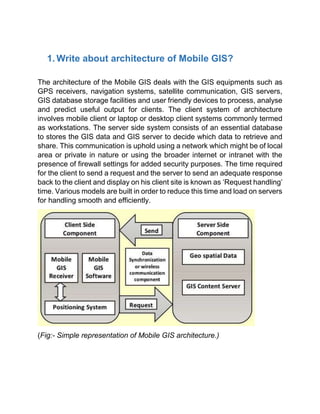
The architecture of the Mobile GIS deals with the GIS equipments such as
GPS receivers, navigation systems, satellite communication, GIS servers,
GIS database storage facilities and user friendly devices to process, analyse
and predict useful output for clients. The client system of architecture
involves mobile client or laptop or desktop client systems commonly termed
as workstations. The server side system consists of an essential database
to stores the GIS data and GIS server to decide which data to retrieve and
share. This communication is uphold using a network which might be of local
area or private in nature or using the broader internet or intranet with the
presence of firewall settings for added security purposes. The time required
for the client to send a request and the server to send an adequate response
back to the client and display on his client site is known as ‘Request handling’
time. Various models are built in order to reduce this time and load on servers
for handling smooth and efficiently.
(Fig:- Simple representation of Mobile GIS architecture.)
2. Write about service models of Cloud GIS?
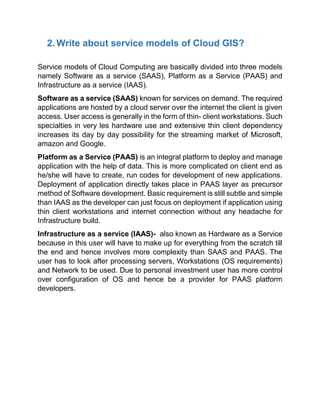
Service models of Cloud Computing are basically divided into three models
namely Software as a service (SAAS), Platform as a Service (PAAS) and
Infrastructure as a service (IAAS).
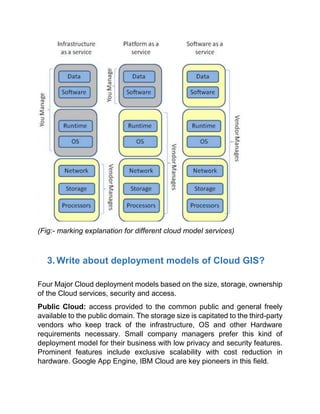
Software as a service (SAAS) known for services on demand. The required
applications are hosted by a cloud server over the internet the client is given
access. User access is generally in the form of thin- client workstations. Such
specialties in very les hardware use and extensive thin client dependency
increases its day by day possibility for the streaming market of Microsoft,
amazon and Google.
Platform as a Service (PAAS) is an integral platform to deploy and manage
application with the help of data. This is more complicated on client end as
he/she will have to create, run codes for development of new applications.
Deployment of application directly takes place in PAAS layer as precursor
method of Software development. Basic requirement is still subtle and simple
than IAAS as the developer can just focus on deployment if application using
thin client workstations and internet connection without any headache for
Infrastructure build.
Infrastructure as a service (IAAS)- also known as Hardware as a Service
because in this user will have to make up for everything from the scratch till
the end and hence involves more complexity than SAAS and PAAS. The
user has to look after processing servers, Workstations (OS requirements)
and Network to be used. Due to personal investment user has more control
over configuration of OS and hence be a provider for PAAS platform
developers.
(Fig:- marking explanation for different cloud model services)
3. Write about deployment models of Cloud GIS?
Four Major Cloud deployment models based on the size, storage, ownership
of the Cloud services, security and access.
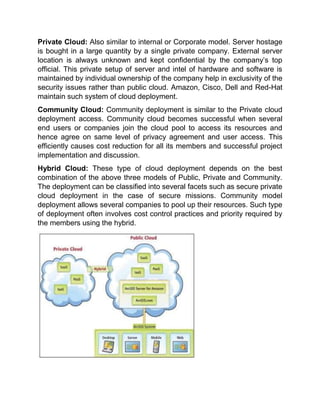
Public Cloud: access provided to the common public and general freely
available to the public domain. The storage size is capitated to the third-party
vendors who keep track of the infrastructure, OS and other Hardware
requirements necessary. Small company managers prefer this kind of
deployment model for their business with low privacy and security features.
Prominent features include exclusive scalability with cost reduction in
hardware. Google App Engine, IBM Cloud are key pioneers in this field.
Private Cloud: Also similar to internal or Corporate model. Server hostage
is bought in a large quantity by a single private company. External server
location is always unknown and kept confidential by the company’s top
official. This private setup of server and intel of hardware and software is
maintained by individual ownership of the company help in exclusivity of the
security issues rather than public cloud. Amazon, Cisco, Dell and Red-Hat
maintain such system of cloud deployment.
Community Cloud: Community deployment is similar to the Private cloud
deployment access. Community cloud becomes successful when several
end users or companies join the cloud pool to access its resources and
hence agree on same level of privacy agreement and user access. This
efficiently causes cost reduction for all its members and successful project
implementation and discussion.
Hybrid Cloud: These type of cloud deployment depends on the best
combination of the above three models of Public, Private and Community.
The deployment can be classified into several facets such as secure private
cloud deployment in the case of secure missions. Community model
deployment allows several companies to pool up their resources. Such type
of deployment often involves cost control practices and priority required by
the members using the hybrid.
4. Write about Geoserver and it’s architecture?
Geoserver is a server created for the ease of open source data handling and
publishing keeping in accordance with the OGC (Open Geospatial
Consortium) rules and guidelines. Geoserver specifically aligns with the
WMS standards (Web Mapping Services) and WFS (Web Feature Services).
The WFS standards deals with easy vector format publishing and handling
in the form of Open Layers. It’s WMTS (Web Map Tile Service) allows online
publishing of multiple geospatial information and editing them. For scripting
it uses J2EE (Java to enterprise) script for deployment of end to end map
applications.
Geoserver architecture deals with the following key elements and they all are
interconnected with each other. Spatial database being the storage option
necessary, Presentation Layer serving as a layer to format back end and
front end requests and provide necessary security to the architecture. Map
editor being the responsible application for back end javascript programs
crucial to launch any application. For proper editing of shape files it is
necessary how the elements are connected to each other and hoe to reflect
the necessary changes.
Map editor GUI Presentation Layer  Geoserver  Spatial Database.
(Fig:- Depiction of GEOSERVER architecture).

Mobile gis

  • 1.
    Mobile GIS Assignment By Soumik Chakraborty (M.TechGIS) NIIT University, Neemrana, Rajasthan
  • 2.
    1. Write aboutarchitecture of Mobile GIS? The architecture of the Mobile GIS deals with the GIS equipments such as GPS receivers, navigation systems, satellite communication, GIS servers, GIS database storage facilities and user friendly devices to process, analyse and predict useful output for clients. The client system of architecture involves mobile client or laptop or desktop client systems commonly termed as workstations. The server side system consists of an essential database to stores the GIS data and GIS server to decide which data to retrieve and share. This communication is uphold using a network which might be of local area or private in nature or using the broader internet or intranet with the presence of firewall settings for added security purposes. The time required for the client to send a request and the server to send an adequate response back to the client and display on his client site is known as ‘Request handling’ time. Various models are built in order to reduce this time and load on servers for handling smooth and efficiently. (Fig:- Simple representation of Mobile GIS architecture.)
  • 3.
    2. Write aboutservice models of Cloud GIS? Service models of Cloud Computing are basically divided into three models namely Software as a service (SAAS), Platform as a Service (PAAS) and Infrastructure as a service (IAAS). Software as a service (SAAS) known for services on demand. The required applications are hosted by a cloud server over the internet the client is given access. User access is generally in the form of thin- client workstations. Such specialties in very les hardware use and extensive thin client dependency increases its day by day possibility for the streaming market of Microsoft, amazon and Google. Platform as a Service (PAAS) is an integral platform to deploy and manage application with the help of data. This is more complicated on client end as he/she will have to create, run codes for development of new applications. Deployment of application directly takes place in PAAS layer as precursor method of Software development. Basic requirement is still subtle and simple than IAAS as the developer can just focus on deployment if application using thin client workstations and internet connection without any headache for Infrastructure build. Infrastructure as a service (IAAS)- also known as Hardware as a Service because in this user will have to make up for everything from the scratch till the end and hence involves more complexity than SAAS and PAAS. The user has to look after processing servers, Workstations (OS requirements) and Network to be used. Due to personal investment user has more control over configuration of OS and hence be a provider for PAAS platform developers.
  • 4.
    (Fig:- marking explanationfor different cloud model services) 3. Write about deployment models of Cloud GIS? Four Major Cloud deployment models based on the size, storage, ownership of the Cloud services, security and access. Public Cloud: access provided to the common public and general freely available to the public domain. The storage size is capitated to the third-party vendors who keep track of the infrastructure, OS and other Hardware requirements necessary. Small company managers prefer this kind of deployment model for their business with low privacy and security features. Prominent features include exclusive scalability with cost reduction in hardware. Google App Engine, IBM Cloud are key pioneers in this field.
  • 5.
    Private Cloud: Alsosimilar to internal or Corporate model. Server hostage is bought in a large quantity by a single private company. External server location is always unknown and kept confidential by the company’s top official. This private setup of server and intel of hardware and software is maintained by individual ownership of the company help in exclusivity of the security issues rather than public cloud. Amazon, Cisco, Dell and Red-Hat maintain such system of cloud deployment. Community Cloud: Community deployment is similar to the Private cloud deployment access. Community cloud becomes successful when several end users or companies join the cloud pool to access its resources and hence agree on same level of privacy agreement and user access. This efficiently causes cost reduction for all its members and successful project implementation and discussion. Hybrid Cloud: These type of cloud deployment depends on the best combination of the above three models of Public, Private and Community. The deployment can be classified into several facets such as secure private cloud deployment in the case of secure missions. Community model deployment allows several companies to pool up their resources. Such type of deployment often involves cost control practices and priority required by the members using the hybrid.
  • 6.
    4. Write aboutGeoserver and it’s architecture? Geoserver is a server created for the ease of open source data handling and publishing keeping in accordance with the OGC (Open Geospatial Consortium) rules and guidelines. Geoserver specifically aligns with the WMS standards (Web Mapping Services) and WFS (Web Feature Services). The WFS standards deals with easy vector format publishing and handling in the form of Open Layers. It’s WMTS (Web Map Tile Service) allows online publishing of multiple geospatial information and editing them. For scripting it uses J2EE (Java to enterprise) script for deployment of end to end map applications. Geoserver architecture deals with the following key elements and they all are interconnected with each other. Spatial database being the storage option necessary, Presentation Layer serving as a layer to format back end and front end requests and provide necessary security to the architecture. Map editor being the responsible application for back end javascript programs crucial to launch any application. For proper editing of shape files it is necessary how the elements are connected to each other and hoe to reflect the necessary changes. Map editor GUI Presentation Layer  Geoserver  Spatial Database. (Fig:- Depiction of GEOSERVER architecture).