Concepts and
Architecture of Grid
Computing
Advanced Topics Spring 2008
Prof. Robert van Engelen
HPC II Spring 2008 2
2/12/08
Overview
 Grid users: who are they?
 Concept of the Grid
 Challenges for the Grid
 Evolution of Grid systems
 Model of the Grid architecture
 Condor-G: Globus and Condor
 Applications
HPC II Spring 2008 3
2/12/08
Grid Users
 Computational/experimental scientists and engineers
 Control remote instruments
 Access to data repositories and (super)computers
 Visualization and data analysis
 Industry
 Link people (video conferencing & remote collaboration systems)
 Share resources
 Problem solving
 Government
 Public policy making based on collaborative information sharing
 Disaster response using information gathering and decision making
 Education
 Virtual classrooms (one-way video conferencing)
 Remote demonstrations and remote access to collections
HPC II Spring 2008 4
2/12/08
Scientific Users of the Grid
 Scientists and engineers may need the Grid for…
 Data intensive applications
 Collider experiments in particle physics produce petabytes per year
 Astronomy digital sky surveys, e.g. the virtual observatory project
 Example data grids: NSF GriPhyN, DOE PPDG, EU DataGrid
 Imaging
 Managing collections of medical images: MRI, CT scans, X-rays, …
 Comparing images and metadata for epidemiological studies
 Scientific simulations
 Using supercomputers as scientific instruments
 Example simulations: Japanese earth simulator, DOE nuclear bomb
simulations, computational chemistry, life sciences, …
 Remote access to instruments
 Example: network for earthquake engineering simulation
HPC II Spring 2008 5
2/12/08
Concept of the Grid
 A common theme underlying these usage modalities is a need for
“coordinated resource sharing and problem solving in dynamic,
multi-institutional virtual organizations”
 What is a Virtual Organization (VO)?
 A group of individuals or institutions defined by a set of sharing rules
 The Grid concept
 Grid = a technology that manages two opposing forces: sharing & trust
 Sharing: coordinated resource sharing in a VO between participants
with varying degrees of prior relationships and trust
 Trust: trust within a VO is precisely defined by the sharing rules
governed by security and access policies
 Limited trust means limited sharing
 No trust means no sharing!
 Why trust at all?
 There is a common goal, could be monetary gain
 Isolation of shared resources from critical infrastructure, e.g. sandboxing
HPC II Spring 2008 6
2/12/08
Resource Sharing Relationships
 Physical organizations
 AirCar, Goeing, CyclesRUs
 Two virtual organizations
 VO-Space: AirCar and Going
collaborate on space project
 VO-Cycles: ray tracing cycle
sharing consortium formed by
Goeing and CyclesRUs
 Resource sharing within a VO
 Is conditional: policies for
when, where, and what
 “can run programs A or B”
 “can read data D”
 “can use idle machines if
budget not exceeded”
 Is secure: pooling of resources
that are certified as “secure”
HPC II Spring 2008 7
2/12/08
Challenges
 Trust (security is built on trusted parties or trusted third-party CA)
 Problem: how to trust VO members and its agents (autonomous apps)
 Solution: proxy credentials provided by a CA in public key infrastructure
 Sharing of applications and data
 Problem: incompatible machines and OS, need to limit access
 Solution: virtualization, Grid resource allocation policies
 Communication of Grid policies and metadata: Grid interoperability
 Problem: incompatible protocols
 Solution: XML-based protocols and open standards
 Reliability and robustness (a non-functional requirement)
 Problem: Grid-based systems can be brittle (network connections)
 Solution: two-phase commit, transaction-based protocols
 Quality of service (QoS) (a non-functional requirement)
 Problem: need end-to-end resource management, transactions
 Solution: budgeting of cycles, bandwidth, and storage capacity
HPC II Spring 2008 8
2/12/08
Evolution of Grid Technologies
 Custom solutions (early 90s)
 “Metacomputing” explorative work
 Applications built directly on Internet protocols (TCP/IP)
 Limited functionality, security, scalability, and robustness
HPC II Spring 2008 9
2/12/08
Evolution of Grid Technologies
 Globus toolkit version 2 (GT2) (1997)
 Popular open-source collection of tools for secure sharing
 Defined and implemented protocols, APIs, and services
 De-facto Grid standards
HPC II Spring 2008 10
2/12/08
Evolution of Grid Technologies
 Open Grid Services Architecture (OGSA) (2002)
 Community standard with multiple implementations
 Globus GT3 implementation
 Service-oriented architecture based on XML Web services
HPC II Spring 2008 11
2/12/08
Open Grid Services
Architecture
 OGSA (GT3) is a redesign of Globus GT2
 Factoring of component behaviors
 Problem: current tools combine too many aspects redundantly
 OGSA identifies basic set of essential services
 Service orientation
 Services instead of applications
 A service has a well-defined web interface (like an HTTP server)
 Aligned with XML web services
 XML-based message protocols
 OGSA’s idea was good, but its use is not successful
 Need simpler, more basic service protocols instead of OGSA-specific extensions
of the web service description language (WSDL)
 Globus GT4 uses WS-RF (resource framework) a set of messaging-level
protocols for resource properties, lifetime management, …
HPC II Spring 2008 12
2/12/08
Evolution of Grid Technologies
 Managed, shared virtual systems (?)
 Improved technology
 Virtualization to make Grid more seamless
 Improved quality of service
 More active management, e.g. network QoS requires WAN-level support
HPC II Spring 2008 13
2/12/08
Model of the Grid Architecture
 The “hour-glass” model of the
Grid architecture
 Thin center: few standards
 Wide top: many high-level
behaviors can be mapped
 Wide bottom: many underlying
technologies and systems
 Role of layers:
 Fabric: interfaces local control
 Connectivity: secure
communications
 Resource: sharing a single
resource
 Collective: coordinated
sharing of multiple resources
 Applications: you decide…
HPC II Spring 2008 14
2/12/08
Fabric Layer
 Need to manage a resource
 Reserve usage in advance
 Allocate space (e.g. storage)
 Grid fabric layer provides standardized access to local
resource-specific operations
 Software is provided to discover
 Computers (OS version, hardware config, usage load)
 Storage systems
 Networks
 Globus General-purpose Architecture for Reservation
and Allocation (GARA)
HPC II Spring 2008 15
2/12/08
Connectivity Layer
 Need secure connectivity to resources
 Assumes trust is based on user, not service providers
 Use public key infrastructure (PKI)
 User is recognized by a Certificate Authority (CA) (within Grid)
 Single sign-on: allow users to authenticate only once
 Delegation: create proxy credentials to allow services/agents to
act on a user’s behalf
 Integrate and obey local security policies in global view
 Unix file permissions, ACLs, …
 Globus Security Infrastructure (GSI)
 Standardized mechanism for proxy credential creation and
mapping to local access authentication scheme (logins)
 Based on generic services security (GSS) API, which allows
applications to perform these security operations autonomously
HPC II Spring 2008 16
2/12/08
Resource Layer
 Need access to resources
 Invoke remote computation
 Monitor computation
 Discover resources
 Perform data transport (e.g. to and from computations)
 Globus Grid Resource Allocation and Management
(GRAM)
 Job manager and reporter
 Globus Monitoring and Discovery Service (MDS-2)
 Registry of resources and monitoring of resource usage stats
 Globus GridFTP
 Good old FTP but faster (multiple streams), integrated security
 Partial file access
HPC II Spring 2008 17
2/12/08
Collective Layer
 Need to coordinate sharing of resources
 Directory services
 Coallocation, scheduling, brokering services
 Monitoring and diagnostic services
 Data replication services
 Tools
 Workflow systems
 Collaboratory services
 Globus DUROC resource coallocation library
HPC II Spring 2008 18
2/12/08
Resource Allocation via
Description Languages
 Condor classified advertisements (ClassAds) describe job and requirements
 machine architecture
 command or executable starting application
 constraints on required resources
 executable size
 required memory
 operating system and release
 owner
 rank specifying preferred resources
 Globus RSL uses LDAP-like notation
[
Type = "job";
Owner = "Myself";
Executable = "Myimage";
Rank = other.PhysicalMemory > 256 && other.Mips > 20 || other.Kflops > 2000;
Imagesize = 275M;
Constraint = other.Virtual > self.Imagesize;
]
HPC II Spring 2008 19
2/12/08
Resource Allocation and Job
Scheduling
 Resource owner states policy
to manage requestors and
allocate resources according
to rules
 user access by group via a
group authorization policy
 predefined time slot when job
has right to run
 maximum CPU amount
allowed for job
 maximum disk amount
available to group
 Job scheduling and match
making based on rules
 Condor schedd
 Globus GRAM for RSL
Condor’s 7 steps to run a Condor job
HPC II Spring 2008 20
2/12/08
Condor-G: Condor for the Grid
 Condor-G can
cross institutional
boundaries
 Supports both
Condor and non-
Condor pools
 Uses
 Grid Security
Infrastructure
(GSI)
 Grid Resource
Allocation
Manager (GRAM)
 Global Access to
Storage (GASS)
7 steps to run a Condor-G job
HPC II Spring 2008 21
2/12/08
Condor-G Glidein
 Condor pool on top of a
Condor-G system
 User submits glideins via
Condor-G over GRAM
 A glidein is a Condor
deamon
 Each glidein creates (part of)
an ad-hoc Condor pool
 User submits Condor jobs to
run on the pool
 Matchmaker more complex
 Can be user-defined
HPC II Spring 2008 22
2/12/08
Two Example Applications
 NEESgrid Earthquake Engineering Collaboratory
 The Virtual Observatory World-Wide Telescope
HPC II Spring 2008 23
2/12/08
NEESgrid
 Used by the earthquake engineering community
 http://it.nees.org
 Goals is to enhance the utility of experimental facilities
 Sharing of experimental data
 Collaboration between experts from different domains
 Five basic functional components
 Collaboration technology
 Information management for sharing data
 Simulation systems and software
 NEESgrid-enabled desktops for direct access to Grid
 Support nodes which maintain online knowledge bases
HPC II Spring 2008 24
2/12/08
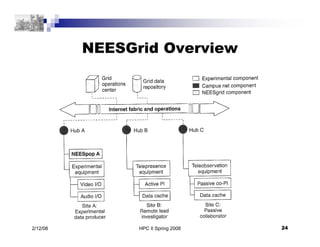
NEESGrid Overview
HPC II Spring 2008 25
2/12/08
NEESPoP
 NEESPoP (NEES Point of Presence) deployed at each
experimental facility
 Provides
 Site status published via Globus MDS
 Teleobservation using streaming data services protocol (NSDS)
 Telecontrol of actuators using transaction-oriented NEES
telecontrol protocol (NTCP)
 Collaboration services (via so-called CHEF portlets)
 Forums, electronic notebooks
 Metadata browser for editing and publishing of metadata associated
with experimental and simulation data
 Remote administration services
 Data access via GridFTP
HPC II Spring 2008 26
2/12/08
NEESgrid and Google Earth
Earthquake engineering-related points of interest
HPC II Spring 2008 27
2/12/08
The Virtual Observatory
World-Wide Telescope
 Unify astronomy archives into giant database
 Integrate archives as a single “intelligent” telescope
 Hope for new discoveries through federating datasets
from multiple independent projects
 Hierarchical architecture
 Archives: raw data (images/text) organized with metadata
 XML Web services: on-demand queries and a XML schema data
model (VOTable) to represent astronomy data
 Registries and portals: record what kind of data the archive
provides (sky coverage, temporal coverage, spectral coverage,
and resolution)
HPC II Spring 2008 28
2/12/08
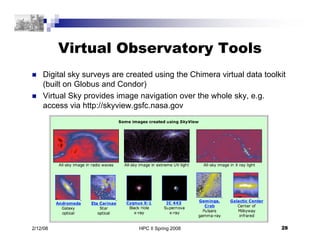
Virtual Observatory Tools
 Digital sky surveys are created using the Chimera virtual data toolkit
(built on Globus and Condor)
 Virtual Sky provides image navigation over the whole sky, e.g.
access via http://skyview.gsfc.nasa.gov
HPC II Spring 2008 29
2/12/08
Further Reading
 [Grid] Chapter 4
 Optional:
 NEESgrid: [Grid] Chapter 6
 Virtual Observatory: [Grid] Chapter 7
 Condor and reliability: [Grid] Chapter 19

Grid.pdf

  • 1.
    Concepts and Architecture ofGrid Computing Advanced Topics Spring 2008 Prof. Robert van Engelen
  • 2.
    HPC II Spring2008 2 2/12/08 Overview  Grid users: who are they?  Concept of the Grid  Challenges for the Grid  Evolution of Grid systems  Model of the Grid architecture  Condor-G: Globus and Condor  Applications
  • 3.
    HPC II Spring2008 3 2/12/08 Grid Users  Computational/experimental scientists and engineers  Control remote instruments  Access to data repositories and (super)computers  Visualization and data analysis  Industry  Link people (video conferencing & remote collaboration systems)  Share resources  Problem solving  Government  Public policy making based on collaborative information sharing  Disaster response using information gathering and decision making  Education  Virtual classrooms (one-way video conferencing)  Remote demonstrations and remote access to collections
  • 4.
    HPC II Spring2008 4 2/12/08 Scientific Users of the Grid  Scientists and engineers may need the Grid for…  Data intensive applications  Collider experiments in particle physics produce petabytes per year  Astronomy digital sky surveys, e.g. the virtual observatory project  Example data grids: NSF GriPhyN, DOE PPDG, EU DataGrid  Imaging  Managing collections of medical images: MRI, CT scans, X-rays, …  Comparing images and metadata for epidemiological studies  Scientific simulations  Using supercomputers as scientific instruments  Example simulations: Japanese earth simulator, DOE nuclear bomb simulations, computational chemistry, life sciences, …  Remote access to instruments  Example: network for earthquake engineering simulation
  • 5.
    HPC II Spring2008 5 2/12/08 Concept of the Grid  A common theme underlying these usage modalities is a need for “coordinated resource sharing and problem solving in dynamic, multi-institutional virtual organizations”  What is a Virtual Organization (VO)?  A group of individuals or institutions defined by a set of sharing rules  The Grid concept  Grid = a technology that manages two opposing forces: sharing & trust  Sharing: coordinated resource sharing in a VO between participants with varying degrees of prior relationships and trust  Trust: trust within a VO is precisely defined by the sharing rules governed by security and access policies  Limited trust means limited sharing  No trust means no sharing!  Why trust at all?  There is a common goal, could be monetary gain  Isolation of shared resources from critical infrastructure, e.g. sandboxing
  • 6.
    HPC II Spring2008 6 2/12/08 Resource Sharing Relationships  Physical organizations  AirCar, Goeing, CyclesRUs  Two virtual organizations  VO-Space: AirCar and Going collaborate on space project  VO-Cycles: ray tracing cycle sharing consortium formed by Goeing and CyclesRUs  Resource sharing within a VO  Is conditional: policies for when, where, and what  “can run programs A or B”  “can read data D”  “can use idle machines if budget not exceeded”  Is secure: pooling of resources that are certified as “secure”
  • 7.
    HPC II Spring2008 7 2/12/08 Challenges  Trust (security is built on trusted parties or trusted third-party CA)  Problem: how to trust VO members and its agents (autonomous apps)  Solution: proxy credentials provided by a CA in public key infrastructure  Sharing of applications and data  Problem: incompatible machines and OS, need to limit access  Solution: virtualization, Grid resource allocation policies  Communication of Grid policies and metadata: Grid interoperability  Problem: incompatible protocols  Solution: XML-based protocols and open standards  Reliability and robustness (a non-functional requirement)  Problem: Grid-based systems can be brittle (network connections)  Solution: two-phase commit, transaction-based protocols  Quality of service (QoS) (a non-functional requirement)  Problem: need end-to-end resource management, transactions  Solution: budgeting of cycles, bandwidth, and storage capacity
  • 8.
    HPC II Spring2008 8 2/12/08 Evolution of Grid Technologies  Custom solutions (early 90s)  “Metacomputing” explorative work  Applications built directly on Internet protocols (TCP/IP)  Limited functionality, security, scalability, and robustness
  • 9.
    HPC II Spring2008 9 2/12/08 Evolution of Grid Technologies  Globus toolkit version 2 (GT2) (1997)  Popular open-source collection of tools for secure sharing  Defined and implemented protocols, APIs, and services  De-facto Grid standards
  • 10.
    HPC II Spring2008 10 2/12/08 Evolution of Grid Technologies  Open Grid Services Architecture (OGSA) (2002)  Community standard with multiple implementations  Globus GT3 implementation  Service-oriented architecture based on XML Web services
  • 11.
    HPC II Spring2008 11 2/12/08 Open Grid Services Architecture  OGSA (GT3) is a redesign of Globus GT2  Factoring of component behaviors  Problem: current tools combine too many aspects redundantly  OGSA identifies basic set of essential services  Service orientation  Services instead of applications  A service has a well-defined web interface (like an HTTP server)  Aligned with XML web services  XML-based message protocols  OGSA’s idea was good, but its use is not successful  Need simpler, more basic service protocols instead of OGSA-specific extensions of the web service description language (WSDL)  Globus GT4 uses WS-RF (resource framework) a set of messaging-level protocols for resource properties, lifetime management, …
  • 12.
    HPC II Spring2008 12 2/12/08 Evolution of Grid Technologies  Managed, shared virtual systems (?)  Improved technology  Virtualization to make Grid more seamless  Improved quality of service  More active management, e.g. network QoS requires WAN-level support
  • 13.
    HPC II Spring2008 13 2/12/08 Model of the Grid Architecture  The “hour-glass” model of the Grid architecture  Thin center: few standards  Wide top: many high-level behaviors can be mapped  Wide bottom: many underlying technologies and systems  Role of layers:  Fabric: interfaces local control  Connectivity: secure communications  Resource: sharing a single resource  Collective: coordinated sharing of multiple resources  Applications: you decide…
  • 14.
    HPC II Spring2008 14 2/12/08 Fabric Layer  Need to manage a resource  Reserve usage in advance  Allocate space (e.g. storage)  Grid fabric layer provides standardized access to local resource-specific operations  Software is provided to discover  Computers (OS version, hardware config, usage load)  Storage systems  Networks  Globus General-purpose Architecture for Reservation and Allocation (GARA)
  • 15.
    HPC II Spring2008 15 2/12/08 Connectivity Layer  Need secure connectivity to resources  Assumes trust is based on user, not service providers  Use public key infrastructure (PKI)  User is recognized by a Certificate Authority (CA) (within Grid)  Single sign-on: allow users to authenticate only once  Delegation: create proxy credentials to allow services/agents to act on a user’s behalf  Integrate and obey local security policies in global view  Unix file permissions, ACLs, …  Globus Security Infrastructure (GSI)  Standardized mechanism for proxy credential creation and mapping to local access authentication scheme (logins)  Based on generic services security (GSS) API, which allows applications to perform these security operations autonomously
  • 16.
    HPC II Spring2008 16 2/12/08 Resource Layer  Need access to resources  Invoke remote computation  Monitor computation  Discover resources  Perform data transport (e.g. to and from computations)  Globus Grid Resource Allocation and Management (GRAM)  Job manager and reporter  Globus Monitoring and Discovery Service (MDS-2)  Registry of resources and monitoring of resource usage stats  Globus GridFTP  Good old FTP but faster (multiple streams), integrated security  Partial file access
  • 17.
    HPC II Spring2008 17 2/12/08 Collective Layer  Need to coordinate sharing of resources  Directory services  Coallocation, scheduling, brokering services  Monitoring and diagnostic services  Data replication services  Tools  Workflow systems  Collaboratory services  Globus DUROC resource coallocation library
  • 18.
    HPC II Spring2008 18 2/12/08 Resource Allocation via Description Languages  Condor classified advertisements (ClassAds) describe job and requirements  machine architecture  command or executable starting application  constraints on required resources  executable size  required memory  operating system and release  owner  rank specifying preferred resources  Globus RSL uses LDAP-like notation [ Type = "job"; Owner = "Myself"; Executable = "Myimage"; Rank = other.PhysicalMemory > 256 && other.Mips > 20 || other.Kflops > 2000; Imagesize = 275M; Constraint = other.Virtual > self.Imagesize; ]
  • 19.
    HPC II Spring2008 19 2/12/08 Resource Allocation and Job Scheduling  Resource owner states policy to manage requestors and allocate resources according to rules  user access by group via a group authorization policy  predefined time slot when job has right to run  maximum CPU amount allowed for job  maximum disk amount available to group  Job scheduling and match making based on rules  Condor schedd  Globus GRAM for RSL Condor’s 7 steps to run a Condor job
  • 20.
    HPC II Spring2008 20 2/12/08 Condor-G: Condor for the Grid  Condor-G can cross institutional boundaries  Supports both Condor and non- Condor pools  Uses  Grid Security Infrastructure (GSI)  Grid Resource Allocation Manager (GRAM)  Global Access to Storage (GASS) 7 steps to run a Condor-G job
  • 21.
    HPC II Spring2008 21 2/12/08 Condor-G Glidein  Condor pool on top of a Condor-G system  User submits glideins via Condor-G over GRAM  A glidein is a Condor deamon  Each glidein creates (part of) an ad-hoc Condor pool  User submits Condor jobs to run on the pool  Matchmaker more complex  Can be user-defined
  • 22.
    HPC II Spring2008 22 2/12/08 Two Example Applications  NEESgrid Earthquake Engineering Collaboratory  The Virtual Observatory World-Wide Telescope
  • 23.
    HPC II Spring2008 23 2/12/08 NEESgrid  Used by the earthquake engineering community  http://it.nees.org  Goals is to enhance the utility of experimental facilities  Sharing of experimental data  Collaboration between experts from different domains  Five basic functional components  Collaboration technology  Information management for sharing data  Simulation systems and software  NEESgrid-enabled desktops for direct access to Grid  Support nodes which maintain online knowledge bases
  • 24.
    HPC II Spring2008 24 2/12/08 NEESGrid Overview
  • 25.
    HPC II Spring2008 25 2/12/08 NEESPoP  NEESPoP (NEES Point of Presence) deployed at each experimental facility  Provides  Site status published via Globus MDS  Teleobservation using streaming data services protocol (NSDS)  Telecontrol of actuators using transaction-oriented NEES telecontrol protocol (NTCP)  Collaboration services (via so-called CHEF portlets)  Forums, electronic notebooks  Metadata browser for editing and publishing of metadata associated with experimental and simulation data  Remote administration services  Data access via GridFTP
  • 26.
    HPC II Spring2008 26 2/12/08 NEESgrid and Google Earth Earthquake engineering-related points of interest
  • 27.
    HPC II Spring2008 27 2/12/08 The Virtual Observatory World-Wide Telescope  Unify astronomy archives into giant database  Integrate archives as a single “intelligent” telescope  Hope for new discoveries through federating datasets from multiple independent projects  Hierarchical architecture  Archives: raw data (images/text) organized with metadata  XML Web services: on-demand queries and a XML schema data model (VOTable) to represent astronomy data  Registries and portals: record what kind of data the archive provides (sky coverage, temporal coverage, spectral coverage, and resolution)
  • 28.
    HPC II Spring2008 28 2/12/08 Virtual Observatory Tools  Digital sky surveys are created using the Chimera virtual data toolkit (built on Globus and Condor)  Virtual Sky provides image navigation over the whole sky, e.g. access via http://skyview.gsfc.nasa.gov
  • 29.
    HPC II Spring2008 29 2/12/08 Further Reading  [Grid] Chapter 4  Optional:  NEESgrid: [Grid] Chapter 6  Virtual Observatory: [Grid] Chapter 7  Condor and reliability: [Grid] Chapter 19