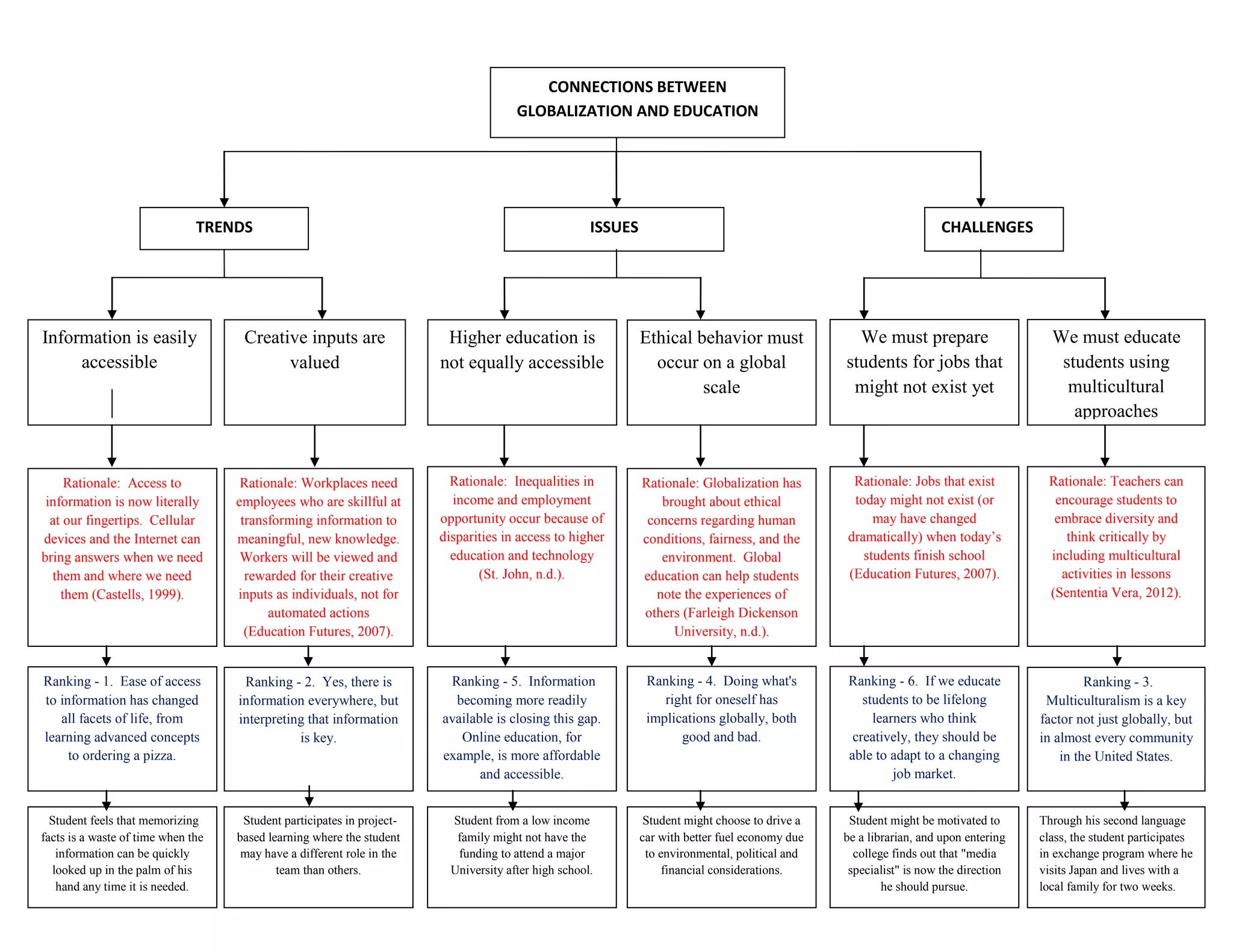
CONNECTIONS BETWEEN
GLOBALIZATION AND EDUCATION
TRENDS ISSUES CHALLENGES
Information is easily
accessible
Creative inputs are
valued
Higher education is
not equally accessible
Ethical behavior must
occur on a global
scale
We must prepare
students for jobs that
might not exist yet
We must educate
students using
multicultural
approaches
Rationale: Access to
information is now literally
at our fingertips. Cellular
devices and the Internet can
bring answers when we need
them and where we need
them (Castells, 1999).
Rationale: Workplaces need
employees who are skillful at
transforming information to
meaningful, new knowledge.
Workers will be viewed and
rewarded for their creative
inputs as individuals, not for
automated actions
(Education Futures, 2007).
Rationale: Inequalities in
income and employment
opportunity occur because of
disparities in access to higher
education and technology
(St. John, n.d.).
Rationale: Globalization has
brought about ethical
concerns regarding human
conditions, fairness, and the
environment. Global
education can help students
note the experiences of
others (Farleigh Dickenson
University, n.d.).
Rationale: Jobs that exist
today might not exist (or
may have changed
dramatically) when today’s
students finish school
(Education Futures, 2007).
Rationale: Teachers can
encourage students to
embrace diversity and
think critically by
including multicultural
activities in lessons
(Sententia Vera, 2012).
Ranking - 1. Ease of access
to information has changed
all facets of life, from
learning advanced concepts
to ordering a pizza.
Ranking - 5. Information
becoming more readily
available is closing this gap.
Online education, for
example, is more affordable
and accessible.
Ranking - 4. Doing what's
right for oneself has
implications globally, both
good and bad.
Ranking - 6. If we educate
students to be lifelong
learners who think
creatively, they should be
able to adapt to a changing
job market.
Ranking - 3.
Multiculturalism is a key
factor not just globally, but
in almost every community
in the United States.
Ranking - 2. Yes, there is
information everywhere, but
interpreting that information
is key.
Student feels that memorizing
facts is a waste of time when the
information can be quickly
looked up in the palm of his
hand any time it is needed.
Student participates in project-
based learning where the student
may have a different role in the
team than others.
Student from a low income
family might not have the
funding to attend a major
University after high school.
Student might choose to drive a
car with better fuel economy due
to environmental, political and
financial considerations.
Student might be motivated to
be a librarian, and upon entering
college finds out that "media
specialist" is now the direction
he should pursue.
Through his second language
class, the student participates
in exchange program where he
visits Japan and lives with a
local family for two weeks.
References
Castells, M. (1999).Information Technology, Globalization and Social Development.Retrieved on April 14, 2014, from
http://www.unrisd.org/80256B3C005BCCF9/(httpAuxPages)/F270E0C066F3DE7780256B67005B728C/$file/dp114.pdf
Education Futures.(2007). Top ten global trends that force us to rethink education. Retrieved on April 14, 2014, from
http://www.educationfutures.com/2007/06/18/top-ten-global-trends-that-force-us-to-rethink-education/
Farleigh Dickenson University.(n.d.).Global Education vs. Globalization.Retrieved on April 14, 2014, from
http://view.fdu.edu/default.aspx?id=263
Sententia Vera. (2102). Ways that teachers can build cultural awareness and sensitivity among students. Retrieved on April 14,
2014, from http://sententiavera.com/2012/04/26/ways-that-teachers-can-build-cultural-awareness-and-sensitivity-among-
students/
St. John, Edward. (n.d.).Issues in Globalization and Social Justice. Retrieved on April 14, 2014, from
http://www.amspressinc.com/iig.html

Week1 globalizationdiagram

  • 1.
    CONNECTIONS BETWEEN GLOBALIZATION ANDEDUCATION TRENDS ISSUES CHALLENGES Information is easily accessible Creative inputs are valued Higher education is not equally accessible Ethical behavior must occur on a global scale We must prepare students for jobs that might not exist yet We must educate students using multicultural approaches Rationale: Access to information is now literally at our fingertips. Cellular devices and the Internet can bring answers when we need them and where we need them (Castells, 1999). Rationale: Workplaces need employees who are skillful at transforming information to meaningful, new knowledge. Workers will be viewed and rewarded for their creative inputs as individuals, not for automated actions (Education Futures, 2007). Rationale: Inequalities in income and employment opportunity occur because of disparities in access to higher education and technology (St. John, n.d.). Rationale: Globalization has brought about ethical concerns regarding human conditions, fairness, and the environment. Global education can help students note the experiences of others (Farleigh Dickenson University, n.d.). Rationale: Jobs that exist today might not exist (or may have changed dramatically) when today’s students finish school (Education Futures, 2007). Rationale: Teachers can encourage students to embrace diversity and think critically by including multicultural activities in lessons (Sententia Vera, 2012). Ranking - 1. Ease of access to information has changed all facets of life, from learning advanced concepts to ordering a pizza. Ranking - 5. Information becoming more readily available is closing this gap. Online education, for example, is more affordable and accessible. Ranking - 4. Doing what's right for oneself has implications globally, both good and bad. Ranking - 6. If we educate students to be lifelong learners who think creatively, they should be able to adapt to a changing job market. Ranking - 3. Multiculturalism is a key factor not just globally, but in almost every community in the United States. Ranking - 2. Yes, there is information everywhere, but interpreting that information is key. Student feels that memorizing facts is a waste of time when the information can be quickly looked up in the palm of his hand any time it is needed. Student participates in project- based learning where the student may have a different role in the team than others. Student from a low income family might not have the funding to attend a major University after high school. Student might choose to drive a car with better fuel economy due to environmental, political and financial considerations. Student might be motivated to be a librarian, and upon entering college finds out that "media specialist" is now the direction he should pursue. Through his second language class, the student participates in exchange program where he visits Japan and lives with a local family for two weeks.
  • 2.
    References Castells, M. (1999).InformationTechnology, Globalization and Social Development.Retrieved on April 14, 2014, from http://www.unrisd.org/80256B3C005BCCF9/(httpAuxPages)/F270E0C066F3DE7780256B67005B728C/$file/dp114.pdf Education Futures.(2007). Top ten global trends that force us to rethink education. Retrieved on April 14, 2014, from http://www.educationfutures.com/2007/06/18/top-ten-global-trends-that-force-us-to-rethink-education/ Farleigh Dickenson University.(n.d.).Global Education vs. Globalization.Retrieved on April 14, 2014, from http://view.fdu.edu/default.aspx?id=263 Sententia Vera. (2102). Ways that teachers can build cultural awareness and sensitivity among students. Retrieved on April 14, 2014, from http://sententiavera.com/2012/04/26/ways-that-teachers-can-build-cultural-awareness-and-sensitivity-among- students/ St. John, Edward. (n.d.).Issues in Globalization and Social Justice. Retrieved on April 14, 2014, from http://www.amspressinc.com/iig.html