Group Activity
Each group will formulate your own
song entitled “How to be Globally,
Cultural and Multicultural Literate?
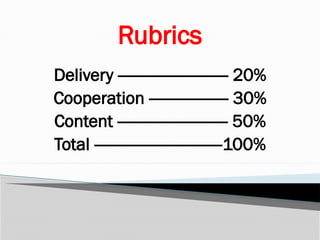
Rubrics
Delivery ------------------------- 20%
Cooperation ------------------ 30%
Content ------------------------- 50%
Total -----------------------------100%
Globalization, Cultural, and
Multicultural Literacy
Reporters:
Crescel Joy Ladra
Jonard Tiña
Katherene Cate Eusebio
What is
Global literacy is an understanding of how the
world is organized and interconnected. It
brings awareness of the possibilities and
constraints facing the world’s people. Students who
are globally literate are able to think critically about
the world and the role that they play in it. These
students have an understanding of and
appreciation for the different cultures, customs,
systems and relationships that exist throughout the
world. Globally literate students are empowered to
affect positive change in the world.
Global Literacy aims to address issues
of globalization, racism, diversity and social
justice (Guo, 2014). It requires awareness and
action, consistent with a broad understanding
of humanity, the planet, and the impact of
human decision on both. Global Literacy also
aims to empower students with knowledge
and take action to make a positive impact in
the world and their local community (Guo,
2014).
Global literacy promotes and encourages:
1. inquiry, reasoning and problem solving
2. collaboration
3. communication and an understanding of world
4. languages and cultures
5. an understanding of globalized systems and
political realities
6. responsible global citizenship
7. respect for diversity
8. an understanding of the skills and technologies
that are necessary for life in the 21st century
9. the ability for students to become advocates for
themselves and their city/state/country
According to the Ontario Ministry of Education
(2015). A global citizen should display most or all of
the following characteristics:
 Respect for humans no matter their race,
gender, religion or political perspectives.
 Respect for diversity and various perspectives.
 Promoting sustainable patterns of living,
consumption, and production.
 Appreciate the natural world and demonstrate
respectful towards the rights of all living things.
Cultural Literacy is the ability to understand and
appreciate the similarities and differences in the
customs, values, and beliefs of one’s own culture
and the culture of others.
(North Central Regional Educational Laboratory,
2000)
Cultural literacy is a term coined by
E. D. Hirsch, referring to the ability to understand
and participate fluently in a given culture. Cultural
literacy is an analogy to literacy proper (the ability to
read and write letters).
A literate reader knows the object-language's
alphabet, grammar, and a sufficient set of
vocabulary; a culturally literate person knows a
given culture's signs and symbols, including its
language, particular dialectic,
stories, entertainment, idioms, and so on. The
culturally literate person is able to talk to and
understand others of that culture with fluency, while
the culturally illiterate person fails to understand
references to past events, idiomatic expressions,
jokes, names, places, etc.
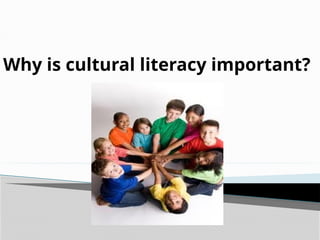
Why is cultural literacy important?
Cultural literacy is important both to individuals and
to the society they live in.
As an individual, your cultural literacy will help you to
successfully interact with people from diverse backgrounds,
including Australian Aboriginal and Torres Strait Islander
peoples. It helps you to develop a critical cultural
perspective, especially if you are part of the 'dominant
culture': instead of taking your own cultural beliefs and
practices for granted and seeing them as 'normal', you can
see them in the context of many cultures and evaluate their
strengths and limitations (Flavell, Thackrah & Hoffman,
2013). Cultural literacy also helps you develop associated
skills, such as communication and self-reflection (Flavell,
Thackrah & Hoffman, 2013).
Cultural literacy contributes positively to the
society in which you live. It
reduces prejudice and inequality based on culture,
increases the value placed on diversity, and
increases participation in the social practices of
that society, including access to institutions and
services (Anning, 2010).
Developing cultural literacy is crucial in the
modern classroom, in that the increasing diversity
of the student population necessitates
understanding and appreciation of others'
experiences, backgrounds and cultures.
Cultural literacy helps students interact and
collaborate effectively, both of which will be
necessary skills in their lives after graduation.
According to educational theories such as
Vygotsky's Social Development Theory, learning
occurs in the social context of community. As such,
a deeper understanding of diversity in one's
community should improve learning. This means
that cultural diversity is our greatest educational
resource.
How does one become more
culturally literate?
Cultural Literacy is about reading... in its widest
sense. By reading more, by reading about different
subjects... when reading becomes a pleasure rather
than a chore, one becomes more culturally literate...
naturally. It's a simple fact that the more one reads,
the more one can understand what is read, the
more enjoyable reading becomes and... the more
culturally literate one becomes.
Are you culturally literate?
Why?
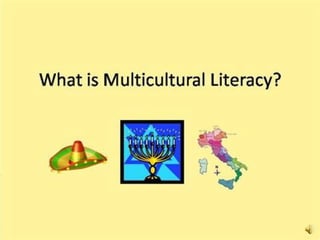
Multicultural Literacy is: Awareness that
culture impacts behavior and beliefs. Awareness
and appreciation of different beliefs, appearances
and lifestyles.
Multicultural Literacy consists of the skills and
ability to identify the creators of knowledge and
their interests (Banks, 1996), to uncover the
assumptions of knowledge, to view knowledge from
diverse ethnic and cultural perspective, and to use
knowledge to guided action that will create a
humane and just world (Boutte, 2008).
Multicultural Literacy brings attention to
diversity, equity and social justice to foster
cultural awareness by addressing difficult
issues like discrimination and oppression
towards other ethnicities (Boutte, 2008).
According to Boutte (2008) education for
multicultural literacy should help students to
develop the 21st
century skills and attitudes
that are needed to become active citizens who
will work towards achieving social justice
within our communities.
Because of the growing racial, language and
ethnic diversity in our country, Multicultural
Literacy needs to be transformed in
substantial ways to prepare students to
function effectively in the 21st
Century (Boutte,
2008).
By making small changes within the
classrooms, it can create big changes globally
(Boutte, 2008). As diversity grows, there is a
need for the emergence of multicultural
education that is more representative of the
students in today’s classrooms.
By teaching students to be advocates for
multiculturalism, we are also sending a message of
empathy and tolerance in schools as a need to
develop deeper understanding of others and
appreciation of different cultures (Banks, 2003).
With this being said, in order for students to develop
these attitudes and skills, it requires basic
knowledge prior to teaching students how to
question assumptions about cultural knowledge
and how to critique and critically think about these
important cultural issues, which is what essentially
makes Multicultural Literacy a 21st
Century Literacy
(Banks, 2003).
What is Globalization and
Multicultural Literacy
Is knowledge of cultures and languages.
We live in multicultural societies, teach in
multicultural settings, and our students
interact with those who come from a different
place. Awareness of and sensitivity to
culturally determined norms promote
understanding. In fact, when students
embrace the principle that difference does not
equal deficiency, they gain an appreciation for
the wealth of diversity that surrounds us.
Example
Surry County Schools is located in a
rural community. In order for our students
to achieve success in the 21st Century,
we need to provide opportunities for them
to be bilingual and to interact with other
cultures. Surry County Schools is
developing bilingual students through the
use of:
 Rosetta Stone - This bilingual program
was purchased for all elementary and middle
schools in the district. Elementary school
computer lab teachers set up a wonderful
learning environment for elementary students. In
the middle schools, students are learning
multiple languages through the use of Rosetta
Stone on their laptops through the 1:1 Laptop
Initiative. Students are learning to speak
Spanish or Mandarin Chinese in the elementary
grades and any chosen language in the middle
grades.
 Virtual High Schools - (North Carolina Virtal Public
High School)-is committed to raising achievement
and closing learning gaps with 21st Century
innnovations. The mission is to provide skills,
student support, and opportunities for learners to
succeed in a globally competitive world. Seventy-
two (72) courses are provided including world
languages. In this spring 2010 semester, the
school district has 60 students enrolled in almost
40 different courses. Over 200 students have
taken courses from the NCVPHS since its
inception.
Skype - This technology is utilized
throughout the school district to allow
students to gain experiences about other
cultures by contacting and seeing other
people from different countries. They are
putting their language skills to the test.
Skype is also used for in-house and
school-to-school communication as well.
How are Multicultural and Global
Literacy Interconnected?
Every classroom contains students of
different race, religion, and cultural
groups. Students embrace diverse
behaviors, cultural values, patterns of
practice, and communication. Yet they all
share one commonality: their educational
opportunity (Guo, 2014).
Teachers should teach their students that
other cultures exist and that these deserve to be
acknowledged and respected. Integrating a variety
of cultural context into lessons and activities,
teaches students to view the world from many
angles, creates a respect for diversity and enables
students to learn exciting information. As
classrooms become increasingly more diverse, it is
important for educators to acknowledge an address
diversity issues and to integrate multiculturalism
information into the classroom curriculum (Guo,
2014)
THANK YOU!!

Globalization_Cultural_and_Multicultural.pptx

  • 1.
    Group Activity Each groupwill formulate your own song entitled “How to be Globally, Cultural and Multicultural Literate?
  • 2.
    Rubrics Delivery ------------------------- 20% Cooperation------------------ 30% Content ------------------------- 50% Total -----------------------------100%
  • 3.
  • 4.
    Reporters: Crescel Joy Ladra JonardTiña Katherene Cate Eusebio
  • 5.
  • 6.
    Global literacy isan understanding of how the world is organized and interconnected. It brings awareness of the possibilities and constraints facing the world’s people. Students who are globally literate are able to think critically about the world and the role that they play in it. These students have an understanding of and appreciation for the different cultures, customs, systems and relationships that exist throughout the world. Globally literate students are empowered to affect positive change in the world.
  • 7.
    Global Literacy aimsto address issues of globalization, racism, diversity and social justice (Guo, 2014). It requires awareness and action, consistent with a broad understanding of humanity, the planet, and the impact of human decision on both. Global Literacy also aims to empower students with knowledge and take action to make a positive impact in the world and their local community (Guo, 2014).
  • 8.
    Global literacy promotesand encourages: 1. inquiry, reasoning and problem solving 2. collaboration 3. communication and an understanding of world 4. languages and cultures 5. an understanding of globalized systems and political realities 6. responsible global citizenship 7. respect for diversity 8. an understanding of the skills and technologies that are necessary for life in the 21st century 9. the ability for students to become advocates for themselves and their city/state/country
  • 9.
    According to theOntario Ministry of Education (2015). A global citizen should display most or all of the following characteristics:  Respect for humans no matter their race, gender, religion or political perspectives.  Respect for diversity and various perspectives.  Promoting sustainable patterns of living, consumption, and production.  Appreciate the natural world and demonstrate respectful towards the rights of all living things.
  • 11.
    Cultural Literacy isthe ability to understand and appreciate the similarities and differences in the customs, values, and beliefs of one’s own culture and the culture of others. (North Central Regional Educational Laboratory, 2000) Cultural literacy is a term coined by E. D. Hirsch, referring to the ability to understand and participate fluently in a given culture. Cultural literacy is an analogy to literacy proper (the ability to read and write letters).
  • 12.
    A literate readerknows the object-language's alphabet, grammar, and a sufficient set of vocabulary; a culturally literate person knows a given culture's signs and symbols, including its language, particular dialectic, stories, entertainment, idioms, and so on. The culturally literate person is able to talk to and understand others of that culture with fluency, while the culturally illiterate person fails to understand references to past events, idiomatic expressions, jokes, names, places, etc.
  • 13.
    Why is culturalliteracy important?
  • 14.
    Cultural literacy isimportant both to individuals and to the society they live in. As an individual, your cultural literacy will help you to successfully interact with people from diverse backgrounds, including Australian Aboriginal and Torres Strait Islander peoples. It helps you to develop a critical cultural perspective, especially if you are part of the 'dominant culture': instead of taking your own cultural beliefs and practices for granted and seeing them as 'normal', you can see them in the context of many cultures and evaluate their strengths and limitations (Flavell, Thackrah & Hoffman, 2013). Cultural literacy also helps you develop associated skills, such as communication and self-reflection (Flavell, Thackrah & Hoffman, 2013).
  • 15.
    Cultural literacy contributespositively to the society in which you live. It reduces prejudice and inequality based on culture, increases the value placed on diversity, and increases participation in the social practices of that society, including access to institutions and services (Anning, 2010). Developing cultural literacy is crucial in the modern classroom, in that the increasing diversity of the student population necessitates understanding and appreciation of others' experiences, backgrounds and cultures.
  • 16.
    Cultural literacy helpsstudents interact and collaborate effectively, both of which will be necessary skills in their lives after graduation. According to educational theories such as Vygotsky's Social Development Theory, learning occurs in the social context of community. As such, a deeper understanding of diversity in one's community should improve learning. This means that cultural diversity is our greatest educational resource.
  • 17.
    How does onebecome more culturally literate?
  • 18.
    Cultural Literacy isabout reading... in its widest sense. By reading more, by reading about different subjects... when reading becomes a pleasure rather than a chore, one becomes more culturally literate... naturally. It's a simple fact that the more one reads, the more one can understand what is read, the more enjoyable reading becomes and... the more culturally literate one becomes.
  • 19.
    Are you culturallyliterate? Why?
  • 21.
    Multicultural Literacy is:Awareness that culture impacts behavior and beliefs. Awareness and appreciation of different beliefs, appearances and lifestyles. Multicultural Literacy consists of the skills and ability to identify the creators of knowledge and their interests (Banks, 1996), to uncover the assumptions of knowledge, to view knowledge from diverse ethnic and cultural perspective, and to use knowledge to guided action that will create a humane and just world (Boutte, 2008).
  • 22.
    Multicultural Literacy bringsattention to diversity, equity and social justice to foster cultural awareness by addressing difficult issues like discrimination and oppression towards other ethnicities (Boutte, 2008). According to Boutte (2008) education for multicultural literacy should help students to develop the 21st century skills and attitudes that are needed to become active citizens who will work towards achieving social justice within our communities.
  • 23.
    Because of thegrowing racial, language and ethnic diversity in our country, Multicultural Literacy needs to be transformed in substantial ways to prepare students to function effectively in the 21st Century (Boutte, 2008). By making small changes within the classrooms, it can create big changes globally (Boutte, 2008). As diversity grows, there is a need for the emergence of multicultural education that is more representative of the students in today’s classrooms.
  • 24.
    By teaching studentsto be advocates for multiculturalism, we are also sending a message of empathy and tolerance in schools as a need to develop deeper understanding of others and appreciation of different cultures (Banks, 2003). With this being said, in order for students to develop these attitudes and skills, it requires basic knowledge prior to teaching students how to question assumptions about cultural knowledge and how to critique and critically think about these important cultural issues, which is what essentially makes Multicultural Literacy a 21st Century Literacy (Banks, 2003).
  • 25.
    What is Globalizationand Multicultural Literacy
  • 26.
    Is knowledge ofcultures and languages. We live in multicultural societies, teach in multicultural settings, and our students interact with those who come from a different place. Awareness of and sensitivity to culturally determined norms promote understanding. In fact, when students embrace the principle that difference does not equal deficiency, they gain an appreciation for the wealth of diversity that surrounds us.
  • 27.
  • 28.
    Surry County Schoolsis located in a rural community. In order for our students to achieve success in the 21st Century, we need to provide opportunities for them to be bilingual and to interact with other cultures. Surry County Schools is developing bilingual students through the use of:
  • 29.
     Rosetta Stone- This bilingual program was purchased for all elementary and middle schools in the district. Elementary school computer lab teachers set up a wonderful learning environment for elementary students. In the middle schools, students are learning multiple languages through the use of Rosetta Stone on their laptops through the 1:1 Laptop Initiative. Students are learning to speak Spanish or Mandarin Chinese in the elementary grades and any chosen language in the middle grades.
  • 30.
     Virtual HighSchools - (North Carolina Virtal Public High School)-is committed to raising achievement and closing learning gaps with 21st Century innnovations. The mission is to provide skills, student support, and opportunities for learners to succeed in a globally competitive world. Seventy- two (72) courses are provided including world languages. In this spring 2010 semester, the school district has 60 students enrolled in almost 40 different courses. Over 200 students have taken courses from the NCVPHS since its inception.
  • 31.
    Skype - Thistechnology is utilized throughout the school district to allow students to gain experiences about other cultures by contacting and seeing other people from different countries. They are putting their language skills to the test. Skype is also used for in-house and school-to-school communication as well.
  • 32.
    How are Multiculturaland Global Literacy Interconnected?
  • 33.
    Every classroom containsstudents of different race, religion, and cultural groups. Students embrace diverse behaviors, cultural values, patterns of practice, and communication. Yet they all share one commonality: their educational opportunity (Guo, 2014).
  • 34.
    Teachers should teachtheir students that other cultures exist and that these deserve to be acknowledged and respected. Integrating a variety of cultural context into lessons and activities, teaches students to view the world from many angles, creates a respect for diversity and enables students to learn exciting information. As classrooms become increasingly more diverse, it is important for educators to acknowledge an address diversity issues and to integrate multiculturalism information into the classroom curriculum (Guo, 2014)
  • 35.