GLOBALIZATION
•is a complex and multifaceted
phenomenon that has
transformed the world in
various ways. It refers to the
increasing interconnectedness
and interdependence of
countries through the exchange
of goods, services, information,
ideas, and cultures.
TYPES OF
GLOBALIZATION
ECONOMIC GLOBALIZATION
• is perhaps the most well-
known and widely
discussed type of
globalization. It involves the
integration of national
economies into a global
economic system through
the flow of goods, services,
capital, and labor across
borders.
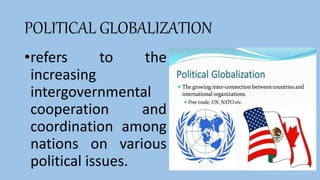
POLITICAL GLOBALIZATION
•refers to the
increasing
intergovernmental
cooperation and
coordination among
nations on various
political issues.
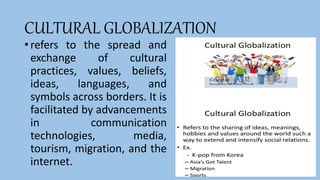
CULTURAL GLOBALIZATION
• refers to the spread and
exchange of cultural
practices, values, beliefs,
ideas, languages, and
symbols across borders. It is
facilitated by advancements
in communication
technologies, media,
tourism, migration, and the
internet.
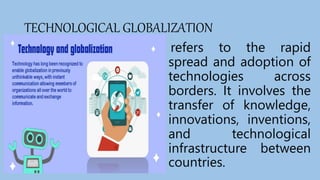
TECHNOLOGICAL GLOBALIZATION
refers to the rapid
spread and adoption of
technologies across
borders. It involves the
transfer of knowledge,
innovations, inventions,
and technological
infrastructure between
countries.
Environmental globalization
refers to the
interconnectedness of
environmental issues across
national boundaries. It
recognizes that environmental
problems such as climate
change, deforestation, pollution,
and biodiversity loss are global
in nature and require
international cooperation and
collective action.
In conclusion,
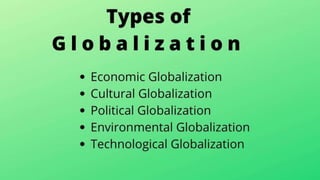
globalization encompasses various types that interact and
influence one another in complex ways.
Economic globalization focuses on the integration of
economies through trade and investment flows.
Political globalization involves intergovernmental cooperation
on political issues.
Cultural globalization refers to the spread of cultural practices
and values across borders.
Technological globalization relates to the diffusion of
technologies worldwide.
Environmental globalization recognizes the global nature of
environmental challenges and promotes international
cooperation to address them
ADVANTAGES
1. Increased Economic Opportunities
•Globalization has led to the expansion of
international trade, which has created new
economic opportunities for businesses and
individuals. With the removal of trade barriers
and the emergence of new markets,
companies can now access a global customer
base and sell their products and services to a
wider audience. This has led to increased
economic growth, job creation, and higher
living standards.
2. IMPROVED EFFICIENCY AND PRODUCTIVITY
•Globalization has facilitated the flow of
ideas, technology, and best practices
across borders, leading to improved
efficiency and productivity. Companies
can now access the latest technologies
and innovations, regardless of their
location, which has led to increased
competitiveness and better quality
products and services.
3. CULTURAL EXCHANGE AND
UNDERSTANDING
•Globalization has also facilitated the
exchange of cultures, ideas, and values
between nations. This has led to increased
understanding and tolerance, and has
helped to break down stereotypes and
prejudices. Cultural exchange has also led to
the development of new art forms, music,
and literature, enriching the cultural
landscape of the world
1. JOB LOSS AND INCOME
INEQUALITY
•One of the most significant disadvantages
of globalization is job loss and income
inequality. As companies outsource their
operations to other countries, where labor
is cheaper, it leads to job loss and
downward pressure on wages in the
home country. This has led to increased
income inequality and social unrest.
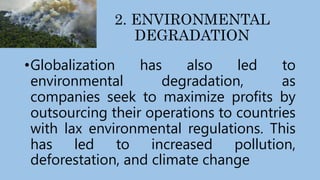
2. ENVIRONMENTAL
DEGRADATION
•Globalization has also led to
environmental degradation, as
companies seek to maximize profits by
outsourcing their operations to countries
with lax environmental regulations. This
has led to increased pollution,
deforestation, and climate change
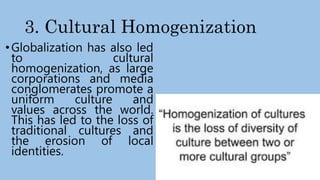
3. Cultural Homogenization
•Globalization has also led
to cultural
homogenization, as large
corporations and media
conglomerates promote a
uniform culture and
values across the world.
This has led to the loss of
traditional cultures and
the erosion of local
identities.
In conclusion,
• globalization has both advantages and
disadvantages. While it has led to increased
economic opportunities, improved efficiency
and productivity, and cultural exchange and
understanding, it has also led to job loss and
income inequality, environmental
degradation, and cultural homogenization. It
is important for policymakers and business
leaders to carefully consider these factors
when making decisions about globalization.
GLOBALIZATION
GLOBALIZATION

GLOBALIZATION

  • 3.
    GLOBALIZATION •is a complexand multifaceted phenomenon that has transformed the world in various ways. It refers to the increasing interconnectedness and interdependence of countries through the exchange of goods, services, information, ideas, and cultures.
  • 4.
  • 6.
    ECONOMIC GLOBALIZATION • isperhaps the most well- known and widely discussed type of globalization. It involves the integration of national economies into a global economic system through the flow of goods, services, capital, and labor across borders.
  • 7.
    POLITICAL GLOBALIZATION •refers tothe increasing intergovernmental cooperation and coordination among nations on various political issues.
  • 8.
    CULTURAL GLOBALIZATION • refersto the spread and exchange of cultural practices, values, beliefs, ideas, languages, and symbols across borders. It is facilitated by advancements in communication technologies, media, tourism, migration, and the internet.
  • 9.
    TECHNOLOGICAL GLOBALIZATION refers tothe rapid spread and adoption of technologies across borders. It involves the transfer of knowledge, innovations, inventions, and technological infrastructure between countries.
  • 10.
    Environmental globalization refers tothe interconnectedness of environmental issues across national boundaries. It recognizes that environmental problems such as climate change, deforestation, pollution, and biodiversity loss are global in nature and require international cooperation and collective action.
  • 11.
    In conclusion, globalization encompassesvarious types that interact and influence one another in complex ways. Economic globalization focuses on the integration of economies through trade and investment flows. Political globalization involves intergovernmental cooperation on political issues. Cultural globalization refers to the spread of cultural practices and values across borders. Technological globalization relates to the diffusion of technologies worldwide. Environmental globalization recognizes the global nature of environmental challenges and promotes international cooperation to address them
  • 13.
  • 14.
    1. Increased EconomicOpportunities •Globalization has led to the expansion of international trade, which has created new economic opportunities for businesses and individuals. With the removal of trade barriers and the emergence of new markets, companies can now access a global customer base and sell their products and services to a wider audience. This has led to increased economic growth, job creation, and higher living standards.
  • 15.
    2. IMPROVED EFFICIENCYAND PRODUCTIVITY •Globalization has facilitated the flow of ideas, technology, and best practices across borders, leading to improved efficiency and productivity. Companies can now access the latest technologies and innovations, regardless of their location, which has led to increased competitiveness and better quality products and services.
  • 16.
    3. CULTURAL EXCHANGEAND UNDERSTANDING •Globalization has also facilitated the exchange of cultures, ideas, and values between nations. This has led to increased understanding and tolerance, and has helped to break down stereotypes and prejudices. Cultural exchange has also led to the development of new art forms, music, and literature, enriching the cultural landscape of the world
  • 18.
    1. JOB LOSSAND INCOME INEQUALITY •One of the most significant disadvantages of globalization is job loss and income inequality. As companies outsource their operations to other countries, where labor is cheaper, it leads to job loss and downward pressure on wages in the home country. This has led to increased income inequality and social unrest.
  • 19.
    2. ENVIRONMENTAL DEGRADATION •Globalization hasalso led to environmental degradation, as companies seek to maximize profits by outsourcing their operations to countries with lax environmental regulations. This has led to increased pollution, deforestation, and climate change
  • 20.
    3. Cultural Homogenization •Globalizationhas also led to cultural homogenization, as large corporations and media conglomerates promote a uniform culture and values across the world. This has led to the loss of traditional cultures and the erosion of local identities.
  • 21.
    In conclusion, • globalizationhas both advantages and disadvantages. While it has led to increased economic opportunities, improved efficiency and productivity, and cultural exchange and understanding, it has also led to job loss and income inequality, environmental degradation, and cultural homogenization. It is important for policymakers and business leaders to carefully consider these factors when making decisions about globalization.