Multinational Corporations
Gross Domestic Product (GDP)
The North American Free Trade
Agreement
Association of Southeast Asian
Nations
Organization of the Petroleum
Exporting Countries
Nixon Shock
Worldwide Stock Market Crash
1979 Oil Crisis
The 1980s Oil Glut
Supertankers
World Energy Consumption
Heavily Indebted Poor Countries
Global North – Global South
Newly Industrialized
Countries
First, Second, and Third
World Countries
Foreign Debt by Nation
Change in the U.S. Workforce
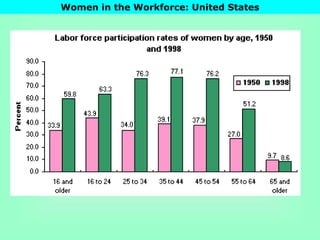
Women in the Workforce
Privatization
Forced Privatization
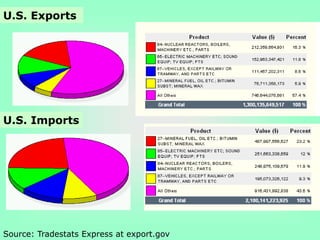
U.S. Exports and Imports
General Agreement on Tariffs
and Trade
The World Trade
Organization
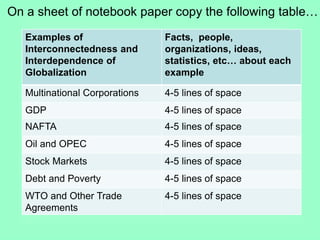
On a sheet of notebook paper copy the following table…
Examples of
Interconnectedness and
Interdependence of
Globalization
Facts, people,
organizations, ideas,
statistics, etc… about each
example
Multinational Corporations 4-5 lines of space
GDP 4-5 lines of space
NAFTA 4-5 lines of space
Oil and OPEC 4-5 lines of space
Stock Markets 4-5 lines of space
Debt and Poverty 4-5 lines of space
WTO and Other Trade
Agreements
4-5 lines of space
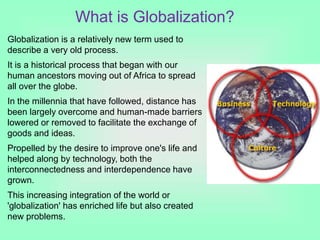
Globalization is a relatively new term used to
describe a very old process.
It is a historical process that began with our
human ancestors moving out of Africa to spread
all over the globe.
In the millennia that have followed, distance has
been largely overcome and human-made barriers
lowered or removed to facilitate the exchange of
goods and ideas.
Propelled by the desire to improve one's life and
helped along by technology, both the
interconnectedness and interdependence have
grown.
This increasing integration of the world or
'globalization' has enriched life but also created
new problems.
What is Globalization?
History of Globalization
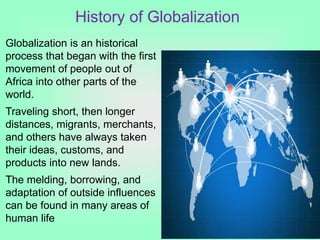
Globalization is an historical
process that began with the first
movement of people out of
Africa into other parts of the
world.
Traveling short, then longer
distances, migrants, merchants,
and others have always taken
their ideas, customs, and
products into new lands.
The melding, borrowing, and
adaptation of outside influences
can be found in many areas of
human life
Multinational Corporations
•A multinational corporation (MNC), also called a transnational
corporation (TNC), is a corporation or enterprise that operates in
more than one country.
•The assets of many MNCs are larger than small nations.
Gross Domestic Product (GDP)
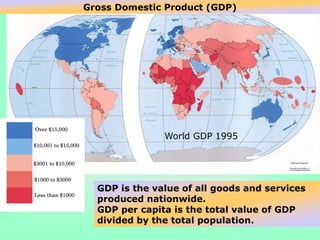
World GDP 1995
GDP is the value of all goods and services
produced nationwide.
GDP per capita is the total value of GDP
divided by the total population.
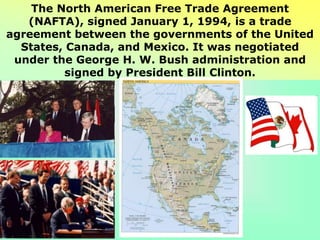
The North American Free Trade Agreement
(NAFTA), signed January 1, 1994, is a trade
agreement between the governments of the United
States, Canada, and Mexico. It was negotiated
under the George H. W. Bush administration and
signed by President Bill Clinton.
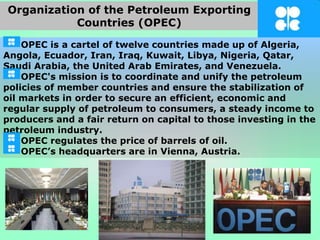
OPEC is a cartel of twelve countries made up of Algeria,
Angola, Ecuador, Iran, Iraq, Kuwait, Libya, Nigeria, Qatar,
Saudi Arabia, the United Arab Emirates, and Venezuela.
OPEC's mission is to coordinate and unify the petroleum
policies of member countries and ensure the stabilization of
oil markets in order to secure an efficient, economic and
regular supply of petroleum to consumers, a steady income to
producers and a fair return on capital to those investing in the
petroleum industry.
OPEC regulates the price of barrels of oil.
OPEC’s headquarters are in Vienna, Austria.
Organization of the Petroleum Exporting
Countries (OPEC)
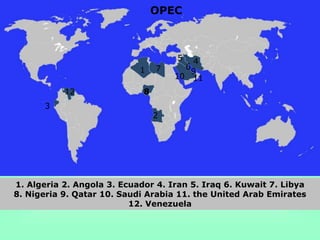
1. Algeria 2. Angola 3. Ecuador 4. Iran 5. Iraq 6. Kuwait 7. Libya
8. Nigeria 9. Qatar 10. Saudi Arabia 11. the United Arab Emirates
12. Venezuela
1
2
3
45
67
8
9
10 11
12
OPEC
Angola
Libya
Algeria
Iraq
Nigeria
Kuwait
Venezuela
Iran
Saudi Arabia
IndonesiaEcuador
Qatar
United Arab Emirates
OPEC
78%
NON-
OPEC
22%
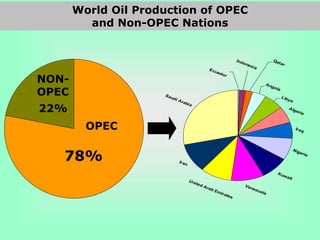
World Oil Production of OPEC
and Non-OPEC Nations
0
20
40
60
80
100
120
1946
1948
1950
1952
1954
1956
1958
1960
1962
1964
1966
1968
1970
1972
1974
1976
1978
1980
1982
1984
1986
1988
1990
1992
1994
1996
1998
2000
2002
2004
2006
2008
Nominal Adjusted
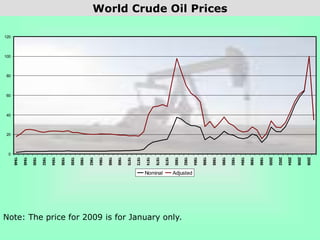
World Crude Oil Prices
Note: The price for 2009 is for January only.
Nixon Shock
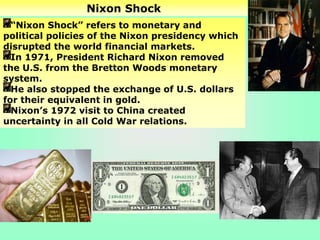
“Nixon Shock” refers to monetary and
political policies of the Nixon presidency which
disrupted the world financial markets.
In 1971, President Richard Nixon removed
the U.S. from the Bretton Woods monetary
system.
He also stopped the exchange of U.S. dollars
for their equivalent in gold.
Nixon’s 1972 visit to China created
uncertainty in all Cold War relations.
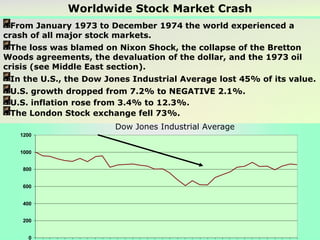
From January 1973 to December 1974 the world experienced a
crash of all major stock markets.
The loss was blamed on Nixon Shock, the collapse of the Bretton
Woods agreements, the devaluation of the dollar, and the 1973 oil
crisis (see Middle East section).
In the U.S., the Dow Jones Industrial Average lost 45% of its value.
U.S. growth dropped from 7.2% to NEGATIVE 2.1%.
U.S. inflation rose from 3.4% to 12.3%.
The London Stock exchange fell 73%.
Worldwide Stock Market Crash
0
200
400
600
800
1000
1200
Dow Jones Industrial Average
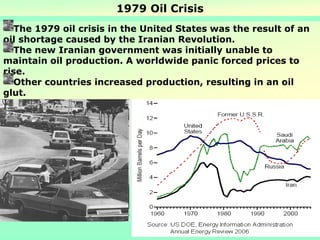
1979 Oil Crisis
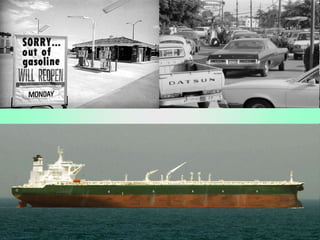
The 1979 oil crisis in the United States was the result of an
oil shortage caused by the Iranian Revolution.
The new Iranian government was initially unable to
maintain oil production. A worldwide panic forced prices to
rise.
Other countries increased production, resulting in an oil
glut.
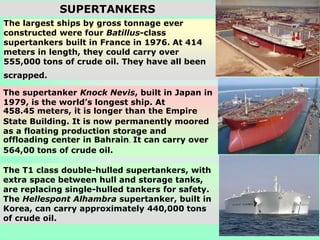
The T1 class double-hulled supertankers, with
extra space between hull and storage tanks,
are replacing single-hulled tankers for safety.
The Hellespont Alhambra supertanker, built in
Korea, can carry approximately 440,000 tons
of crude oil.
The supertanker Knock Nevis, built in Japan in
1979, is the world’s longest ship. At
458.45 meters, it is longer than the Empire
State Building. It is now permanently moored
as a floating production storage and
offloading center in Bahrain. It can carry over
564,00 tons of crude oil.
The largest ships by gross tonnage ever
constructed were four Batillus-class
supertankers built in France in 1976. At 414
meters in length, they could carry over
555,000 tons of crude oil. They have all been
scrapped.
SUPERTANKERS
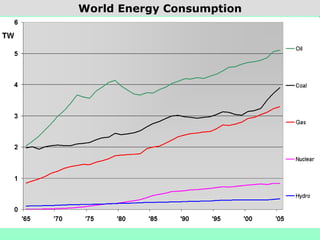
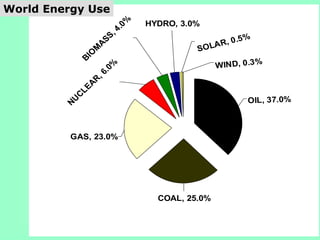
World Energy Consumption
OIL, 37.0%
COAL, 25.0%
GAS, 23.0%
N
U
C
LEA
R
,6.0%
B
IO
M
A
SS,4.0%
HYDRO, 3.0%
SOLAR, 0.5%
WIND, 0.3%
World Energy Use
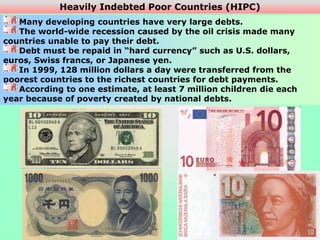
Heavily Indebted Poor Countries (HIPC)
Many developing countries have very large debts.
The world-wide recession caused by the oil crisis made many
countries unable to pay their debt.
Debt must be repaid in “hard currency” such as U.S. dollars,
euros, Swiss francs, or Japanese yen.
In 1999, 128 million dollars a day were transferred from the
poorest countries to the richest countries for debt payments.
According to one estimate, at least 7 million children die each
year because of poverty created by national debts.
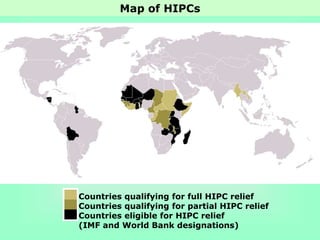
Map of HIPCs
Countries qualifying for full HIPC relief
Countries qualifying for partial HIPC relief
Countries eligible for HIPC relief
(IMF and World Bank designations)
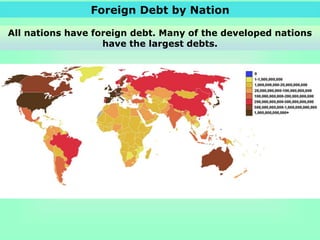
Foreign Debt by Nation
All nations have foreign debt. Many of the developed nations
have the largest debts.
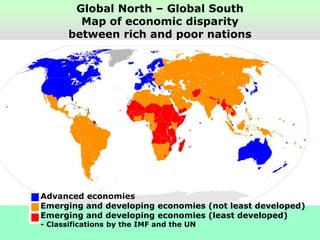
Global North – Global South
Map of economic disparity
between rich and poor nations
Advanced economies
Emerging and developing economies (not least developed)
Emerging and developing economies (least developed)
- Classifications by the IMF and the UN
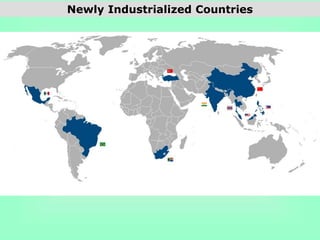
Newly Industrialized Countries
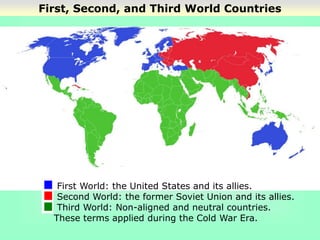
First, Second, and Third World Countries
First World: the United States and its allies.
Second World: the former Soviet Union and its allies.
Third World: Non-aligned and neutral countries.
These terms applied during the Cold War Era.
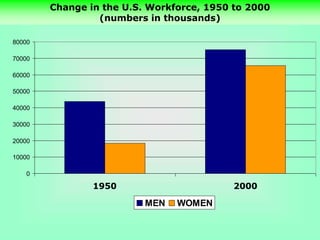
0
10000
20000
30000
40000
50000
60000
70000
80000
1950 2000
MEN WOMEN
Change in the U.S. Workforce, 1950 to 2000
(numbers in thousands)
Women in the Workforce: United States
Privatization
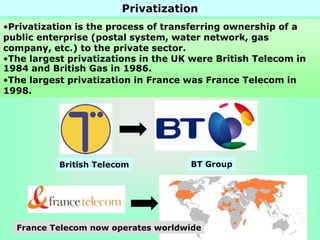
•Privatization is the process of transferring ownership of a
public enterprise (postal system, water network, gas
company, etc.) to the private sector.
•The largest privatizations in the UK were British Telecom in
1984 and British Gas in 1986.
•The largest privatization in France was France Telecom in
1998.
British Telecom BT Group
France Telecom now operates worldwide
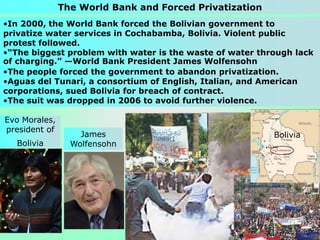
•In 2000, the World Bank forced the Bolivian government to
privatize water services in Cochabamba, Bolivia. Violent public
protest followed.
•“The biggest problem with water is the waste of water through lack
of charging.” —World Bank President James Wolfensohn
•The people forced the government to abandon privatization.
•Aguas del Tunari, a consortium of English, Italian, and American
corporations, sued Bolivia for breach of contract.
•The suit was dropped in 2006 to avoid further violence.
The World Bank and Forced Privatization
Evo Morales,
president of
Bolivia
James
Wolfensohn
Bolivia
U.S. Exports
Source: Tradestats Express at export.gov
U.S. Imports
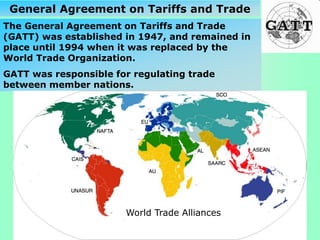
The General Agreement on Tariffs and Trade
(GATT) was established in 1947, and remained in
place until 1994 when it was replaced by the
World Trade Organization.
GATT was responsible for regulating trade
between member nations.
General Agreement on Tariffs and Trade
World Trade Alliances
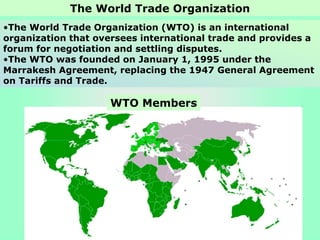
•The World Trade Organization (WTO) is an international
organization that oversees international trade and provides a
forum for negotiation and settling disputes.
•The WTO was founded on January 1, 1995 under the
Marrakesh Agreement, replacing the 1947 General Agreement
on Tariffs and Trade.
The World Trade Organization
WTO Members
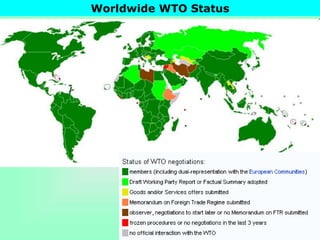
Worldwide WTO Status

Globalization

  • 1.
    Multinational Corporations Gross DomesticProduct (GDP) The North American Free Trade Agreement Association of Southeast Asian Nations Organization of the Petroleum Exporting Countries Nixon Shock Worldwide Stock Market Crash 1979 Oil Crisis The 1980s Oil Glut Supertankers World Energy Consumption Heavily Indebted Poor Countries Global North – Global South Newly Industrialized Countries First, Second, and Third World Countries Foreign Debt by Nation Change in the U.S. Workforce Women in the Workforce Privatization Forced Privatization U.S. Exports and Imports General Agreement on Tariffs and Trade The World Trade Organization
  • 2.
    On a sheetof notebook paper copy the following table… Examples of Interconnectedness and Interdependence of Globalization Facts, people, organizations, ideas, statistics, etc… about each example Multinational Corporations 4-5 lines of space GDP 4-5 lines of space NAFTA 4-5 lines of space Oil and OPEC 4-5 lines of space Stock Markets 4-5 lines of space Debt and Poverty 4-5 lines of space WTO and Other Trade Agreements 4-5 lines of space
  • 3.
    Globalization is arelatively new term used to describe a very old process. It is a historical process that began with our human ancestors moving out of Africa to spread all over the globe. In the millennia that have followed, distance has been largely overcome and human-made barriers lowered or removed to facilitate the exchange of goods and ideas. Propelled by the desire to improve one's life and helped along by technology, both the interconnectedness and interdependence have grown. This increasing integration of the world or 'globalization' has enriched life but also created new problems. What is Globalization?
  • 4.
    History of Globalization Globalizationis an historical process that began with the first movement of people out of Africa into other parts of the world. Traveling short, then longer distances, migrants, merchants, and others have always taken their ideas, customs, and products into new lands. The melding, borrowing, and adaptation of outside influences can be found in many areas of human life
  • 5.
    Multinational Corporations •A multinationalcorporation (MNC), also called a transnational corporation (TNC), is a corporation or enterprise that operates in more than one country. •The assets of many MNCs are larger than small nations.
  • 6.
    Gross Domestic Product(GDP) World GDP 1995 GDP is the value of all goods and services produced nationwide. GDP per capita is the total value of GDP divided by the total population.
  • 7.
    The North AmericanFree Trade Agreement (NAFTA), signed January 1, 1994, is a trade agreement between the governments of the United States, Canada, and Mexico. It was negotiated under the George H. W. Bush administration and signed by President Bill Clinton.
  • 8.
    OPEC is acartel of twelve countries made up of Algeria, Angola, Ecuador, Iran, Iraq, Kuwait, Libya, Nigeria, Qatar, Saudi Arabia, the United Arab Emirates, and Venezuela. OPEC's mission is to coordinate and unify the petroleum policies of member countries and ensure the stabilization of oil markets in order to secure an efficient, economic and regular supply of petroleum to consumers, a steady income to producers and a fair return on capital to those investing in the petroleum industry. OPEC regulates the price of barrels of oil. OPEC’s headquarters are in Vienna, Austria. Organization of the Petroleum Exporting Countries (OPEC)
  • 9.
    1. Algeria 2.Angola 3. Ecuador 4. Iran 5. Iraq 6. Kuwait 7. Libya 8. Nigeria 9. Qatar 10. Saudi Arabia 11. the United Arab Emirates 12. Venezuela 1 2 3 45 67 8 9 10 11 12 OPEC
  • 10.
    Angola Libya Algeria Iraq Nigeria Kuwait Venezuela Iran Saudi Arabia IndonesiaEcuador Qatar United ArabEmirates OPEC 78% NON- OPEC 22% World Oil Production of OPEC and Non-OPEC Nations
  • 13.
  • 14.
    Nixon Shock “Nixon Shock”refers to monetary and political policies of the Nixon presidency which disrupted the world financial markets. In 1971, President Richard Nixon removed the U.S. from the Bretton Woods monetary system. He also stopped the exchange of U.S. dollars for their equivalent in gold. Nixon’s 1972 visit to China created uncertainty in all Cold War relations.
  • 15.
    From January 1973to December 1974 the world experienced a crash of all major stock markets. The loss was blamed on Nixon Shock, the collapse of the Bretton Woods agreements, the devaluation of the dollar, and the 1973 oil crisis (see Middle East section). In the U.S., the Dow Jones Industrial Average lost 45% of its value. U.S. growth dropped from 7.2% to NEGATIVE 2.1%. U.S. inflation rose from 3.4% to 12.3%. The London Stock exchange fell 73%. Worldwide Stock Market Crash 0 200 400 600 800 1000 1200 Dow Jones Industrial Average
  • 16.
    1979 Oil Crisis The1979 oil crisis in the United States was the result of an oil shortage caused by the Iranian Revolution. The new Iranian government was initially unable to maintain oil production. A worldwide panic forced prices to rise. Other countries increased production, resulting in an oil glut.
  • 18.
    The T1 classdouble-hulled supertankers, with extra space between hull and storage tanks, are replacing single-hulled tankers for safety. The Hellespont Alhambra supertanker, built in Korea, can carry approximately 440,000 tons of crude oil. The supertanker Knock Nevis, built in Japan in 1979, is the world’s longest ship. At 458.45 meters, it is longer than the Empire State Building. It is now permanently moored as a floating production storage and offloading center in Bahrain. It can carry over 564,00 tons of crude oil. The largest ships by gross tonnage ever constructed were four Batillus-class supertankers built in France in 1976. At 414 meters in length, they could carry over 555,000 tons of crude oil. They have all been scrapped. SUPERTANKERS
  • 19.
  • 20.
    OIL, 37.0% COAL, 25.0% GAS,23.0% N U C LEA R ,6.0% B IO M A SS,4.0% HYDRO, 3.0% SOLAR, 0.5% WIND, 0.3% World Energy Use
  • 21.
    Heavily Indebted PoorCountries (HIPC) Many developing countries have very large debts. The world-wide recession caused by the oil crisis made many countries unable to pay their debt. Debt must be repaid in “hard currency” such as U.S. dollars, euros, Swiss francs, or Japanese yen. In 1999, 128 million dollars a day were transferred from the poorest countries to the richest countries for debt payments. According to one estimate, at least 7 million children die each year because of poverty created by national debts.
  • 22.
    Map of HIPCs Countriesqualifying for full HIPC relief Countries qualifying for partial HIPC relief Countries eligible for HIPC relief (IMF and World Bank designations)
  • 23.
    Foreign Debt byNation All nations have foreign debt. Many of the developed nations have the largest debts.
  • 24.
    Global North –Global South Map of economic disparity between rich and poor nations Advanced economies Emerging and developing economies (not least developed) Emerging and developing economies (least developed) - Classifications by the IMF and the UN
  • 25.
  • 26.
    First, Second, andThird World Countries First World: the United States and its allies. Second World: the former Soviet Union and its allies. Third World: Non-aligned and neutral countries. These terms applied during the Cold War Era.
  • 27.
    0 10000 20000 30000 40000 50000 60000 70000 80000 1950 2000 MEN WOMEN Changein the U.S. Workforce, 1950 to 2000 (numbers in thousands)
  • 28.
    Women in theWorkforce: United States
  • 29.
    Privatization •Privatization is theprocess of transferring ownership of a public enterprise (postal system, water network, gas company, etc.) to the private sector. •The largest privatizations in the UK were British Telecom in 1984 and British Gas in 1986. •The largest privatization in France was France Telecom in 1998. British Telecom BT Group France Telecom now operates worldwide
  • 30.
    •In 2000, theWorld Bank forced the Bolivian government to privatize water services in Cochabamba, Bolivia. Violent public protest followed. •“The biggest problem with water is the waste of water through lack of charging.” —World Bank President James Wolfensohn •The people forced the government to abandon privatization. •Aguas del Tunari, a consortium of English, Italian, and American corporations, sued Bolivia for breach of contract. •The suit was dropped in 2006 to avoid further violence. The World Bank and Forced Privatization Evo Morales, president of Bolivia James Wolfensohn Bolivia
  • 31.
    U.S. Exports Source: TradestatsExpress at export.gov U.S. Imports
  • 32.
    The General Agreementon Tariffs and Trade (GATT) was established in 1947, and remained in place until 1994 when it was replaced by the World Trade Organization. GATT was responsible for regulating trade between member nations. General Agreement on Tariffs and Trade World Trade Alliances
  • 33.
    •The World TradeOrganization (WTO) is an international organization that oversees international trade and provides a forum for negotiation and settling disputes. •The WTO was founded on January 1, 1995 under the Marrakesh Agreement, replacing the 1947 General Agreement on Tariffs and Trade. The World Trade Organization WTO Members
  • 34.