“ The need of a constantly expanding market for its products chases the bourgeoisie over the whole surface of the globe” - Karl Marx
Globalization Term coined in 1981 International Economic Integration Stage of late capitalism  Political development Nation-state seen as the prime actor losing vital functions  Homogenization  Cultural changes Some could say globalization started during the birth of the Ottoman Empire
Segmented Trading World of Eurasia Trading empires built by Spain, Ottoman Empire, Portugal, Britain, and Holland Silk Road and Spice Route Expansion of Slave Trade in 1650 Colonialism of Ottoman lands by the French and British  Natural Resources brought to Western Europe from Ottoman Lands French and Brits integrating European culture into North Africa http:// Caveman commercial
Others say 1571…
1571 Founding of Manila Spanish in the Philippines conquered the Muslim settlement at Manila Transpacific mindsets  Exchanges of peoples, information, finances, and prayers parallel the modern phenomenon globalization Establishment of regular transpacific trade marks the creation of steady Asian-American ties Possible regular transpacific trade Forged the missing link in the global trade network Next two centuries this attraction fuelled other globalizing exchanges Parallel to the commercial ties—across the Pacific.
But I believe it began after WWI…
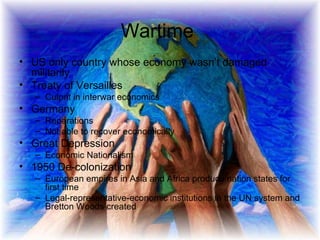
Wartime  US only country whose economy wasn’t damaged militarily Treaty of Versailles Culprit in interwar economics Germany Reparations Not able to recover economically Great Depression Economic Nationalism 1950 De-colonization European empires in Asia and Africa produce nation states for first time  Legal-representative-economic institutions in the UN system and Bretton Woods created
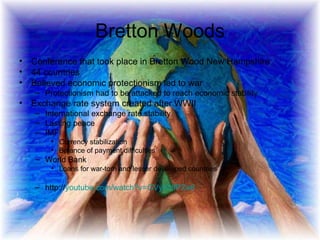
Bretton Woods Conference that took place in Bretton Wood New Hampshire 44 countries Believed economic protectionism led to war Protectionism had to be attacked to reach economic stability Exchange rate system created after WWII International exchange rate stability Lasting peace IMF Currency stabilization Balance of payment difficulties World Bank Loans for war-torn and lesser developed countries http:// youtube.com/watch?v =GVytOtfPZe8
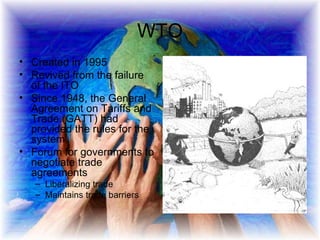
WTO Created in 1995 Revived from the failure of the ITO Since 1948, the General Agreement on Tariffs and Trade (GATT) had provided the rules for the system.  Forum for governments to negotiate trade agreements  Liberalizing trade Maintains trade barriers
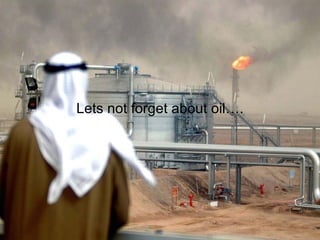
Lets not forget about oil….
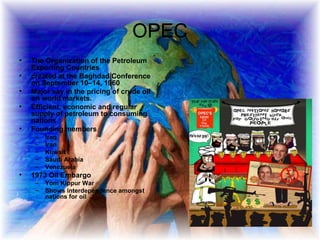
OPEC The Organization of the Petroleum Exporting Countries   created at the Baghdad Conference on September 10–14, 1960   Major say in the pricing of crude oil on world markets.  Efficient, economic and regular supply of petroleum to consuming nations  Founding members Iraq Iran Kuwait Saudi Arabia Venezuela  1973 Oil Embargo Yom Kippur War Shows interdependence amongst nations for oil
New Global History Innovations New Global History lies in some of the following innovations:  Space Program Sense of inhabiting a concrete global entity "Spaceship Earth“ which can be viewed from outside the earth's atmosphere;  Satellites in outer space  Link the peoples of the earth in an unparalleled fashion Nuclear Threats Either weapons or utility plants Demonstrates territorial states cannot adequately protect its citizens from military or ecologically related "invasions"  e.g., Chernobyl  Environmental Problems  Ozone holes & global warming Refuse to conform to lines drawn on a map  Multinational Corporations & Big Business Dominate our economic and cultural lives.

History Of Globalization

  • 1.
  • 2.
    “ The needof a constantly expanding market for its products chases the bourgeoisie over the whole surface of the globe” - Karl Marx
  • 3.
    Globalization Term coinedin 1981 International Economic Integration Stage of late capitalism Political development Nation-state seen as the prime actor losing vital functions Homogenization Cultural changes Some could say globalization started during the birth of the Ottoman Empire
  • 4.
    Segmented Trading Worldof Eurasia Trading empires built by Spain, Ottoman Empire, Portugal, Britain, and Holland Silk Road and Spice Route Expansion of Slave Trade in 1650 Colonialism of Ottoman lands by the French and British Natural Resources brought to Western Europe from Ottoman Lands French and Brits integrating European culture into North Africa http:// Caveman commercial
  • 5.
  • 6.
    1571 Founding ofManila Spanish in the Philippines conquered the Muslim settlement at Manila Transpacific mindsets Exchanges of peoples, information, finances, and prayers parallel the modern phenomenon globalization Establishment of regular transpacific trade marks the creation of steady Asian-American ties Possible regular transpacific trade Forged the missing link in the global trade network Next two centuries this attraction fuelled other globalizing exchanges Parallel to the commercial ties—across the Pacific.
  • 7.
    But I believeit began after WWI…
  • 8.
    Wartime USonly country whose economy wasn’t damaged militarily Treaty of Versailles Culprit in interwar economics Germany Reparations Not able to recover economically Great Depression Economic Nationalism 1950 De-colonization European empires in Asia and Africa produce nation states for first time Legal-representative-economic institutions in the UN system and Bretton Woods created
  • 9.
    Bretton Woods Conferencethat took place in Bretton Wood New Hampshire 44 countries Believed economic protectionism led to war Protectionism had to be attacked to reach economic stability Exchange rate system created after WWII International exchange rate stability Lasting peace IMF Currency stabilization Balance of payment difficulties World Bank Loans for war-torn and lesser developed countries http:// youtube.com/watch?v =GVytOtfPZe8
  • 10.
    WTO Created in1995 Revived from the failure of the ITO Since 1948, the General Agreement on Tariffs and Trade (GATT) had provided the rules for the system. Forum for governments to negotiate trade agreements Liberalizing trade Maintains trade barriers
  • 11.
    Lets not forgetabout oil….
  • 12.
    OPEC The Organizationof the Petroleum Exporting Countries created at the Baghdad Conference on September 10–14, 1960 Major say in the pricing of crude oil on world markets. Efficient, economic and regular supply of petroleum to consuming nations Founding members Iraq Iran Kuwait Saudi Arabia Venezuela 1973 Oil Embargo Yom Kippur War Shows interdependence amongst nations for oil
  • 13.
    New Global HistoryInnovations New Global History lies in some of the following innovations: Space Program Sense of inhabiting a concrete global entity "Spaceship Earth“ which can be viewed from outside the earth's atmosphere; Satellites in outer space Link the peoples of the earth in an unparalleled fashion Nuclear Threats Either weapons or utility plants Demonstrates territorial states cannot adequately protect its citizens from military or ecologically related "invasions" e.g., Chernobyl Environmental Problems Ozone holes & global warming Refuse to conform to lines drawn on a map Multinational Corporations & Big Business Dominate our economic and cultural lives.