



Risha Jamal
Hifza Junaid
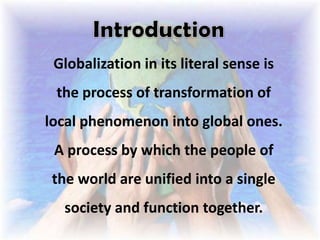
Globalization in its literal sense is

the process of transformation of
local phenomenon into global ones.

A process by which the people of
the world are unified into a single
society and function together.
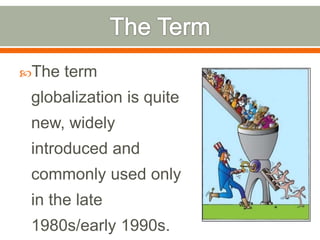
The

term

globalization is quite
new, widely
introduced and
commonly used only

in the late
1980s/early 1990s.
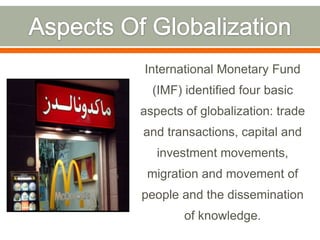
International Monetary Fund

(IMF) identified four basic
aspects of globalization: trade
and transactions, capital and
investment movements,
migration and movement of

people and the dissemination
of knowledge.
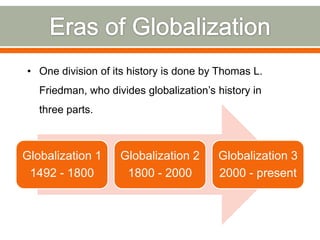
• One division of its history is done by Thomas L.

Friedman, who divides globalization‟s history in
three parts.

Globalization 1
1492 - 1800

Globalization 2
1800 - 2000

Globalization 3
2000 - present


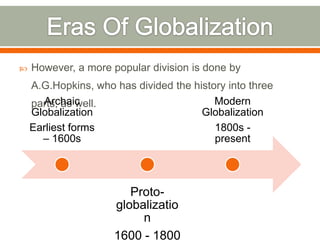
However, a more popular division is done by

A.G.Hopkins, who has divided the history into three
Archaic
Modern
parts, as well.
Globalization
Globalization
Earliest forms
1800s – 1600s
present

Protoglobalizatio
n
1600 - 1800
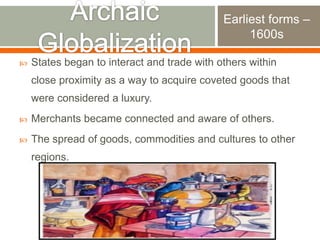
Earliest forms –
1600s


States began to interact and trade with others within

close proximity as a way to acquire coveted goods that
were considered a luxury.


Merchants became connected and aware of others.



The spread of goods, commodities and cultures to other
regions.
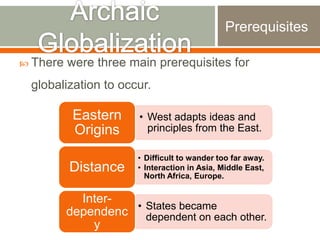
Prerequisites
 There

were three main prerequisites for

globalization to occur.

Eastern
Origins

• West adapts ideas and
principles from the East.

Distance

• Difficult to wander too far away.
• Interaction in Asia, Middle East,
North Africa, Europe.

Inter• States became
dependenc dependent on each other.
y
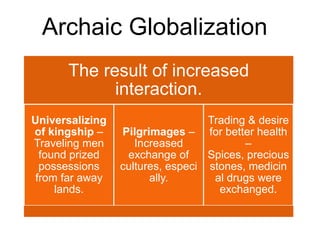
Archaic Globalization
The result of increased
interaction.
Universalizing
of kingship –
Traveling men
found prized
possessions
from far away
lands.

Trading & desire
Pilgrimages – for better health
Increased
–
Spices, precious
exchange of
cultures, especi stones, medicin
ally.
al drugs were
exchanged.
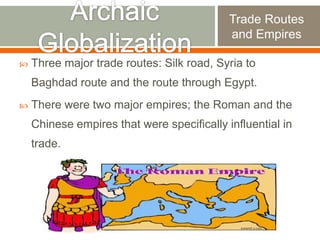
Trade Routes
and Empires


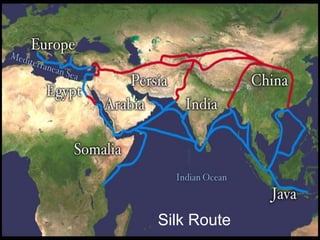
Three major trade routes: Silk road, Syria to

Baghdad route and the route through Egypt.


There were two major empires; the Roman and the
Chinese empires that were specifically influential in

trade.
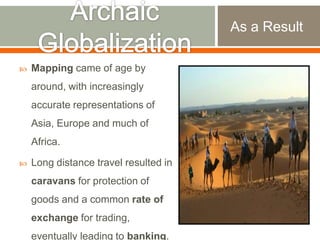
Silk Route
As a Result


Mapping came of age by

around, with increasingly
accurate representations of
Asia, Europe and much of

Africa.


Long distance travel resulted in
caravans for protection of
goods and a common rate of
exchange for trading,
eventually leading to banking.
As a Result


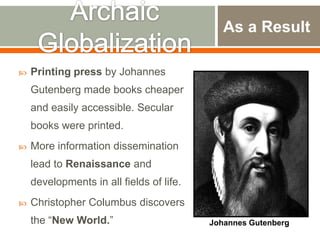
Printing press by Johannes

Gutenberg made books cheaper
and easily accessible. Secular
books were printed.


More information dissemination
lead to Renaissance and
developments in all fields of life.



Christopher Columbus discovers
the “New World.”

Johannes Gutenberg
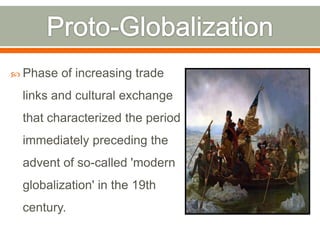
 Phase

of increasing trade

links and cultural exchange
that characterized the period

immediately preceding the
advent of so-called 'modern
globalization' in the 19th
century.


This period is marked by trade arrangements (East India

Company), the shift of domination to Western Europe,
the rise of larger-scale conflicts between powerful
nations and rise of new commodities.
Changes in
Trade and Wars


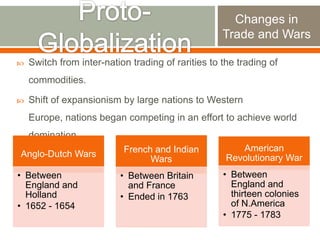
Switch from inter-nation trading of rarities to the trading of
commodities.



Shift of expansionism by large nations to Western
Europe, nations began competing in an effort to achieve world
domination.

Anglo-Dutch Wars

• Between
England and
Holland
• 1652 - 1654

French and Indian
Wars
• Between Britain
and France
• Ended in 1763

American
Revolutionary War
• Between
England and
thirteen colonies
of N.America
• 1775 - 1783
Atlantic Slave
Trade


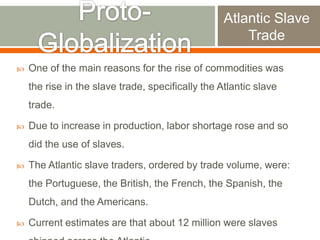
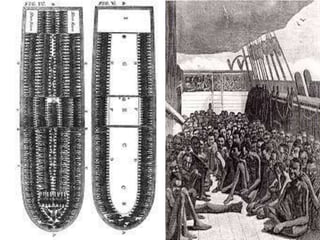
One of the main reasons for the rise of commodities was

the rise in the slave trade, specifically the Atlantic slave
trade.


Due to increase in production, labor shortage rose and so

did the use of slaves.


The Atlantic slave traders, ordered by trade volume, were:
the Portuguese, the British, the French, the Spanish, the
Dutch, and the Americans.



Current estimates are that about 12 million were slaves
As a Result


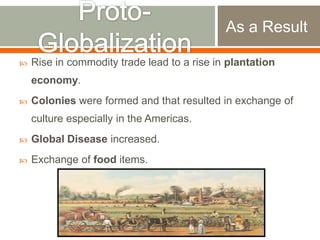
Rise in commodity trade lead to a rise in plantation

economy.


Colonies were formed and that resulted in exchange of
culture especially in the Americas.



Global Disease increased.



Exchange of food items.
As a Result


New technologies were invented as the need arose.



Guns, and particularly the naval cannon, played a
major role.



Increasing the size and versatility of ocean-going
ships was a key gain.



Calculation of direction and speed of wind and ship.



Better and more efficient printing presses.
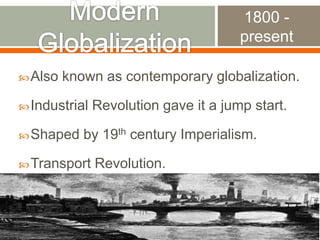
1800 present
 Also

known as contemporary globalization.

 Industrial
 Shaped

Revolution gave it a jump start.

by 19th century Imperialism.

 Transport

Revolution.


After WWII, Bretton Woods Conference took place where
the framework of international monetary policy,
commerce and finance was laid.


This lead to the founding of several international
institutions intended to facilitate economic growth and
lowered trade barriers.



Lead to the formation of GATT and later, WTO.
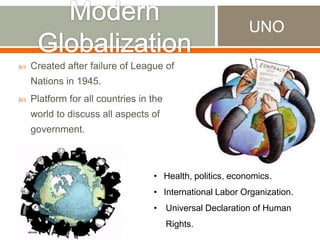
UNO


Created after failure of League of
Nations in 1945.



Platform for all countries in the
world to discuss all aspects of
government.

• Health, politics, economics.

• International Labor Organization.
• Universal Declaration of Human
Rights.
Internet and its
effects


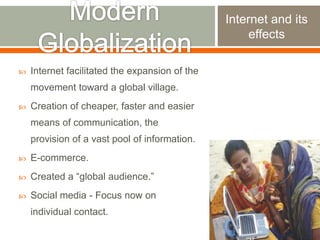
Internet facilitated the expansion of the

movement toward a global village.


Creation of cheaper, faster and easier
means of communication, the

provision of a vast pool of information.


E-commerce.



Created a “global audience.”



Social media - Focus now on
individual contact.
As a Result

 Exports

nearly doubled from 8.5% from total

Gross World Product in 1970 to 16.2% in
2001.
 Aviation

became affordable to middle classes

in developed countries in the „70s.
 1990

– the growth of low – cost

communication networks accelerated the rate
of communication between countries.
As a Result


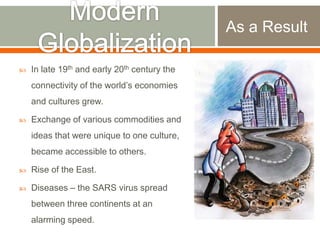
In late 19th and early 20th century the

connectivity of the world‟s economies
and cultures grew.


Exchange of various commodities and
ideas that were unique to one culture,
became accessible to others.



Rise of the East.



Diseases – the SARS virus spread
between three continents at an
alarming speed.
Thank you!!

Globalization in world history

  • 1.
  • 2.
    Globalization in itsliteral sense is the process of transformation of local phenomenon into global ones. A process by which the people of the world are unified into a single society and function together.
  • 3.
    The term globalization is quite new,widely introduced and commonly used only in the late 1980s/early 1990s.
  • 4.
    International Monetary Fund (IMF)identified four basic aspects of globalization: trade and transactions, capital and investment movements, migration and movement of people and the dissemination of knowledge.
  • 5.
    • One divisionof its history is done by Thomas L. Friedman, who divides globalization‟s history in three parts. Globalization 1 1492 - 1800 Globalization 2 1800 - 2000 Globalization 3 2000 - present
  • 6.
     However, a morepopular division is done by A.G.Hopkins, who has divided the history into three Archaic Modern parts, as well. Globalization Globalization Earliest forms 1800s – 1600s present Protoglobalizatio n 1600 - 1800
  • 7.
    Earliest forms – 1600s  Statesbegan to interact and trade with others within close proximity as a way to acquire coveted goods that were considered a luxury.  Merchants became connected and aware of others.  The spread of goods, commodities and cultures to other regions.
  • 8.
    Prerequisites  There were threemain prerequisites for globalization to occur. Eastern Origins • West adapts ideas and principles from the East. Distance • Difficult to wander too far away. • Interaction in Asia, Middle East, North Africa, Europe. Inter• States became dependenc dependent on each other. y
  • 9.
    Archaic Globalization The resultof increased interaction. Universalizing of kingship – Traveling men found prized possessions from far away lands. Trading & desire Pilgrimages – for better health Increased – Spices, precious exchange of cultures, especi stones, medicin ally. al drugs were exchanged.
  • 10.
    Trade Routes and Empires  Threemajor trade routes: Silk road, Syria to Baghdad route and the route through Egypt.  There were two major empires; the Roman and the Chinese empires that were specifically influential in trade.
  • 11.
  • 12.
    As a Result  Mappingcame of age by around, with increasingly accurate representations of Asia, Europe and much of Africa.  Long distance travel resulted in caravans for protection of goods and a common rate of exchange for trading, eventually leading to banking.
  • 13.
    As a Result  Printingpress by Johannes Gutenberg made books cheaper and easily accessible. Secular books were printed.  More information dissemination lead to Renaissance and developments in all fields of life.  Christopher Columbus discovers the “New World.” Johannes Gutenberg
  • 14.
     Phase of increasingtrade links and cultural exchange that characterized the period immediately preceding the advent of so-called 'modern globalization' in the 19th century.
  • 15.
     This period ismarked by trade arrangements (East India Company), the shift of domination to Western Europe, the rise of larger-scale conflicts between powerful nations and rise of new commodities.
  • 16.
    Changes in Trade andWars  Switch from inter-nation trading of rarities to the trading of commodities.  Shift of expansionism by large nations to Western Europe, nations began competing in an effort to achieve world domination. Anglo-Dutch Wars • Between England and Holland • 1652 - 1654 French and Indian Wars • Between Britain and France • Ended in 1763 American Revolutionary War • Between England and thirteen colonies of N.America • 1775 - 1783
  • 17.
    Atlantic Slave Trade  One ofthe main reasons for the rise of commodities was the rise in the slave trade, specifically the Atlantic slave trade.  Due to increase in production, labor shortage rose and so did the use of slaves.  The Atlantic slave traders, ordered by trade volume, were: the Portuguese, the British, the French, the Spanish, the Dutch, and the Americans.  Current estimates are that about 12 million were slaves
  • 19.
    As a Result  Risein commodity trade lead to a rise in plantation economy.  Colonies were formed and that resulted in exchange of culture especially in the Americas.  Global Disease increased.  Exchange of food items.
  • 20.
    As a Result  Newtechnologies were invented as the need arose.  Guns, and particularly the naval cannon, played a major role.  Increasing the size and versatility of ocean-going ships was a key gain.  Calculation of direction and speed of wind and ship.  Better and more efficient printing presses.
  • 21.
    1800 present  Also knownas contemporary globalization.  Industrial  Shaped Revolution gave it a jump start. by 19th century Imperialism.  Transport Revolution.
  • 22.
     After WWII, BrettonWoods Conference took place where the framework of international monetary policy, commerce and finance was laid.  This lead to the founding of several international institutions intended to facilitate economic growth and lowered trade barriers.  Lead to the formation of GATT and later, WTO.
  • 23.
    UNO  Created after failureof League of Nations in 1945.  Platform for all countries in the world to discuss all aspects of government. • Health, politics, economics. • International Labor Organization. • Universal Declaration of Human Rights.
  • 24.
    Internet and its effects  Internetfacilitated the expansion of the movement toward a global village.  Creation of cheaper, faster and easier means of communication, the provision of a vast pool of information.  E-commerce.  Created a “global audience.”  Social media - Focus now on individual contact.
  • 25.
    As a Result Exports nearly doubled from 8.5% from total Gross World Product in 1970 to 16.2% in 2001.  Aviation became affordable to middle classes in developed countries in the „70s.  1990 – the growth of low – cost communication networks accelerated the rate of communication between countries.
  • 26.
    As a Result  Inlate 19th and early 20th century the connectivity of the world‟s economies and cultures grew.  Exchange of various commodities and ideas that were unique to one culture, became accessible to others.  Rise of the East.  Diseases – the SARS virus spread between three continents at an alarming speed.
  • 28.