Globalization in Economy




Definition:

◦ An economic phenomenon?
◦ A social phenomenon?
◦ A cultural phenomenon?

The movement towards the expansion of
economic and social ties between countries
through the spread of corporate institutions
and the capitalist philosophy that leads to
the shrinking
of the world in economic terms.


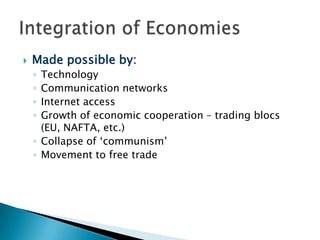
Made possible by:
Technology
Communication networks
Internet access
Growth of economic cooperation – trading blocs
(EU, NAFTA, etc.)
◦ Collapse of ‘communism’
◦ Movement to free trade
◦
◦
◦
◦








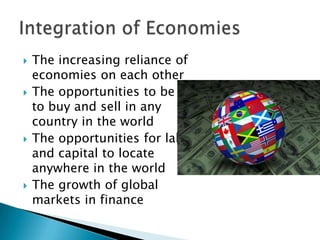
The increasing reliance of
economies on each other
The opportunities to be able
to buy and sell in any
country in the world
The opportunities for labour
and capital to locate
anywhere in the world
The growth of global
markets in finance


Made possible by:
Technology
Communication networks
Internet access
Growth of economic cooperation – trading blocs
(EU, NAFTA, etc.)
◦ Collapse of ‘communism’
◦ Movement to free trade
◦
◦
◦
◦


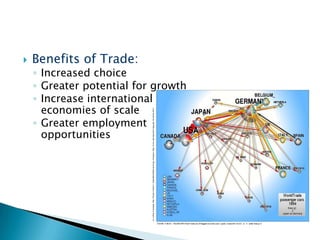
Benefits of Trade:

◦ Increased choice
◦ Greater potential for growth
◦ Increase international
economies of scale
◦ Greater employment
opportunities


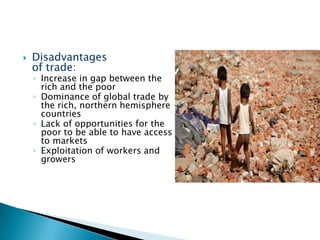
Disadvantages
of trade:

◦ Increase in gap between the
rich and the poor
◦ Dominance of global trade by
the rich, northern hemisphere
countries
◦ Lack of opportunities for the
poor to be able to have access
to markets
◦ Exploitation of workers and
growers
Globalization in economics

Globalization in economics

  • 1.
  • 2.
      Definition: ◦ An economicphenomenon? ◦ A social phenomenon? ◦ A cultural phenomenon? The movement towards the expansion of economic and social ties between countries through the spread of corporate institutions and the capitalist philosophy that leads to the shrinking of the world in economic terms.
  • 3.
     Made possible by: Technology Communicationnetworks Internet access Growth of economic cooperation – trading blocs (EU, NAFTA, etc.) ◦ Collapse of ‘communism’ ◦ Movement to free trade ◦ ◦ ◦ ◦
  • 5.
        The increasing relianceof economies on each other The opportunities to be able to buy and sell in any country in the world The opportunities for labour and capital to locate anywhere in the world The growth of global markets in finance
  • 6.
     Made possible by: Technology Communicationnetworks Internet access Growth of economic cooperation – trading blocs (EU, NAFTA, etc.) ◦ Collapse of ‘communism’ ◦ Movement to free trade ◦ ◦ ◦ ◦
  • 7.
     Benefits of Trade: ◦Increased choice ◦ Greater potential for growth ◦ Increase international economies of scale ◦ Greater employment opportunities
  • 8.
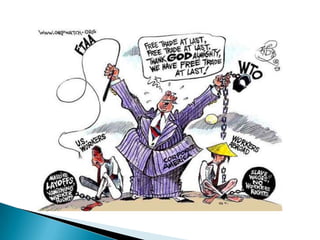
     Disadvantages of trade: ◦ Increasein gap between the rich and the poor ◦ Dominance of global trade by the rich, northern hemisphere countries ◦ Lack of opportunities for the poor to be able to have access to markets ◦ Exploitation of workers and growers