Globalization – whatis it?
What is the definition of globalization?
Benefits and negative effects?
What are the top examples of globalization?
What famous quotes have been said about
globalization?
Module 1 - Globalization
3.
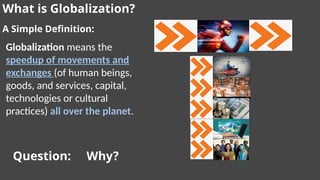
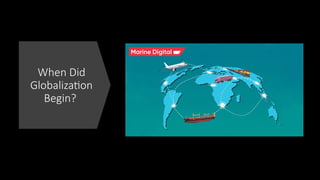
What is Globalization?
ASimple Definition:
Globalization means the
speedup of movements and
exchanges (of human beings,
goods, and services, capital,
technologies or cultural
practices) all over the planet.
Question: Why?
4.
Aren't these thingsmoving/working out fine before?
YES. But they were quite slow
YES. But how slow was things moving before?
6.
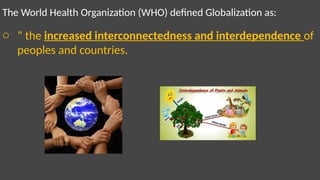
The World HealthOrganization (WHO) defined Globalization as:
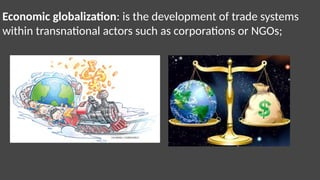
o “ the increased interconnectedness and interdependence of
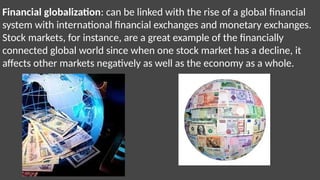
peoples and countries.
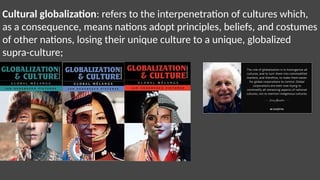
7.
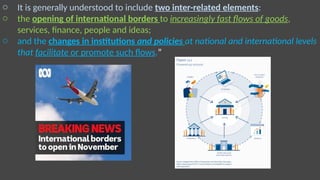
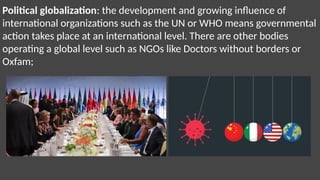
o It isgenerally understood to include two inter-related elements:
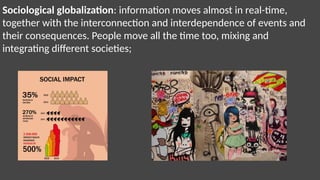
o the opening of international borders to increasingly fast flows of goods,
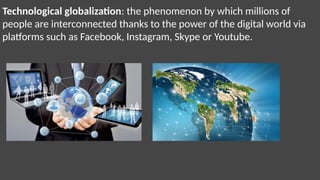
services, finance, people and ideas;
o and the changes in institutions and policies at national and international levels
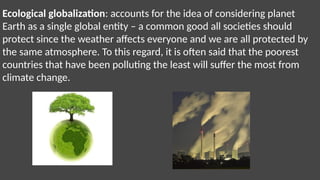
that facilitate or promote such flows.”
8.
What Is Globalizationin the Economy?
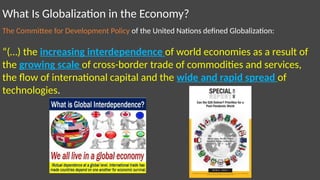
The Committee for Development Policy of the United Nations defined Globalization:
“(…) the increasing interdependence of world economies as a result of
the growing scale of cross-border trade of commodities and services,
the flow of international capital and the wide and rapid spread of
technologies.
9.
It reflects thecontinuing expansion and mutual integration of market
frontiers (…) and the rapid growing significance of information in all types of
productive activities and marketization are the two major driving forces for
economic globalization.”
10.
What Is Globalizationin Geography?
In geography
Globalization
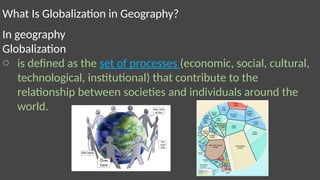
o is defined as the set of processes (economic, social, cultural,
technological, institutional) that contribute to the
relationship between societies and individuals around the
world.
11.
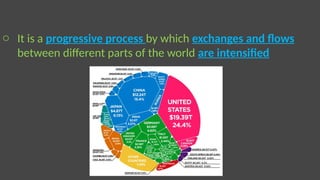
o It isa progressive process by which exchanges and flows
between different parts of the world are intensified
12.
Globalization and theG20: What is the G20?
The G20
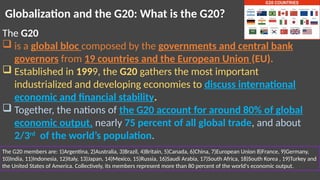
is a global bloc composed by the governments and central bank
governors from 19 countries and the European Union (EU).
Established in 1999, the G20 gathers the most important
industrialized and developing economies to discuss international
economic and financial stability.
Together, the nations of the G20 account for around 80% of global
economic output, nearly 75 percent of all global trade, and about
2/3rd
of the world’s population.
The G20 members are: 1)Argentina, 2)Australia, 3)Brazil, 4)Britain, 5)Canada, 6)China, 7)European Union 8)France, 9)Germany,
10)India, 11)Indonesia, 12)Italy, 13)Japan, 14)Mexico, 15)Russia, 16)Saudi Arabia, 17)South Africa, 18)South Korea , 19)Turkey and
the United States of America. Collectively, its members represent more than 80 percent of the world's economic output.
13.
• G20 leadersget together in an annual summit to discuss and
coordinate pressing global issues of mutual interest.
• Though economics and trade are usually the centerpieces of each
summit’s agenda, issues like climate change, migration policies,
terrorism, the future of work, or global wealth are recurring focuses
too.
• Since the G20 leaders represent the “political backbone of the global
financial architecture that secures open markets, orderly capital
flows, and a safety net for countries in difficulty”, it is often thanks to
bilateral meetings during summits that major international
agreements are achieved and that globalization is able to move
forward.
14.
• The jointaction of G20 leaders has unquestionably been useful to
save the global financial system in the 2008/2009 crisis, thanks to
trade barriers removal and the implementation of huge financial
reforms.
• Nonetheless, the G20 has been struggling to be successful at
coordinating monetary and fiscal policies and unable to root out tax
evasion and corruption, among other downsides of globalization.
• As a result of this and other failures from the G20 in coordinating
globalization, popular, nationalist movements across the world have
been defending countries should pursue their interests alone or form
fruitful coalitions.
15.
How Do WeMake Globalization More Just?
The ability of countries to rise above narrow self-interest has brought
unprecedented economic wealth and plenty of applicable scientific
progress.
However, for different reasons, not everyone has been benefiting the
same from globalization and technological change: wealth is unfairly
distributed and economic growth came at huge environmental costs.
How can countries rise above narrow self-interest and act together or
designing fairer societies and a healthier planet?
How do we make globalization more just?
16.
According to ChristineLagarde, former President of the International
Monetary Fund, “debates about trade and access to foreign goods are as
old as society itself ” and history tells us that closing borders or
protectionism policies are not the way to go, as many countries doing it
have failed.
Lagarde defends we should pursue globalization policies that
extend the benefits of openness and integration while
alleviating their side effects. How to make globalization more
just is a very complex question that involves redesigning
economic systems. But how? That’s the question.
17.
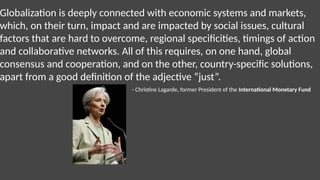
Globalization is deeplyconnected with economic systems and markets,
which, on their turn, impact and are impacted by social issues, cultural
factors that are hard to overcome, regional specificities, timings of action
and collaborative networks. All of this requires, on one hand, global
consensus and cooperation, and on the other, country-specific solutions,
apart from a good definition of the adjective “just”.
- Christine Lagarde, former President of the International Monetary Fund
When Did Globalization
Begin?The History of
Globalization
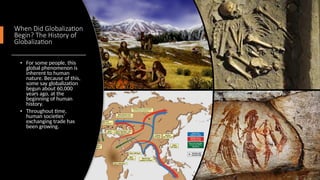
• For some people, this
global phenomenon is
inherent to human
nature. Because of this,
some say globalization
begun about 60,000
years ago, at the
beginning of human
history.
• Throughout time,
human societies’
exchanging trade has
been growing.
21.
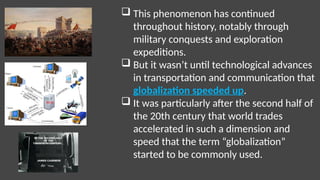
This phenomenonhas continued
throughout history, notably through
military conquests and exploration
expeditions.
But it wasn’t until technological advances
in transportation and communication that
globalization speeded up.
It was particularly after the second half of
the 20th century that world trades
accelerated in such a dimension and
speed that the term “globalization”
started to be commonly used.
22.
Examples of Globalization
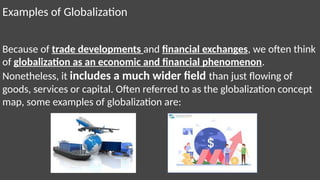
Becauseof trade developments and financial exchanges, we often think
of globalization as an economic and financial phenomenon.
Nonetheless, it includes a much wider field than just flowing of
goods, services or capital. Often referred to as the globalization concept
map, some examples of globalization are:
23.
Economic globalization: isthe development of trade systems
within transnational actors such as corporations or NGOs;
24.
Financial globalization: canbe linked with the rise of a global financial
system with international financial exchanges and monetary exchanges.
Stock markets, for instance, are a great example of the financially
connected global world since when one stock market has a decline, it
affects other markets negatively as well as the economy as a whole.
25.
Cultural globalization: refersto the interpenetration of cultures which,
as a consequence, means nations adopt principles, beliefs, and costumes
of other nations, losing their unique culture to a unique, globalized
supra-culture;
26.
Political globalization: thedevelopment and growing influence of
international organizations such as the UN or WHO means governmental
action takes place at an international level. There are other bodies
operating a global level such as NGOs like Doctors without borders or
Oxfam;
27.
Sociological globalization: informationmoves almost in real-time,
together with the interconnection and interdependence of events and
their consequences. People move all the time too, mixing and
integrating different societies;
28.
Technological globalization: thephenomenon by which millions of
people are interconnected thanks to the power of the digital world via
platforms such as Facebook, Instagram, Skype or Youtube.
29.
Geographic globalization: isthe new organization and hierarchy of
different regions of the world that is constantly changing. Moreover,
with transportation and flying made so easy and affordable, apart from a
few countries with demanding visas, it is possible to travel the world
without barely any restrictions;
30.
Ecological globalization: accountsfor the idea of considering planet
Earth as a single global entity – a common good all societies should
protect since the weather affects everyone and we are all protected by
the same atmosphere. To this regard, it is often said that the poorest
countries that have been polluting the least will suffer the most from
climate change.






![Defining-Globalization [Autosaved].pptx](https://cdn.slidesharecdn.com/ss_thumbnails/defining-globalizationautosaved-230911022910-7acc566e-thumbnail.jpg?width=640&height=640&fit=bounds)


