International Environment
Dr. Ankit Jain
International Environment
• Managing a business in a foreign country requires managers to
deal with a large variety of cultural and environmental
differences.
• As a result, international managers must continually monitor the
political, legal, sociocultural, economic, and technological
environments.
Problems in International Business
• Political and Legal Differences
• Cultural Differences
• Economic Differences
• Differences in the Language
• Trade Restriction
• High Transportation Cost
Need for International Business
• It provides the flow of ideas, services, and capital across the
world.
• It offers consumers new choices.
• It permits the acquisition of a wider variety of products.
• It facilitates the mobility of labor, capital, and technology.
• It provides challenging employment opportunities, reallocates
resources, makes preferential choices, and shifts activities to a
global level
Meaning of Globalisation
• Globalisation is the integration of the world economy and
exchanging the ideas, products, technologies etc.
• The globalisation hit India late but had huge impact on the
nations economic policies and various other aspects.
• The essence of Globalisation is connectivity.
Globalization is grounded in the theory of comparative advantage
which states that countries that are good at producing a particular
goods are better off exporting it to countries that are less efficient
at producing that good.
Aspects of globalisation
• Trade and transactions
• Capital and investment movement
• Migration
• Dissemination of knowledge
Types of Globalisation
• Economic Globalisation
• Political Globalisation
• Social Globalisation
Essential Condition for Globalisation
• Business Freedom (liberalisation in external sector)
• Infrastructural Facilities
• Government Support (policy and procedural reforms)
• Resources (finance, human resource, tech., R&D, brand image)
• Competitiveness ( cost, quality, tech., marketing, after sale
service)
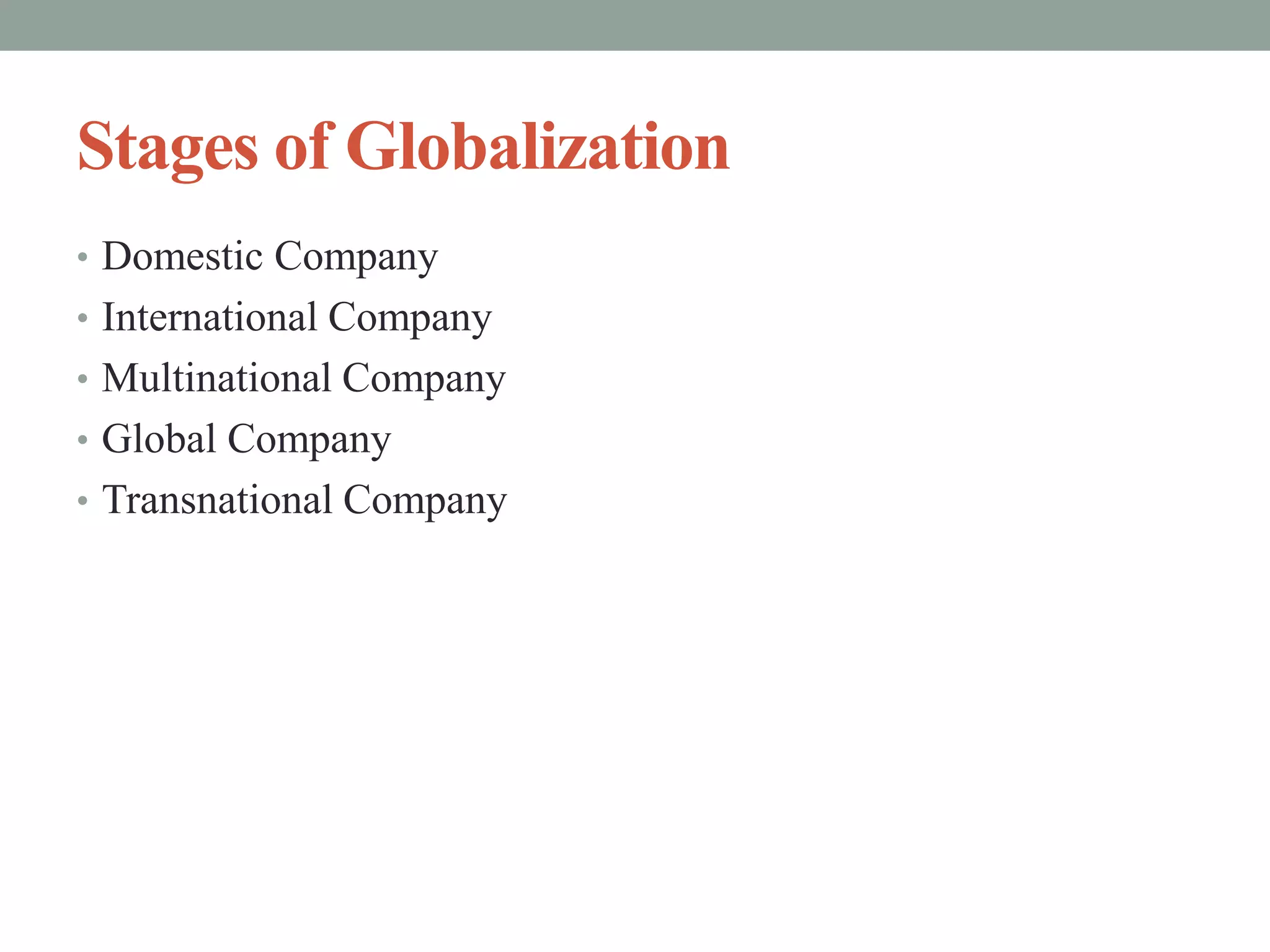
Stages of Globalization
• Domestic Company
• International Company
• Multinational Company
• Global Company
• Transnational Company
Domestic Company
• Domestic company limits its operations, mission and vision to
the national political boundaries.
• These companies focus its view on the domestic market
opportunities, domestic suppliers, domestic financial
companies, domestic customers etc.
• These companies analyze the national environment of the
country, formulate the strategies to exploit the opportunities
offered by the environment.
International Company
Multinational Company
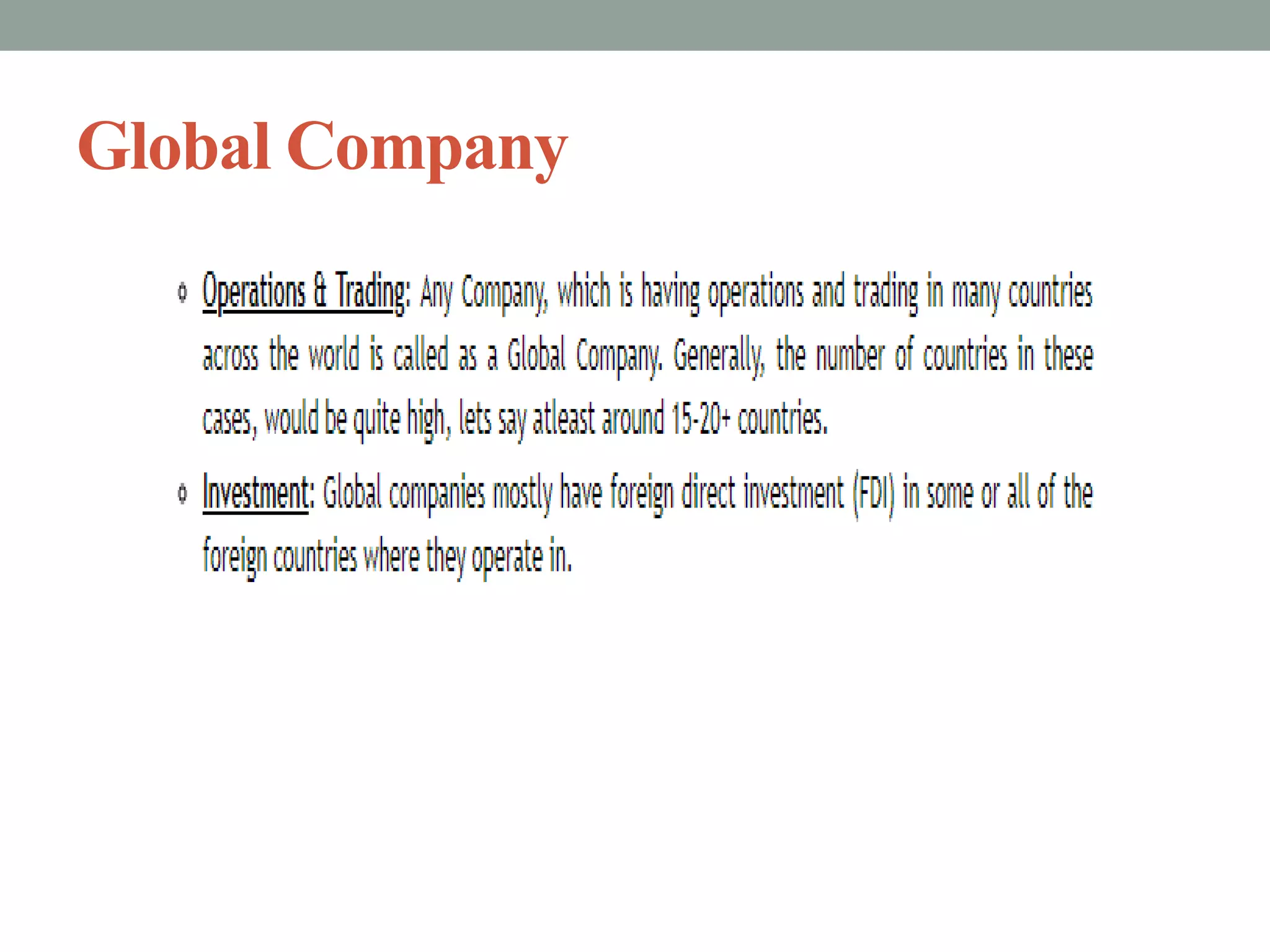
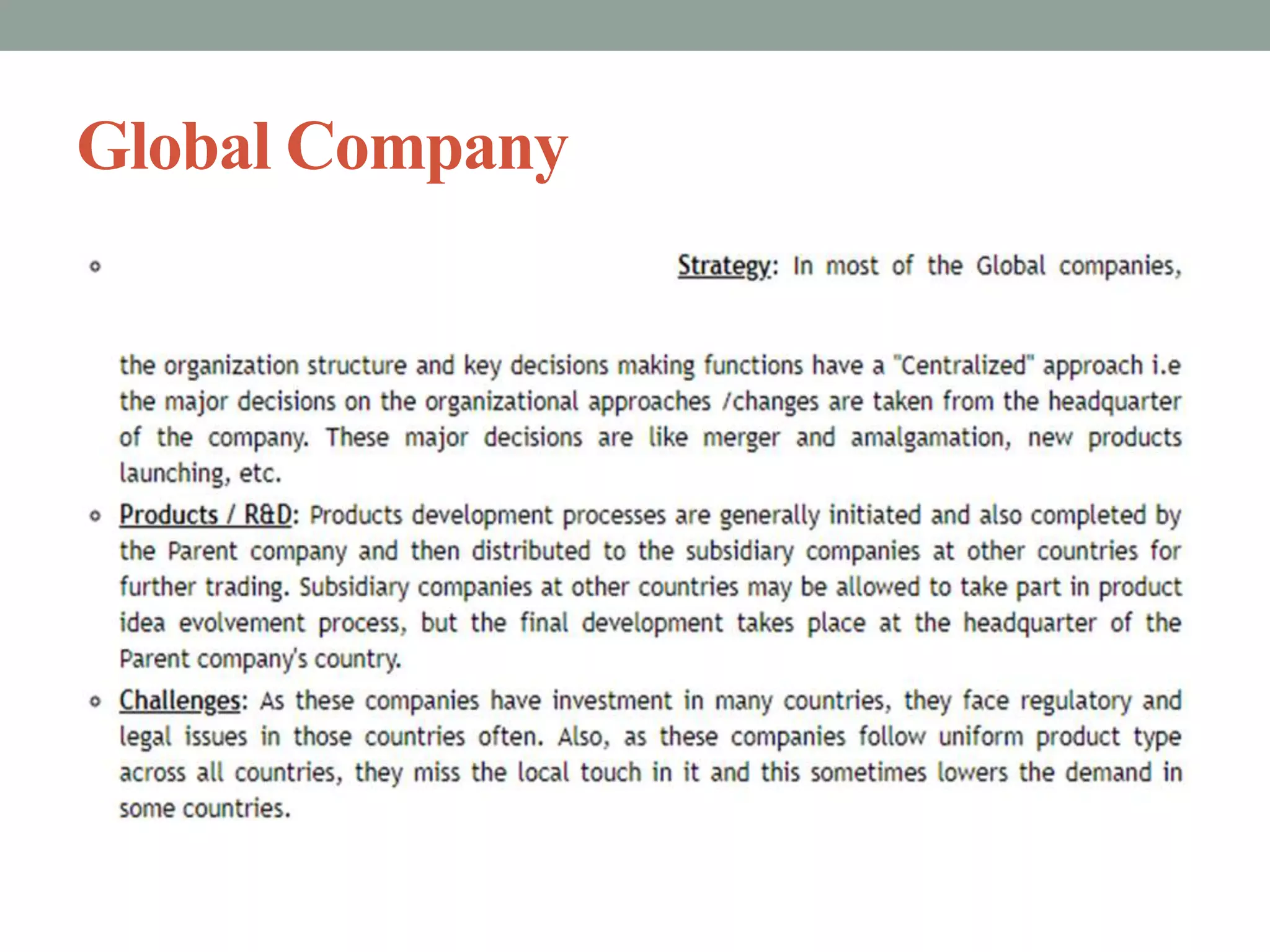
Global Company
Global Company
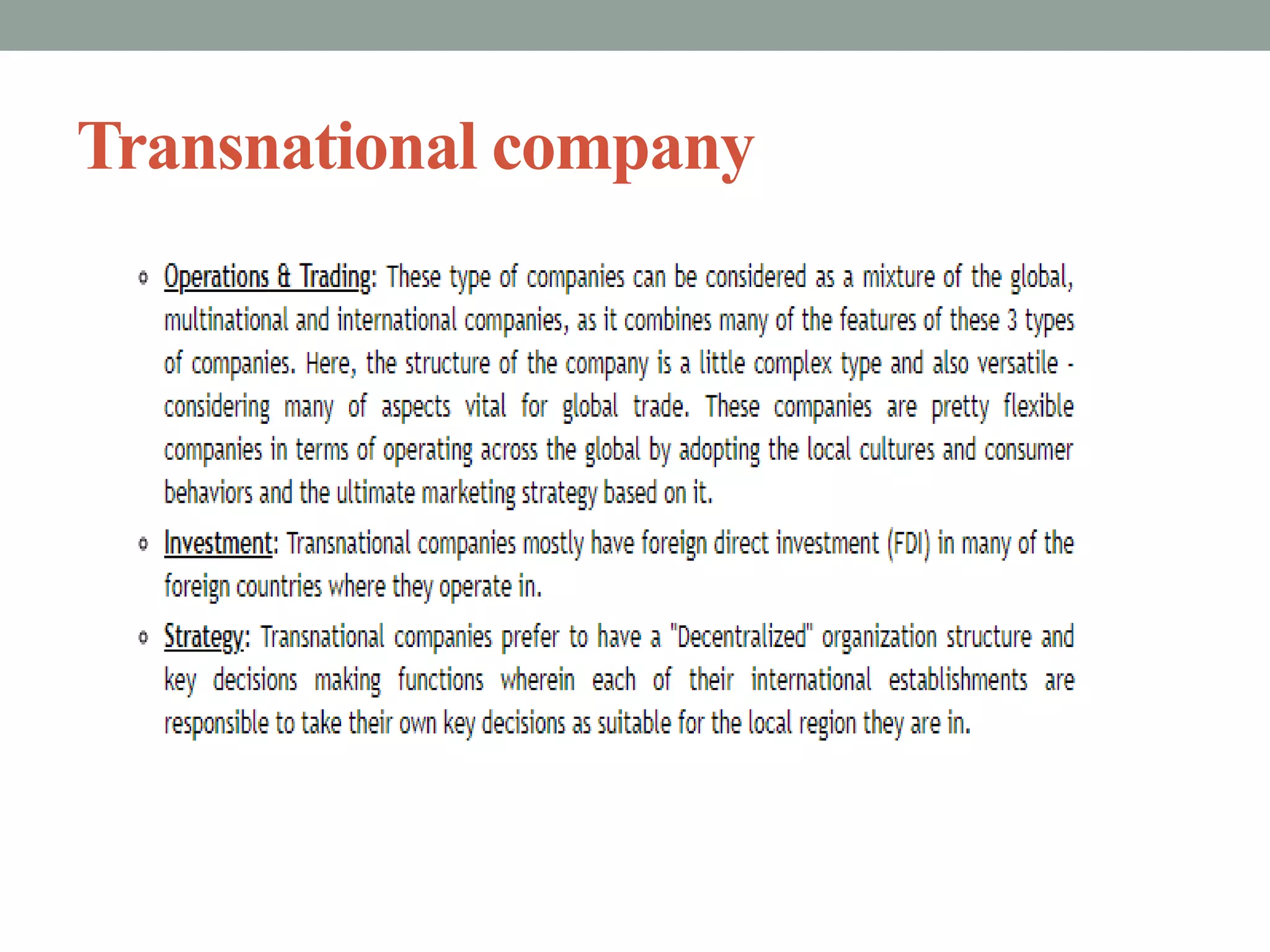
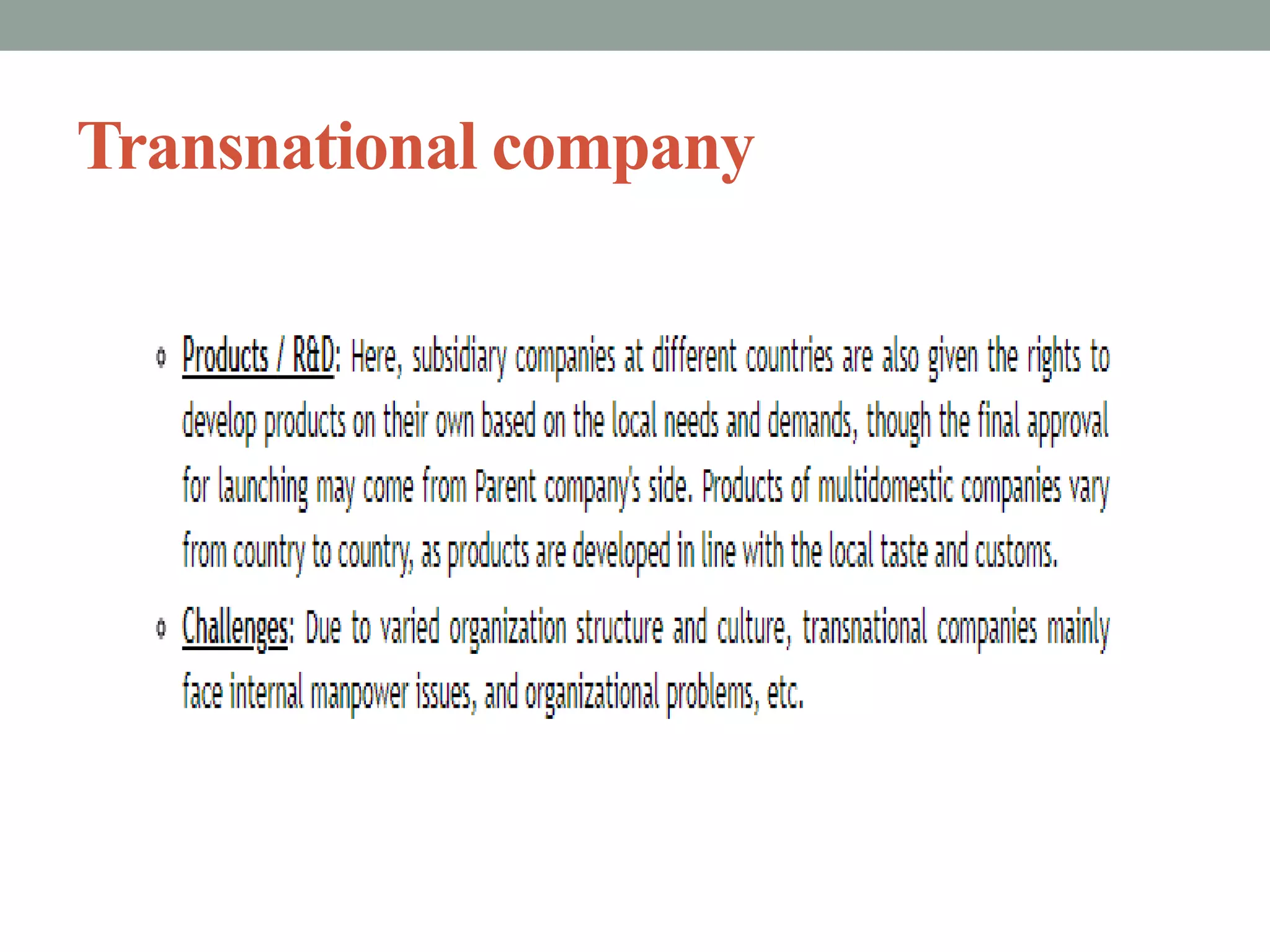
Transnational company
Foreign Market
Entry Methods
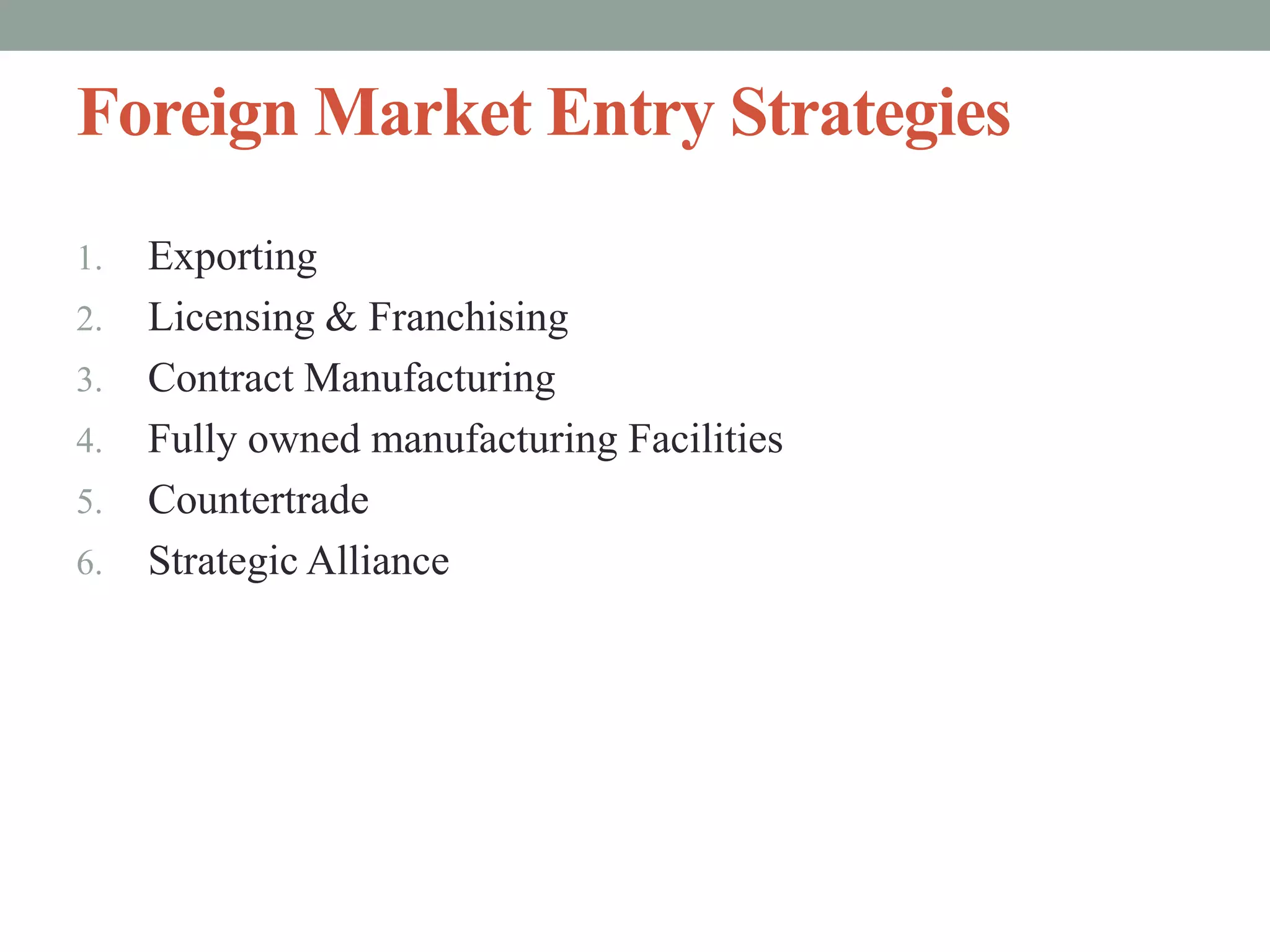
Foreign Market Entry Strategies
1. Exporting
2. Licensing & Franchising
3. Contract Manufacturing
4. Fully owned manufacturing Facilities
5. Countertrade
6. Strategic Alliance
Exporting
• Exporting is the most traditional and well established form of
operating in foreign markets.
• Exporting can be defined as the goods and services produced in
one country and purchased by citizens of another country. If it is
produced domestically and sold to someone from a foreign
country, it is an export.
• No direct manufacturing is required in an overseas country,
significant investments in marketing are required.
Reasons for selecting Export
• The volume of foreign business is not large enough to justify
production in the foreign market.
• Cost of Production in the foreign market is high.
• Foreign market is characterized by infrastructural problem or
availability of raw material.
• The company has no permanent interest in foreign market or that
there is no guarantee of the market available for a long period.
• Foreign Investment not favored by foreign country.
Methods of Exporting
• Direct Exporting
• Indirect Exporting
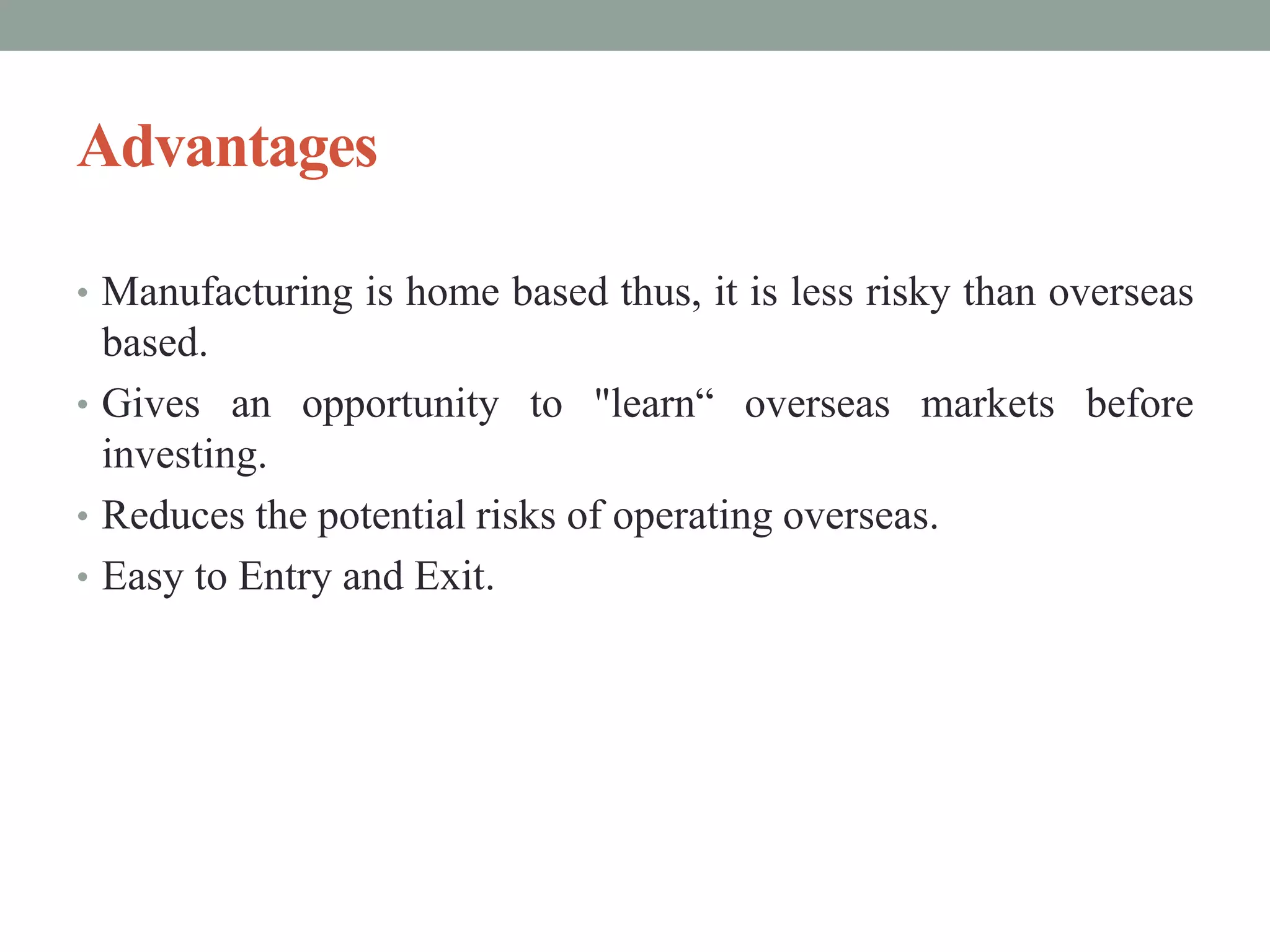
Advantages
• Manufacturing is home based thus, it is less risky than overseas
based.
• Gives an opportunity to "learn“ overseas markets before
investing.
• Reduces the potential risks of operating overseas.
• Easy to Entry and Exit.
Disadvantages
• Logistical difficulties
• Less suitable for service products.
• Not appropriate if other lower cost manufacturing locations
exist.
• High transport costs can make exporting
uneconomical.
Strategic InternationalAlliance
• A strategic international alliance (SIA) is a business relationship
established by two or more companies to cooperate out of
mutual need and to share risk in achieving a common objective.
• SIAs are sought as a way to shore up weaknesses and increase
competitive strengths.
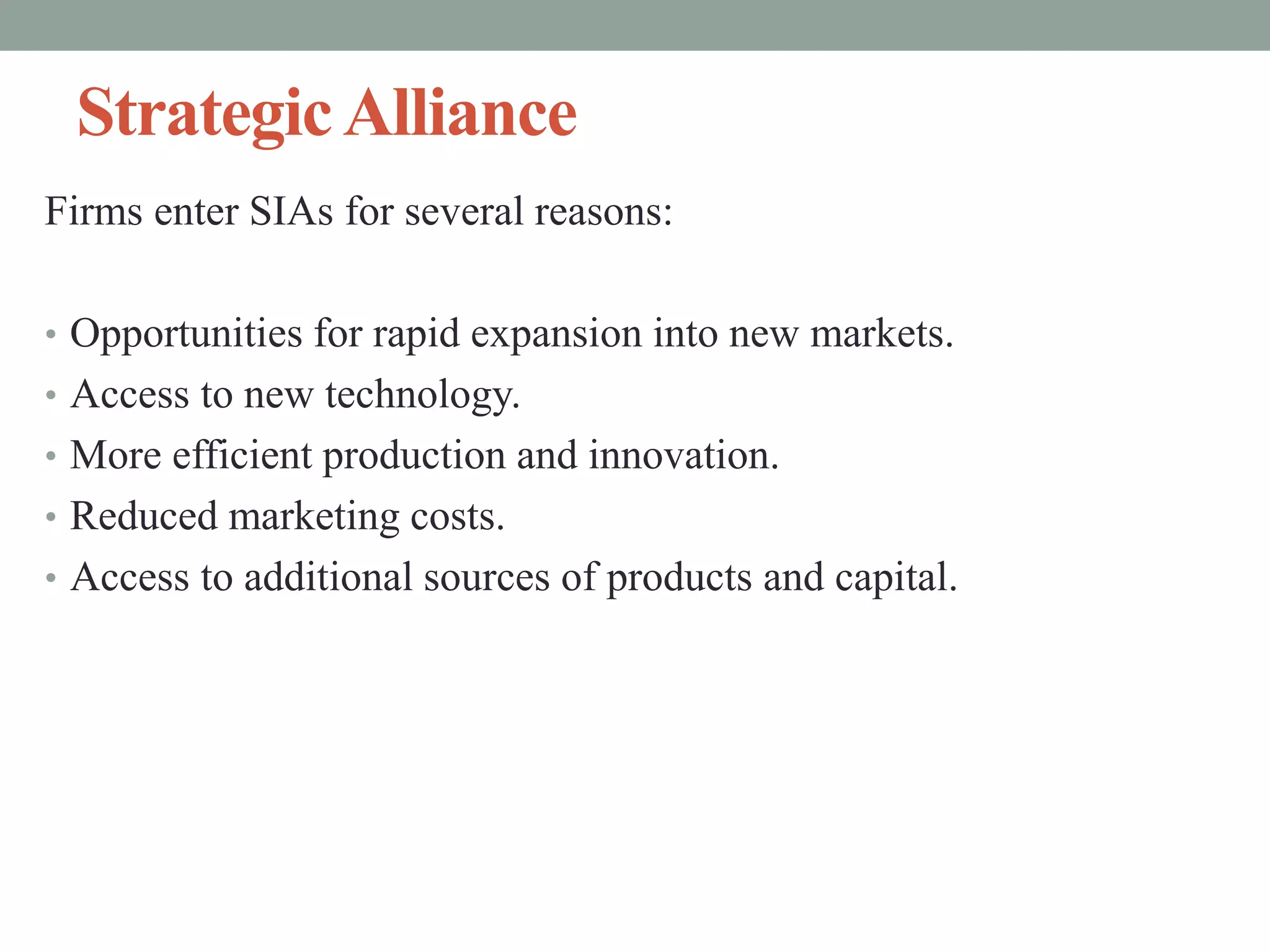
StrategicAlliance
Firms enter SIAs for several reasons:
• Opportunities for rapid expansion into new markets.
• Access to new technology.
• More efficient production and innovation.
• Reduced marketing costs.
• Access to additional sources of products and capital.
StrategicAlliance
Strategic Alliance can be of two types:
a. Joint Venture
b. Merger and Acquisition
Licensing
Licensing is defined as a business arrangement, wherein a
company authorizes another company by issuing a license to
temporarily access its intellectual property rights, i.e.
manufacturing process, brand name, copyright, trademark, patent,
technology, trade secret, etc. for adequate consideration and
under specified conditions.
Franchising
Franchising is an arrangement in which the franchisor
permits franchisee to use business model or brand name for
a fee, to conduct business, as an independent branch of the
parent company (franchisor).
E.g. Mc Donald’s, Domino’s etc.
Contract Manufacturing
• Under this method a company doing international marketing
contracts with firms in foreign countries to manufacture or
assemble the products while retaining the responsibility of
marketing the product.
• Contract manufacturing is a process that establish a working
agreement between two companies.
• As part of the agreement, one company will custom produce
parts or other materials on behalf of their client.
Countertrade
• Counter trade is an import / export relationship between nations
or large companies in which good and/or services are
exchanged for goods and services instead of money.
• In some cases monetary evaluations are made.
• It helps government reduce imbalances in trade between them
and other countries.
• It is often used by developing countries to control trade and as a
development technique.
Wholly Owned Manufacturing Facilities
The firm owns 100% of the stock
The firm can set up a Green-field venture.
Foreign Trade Policy
Foreign Trade
• Any trade execution between two countries is called Foreign
trade or International trade.
• The foreign trade policy and regulation is a very important
determinant of the business environment.
The Foreign Trade (Development and
Regulation)Act, 1992
• This Act which replaced the Imports and Exports (Control) Act,
1947, came into force on 19th June 1992.
• Foreign trade policy for 5 years.
• Presently policy period 2015-20.
• This policy passed by Ministry of Commerce and Industries.
Objective of FTP
• The new foreign trade policy aims to double India’s exports to
$900 billion by 2020.
• To achieve this target, the exports need to grow at about 14%
every year.
• Too boost export government introduced “Make in India”
scheme.
Need of FTP
• Facilitate import and export of goods and services.
• Develop export potential.
• Improve efficiency and competitiveness of Indian Industries.
• Create favorable Balance of Payment.
Ease of doing International Business
• State/Union agencies will not seize/delay export consignment. If
there is any doubt they ask for undertaking.
• If export stock seized then it must release in 7 days.
• Single window 24/7 custom clearance at ports.
• Faster clearance to agro/ perishable product.
• Custom duty self assessment permitted.
• Indian trade portal: Provide information on foreign market tax
regimes, provisions of trade agreement.
• Digital Lockers provided to exporter/importer.
• Facility to pay taxes/ fees online.
Foreign Investment
• Every country requires capital for its economic growth and the
funds cannot be raised alone from its internal sources.
• Foreign Direct Investment (FDI) and Foreign Portfolio
Investment (FPI) are the two ways through which foreign
investors can invest in an economy.
Foreign Direct Investment (FDI)
Foreign direct investment (FDI) is when a foreign company or
individual makes an investment in India that involves either:
(i) Green Field Investment
(ii) Brown Field Investment
Foreign Portfolio Investment
• FPI’s investment is in the stock markets & securities & its approach
is always of short term whereas FDI’s investment is always of long
term.
There are three main institutions that handle the FDI related issues
in India.
(i) Foreign Investment Facilitation Portal( FIFP).
(Foreign Investment Promotion Board)
(ii) Foreign Investment Implementation Authority ( FIIA ).
(iii) Secretariat for Industrial Assistance ( SIA ).
Prohibited Sectors of FDI
• Gambling and Betting
• Lottery business (including government/ private lottery, online
lotteries etc)
• Manufacturing of tobacco, cigars, cigarettes and tobacco or
tobacco substitutes.
• Atomic Energy
• Business of chit fund
• Real estate business or construction of farm houses.
FDI Routes
• Automatic Routes: By this route FDI is allowed without prior
approval by Government or Reserve Bank of India.
• Approved Route: By Foreign Investment Facilitation Portal.
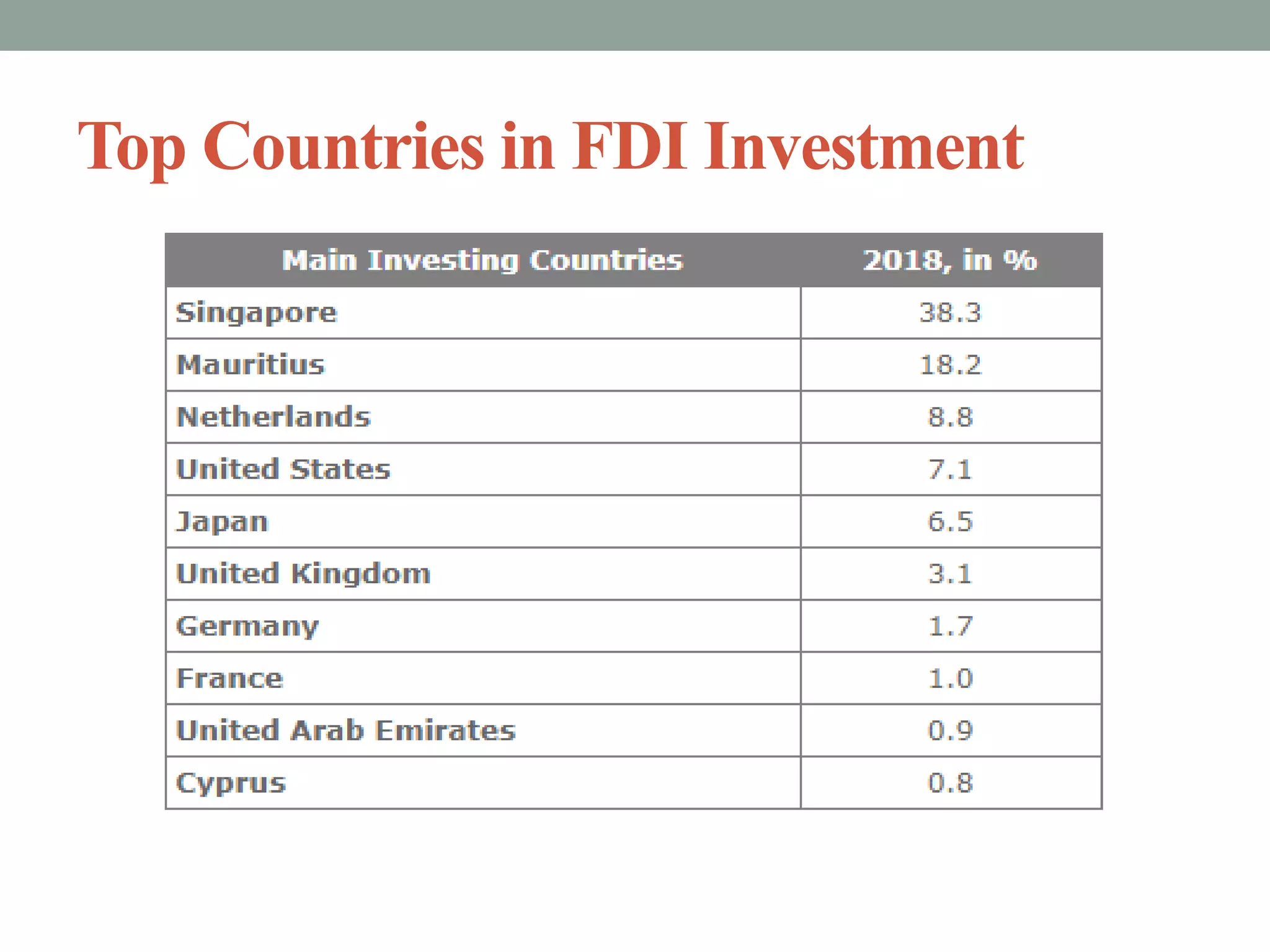
Top Countries in FDI Investment

International environment ppt

  • 1.
  • 2.
    International Environment • Managinga business in a foreign country requires managers to deal with a large variety of cultural and environmental differences. • As a result, international managers must continually monitor the political, legal, sociocultural, economic, and technological environments.
  • 3.
    Problems in InternationalBusiness • Political and Legal Differences • Cultural Differences • Economic Differences • Differences in the Language • Trade Restriction • High Transportation Cost
  • 4.
    Need for InternationalBusiness • It provides the flow of ideas, services, and capital across the world. • It offers consumers new choices. • It permits the acquisition of a wider variety of products. • It facilitates the mobility of labor, capital, and technology. • It provides challenging employment opportunities, reallocates resources, makes preferential choices, and shifts activities to a global level
  • 5.
    Meaning of Globalisation •Globalisation is the integration of the world economy and exchanging the ideas, products, technologies etc. • The globalisation hit India late but had huge impact on the nations economic policies and various other aspects. • The essence of Globalisation is connectivity.
  • 6.
    Globalization is groundedin the theory of comparative advantage which states that countries that are good at producing a particular goods are better off exporting it to countries that are less efficient at producing that good.
  • 7.
    Aspects of globalisation •Trade and transactions • Capital and investment movement • Migration • Dissemination of knowledge
  • 8.
    Types of Globalisation •Economic Globalisation • Political Globalisation • Social Globalisation
  • 9.
    Essential Condition forGlobalisation • Business Freedom (liberalisation in external sector) • Infrastructural Facilities • Government Support (policy and procedural reforms) • Resources (finance, human resource, tech., R&D, brand image) • Competitiveness ( cost, quality, tech., marketing, after sale service)
  • 10.
    Stages of Globalization •Domestic Company • International Company • Multinational Company • Global Company • Transnational Company
  • 11.
    Domestic Company • Domesticcompany limits its operations, mission and vision to the national political boundaries. • These companies focus its view on the domestic market opportunities, domestic suppliers, domestic financial companies, domestic customers etc. • These companies analyze the national environment of the country, formulate the strategies to exploit the opportunities offered by the environment.
  • 12.
  • 13.
  • 14.
  • 15.
  • 16.
  • 17.
  • 18.
  • 19.
  • 20.
    Foreign Market EntryStrategies 1. Exporting 2. Licensing & Franchising 3. Contract Manufacturing 4. Fully owned manufacturing Facilities 5. Countertrade 6. Strategic Alliance
  • 21.
    Exporting • Exporting isthe most traditional and well established form of operating in foreign markets. • Exporting can be defined as the goods and services produced in one country and purchased by citizens of another country. If it is produced domestically and sold to someone from a foreign country, it is an export. • No direct manufacturing is required in an overseas country, significant investments in marketing are required.
  • 22.
    Reasons for selectingExport • The volume of foreign business is not large enough to justify production in the foreign market. • Cost of Production in the foreign market is high. • Foreign market is characterized by infrastructural problem or availability of raw material. • The company has no permanent interest in foreign market or that there is no guarantee of the market available for a long period. • Foreign Investment not favored by foreign country.
  • 23.
    Methods of Exporting •Direct Exporting • Indirect Exporting
  • 24.
    Advantages • Manufacturing ishome based thus, it is less risky than overseas based. • Gives an opportunity to "learn“ overseas markets before investing. • Reduces the potential risks of operating overseas. • Easy to Entry and Exit.
  • 25.
    Disadvantages • Logistical difficulties •Less suitable for service products. • Not appropriate if other lower cost manufacturing locations exist. • High transport costs can make exporting uneconomical.
  • 26.
    Strategic InternationalAlliance • Astrategic international alliance (SIA) is a business relationship established by two or more companies to cooperate out of mutual need and to share risk in achieving a common objective. • SIAs are sought as a way to shore up weaknesses and increase competitive strengths.
  • 27.
    StrategicAlliance Firms enter SIAsfor several reasons: • Opportunities for rapid expansion into new markets. • Access to new technology. • More efficient production and innovation. • Reduced marketing costs. • Access to additional sources of products and capital.
  • 28.
    StrategicAlliance Strategic Alliance canbe of two types: a. Joint Venture b. Merger and Acquisition
  • 29.
    Licensing Licensing is definedas a business arrangement, wherein a company authorizes another company by issuing a license to temporarily access its intellectual property rights, i.e. manufacturing process, brand name, copyright, trademark, patent, technology, trade secret, etc. for adequate consideration and under specified conditions.
  • 30.
    Franchising Franchising is anarrangement in which the franchisor permits franchisee to use business model or brand name for a fee, to conduct business, as an independent branch of the parent company (franchisor). E.g. Mc Donald’s, Domino’s etc.
  • 31.
    Contract Manufacturing • Underthis method a company doing international marketing contracts with firms in foreign countries to manufacture or assemble the products while retaining the responsibility of marketing the product. • Contract manufacturing is a process that establish a working agreement between two companies. • As part of the agreement, one company will custom produce parts or other materials on behalf of their client.
  • 32.
    Countertrade • Counter tradeis an import / export relationship between nations or large companies in which good and/or services are exchanged for goods and services instead of money. • In some cases monetary evaluations are made. • It helps government reduce imbalances in trade between them and other countries. • It is often used by developing countries to control trade and as a development technique.
  • 33.
    Wholly Owned ManufacturingFacilities The firm owns 100% of the stock The firm can set up a Green-field venture.
  • 34.
  • 35.
    Foreign Trade • Anytrade execution between two countries is called Foreign trade or International trade. • The foreign trade policy and regulation is a very important determinant of the business environment.
  • 36.
    The Foreign Trade(Development and Regulation)Act, 1992 • This Act which replaced the Imports and Exports (Control) Act, 1947, came into force on 19th June 1992. • Foreign trade policy for 5 years. • Presently policy period 2015-20. • This policy passed by Ministry of Commerce and Industries.
  • 37.
    Objective of FTP •The new foreign trade policy aims to double India’s exports to $900 billion by 2020. • To achieve this target, the exports need to grow at about 14% every year. • Too boost export government introduced “Make in India” scheme.
  • 38.
    Need of FTP •Facilitate import and export of goods and services. • Develop export potential. • Improve efficiency and competitiveness of Indian Industries. • Create favorable Balance of Payment.
  • 39.
    Ease of doingInternational Business • State/Union agencies will not seize/delay export consignment. If there is any doubt they ask for undertaking. • If export stock seized then it must release in 7 days. • Single window 24/7 custom clearance at ports. • Faster clearance to agro/ perishable product. • Custom duty self assessment permitted.
  • 40.
    • Indian tradeportal: Provide information on foreign market tax regimes, provisions of trade agreement. • Digital Lockers provided to exporter/importer. • Facility to pay taxes/ fees online.
  • 41.
  • 42.
    • Every countryrequires capital for its economic growth and the funds cannot be raised alone from its internal sources. • Foreign Direct Investment (FDI) and Foreign Portfolio Investment (FPI) are the two ways through which foreign investors can invest in an economy.
  • 43.
    Foreign Direct Investment(FDI) Foreign direct investment (FDI) is when a foreign company or individual makes an investment in India that involves either: (i) Green Field Investment (ii) Brown Field Investment
  • 44.
    Foreign Portfolio Investment •FPI’s investment is in the stock markets & securities & its approach is always of short term whereas FDI’s investment is always of long term.
  • 46.
    There are threemain institutions that handle the FDI related issues in India. (i) Foreign Investment Facilitation Portal( FIFP). (Foreign Investment Promotion Board) (ii) Foreign Investment Implementation Authority ( FIIA ). (iii) Secretariat for Industrial Assistance ( SIA ).
  • 47.
    Prohibited Sectors ofFDI • Gambling and Betting • Lottery business (including government/ private lottery, online lotteries etc) • Manufacturing of tobacco, cigars, cigarettes and tobacco or tobacco substitutes. • Atomic Energy • Business of chit fund • Real estate business or construction of farm houses.
  • 48.
    FDI Routes • AutomaticRoutes: By this route FDI is allowed without prior approval by Government or Reserve Bank of India. • Approved Route: By Foreign Investment Facilitation Portal.
  • 49.
    Top Countries inFDI Investment