1 
PROJECT REPORT 
ON 
GLOBALIZATION IN INDIA 
Submitted To: Submitted By: 
Dr. Ashok Kumar Panigrahi JINAL KAMANI(A042) 
Associate Professor in Finance 
SPTM , Shirpur campus.
2 
Certificate 
This is to certify that the report on GLOBALISATION in India from the course 
macroeconomics concept and application presented by roll number represents their original 
work which was carried out by them at NMIMS Shirpur, under guidance and supervision of 
Name of guide: Dr Ashok Kumar Panigrahi 
Date 4th August, 2014.
3 
Acknowledgement 
We would like to thank our guide, Dr Ashok Kumar Panigrahi and Dr. (Prof) S.S.Deshpande 
(U.G chairperson, senior professor, NMIMS Shirpur campus) for their guidance and support 
in the duration of MBA (Pharmaceutical technology) and all other people who have helped us 
in the report
4 
Table of contents 
Sr 
No. 
Title Page 
no. 
1. ABSTRACT 4 
2. INTRODUCTION 5 
3. STRATEGIES INITIATED 7 
4. PROCESS OF GLOBALISATION 8 
5. DIFFERENCE BETWEEN 
LIBERALISATION AND 
GLOBALIZATION 
10 
6. METHODOLOGY 11 
7. NEGATIVE EFFECTS OF 
GLOBALISATION 
23 
8. FUTURE ASPECTS 24 
9. IMPACT OF GLOBALISATION 25 
10. CONCLUSION 26 
11. REFERENCES 27
5 
Abstract 
Globalisation is the new buzzword that has come to dominate the world since the nineties of 
the last century with the end of the cold war and the break-up of the former Soviet Union and 
the global trend towards the rolling ball. The frontiers of the state with increased reliance on 
the market economy and renewed faith in the private capital and resources, a process of 
structural adjustment spurred by the studies and influences of the World Bank and other 
International organisations have started in many of the developing countries. Also 
Globalisation has brought in new opportunities to developing countries. Greater access to 
developed country markets and technology transfer hold out promise improved productivity 
and higher living standard. But globalisation has also thrown up new challenges like growing 
inequality across and within nations, volatility in financial market and environmental 
deteriorations. Another negative aspect of globalisation is that a great majority of developing 
countries remain removed from the process. Till the nineties the process of globalisation of 
the Indian economy was constrained by the barriers to trade and investment liberalisation of 
trade, investment and financial flows initiated in the nineties has progressively lowered the 
barriers to competition and hastened the pace of globalisation. This paper presents the 
performance of the Indian economy with globalisation as its key drive. Various sectors of the 
Indian economy are considered for the study. 
Key words: Globalisation, growth trends, GDP, growth rate of various sectors of the 
economy, benefits and pitfalls, future of Indian economy
6 
Introduction 
Indian economy had experienced major policy changes in early 1990s. The new economic 
reform, popularly known as, Liberalization, Privatization and Globalization (LPG model) 
aimed at making the Indian economy as fastest growing economy and globally competitive. 
The series of reforms undertaken with respect to industrial sector, trade as well as financial 
sector aimed at making the economy more efficient. With the onset of reforms to liberalize 
the Indian economy in July of 1991, a new chapter has dawned for India and her billion plus 
population. This period of economic transition has had a tremendous impact on the overall 
economic development of almost all major sectors of the economy, and its effects over the 
last decade can hardly be overlooked. Besides, it also marks the advent of the real integration 
of the Indian economy into the global economy. This era of reforms has also ushered in a 
remarkable change in the Indian mindset, as it deviates from the traditional values held since 
Independence in 1947, such as self reliance and socialistic policies of economic development, 
which mainly due to the inward looking restrictive form of governance, resulted in the 
isolation, overall backwardness and inefficiency of the economy, amongst a host of other 
problems. Now that India is in the process of restructuring her economy, with aspirations of 
elevating herself from her present desolate position in the world, the need to speed up her 
economic development is even more imperative. And having witnessed the positive role that 
Foreign Direct Investment (FDI) has played in the rapid economic growth of most of the 
Southeast Asian countries and most notably China, India has embarked on an ambitious plan 
to emulate the successes of her neighbours to the east and is trying to sell herself as a safe and 
profitable destination for FDI. Globalization has many meanings depending on the context 
and on the person who is talking about. Though the precise definition of globalization is still 
unavailable a few definitions are worth viewing, Guy Brainpan: says that the process of 
globalization not only includes opening up of world trade, development of advanced means 
of communication, internationalization of financial markets, growing importance of MNCs, 
population migrations and more generally increased mobility of persons, goods, capital, data 
and ideas but also infections, diseases and pollution. The term globalization refers to the 
integration of economies of the world through uninhibited trade and financial flows, as also 
through mutual exchange of technology and knowledge. Ideally, it also contains free inter-country 
movement of labour. In context to India, this implies opening up the economy to 
foreign direct investment by providing facilities to foreign companies to invest in different 
fields of economic activity in India, removing constraints and obstacles to the entry of MNCs 
in India, allowing Indian companies to enter into foreign collaborations and also encouraging 
them to set up joint ventures abroad; carrying out massive import liberalization programs by 
switching over from quantitative restrictions to tariffs and import duties, therefore 
globalization has been identified with the policy reforms of 1991 in India.
7 
Strategies Initiated 
Major measures initiated as a part of the liberalization and globalization strategy in the early 
nineties included the following: 
 Disinvestment 
 Devaluation 
 Dismantling of The Industrial Licensing Regime 
 Allowing Foreign Direct Investment 
 Non Resident Indian Scheme 
 Throwing Open Industries Reserved For The Public Sector to Private Participation 
 Abolition of the (MRTP) Act 
 The removal of quantitative restrictions on imports. 
 The reduction of the peak customs tariff 
Importance of the Study 
Globalisation has brought in new opportunities to developing countries. Greater access to 
developed country markets and technology transfer hold out promise improved productivity 
and higher living standard. India’s economic growth has been substantially high and India 
has become progress vibrant and nationally competitive. This urged to study the performance 
of India in this fiscal year due to the initialisation of globalisation 
Objective of the Study 
 To understand the meaning of globalization. 
 To analyse the Economic performance and growth of India due to globalization in the 
current pace. 
 To analyse the pleasant and unpleasant side of globalization. 
 To analyse the pitfalls of globalization. 
 To estimate the future of the Indian economy.
8 
PROCESS OF GLOBALISATION IN INDIA 
Since the early 1970s, there have been several research papers on varied issues of 
globalization with reference to India. However, one of the basic issues is still not researched 
sufficiently. The key concern of this paper is to explain the meaning of Globalization in terms 
of the genesis, the evolution, and the characteristics of globalization with respect to India. 
In other words, the paper focuses on what globalization has meant for India during the last 
about 60 years. Overlooking such a fundamental issue in the past studies has lead to 
confusion on the subject has lead to misplaced views on the meaning, problems and prospects 
of globalization with respect to India. 
First, it is believed that India put restrictions on Foreign Direct Investments (FDI) that 
restricted the flow of FDI to India since India became free from colonial rule in 1947. The 
policies of the GOI and the amount of FDI in India since 1948 to 1961 reveal a different 
story. India has also been a founder member of General Agreement of Tariff and Trade 
(GATT), a body for frees global trade and investment, way back in 1948. 
Second, globalization with respect to India has been seen mostly in terms of how freely the 
GOI has allowed the foreign business entities to operate in India and how much of foreign 
direct investments have entered India. However, seeing globalization on these lines is only 
seeing globalization as a one-way process. 
Third, globalization process in India is generally perceived as a phenomenon of post 1991. 
The trends in the changes in the policies of the GOI again reveal a different reality. Further 
contrary to the reality, the amount FDI in India in the post 1991 period is presumed to be 
mainly from the American companies. 
To clarify the concept of globalization and place it in the proper perspective, our researchers 
has undertaken a historical analysis of the various processes involved in the evolution of 
globalization since 1947 with respect to India. For our analysis, we took seven key 
parameters, via. trade and investment policies of the GOI during 1947-2004, responses of 
foreign companies to the trade and investment policies of GOI responses of foreign 
governments in terms of the structure and motivation of their overseas development 
assistance GATT/WTO policies on trade and investment, trends in foreign direct investments, 
exports including outsourcing from India, an outward foreign direct investments from India. 
The overall analysis of the seven variables of globalisation process discovers the meaning 
globalization with reference to India. 
India tried to integrate with the world economy as soon as it became a sovereign state but 
with its own terms and conditions. However, over these years, India has slowly been 
pressured by the several external forces like the foreign governments, foreign corporations 
and international agencies to integrate on their terms. The roots of the present globalization 
process in India lie way back in thel980s. India started to liberalize trade in 1977-78. This 
open policy increased the number of items in the Open General License (OGL).
9 
Globalization has been only a one-way process that is foreign enterprises has found a 
Favourable way to do business in India since Independence. Foreign companies have 
invested in India only when the policies of the GOI have favoured either the market seeking 
or the efficiency seeking objectives of the foreign firms. The foreign firms have either left 
India or critiqued India otherwise. From the historical observations, it is imperative that the 
GOI, the foreign companies and the governments of other nations have to recognize and respect 
the need for both Globalization of India and globalization in India in order to ensure that the 
globalization process takes off in a balanced and sustained manner. 
Hence, while undertaking policies on liberalization of Indian economy, the GOI has to take care that 
liberalization does not lead to globalization of India alone as it has been presumed in the past 15 
years. The policies of the GOI should be able to direct foreign direct investment into manufacturing 
sector and high technology areas through which the Indian economy can effectively be part of the 
globalization process worldwide. With similar framework of our study, further research may be 
conducted on other developing countries in Asia to enhance our understanding of globalization 
process in other countries of Asia
10 
Difference between Liberalization and Globalization 
Globalization as many of you have heard is the greater integration among countries and 
economies for trade, economic, social, and political benefits. Globalization in trade is also 
called 'one global market place' where a consumer does not have to restrict their purchases to 
one country/economy and can enjoy the benefits of the goods and services produced 
worldwide. For example, Macy is a popular department store in the United States, but does 
not have outlets in many Asian countries. Many years ago before globalization, an Asian 
consumer would not be able to purchase Macy's products, however, nowadays due to 
globalization, any customer, in any part of the world, can purchase Macy's products and have 
them delivered to their doorstep by making transactions online. Liberalization, though 
similar to globalization, is more focused on the local economy Liberalization generally refers 
to the removal of restrictions; usually government rules and Regulations imposed on social, 
economic, or political matters. Liberalization maybe trade, social, economic, or capital 
market related. Social liberalization, For example, maybe related to things like making 
abortion related laws less stringent. Trade liberalization maybe with regard to reducing 
restrictions on imports or exports and facilitating free trade Difference between them: 
Globalization and liberalization are concepts that are closely related to one another. A 
country usually experiences liberalization of its economic and other policies, which is later on 
followed by globalization. There are, however, many differences between the two. 
Liberalization generally relates to activity within a certain country as a result of 
modernization and development. Globalization relates to activities among countries and 
results in interdependence and interaction among countries and facilitates the movement of 
goods and services, capital, individuals, knowledge, technology.
11 
Methodology 
Secondary data is collected for the study. The data is collected from various journals and 
internet links in order to 
 Compare and analyse the growth statistics of various sectors of the economy. 
 Tabulating and estimating the GDP of the Indian economy. 
 To estimate the contributions made by the different sectors on India’s growth. 
 To analyse India’s current position among the world countries in terms of GDP 
 To determine the contributions made by India to the world economy. 
Growth of GDP 
Chart showing the growth in GDP 
12 
10 
8 
6 
4 
2 
0 
1 2 3 4 5 6 7 8 9 10 11 12 
GDP 
year 
india 
COUNTRY 2000 2001 2002 2003 2004 2005 2006 2007 2008 2009 2010 2011 
INDIA 5.5 6 4.3 4.3 8.3 6.2 8.4 9.2 9 7.4 7.4 10.4 
The economic scenario in India has been pretty stable over the last 5 years. Despite the 
economic downturn two years back the Indian economy has managed to remain stable. The 
India GDP recorded for the period December 2010 stood at 7.4 percent. However according 
to the (CMIE) or Centre for Monitoring Indian Economy India will record a GDP of 10.4 per
12 
cent in the year 2011. India's GDP growth 2010 - 2011 has not been phenomenal but is 
certainly encouraging. 
Growth of Foreign Exchange Reserves 
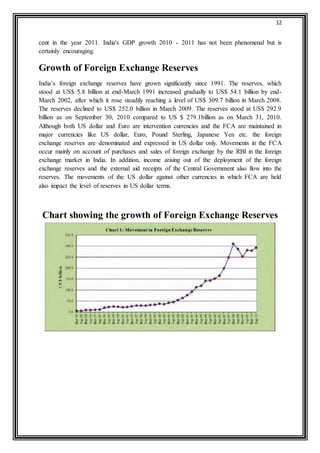
India’s foreign exchange reserves have grown significantly since 1991. The reserves, which 
stood at US$ 5.8 billion at end-March 1991 increased gradually to US$ 54.1 billion by end- 
March 2002, after which it rose steadily reaching a level of US$ 309.7 billion in March 2008. 
The reserves declined to US$ 252.0 billion in March 2009. The reserves stood at US$ 292.9 
billion as on September 30, 2010 compared to US $ 279.1billion as on March 31, 2010. 
Although both US dollar and Euro are intervention currencies and the FCA are maintained in 
major currencies like US dollar, Euro, Pound Sterling, Japanese Yen etc. the foreign 
exchange reserves are denominated and expressed in US dollar only. Movements in the FCA 
occur mainly on account of purchases and sales of foreign exchange by the RBI in the foreign 
exchange market in India. In addition, income arising out of the deployment of the foreign 
exchange reserves and the external aid receipts of the Central Government also flow into the 
reserves. The movements of the US dollar against other currencies in which FCA are held 
also impact the level of reserves in US dollar terms. 
Chart showing the growth of Foreign Exchange Reserves
13 
Growth of FDI 
Chart showing the source of FDI into India between April 
2000 and March 2011 
FDI 
MAURITIUS 
SINGAPORE 
USA 
UK 
NETHERLAND 
JAPAN 
CYPRUS 
GERANY 
During April-February 2010-11, Mauritius has led investors into India with US$ 6,637 million worth 
of FDI comprising 42 per cent of the total FDI equity inflows into the country. The FDI equity 
inflows from Mauritius is followed by Singapore at US$ 1,641 million and the US with US$ 1,120 
million, according to data released by DIPP. 
Year A. Direct investment B. Portfolio investment Total (A+B) 
Rupees 
crore 
US $ 
million 
Rupees 
crore 
US $ 
million 
Rupees 
crore 
US $ million 
2000-01 18406 4029 12609 2760 31015 6789 
2001-02 29235 6130 9639 2021 38874 8151 
2002-03 24367 5035 4738 979 29105 6014 
2003-04 19860 4322 52279 11377 72139 15699 
2004-05 27188 6051 41854 9315 69042 15366 
2005-06 39674 8961 55307 12492 94981 21453 
2006-07 103367 22826 31713 7003 135080 29829 
2007-08 140180 34835 109741 27271 249921 62106
14 
2008-09 161536 35180 -63618 -13855 97918 21325 
2009-10 176304 37182 153511 32375 329815 69557 
India has been ranked at the second place in global foreign direct investments in 2010 and 
will continue to remain among the top five attractive destinations for international investors 
during 2010-12 , according to United Nations Conference on Trade and Development 
(UNCTAD) in a report on world investment prospects titled, 'World Investment Prospects 
Survey 2009-2012'. India attracted FDI equity inflows of US$ 1,274 million in February 
2011. The cumulative amount of FDI equity inflows from April 2000 to February 2011 stood 
at US$ 128.642 billion, according to the data released by the Department of Industrial Policy 
and Promotion (DIPP)The services sector comprising financial and non-financial services 
attracted 21 per cent of the total FDI equity inflow into India, with FDI worth US$ 3,274 
million during April-February 2010-11, while telecommunications including radio paging, 
cellular mobile and basic telephone services attracted second largest amount of FDI worth 
US$ 1,410 million during the same period. Housing and Real Estate industry was the third 
highest sector attracting FDI worth US$ 1,109 million followed by power sector which 
garnered US$ 1,237 million during April-December 2010-11. The Automobile sector 
received FDI worth US$ 1,320 million. 
Growth of Capital Market 
In respect of market capitalization (which takes into account the market value of a quoted 
company by multiplying its current share price by the number of shares in issue), India is in 
the fourth position with $ 894 billion after the US ($ 17,000 billion), Japan ($ 4800 billion) 
and China ($ 1000). India is expected to soon cross the trillion dollar mark. 
Growth in the Number of Billionaires 
India, presently with exactly 55 "dollar-billionaires" (individuals with a total net worth of one 
billion dollars and above), accounts for roughly 4.5% of the global total of 1210 billionaires 
across the six continents. The number of billionaires of India has risen to 40 (from 36 last 
year)more than those of Japan (24), China (17), France (14) and Italy (14) this year. A press 
report was jubilant: This is the richest year for India. The combined wealth of the Indian 
billionaires marked an increase of 60 per cent from $ 106 billion in 2006 to $ 170 billion in 
2007. The 40 Indian billionaires have assets worth about Rs. 7.50 lakh crores whereas the 
cumulative investment in the 91 Public Sector Undertakings by the Central Government of 
India is Rs. 3.93 lakh crores only.
15 
Growth in Industrial Sector 
Chart showing the current Industrial Growth Rate in 
India on Year-on-Year Basis 
(Base 
Year 
2004-05) 
12 
10 
8 
6 
4 
2 
0 
1 2 3 4 5 6 7 8 9 10 11 12 13 
YEAR 
INDIA 
Country 2000 2001 2002 2003 2004 2005 2006 2007 2008 2009 2010 2011 
India 6 7.5 4.7 6 6.5 7.4 7.9 7.5 8.5 4.8 9.3 9.7 
Sector Wise Growth of GDP 
Indian exports increased by 26.8 per cent (y-o-y) and touched US$ 18.9 billion in November 
2010. This rapid growth in the exports from India urged the Indian Government to conclude 
that the total shipments in 2010-11 might go up to US$ 215 billion. For the period April 2010 
to November 2010 exports in the country grew by 26.7 per cent to US$ 140.3 billion. 
On the other hand imports increased to US$ 222 billion India also made a substantial profit 
from Foreign Exchange Earnings. The number of Foreign Tourist that visited the country 
from January- November 2010 was about 4.93 million as compared to 4.46 million foreign 
tourists during the same period in 2009, registering a growth rate of 10.4 per cent. The (FEE) 
or Foreign Exchange Earnings went up to a whopping US$ 12.88 billion during the period 
January-November 2010 as compared to US$ 10.67 billion during January-November 2009. 
The growth rate registered by the Ministry of Tourism was 20.7 percent.
16 
The logistics industry in India is also witnessing enormous activity. According to a study 
conducted by the shipping ministry in India, some of the important ports in the country 
handled about 44.4 million tons of freight in September 2010. There was a growth rate of 4.5 
per cent as compared to the growth rate in September 2009 which stood at 5.9 per cent. 
According to Frost Sullivan, the traffic in these ports is going to rise from 814.1 (MT) to 
1,373.1 MT from the period 2010 to 2015 at a steady CAGR of 11 percent. The investment 
industry in India also showed positive signs of growth in 2010. According to the reports 
released by the Association of Mutual Funds in India the total assets that the mutual fund 
industry managed accounted at US$ 160.44 billion in September 2010.According to the 
reports released by the Telecom Regulatory Authority of India (TRAI) the total number of 
telephone users in India reached 742.12 million in October 31, 2010. 
This took the total telephone using population in the country to 62.51 percent. The number of 
wireless subscribers also increased to 706.69 million. According to the NASSCOM's 
Strategic Review 2010, the IT-BPO sector in India remained the fastest developing industry 
churning out total revenue of USD 73.1 billion in 2010. The Information Technology and 
software services generated revenues of USD 63.7 billion. The vehicles industry in India also 
witnessed a substantial growth in 2010. The production of vehicles in India grew by 32.4 per 
cent in August 2010, as against the corresponding period in 2009. Ranging from the 
commercial vehicles to two-wheelers to the Passenger vehicles segment all registered striking 
growth rates of 49 per cent, 31 per cent and 32 percent. 
According to the reports of the Gem and Jewellery Export Promotion Council, the shipment 
of jewellery from India was worth US$ 23.57 billion during the April-November 2010, 
recording an increase of 38.25 per cent as compared to that of US$ 17.05 billion as against 
the same period. Even the aviation industry registered a steady growth in 2010 as compared 
to the previous year. As per the Ministry of Civil Aviation, the total number of passengers 
carried by the domestic airlines during January-November, 2010 were 46.81 million as 
compared to 39.35 million in the previous year, registering a profit of 18.9 per cent.
17 
Unpleasant Side of Globalization 
Poverty Rate 
Chart showing the poverty rate in India 
40 
35 
30 
25 
20 
15 
10 
5 
0 
1 2 3 4 5 6 7 8 9 10 11 12 
POVERTY RATE 
YEAR 
Country 2000 2001 2002 2003 2004 2005 2006 2007 2008 2009 2010 2011 
India 35 35 25 25 25 25 25 25 25 25 25 25 
In spite of the decline in the poverty rate, the number of rural landless families increased 
from 35 per cent in 1987 to 45 per cent in 1999, further to 55 per cent in 2005. The farmers 
are destined to die of starvation or suicide. Replying to the Short Duration Discussion on 
Import of Wheat and Agrarian Distress on May 18, 2006, Agriculture Minister Sharad Pawar 
informed the Rajya Sabha that roughly 1, 00,000 farmers committed suicide during the period 
1993-2003 mainly due to indebtedness. 
In his interview to The Indian Express on November 15, 2005, Sharad Pawar said: The 
farming community has been ignored in this country and especially so over the last eight to 
ten years. The total investment in the agriculture sector is going down. In the last few years, 
the average budgetary provision from the Indian Government for irrigation is less than 0.35 
percent. Employment and Unemployment Agricultural and allied sectors accounted for about 
52.1% of the total workforce in 2009–10. While agriculture has faced stagnation in growth, 
services have seen a steady growth. Of the total workforce, 7% is in the organised sector, 
two-thirds of which are in the public sector. 
The NSSO survey estimated that in 2004–05, 8.3% of the population was unemployed, and 
an increase of 2.2% over 1993 levels, with unemployment uniformly higher in urban areas 
and among women. Growth of labour stagnated at around 2% for the decade between 1994– 
2005, about the same as that for the preceding decade. Avenues for employment generation 
have been identified in the IT and travel and tourism sectors, which have been experiencing 
high annual growth rates of above 9%.
18 
Chart showing the employment rate in India 
12 
10 
8 
6 
4 
2 
0 
1 2 3 4 5 6 7 8 9 10 
employment rate 
year 
Country 2002 2003 2004 2005 2006 2007 2008 2009 2010 2011 
India 8.8 8.8 9.5 9.2 8.9 7.8 7.2 6.8 10.7 
10.8 
Growth in Agriculture 
INDIA 
In 1951, agriculture provided employment to 72 per cent of the population and contributed 59 
per cent of the gross domestic product. However, by 2001 the population depending upon 
agriculture came to 58 per cent whereas the share of agriculture in the GDP went down 
drastically to 24 percent and further to 22 per cent in 2006-07. This has resulted in a lowering 
the per capita income of the farmers and increasing the rural indebtedness. The agricultural 
growth of 3.2 per cent observed from 1980 to 1997 decelerated to two per cent subsequently. 
The Approach to the Eleventh Five Year Plan released in December 2006 stated that the 
growth rate of agricultural GDP including forestry and fishing is likely to be below two per 
cent in the Tenth Plan period. The reasons for the deceleration of the growth of agriculture 
are given in the Economic Survey 2006-07: Low investment, imbalance in fertilizer use, low 
seeds replacement rate, distorted incentive system and low post-harvest value addition 
continued to be a drag on the sectors performance. With more than half the population 
directly depending on this sector, low agricultural growth has serious implications for the 
inclusiveness of growth.
19 
Social Services 
Rate of Literacy 
Chart showing the Literacy Rate in India 
62 
60 
58 
56 
54 
52 
50 
48 
46 
1 2 3 4 5 6 7 8 9 10 11 12 
literacy rate 
year 
india 
Country 2000 2001 2002 2003 2004 2005 2006 2007 2008 2009 2010 2011 
India 52 52 52 59.5 59.5 59.5 59.5 61 61 61 61 61 
Though there is a increase in literacy rate, About the quality of education given to children, 
the Approach to the Eleventh Five Year Plan stated: A recent study has found that 38 per cent 
of the children who have completed four years of schooling cannot read a small paragraph 
with short sentences meant to be read by a student of Class II. About 55 per cent of such 
children cannot divide a three digit number by a one digit number. These are indicators of 
serious learning problems which must be addressed.
20 
Infant Mortality Rate 
Chart showing the infant mortality rate in India 
70 
60 
50 
40 
30 
20 
10 
0 
1 2 3 4 5 6 7 8 9 10 11 12 
INFANT MORTALITY 
YEAR 
india 
Country 2000 2001 2002 2003 2004 2005 2006 2007 2008 2009 2010 2011 
India 64.9 63.19 61.47 59.59 57.92 56.29 54.63 34.61 32.31 30.15 49.13 47.57 
The Approach to the Eleventh Plan concedes that progress implementing the objectives of 
health have been slow. The Report gave the particulars of the rates of infant mortality (per 
1000 live births) for India as 60 against Sri Lanka (13), China (30) and Vietnam (19). The 
rate of maternal mortality (per 1, 00,000 deliveries) of India is 407 against Sri Lanka (92), 
China (56) and Vietnam (130). Compared to other countries, the mortality rate is high. This 
should be taken care
21 
Growth of Slum Capitals 
Slum Population in India – 
Slum Population simply refers to people living in slum areas below the poverty line. As India 
is still on the path of development, there is large number of people living below the poverty 
line. These people usually live in slum areas connected to the city. According to Government 
sources, the Slum Population of India have exceeds the population of Britain. It has doubled 
in last two decades. According to last census in 2001, the slum-dwelling population of India 
had risen from 27.9 million in 1981 to 61.8 million in 2001. Indian economy has achieved a 
significant growth of 8 percent annually in last four years, but there is still large number of 
people nearly 1.1 billion still survives on less than 1 $ (around 46 INR) in a decade. Increase 
in Indian Population over a period of time has also resulted in slum population growth. 
Despite of Government efforts to build new houses and other basic infrastructure, most of the 
people living in slum areas do not have electricity, water supply and cooking gas. 
Slum Population in Mumbai – 
The financial capital of India known as Mumbai is home to estimate 6.5 million slum people. 
Nearly half of Mumbai's Population lives in small shacks surrounded by open sewers. Nearly 
55% of Mumbai's population lives in Slum areas. 
Slum Population in Delhi – 
After Mumbai, Delhi has the second largest slum Population in India. Nearly 1.8 million 
people lives in slum areas in capital of India - New Delhi. These people are mostly 
unemployed or daily wage workers who cannot even afford basic necessities of life. 
India’s Current Position among the World Countries in 
Terms of GDP 
The Economy of India is the tenth largest in the world by nominal GDP and the fourth largest 
by purchasing power parity (PPP). The country's per capita GDP (PPP) is $3,339 (IMF, 
129th) in 2010. Following strong economic reforms from the post-independence socialist 
economy, the country's economic growth progressed at a rapid pace, as free market principles 
were initiated in 1991 for international competition and foreign investment. The country 
which was termed underdeveloped till a few decades back has shown the world its great 
potential. Moving along slowly with accurately measured footsteps India is surely treading 
on. The policy-makers of the country realized at the right time their age old ideas and beliefs 
and started moving towards the direction of growth. Over the years numerous steps have been 
taken to rationalize taxes and reduce red-tapes in the country the recent all round growth 
and development has made people across the globe realize the importance of the country as a 
well read and powerful economy. With its galloping GDP figures India forced other powerful
22 
economies to sit up and take notice of it. The country today, despite all odds is showing signs 
of health, wealth and vigour. 
Backed by sound economic policies and information technological advancements, the 
South-East Asian countries have prospered as their employment growth rate has increased 
tremendously. One fine example of this phenomenon is India which continues to have a 
economic growth rate of 8 percent or more per year. 
 Easy access to foreign capital and increased foreign direct investment lays down the 
foundation for a competitive and yet, thriving market. 
 Since the players increase in the market, the consumers not only get better products 
but also at a cheaper price. And hence, one of the benefits of globalization is low 
inflation rate which helps the country to have a stabilized economy. 
 Poverty has reduced in the Asian countries which have adopted liberalized economic 
policies. 
 Companies from other countries bring their products with their technologies. Newer 
technologies in IT, production and research cuts down the production cost, and 
increase sales. Moreover, it also sharpens the skills of the local labour force.
23 
The Negative Effects of Globalization 
 Developed nations have outsourced manufacturing and white collar jobs. That means 
less jobs for their people. This has happened because manufacturing work is 
outsourced to developing nations like China where the cost of manufacturing goods 
and wages are lower. Programmers, editors, scientists and accountants have lost their 
jobs due the outsourcing to cheaper locations like India. 
 Globalization has led to exploitation of labour. Prisoners and child workers are used 
to work in inhumane conditions. Safety standards are ignored to produce cheap goods. 
 Job insecurity. Earlier people had stable, permanent jobs. Now people live in constant 
dread of losing their jobs to competition. Increased job competition has led to 
reduction in wages and consequently lower standards of living. 
 Terrorists have access to sophisticated weapons enhancing their ability to inflict 
damage. 
 Terrorists use the Internet for communicating among themselves. 
 Companies have set up industries causing pollution in countries with poor regulation 
of pollution. 
 Fast food chains like McDonalds and KFC are spreading in the developing world. 
People are consuming more junk food from these joints which has an adverse impact 
on their health. 
 The benefits of globalization are not universal. The rich are getting richer and the 
poor are becoming poorer. 
 Bad aspects of foreign cultures are affecting the local cultures through TV and the 
Internet. 
 Enemy nations can spread propaganda through the Internet. 
Deadly diseases like HIV/AIDS are being spread by travellers to the remotest corners of the 
globe. 
 Local industries are being taken over by foreign multinationals. 
 The increase in prices has reduced the government’s ability to sustain social welfare 
schemes in developed countries. 
 There is increase in human trafficking. 
 Multinational Companies and corporations which were previously restricted to 
commercial activities are increasingly influencing political decisions.
24 
Future of Indian Economy 
Indian Economy: Future Challenges 
 Experts believe that the contribution of India in the world GDP is estimated to increase 
from 6% to 11% by the year 2025, while on the flip side the contribution of US in world 
. 
 GDP is presumed to decline from 21% to 18%. This indicates towards the emergence of 
India as the third biggest global economy after US and China. The evaluation is 
supported by the overall development in all the sectors in India. 
 Sustaining the growth momentum and achieving an annual average growth of 9-10 % in 
the next five years. 
 Simplifying procedures and relaxing entry barriers for business activities and Providing 
investor friendly laws and tax system. 
 Boosting agricultural growth through diversification and development of agro 
processing. 
 Expanding industry fast, by at least 10% per year to integrate not only the surplus labour 
in agriculture but also the unprecedented number of women and teenagers joining the 
labour force every year. 
 Developing world-class infrastructure for sustaining growth in all the sectors of the 
economy 
 Allowing foreign investment in more areas. 
 Effecting fiscal consolidation and eliminating the revenue deficit through revenue 
enhancement and expenditure management. 
 Some regard globalization as the spread of western culture and influence at the expense 
of local culture. Protecting domestic culture is also a challenge. 
 Global corporations are responsible for global warming, the depletion of natural 
resources, and the production of harmful chemicals and the destruction of organic 
agriculture. 
 The government should reduce its budget deficit through proper pricing mechanisms 
and better direction of subsidies. 
 Empowering the population through universal education and health care, India must 
maximize the benefits of its youthful demographics and turn itself into the knowledge 
hub of the world through the application of information and communications technology 
(ICT) in all aspects of Indian life although, the government is committed to furthering 
economic reforms and developing basic infrastructure to improve lives of the rural poor 
and boost economic performance. 
 Government had reduced its controls on foreign trade and investment in some areas and 
has indicated more liberalization in civil aviation, telecom and insurance sector in the 
future. 
 The lesson of recent experience is that a country must carefully choose a combination of 
policies that best enables it to take the opportunity - while avoiding the pitfalls. For over
25 
century the United States has been the largest economy in the world but major 
developments have taken place in the world economy since then, leading to the shift of 
Focus from the US and the rich countries of Europe to the two Asian giants- India and 
China. 
 Economics experts and various studies conducted across the globe envisage India and 
China to rule the world in the 21st century. India, which is now the fourth largest 
economy in terms of purchasing power parity, may overtake Japan and become third 
major economic power within 10 years. 
IMPACT OF GLOBALISATION IN INDIA 
India opened up the economy in the early nineties following a major crisis that led by a 
foreign exchange crunch that dragged the economy close to defaulting on loans. The response 
was a slew of Domestic and external sector policy measures partly prompted by the 
Immediate needs and partly by the demand of the multilateral organisations. The new policy 
regime radically pushed forward in favour of a more open and market oriented economy. 
Major measures initiated as a part of the liberalisation and globalisation strategy in the early 
Nineties included scrapping of the industrial licensing regime, reduction in the number of 
Areas reserved for the public sector, amendment of the monopolies and the restrictive trade 
Practices act, start of the privatisation programme, reduction in tariff rates and change over to 
Market determined exchange rates. 
Over the years there has been a steady liberalisation of the current account transactions, more 
and more sectors opened up for foreign direct investments and portfolio investments 
Facilitating entry of foreign investors in telecom, roads, ports, airports, insurance and other 
major sectors. 
The Indian tariff rates reduced sharply over the decade from a weighted average of 
72.5% in 1991-92 to 24.6 in 1996-97.Though tariff rates went up slowly in the late 
nineties it touched 35.1% in 2001-02. India is committed to reduced tariff rates. Peak 
tariff rates are to be reduced to be reduced to the minimum with a peak rate of 20%, in 
another 2 years most non-tariff barriers have been dismantled by march 2002, 
including almost all quantitative restrictions. 
The liberalisation of the domestic economy and the increasing integration of India with the 
global economy have helped step up GDP growth rates, which picked up from 5.6% in 1990- 
91 to a peak level of 77.8% in 1996-97. Growth rates have slowed down since the country 
has still been able to achieve 5-6% growth rate in three of the last six years. Though growth 
rates has slumped to the lowest level 4.3% in 2002-03 mainly because of the worst droughts 
in two decades the growth rates are expected to go up close to 70% in 2003-04. A Global 
Comparison shows that India is now the fastest growing just after China. 
This is major improvement given that India is growth rate in the 1970's was very low at 3% 
And GDP growth in countries like Brazil, Indonesia, Korea, and Mexico was more than twice 
that of India. Though India's average annual growth rate almost doubled in the eighties to 
5.9% it was still lower than the growth rate in China, Korea and Indonesia. The pickup in 
GDP growth has helped improve India's global position. Consequently India's position in the 
Global economy has improved from the 8th position in 1991 to 4th place in 2001. When GDP 
Is calculated on a purchasing power parity basis.
26 
Conclusion 
For those who predicted otherwise, India is one of the fastest growing countries today. Its 
population which was once the most talked about subject has actually turned the tables for 
India. With a host of economic advantages, a well educated and young population India is all 
set to rule and give the superpowers a run for their money. 
As far as the economic scenario is concerned India is surely on a roll. The last twenty years 
have really proved extremely beneficial for India. The country now stands only after Brazil as 
far as GDP ranking is concerned. India has replaced Russia and grabbed the second position 
in the global forefront mostly due to the strategic planning and huge amount of expenditures 
on education in India. India GDP 2011 is expected to cross the 8 percent mark and move to 9 
percent GDP growth in India is the second largest populated country in the world 
sheltering over one billion people. 
Although India has not had a striking 10 percent year over year economic growth as its 
neighbour China it has still managed to grow at a nominal rate. India's GDP growth has been 
slow but careful According to trade pundits India will take the third position as Far as GDP 
growth in concerned by 2020 replacing Germany, the UK, and Japan. Only United States and 
China will be ahead of it.
27 
REFERENCES 
 India GDP - real growth rate - Economy. (n.d.). Index Mundi - Country Facts., 
http://www.indexmundi.com/india 
 Reserve Bank of India. (n.d.). Reserve Bank of India - India's Central Bank. 
http://www.rbi.org.in/scripts/PublicationsView.aspx?id=13157#S1 
 India GDP 2010-2011. (2001, July 4). Business in India. , from 
http://business.mapsofindia.com/india-gdp/2010-2011.html 
 Sunanda, c. (2010, September 9). Future Challenges for Indian Economy - 
ManagementParadise.com http://www.managementparadise.com/forums/managerial-economics- 
eco/200544-future-challenges- indian-economy.html 
 Foreign Direct Investment. (2011, July 29). India Knowledge Centre., from 
http://www.ibef.org/india/economy

Globalisation

  • 1.
    1 PROJECT REPORT ON GLOBALIZATION IN INDIA Submitted To: Submitted By: Dr. Ashok Kumar Panigrahi JINAL KAMANI(A042) Associate Professor in Finance SPTM , Shirpur campus.
  • 2.
    2 Certificate Thisis to certify that the report on GLOBALISATION in India from the course macroeconomics concept and application presented by roll number represents their original work which was carried out by them at NMIMS Shirpur, under guidance and supervision of Name of guide: Dr Ashok Kumar Panigrahi Date 4th August, 2014.
  • 3.
    3 Acknowledgement Wewould like to thank our guide, Dr Ashok Kumar Panigrahi and Dr. (Prof) S.S.Deshpande (U.G chairperson, senior professor, NMIMS Shirpur campus) for their guidance and support in the duration of MBA (Pharmaceutical technology) and all other people who have helped us in the report
  • 4.
    4 Table ofcontents Sr No. Title Page no. 1. ABSTRACT 4 2. INTRODUCTION 5 3. STRATEGIES INITIATED 7 4. PROCESS OF GLOBALISATION 8 5. DIFFERENCE BETWEEN LIBERALISATION AND GLOBALIZATION 10 6. METHODOLOGY 11 7. NEGATIVE EFFECTS OF GLOBALISATION 23 8. FUTURE ASPECTS 24 9. IMPACT OF GLOBALISATION 25 10. CONCLUSION 26 11. REFERENCES 27
  • 5.
    5 Abstract Globalisationis the new buzzword that has come to dominate the world since the nineties of the last century with the end of the cold war and the break-up of the former Soviet Union and the global trend towards the rolling ball. The frontiers of the state with increased reliance on the market economy and renewed faith in the private capital and resources, a process of structural adjustment spurred by the studies and influences of the World Bank and other International organisations have started in many of the developing countries. Also Globalisation has brought in new opportunities to developing countries. Greater access to developed country markets and technology transfer hold out promise improved productivity and higher living standard. But globalisation has also thrown up new challenges like growing inequality across and within nations, volatility in financial market and environmental deteriorations. Another negative aspect of globalisation is that a great majority of developing countries remain removed from the process. Till the nineties the process of globalisation of the Indian economy was constrained by the barriers to trade and investment liberalisation of trade, investment and financial flows initiated in the nineties has progressively lowered the barriers to competition and hastened the pace of globalisation. This paper presents the performance of the Indian economy with globalisation as its key drive. Various sectors of the Indian economy are considered for the study. Key words: Globalisation, growth trends, GDP, growth rate of various sectors of the economy, benefits and pitfalls, future of Indian economy
  • 6.
    6 Introduction Indianeconomy had experienced major policy changes in early 1990s. The new economic reform, popularly known as, Liberalization, Privatization and Globalization (LPG model) aimed at making the Indian economy as fastest growing economy and globally competitive. The series of reforms undertaken with respect to industrial sector, trade as well as financial sector aimed at making the economy more efficient. With the onset of reforms to liberalize the Indian economy in July of 1991, a new chapter has dawned for India and her billion plus population. This period of economic transition has had a tremendous impact on the overall economic development of almost all major sectors of the economy, and its effects over the last decade can hardly be overlooked. Besides, it also marks the advent of the real integration of the Indian economy into the global economy. This era of reforms has also ushered in a remarkable change in the Indian mindset, as it deviates from the traditional values held since Independence in 1947, such as self reliance and socialistic policies of economic development, which mainly due to the inward looking restrictive form of governance, resulted in the isolation, overall backwardness and inefficiency of the economy, amongst a host of other problems. Now that India is in the process of restructuring her economy, with aspirations of elevating herself from her present desolate position in the world, the need to speed up her economic development is even more imperative. And having witnessed the positive role that Foreign Direct Investment (FDI) has played in the rapid economic growth of most of the Southeast Asian countries and most notably China, India has embarked on an ambitious plan to emulate the successes of her neighbours to the east and is trying to sell herself as a safe and profitable destination for FDI. Globalization has many meanings depending on the context and on the person who is talking about. Though the precise definition of globalization is still unavailable a few definitions are worth viewing, Guy Brainpan: says that the process of globalization not only includes opening up of world trade, development of advanced means of communication, internationalization of financial markets, growing importance of MNCs, population migrations and more generally increased mobility of persons, goods, capital, data and ideas but also infections, diseases and pollution. The term globalization refers to the integration of economies of the world through uninhibited trade and financial flows, as also through mutual exchange of technology and knowledge. Ideally, it also contains free inter-country movement of labour. In context to India, this implies opening up the economy to foreign direct investment by providing facilities to foreign companies to invest in different fields of economic activity in India, removing constraints and obstacles to the entry of MNCs in India, allowing Indian companies to enter into foreign collaborations and also encouraging them to set up joint ventures abroad; carrying out massive import liberalization programs by switching over from quantitative restrictions to tariffs and import duties, therefore globalization has been identified with the policy reforms of 1991 in India.
  • 7.
    7 Strategies Initiated Major measures initiated as a part of the liberalization and globalization strategy in the early nineties included the following:  Disinvestment  Devaluation  Dismantling of The Industrial Licensing Regime  Allowing Foreign Direct Investment  Non Resident Indian Scheme  Throwing Open Industries Reserved For The Public Sector to Private Participation  Abolition of the (MRTP) Act  The removal of quantitative restrictions on imports.  The reduction of the peak customs tariff Importance of the Study Globalisation has brought in new opportunities to developing countries. Greater access to developed country markets and technology transfer hold out promise improved productivity and higher living standard. India’s economic growth has been substantially high and India has become progress vibrant and nationally competitive. This urged to study the performance of India in this fiscal year due to the initialisation of globalisation Objective of the Study  To understand the meaning of globalization.  To analyse the Economic performance and growth of India due to globalization in the current pace.  To analyse the pleasant and unpleasant side of globalization.  To analyse the pitfalls of globalization.  To estimate the future of the Indian economy.
  • 8.
    8 PROCESS OFGLOBALISATION IN INDIA Since the early 1970s, there have been several research papers on varied issues of globalization with reference to India. However, one of the basic issues is still not researched sufficiently. The key concern of this paper is to explain the meaning of Globalization in terms of the genesis, the evolution, and the characteristics of globalization with respect to India. In other words, the paper focuses on what globalization has meant for India during the last about 60 years. Overlooking such a fundamental issue in the past studies has lead to confusion on the subject has lead to misplaced views on the meaning, problems and prospects of globalization with respect to India. First, it is believed that India put restrictions on Foreign Direct Investments (FDI) that restricted the flow of FDI to India since India became free from colonial rule in 1947. The policies of the GOI and the amount of FDI in India since 1948 to 1961 reveal a different story. India has also been a founder member of General Agreement of Tariff and Trade (GATT), a body for frees global trade and investment, way back in 1948. Second, globalization with respect to India has been seen mostly in terms of how freely the GOI has allowed the foreign business entities to operate in India and how much of foreign direct investments have entered India. However, seeing globalization on these lines is only seeing globalization as a one-way process. Third, globalization process in India is generally perceived as a phenomenon of post 1991. The trends in the changes in the policies of the GOI again reveal a different reality. Further contrary to the reality, the amount FDI in India in the post 1991 period is presumed to be mainly from the American companies. To clarify the concept of globalization and place it in the proper perspective, our researchers has undertaken a historical analysis of the various processes involved in the evolution of globalization since 1947 with respect to India. For our analysis, we took seven key parameters, via. trade and investment policies of the GOI during 1947-2004, responses of foreign companies to the trade and investment policies of GOI responses of foreign governments in terms of the structure and motivation of their overseas development assistance GATT/WTO policies on trade and investment, trends in foreign direct investments, exports including outsourcing from India, an outward foreign direct investments from India. The overall analysis of the seven variables of globalisation process discovers the meaning globalization with reference to India. India tried to integrate with the world economy as soon as it became a sovereign state but with its own terms and conditions. However, over these years, India has slowly been pressured by the several external forces like the foreign governments, foreign corporations and international agencies to integrate on their terms. The roots of the present globalization process in India lie way back in thel980s. India started to liberalize trade in 1977-78. This open policy increased the number of items in the Open General License (OGL).
  • 9.
    9 Globalization hasbeen only a one-way process that is foreign enterprises has found a Favourable way to do business in India since Independence. Foreign companies have invested in India only when the policies of the GOI have favoured either the market seeking or the efficiency seeking objectives of the foreign firms. The foreign firms have either left India or critiqued India otherwise. From the historical observations, it is imperative that the GOI, the foreign companies and the governments of other nations have to recognize and respect the need for both Globalization of India and globalization in India in order to ensure that the globalization process takes off in a balanced and sustained manner. Hence, while undertaking policies on liberalization of Indian economy, the GOI has to take care that liberalization does not lead to globalization of India alone as it has been presumed in the past 15 years. The policies of the GOI should be able to direct foreign direct investment into manufacturing sector and high technology areas through which the Indian economy can effectively be part of the globalization process worldwide. With similar framework of our study, further research may be conducted on other developing countries in Asia to enhance our understanding of globalization process in other countries of Asia
  • 10.
    10 Difference betweenLiberalization and Globalization Globalization as many of you have heard is the greater integration among countries and economies for trade, economic, social, and political benefits. Globalization in trade is also called 'one global market place' where a consumer does not have to restrict their purchases to one country/economy and can enjoy the benefits of the goods and services produced worldwide. For example, Macy is a popular department store in the United States, but does not have outlets in many Asian countries. Many years ago before globalization, an Asian consumer would not be able to purchase Macy's products, however, nowadays due to globalization, any customer, in any part of the world, can purchase Macy's products and have them delivered to their doorstep by making transactions online. Liberalization, though similar to globalization, is more focused on the local economy Liberalization generally refers to the removal of restrictions; usually government rules and Regulations imposed on social, economic, or political matters. Liberalization maybe trade, social, economic, or capital market related. Social liberalization, For example, maybe related to things like making abortion related laws less stringent. Trade liberalization maybe with regard to reducing restrictions on imports or exports and facilitating free trade Difference between them: Globalization and liberalization are concepts that are closely related to one another. A country usually experiences liberalization of its economic and other policies, which is later on followed by globalization. There are, however, many differences between the two. Liberalization generally relates to activity within a certain country as a result of modernization and development. Globalization relates to activities among countries and results in interdependence and interaction among countries and facilitates the movement of goods and services, capital, individuals, knowledge, technology.
  • 11.
    11 Methodology Secondarydata is collected for the study. The data is collected from various journals and internet links in order to  Compare and analyse the growth statistics of various sectors of the economy.  Tabulating and estimating the GDP of the Indian economy.  To estimate the contributions made by the different sectors on India’s growth.  To analyse India’s current position among the world countries in terms of GDP  To determine the contributions made by India to the world economy. Growth of GDP Chart showing the growth in GDP 12 10 8 6 4 2 0 1 2 3 4 5 6 7 8 9 10 11 12 GDP year india COUNTRY 2000 2001 2002 2003 2004 2005 2006 2007 2008 2009 2010 2011 INDIA 5.5 6 4.3 4.3 8.3 6.2 8.4 9.2 9 7.4 7.4 10.4 The economic scenario in India has been pretty stable over the last 5 years. Despite the economic downturn two years back the Indian economy has managed to remain stable. The India GDP recorded for the period December 2010 stood at 7.4 percent. However according to the (CMIE) or Centre for Monitoring Indian Economy India will record a GDP of 10.4 per
  • 12.
    12 cent inthe year 2011. India's GDP growth 2010 - 2011 has not been phenomenal but is certainly encouraging. Growth of Foreign Exchange Reserves India’s foreign exchange reserves have grown significantly since 1991. The reserves, which stood at US$ 5.8 billion at end-March 1991 increased gradually to US$ 54.1 billion by end- March 2002, after which it rose steadily reaching a level of US$ 309.7 billion in March 2008. The reserves declined to US$ 252.0 billion in March 2009. The reserves stood at US$ 292.9 billion as on September 30, 2010 compared to US $ 279.1billion as on March 31, 2010. Although both US dollar and Euro are intervention currencies and the FCA are maintained in major currencies like US dollar, Euro, Pound Sterling, Japanese Yen etc. the foreign exchange reserves are denominated and expressed in US dollar only. Movements in the FCA occur mainly on account of purchases and sales of foreign exchange by the RBI in the foreign exchange market in India. In addition, income arising out of the deployment of the foreign exchange reserves and the external aid receipts of the Central Government also flow into the reserves. The movements of the US dollar against other currencies in which FCA are held also impact the level of reserves in US dollar terms. Chart showing the growth of Foreign Exchange Reserves
  • 13.
    13 Growth ofFDI Chart showing the source of FDI into India between April 2000 and March 2011 FDI MAURITIUS SINGAPORE USA UK NETHERLAND JAPAN CYPRUS GERANY During April-February 2010-11, Mauritius has led investors into India with US$ 6,637 million worth of FDI comprising 42 per cent of the total FDI equity inflows into the country. The FDI equity inflows from Mauritius is followed by Singapore at US$ 1,641 million and the US with US$ 1,120 million, according to data released by DIPP. Year A. Direct investment B. Portfolio investment Total (A+B) Rupees crore US $ million Rupees crore US $ million Rupees crore US $ million 2000-01 18406 4029 12609 2760 31015 6789 2001-02 29235 6130 9639 2021 38874 8151 2002-03 24367 5035 4738 979 29105 6014 2003-04 19860 4322 52279 11377 72139 15699 2004-05 27188 6051 41854 9315 69042 15366 2005-06 39674 8961 55307 12492 94981 21453 2006-07 103367 22826 31713 7003 135080 29829 2007-08 140180 34835 109741 27271 249921 62106
  • 14.
    14 2008-09 16153635180 -63618 -13855 97918 21325 2009-10 176304 37182 153511 32375 329815 69557 India has been ranked at the second place in global foreign direct investments in 2010 and will continue to remain among the top five attractive destinations for international investors during 2010-12 , according to United Nations Conference on Trade and Development (UNCTAD) in a report on world investment prospects titled, 'World Investment Prospects Survey 2009-2012'. India attracted FDI equity inflows of US$ 1,274 million in February 2011. The cumulative amount of FDI equity inflows from April 2000 to February 2011 stood at US$ 128.642 billion, according to the data released by the Department of Industrial Policy and Promotion (DIPP)The services sector comprising financial and non-financial services attracted 21 per cent of the total FDI equity inflow into India, with FDI worth US$ 3,274 million during April-February 2010-11, while telecommunications including radio paging, cellular mobile and basic telephone services attracted second largest amount of FDI worth US$ 1,410 million during the same period. Housing and Real Estate industry was the third highest sector attracting FDI worth US$ 1,109 million followed by power sector which garnered US$ 1,237 million during April-December 2010-11. The Automobile sector received FDI worth US$ 1,320 million. Growth of Capital Market In respect of market capitalization (which takes into account the market value of a quoted company by multiplying its current share price by the number of shares in issue), India is in the fourth position with $ 894 billion after the US ($ 17,000 billion), Japan ($ 4800 billion) and China ($ 1000). India is expected to soon cross the trillion dollar mark. Growth in the Number of Billionaires India, presently with exactly 55 "dollar-billionaires" (individuals with a total net worth of one billion dollars and above), accounts for roughly 4.5% of the global total of 1210 billionaires across the six continents. The number of billionaires of India has risen to 40 (from 36 last year)more than those of Japan (24), China (17), France (14) and Italy (14) this year. A press report was jubilant: This is the richest year for India. The combined wealth of the Indian billionaires marked an increase of 60 per cent from $ 106 billion in 2006 to $ 170 billion in 2007. The 40 Indian billionaires have assets worth about Rs. 7.50 lakh crores whereas the cumulative investment in the 91 Public Sector Undertakings by the Central Government of India is Rs. 3.93 lakh crores only.
  • 15.
    15 Growth inIndustrial Sector Chart showing the current Industrial Growth Rate in India on Year-on-Year Basis (Base Year 2004-05) 12 10 8 6 4 2 0 1 2 3 4 5 6 7 8 9 10 11 12 13 YEAR INDIA Country 2000 2001 2002 2003 2004 2005 2006 2007 2008 2009 2010 2011 India 6 7.5 4.7 6 6.5 7.4 7.9 7.5 8.5 4.8 9.3 9.7 Sector Wise Growth of GDP Indian exports increased by 26.8 per cent (y-o-y) and touched US$ 18.9 billion in November 2010. This rapid growth in the exports from India urged the Indian Government to conclude that the total shipments in 2010-11 might go up to US$ 215 billion. For the period April 2010 to November 2010 exports in the country grew by 26.7 per cent to US$ 140.3 billion. On the other hand imports increased to US$ 222 billion India also made a substantial profit from Foreign Exchange Earnings. The number of Foreign Tourist that visited the country from January- November 2010 was about 4.93 million as compared to 4.46 million foreign tourists during the same period in 2009, registering a growth rate of 10.4 per cent. The (FEE) or Foreign Exchange Earnings went up to a whopping US$ 12.88 billion during the period January-November 2010 as compared to US$ 10.67 billion during January-November 2009. The growth rate registered by the Ministry of Tourism was 20.7 percent.
  • 16.
    16 The logisticsindustry in India is also witnessing enormous activity. According to a study conducted by the shipping ministry in India, some of the important ports in the country handled about 44.4 million tons of freight in September 2010. There was a growth rate of 4.5 per cent as compared to the growth rate in September 2009 which stood at 5.9 per cent. According to Frost Sullivan, the traffic in these ports is going to rise from 814.1 (MT) to 1,373.1 MT from the period 2010 to 2015 at a steady CAGR of 11 percent. The investment industry in India also showed positive signs of growth in 2010. According to the reports released by the Association of Mutual Funds in India the total assets that the mutual fund industry managed accounted at US$ 160.44 billion in September 2010.According to the reports released by the Telecom Regulatory Authority of India (TRAI) the total number of telephone users in India reached 742.12 million in October 31, 2010. This took the total telephone using population in the country to 62.51 percent. The number of wireless subscribers also increased to 706.69 million. According to the NASSCOM's Strategic Review 2010, the IT-BPO sector in India remained the fastest developing industry churning out total revenue of USD 73.1 billion in 2010. The Information Technology and software services generated revenues of USD 63.7 billion. The vehicles industry in India also witnessed a substantial growth in 2010. The production of vehicles in India grew by 32.4 per cent in August 2010, as against the corresponding period in 2009. Ranging from the commercial vehicles to two-wheelers to the Passenger vehicles segment all registered striking growth rates of 49 per cent, 31 per cent and 32 percent. According to the reports of the Gem and Jewellery Export Promotion Council, the shipment of jewellery from India was worth US$ 23.57 billion during the April-November 2010, recording an increase of 38.25 per cent as compared to that of US$ 17.05 billion as against the same period. Even the aviation industry registered a steady growth in 2010 as compared to the previous year. As per the Ministry of Civil Aviation, the total number of passengers carried by the domestic airlines during January-November, 2010 were 46.81 million as compared to 39.35 million in the previous year, registering a profit of 18.9 per cent.
  • 17.
    17 Unpleasant Sideof Globalization Poverty Rate Chart showing the poverty rate in India 40 35 30 25 20 15 10 5 0 1 2 3 4 5 6 7 8 9 10 11 12 POVERTY RATE YEAR Country 2000 2001 2002 2003 2004 2005 2006 2007 2008 2009 2010 2011 India 35 35 25 25 25 25 25 25 25 25 25 25 In spite of the decline in the poverty rate, the number of rural landless families increased from 35 per cent in 1987 to 45 per cent in 1999, further to 55 per cent in 2005. The farmers are destined to die of starvation or suicide. Replying to the Short Duration Discussion on Import of Wheat and Agrarian Distress on May 18, 2006, Agriculture Minister Sharad Pawar informed the Rajya Sabha that roughly 1, 00,000 farmers committed suicide during the period 1993-2003 mainly due to indebtedness. In his interview to The Indian Express on November 15, 2005, Sharad Pawar said: The farming community has been ignored in this country and especially so over the last eight to ten years. The total investment in the agriculture sector is going down. In the last few years, the average budgetary provision from the Indian Government for irrigation is less than 0.35 percent. Employment and Unemployment Agricultural and allied sectors accounted for about 52.1% of the total workforce in 2009–10. While agriculture has faced stagnation in growth, services have seen a steady growth. Of the total workforce, 7% is in the organised sector, two-thirds of which are in the public sector. The NSSO survey estimated that in 2004–05, 8.3% of the population was unemployed, and an increase of 2.2% over 1993 levels, with unemployment uniformly higher in urban areas and among women. Growth of labour stagnated at around 2% for the decade between 1994– 2005, about the same as that for the preceding decade. Avenues for employment generation have been identified in the IT and travel and tourism sectors, which have been experiencing high annual growth rates of above 9%.
  • 18.
    18 Chart showingthe employment rate in India 12 10 8 6 4 2 0 1 2 3 4 5 6 7 8 9 10 employment rate year Country 2002 2003 2004 2005 2006 2007 2008 2009 2010 2011 India 8.8 8.8 9.5 9.2 8.9 7.8 7.2 6.8 10.7 10.8 Growth in Agriculture INDIA In 1951, agriculture provided employment to 72 per cent of the population and contributed 59 per cent of the gross domestic product. However, by 2001 the population depending upon agriculture came to 58 per cent whereas the share of agriculture in the GDP went down drastically to 24 percent and further to 22 per cent in 2006-07. This has resulted in a lowering the per capita income of the farmers and increasing the rural indebtedness. The agricultural growth of 3.2 per cent observed from 1980 to 1997 decelerated to two per cent subsequently. The Approach to the Eleventh Five Year Plan released in December 2006 stated that the growth rate of agricultural GDP including forestry and fishing is likely to be below two per cent in the Tenth Plan period. The reasons for the deceleration of the growth of agriculture are given in the Economic Survey 2006-07: Low investment, imbalance in fertilizer use, low seeds replacement rate, distorted incentive system and low post-harvest value addition continued to be a drag on the sectors performance. With more than half the population directly depending on this sector, low agricultural growth has serious implications for the inclusiveness of growth.
  • 19.
    19 Social Services Rate of Literacy Chart showing the Literacy Rate in India 62 60 58 56 54 52 50 48 46 1 2 3 4 5 6 7 8 9 10 11 12 literacy rate year india Country 2000 2001 2002 2003 2004 2005 2006 2007 2008 2009 2010 2011 India 52 52 52 59.5 59.5 59.5 59.5 61 61 61 61 61 Though there is a increase in literacy rate, About the quality of education given to children, the Approach to the Eleventh Five Year Plan stated: A recent study has found that 38 per cent of the children who have completed four years of schooling cannot read a small paragraph with short sentences meant to be read by a student of Class II. About 55 per cent of such children cannot divide a three digit number by a one digit number. These are indicators of serious learning problems which must be addressed.
  • 20.
    20 Infant MortalityRate Chart showing the infant mortality rate in India 70 60 50 40 30 20 10 0 1 2 3 4 5 6 7 8 9 10 11 12 INFANT MORTALITY YEAR india Country 2000 2001 2002 2003 2004 2005 2006 2007 2008 2009 2010 2011 India 64.9 63.19 61.47 59.59 57.92 56.29 54.63 34.61 32.31 30.15 49.13 47.57 The Approach to the Eleventh Plan concedes that progress implementing the objectives of health have been slow. The Report gave the particulars of the rates of infant mortality (per 1000 live births) for India as 60 against Sri Lanka (13), China (30) and Vietnam (19). The rate of maternal mortality (per 1, 00,000 deliveries) of India is 407 against Sri Lanka (92), China (56) and Vietnam (130). Compared to other countries, the mortality rate is high. This should be taken care
  • 21.
    21 Growth ofSlum Capitals Slum Population in India – Slum Population simply refers to people living in slum areas below the poverty line. As India is still on the path of development, there is large number of people living below the poverty line. These people usually live in slum areas connected to the city. According to Government sources, the Slum Population of India have exceeds the population of Britain. It has doubled in last two decades. According to last census in 2001, the slum-dwelling population of India had risen from 27.9 million in 1981 to 61.8 million in 2001. Indian economy has achieved a significant growth of 8 percent annually in last four years, but there is still large number of people nearly 1.1 billion still survives on less than 1 $ (around 46 INR) in a decade. Increase in Indian Population over a period of time has also resulted in slum population growth. Despite of Government efforts to build new houses and other basic infrastructure, most of the people living in slum areas do not have electricity, water supply and cooking gas. Slum Population in Mumbai – The financial capital of India known as Mumbai is home to estimate 6.5 million slum people. Nearly half of Mumbai's Population lives in small shacks surrounded by open sewers. Nearly 55% of Mumbai's population lives in Slum areas. Slum Population in Delhi – After Mumbai, Delhi has the second largest slum Population in India. Nearly 1.8 million people lives in slum areas in capital of India - New Delhi. These people are mostly unemployed or daily wage workers who cannot even afford basic necessities of life. India’s Current Position among the World Countries in Terms of GDP The Economy of India is the tenth largest in the world by nominal GDP and the fourth largest by purchasing power parity (PPP). The country's per capita GDP (PPP) is $3,339 (IMF, 129th) in 2010. Following strong economic reforms from the post-independence socialist economy, the country's economic growth progressed at a rapid pace, as free market principles were initiated in 1991 for international competition and foreign investment. The country which was termed underdeveloped till a few decades back has shown the world its great potential. Moving along slowly with accurately measured footsteps India is surely treading on. The policy-makers of the country realized at the right time their age old ideas and beliefs and started moving towards the direction of growth. Over the years numerous steps have been taken to rationalize taxes and reduce red-tapes in the country the recent all round growth and development has made people across the globe realize the importance of the country as a well read and powerful economy. With its galloping GDP figures India forced other powerful
  • 22.
    22 economies tosit up and take notice of it. The country today, despite all odds is showing signs of health, wealth and vigour. Backed by sound economic policies and information technological advancements, the South-East Asian countries have prospered as their employment growth rate has increased tremendously. One fine example of this phenomenon is India which continues to have a economic growth rate of 8 percent or more per year.  Easy access to foreign capital and increased foreign direct investment lays down the foundation for a competitive and yet, thriving market.  Since the players increase in the market, the consumers not only get better products but also at a cheaper price. And hence, one of the benefits of globalization is low inflation rate which helps the country to have a stabilized economy.  Poverty has reduced in the Asian countries which have adopted liberalized economic policies.  Companies from other countries bring their products with their technologies. Newer technologies in IT, production and research cuts down the production cost, and increase sales. Moreover, it also sharpens the skills of the local labour force.
  • 23.
    23 The NegativeEffects of Globalization  Developed nations have outsourced manufacturing and white collar jobs. That means less jobs for their people. This has happened because manufacturing work is outsourced to developing nations like China where the cost of manufacturing goods and wages are lower. Programmers, editors, scientists and accountants have lost their jobs due the outsourcing to cheaper locations like India.  Globalization has led to exploitation of labour. Prisoners and child workers are used to work in inhumane conditions. Safety standards are ignored to produce cheap goods.  Job insecurity. Earlier people had stable, permanent jobs. Now people live in constant dread of losing their jobs to competition. Increased job competition has led to reduction in wages and consequently lower standards of living.  Terrorists have access to sophisticated weapons enhancing their ability to inflict damage.  Terrorists use the Internet for communicating among themselves.  Companies have set up industries causing pollution in countries with poor regulation of pollution.  Fast food chains like McDonalds and KFC are spreading in the developing world. People are consuming more junk food from these joints which has an adverse impact on their health.  The benefits of globalization are not universal. The rich are getting richer and the poor are becoming poorer.  Bad aspects of foreign cultures are affecting the local cultures through TV and the Internet.  Enemy nations can spread propaganda through the Internet. Deadly diseases like HIV/AIDS are being spread by travellers to the remotest corners of the globe.  Local industries are being taken over by foreign multinationals.  The increase in prices has reduced the government’s ability to sustain social welfare schemes in developed countries.  There is increase in human trafficking.  Multinational Companies and corporations which were previously restricted to commercial activities are increasingly influencing political decisions.
  • 24.
    24 Future ofIndian Economy Indian Economy: Future Challenges  Experts believe that the contribution of India in the world GDP is estimated to increase from 6% to 11% by the year 2025, while on the flip side the contribution of US in world .  GDP is presumed to decline from 21% to 18%. This indicates towards the emergence of India as the third biggest global economy after US and China. The evaluation is supported by the overall development in all the sectors in India.  Sustaining the growth momentum and achieving an annual average growth of 9-10 % in the next five years.  Simplifying procedures and relaxing entry barriers for business activities and Providing investor friendly laws and tax system.  Boosting agricultural growth through diversification and development of agro processing.  Expanding industry fast, by at least 10% per year to integrate not only the surplus labour in agriculture but also the unprecedented number of women and teenagers joining the labour force every year.  Developing world-class infrastructure for sustaining growth in all the sectors of the economy  Allowing foreign investment in more areas.  Effecting fiscal consolidation and eliminating the revenue deficit through revenue enhancement and expenditure management.  Some regard globalization as the spread of western culture and influence at the expense of local culture. Protecting domestic culture is also a challenge.  Global corporations are responsible for global warming, the depletion of natural resources, and the production of harmful chemicals and the destruction of organic agriculture.  The government should reduce its budget deficit through proper pricing mechanisms and better direction of subsidies.  Empowering the population through universal education and health care, India must maximize the benefits of its youthful demographics and turn itself into the knowledge hub of the world through the application of information and communications technology (ICT) in all aspects of Indian life although, the government is committed to furthering economic reforms and developing basic infrastructure to improve lives of the rural poor and boost economic performance.  Government had reduced its controls on foreign trade and investment in some areas and has indicated more liberalization in civil aviation, telecom and insurance sector in the future.  The lesson of recent experience is that a country must carefully choose a combination of policies that best enables it to take the opportunity - while avoiding the pitfalls. For over
  • 25.
    25 century theUnited States has been the largest economy in the world but major developments have taken place in the world economy since then, leading to the shift of Focus from the US and the rich countries of Europe to the two Asian giants- India and China.  Economics experts and various studies conducted across the globe envisage India and China to rule the world in the 21st century. India, which is now the fourth largest economy in terms of purchasing power parity, may overtake Japan and become third major economic power within 10 years. IMPACT OF GLOBALISATION IN INDIA India opened up the economy in the early nineties following a major crisis that led by a foreign exchange crunch that dragged the economy close to defaulting on loans. The response was a slew of Domestic and external sector policy measures partly prompted by the Immediate needs and partly by the demand of the multilateral organisations. The new policy regime radically pushed forward in favour of a more open and market oriented economy. Major measures initiated as a part of the liberalisation and globalisation strategy in the early Nineties included scrapping of the industrial licensing regime, reduction in the number of Areas reserved for the public sector, amendment of the monopolies and the restrictive trade Practices act, start of the privatisation programme, reduction in tariff rates and change over to Market determined exchange rates. Over the years there has been a steady liberalisation of the current account transactions, more and more sectors opened up for foreign direct investments and portfolio investments Facilitating entry of foreign investors in telecom, roads, ports, airports, insurance and other major sectors. The Indian tariff rates reduced sharply over the decade from a weighted average of 72.5% in 1991-92 to 24.6 in 1996-97.Though tariff rates went up slowly in the late nineties it touched 35.1% in 2001-02. India is committed to reduced tariff rates. Peak tariff rates are to be reduced to be reduced to the minimum with a peak rate of 20%, in another 2 years most non-tariff barriers have been dismantled by march 2002, including almost all quantitative restrictions. The liberalisation of the domestic economy and the increasing integration of India with the global economy have helped step up GDP growth rates, which picked up from 5.6% in 1990- 91 to a peak level of 77.8% in 1996-97. Growth rates have slowed down since the country has still been able to achieve 5-6% growth rate in three of the last six years. Though growth rates has slumped to the lowest level 4.3% in 2002-03 mainly because of the worst droughts in two decades the growth rates are expected to go up close to 70% in 2003-04. A Global Comparison shows that India is now the fastest growing just after China. This is major improvement given that India is growth rate in the 1970's was very low at 3% And GDP growth in countries like Brazil, Indonesia, Korea, and Mexico was more than twice that of India. Though India's average annual growth rate almost doubled in the eighties to 5.9% it was still lower than the growth rate in China, Korea and Indonesia. The pickup in GDP growth has helped improve India's global position. Consequently India's position in the Global economy has improved from the 8th position in 1991 to 4th place in 2001. When GDP Is calculated on a purchasing power parity basis.
  • 26.
    26 Conclusion Forthose who predicted otherwise, India is one of the fastest growing countries today. Its population which was once the most talked about subject has actually turned the tables for India. With a host of economic advantages, a well educated and young population India is all set to rule and give the superpowers a run for their money. As far as the economic scenario is concerned India is surely on a roll. The last twenty years have really proved extremely beneficial for India. The country now stands only after Brazil as far as GDP ranking is concerned. India has replaced Russia and grabbed the second position in the global forefront mostly due to the strategic planning and huge amount of expenditures on education in India. India GDP 2011 is expected to cross the 8 percent mark and move to 9 percent GDP growth in India is the second largest populated country in the world sheltering over one billion people. Although India has not had a striking 10 percent year over year economic growth as its neighbour China it has still managed to grow at a nominal rate. India's GDP growth has been slow but careful According to trade pundits India will take the third position as Far as GDP growth in concerned by 2020 replacing Germany, the UK, and Japan. Only United States and China will be ahead of it.
  • 27.
    27 REFERENCES India GDP - real growth rate - Economy. (n.d.). Index Mundi - Country Facts., http://www.indexmundi.com/india  Reserve Bank of India. (n.d.). Reserve Bank of India - India's Central Bank. http://www.rbi.org.in/scripts/PublicationsView.aspx?id=13157#S1  India GDP 2010-2011. (2001, July 4). Business in India. , from http://business.mapsofindia.com/india-gdp/2010-2011.html  Sunanda, c. (2010, September 9). Future Challenges for Indian Economy - ManagementParadise.com http://www.managementparadise.com/forums/managerial-economics- eco/200544-future-challenges- indian-economy.html  Foreign Direct Investment. (2011, July 29). India Knowledge Centre., from http://www.ibef.org/india/economy