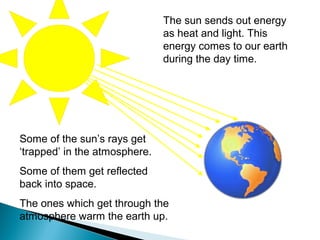
The sun sends out energy
as heat and light. This
energy comes to our earth
during the day time.
Some of the sun’s rays get
‘trapped’ in the atmosphere.
Some of them get reflected
back into space.
The ones which get through the
atmosphere warm the earth up.
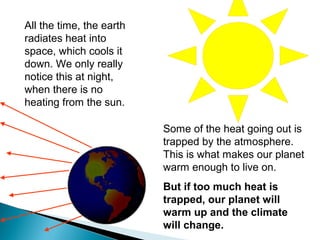
All the time, the earth
radiates heat into
space, which cools it
down. We only really
notice this at night,
when there is no
heating from the sun.
Some of the heat going out is
trapped by the atmosphere.
This is what makes our planet
warm enough to live on.
But if too much heat is
trapped, our planet will
warm up and the climate
will change.
What is the atmosphere and why
does it trap heat?
The atmosphere is the air around the
surface of the earth. It is made from a
mixture of gases. We need it for
animals and plants to survive.
Some of the gases act like a blanket,
trapping heat. These gases are called
‘greenhouse gases’.
This is known as the ‘Natural
Greenhouse Effect’. Without it, the
earth would be much colder.
(the atmosphere is
really much thinner
than it looks above)
So why is global warming
happening?
(the atmosphere is
really much thinner
than it looks above)
The heating of the earth through
human activities is called the
‘Enhanced Greenhouse Effect’ and
this is causing the earth to heat up, or
global warming.
Global warming doesn’t just mean
that the earth gets hotter, it means
that the whole climate is changing.
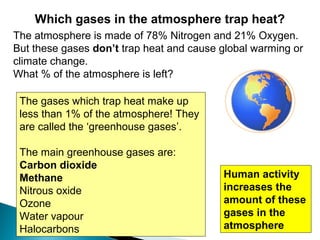
Which gases in the atmosphere trap heat?
The atmosphere is made of 78% Nitrogen and 21% Oxygen.
But these gases don’t trap heat and cause global warming or
climate change.
What % of the atmosphere is left?
The gases which trap heat make up
less than 1% of the atmosphere! They
are called the ‘greenhouse gases’.
The main greenhouse gases are:
Carbon dioxide
Methane
Nitrous oxide
Ozone
Water vapour
Halocarbons
Human activity
increases the
amount of these
gases in the
atmosphere
 Carbon dioxide
◦ combustion of solid waste, fossil fuels (oil, natural gas, and coal),
and wood and wood products
 Methane :
◦ production and transport of coal, natural gas, and oil. Methane
emissions also result from the decomposition of organic wastes in
municipal solid waste landfills, and the raising of livestock.
 Nitrous oxide
◦ agricultural and industrial activities, as well as during combustion of
solid waste and fossil fuels.
 hydrofluorocarbons (HFCs), perfluorocarbons
(PFCs), and sulfur hexafluoride (SF6),
◦ industrial processes.
How do humans increase carbon dioxide levels in
the atmosphere?
Burning fossil fuels
releases the carbon dioxide
stored millions of years
ago. Most of the increased
carbon dioxide comes from
fossil fuels
Deforestation releases the
carbon stored in trees. Less
trees also means less carbon
dioxide can be removed from
the atmosphere.
How do humans increase methane levels in the
atmosphere?
The amount of methane in
the atmosphere has
increased by two and a half
times since the Industrial
Revolution.
Increased
rubbish in
landfill
Increased livestock farming
Methane is also
released when
fossil fuels are
extracted
Methane is produced when
bacteria rot organic matter
Power Plants
40% of carbon dioxide emissions stem from the burning of fossil fuels for the purpose of
electricity generation
Cars
20% of carbon dioxide emissions comes from the burning of gasoline in internal-
combustion engines of cars and light trucks with poor gas mileage contribute the most to
global warming
Trucks
Another 13% of carbon dioxide emissions come from
trucks used mostly for commercial purposes
Airplanes
Aviation causes 3.5 percent of global warming,
and the figure could rise to 15 percent by 2050
Carbon Dioxide from Buildings
Buildings structure account for about 12% of
carbon dioxide emissions
Greenhouse Gas
Emissions
Methane
• Derived from sources such as rice paddies, bovine
flatulence, bacteria in bogs and fossil fuel
production
• In flooded fields, anaerobic conditions develop
and the organic matter in the soil decomposes
Nitrous oxide
• Naturally produced by oceans and rainforests
• Man-made sources-nylon and nitric acid
production, the use of fertilizers in agriculture,
cars with catalytic converters and the burning
of organic matter
Deforestation
• Responsible for 25% of all carbon emissions
entering the atmosphere by the burning and cutting of about 34 million acres of
trees each year
 Health
 Water resources
 Polar regions
 Mountains
 Forests
 Deserts
 Coastal Zones
 Agriculture
 International
Effects of Global
Warming
Negative Effects
Rising Sea Level
Change of precipitation and local climate
conditions; acid rain
Alteration of forests and crop yields
Expansions of deserts into existing rangelands
More intense rainstorms
Destabilization of Ocean currents
Positive Effects
Can stimulate plant growth in places where CO2 and temperature are the limiting
factors (preventing photorespiration which can destroy existing sugars)
Melting Arctic ice may open the Northwest Passage in summer, which would cut
5,000 nautical miles from shipping routes between Europe and Asia
 The effects are difficult to measure, but potentially
dramatic.
 Many species inhabit precisely bounded ecological
niches, and so small changes in climate can cause
disruptions in habitat or food availability.
 Loss of key predator or prey species affects the life
cycles of other organisms in the food chain.
Associated Climate Changes
• Global sea-level has increased 1-2
mm/yr; in 100 years a rise in sea level
between 3.5 and 34.6 in. (9-88 cm) is
expected
• Duration of ice cover of rivers and lakes
decreased by 2 weeks in N.
Hemisphere
• Arctic ice has thinned substantially,
decreased in extent by 10-15%
 Reduced permafrost in polar, sub-polar,
mountainous regions
 Growing season lengthened by 1-4 days in N.
Hemisphere
 Retreat of continental glaciers on all continents
 Snow cover decreased by 10% (reduced solar
reflection)
Source: Intergovernmental Panel on Climate Change, 2001 Report
 The growth of crops depends on many factors,
including temperature, precipitation, soil fertility,
and surrounding land uses.
 Extreme weather events (drought, hurricanes,
floods, etc.) are very damaging to crops. The effects
of more gradual affects (e.g., average temperature
increase) are difficult to predict.
 Developing countries will be much harder hit than
developed countries, due to limited agricultural
flexibility.
There are two basic adjustments: 
● Work to mitigate the situation (reduce its severity)
by reducing emissions of greenhouse gases
Global Warming Lec 14

Global Warming Lec 14

  • 3.
    The sun sendsout energy as heat and light. This energy comes to our earth during the day time. Some of the sun’s rays get ‘trapped’ in the atmosphere. Some of them get reflected back into space. The ones which get through the atmosphere warm the earth up.
  • 4.
    All the time,the earth radiates heat into space, which cools it down. We only really notice this at night, when there is no heating from the sun. Some of the heat going out is trapped by the atmosphere. This is what makes our planet warm enough to live on. But if too much heat is trapped, our planet will warm up and the climate will change.
  • 5.
    What is theatmosphere and why does it trap heat? The atmosphere is the air around the surface of the earth. It is made from a mixture of gases. We need it for animals and plants to survive. Some of the gases act like a blanket, trapping heat. These gases are called ‘greenhouse gases’. This is known as the ‘Natural Greenhouse Effect’. Without it, the earth would be much colder. (the atmosphere is really much thinner than it looks above)
  • 6.
    So why isglobal warming happening? (the atmosphere is really much thinner than it looks above) The heating of the earth through human activities is called the ‘Enhanced Greenhouse Effect’ and this is causing the earth to heat up, or global warming. Global warming doesn’t just mean that the earth gets hotter, it means that the whole climate is changing.
  • 7.
    Which gases inthe atmosphere trap heat? The atmosphere is made of 78% Nitrogen and 21% Oxygen. But these gases don’t trap heat and cause global warming or climate change. What % of the atmosphere is left? The gases which trap heat make up less than 1% of the atmosphere! They are called the ‘greenhouse gases’. The main greenhouse gases are: Carbon dioxide Methane Nitrous oxide Ozone Water vapour Halocarbons Human activity increases the amount of these gases in the atmosphere
  • 8.
     Carbon dioxide ◦combustion of solid waste, fossil fuels (oil, natural gas, and coal), and wood and wood products  Methane : ◦ production and transport of coal, natural gas, and oil. Methane emissions also result from the decomposition of organic wastes in municipal solid waste landfills, and the raising of livestock.  Nitrous oxide ◦ agricultural and industrial activities, as well as during combustion of solid waste and fossil fuels.  hydrofluorocarbons (HFCs), perfluorocarbons (PFCs), and sulfur hexafluoride (SF6), ◦ industrial processes.
  • 9.
    How do humansincrease carbon dioxide levels in the atmosphere? Burning fossil fuels releases the carbon dioxide stored millions of years ago. Most of the increased carbon dioxide comes from fossil fuels Deforestation releases the carbon stored in trees. Less trees also means less carbon dioxide can be removed from the atmosphere.
  • 10.
    How do humansincrease methane levels in the atmosphere? The amount of methane in the atmosphere has increased by two and a half times since the Industrial Revolution. Increased rubbish in landfill Increased livestock farming Methane is also released when fossil fuels are extracted Methane is produced when bacteria rot organic matter
  • 11.
    Power Plants 40% ofcarbon dioxide emissions stem from the burning of fossil fuels for the purpose of electricity generation Cars 20% of carbon dioxide emissions comes from the burning of gasoline in internal- combustion engines of cars and light trucks with poor gas mileage contribute the most to global warming Trucks Another 13% of carbon dioxide emissions come from trucks used mostly for commercial purposes Airplanes Aviation causes 3.5 percent of global warming, and the figure could rise to 15 percent by 2050 Carbon Dioxide from Buildings Buildings structure account for about 12% of carbon dioxide emissions
  • 12.
    Greenhouse Gas Emissions Methane • Derivedfrom sources such as rice paddies, bovine flatulence, bacteria in bogs and fossil fuel production • In flooded fields, anaerobic conditions develop and the organic matter in the soil decomposes Nitrous oxide • Naturally produced by oceans and rainforests • Man-made sources-nylon and nitric acid production, the use of fertilizers in agriculture, cars with catalytic converters and the burning of organic matter Deforestation • Responsible for 25% of all carbon emissions entering the atmosphere by the burning and cutting of about 34 million acres of trees each year
  • 13.
     Health  Waterresources  Polar regions  Mountains  Forests  Deserts  Coastal Zones  Agriculture  International
  • 14.
    Effects of Global Warming NegativeEffects Rising Sea Level Change of precipitation and local climate conditions; acid rain Alteration of forests and crop yields Expansions of deserts into existing rangelands More intense rainstorms Destabilization of Ocean currents Positive Effects Can stimulate plant growth in places where CO2 and temperature are the limiting factors (preventing photorespiration which can destroy existing sugars) Melting Arctic ice may open the Northwest Passage in summer, which would cut 5,000 nautical miles from shipping routes between Europe and Asia
  • 15.
     The effectsare difficult to measure, but potentially dramatic.  Many species inhabit precisely bounded ecological niches, and so small changes in climate can cause disruptions in habitat or food availability.  Loss of key predator or prey species affects the life cycles of other organisms in the food chain.
  • 16.
    Associated Climate Changes •Global sea-level has increased 1-2 mm/yr; in 100 years a rise in sea level between 3.5 and 34.6 in. (9-88 cm) is expected • Duration of ice cover of rivers and lakes decreased by 2 weeks in N. Hemisphere • Arctic ice has thinned substantially, decreased in extent by 10-15%
  • 17.
     Reduced permafrostin polar, sub-polar, mountainous regions  Growing season lengthened by 1-4 days in N. Hemisphere  Retreat of continental glaciers on all continents  Snow cover decreased by 10% (reduced solar reflection) Source: Intergovernmental Panel on Climate Change, 2001 Report
  • 18.
     The growthof crops depends on many factors, including temperature, precipitation, soil fertility, and surrounding land uses.  Extreme weather events (drought, hurricanes, floods, etc.) are very damaging to crops. The effects of more gradual affects (e.g., average temperature increase) are difficult to predict.  Developing countries will be much harder hit than developed countries, due to limited agricultural flexibility.
  • 19.
    There are twobasic adjustments:  ● Work to mitigate the situation (reduce its severity) by reducing emissions of greenhouse gases