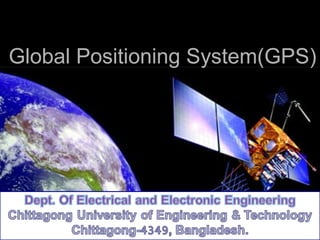
Global Positioning System(GPS)Global Positioning System(GPS)
Course TeachersCourse Teachers
Dr. Muhammad Ahsan UllahDr. Muhammad Ahsan Ullah
&&
Mr. Rashed Md. Murad HasanMr. Rashed Md. Murad Hasan
This was presented as a coursework of Electronic Communication
Sessional in Level 3, Term 1.
Correspondence: amimul66@gmail.com
PRESENTED BY
Md.Hasanul Azim (1002061)
Sakib Reza (1002062)
Md. Adibul Islam (1002063)
Rajib Ghose (1002064)
Irfan Uddin (1002065)
Md. Amimul Ehsan (1002066)
Correspondence: amimul66@gmail.com
Objectives:Objectives:
 To observe the GPS Module.To observe the GPS Module.
 Creating waypoints by the GPS.Creating waypoints by the GPS.
 To determine Elevation & Location usingTo determine Elevation & Location using
the GPS.the GPS.
Lab Experiment RequriedLab Experiment Requried
InstrumentInstrument
 GARMIN eTREXGARMIN eTREX
(GPS)(GPS)
 Two batteriesTwo batteries
What is the GPS?What is the GPS?
 A network of satellite that continuouslyA network of satellite that continuously
transmit coded information which makes ittransmit coded information which makes it
possible to precisely identify locations onpossible to precisely identify locations on
earth is called a GPS.earth is called a GPS.
Components of the GPS SystemComponents of the GPS System
GPS
Space Segment Control Segment User Segment
Space SegmentSpace Segment
 24 satellite vehicles24 satellite vehicles
 Six orbital planesSix orbital planes
 Inclined 55Inclined 55oo
with respect towith respect to
equatorequator
 Orbits separated by 60Orbits separated by 60oo
 20,200 km elevation20,200 km elevation
above Earthabove Earth
 Orbital period of 11 hr 55Orbital period of 11 hr 55
minmin
 Five to eight satellitesFive to eight satellites
visible from any point onvisible from any point on
EarthEarth
Control SegmentControl Segment
 Monitor stationsMonitor stations
 Master control stationMaster control station
Schreiber AFB, ColoradoSchreiber AFB, Colorado
 Ground antennasGround antennas
GPS Ground Control StationsGPS Ground Control Stations
User segmentUser segment
 GPS antennasGPS antennas
 ReceiverReceiver
 ProcessorsProcessors
 Precise timingPrecise timing
 Used byUsed by
 AircraftAircraft
 Ground vehiclesGround vehicles
 ShipsShips
 IndividualsIndividuals
GPS Communication and ControlGPS Communication and Control
How does the GPS work?How does the GPS work?
GPS works by receiving
signals from special
satellites that orbit the earth
twice a day at an altitude of
about 13 thousand miles.
A minimum no. of 24
satellites are required for the
GPS to function, but there
are usually 33 satellites
circulating the glob in case
of ones fails.
http://youtu.be/8sHDEUe1pY4
GPS satellites continuously emits RF signal that provides two
signals of information :
1.the current time
2. where exactly about the earth the sat is at that time
GPS receivers use this information to do a special calculation
called triangulation
http://youtu.be/HjRgfFSA-yU
The receivers compare the time the signal was sent from theThe receivers compare the time the signal was sent from the
satellite with the time the signal was received.satellite with the time the signal was received.
The difference in the time indicates the distance between theThe difference in the time indicates the distance between the
receiver and the satellite.receiver and the satellite.
http://youtu.be/0jrvliE3rX4
A GPS receiver needs to get signals from three satellites to
calculate latitude and longitude.
It needs the signal from 4th sat to calculate the altitude.
http://youtu.be/xfzKu0a0RaA
According to Einstein’s theory of relativity-According to Einstein’s theory of relativity-
Time dilation occurs in satellite with respectTime dilation occurs in satellite with respect
to ground which is reduced by using Atomicto ground which is reduced by using Atomic
Clock.Clock.
Atomic clock is an extremely accurate typeAtomic clock is an extremely accurate type
of clock that is regulated by the vibrations ofof clock that is regulated by the vibrations of
an atomic or molecular system such asan atomic or molecular system such as
cesium or ammonia.cesium or ammonia.
Triangulation is a process by which the
location of a radio transmitter can be
determined of a three dimensional point.
Working ProcedureWorking Procedure
Working Procedure:Working Procedure:
Creating Waypoints Using the Map:Creating Waypoints Using the Map:
To create a waypoint using the Map page:To create a waypoint using the Map page:
1. On the Map page, use the ROCKER to move the pointer to the1. On the Map page, use the ROCKER to move the pointer to the
map item you want to mark.map item you want to mark.
2. Press release the ROCKER to capture the pointer location and2. Press release the ROCKER to capture the pointer location and
open the information page for the map item.open the information page for the map item.
3. Select Save. If there is no information for that point, a3. Select Save. If there is no information for that point, a
““No map information at this point. Do you want to create a userNo map information at this point. Do you want to create a user
waypoint here?” prompt appears. Select Yes.waypoint here?” prompt appears. Select Yes.
Working Procedure:Working Procedure:
Marking Current Location:Marking Current Location:
Press in and hold the ROCKER to mark current location forPress in and hold the ROCKER to mark current location for
creating a new waypoint. There must be a valid position to markcreating a new waypoint. There must be a valid position to mark
current location.current location.
To mark current location the following procedure is followed:To mark current location the following procedure is followed:
a.a. Press & hold the ROCKER until the Mark waypoint pagePress & hold the ROCKER until the Mark waypoint page
appears. A default three digit name and symbol are assigned toappears. A default three digit name and symbol are assigned to
the new waypoint.the new waypoint.
b.b. To accept the waypoint with the default information, select OK.To accept the waypoint with the default information, select OK.
Data and CalculationData and Calculation
Waypoint 1:Waypoint 1:
Latitude: N22º27.770Latitude: N22º27.770΄΄
Longitude: E91º58.312Longitude: E91º58.312΄΄
Elevation: 101Elevation: 101
Waypoint 2:Waypoint 2:
Latitude: N22º27.782Latitude: N22º27.782΄΄
Longitude: E91º58.310Longitude: E91º58.310΄΄
Elevation: 90Elevation: 90
Data and CalculationData and Calculation
 Distance between two waypoint 01 & 02:Distance between two waypoint 01 & 02:
Latitude: dN=0.0002ºLatitude: dN=0.0002º
Longitude: dE=0.00033ºLongitude: dE=0.00033º
so distance= 36.53 mso distance= 36.53 m
[Lat- 1º=110.64km[Lat- 1º=110.64km
Lon- 1º=107.55km]Lon- 1º=107.55km]
Application of GPS TechnologyApplication of GPS Technology
LocationLocation
NavigationNavigation
TrackingTracking
MappingMapping
Determining a basic positionDetermining a basic position
Getting from one location to anotherGetting from one location to another Creating maps of the worldCreating maps of the world
Monitoring the movement of thingsMonitoring the movement of things
 Vehicle controlVehicle control
 Driving carDriving car
SurveySurvey
Determination ofDetermination of
 latitudelatitude
 longitudelongitude
 altitudealtitude
Application of GPS TechnologyApplication of GPS Technology
Operation in Desert StormOperation in Desert Storm
 GPS is widely used in the militaryGPS is widely used in the military
 VehiclesVehicles
 AircraftAircraft
 Marine vesselsMarine vessels
GPS Uses for the MilitaryGPS Uses for the Military
ACCURACY AND LIMITIONSACCURACY AND LIMITIONS
Some factors affecting accuracy of GPSSome factors affecting accuracy of GPS
Input errorsInput errors
Dilution of precisionDilution of precision
SD(position)= DOP*SD(position)= DOP*
SD(inputs)SD(inputs)
DOP can be improvedDOP can be improved
by more satellites.by more satellites.
Inputs improved by DGPSInputs improved by DGPS
ACCURACY AND LIMITIONSACCURACY AND LIMITIONS
GPS signal can be reflected by objectsGPS signal can be reflected by objects
before reaching to receiver.before reaching to receiver.
Signal delay caused by Ionosphere andSignal delay caused by Ionosphere and
TroposphereTroposphere
Orbit errorsOrbit errors
ConclusionConclusion
The technology of the GPS is allowing for hugeThe technology of the GPS is allowing for huge
changes in society . The cost of receiver ischanges in society . The cost of receiver is
dropping and at the same time the accuracy ofdropping and at the same time the accuracy of
the system is improving.the system is improving.
THANK YOUTHANK YOU

Global Positioning System

  • 1.
    Global Positioning System(GPS)GlobalPositioning System(GPS)
  • 2.
    Course TeachersCourse Teachers Dr.Muhammad Ahsan UllahDr. Muhammad Ahsan Ullah && Mr. Rashed Md. Murad HasanMr. Rashed Md. Murad Hasan This was presented as a coursework of Electronic Communication Sessional in Level 3, Term 1. Correspondence: amimul66@gmail.com
  • 3.
    PRESENTED BY Md.Hasanul Azim(1002061) Sakib Reza (1002062) Md. Adibul Islam (1002063) Rajib Ghose (1002064) Irfan Uddin (1002065) Md. Amimul Ehsan (1002066) Correspondence: amimul66@gmail.com
  • 4.
    Objectives:Objectives:  To observethe GPS Module.To observe the GPS Module.  Creating waypoints by the GPS.Creating waypoints by the GPS.  To determine Elevation & Location usingTo determine Elevation & Location using the GPS.the GPS.
  • 5.
    Lab Experiment RequriedLabExperiment Requried InstrumentInstrument  GARMIN eTREXGARMIN eTREX (GPS)(GPS)  Two batteriesTwo batteries
  • 6.
    What is theGPS?What is the GPS?  A network of satellite that continuouslyA network of satellite that continuously transmit coded information which makes ittransmit coded information which makes it possible to precisely identify locations onpossible to precisely identify locations on earth is called a GPS.earth is called a GPS.
  • 7.
    Components of theGPS SystemComponents of the GPS System GPS Space Segment Control Segment User Segment
  • 8.
    Space SegmentSpace Segment 24 satellite vehicles24 satellite vehicles  Six orbital planesSix orbital planes  Inclined 55Inclined 55oo with respect towith respect to equatorequator  Orbits separated by 60Orbits separated by 60oo  20,200 km elevation20,200 km elevation above Earthabove Earth  Orbital period of 11 hr 55Orbital period of 11 hr 55 minmin  Five to eight satellitesFive to eight satellites visible from any point onvisible from any point on EarthEarth
  • 9.
    Control SegmentControl Segment Monitor stationsMonitor stations  Master control stationMaster control station Schreiber AFB, ColoradoSchreiber AFB, Colorado  Ground antennasGround antennas
  • 10.
    GPS Ground ControlStationsGPS Ground Control Stations
  • 11.
    User segmentUser segment GPS antennasGPS antennas  ReceiverReceiver  ProcessorsProcessors  Precise timingPrecise timing  Used byUsed by  AircraftAircraft  Ground vehiclesGround vehicles  ShipsShips  IndividualsIndividuals
  • 12.
    GPS Communication andControlGPS Communication and Control
  • 13.
    How does theGPS work?How does the GPS work?
  • 14.
    GPS works byreceiving signals from special satellites that orbit the earth twice a day at an altitude of about 13 thousand miles. A minimum no. of 24 satellites are required for the GPS to function, but there are usually 33 satellites circulating the glob in case of ones fails. http://youtu.be/8sHDEUe1pY4
  • 15.
    GPS satellites continuouslyemits RF signal that provides two signals of information : 1.the current time 2. where exactly about the earth the sat is at that time GPS receivers use this information to do a special calculation called triangulation http://youtu.be/HjRgfFSA-yU
  • 16.
    The receivers comparethe time the signal was sent from theThe receivers compare the time the signal was sent from the satellite with the time the signal was received.satellite with the time the signal was received. The difference in the time indicates the distance between theThe difference in the time indicates the distance between the receiver and the satellite.receiver and the satellite. http://youtu.be/0jrvliE3rX4
  • 17.
    A GPS receiverneeds to get signals from three satellites to calculate latitude and longitude. It needs the signal from 4th sat to calculate the altitude. http://youtu.be/xfzKu0a0RaA
  • 18.
    According to Einstein’stheory of relativity-According to Einstein’s theory of relativity- Time dilation occurs in satellite with respectTime dilation occurs in satellite with respect to ground which is reduced by using Atomicto ground which is reduced by using Atomic Clock.Clock.
  • 19.
    Atomic clock isan extremely accurate typeAtomic clock is an extremely accurate type of clock that is regulated by the vibrations ofof clock that is regulated by the vibrations of an atomic or molecular system such asan atomic or molecular system such as cesium or ammonia.cesium or ammonia. Triangulation is a process by which the location of a radio transmitter can be determined of a three dimensional point.
  • 20.
  • 21.
    Working Procedure:Working Procedure: CreatingWaypoints Using the Map:Creating Waypoints Using the Map: To create a waypoint using the Map page:To create a waypoint using the Map page: 1. On the Map page, use the ROCKER to move the pointer to the1. On the Map page, use the ROCKER to move the pointer to the map item you want to mark.map item you want to mark. 2. Press release the ROCKER to capture the pointer location and2. Press release the ROCKER to capture the pointer location and open the information page for the map item.open the information page for the map item. 3. Select Save. If there is no information for that point, a3. Select Save. If there is no information for that point, a ““No map information at this point. Do you want to create a userNo map information at this point. Do you want to create a user waypoint here?” prompt appears. Select Yes.waypoint here?” prompt appears. Select Yes.
  • 22.
    Working Procedure:Working Procedure: MarkingCurrent Location:Marking Current Location: Press in and hold the ROCKER to mark current location forPress in and hold the ROCKER to mark current location for creating a new waypoint. There must be a valid position to markcreating a new waypoint. There must be a valid position to mark current location.current location. To mark current location the following procedure is followed:To mark current location the following procedure is followed: a.a. Press & hold the ROCKER until the Mark waypoint pagePress & hold the ROCKER until the Mark waypoint page appears. A default three digit name and symbol are assigned toappears. A default three digit name and symbol are assigned to the new waypoint.the new waypoint. b.b. To accept the waypoint with the default information, select OK.To accept the waypoint with the default information, select OK.
  • 23.
    Data and CalculationDataand Calculation Waypoint 1:Waypoint 1: Latitude: N22º27.770Latitude: N22º27.770΄΄ Longitude: E91º58.312Longitude: E91º58.312΄΄ Elevation: 101Elevation: 101 Waypoint 2:Waypoint 2: Latitude: N22º27.782Latitude: N22º27.782΄΄ Longitude: E91º58.310Longitude: E91º58.310΄΄ Elevation: 90Elevation: 90
  • 24.
    Data and CalculationDataand Calculation  Distance between two waypoint 01 & 02:Distance between two waypoint 01 & 02: Latitude: dN=0.0002ºLatitude: dN=0.0002º Longitude: dE=0.00033ºLongitude: dE=0.00033º so distance= 36.53 mso distance= 36.53 m [Lat- 1º=110.64km[Lat- 1º=110.64km Lon- 1º=107.55km]Lon- 1º=107.55km]
  • 25.
    Application of GPSTechnologyApplication of GPS Technology
  • 26.
    Application of GPSTechnologyApplication of GPS Technology LocationLocation NavigationNavigation TrackingTracking MappingMapping Determining a basic positionDetermining a basic position Getting from one location to anotherGetting from one location to another Creating maps of the worldCreating maps of the world Monitoring the movement of thingsMonitoring the movement of things
  • 27.
     Vehicle controlVehiclecontrol  Driving carDriving car SurveySurvey Determination ofDetermination of  latitudelatitude  longitudelongitude  altitudealtitude Application of GPS TechnologyApplication of GPS Technology
  • 28.
    Operation in DesertStormOperation in Desert Storm  GPS is widely used in the militaryGPS is widely used in the military  VehiclesVehicles  AircraftAircraft  Marine vesselsMarine vessels GPS Uses for the MilitaryGPS Uses for the Military
  • 29.
  • 30.
    ACCURACY AND LIMITIONSACCURACYAND LIMITIONS Some factors affecting accuracy of GPSSome factors affecting accuracy of GPS Input errorsInput errors Dilution of precisionDilution of precision SD(position)= DOP*SD(position)= DOP* SD(inputs)SD(inputs) DOP can be improvedDOP can be improved by more satellites.by more satellites. Inputs improved by DGPSInputs improved by DGPS
  • 31.
    ACCURACY AND LIMITIONSACCURACYAND LIMITIONS GPS signal can be reflected by objectsGPS signal can be reflected by objects before reaching to receiver.before reaching to receiver. Signal delay caused by Ionosphere andSignal delay caused by Ionosphere and TroposphereTroposphere Orbit errorsOrbit errors
  • 32.
    ConclusionConclusion The technology ofthe GPS is allowing for hugeThe technology of the GPS is allowing for huge changes in society . The cost of receiver ischanges in society . The cost of receiver is dropping and at the same time the accuracy ofdropping and at the same time the accuracy of the system is improving.the system is improving.
  • 33.