Rural Village Marketing
  and Microfinance:
 Global Strategies in
  Emerging Markets
        Jane Ives, Bentley Collage
 Frank Cutitta, Global Branding Institute
        Martin Sours, Thunderbird
  Chris Fussner, TransTechnology Corp.


                          CGB
                The Center for Global Branding   BENTLEY COLLEGE
Orthodox View
Rich Get Richer
Need Equity to Get a Loan
Large-Scale Multinational Banks
Do the Lending
Rural Poor Are Bad Credit Risks
From Microcredit to Microfinance
 Microfinance Institutions (MFI)
 Are the Key
 Income, Credit, Investment Cycle
 Breaks Poverty
 Reduces the Need for High-Cost,
 Traditional Credit
 Creates the Smoothing of
 Consumption of Nutrition and
 Education Goods and Services
The Concept of “Social Energy”
Fosters Positive and Rational
Risk-Taking
Allows Leaders to Arise at the
Local Level
Creates a Dynamic of the Diffusion
of Ideas and Optimism throughout
the Society
Innovation
Topical Term in Today’s Microfinance
Activities
Represents the Groundwork of
Financial Institutional-Building
Represents an Understanding of the
Livelihood of Target Clients
Captures the Nuanced Context of the
Local Setting
Leads to Voluntary Savings Products
Provided by the Association for Social
Advancement (ASA)
Providing Choice: A Key
     Microfinance Activity
Offers Both Liquid and Illiquid
Microfinance Products
Life Insurance
Contractual Savings Products
Flexible Opportunity for Village/Rural
Poor to Both Save and Borrow
Multiple Microfinance Forms:
Traditional, Informal, and Modern
 Moneylenders; The Traditional,
 Regressive, Potentially Exploitative
 Method of Borrowing
 Informal Groups, esp. Housewives
 Groups
 Modern Forms—NGOs, Grameen Bank
 Key Elements
 Based on Trust, not Law nor Contract
 Borrower Must Join a Group
 High Priority Given to Social Capital
Grameen Bank and
  Women’s Empowerment
Grameen Bank, Established in 1983,
Targeted Bangladesh’s Very Poor
Loans of $12–15 Bought a Sewing
Machine, Goats, Ducks, etc.
Women Have Better Repayment
Rate(s) than Men
Break the Cycle of Moneylenders
Who Offered Long-Term Loans
Key Islamic Issues
Daden Financing of Crop Rotation
(Forward Sales of Crops which
Substitute for Interest)
Profit Sharing among the Group
Also Replaces Interest
Loans Based upon Land Worked
Trade Credit Based on Product
Worked, Like Jewelry
Rural Marketing
“Rural” Is, Above All, a Mindset
Rural Is Agricultural Dependent
Rural Distribution Is Essential but
Difficult and Uses Small-Scale
Transport
Affordability Means Small Unit Size
to be Marketed/Sold
Products Must Compete with Long-
Standing, Natural Products For
Cleaning, etc.
Rural Marketing: The Four “A’s”
Availability of Product and/or
Service; Attention Must be Paid to
Distribution Channels
Affordability; Product Has to be
Priced Realistically
Acceptability; The Product Has to be
Relevant and Desirable
Awareness; Brand Management Is
the Key Here
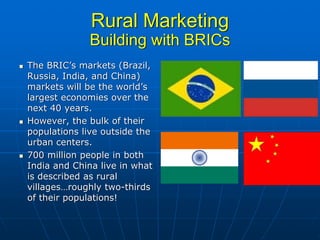
Rural Marketing
             Building with BRICs
The BRIC’s markets (Brazil,
Russia, India, and China)
markets will be the world’s
largest economies over the
next 40 years.
However, the bulk of their
populations live outside the
urban centers.
700 million people in both
India and China live in what
is described as rural
villages…roughly two-thirds
of their populations!
Rural Marketing
     Need for Distribution Networks
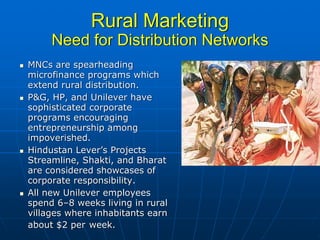
MNCs are spearheading
microfinance programs which
extend rural distribution.
P&G, HP, and Unilever have
sophisticated corporate
programs encouraging
entrepreneurship among
impoverished.
Hindustan Lever’s Projects
Streamline, Shakti, and Bharat
are considered showcases of
corporate responsibility.
All new Unilever employees
spend 6–8 weeks living in rural
villages where inhabitants earn
about $2 per week.
Strange Bedfellows
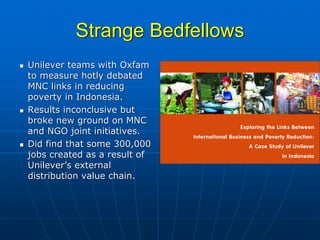
Unilever teams with Oxfam
to measure hotly debated
MNC links in reducing
poverty in Indonesia.
Results inconclusive but
broke new ground on MNC
and NGO joint initiatives.
Did find that some 300,000
jobs created as a result of
Unilever’s external
distribution value chain.
Rural Marketing
             Consumer Education
Rural villagers need to know
a products benefit(s) before
the brand can be sold.
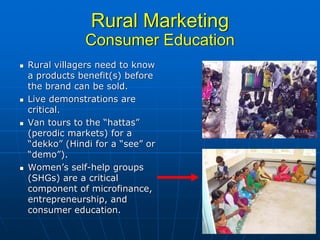
Live demonstrations are
critical.
Van tours to the “hattas”
(perodic markets) for a
“dekko” (Hindi for a “see” or
“demo”).
Women’s self-help groups
(SHGs) are a critical
component of microfinance,
entrepreneurship, and
consumer education.
Rural Marketing
                Education
Rural marketer must be
both educator and
student.
Some products may be
used in rural settings
differently than urban
or suburban areas.
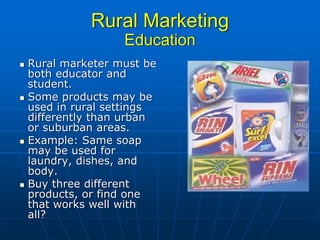
Example: Same soap
may be used for
laundry, dishes, and
body.
Buy three different
products, or find one
that works well with
all?
Rural Marketing
                      Packaging
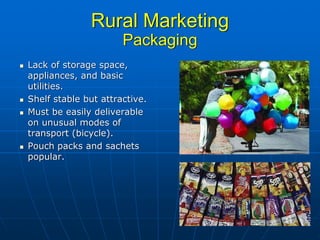
Lack of storage space,
appliances, and basic
utilities.
Shelf stable but attractive.
Must be easily deliverable
on unusual modes of
transport (bicycle).
Pouch packs and sachets
popular.
Rural Marketing
                        Pricing
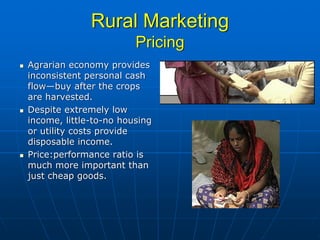
Agrarian economy provides
inconsistent personal cash
flow—buy after the crops
are harvested.
Despite extremely low
income, little-to-no housing
or utility costs provide
disposable income.
Price:performance ratio is
much more important than
just cheap goods.
Rural Marketing
 Marketing Technology Infrastructure
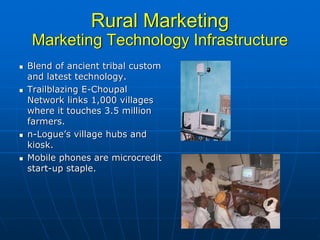
Blend of ancient tribal custom
and latest technology.
Trailblazing E-Choupal
Network links 1,000 villages
where it touches 3.5 million
farmers.
n-Logue’s village hubs and
kiosk.
Mobile phones are microcredit
start-up staple.
Rural Marketing
 Marketing Technology Infrastructure
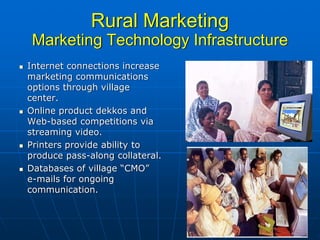
Internet connections increase
marketing communications
options through village
center.
Online product dekkos and
Web-based competitions via
streaming video.
Printers provide ability to
produce pass-along collateral.
Databases of village “CMO”
e-mails for ongoing
communication.
Rural Marketing
          Creative and Messaging
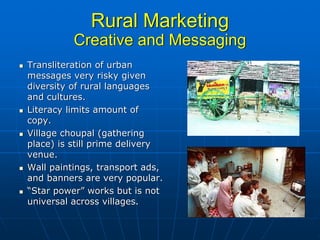
Transliteration of urban
messages very risky given
diversity of rural languages
and cultures.
Literacy limits amount of
copy.
Village choupal (gathering
place) is still prime delivery
venue.
Wall paintings, transport ads,
and banners are very popular.
“Star power” works but is not
universal across villages.
Rural Marketing
         Buzz and Word of Mouth
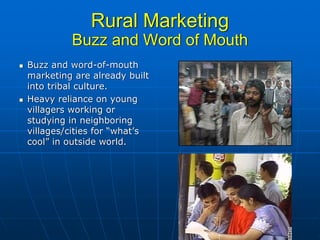
Buzz and word-of-mouth
marketing are already built
into tribal culture.
Heavy reliance on young
villagers working or
studying in neighboring
villages/cities for “what’s
cool” in outside world.
Bangladesh Specifics
1970s—Young activists want to
rebuild the country with village-
based groups
1980s—“Target Groups” approach,
minimizing paperwork and
decentralizing decision-making
Early 1990s—Greater emphasis on
individual borrower accountability
Today—Diversified financial services
Sri Lanka
Sarvodaya Economic Enterprise
Development Services (SEEDS)
Founded in 1958, incorporated in 1972
Based on a vision of a new social order
Sri Lanka’s largest NGO with global
linkages
Provides training, introduces new
technologies, and links producers and
end-clients
Philippines
A vision of a viable, private, accessible
microfinance market
Create a greater role for the private
sector
Establish a market-oriented financial
credit policy environment
Capacity-building in local deposit
mobilization, project management,
and use of information technology
Energy: A New Frontier
Links between energy and
microfinance need to be strengthened
Microfinance clients need access to
reliable energy services
Success can involve multiple clients;
energy providers, poverty reduction,
and economic development donors
Costs of energy must match
consumers’ income flows
In Sum
Microfinance: A key element in
fostering an ethical, market-driven
economy
Key institutions are in play
•   Microfinance Institute
•   ACCION in Latin America
•   Citigroup Microfinance Group
•   Grameen Foundation and Bank
•   The Kearny Alliance
•   World Council of Credit Unions

Global Microfinance & Grameen

  • 1.
    Rural Village Marketing and Microfinance: Global Strategies in Emerging Markets Jane Ives, Bentley Collage Frank Cutitta, Global Branding Institute Martin Sours, Thunderbird Chris Fussner, TransTechnology Corp. CGB The Center for Global Branding BENTLEY COLLEGE
  • 2.
    Orthodox View Rich GetRicher Need Equity to Get a Loan Large-Scale Multinational Banks Do the Lending Rural Poor Are Bad Credit Risks
  • 3.
    From Microcredit toMicrofinance Microfinance Institutions (MFI) Are the Key Income, Credit, Investment Cycle Breaks Poverty Reduces the Need for High-Cost, Traditional Credit Creates the Smoothing of Consumption of Nutrition and Education Goods and Services
  • 4.
    The Concept of“Social Energy” Fosters Positive and Rational Risk-Taking Allows Leaders to Arise at the Local Level Creates a Dynamic of the Diffusion of Ideas and Optimism throughout the Society
  • 5.
    Innovation Topical Term inToday’s Microfinance Activities Represents the Groundwork of Financial Institutional-Building Represents an Understanding of the Livelihood of Target Clients Captures the Nuanced Context of the Local Setting Leads to Voluntary Savings Products Provided by the Association for Social Advancement (ASA)
  • 6.
    Providing Choice: AKey Microfinance Activity Offers Both Liquid and Illiquid Microfinance Products Life Insurance Contractual Savings Products Flexible Opportunity for Village/Rural Poor to Both Save and Borrow
  • 7.
    Multiple Microfinance Forms: Traditional,Informal, and Modern Moneylenders; The Traditional, Regressive, Potentially Exploitative Method of Borrowing Informal Groups, esp. Housewives Groups Modern Forms—NGOs, Grameen Bank Key Elements Based on Trust, not Law nor Contract Borrower Must Join a Group High Priority Given to Social Capital
  • 8.
    Grameen Bank and Women’s Empowerment Grameen Bank, Established in 1983, Targeted Bangladesh’s Very Poor Loans of $12–15 Bought a Sewing Machine, Goats, Ducks, etc. Women Have Better Repayment Rate(s) than Men Break the Cycle of Moneylenders Who Offered Long-Term Loans
  • 9.
    Key Islamic Issues DadenFinancing of Crop Rotation (Forward Sales of Crops which Substitute for Interest) Profit Sharing among the Group Also Replaces Interest Loans Based upon Land Worked Trade Credit Based on Product Worked, Like Jewelry
  • 10.
    Rural Marketing “Rural” Is,Above All, a Mindset Rural Is Agricultural Dependent Rural Distribution Is Essential but Difficult and Uses Small-Scale Transport Affordability Means Small Unit Size to be Marketed/Sold Products Must Compete with Long- Standing, Natural Products For Cleaning, etc.
  • 11.
    Rural Marketing: TheFour “A’s” Availability of Product and/or Service; Attention Must be Paid to Distribution Channels Affordability; Product Has to be Priced Realistically Acceptability; The Product Has to be Relevant and Desirable Awareness; Brand Management Is the Key Here
  • 12.
    Rural Marketing Building with BRICs The BRIC’s markets (Brazil, Russia, India, and China) markets will be the world’s largest economies over the next 40 years. However, the bulk of their populations live outside the urban centers. 700 million people in both India and China live in what is described as rural villages…roughly two-thirds of their populations!
  • 13.
    Rural Marketing Need for Distribution Networks MNCs are spearheading microfinance programs which extend rural distribution. P&G, HP, and Unilever have sophisticated corporate programs encouraging entrepreneurship among impoverished. Hindustan Lever’s Projects Streamline, Shakti, and Bharat are considered showcases of corporate responsibility. All new Unilever employees spend 6–8 weeks living in rural villages where inhabitants earn about $2 per week.
  • 14.
    Strange Bedfellows Unilever teamswith Oxfam to measure hotly debated MNC links in reducing poverty in Indonesia. Results inconclusive but broke new ground on MNC and NGO joint initiatives. Did find that some 300,000 jobs created as a result of Unilever’s external distribution value chain.
  • 15.
    Rural Marketing Consumer Education Rural villagers need to know a products benefit(s) before the brand can be sold. Live demonstrations are critical. Van tours to the “hattas” (perodic markets) for a “dekko” (Hindi for a “see” or “demo”). Women’s self-help groups (SHGs) are a critical component of microfinance, entrepreneurship, and consumer education.
  • 16.
    Rural Marketing Education Rural marketer must be both educator and student. Some products may be used in rural settings differently than urban or suburban areas. Example: Same soap may be used for laundry, dishes, and body. Buy three different products, or find one that works well with all?
  • 17.
    Rural Marketing Packaging Lack of storage space, appliances, and basic utilities. Shelf stable but attractive. Must be easily deliverable on unusual modes of transport (bicycle). Pouch packs and sachets popular.
  • 18.
    Rural Marketing Pricing Agrarian economy provides inconsistent personal cash flow—buy after the crops are harvested. Despite extremely low income, little-to-no housing or utility costs provide disposable income. Price:performance ratio is much more important than just cheap goods.
  • 19.
    Rural Marketing MarketingTechnology Infrastructure Blend of ancient tribal custom and latest technology. Trailblazing E-Choupal Network links 1,000 villages where it touches 3.5 million farmers. n-Logue’s village hubs and kiosk. Mobile phones are microcredit start-up staple.
  • 20.
    Rural Marketing MarketingTechnology Infrastructure Internet connections increase marketing communications options through village center. Online product dekkos and Web-based competitions via streaming video. Printers provide ability to produce pass-along collateral. Databases of village “CMO” e-mails for ongoing communication.
  • 21.
    Rural Marketing Creative and Messaging Transliteration of urban messages very risky given diversity of rural languages and cultures. Literacy limits amount of copy. Village choupal (gathering place) is still prime delivery venue. Wall paintings, transport ads, and banners are very popular. “Star power” works but is not universal across villages.
  • 22.
    Rural Marketing Buzz and Word of Mouth Buzz and word-of-mouth marketing are already built into tribal culture. Heavy reliance on young villagers working or studying in neighboring villages/cities for “what’s cool” in outside world.
  • 23.
    Bangladesh Specifics 1970s—Young activistswant to rebuild the country with village- based groups 1980s—“Target Groups” approach, minimizing paperwork and decentralizing decision-making Early 1990s—Greater emphasis on individual borrower accountability Today—Diversified financial services
  • 24.
    Sri Lanka Sarvodaya EconomicEnterprise Development Services (SEEDS) Founded in 1958, incorporated in 1972 Based on a vision of a new social order Sri Lanka’s largest NGO with global linkages Provides training, introduces new technologies, and links producers and end-clients
  • 25.
    Philippines A vision ofa viable, private, accessible microfinance market Create a greater role for the private sector Establish a market-oriented financial credit policy environment Capacity-building in local deposit mobilization, project management, and use of information technology
  • 26.
    Energy: A NewFrontier Links between energy and microfinance need to be strengthened Microfinance clients need access to reliable energy services Success can involve multiple clients; energy providers, poverty reduction, and economic development donors Costs of energy must match consumers’ income flows
  • 27.
    In Sum Microfinance: Akey element in fostering an ethical, market-driven economy Key institutions are in play • Microfinance Institute • ACCION in Latin America • Citigroup Microfinance Group • Grameen Foundation and Bank • The Kearny Alliance • World Council of Credit Unions