TALAT Lecture 2404


                        Quality Considerations

                                51 pages, 29 figures

                                  Advanced Level

         prepared by Dimitris Kosteas, Technische Universität München


Objectives:
− To provide understanding of underlying concepts and tools for handling experimental
  data and its comparison to existing design recommendations
− To provide understanding of classification parameters for structural details and
  quantitative links between design principles and quality criteria
− Enable sophisticated design for further structural details not included in current
  recommendations
− To teach methods of enhancing fatigue strength, especially as post-weld treatments


Prerequisites:
− Background knowledge in engineering, materials and fatigue required


Date of Issue: 1994
 EAA - European Aluminium Association
2404 Quality Considerations

Table of Contents

 2404.01 Fatigue Design Data Management........................................................... 3
   Early Developments.................................................................................................5
   The Aluminium Data Bank......................................................................................6
     The Original PC Version .................................................................................... 6
     The New Version ................................................................................................. 8
   The ALFABET Project ..........................................................................................15
   Design Tools ..........................................................................................................16
   Literature/References .............................................................................................17
 2404.02 Quality Criteria and Classification of Structural Details ................... 18
   Objectives ..............................................................................................................19
   Scope of the Specifications....................................................................................20
   Quality Levels ........................................................................................................21
   Extent and Methods of Inspection .........................................................................22
     Details to Methods and Scope of Inspection..................................................... 23
     Frequency of Partial Inspection ....................................................................... 27
   Acceptance Criteria................................................................................................27
     Detailed comments on individual acceptance criteria: .................................... 30
   Remarks on Quality Assurance and Quality Requirements ...................................33
     Selection of Quality Requirements According to Stage of Work ...................... 34
   Structural Detail Configurations ............................................................................35
   Literature/References .............................................................................................39
 2404.03 Improving Fatigue Performance ........................................................... 41
   Improvement Methods ...........................................................................................41
   Geometry or Shape Changing Methods .................................................................42
     Grinding............................................................................................................ 42
     TIG-Remelting or Dressing............................................................................... 43
     Peening ............................................................................................................. 43
   Residual Stress Methods ........................................................................................43
     Peening ............................................................................................................. 43
     Spot Heating and Thermal Stress Relief ........................................................... 44
   Comparison of Techniques ....................................................................................44
   Comparison of Cost ...............................................................................................45
   Applicability ..........................................................................................................46
   Fatigue Improvement - Research Results ..............................................................47
     Improving 5086 Welds for Ship Construction by Peening................................ 47
     Improving Welds in Transportation Applications by Shot Peening and TIG Re-
     melting .............................................................................................................. 49
     Improving Fatigue in Rail Cars by Peening and TIG-Remelting ..................... 50
   Literature/References .............................................................................................50
 2405.05 List of Figures.......................................................................................... 52


TALAT 2404                                                     2
2404.01        Fatigue Design Data Management

           •   Early developments
           •   The Aluminium Data Bank
           •   The ALFABET projects
           •   Design tools
           •   Literature/References


The Aluminium Data Bank is a joint project of the Technical University of Munich,
Germany, and the Iowa State University, Ames, Iowa, USA. It serves the harmonised
documentation, analysis, evaluation and presentation of material data, especially in the
area of fatigue, from earlier small specimen tests and more recent comprehensive data
generated from larger welded components and full-size elements. Data from other alu-
minium joint types as well as substantial fracture mechanics and crack propagation data
is being added.
The further development is visualised under the ALFABET Project. The Aluminium
Data Bank shall be coupled through an application oriented interface to other informati-
on sources like literature, handbooks, expert knowledge and instruments such as design
concepts and procedures, codes, recommendations. Of great importance is here the ma-
nagement of a large body of information in conjunction with the options offered, from a
retrospective search of characteristic values from the original sources to the evaluating
and design procedures.
While the above statements outline the two main goals from the user's point of view it
has been necessary to deal with additional questions of why, what for, advantages and
disadvantages, how, whom to address, what data to document and process in dealing
with a distinct package of information as is the case in drafting the design concepts for
aluminium structures. Some of these ideas are mentioned briefly as introductory remarks
to the specific task of ALFABET since they help provide guidelines along which the
project itself will have to move. But these also provide elements for further work and
harmonisation of procedures in testing and evaluating material and structural component
behaviour, i.e. tasks to be addressed within the intended work of RILEM.
The development of a data bank has the purpose to use computers to provide a better ac-
cess to data, but also help scrutinise this data. Material data should be computerised to
the same level as other computerised engineering tools, such as design procedures and
recommendations. These steps help broaden the range of materials choices and share
materials experiences more effectively. The developed materials data system, and in our
specific task the structural design system itself, should exhibit easy access, accuracy,
availability for further computerised use, timelessness, completeness and uniformity,
data comparison and user-friendly presentation.
Looking into the types of databases that may be developed it was recognised that these
may be built some times merely as published data. The user of a database wishes to have
a reliable distributor of the database, most times he will need multiple (compatible ?)


TALAT 2404                                   3
databases, he will have his own computer and he will not want to learn many systems,
he needs user-oriented on-line help.


Developing a public available database will be associated with some disadvantages
though. There may be a weak or diffuse objective, the product itself not user-friendly.
Also inconsistency in the materials (fatigue in our case) parameters, stale data, and data
acquisition will depend on volunteer effort. End user does not control activities of data-
base manager. Further, there will generally not be enough experts to validate data and
funding of the database activities will be variable and insufficient.
Being aware or even having experienced some of the above disadvantages it was tried to
avoid them as far as possible in the development of ALFABET by: (a) emphasising the
collecting and reporting of new materials and components behaviour information, (b)
focusing on high priority industry fatigue data requirements (the fact should be stressed
here that the AlDaBa and ALFABET projects are design-oriented and not so much ma-
terial selection tools), (c) standardising and automating fatigue data collection and sto-
rage formats, (d) periodically purging the active system of stale data, (e) supplementing
the expertise of validation experts with knowledge base systems, and (f) adequate and
consistent funding of activities. The last point is, admittedly, a point of major concern.
Thus the general materials data flow in a data bank development could be as follows:
       −      data generation by testing or in-service measurement
       −      data analysis by modelling and statistical procedures
       −      data dissemination by publication and databases themselves
       −      data combination and comparison, re-analysis and "standardisation" of values
       −      distribution of handbooks, publication of databases
Finally, types of fatigue data required and suggestions on the data format are
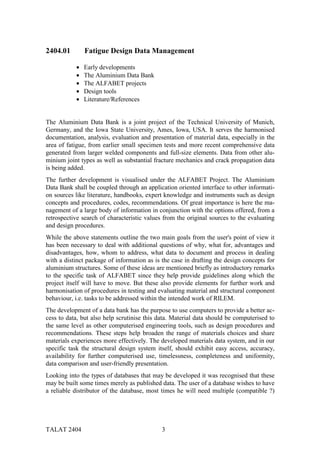
summarised in Figure 2404.01.01 and Figure 2404.01.02.

                                                            Standard Material Coupon Tests
                                                            *   Material Data
                                                            *   Stress-Life
                                                            *   Strain Life
                                                            *   Failure Location
                                                            *   Crack-Growth Rate

                                                            Material/Structural Coupon Design Verification Tests
                                                            *   Duplicate local geometrical details
                                                            *   Duplicate fabrication and service preparation details
                                                            *   Simulate expected service history

                                                            Component and Full-Scale Design Verification Tests
                                                            *  Duplicate complete fabrication history
                                                            *  Duplicate joining and set-up conditions
                                                            *  Simulate expected service history
                                                            *  Compare to or perform in-service measurements


                                                  alu

           Training in Aluminium Application Technologies
                                                                          Required Fatigue Data                     2404.01.01


TALAT 2404                                                                          4
Fatigue Test Data Format

        Material Identification                        Test Parameters and Procedures   Test Results and Analysis
        reference source,                              date                             no. of specimens
        data base or other                             test facility and engineer       rate of loading
                                                       test environment                 loading parameters
        Test identification                            testing machine and fixture      loading statistical data
        type, standard or other, date                  loading parameters               mechanical parameters
                                                       loading rate                     physical parameters
        Description of specimens                       strain instrumentation           strength or/and strain
        identification
                                                       data collection method             nominal, average
        preparation
                                                       sample rate                        standard deviation, coefficient
        joining procedure
                                                                                        failure location
        inspection and results
                                                                                        failure mode
        specimen layout reference
                                                                                        test validation, data quality
        specimen orientation
                                                                                        raw test data source
        specimen geometry
                                                                                        remarks, if any, such as
                                                                                          significant deviation
                                                                                          from standard

    Source: D. Kosteas, TUM

                                           alu

    Training in Aluminium Application Technologies
                                                             Fatigue Test Data Format                       2404.01.02

As will be seen in the following, several of these suggestions have already been taken
into account and have been incorporated in the format of the Aluminium Data Bank.

Early Developments

First decisive steps in the computerisation of fatigue test results in the form of a data
bank for aluminium can be traced back to initial work by Munse followed by efforts by
Sanders around 1970 who started the Welding Research Council Aluminium Data Bank
at Iowa State University [1]. Data were initially stored on punched cards.

Regressional analysis software was developed in the late sixties by Kosteas at the Uni-
versity of Karlsruhe [2] and applied thereafter on consecutive comprehensive
evaluations on aluminium fatigue test data. A cooperation was initiated in the early
eighties under the Committee on Aluminum Fatigue Data Exchange and Evaluation
(CAFDEE) [3] resulting since 1985 in a simultaneous installation and operation of the
Aluminium Data Bank at the Iowa State University and the Technical University of Mu-
nich.

One of the primary tasks of the last years has been the user-oriented adaptation of avail-
able aluminium test data and software for its evaluation, whereby the former main frame
computer operation has been abandoned in favour of the now broadly available personal
computers.

The logical extension and applicability in engineering design led to the concept of a ma-
nagement system for such material, technological, manufacturing, quality control and


TALAT 2404                                                                  5
reliability information and processes as needed during the design procedure of alumini-
um constructions, Figure 2404.01.03.


                                                             ALFABET
                                                           Expert System
                                                              Aluminium Data Bank
                                                                   Fatigue of
                                                              Aluminium Structures


                     Design Assessment                                                     Production
                          Reliability                                                      Literature
                     Fitness-for-Purpose                                                Expert Knowledge


                                                                   Interface
                                                                     to the
                                                                      User
    Source: D. Kosteas, TUM

                                           alu

    Training in Aluminium Application Technologies
                                                     Data Management- ALFABET Expert System       2404.01.03


The first task is complete by now and consists of what is understood as the Aluminium
Data Bank (ALDABA). The bank is itself a part of the second more comprehensive task,
the Aluminium Fatigue Behaviour Evaluation Task (ALFABET) Project. These two are
described in more detail in the following chapters.


The Aluminium Data Bank


The Original PC Version

In the first stage of the data bank, from 1987 to 1989, the use of commercially available
software was favoured since development and employment had to be performed in par-
allel. Extensive analyses, significant to drafting the ECCS European Recommendations
for fatigue design in aluminium, were carried out [4]. This work was invaluable in test-
ing procedures and providing decisions for future applications.

The data bank management was based on the dBase III+ software package. A positive
fact was the rather powerful structured query language (SQL) for data retrieval and sel-
ection. However concerning the user menu, graphics, colours or hardware programming
we were confronted by serious handicaps. In order to circumvent licence problems with
directly applicable programmes, i.e. *.EXE or *.COM files, dBase programme run-


TALAT 2404                                                              6
versions were constructed by means of the compiler system "Clipper". Available data
was stored in three parts:

                          (a) the literature data bank,
                          (b)the detail and data description data bank, and
                          (c) the fatigue test data points themselves and their mathematical processing.

Parts (a) and (b) were written in dBase III+, whereby the rather complex statistical for-
mulas of part (c) were executed in Pascal - all parts integrated to one programme by
means of "Clipper". Part (b) is essential to the user since it allows data set selection and
detail classification. A comprehensive parameter field has been covered by the format of
the detail description data bank, see Figure 2404.01.04.


    A. General                                       D. Welding Process and Procedure         E. Base Material
    1. Data Set No.                                  1. Welding Process                       1. Alloy Designation (4 Letter AA Designation)
    2. Literature No.                                2. Welding Procedure                     2. Temper or Heat Treatment
    3. Page No., Table No., etc.                     3. Welding Position                      3. Product Name or National Designation
    4. Test Year (19__)                              4. Filler Material (4 Letter AA)         4. Fabricator
    5. Confidential (Y/N)                            5. Filler Material (Product Name)        5. Product Form
    6. Last Check (dd/mm/yy)                         6. Welding Wire Diameter (mm)            6. Chemical Composition
    7. Remarks                                       7. Shielding Gas                         7. Tested Yield Strength (MPa)
                                                     8. Shielding Gas Flow Rate (l/min)       8. Yield Point Off-Set (%)
    B. Joint Description                             9. No. of Passes                         9. Tested Ultimate Strength (MPa)
    1. Basic Weld Type                               10. Welding Speed (cm/min)               10. Ultimate Strain (%)
    2. Edge Preparation                              11. Welding Current (Ampere)
    3. Weld Geometry                                 12. Welding Voltage (Volts)              F. Test Conditions
    Joint Dimensions                                 13. Non-destructive Examination          1. Test Machine
    4. R (mm)                                            Technique                            2. Mode of Loading
    5. F (mm)                                        14. Discontinuities                      3. Orientation of Weld and Load
    6. p (degrees)                                   15. Pre-Weld Treatment                   4. Environmental Conditions
    7. H (mm)                                        16. Post-weld Treatment I                5. Type of Loading
    8. D (mm)                                            (Notch Shape Modification Methods)   6. Temperature (°C)
                                                     17. Post-weld Treatment II               7. Frequency (Hz)
    C. Specimen Description
                                                         (Mechanical Treatments)              8. Failure Criteria
    1. Specimen Description
                                                     18. Post-weld Treatment III              9. Basis of Recorded Stress or Strain
    2. Thickness (mm)
                                                         (Thermal Methods)                    10. R-Ratio
    3. Width (mm)
    4. Tested Yield Strength (MPa)                                                            11. Number of Stress Levels
    5. Yield Point Off-Set (%)                                                                12. Number of Data Points
    6. Tested Ultimate Strength (MPa)
    7. Ultimate Strain (%)
    8. Gage Length (mm)
                                                                                                                     Source: D. Kosteas, TUM

                                           alu
                                                          Test Data Description Parameters                                 2404.01.04
    Training in Aluminium Application Technologies


The data bank primarily covered fatigue test data of various alloys in structural enginee-
ring applications (alloy groups 5xxx, 6xxx and 7xxx), base material and numerous wel-
ded joint types. The original CAFDEE data bank included approx. 15000 data points on
small specimens, which have now been to a large extend re-checked and validated.
Though interesting in many ways these older data on small specimens presented pro-
blems regarding the capability to lead to reliable conclusions [5]. There were serious
gaps in the documentation, even of geometrical or welding and, at times, testing para-
meters. Beyond this, small specimen data will not reflect actual component behaviour in
service. These facts have been widely acknowledged and led to decisions about 10 years
ago in the area of aluminium constructions for experimental research in fatigue and
eventually for evaluating carefully performed observations mainly on large components.


TALAT 2404                                                                     7
In the course of these comprehensive fatigue test series at the Technical University of
Munich between 1982 and 1990 a nucleus of approx. 1,000 extensively documented and
published data points on large structural components, beams, have been generated. Fur-
ther fatigue tests performed by industry on components and made available during the
recent recommendations drafting process [6] will hopefully become publicly available in
the near future. These, together with recent work performed by Fisher and Menzemer,
will increase the contingent to more than 2,500 data points. It should also be mentioned
that in the course of the last years' evaluation almost another 20,000 data points on small
specimens provided by industry [6] served in drafting the European Recommendations
[7, 8].


The New Version

A user-friendly data bank, allowing ready access to information and compatibility to all
other steps in the structural design procedures, should enable a simple, logical and relia-
ble dialogue with the user. This led to a menu-driven programme with controls against
unintended input errors.

Consequently the decision was made in 1989 to choose the latest Turbo-Pascal version
5.5 as the new programming language (this being at that time the only language allow-
ing object-oriented-programming). Another advantage for the user was reached by using
the much more rapid and reliable BIOS system to control input/output functions and
thus avoiding any harmonisation problems with other programmes.

A basic feature in this new version is the main menu, guiding the user through the whole
programme. An object-oriented window and menu management system had to be de-
veloped with simple mouse- or key-driven selection of programme functions. In a dialo-
gue with the user, further information may have to be supplied and its plausibility
checked immediately. Common compilers on the market did not offer such language ca-
pacities, so that all tools were written in assembler language, guaranteeing maximum
control of the hardware combined with maximum of operation speed.

In the last two years the statistical/regression data part of the bank, as well as the data in-
formation and data set description parts of the system was finished for mouse-supported
operation. The main menu appears on the screen, when typing "ALF.EXE", which out-
lines the capacities of the programme. The division into three main parts is established
through the menu points 'Literature Data', 'Data Description' and 'Fatigue Test Data' (see
Figure 2404.01.05).

Programming languages are planned to be flexible and open for each area, so normally
these languages provide no special features for screen or file handling. Pascal, as such a
programming code, offers no special routines for generating menus or other features. All
had to be developed and tested in first place. The aim was to give the whole system a
unique and simple outlook and operating capacity. Turbo-Pascal allows only a very
simple file handling, so further new tools had to be developed for writing and reading


TALAT 2404                                      8
so-called 'streams' into and from a file. A further comprehensive parameter field had to
be developed for covering the format of the literature description data bank (see Figure
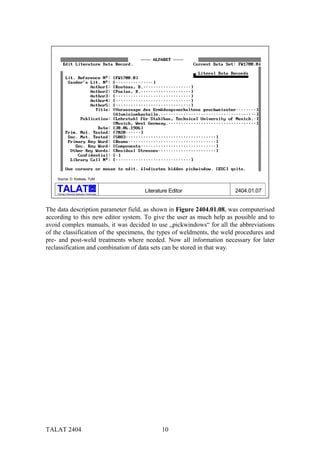
2404.01.06). To computerise this format another editor had to be written, which allows
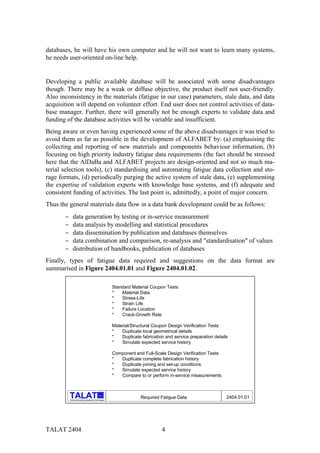
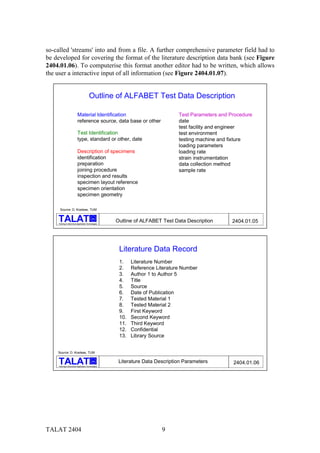
the user a interactive input of all information (see Figure 2404.01.07).


                                         Outline of ALFABET Test Data Description

                           Material Identification                              Test Parameters and Procedure
                           reference source, data base or other                 date
                                                                                test facility and engineer
                           Test Identification                                  test environment
                           type, standard or other, date                        testing machine and fixture
                                                                                loading parameters
                           Description of specimens                             loading rate
                           identification                                       strain instrumentation
                           preparation                                          data collection method
                           joining procedure                                    sample rate
                           inspection and results
                           specimen layout reference
                           specimen orientation
                           specimen geometry

      Source: D. Kosteas, TUM

                                            alu

     Training in Aluminium Application Technologies
                                                      Outline of ALFABET Test Data Description       2404.01.05


                                                       Literature Data Record
                                                       1.    Literature Number
                                                       2.    Reference Literature Number
                                                       3.    Author 1 to Author 5
                                                       4.    Title
                                                       5.    Source
                                                       6.    Date of Publication
                                                       7.    Tested Material 1
                                                       8.    Tested Material 2
                                                       9.    First Keyword
                                                       10.   Second Keyword
                                                       11.   Third Keyword
                                                       12.   Confidential
                                                       13.   Library Source


    Source: D. Kosteas, TUM

                                            alu
                                                       Literature Data Description Parameters        2404.01.06
     Training in Aluminium Application Technologies


TALAT 2404                                                               9
Source: D. Kosteas, TUM

                                           alu

    Training in Aluminium Application Technologies
                                                     Literature Editor   2404.01.07


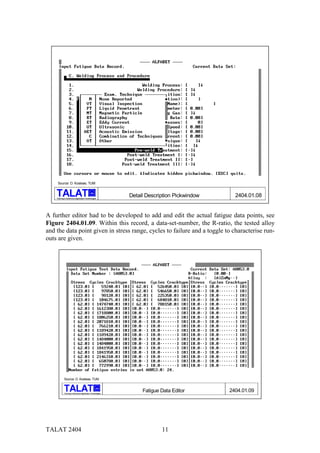
The data description parameter field, as shown in Figure 2404.01.08, was computerised
according to this new editor system. To give the user as much help as possible and to
avoid complex manuals, it was decided to use „pickwindows“ for all the abbreviations
of the classification of the specimens, the types of weldments, the weld procedures and
pre- and post-weld treatments where needed. Now all information necessary for later
reclassification and combination of data sets can be stored in that way.


TALAT 2404                                                  10
Source: D. Kosteas, TUM

                                             alu

    Training in Aluminium Application Technologies
                                                             Detail Description Pickwindow     2404.01.08


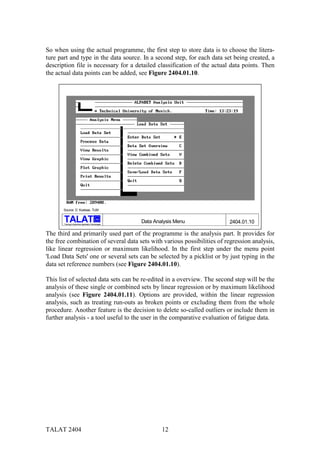
A further editor had to be developed to add and edit the actual fatigue data points, see
Figure 2404.01.09. Within this record, a data-set-number, the R-ratio, the tested alloy
and the data point given in stress range, cycles to failure and a toggle to characterise run-
outs are given.


            Source: D. Kosteas, TUM

                                                   alu

            Training in Aluminium Application Technologies
                                                                  Fatigue Data Editor        2404.01.09


TALAT 2404                                                                11
So when using the actual programme, the first step to store data is to choose the litera-
ture part and type in the data source. In a second step, for each data set being created, a
description file is necessary for a detailed classification of the actual data points. Then
the actual data points can be added, see Figure 2404.01.10.


       Source: D. Kosteas, TUM

                                              alu

       Training in Aluminium Application Technologies
                                                        Data Analysis Menu   2404.01.10

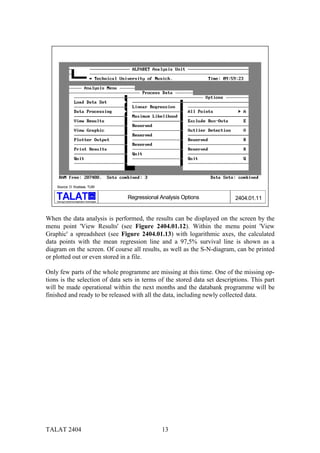
The third and primarily used part of the programme is the analysis part. It provides for
the free combination of several data sets with various possibilities of regression analysis,
like linear regression or maximum likelihood. In the first step under the menu point
'Load Data Sets' one or several sets can be selected by a picklist or by just typing in the
data set reference numbers (see Figure 2404.01.10).

This list of selected data sets can be re-edited in a overview. The second step will be the
analysis of these single or combined sets by linear regression or by maximum likelihood
analysis (see Figure 2404.01.11). Options are provided, within the linear regression
analysis, such as treating run-outs as broken points or excluding them from the whole
procedure. Another feature is the decision to delete so-called outliers or include them in
further analysis - a tool useful to the user in the comparative evaluation of fatigue data.


TALAT 2404                                                      12
Source: D. Kosteas, TUM

                                           alu
                                                     Regressional Analysis Options   2404.01.11
    Training in Aluminium Application Technologies


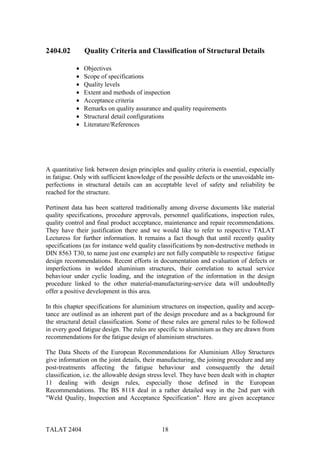
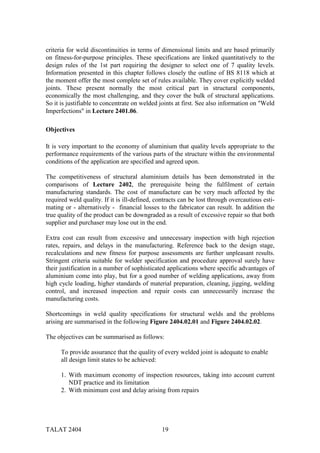
When the data analysis is performed, the results can be displayed on the screen by the
menu point 'View Results' (see Figure 2404.01.12). Within the menu point 'View
Graphic' a spreadsheet (see Figure 2404.01.13) with logarithmic axes, the calculated
data points with the mean regression line and a 97,5% survival line is shown as a
diagram on the screen. Of course all results, as well as the S-N-diagram, can be printed
or plotted out or even stored in a file.

Only few parts of the whole programme are missing at this time. One of the missing op-
tions is the selection of data sets in terms of the stored data set descriptions. This part
will be made operational within the next months and the databank programme will be
finished and ready to be released with all the data, including newly collected data.


TALAT 2404                                                        13
Source: D. Kosteas, TUM

                                          alu

   Training in Aluminium Application Technologies
                                                    Regressional Analysis Results    2404.01.12


                                           alu

   Training in Aluminium Application Technologies
                                                    S-N Diagram of Calculated Data   2404.01.13


TALAT 2404                                                       14
The ALFABET Project

Linking the Aluminium Data Bank as one information source to further such sources
and decision-forming tools (literature, handbooks, manuals, expert knowledge, the latter
being naturally limited in its availability by time or age) and then to design recommen-
dations, together with appropriate reliability and fitness-for-purpose estimates offers a
complete system for the design of aluminium structures. Of prime interest will be the
development of an interface between these information sources and the user, which will
provide guidance to the user allowing for design levels of varying sophistication degree
according to the desired application. Since respective efforts on the development of de-
sign recommendations have demonstrated the need for further clarification of manufac-
turing and quality control parameters to allow for reliable classification of structural
details, a close cooperation with the industrial side providing "manufacturing and weld-
ing technology" to supplement the above efforts on the "design technology" is strongly
recommended and desired.

Work associated with the development of the data bank as stated above is understood as
Phase I of this project. Phase II deals with the link between data description and data
analysis. As already pointed out this is of essential importance to the detail classification
and evaluation in the design procedure and reliability analysis. Extensive structural de-
tail description and fatigue data, see Figure 2404.01.01, supported by graphics and
cross-reference to detail design parameters, manufacturing options, quality criteria and
strength behaviour must be provided. In this step occurs also the input of corresponding
welding technology information to an extent appropriate and necessary to the
corresponding design and reliability level.

Several add-on packages occupy a position between Phases II and III, such as finite ele-
ment modelling and analysis, reliability analysis, fracture mechanics analysis and life
estimations. These are to be linked to respective material and component values as given
through the data bank. Work has already commenced in independent projects recording
such data.

In Phase III the actual integration of the above steps to the whole system has to be un-
dertaken, Figure 2404.01.14. It will provide the interface and feedback system for the
user. An essential part of this work is the verification, operability and close adaptation to
application needs of the system. It is self-evident that such an ambitious task can only be
carried out as a joint venture.

Continuing efforts to enhance the volume of the data bank are independent of the above
phases and will have to be performed parallel to other efforts and on a continuous basis
as new information from research or from further sources in literature keeps coming in.
Besides the large contingent of data as mentioned previously the following data input
tasks are being considered for the immediate future:


TALAT 2404                                     15
− further component test data in currently performed fatigue tests in Europe and
                 USA,
               − data as given in Japanese literature,
               − validation of component test data as outlined in [9],
               − comprehensive fracture mechanics properties data for aluminium alloys
                 currently being recorded at the TUM, and
               − extensive crack propagation test data generated by Jaccard [10] or Graf and
                 Kosteas [11,12] at the TUM in the early eighties for base material, weld metal
                 and HAZ material of different aluminium alloys and weldments under
                 variation of stress ratio and plate thickness.


             A. Rough goal definition                         Expert System for static and fatigue design formulation of application
             B. Initial Information Accumulation              1.   Literature survey and compilation
             (largely unstructured in this place)             2.   Information from practice
                                                              3.   Definitions
                                                              4.   Documentation of standard recommendations etc.
                                                                   cross section references to other documents
                                                                   design and manufacturing rules
                                                              5.   quality criteria
                                                                   Fitness for Purpose, NDT, Detail Classification
                                                              6.   Available software
                                                                   Drafting Software
             C. Knowledge Presentation                        Accumulated documentation material to be structured, ordered and presented
                                                              in an abstract and universal format
             D. Main Information Accumulation                 Application oriented, enhanced documentation
             E. Pilot or Prototype study                      Performed for a number of case-studies
                                                              Check ES format, alter, amend, re-check (Iteration)
             F. Detailed Study                                ES integration in actual working format
             G. System Development                            ES adaptation after D
             H. Check and Validation Phase                    Actual design cases compared to ES solution
             I. Installation and Acceptance Phase             Efficiency in industrial application
             J. Maintenance and Updating

  Source: D. Kosteas, TUM

                                         alu

  Training in Aluminium Application Technologies
                                                   Development Stages of the Expert Design System                             2404.01.14


Design Tools

A first item has been produced by the Technical University of Munich, the "Classifica-
tion and Design of Fatigue Loaded Aluminium Constructions" as a computerised ver-
sion of the "ERAAS Fatigue Design" rules. It comprises of a complete manual of the
recommendations, quick cross-references, a structural detail unit with full descriptions,
a survey menu for the selection of details and a complete design menu featuring all sig-
nificant spectrum input and performing the final fatigue assessment.

A demonstration of its application is given with the fatigue assessment calculation
example in Lecture 2402.


TALAT 2404                                                                     16
Literature/References

[1]   Sanders W. W., Jr. and Day R. H.: „Fatigue Behaviour of Aluminum Alloy
              Weldments“. WRC-Bulletin 286, Welding Research Council, New York,
              August 1983
[2]   Steinhard O. und Kosteas D.: „Die Schwingfestigkeit geschweißter
              Aluminiumverbindungen           aus      der       Sicht    optimierter
              Lebensdauerfunktionen“. Mitteilungen der Versuchsanstalt Stahl, Holz
              und Steine der Universität Karlsruhe, Reihe 3, Heft 5, 1971
[3]   Kosteas D., Kirou J., Sanders W. W., Jr.: „Fatigue Behaviour of Aluminium Alloy
              Weldments - A CAFDEE Report“. Vol. 1 to Vol. 4, Eng.Res.Inst., Iowa
              State University, Ames, 1986
[4]   Kosteas D., Uhry A.: „Fatigue Behaviour of Aluminium Structures - European
              Full Scale Tests“. CEC-COST 506 - EAA, Parts 2 to 3, Munich/Voreppe
              1989
[5]   Kosteas D.: „Influence of Residual Stresses on S-N Curve Parameters of
              Aluminium Weldments“. IIW-Doc XIII - 1239 - 87
[6]   Jaccard R.: „Unpublished Internal Reports and Materials“. Provided by Alusuisse,
              Zürich/Switzerland for the EAA ECCS Fatigue Workshops Munich and
              Zürich
[7]   Kosteas D.: „European Recommendations for Fatigue Design of Aluminium
              Structures“. Proc. International Conference for Aluminium Weldments,
              5th INALCO ‘92, Munich 27-29 April 1992
[8]   Sanders W. W., Jr., Maddox S. J., Kosteas D.: „Aluminium Fatigue Data -
              Description and Principles for Evaluation“. Proc. International
              Conference for Aluminium Weldments, 2nd INALCO ‘82, Munich May
              1982
[9]   Kosteas D.: „Contemplation on the ERAAS Fatigue, a State-of-the-Art of
              Developments“. ECCS Doc. 28.05.1986.
[10] Jaccard R.: „Einführung in die Bruchmechanik - Der Ermüdungsbruch“.
             Seminarreihe der Aluminium-Zentrale e.V., 12-13 September 1990,
             Meckenheim
[11] Graf U.: „Ermittlung der Kennwerte für den Ermüdungsrißfortschritt“.
           Seminarreihe der Aluminium-Zentrale e.V., 12-13 September 1990,
           Meckenheim
[12] Graf U.: Bruchmechanische Verfahren bei Aluminiumbauteilen“. Dissertation an
             der TU München in Berichten aus dem Konstruktiven Ingenieurbau,
             München 1992


TALAT 2404                                 17
2404.02         Quality Criteria and Classification of Structural Details

            •   Objectives
            •   Scope of specifications
            •   Quality levels
            •   Extent and methods of inspection
            •   Acceptance criteria
            •   Remarks on quality assurance and quality requirements
            •   Structural detail configurations
            •   Literature/References


A quantitative link between design principles and quality criteria is essential, especially
in fatigue. Only with sufficient knowledge of the possible defects or the unavoidable im-
perfections in structural details can an acceptable level of safety and reliability be
reached for the structure.

Pertinent data has been scattered traditionally among diverse documents like material
quality specifications, procedure approvals, personnel qualifications, inspection rules,
quality control and final product acceptance, maintenance and repair recommendations.
They have their justification there and we would like to refer to respective TALAT
Lecturess for further information. It remains a fact though that until recently quality
specifications (as for instance weld quality classifications by non-destructive methods in
DIN 8563 T30, to name just one example) are not fully compatible to respective fatigue
design recommendations. Recent efforts in documentation and evaluation of defects or
imperfections in welded aluminium structures, their correlation to actual service
behaviour under cyclic loading, and the integration of the information in the design
procedure linked to the other material-manufacturing-service data will undoubtedly
offer a positive development in this area.

In this chapter specifications for aluminium structures on inspection, quality and accep-
tance are outlined as an inherent part of the design procedure and as a background for
the structural detail classification. Some of these rules are general rules to be followed
in every good fatigue design. The rules are specific to aluminium as they are drawn from
recommendations for the fatigue design of aluminium structures.

The Data Sheets of the European Recommendations for Aluminium Alloy Structures
give information on the joint details, their manufacturing, the joining procedure and any
post-treatments affecting the fatigue behaviour and consequently the detail
classification, i.e. the allowable design stress level. They have been dealt with in chapter
11 dealing with design rules, especially those defined in the European
Recommendations. The BS 8118 deal in a rather detailed way in the 2nd part with
"Weld Quality, Inspection and Acceptance Specification". Here are given acceptance


TALAT 2404                                    18
criteria for weld discontinuities in terms of dimensional limits and are based primarily
on fitness-for-purpose principles. These specifications are linked quantitatively to the
design rules of the 1st part requiring the designer to select one of 7 quality levels.
Information presented in this chapter follows closely the outline of BS 8118 which at
the moment offer the most complete set of rules available. They cover explicitly welded
joints. These present normally the most critical part in structural components,
economically the most challenging, and they cover the bulk of structural applications.
So it is justifiable to concentrate on welded joints at first. See also information on "Weld
Imperfections" in Lecture 2401.06.

Objectives

It is very important to the economy of aluminium that quality levels appropriate to the
performance requirements of the various parts of the structure within the environmental
conditions of the application are specified and agreed upon.

The competitiveness of structural aluminium details has been demonstrated in the
comparisons of Lecture 2402, the prerequisite being the fulfilment of certain
manufacturing standards. The cost of manufacture can be very much affected by the
required weld quality. If it is ill-defined, contracts can be lost through overcautious esti-
mating or - alternatively - financial losses to the fabricator can result. In addition the
true quality of the product can be downgraded as a result of excessive repair so that both
supplier and purchaser may lose out in the end.

Extra cost can result from excessive and unnecessary inspection with high rejection
rates, repairs, and delays in the manufacturing. Reference back to the design stage,
recalculations and new fitness for purpose assessments are further unpleasant results.
Stringent criteria suitable for welder specification and procedure approval surely have
their justification in a number of sophisticated applications where specific advantages of
aluminium come into play, but for a good number of welding applications, away from
high cycle loading, higher standards of material preparation, cleaning, jigging, welding
control, and increased inspection and repair costs can unnecessarily increase the
manufacturing costs.

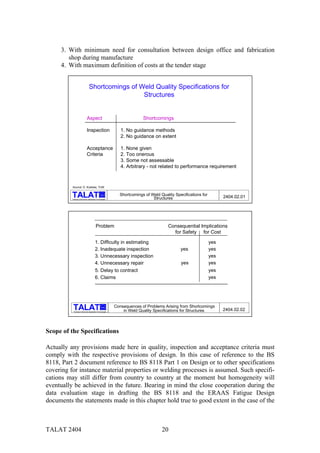
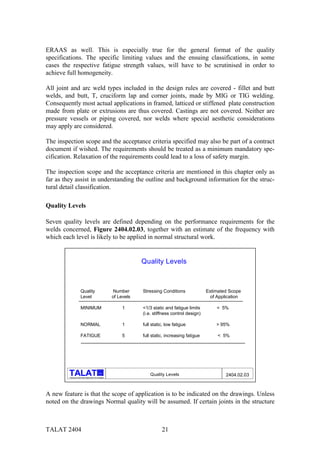
Shortcomings in weld quality specifications for structural welds and the problems
arising are summarised in the following Figure 2404.02.01 and Figure 2404.02.02.

The objectives can be summarised as follows:

      To provide assurance that the quality of every welded joint is adequate to enable
      all design limit states to be achieved:

      1. With maximum economy of inspection resources, taking into account current
         NDT practice and its limitation
      2. With minimum cost and delay arising from repairs


TALAT 2404                                     19
3. With minimum need for consultation between design office and fabrication
        shop during manufacture
     4. With maximum definition of costs at the tender stage


                                Shortcomings of Weld Quality Specifications for
                                                 Structures


                             Aspect                                       Shortcomings

                             Inspection                        1. No guidance methods
                                                               2. No guidance on extent

                             Acceptance                        1. None given
                             Criteria                          2. Too onerous
                                                               3. Some not assessable
                                                               4. Arbitrary - not related to performance requirement


          Source: D. Kosteas, TUM

                                                 alu          Shortcomings of Weld Quality Specifications for
          Training in Aluminium Application Technologies                       Structures                             2404.02.01


                                          Problem                                      Consequential Implications
                                                                                         for Safety for Cost

                                         1. Difficulty in estimating                                            yes
                                         2. Inadequate inspection                             yes               yes
                                         3. Unnecessary inspection                                              yes
                                         4. Unnecessary repair                                yes               yes
                                         5. Delay to contract                                                   yes
                                         6. Claims                                                              yes


                                                   alu      Consequences of Problems Arising from Shortcomings
           Training in Aluminium Application Technologies       in Weld Quality Specifications for Structures         2404.02.02


Scope of the Specifications

Actually any provisions made here in quality, inspection and acceptance criteria must
comply with the respective provisions of design. In this case of reference to the BS
8118, Part 2 document reference to BS 8118 Part 1 on Design or to other specifications
covering for instance material properties or welding processes is assumed. Such specifi-
cations may still differ from country to country at the moment but homogeneity will
eventually be achieved in the future. Bearing in mind the close cooperation during the
data evaluation stage in drafting the BS 8118 and the ERAAS Fatigue Design
documents the statements made in this chapter hold true to good extent in the case of the


TALAT 2404                                                                          20
ERAAS as well. This is especially true for the general format of the quality
specifications. The specific limiting values and the ensuing classifications, in some
cases the respective fatigue strength values, will have to be scrutinised in order to
achieve full homogeneity.

All joint and arc weld types included in the design rules are covered - fillet and butt
welds, and butt, T, cruciform lap and corner joints, made by MIG or TIG welding.
Consequently most actual applications in framed, latticed or stiffened plate construction
made from plate or extrusions are thus covered. Castings are not covered. Neither are
pressure vessels or piping covered, nor welds where special aesthetic considerations
may apply are considered.

The inspection scope and the acceptance criteria specified may also be part of a contract
document if wished. The requirements should be treated as a minimum mandatory spe-
cification. Relaxation of the requirements could lead to a loss of safety margin.

The inspection scope and the acceptance criteria are mentioned in this chapter only as
far as they assist in understanding the outline and background information for the struc-
tural detail classification.

Quality Levels

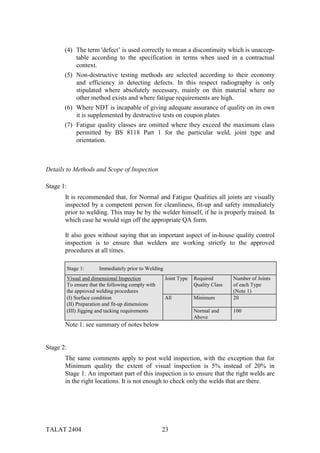
Seven quality levels are defined depending on the performance requirements for the
welds concerned, Figure 2404.02.03, together with an estimate of the frequency with
which each level is likely to be applied in normal structural work.


                                                                      Quality Levels


                       Quality                             Number     Stressing Conditions              Estimated Scope
                       Level                              of Levels                                       of Application

                       MINIMUM                                 1      <1/3 static and fatigue limits        < 5%
                                                                      (i.e. stiffness control design)

                       NORMAL                                  1      full static, low fatigue              > 95%

                       FATIGUE                                 5      full static, increasing fatigue        < 5%


                                                alu
                                                                          Quality Levels                         2404.02.03
         Training in Aluminium Application Technologies


A new feature is that the scope of application is to be indicated on the drawings. Unless
noted on the drawings Normal quality will be assumed. If certain joints in the structure


TALAT 2404                                                                      21
require a fatigue strength in excess of Class 20 (in the BS 8118, i.e. fatigue strength
design value at 2*106 cycles) the required class (above Class 20) will be marked on the
drawings.

This ensures maximum economy by directing quality control resources to those areas
which particularly need them.


Extent and Methods of Inspection

This part is not directly involved in the design procedure, it is rather the product of its
application, the acceptance criteria, that interest the design engineer and influence the
classification of structural details. Nevertheless, since it inherently affects the
acceptance criteria themselves and since, as mentioned, it has to be integrated in the
reliability and economic considerations it has been decided to include this information.

The four main methods of assuring weld quality are of equal importance:
       − ensuring that a viable welding procedure is implemented
       − ensuring that operatives are competent
       − ensuring that quality is controlled during production
       − ensuring that the f i n a l product meets the required quality standard

The first two items are ensured by requiring procedures and welders to be tested in
accordance with respective specifications. The third item, quality control during produc-
tion, is considered to be primarily the responsibility of the fabricator, so that there are no
mandatory requirements at this stage apart from the inspection of joints prior to welding.

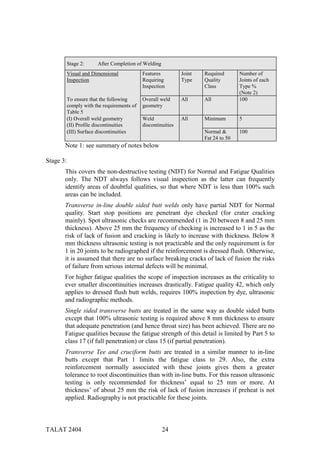
Methods and scope of final inspection of the product are summarised in the tables
below. The inspection procedure is divided in four stages:
       (a) immediately prior to welding - visual and dimensional inspection -,
       (b) after completion of welding - visual and dimensional inspection -,
       (c) after visual inspection - non destructive testing -, and
       (d) after non destructive testing - inspection through destructive testing.

Efficient deployment of inspection resources is essential and inspection should be
increased according to the following rules:
       (1) Visual inspection is still considered to be the most important method
       (2) The scope of inspection is increased where high quality level is necessary
           for performance. In this transversely stressed welds are given more
           inspection than longitudinally stressed welds
       (3) The scope of inspection is increased where joint and weld types require
           more welding skill and may be more prone to defects, i.e. single sided butt
           welds.


TALAT 2404                                     22
(4) The term 'defect’ is used correctly to mean a discontinuity which is unaccep-
           table according to the specification in terms when used in a contractual
           context.
       (5) Non-destructive testing methods are selected according to their economy
           and efficiency in detecting defects. In this respect radiography is only
           stipulated where absolutely necessary, mainly on thin material where no
           other method exists and where fatigue requirements are high.
       (6) Where NDT is incapable of giving adequate assurance of quality on its own
           it is supplemented by destructive tests on coupon plates
       (7) Fatigue quality classes are omitted where they exceed the maximum class
           permitted by BS 8118 Part 1 for the particular weld, joint type and
           orientation.


Details to Methods and Scope of Inspection

Stage 1:
       It is recommended that, for Normal and Fatigue Qualities all joints are visually
       inspected by a competent person for cleanliness, fit-up and safety immediately
       prior to welding. This may be by the welder himself, if he is properly trained. In
       which case he would sign off the appropriate QA form.

       It also goes without saying that an important aspect of in-house quality control
       inspection is to ensure that welders are working strictly to the approved
       procedures at all times.

           Stage 1:      Immediately prior to Welding
           Visual and dimensional Inspection            Joint Type   Required        Number of Joints
           To ensure that the following comply with                  Quality Class   of each Type
           the approved welding procedures                                           (Note 1)
           (I) Surface condition                        All          Minimum         20
           (II) Preparation and fit-up dimensions
           (III) Jigging and tacking requirements                    Normal and      100
                                                                     Above
       Note 1: see summary of notes below


Stage 2:
       The same comments apply to post weld inspection, with the exception that for
       Minimum quality the extent of visual inspection is 5% instead of 20% in
       Stage 1. An important part of this inspection is to ensure that the right welds are
       in the right locations. It is not enough to check only the welds that are there.


TALAT 2404                                            23
Stage 2:     After Completion of Welding
           Visual and Dimensional            Features          Joint   Required       Number of
           Inspection                        Requiring         Type    Quality        Joints of each
                                             Inspection                Class          Type %
                                                                                      (Note 2)
           To ensure that the following      Overall weld      All     All            100
           comply with the requirements of   geometry
           Table 5
           (I) Overall weld geometry         Weld              All     Minimum        5
           (II) Profile discontinuities      discontinuities
           (III) Surface discontinuities                               Normal &       100
                                                                       Fat 24 to 50
       Note 1: see summary of notes below

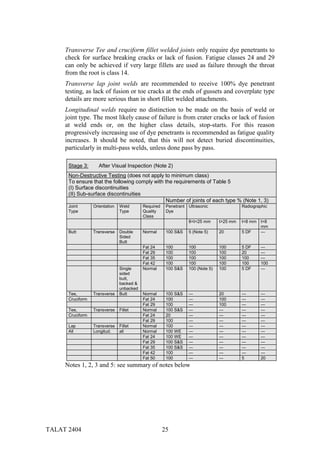
Stage 3:
       This covers the non-destructive testing (NDT) for Normal and Fatigue Qualities
       only. The NDT always follows visual inspection as the latter can frequently
       identify areas of doubtful qualities, so that where NDT is less than 100% such
       areas can be included.
       Transverse in-line double sided butt welds only have partial NDT for Normal
       quality. Start stop positions are penetrant dye checked (for crater cracking
       mainly). Spot ultrasonic checks are recommended (1 in 20 between 8 and 25 mm
       thickness). Above 25 mm the frequency of checking is increased to 1 in 5 as the
       risk of lack of fusion and cracking is likely to increase with thickness. Below 8
       mm thickness ultrasonic testing is not practicable and the only requirement is for
       1 in 20 joints to be radiographed if the reinforcement is dressed flush. Otherwise,
       it is assumed that there are no surface breaking cracks of lack of fusion the risks
       of failure from serious internal defects will be minimal.
       For higher fatigue qualities the scope of inspection increases as the criticality to
       ever smaller discontinuities increases drastically. Fatigue quality 42, which only
       applies to dressed flush butt welds, requires 100% inspection by dye, ultrasonic
       and radiographic methods.
       Single sided transverse butts are treated in the same way as double sided butts
       except that 100% ultrasonic testing is required above 8 mm thickness to ensure
       that adequate penetration (and hence throat size) has been achieved. There are no
       Fatigue qualities because the fatigue strength of this detail is limited by Part 5 to
       class 17 (if full penetration) or class 15 (if partial penetration).
       Transverse Tee and cruciform butts are treated in a similar manner to in-line
       butts except that Part 1 limits the fatigue class to 29. Also, the extra
       reinforcement normally associated with these joints gives them a greater
       tolerance to root discontinuities than with in-line butts. For this reason ultrasonic
       testing is only recommended for thickness’ equal to 25 mm or more. At
       thickness’ of about 25 mm the risk of lack of fusion increases if preheat is not
       applied. Radiography is not practicable for these joints.


TALAT 2404                                            24
Transverse Tee and cruciform fillet welded joints only require dye penetrants to
     check for surface breaking cracks or lack of fusion. Fatigue classes 24 and 29
     can only be achieved if very large fillets are used as failure through the throat
     from the root is class 14.
     Transverse lap joint welds are recommended to receive 100% dye penetrant
     testing, as lack of fusion or toe cracks at the ends of gussets and coverplate type
     details are more serious than in short fillet welded attachments.
     Longitudinal welds require no distinction to be made on the basis of weld or
     joint type. The most likely cause of failure is from crater cracks or lack of fusion
     at weld ends or, on the higher class details, stop-starts. For this reason
     progressively increasing use of dye penetrants is recommended as fatigue quality
     increases. It should be noted, that this will not detect buried discontinuities,
     particularly in multi-pass welds, unless done pass by pass.

      Stage 3:      After Visual Inspection (Note 2)
      Non-Destructive Testing (does not apply to minimum class)
      To ensure that the following comply with the requirements of Table 5
      (I) Surface discontinuities
      (II) Sub-surface discontinuities
                                                Number of joints of each type % (Note 1, 3)
      Joint       Orientation   Weld       Required    Penetrant Ultrasonic               Radiographic
      Type                      Type       Quality     Dye
                                           Class
                                                                 8<t<25 mm      t>25 mm   t<8 mm   t>8
                                                                                                   mm
      Butt        Transverse    Double     Normal      100 S&S   5 (Note 5)     20        5 DF     ---
                                Sided
                                Butt
                                           Fat 24      100       100            100       5 DF     ---
                                           Fat 29      100       100            100       20       ---
                                           Fat 35      100       100            100       100      ---
                                           Fat 42      100       100            100       100      100
                                Single     Normal      100 S&S   100 (Note 5)   100       5 DF     ---
                                sided
                                butt,
                                backed &
                                unbacked
      Tee,        Transverse    Butt       Normal      100 S&S   ---            20        ---      ---
      Cruciform                            Fat 24      100       ---            100       ---      ---
                                           Fat 29      100       ---            100       ---      ---
      Tee,        Transverse    Fillet     Normal      100 S&S   ---            ---       ---      ---
      Cruciform                            Fat 24      20        ---            ---       ---      ---
                                           Fat 29      100       ---            ---       ---      ---
      Lap         Transverse    Fillet     Normal      100       ---            ---       ---      ---
      All         Longitud.     all        Normal      100 WE    ---            ---       ---      ---
                                           Fat 24      100 WE    ---            ---       ---      ---
                                           Fat 29      100 S&S   ---            ---       ---      ---
                                           Fat 35      100 S&S   ---            ---       ---      ---
                                           Fat 42      100       ---            ---       ---      ---
                                           Fat 50      100       ---            ---       5        20
     Notes 1, 2, 3 and 5: see summary of notes below


TALAT 2404                                            25
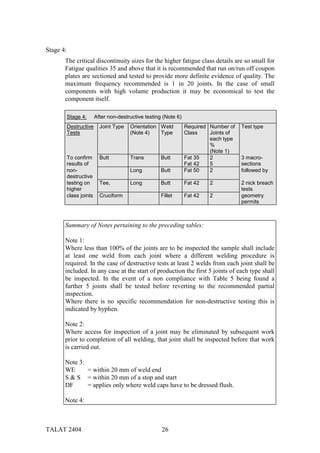
Stage 4:
       The critical discontinuity sizes for the higher fatigue class details are so small for
       Fatigue qualities 35 and above that it is recommended that run on/run off coupon
       plates are sectioned and tested to provide more definite evidence of quality. The
       maximum frequency recommended is 1 in 20 joints. In the case of small
       components with high volume production it may be economical to test the
       component itself.

           Stage 4:       After non-destructive testing (Note 6)
           Destructive      Joint Type   Orientation Weld          Required Number of   Test type
           Tests                         (Note 4)    Type          Class    Joints of
                                                                            each type
                                                                            %
                                                                            (Note 1)
           To confirm       Butt         Trans         Butt        Fat 35   2           3 macro-
           results of                                              Fat 42   5           sections
           non-                          Long          Butt        Fat 50   2           followed by
           destructive
           testing on       Tee,         Long          Butt        Fat 42   2           2 nick breach
           higher                                                                       tests
           class joints     Cruciform                  Fillet      Fat 42   2           geometry
                                                                                        permits


       Summary of Notes pertaining to the preceding tables:

       Note 1:
       Where less than 100% of the joints are to be inspected the sample shall include
       at least one weld from each joint where a different welding procedure is
       required. In the case of destructive tests at least 2 welds from each joint shall be
       included. In any case at the start of production the first 5 joints of each type shall
       be inspected. In the event of a non compliance with Table 5 being found a
       further 5 joints shall be tested before reverting to the recommended partial
       inspection.
       Where there is no specific recommendation for non-destructive testing this is
       indicated by hyphen.

       Note 2:
       Where access for inspection of a joint may be eliminated by subsequent work
       prior to completion of all welding, that joint shall be inspected before that work
       is carried out.

       Note 3:
       WE      = within 20 mm of weld end
       S & S = within 20 mm of a stop and start
       DF      = applies only where weld caps have to be dressed flush.

       Note 4:


TALAT 2404                                             26
'Transverse' applies to all welds whose axes are orientated at an angle greater
       than 45° to the longitudinal axis of the member. Welds whose angles are less
       than 45° shall be treated as 'longitudinal.

       All welds within 100 mm of the connection between load-carrying members or
       main loading points shall be treated as 'transverse'.

       Note 5:
       Radiography may be used in place of ultrasonic inspection for detection
       purposes. However ultrasonic inspection may be required for assessment of the
       compliance of discontinuities with Table B2.

       Note 6:
       Where run-off test plates are used for destructive testing they shall be located so
       that they comply with Note 1. Where production components are to be sampled
       for destructive tests the appropriate additional number of components shall be
       made at the time of production.


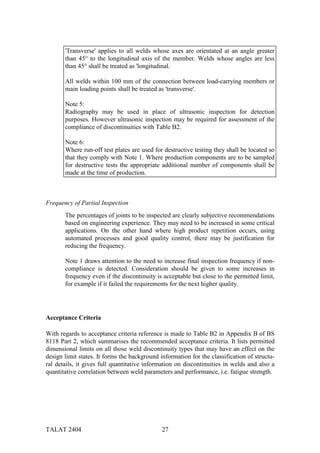
Frequency of Partial Inspection
       The percentages of joints to be inspected are clearly subjective recommendations
       based on engineering experience. They may need to be increased in some critical
       applications. On the other hand where high product repetition occurs, using
       automated processes and good quality control, there may be justification for
       reducing the frequency.

       Note 1 draws attention to the need to increase final inspection frequency if non-
       compliance is detected. Consideration should be given to some increases in
       frequency even if the discontinuity is acceptable but close to the permitted limit,
       for example if it failed the requirements for the next higher quality.


Acceptance Criteria

With regards to acceptance criteria reference is made to Table B2 in Appendix B of BS
8118 Part 2, which summarises the recommended acceptance criteria. It lists permitted
dimensional limits on all those weld discontinuity types that may have an effect on the
design limit states. It forms the background information for the classification of structu-
ral details, it gives full quantitative information on discontinuities in welds and also a
quantitative correlation between weld parameters and performance, i.e. fatigue strength.


TALAT 2404                                    27
The following main features are mentioned:

(a) it covers all seven quality levels. The higher the performance requirement, the higher
    will be the required level. In most cases the higher the quality the smaller is the
    allowable discontinuity size
(b) the minimum and fatigue quality levels are intended to be applied to specific joints,
    as required, rather then complete structures.
(c) the dimensional measurements are defined by reference to diagrams of typical
    structural joints.
(d) the discontinuities are grouped into four categories, each relating to particular
    inspection techniques. Overall geometry and profile measurements will be visual
    with the aid of measuring tapes and weld gauges. Surface breaking discontinuities
    will be visually inspected with the aid of weld gauges and penetrant dyes.
    Subsurface discontinuities will be determined by ultrasonic and radiographic
    techniques.
(e) The permitted dimensional limits are determined primarily on a fitness for purpose
    basis (FFP), assuming maximum stresses permitted by Part 1. However, FFP would
    for one reason or another allow gross discontinuities which are indicative of serious
    lapses of quality control, either in material or workmanship, their sizes are limited
    for practical reasons.
(f) The permitted discontinuity sizes for longitudinally stresses welds are often
    significantly relaxed over those for transverse welds according to FFP criteria. This
    can have important economic benefits, particularly in structures such as rail vehicles
    where the welds are predominantly stresses in the longitudinal direction. In framed
    or lattice structures the definition of 'longitudinal' and 'transverse' in Note 4 should
    be clear. In more complex structures, e.g. stiffened shells, the 'longitudinal' welds
    should be labelled as such on the drawings to obtain the necessary benefits.
(g) Characterisation of subsurface discontinuities is kept to a minimum to avoid
    unnecessary inspection problems.
(h) The symbols and terminology are consistent with those in ISO/DIS 10 042.2 where
    applicable.
(i) The tabled information on acceptance criteria of BS 8118 (Table B2 in Appendix B,
    Part 2) is intended to be suitable for use by inspectors and welding engineers in the
    fabrication shop without recourse to the designer. For this reason permitted methods
    of rectification of non-confirming welds are given in the final column of the table.
   Only in the cases where major dismantling of the joint would be required has the
   designer to be consulted.

In cases where the stressing conditions are known to be very low and when delay for
repair might be very expensive to the contract, the designer may be asked to do an
engineering critical assessment (ECA). This course of action should not be encouraged
as a general practice.


TALAT 2404                                    28
The prime technical objective of the table is to ensure that the risk of failure from a weld
discontinuity is not greater than that from any other cause considered by Part 1. At the
same time discontinuity limits must not be so restrictive that the cost of welding and risk
of repair is unacceptable.

The prime contractual objective of the table is to ensure that it is both comprehensive in
its coverage and comprehensible to welding engineers and inspectors. Technical
correctness is of no avail if the requirements are incorrectly interpreted.

These objectives presented a formidable task when the number of influencing factors
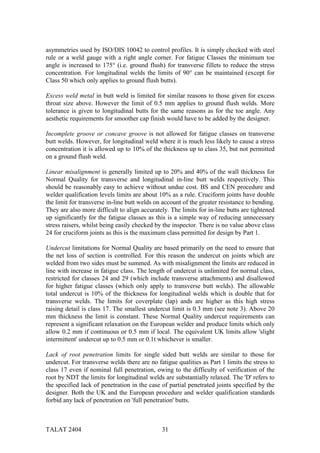
was taken into account. Figure 2404.02.04 lists the main ones. Even if only three values
were ascribed to each variable the number of possible permutations would exceed 10
million!


                  Variables Affecting Acceptability of Discontinuities
       Main Factor                                                            Variables

       DETAIL GEOMETRY                                                        Member Type
                                                                              Joint Type
                                                                              Weld Type
                                                                              Orientation of weld axis to member axis

       PERFORMANCE REQUIREMENT
       Loading Types                                                          Static
                                                                              Cyclic
       Stress Pattern                                                         Tension
                                                                              Compression
                                                                              Shear
                                                                              Severity of gradient
                                                                              Orientation of stress to weld axis
       WELD DISCONTINUITY                                                     Type
                                                                              Orientation of discontinuity to stress
                                                                              Size
                                                                              Location
     Source: D. Kosteas, TUM

                                            alu       Variables Affecting Acceptability of Discontinuities             2404.02.04
     Training in Aluminium Application Technologies


The problem was one of grouping and simplifying the variables so that the most
dominant parameters were retained. For example no distinction is made between welds
in tension or compression. Any effect on fatigue is ignored by Part 1. The extra
communication problems of labelling tension and compression on the drawings and
ensuring correct interpretation in the fabrication shop was not considered to be worth
the effort.

´Orientation´ is an all important factor. A further simplifying assumption was that
longitudinal welds away from main joints and loading points would be required to
transmit primarily shear force.


TALAT 2404                                                                     29
The assumption is made that all modes of failure are by ductile tearing and that any
growth of a discontinuity under cyclic loading must be limited to ensure that failure by
plastic collapse does not occur prior to the end of the design life of the joint.

The table does not pretend to solve all quality problems. One of the many difficulties is
the limitation of current commercial NDT techniques to detect, characterise and
(particularly) measure the dimension of small embedded discontinuities. For the higher
classes, where it is considered that measurement is impracticable, if it is large enough to
be detected and characterised then it is assumed to be large enough not to be permitted.
This may lead to some argument, but hopefully, as the higher class qualities will not be
required very often, it should not have a serious effect overall. For this reason it is very
important that the designer does not overspecify the required quality level.


Detailed comments on individual acceptance criteria:

Overall geometry involves checking that the right weld is in the right place and of the
right length. This may seem an obvious requirement, but it needs stating, as this can be
the one of the most serious sources of error of all. The dimension D is the nominal
dimension, weld type etc. specified on the drawings.

Throat thickness in butt welds is defined in the symbol drawings as the minimum
transverse distance between the two joints surfaces. This takes into account the effect of
cap profile and lack of penetration. For fillet welds the same applies, but here the root
gap must be taken into account if it is known. There is no negative tolerance on throat
size as there is no practical NDT method for measuring true throat on fillets and their
butts. In order to avoid unnecessary repair due to local non-compliance on average value
over 50 mm may be used for Minimum and Normal class. Local shortfalls in throat can
become more significant in fatigue situations and so the averaging is not permitted. For
Normal class an upper tolerance of +5 mm is allowed for fillet welds to alert the
inspector to instances where the procedure has not been followed. It also may imply
excessive heat input which could give rise to weld metal cracking or extensive softening
which might not occur in the original procedure.

Leg length of a fillet weld has no negative tolerance. This ensures that risk of failure
from the fusion boundary rather than the throat is avoided. As compared with throat
thickness, the average facility is not allowed for the highest fatigue classes only (which
only applies to longitudinal welds) in order to control variations in profile. There is no
limits on asymmetry of the 2 legs as in ISO/DIS 10042, which is considered to be an
unnecessary waste of inspection effort on production welds in structure.

Toe angle has a minimum limit of 90° for Normal Class. This is chosen to be an easy
method of avoiding unacceptable convex weld profiles which may obscure lack of
fusion (cold lap). It avoids the current practise of having to assess weld profile shape on
the basis of profile comparison diagrams. The toe angle is considered to be a more
important (and more easily measured) parameter than the cap shape and leg


TALAT 2404                                    30
asymmetries used by ISO/DIS 10042 to control profiles. It is simply checked with steel
rule or a weld gauge with a right angle corner. For fatigue Classes the minimum toe
angle is increased to 175° (i.e. ground flush) for transverse fillets to reduce the stress
concentration. For longitudinal welds the limits of 90° can be maintained (except for
Class 50 which only applies to ground flush butts).

Excess weld metal in butt weld is limited for similar reasons to those given for excess
throat size above. However the limit of 0.5 mm applies to ground flush welds. More
tolerance is given to longitudinal butts for the same reasons as for the toe angle. Any
aesthetic requirements for smoother cap finish would have to be added by the designer.

Incomplete groove or concave groove is not allowed for fatigue classes on transverse
butt welds. However, for longitudinal weld where it is much less likely to cause a stress
concentration it is allowed up to 10% of the thickness up to class 35, but not permitted
on a ground flush weld.

Linear misalignment is generally limited up to 20% and 40% of the wall thickness for
Normal Quality for transverse and longitudinal in-line butt welds respectively. This
should be reasonably easy to achieve without undue cost. BS and CEN procedure and
welder qualification levels limits are about 10% as a rule. Cruciform joints have double
the limit for transverse in-line butt welds on account of the greater resistance to bending.
They are also more difficult to align accurately. The limits for in-line butts are tightened
up significantly for the fatigue classes as this is a simple way of reducing unnecessary
stress raisers, whilst being easily checked by the inspector. There is no value above class
24 for cruciform joints as this is the maximum class permitted for design by Part 1.

Undercut limitations for Normal Quality are based primarily on the need to ensure that
the net loss of section is controlled. For this reason the undercut on joints which are
welded from two sides must be summed. As with misalignment the limits are reduced in
line with increase in fatigue class. The length of undercut is unlimited for normal class,
restricted for classes 24 and 29 (which include transverse attachments) and disallowed
for higher fatigue classes (which only apply to transverse butt welds). The allowable
total undercut is 10% of the thickness for longitudinal welds which is double that for
transverse welds. The limits for coverplate (lap) ands are higher as this high stress
raising detail is class 17. The smallest undercut limit is 0.3 mm (see note 3). Above 20
mm thickness the limit is constant. These Normal Quality undercut requirements can
represent a significant relaxation on the European welder and produce limits which only
allow 0.2 mm if continuous or 0.5 mm if local. The equivalent UK limits allow 'slight
intermittent' undercut up to 0.5 mm or 0.1t whichever is smaller.

Lack of root penetration limits for single sided butt welds are similar to those for
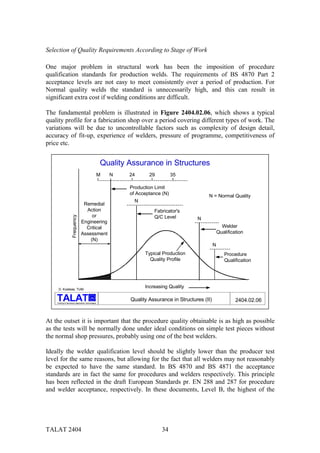
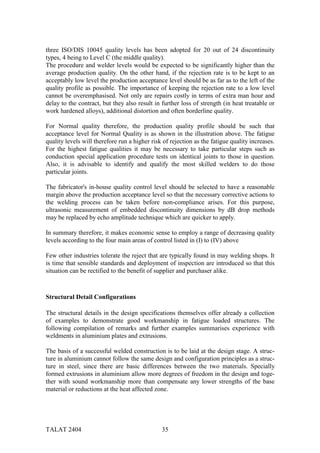
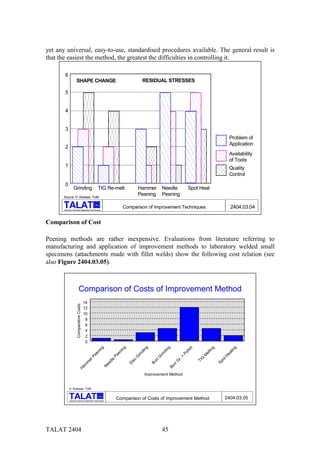
undercut. For transverse welds there are no fatigue qualities as Part 1 limits the stress to
class 17 even if nominal full penetration, owing to the difficulty of verification of the
root by NDT the limits for longitudinal welds are substantially relaxed. The 'D' refers to
the specified lack of penetration in the case of partial penetrated joints specified by the
designer. Both the UK and the European procedure and welder qualification standards
forbid any lack of penetration on 'full penetration' butts.


TALAT 2404                                    31
Porosity is limited to a 2 mm diameter pores if surface breaking. There is also a limit of
10% nominal loss of section on any line parallel to the weld aims for transversely loaded
welds (20% if longitudinal). There are no specified limits for embedded porosity as it
cannot be accessed properly without radiography which is not specified for Normal
Quality. The main practical limitation on porosity is really the degree to which it
obscures other more serious discontinuities. In which case an ultrasonic inspector may
reject it for that reason, if bad enough. For fatigue classes the limits are tightened up.
The specification is very much simpler to apply than the welder and procedure
qualification specifications which have separate criteria for many different cavity types.

Lack of fusion is permitted to a limited degree on a fitness-for-purpose basis. It must be
remembered that structural designers specify more partially fused joints (fillets and
partial penetration butts) that fully fused joints. To extend the procedure and welder
qualification requirements of 'no lack of fusion' to all production welds is therefore
grossly uneconomical. The danger is that if the inspector cannot characterise the
discontinuity properly it is likely to be rejected if it looks like lack of fusion. Also, with
MIG welding minor lack of fusion occurrences are difficult to avoid from time to time.
Surface breaking lack of fusion is forbidden for Normal Quality and above. This is
because it is potentially much more damaging than embedded lack of fusion,
particularly at a weld toe. Being planar, lack of fusion is more crack-like. Within 6 mm
of the surface the length is strictly limited except for longitudinal welds. If more than 6
mm below the surface it is acceptable up to a nominal initial area loss of 5% for
transverse welds and 10% for longitudinal. These are expressed as limits on
accumulated length over 100 mm or 1.5t and 3r for transverse and longitudinal welds
respectively, which gives the above area losses for a 3 mm high lack of fusion. This is
the only height limit, as NDT cannot measure smaller limits adequately. Lack of fusion
above 3 mm was considered to amount to unacceptability poor welding and hence was
rejected on grounds of loss of quality control.

Cracks are not permitted except for crater cracks where Minimum Class is allowed.
Small HAZ cracks do occur in 6000 series alloys from time to time. If they are small
enough not to be detected or characterised as such by NDT then they would be unlikely
to impair the performance of the joint. Otherwise cracks are considered unacceptable on
the grounds that they represent a serious departure in control of welding metallurgy.

Acceptable remedial measures are given in the last column of the table, should non-
conformities be found. These may be repairs by grinding out only or grinding followed
by welding. Only in the case of serious errors where the joint has to be fully taken apart
and remade does the engineer (designer) have to be involved.


TALAT 2404                                     32
Remarks on Quality Assurance and Quality Requirements

The basic aim of quality assurance is to provide evidence to the purchaser that the
necessary quality of a product has been achieved. For this reason it is necessary to define
the required quality and to provide sufficient data that the purchaser can be convinced
that the quality has been met.

It is important not to confuse these two issues. Figure 2404.02.05 illustrates this point.
The minimum required quality in the production of welds should normally be higher
than that needed to obtain the required performance. It is the designer's responsibility to
define the performance requirement.


                                                      Quality Assurance in Structures

                                                       QUALITY                                ASSURANCE


                                  Performance Requirements *                               Extent of Inspection
                                                                                         (Minimum Mandatory***)
                                   depend only on the required:                        depends on:
                                   1. static strength**                                performance requirements
                                   2. fatigue strength                                 likelihood of welding problem


                                                         *     Tempered by some Q/C considerations
                                                         **    Gross deformability not included
                                                         ***   May be increased for very critical applications


      D. Kosteas, TUM

                                            alu

     Training in Aluminium Application Technologies
                                                                  Quality Assurance in Structures (I)              2404.02.05


If the purchaser wants greater assurance that the required quality has been met, and is
willing to pay for it, then the scope and methods of testing should be extended. If these
need to be increased for particular critical applications the contract documents can
impose additional requirements.

In the author's view, additional assurance of performance should not be obtained by
increasing the required quality level above what is needed. The money is better spent on
ensuring that the original quality has actually been met. For example partial inspection
may be increased to 100% inspection on critical welds.

From the point of view of welder morale it is much better that repairs are done only
where really necessary, rather than for some arbitrary reason unrelated to the service
requirements of the product.


TALAT 2404                                                                        33
Selection of Quality Requirements According to Stage of Work

One major problem in structural work has been the imposition of procedure
qualification standards for production welds. The requirements of BS 4870 Part 2
acceptance levels are not easy to meet consistently over a period of production. For
Normal quality welds the standard is unnecessarily high, and this can result in
significant extra cost if welding conditions are difficult.

The fundamental problem is illustrated in Figure 2404.02.06, which shows a typical
quality profile for a fabrication shop over a period covering different types of work. The
variations will be due to uncontrollable factors such as complexity of design detail,
accuracy of fit-up, experience of welders, pressure of programme, competitiveness of
price etc.


                                                     Quality Assurance in Structures
                                                     M   N   24      29          35

                                                             Production Limit
                                                             of Acceptance (N)                 N = Normal Quality
                                                               N
                                  Remedial
                                   Action                              Fabricator's
                                      or
                     Frequency


                                                                       Q/C Level          N
                                 Engineering
                                   Critical                                                               Welder
                                 Assessment                                                             Qualification
                                     (N)
                                                                                                    N
                                                                   Typical Production                      Procedure
                                                                     Quality Profile                       Qualification


     D. Kosteas, TUM
                                                                   Increasing Quality

                                           alu

    Training in Aluminium Application Technologies
                                                             Quality Assurance in Structures (II)                2404.02.06


At the outset it is important that the procedure quality obtainable is as high as possible
as the tests will be normally done under ideal conditions on simple test pieces without
the normal shop pressures, probably using one of the best welders.

Ideally the welder qualification level should be slightly lower than the producer test
level for the same reasons, but allowing for the fact that all welders may not reasonably
be expected to have the same standard. In BS 4870 and BS 4871 the acceptance
standards are in fact the same for procedures and welders respectively. This principle
has been reflected in the draft European Standards pr. EN 288 and 287 for procedure
and welder acceptance, respectively. In these documents, Level B, the highest of the


TALAT 2404                                                                34
three ISO/DIS 10045 quality levels has been adopted for 20 out of 24 discontinuity
types, 4 being to Level C (the middle quality).
The procedure and welder levels would be expected to be significantly higher than the
average production quality. On the other hand, if the rejection rate is to be kept to an
acceptably low level the production acceptance level should be as far as to the left of the
quality profile as possible. The importance of keeping the rejection rate to a low level
cannot be overemphasised. Not only are repairs costly in terms of extra man hour and
delay to the contract, but they also result in further loss of strength (in heat treatable or
work hardened alloys), additional distortion and often borderline quality.

For Normal quality therefore, the production quality profile should be such that
acceptance level for Normal Quality is as shown in the illustration above. The fatigue
quality levels will therefore run a higher risk of rejection as the fatigue quality increases.
For the highest fatigue qualities it may be necessary to take particular steps such as
conduction special application procedure tests on identical joints to those in question.
Also, it is advisable to identify and qualify the most skilled welders to do those
particular joints.

The fabricator's in-house quality control level should be selected to have a reasonable
margin above the production acceptance level so that the necessary corrective actions to
the welding process can be taken before non-compliance arises. For this purpose,
ultrasonic measurement of embedded discontinuity dimensions by dB drop methods
may be replaced by echo amplitude technique which are quicker to apply.

In summary therefore, it makes economic sense to employ a range of decreasing quality
levels according to the four main areas of control listed in (I) to (IV) above

Few other industries tolerate the reject that are typically found in may welding shops. It
is time that sensible standards and deployment of inspection are introduced so that this
situation can be rectified to the benefit of supplier and purchaser alike.


Structural Detail Configurations

The structural details in the design specifications themselves offer already a collection
of examples to demonstrate good workmanship in fatigue loaded structures. The
following compilation of remarks and further examples summarises experience with
weldments in aluminium plates and extrusions.

The basis of a successful welded construction is to be laid at the design stage. A struc-
ture in aluminium cannot follow the same design and configuration principles as a struc-
ture in steel, since there are basic differences between the two materials. Specially
formed extrusions in aluminium allow more degrees of freedom in the design and toge-
ther with sound workmanship more than compensate any lower strengths of the base
material or reductions at the heat affected zone.


TALAT 2404                                     35
The following rules are given for good design of welded details:


as far as possible in low stress areas, in beams near the neutral axis                             Figure
                                                                                                 2404.02.07
                                                                                                    (A)
In case of abrupt stiffness changes in the component welds should be                               Figure
placed in greater distance to this location                                                      2404.02.07
                                                                                                     (B)
Avoid non- or poorly controllable additional stresses on the weld, for                             Figure
instance secondary bending due to eccentricity in the cross section -                            2404.02.07
different plate thickness                                                                            (C)
....or due to impediment of deformation through torsional loading                                  Figure
                                                                                                 2404.02.07
                                                                                                    (D)


                                                            A                         B


                                    D

                                                                                C


   Source: R. Jaccard, Alusuisse-Lonza Services

                                          alu
                                                    Recommended Weld Detail Configurations (I)   2404.02.07
   Training in Aluminium Application Technologies


TALAT 2404                                                              36
....or due to abrupt changes in the load path at the location of the weld                          Figure
                                                                                                 2404.02.08
                                                                                                     (E)
Separate stress concentrations at weld end from geometric notches                                  Figure
                                                                                                 2404.02.08
                                                                                                     (F)
Welds should be positioned so that ensuing residual stresses in the                                Figure
component are kept to a minimum, for example through avoidance of                                2404.02.08
short welds and by using of an edge to edge weld rather (caution                                    (G)
should be taken though to ensure good workmanship at the edges)
                                                                                                   Figure
....or through respective preparation of the parts to be joined                                  2404.02.08
                                                                                                    (H)


                            E
                                                                                   F


                                                           G

                                                                              H


    Source: R. Jaccard, Alusuisse-Lonza Services

                                         alu
                                                   Recommended Weld Detail Configurations (II)   2404.02.08
  Training in Aluminium Application Technologies


Welds should be positioned so that industrial manufacturing in the required quality is
ensured. This is a rather general requirement for all welds but it may be especially
important when the product has to meet higher standards or to undergo increasing
fatigue loading.


TALAT 2404                                                             37
The following requirements are normally mentioned in the case of                                          Figure
static loading, but they are also important in the case of fatigue loading                              2404.02.09
as they help reduce stiffness and stress raisers or secondary and                                           (I)
residual stresses in the component.
− Attachments should be, where possible, welded parallel to the
    loading direction.
− A welding process with low energy input should be used, multiple
    passes avoided.
− A local enhancement of cross section helps compensate for lower
    strength and if combined with a special extruded part, such as
    backing bar, where this is required by the welding process selected,
    enhances further the strength of the joint.
The notch sensitivity of a weld will be reduced and the fatigue strength                                  Figure
of the joint increased,                                                                                 2404.02.09
if the shortest possible attachment length is used, prefer transverse                                      (K)
attachments over the entire width of the component,
if intermittent welds are avoided
....or if longitudinal attachments or gusset plates are necessary:                                        Figure
perform a gradual transition                                                                            2404.02.09
                                                                                                            (L)
if tack welds are avoided by secure fixing of the parts to be joined and                                  Figure
by applying longitudinal welds instead of transverse ones, simulta-                                     2404.02.09
neously utilising the advantages of specially extruded aluminium                                           (M)
shapes


                                           I


                                                                                                    K


                                                                                             M

                                                              L


      Source: R. Jaccard, Alusuisse-Lonza Services

                                           alu
                                                     Recommended Weld Detail Configurations (III)   2404.02.09
    Training in Aluminium Application Technologies


TALAT 2404                                                               38
Weld size should correspond to the plate thickness in butt welds and to                               Figure
the thickness of the thinner part joined in fillet welds.                                           2404.02.10
                                                                                                       (N)
Unsymmetrical welds will cause deformations to the component, as in                                   Figure
the case of stiffeners. Especially thin-walled parts are very difficult to                          2404.02.10
straighten out after welding. Jigging during the welding or use of large                               (O)
extruded elements with integrated stiffeners can only be recommended.
Avoid concentrations of welds by using pre-formed or cast parts (we                                   Figure
remind that design recommendations do not cover the latter yet and ex-                              2404.02.10
pert advice should be sought), avoid sheet and prefer extruded elements                                 (P)
at connections.


                                             N
                                                                                            O


                                                                              P


      Source: R. Jaccard, Alusuisse-Lonza Services

                                           alu
                                                     Recommended Weld Detail Configurations (IV)   2404.02.10
    Training in Aluminium Application Technologies


In selecting the right configuration in welded structures think also of the problems that
may arise through exposure to corrosion, especially in connection with the results of
weld heat input or post weld heat treatments. Fatigue strength can be reduced signific-
antly in corrosive environment.


Literature/References


TALAT 2404                                                               39
NN.:         European Recommendations for Aluminium Alloy Structures -
             Fatigue Design, ECCS Doc. No 68, Brussels, 1992

NN.:         British Standards Institutions: Structural Use of Aluminium, BS 8118,
             Part 1, Code of practice for design, 1992; Part 2, Specifications for
             materials, workmanship and protection, 1992


TALAT 2404                             40
2404.03         Improving Fatigue Performance

            •   Improvement methods
            •   Geometry or shape changing methods
            •   Residual stress methods
            •   Comparison of techniques
            •   Comparison of cost
            •   Applicability
            •   Fatigue improvement - research results
            •   Literature/References


Problems associated with fatigue as well as stress corrosion cracking of critical compo-
nents inhibit performance in the various application fields. Effective new ways of
combating fatigue and stress corrosion cracking are sought after.

Both fatigue and stress corrosion are mentioned as causes since crack formation is a pri-
mary characteristic in both and since they are often interrelated as far as environmental
actions are observed. This chapter does not treat though the surface and environment
interrelation as far as corrosion phenomena or the decontamination and mechanical
treatment of component surfaces (so called surface conditioning procedures that are
used to prepare surfaces for resistance spot welding or adhesive bonding) prior to
various joining procedures is concerned. Such pre-joining treatments are mentioned in
respective chapters of the TALAT course dealing with material surfaces or joints. Here
the post-manufacturing treatment methods are handled which improve the fatigue
behaviour of an element or joint.

It is pointed out though that the most efficient way to avoid fatigue failure is through
careful, correct design and manufacturing in the first place. In this sense a number of
workmanship considerations mentioned in Lecture 2402, manufacturing procedures,
especially appropriate welding techniques, as given in Lecture 2404.02 on Quality
Assurance and Reliability and the structural detail descriptions of current
recommendations like "ERAAS Fatigue Design" and "BS 8118, Part 1: Design, Part 2:
Workmanship", indicate influences and good design practice. Economical
considerations may force the engineer to use a detail of lower fatigue strength. If in such
cases the other material properties have to be utilised to their highest extent, fatigue
strength enhancing methods may have to be considered and prove beneficial if their
application is localised.

Improvement Methods

The following paragraphs outline the most important strength enhancing methods and
quantify their effects on structural components.


TALAT 2404                                    41
Fatigue strength or endurance life of a component or, especially, a joint depends on geo-
metry, nominal and residual stresses, material properties, environmental effects and,
finally, existing cracks or notches in general. A post-manufacturing treatment (and in
most cases this will be a post-weld treatment) will affect one or more of the above in
such a way that life to failure is extended. Quantitative statements about such methods,
comparing their application, reliability and cost in relation to overall manufacturing and
operating costs are of equal importance to the designer as information on the achieved
effect, see Figure 2404.03.01.


                                           Improving Fatigue Performance (I)
                                                                   AVOID fatigue in first place
                                                            through correct design and manufacturing


                                                               IMPROVE fatigue strength through
                                                                 post-manufacturing treatments

                                                                             by affecting


                                                        material properties, nominal or residual stresses,
                                                                environmental effects, geometry,
                                                                 existing imperfections or cracks

                                                                               through


                                                                                            Inducing beneficial
                                                 Altering initial geometry
                                                                                            residual stresses
    Source: D. Kosteas, TUM

                                           alu

    Training in Aluminium Application Technologies
                                                               Improving Fatigue Performance (I)                  2404.03.01


The different methods may be grouped in two main types. Those that (a) alter the initial
geometric form and those that (b) induce beneficial residual stresses altering the initial
stress pattern (i.e. lower effective stress ranges) at the critical section.

Geometry or Shape Changing Methods

Shape change methods include such techniques as weld reinforcement, water erosion,
machining, such as drilling/grinding/peening, remelting of welds. In the sense of post-
manufacturing treatments as mentioned above the following three are the ones most
widely used.


Grinding
Disc or conical grinding and burr grinding are widely used techniques. Grinding off
≈ 0.5 mm at the toe of a weld has beneficial effects removing sharp notches, cracks.


TALAT 2404                                                                          42
TIG-Remelting or Dressing
This treatment involves re-melting the toe regions of welds with the aim of improving
their profile so that the stress concentration is reduced where the weld bead meets the
base metal, see Figure 2404.03.02. Besides a certain change in the pattern of the
residual stresses may be produced.


                                                     Electrode                          A               B


                                                                              (A) undressed and (B) dressed fillet welds.
                                                                            In (B) an improved profile has been produced.

    D. Kosteas, TUM

                                           alu
                                                                 TIG Dressing of a Butt Weld                  2404.03.02
    Training in Aluminium Application Technologies


Peening
The technique may be used for stress control such as in manufacturing repairs or
treatment of surfaces subject to stress corrosion, stress relief of weld regions, peening
after grinding. Variations of the procedure such as single-point or hammer peening, shot
peening, multiple-point or needle peening, rotary flap peening, brush shot peening, etc.
are known. Peening not only may change the initial form beneficially, i.e. remove sharp
notches, but may also induce substantial residual stresses on the treated surface through
cold working. The problem that arises is how to determine how much cold working has
been done to the part so that an extrapolation from test data to manufacturing in practice
can be achieved. The so called Almen intensity is used as a reference.

Residual Stress Methods

Refer to Figure 2404.03.03.


Peening
Essentially the same peening methods as above are used.


TALAT 2404                                                                    43
Spot Heating and Thermal Stress Relief
Local heating with two welding guns, treating critical areas from both sides and
simultaneously, produces in this part of the component during subsequent cooling
tensile residual stresses. These will be counterbalanced by compressive residual stresses
at the remaining parts of the component. The method is applied in such a way that
critical locations with notches, such as a weld profile, will fall into the area of
compressive residual stresses. The technique has a general and a specific disadvantage,
though. The rather difficult fixation of areas to be heat treated and the fact that it is
applicable only in such cases when the critical area where compressive stresses are to be
induced is small relative to the rest of the cross section. This is the case typically at the
end of longitudinal fillet welds of an attachment. The second disadvantage is specific to
aluminium alloys where welding is detrimental to strength. So this method is not in use.
A general thermal stress relief is of course beneficial to welded structures in general and
specifically for aluminium, since enhancement factors may be activated due to a
reduction of initial tensile residual stresses, see Lecture 2402 on the effect of R-ratio or
the ERAAS Fatigue Design rules.


                                           Improving Fatigue Performance (II)
                                                             Inducing
                                                         Residual Stresses


                                                                                          Thermal
                                           Peening             S H
                                                                pot eating              Stress Relief


                                                                 associated with some disadvantages
                                                           either of general nature or specific to aluminium


    Source: D. Kosteas, TUM

                                            alu

     Training in Aluminium Application Technologies
                                                      Improving Fatigue Performance (II)              2404.03.03


Comparison of Techniques

A qualitative evaluation of some commonly used techniques, Figure 2404.03.04, on the
basis of "application", accounting for the difficulties in using the method especially on-
site, "tools", accounting for availability of devices and degree of knowledge in using
them, "quality control", accounting normally for the greatest scatter since there are not


TALAT 2404                                                            44
yet any universal, easy-to-use, standardised procedures available. The general result is
that the easiest the method, the greatest the difficulties in controlling it.

        6
                      SHAPE CHANGE                                                        RESIDUAL STRESSES

        5


        4


        3
                                                                                                                                                    Problem of
                                                                                                                                                    Application
        2
                                                                                                                                                    Availability
                                                                                                                                                    of Tools
        1
                                                                                                                                                    Quality
                                                                                                                                                    Control
        0
                  Grinding                            TIG Re-melt                     Hammer           Needle             Spot Heat
      Source: D. Kosteas, TUM
                                                                                      Peening          Peening
                                                    alu

       Training in Aluminium Application Technologies
                                                                           Comparison of Improvement Techniques                                     2404.03.04


Comparison of Cost

Peening methods are rather inexpensive. Evaluations from literature referring to
manufacturing and application of improvement methods to laboratory welded small
specimens (attachments made with fillet welds) show the following cost relation (see
also Figure 2404.03.05).


                             Comparison of Costs of Improvement Method
                                           14
                       Comparative Costs


                                           12
                                           10
                                            8
                                            6
                                            4
                                            2
                                            0
                                                                           g


                                                                                          g
                                                         g


                                                                                                          ng


                                                                                                                           h


                                                                                                                                        ng


                                                                                                                                                     g
                                                                           n


                                                                                         n


                                                                                                                        lis
                                                      in


                                                                                                                                                    tin
                                                                        ni


                                                                                      di


                                                                                                       di


                                                                                                                                       ti
                                                    n


                                                                                                                      Po


                                                                                                                                    el


                                                                                                                                                ea
                                                                       e


                                                                                   r in


                                                                                                     r in
                                                 ee


                                                                                                                                    M
                                                                    Pe


                                                                                                                                                H
                                                                                  G


                                                                                                                      +
                                                P


                                                                                                rG


                                                                                                                               G


                                                                                                                                               ot
                                                                                                                   r.
                                                                    e
                                             er


                                                                                isc


                                                                                                                               TI
                                                                                                 r


                                                                                                               G
                                                                  dl


                                                                                                                                             Sp
                                                                                              Bu
                                             m


                                                                               D
                                                                ee


                                                                                                              rr
                                           am


                                                                                                            Bu
                                                                N
                              H


                                                                                          Improvement Method


             D. Kosteas, TUM

                                                          alu

             Training in Aluminium Application Technologies
                                                                        Comparison of Costs of Improvement Method                               2404.03.05


TALAT 2404                                                                                             45
Method                                               Comparative Costs
       Single-point (hammer) peening                        1
       Disc grinding                                        2 to 4
       Burr grinding                                        4.5
       Burr grinding and polishing                          12
       As previously plus measurement grinding depth        110
       TIG remelting                                        3 to 4.5
       Spot heating                                         2
       Multiple-point (needle) peening                      0.5

For comparison, welding costs, without cutting, handling and fitting, are approximately
equivalent to TIG remelting.

It must be pointed out though that in a real structure the number and extent of areas to
be treated by improvement methods would be small in relation to the whole structure
and accordingly the cost of the improvement methods will be definitely lower than in
these examples with small specimens, where each one has been treated.

Applicability

Peening methods improving both the shape and the residual stress situation besides
being rather economical are also easy to apply. TIG dressing is also an interesting
method when welding is possible, but may show disadvantages if not sufficiently
controlled.

When using peening methods the depth of maximum compressive stress as well as the
total depth of influence are related to the diameter of the surface indentation rather and
not so much to the tool diameter. Literature studies evaluating shot/needle/hammer
peening show approximately the following respective diameters for the surface
indentation: 0.7/1.4/3.9 mm. The total extent (depth) of residual stress modification is in
a ratio of 1:1 to these values, but the depth of the cold worked layer or the depth of the
maximum value of compressive stress is at a ratio of 1:10 to the indentation diameters.

Another interesting observation referring to the shaking down of very high compressive
stresses near the surface with cyclic loading has been reported. After 1000 cycles the
originally different values for each peening method relax to approximately half the yield
strength of the material. This has been observed in steel and a verification in the case of
aluminium alloys should be undertaken. First observations made with aluminium weld-
ments in full-size components should be studied in more detail to clarify whether and to
what extent the magnitude of residual stresses induced by improvement methods is
reduced by fatigue cycles, the influence of the weld type or of the stress concentration
gradient, the possibility to apply analytical models of damage accumulation, like the
Palmgren-Miner rule, to components improved by different techniques.


TALAT 2404                                    46
Peening creates surface marks which act as stress concentrations. Only if the stress
concentration due to these peening marks is lower than the original stress concentration
of the component an improvement in life or fatigue strength can be achieved. The
degree of cold working will grow from the lowest to the highest values from shot
peening, over multiple-point peening and single-point peening, to deformation cracking.
The degree of improvement depends on the type of detail. It will be the highest for a
plain plate in the lowest region of cold working, i.e. for shot peening. Butt welds reach a
maximum improvement for multiple-point (needle) peening. Fillet welds show a
growing improvement with growing degree of cold working and reach their maximum
just prior to deformation cracking. These observations have been made on steel welds.

Again on steel welds some fracture mechanics observations show that cracks at fillet
weld toes begin to grow within a small percentage of total fatigue lives for peened
welds. Also defects which are equally as severe as those found at weld toes of
unimproved welds have been observed at the toes of peened welds. Therefore fatigue
strength improvement due to peening methods seems to be achieved only through
retardation in crack propagation. The use of crack-initiation models together with crack-
propagation models cannot be justified.

An improvement in fatigue strength and accordingly an increase in fatigue classification
cannot be justified for all structural details. For instance structural details in which
cracks initiate from a weld root cannot be influenced by the improvement methods
described above. A maximum improvement classification probably exists. If a design
requires greater strength then another manufacturing or joining method must be chosen.
Prototype testing on the other hand could enable higher than recommended values.

Fatigue Improvement - Research Results

In the following a collection of characteristic published test results is presented demon-
strating the effect of peening and/or TIG-remelting on aluminium welds.


Improving 5086 Welds for Ship Construction by Peening

   Studies in the seventies had shown serious degrading of 5086 alloy by welding such
   as softening of the weld bead, presence of weld microporosity at levels either
   undetectable by radiography or allowable by current standards. Fatigue strengths
   were reduced at 107 cycles for weldments in air to ≈1/3 and for weldments in
   seawater to ≈1/8 of the respective lower boundary value (σa=20 ksi=138 MPa) for
   base metal in air. The material for the investigations was 6.4 and 15. 9 mm thick
   5086 H116 butt and fillet welds with 5356 filler metal and welded automatically in
   the flat position by the GMAW (or MIG) process in the spray mode.

   After machining the test sections of the specimens with transverse welds (butt with
   weld reinforcement removed and transverse one-side attachment with fillets) were
   given a rotary wire brush finish.


TALAT 2404                                    47
Shot peening with two types of rotating brushes, a cast steel shot brush and a
  tungsten carbide shot brush, was investigated. This type of peening has a potential for
  use as a portable, manual or automatic method of controlled peening. The initial
  material, butt or fillet weld fatigue strengths were ≈20/12/8 ksi for 106 cycles and
  16/8/6 ksi (1ksi=6.895MPa) for 107 cycles respectively.

  Fatigue cracks initiated and propagated through the weld metal for butt welds. In
  fillet welds they initiated at weld toes and propagated through the HAZ.

  The butt-welded 15.9 mm thick specimens with weld reinforcements removed were
  brush peened (cast steel shot brush with 20.3 or 30.5 mm dia) to different intensities
  and subsequently fatigued. Some specimens were overpeened to intensities of Almen
  0.0080 in (0.2 mm) to indicate any degradation in fatigue performance. The overall
  result is that peening significantly improves the fatigue strength of butt-welded 5086-
  H116. In the high-cycle region values for the base metal are reached or surpassed. In
  the low-cycle regime peened specimens are somewhat lower than the base metal. It is
  also significant that maximum peening intensities did not lead to any deleterious
  overpeening.

  During the postweld peening of the fillet welds areas further than 9.5 mm from the
  toe of the weld were masked with cloth adhesive tape to prevent inadvertent peening
  of these areas. In some specimens only the toes of the welds were peened, in others
  both the toes and the plate surface opposite the stiffener (underside) were peened.

  Peening with the broad cast steel shot brush did not prove to be universally beneficial
  though. Moving the brush parallel to the tee attachment formed rolled lips at the free
  edges of some specimens which sometimes acted as crack initiation sites. In other
  cases local weld irregularities masked weld toes from the peening brush. Finally,
  peening only the weld toe moved the crack initiation location to the back or
  unwelded side. A 100% peening coverage was attained at fillet welds by using the
  small tungsten carbide peening brush, specifically designed for peening in restricted
  areas. The brush could be manipulated for peening either parallel or perpendicular to
  the stiffener and thus removing any irregularities at the weld toe. The improved
  fatigue performance of such specimens, an enhancement of fatigue strength at 107
  cycles by the factor 1.8, is significant.

  The ability to conduct the peening operation in an aluminium ship structure makes
  brush peening an attractive method for treating areas susceptible to fatigue cracking
  both in new construction and during repair in ships or other high performance craft.


TALAT 2404                                  48
Improving Welds in Transportation Applications by Shot Peening and TIG
Re-melting

  Following an earlier study on the influence of shot peening on welded aluminium
  alloys such as 5086, 6082, and 7020, and the general statement of 80% improvement
  upon fatigue behaviour due to peening, a more detailed recent study in France has
  undertaken the task to define the improvement in fatigue for shot-peened 5086-H111
  butt and fillet welds. The fillet welded cruciform joints in 6 mm thickness were
  welded (a) without any edge preparation and (b) with a groove preparation. In case
  (a) peening effects on a weld with internal defects could be studied. An automatic
  MIG process with 5356 filler metal was used.

  The shot peening was undertaken with three different kinds of shot/ dia [µm]/ Almen
  intensity French Standard: glass/300/F10N-F30N, ceramic/425/F20A-F25A, mild
  steel/800/F45A-F50A. Induced residual stresses were recorded by X-ray diffraction.
  They reached a value at the surface depending on the shot, 150/120/80 MPa for
  glass/ceramic/steel. The maximum stress value was with 200 MPa the same for the
  three cases as related to the mechanical properties of the alloy itself. The depth of the
  maximum was at 20/80/200 µm and the depth affected by shot peening was
  300/600/1000 µm for glass/ceramic/steel.

  Specimens were fatigued at R = +0.1 at a frequency of 100 Hz and maxσ = 90 MPa.
  The same value was adopted for both butt and fillet welds on the experience that an
  one-side butt weld has a lower fatigue strength than a double-side butt weld and
  similar to the strength of a fillet weld.

  Comparing results at the 90 MPa level for the butt weld it may be stated that shot
  peening with glass had a slight improvement upon life, but ceramic or steel improved
  life by a factor of 15 over the values for untreated specimens. A maximum
  improvement is reached for a depth of ≈ 600 µm, beyond this value no further
  improvement is obtained. The greater depth reached with steel shot did not contribute
  thus to any further improvement and it must be noted that the shot diameter with 800
  µm may have been the cause of detrimental effects, reducing the overall positive
  influence of shot peening. For practical applications a diameter of 400 µm is
  recommended. Fatigue cracks initiated on the surface, at weld toes or in zones with
  undercut. The life enhancement from shot peening is obvious.

  Analogous comparisons can be drawn for the fillet welds. Naturally all results for
  specimens with a groove preparation were better than those without edge preparation.
  At joints with a groove preparation cracks initiated again most probably at weld toes
  on the specimen surface. The life improvement was ≈10 times in relation to
  respective unpeened specimens and it was greatest for the glass or steel shot and
  somewhat lower for the ceramic shot.

  Fillet welds without a groove preparation exhibited a crack initiation in the weld
  when unpeened and when shot peened a fracture at half depth (weld root?)
  propagating to the outer surface before any crack initiation from the outside could be


TALAT 2404                                   49
detected - thus explaining the lower fatigue behaviour in relation to the above case
  with a groove preparation and fatigue cracks emanating from external weld toes. A
  fatigue life improvement through shot peening was significant in all three cases
  relative to the unpeened specimens, the lower values for glass shot, an improvement
  of ≈ 7 times for ceramic and even more than 25 times for steel shot. Parallel
  investigations with TIG-remelted fillet welds gave the following results. Smoothing
  the surface by TIG-remelting meant a significant improvement for fillet welds with
  groove preparation of the joint, indicating that surface geometrical conditions play a
  significant role when cracks emanate from external sites such as the weld toe. But the
  improvement was lower than the effect of shot peening. For fillet welds without
  groove preparation TIG-remelting had no practical effect since the crack initiation
  site, the internal weld root, was not affected by the external geometrical smoothing
  effect.


Improving Fatigue in Rail Cars by Peening and TIG-Remelting

  Similar results have been reported in investigations a decade ago with weld details in
  Australian rail cars. Laboratory tests have shown needle peening the toes of
  aluminium alloy 5083 fillet welds is an effective method for improving fatigue
  performance over a wide range of applied stresses. In this regard, greater benefit is
  obtained if the peening operation is carried out after, rather than before, the
  application of any preload or mean stress. Field trials on welded aluminium wagons
  over periods of up to eight years have confirmed that peening the toe regions of
  critical welds both delays the onset of fatigue cracking and reduces the number of
  cracks that form. Laboratory tests have shown that TIG dressing of MIG fillet and
  butt welds may be even more effective than peening in improving fatigue
  performance of aluminium alloy weldments. This statement does not seem to hold
  though in the light of the more recent French investigations reported above.


Literature/References


TALAT 2404                                  50
[1] N.N.:     European Recommendations for Aluminium Alloy Structures-Fatigue
              Design. ECCS Doc. 68, Brussels 1992

[2] N.N.:     BS 8118. Structural Use of Aluminium. Part 1: Design, Part 2:
              Workmanship. BSI 1991

[3] Bremen, I.F.C. Smith and W.J. Muster: Erhöhung der Ermüdungsfestigkeit
             Geschweißter Verbindungen. Publication ICOM 131, EPFLausanne,
             September 1984

[4] Smith, V. Dubois and U. Bremen: Peening Methods for Improvement of Fatigue
             Strength. Publication ICOM 230, EPFLausanne, February 1990

[5] Montemarano and M.E. Wells: Improving the Fatigue Performance of Welded
           Aluminum Alloys. Welding Journal, June 1980

[6] Albert, S. Bompard, M. Bramat and L. Castex: Shot Peening Effect on Fatigue
              Behaviour of Aluminium Welded Joints. In: Proceedings 5th INALCO
              1992, ed. D. Kosteas, R. Ondra and F. Ostermann. Munich, April 1992,
              pp. 2.1.1 to 20

[7] Polmear: Post-Weld Surface Treatments to Improve Fatigue Properties of
      Aluminium Weldments. Australian Welding Research, December 1985,
      pp. 64 to 68


TALAT 2404                                 51
2405.05      List of Figures


Figure Nr.   Figure Title (Overhead)
2404.01.01   Required Fatigue Data
2404.01.02   Fatigue Test Data Format
2404.01.03   Data Management - ALFABET Expert System
2404.01.04   Test Data Description Parameters
2404.01.05   Outline of ALFABET Test Data Description
2404.01.06   Literature Data Description Parameters
2404.01.07   Literature Editor
2404.01.08   Detail Description Pickwindow
2404.01.09   Fatigue Data Editor
2404.01.10   Data Analysis Menu
2404.01.11   Regressional Analysis Options
2404.01.12   Regressional Analysis Results
2404.01.13   S-N Diagram of Calculated Data
2404.01.14   Development Stages of the Expert Design System

2404.02.01   Shortcomings of Weld Quality Specifications for Structures
2404.02.02   Consequences of Problems Arising from Shortcomings in Weld
             Quality Specifications for Structures
2404.02.03   Quality Levels
2404.02.04   Variables Affecting Acceptability of Discontinuities
2404.02.05   Quality Assurance in Structures (I)
2404.02.06   Quality Assurance in Structures (II)
2404.02.07   Recommended Weld Detail Configurations (I)
2404.02.08   Recommended Weld Detail Configurations (II)
2404.02.09   Recommended Weld Detail Configurations (III)
2404.02.10   Recommended Weld Detail Configurations (IV)

2404.03.01   Improving Fatigue Performance (I)
2404.03.02   TIG Dressing of a Butt Weld
2404.03.03   Improving Fatigue Performance (II)
2404.03.04   Comparison of Improvement Techniques
2404.03.05   Comparison of Costs of Improvement Method


TALAT 2404                               52

TALAT Lecture 2404: Quality Considerations

  • 1.
    TALAT Lecture 2404 Quality Considerations 51 pages, 29 figures Advanced Level prepared by Dimitris Kosteas, Technische Universität München Objectives: − To provide understanding of underlying concepts and tools for handling experimental data and its comparison to existing design recommendations − To provide understanding of classification parameters for structural details and quantitative links between design principles and quality criteria − Enable sophisticated design for further structural details not included in current recommendations − To teach methods of enhancing fatigue strength, especially as post-weld treatments Prerequisites: − Background knowledge in engineering, materials and fatigue required Date of Issue: 1994  EAA - European Aluminium Association
  • 2.
    2404 Quality Considerations Tableof Contents 2404.01 Fatigue Design Data Management........................................................... 3 Early Developments.................................................................................................5 The Aluminium Data Bank......................................................................................6 The Original PC Version .................................................................................... 6 The New Version ................................................................................................. 8 The ALFABET Project ..........................................................................................15 Design Tools ..........................................................................................................16 Literature/References .............................................................................................17 2404.02 Quality Criteria and Classification of Structural Details ................... 18 Objectives ..............................................................................................................19 Scope of the Specifications....................................................................................20 Quality Levels ........................................................................................................21 Extent and Methods of Inspection .........................................................................22 Details to Methods and Scope of Inspection..................................................... 23 Frequency of Partial Inspection ....................................................................... 27 Acceptance Criteria................................................................................................27 Detailed comments on individual acceptance criteria: .................................... 30 Remarks on Quality Assurance and Quality Requirements ...................................33 Selection of Quality Requirements According to Stage of Work ...................... 34 Structural Detail Configurations ............................................................................35 Literature/References .............................................................................................39 2404.03 Improving Fatigue Performance ........................................................... 41 Improvement Methods ...........................................................................................41 Geometry or Shape Changing Methods .................................................................42 Grinding............................................................................................................ 42 TIG-Remelting or Dressing............................................................................... 43 Peening ............................................................................................................. 43 Residual Stress Methods ........................................................................................43 Peening ............................................................................................................. 43 Spot Heating and Thermal Stress Relief ........................................................... 44 Comparison of Techniques ....................................................................................44 Comparison of Cost ...............................................................................................45 Applicability ..........................................................................................................46 Fatigue Improvement - Research Results ..............................................................47 Improving 5086 Welds for Ship Construction by Peening................................ 47 Improving Welds in Transportation Applications by Shot Peening and TIG Re- melting .............................................................................................................. 49 Improving Fatigue in Rail Cars by Peening and TIG-Remelting ..................... 50 Literature/References .............................................................................................50 2405.05 List of Figures.......................................................................................... 52 TALAT 2404 2
  • 3.
    2404.01 Fatigue Design Data Management • Early developments • The Aluminium Data Bank • The ALFABET projects • Design tools • Literature/References The Aluminium Data Bank is a joint project of the Technical University of Munich, Germany, and the Iowa State University, Ames, Iowa, USA. It serves the harmonised documentation, analysis, evaluation and presentation of material data, especially in the area of fatigue, from earlier small specimen tests and more recent comprehensive data generated from larger welded components and full-size elements. Data from other alu- minium joint types as well as substantial fracture mechanics and crack propagation data is being added. The further development is visualised under the ALFABET Project. The Aluminium Data Bank shall be coupled through an application oriented interface to other informati- on sources like literature, handbooks, expert knowledge and instruments such as design concepts and procedures, codes, recommendations. Of great importance is here the ma- nagement of a large body of information in conjunction with the options offered, from a retrospective search of characteristic values from the original sources to the evaluating and design procedures. While the above statements outline the two main goals from the user's point of view it has been necessary to deal with additional questions of why, what for, advantages and disadvantages, how, whom to address, what data to document and process in dealing with a distinct package of information as is the case in drafting the design concepts for aluminium structures. Some of these ideas are mentioned briefly as introductory remarks to the specific task of ALFABET since they help provide guidelines along which the project itself will have to move. But these also provide elements for further work and harmonisation of procedures in testing and evaluating material and structural component behaviour, i.e. tasks to be addressed within the intended work of RILEM. The development of a data bank has the purpose to use computers to provide a better ac- cess to data, but also help scrutinise this data. Material data should be computerised to the same level as other computerised engineering tools, such as design procedures and recommendations. These steps help broaden the range of materials choices and share materials experiences more effectively. The developed materials data system, and in our specific task the structural design system itself, should exhibit easy access, accuracy, availability for further computerised use, timelessness, completeness and uniformity, data comparison and user-friendly presentation. Looking into the types of databases that may be developed it was recognised that these may be built some times merely as published data. The user of a database wishes to have a reliable distributor of the database, most times he will need multiple (compatible ?) TALAT 2404 3
  • 4.
    databases, he willhave his own computer and he will not want to learn many systems, he needs user-oriented on-line help. Developing a public available database will be associated with some disadvantages though. There may be a weak or diffuse objective, the product itself not user-friendly. Also inconsistency in the materials (fatigue in our case) parameters, stale data, and data acquisition will depend on volunteer effort. End user does not control activities of data- base manager. Further, there will generally not be enough experts to validate data and funding of the database activities will be variable and insufficient. Being aware or even having experienced some of the above disadvantages it was tried to avoid them as far as possible in the development of ALFABET by: (a) emphasising the collecting and reporting of new materials and components behaviour information, (b) focusing on high priority industry fatigue data requirements (the fact should be stressed here that the AlDaBa and ALFABET projects are design-oriented and not so much ma- terial selection tools), (c) standardising and automating fatigue data collection and sto- rage formats, (d) periodically purging the active system of stale data, (e) supplementing the expertise of validation experts with knowledge base systems, and (f) adequate and consistent funding of activities. The last point is, admittedly, a point of major concern. Thus the general materials data flow in a data bank development could be as follows: − data generation by testing or in-service measurement − data analysis by modelling and statistical procedures − data dissemination by publication and databases themselves − data combination and comparison, re-analysis and "standardisation" of values − distribution of handbooks, publication of databases Finally, types of fatigue data required and suggestions on the data format are summarised in Figure 2404.01.01 and Figure 2404.01.02. Standard Material Coupon Tests * Material Data * Stress-Life * Strain Life * Failure Location * Crack-Growth Rate Material/Structural Coupon Design Verification Tests * Duplicate local geometrical details * Duplicate fabrication and service preparation details * Simulate expected service history Component and Full-Scale Design Verification Tests * Duplicate complete fabrication history * Duplicate joining and set-up conditions * Simulate expected service history * Compare to or perform in-service measurements alu Training in Aluminium Application Technologies Required Fatigue Data 2404.01.01 TALAT 2404 4
  • 5.
    Fatigue Test DataFormat Material Identification Test Parameters and Procedures Test Results and Analysis reference source, date no. of specimens data base or other test facility and engineer rate of loading test environment loading parameters Test identification testing machine and fixture loading statistical data type, standard or other, date loading parameters mechanical parameters loading rate physical parameters Description of specimens strain instrumentation strength or/and strain identification data collection method nominal, average preparation sample rate standard deviation, coefficient joining procedure failure location inspection and results failure mode specimen layout reference test validation, data quality specimen orientation raw test data source specimen geometry remarks, if any, such as significant deviation from standard Source: D. Kosteas, TUM alu Training in Aluminium Application Technologies Fatigue Test Data Format 2404.01.02 As will be seen in the following, several of these suggestions have already been taken into account and have been incorporated in the format of the Aluminium Data Bank. Early Developments First decisive steps in the computerisation of fatigue test results in the form of a data bank for aluminium can be traced back to initial work by Munse followed by efforts by Sanders around 1970 who started the Welding Research Council Aluminium Data Bank at Iowa State University [1]. Data were initially stored on punched cards. Regressional analysis software was developed in the late sixties by Kosteas at the Uni- versity of Karlsruhe [2] and applied thereafter on consecutive comprehensive evaluations on aluminium fatigue test data. A cooperation was initiated in the early eighties under the Committee on Aluminum Fatigue Data Exchange and Evaluation (CAFDEE) [3] resulting since 1985 in a simultaneous installation and operation of the Aluminium Data Bank at the Iowa State University and the Technical University of Mu- nich. One of the primary tasks of the last years has been the user-oriented adaptation of avail- able aluminium test data and software for its evaluation, whereby the former main frame computer operation has been abandoned in favour of the now broadly available personal computers. The logical extension and applicability in engineering design led to the concept of a ma- nagement system for such material, technological, manufacturing, quality control and TALAT 2404 5
  • 6.
    reliability information andprocesses as needed during the design procedure of alumini- um constructions, Figure 2404.01.03. ALFABET Expert System Aluminium Data Bank Fatigue of Aluminium Structures Design Assessment Production Reliability Literature Fitness-for-Purpose Expert Knowledge Interface to the User Source: D. Kosteas, TUM alu Training in Aluminium Application Technologies Data Management- ALFABET Expert System 2404.01.03 The first task is complete by now and consists of what is understood as the Aluminium Data Bank (ALDABA). The bank is itself a part of the second more comprehensive task, the Aluminium Fatigue Behaviour Evaluation Task (ALFABET) Project. These two are described in more detail in the following chapters. The Aluminium Data Bank The Original PC Version In the first stage of the data bank, from 1987 to 1989, the use of commercially available software was favoured since development and employment had to be performed in par- allel. Extensive analyses, significant to drafting the ECCS European Recommendations for fatigue design in aluminium, were carried out [4]. This work was invaluable in test- ing procedures and providing decisions for future applications. The data bank management was based on the dBase III+ software package. A positive fact was the rather powerful structured query language (SQL) for data retrieval and sel- ection. However concerning the user menu, graphics, colours or hardware programming we were confronted by serious handicaps. In order to circumvent licence problems with directly applicable programmes, i.e. *.EXE or *.COM files, dBase programme run- TALAT 2404 6
  • 7.
    versions were constructedby means of the compiler system "Clipper". Available data was stored in three parts: (a) the literature data bank, (b)the detail and data description data bank, and (c) the fatigue test data points themselves and their mathematical processing. Parts (a) and (b) were written in dBase III+, whereby the rather complex statistical for- mulas of part (c) were executed in Pascal - all parts integrated to one programme by means of "Clipper". Part (b) is essential to the user since it allows data set selection and detail classification. A comprehensive parameter field has been covered by the format of the detail description data bank, see Figure 2404.01.04. A. General D. Welding Process and Procedure E. Base Material 1. Data Set No. 1. Welding Process 1. Alloy Designation (4 Letter AA Designation) 2. Literature No. 2. Welding Procedure 2. Temper or Heat Treatment 3. Page No., Table No., etc. 3. Welding Position 3. Product Name or National Designation 4. Test Year (19__) 4. Filler Material (4 Letter AA) 4. Fabricator 5. Confidential (Y/N) 5. Filler Material (Product Name) 5. Product Form 6. Last Check (dd/mm/yy) 6. Welding Wire Diameter (mm) 6. Chemical Composition 7. Remarks 7. Shielding Gas 7. Tested Yield Strength (MPa) 8. Shielding Gas Flow Rate (l/min) 8. Yield Point Off-Set (%) B. Joint Description 9. No. of Passes 9. Tested Ultimate Strength (MPa) 1. Basic Weld Type 10. Welding Speed (cm/min) 10. Ultimate Strain (%) 2. Edge Preparation 11. Welding Current (Ampere) 3. Weld Geometry 12. Welding Voltage (Volts) F. Test Conditions Joint Dimensions 13. Non-destructive Examination 1. Test Machine 4. R (mm) Technique 2. Mode of Loading 5. F (mm) 14. Discontinuities 3. Orientation of Weld and Load 6. p (degrees) 15. Pre-Weld Treatment 4. Environmental Conditions 7. H (mm) 16. Post-weld Treatment I 5. Type of Loading 8. D (mm) (Notch Shape Modification Methods) 6. Temperature (°C) 17. Post-weld Treatment II 7. Frequency (Hz) C. Specimen Description (Mechanical Treatments) 8. Failure Criteria 1. Specimen Description 18. Post-weld Treatment III 9. Basis of Recorded Stress or Strain 2. Thickness (mm) (Thermal Methods) 10. R-Ratio 3. Width (mm) 4. Tested Yield Strength (MPa) 11. Number of Stress Levels 5. Yield Point Off-Set (%) 12. Number of Data Points 6. Tested Ultimate Strength (MPa) 7. Ultimate Strain (%) 8. Gage Length (mm) Source: D. Kosteas, TUM alu Test Data Description Parameters 2404.01.04 Training in Aluminium Application Technologies The data bank primarily covered fatigue test data of various alloys in structural enginee- ring applications (alloy groups 5xxx, 6xxx and 7xxx), base material and numerous wel- ded joint types. The original CAFDEE data bank included approx. 15000 data points on small specimens, which have now been to a large extend re-checked and validated. Though interesting in many ways these older data on small specimens presented pro- blems regarding the capability to lead to reliable conclusions [5]. There were serious gaps in the documentation, even of geometrical or welding and, at times, testing para- meters. Beyond this, small specimen data will not reflect actual component behaviour in service. These facts have been widely acknowledged and led to decisions about 10 years ago in the area of aluminium constructions for experimental research in fatigue and eventually for evaluating carefully performed observations mainly on large components. TALAT 2404 7
  • 8.
    In the courseof these comprehensive fatigue test series at the Technical University of Munich between 1982 and 1990 a nucleus of approx. 1,000 extensively documented and published data points on large structural components, beams, have been generated. Fur- ther fatigue tests performed by industry on components and made available during the recent recommendations drafting process [6] will hopefully become publicly available in the near future. These, together with recent work performed by Fisher and Menzemer, will increase the contingent to more than 2,500 data points. It should also be mentioned that in the course of the last years' evaluation almost another 20,000 data points on small specimens provided by industry [6] served in drafting the European Recommendations [7, 8]. The New Version A user-friendly data bank, allowing ready access to information and compatibility to all other steps in the structural design procedures, should enable a simple, logical and relia- ble dialogue with the user. This led to a menu-driven programme with controls against unintended input errors. Consequently the decision was made in 1989 to choose the latest Turbo-Pascal version 5.5 as the new programming language (this being at that time the only language allow- ing object-oriented-programming). Another advantage for the user was reached by using the much more rapid and reliable BIOS system to control input/output functions and thus avoiding any harmonisation problems with other programmes. A basic feature in this new version is the main menu, guiding the user through the whole programme. An object-oriented window and menu management system had to be de- veloped with simple mouse- or key-driven selection of programme functions. In a dialo- gue with the user, further information may have to be supplied and its plausibility checked immediately. Common compilers on the market did not offer such language ca- pacities, so that all tools were written in assembler language, guaranteeing maximum control of the hardware combined with maximum of operation speed. In the last two years the statistical/regression data part of the bank, as well as the data in- formation and data set description parts of the system was finished for mouse-supported operation. The main menu appears on the screen, when typing "ALF.EXE", which out- lines the capacities of the programme. The division into three main parts is established through the menu points 'Literature Data', 'Data Description' and 'Fatigue Test Data' (see Figure 2404.01.05). Programming languages are planned to be flexible and open for each area, so normally these languages provide no special features for screen or file handling. Pascal, as such a programming code, offers no special routines for generating menus or other features. All had to be developed and tested in first place. The aim was to give the whole system a unique and simple outlook and operating capacity. Turbo-Pascal allows only a very simple file handling, so further new tools had to be developed for writing and reading TALAT 2404 8
  • 9.
    so-called 'streams' intoand from a file. A further comprehensive parameter field had to be developed for covering the format of the literature description data bank (see Figure 2404.01.06). To computerise this format another editor had to be written, which allows the user a interactive input of all information (see Figure 2404.01.07). Outline of ALFABET Test Data Description Material Identification Test Parameters and Procedure reference source, data base or other date test facility and engineer Test Identification test environment type, standard or other, date testing machine and fixture loading parameters Description of specimens loading rate identification strain instrumentation preparation data collection method joining procedure sample rate inspection and results specimen layout reference specimen orientation specimen geometry Source: D. Kosteas, TUM alu Training in Aluminium Application Technologies Outline of ALFABET Test Data Description 2404.01.05 Literature Data Record 1. Literature Number 2. Reference Literature Number 3. Author 1 to Author 5 4. Title 5. Source 6. Date of Publication 7. Tested Material 1 8. Tested Material 2 9. First Keyword 10. Second Keyword 11. Third Keyword 12. Confidential 13. Library Source Source: D. Kosteas, TUM alu Literature Data Description Parameters 2404.01.06 Training in Aluminium Application Technologies TALAT 2404 9
  • 10.
    Source: D. Kosteas,TUM alu Training in Aluminium Application Technologies Literature Editor 2404.01.07 The data description parameter field, as shown in Figure 2404.01.08, was computerised according to this new editor system. To give the user as much help as possible and to avoid complex manuals, it was decided to use „pickwindows“ for all the abbreviations of the classification of the specimens, the types of weldments, the weld procedures and pre- and post-weld treatments where needed. Now all information necessary for later reclassification and combination of data sets can be stored in that way. TALAT 2404 10
  • 11.
    Source: D. Kosteas,TUM alu Training in Aluminium Application Technologies Detail Description Pickwindow 2404.01.08 A further editor had to be developed to add and edit the actual fatigue data points, see Figure 2404.01.09. Within this record, a data-set-number, the R-ratio, the tested alloy and the data point given in stress range, cycles to failure and a toggle to characterise run- outs are given. Source: D. Kosteas, TUM alu Training in Aluminium Application Technologies Fatigue Data Editor 2404.01.09 TALAT 2404 11
  • 12.
    So when usingthe actual programme, the first step to store data is to choose the litera- ture part and type in the data source. In a second step, for each data set being created, a description file is necessary for a detailed classification of the actual data points. Then the actual data points can be added, see Figure 2404.01.10. Source: D. Kosteas, TUM alu Training in Aluminium Application Technologies Data Analysis Menu 2404.01.10 The third and primarily used part of the programme is the analysis part. It provides for the free combination of several data sets with various possibilities of regression analysis, like linear regression or maximum likelihood. In the first step under the menu point 'Load Data Sets' one or several sets can be selected by a picklist or by just typing in the data set reference numbers (see Figure 2404.01.10). This list of selected data sets can be re-edited in a overview. The second step will be the analysis of these single or combined sets by linear regression or by maximum likelihood analysis (see Figure 2404.01.11). Options are provided, within the linear regression analysis, such as treating run-outs as broken points or excluding them from the whole procedure. Another feature is the decision to delete so-called outliers or include them in further analysis - a tool useful to the user in the comparative evaluation of fatigue data. TALAT 2404 12
  • 13.
    Source: D. Kosteas,TUM alu Regressional Analysis Options 2404.01.11 Training in Aluminium Application Technologies When the data analysis is performed, the results can be displayed on the screen by the menu point 'View Results' (see Figure 2404.01.12). Within the menu point 'View Graphic' a spreadsheet (see Figure 2404.01.13) with logarithmic axes, the calculated data points with the mean regression line and a 97,5% survival line is shown as a diagram on the screen. Of course all results, as well as the S-N-diagram, can be printed or plotted out or even stored in a file. Only few parts of the whole programme are missing at this time. One of the missing op- tions is the selection of data sets in terms of the stored data set descriptions. This part will be made operational within the next months and the databank programme will be finished and ready to be released with all the data, including newly collected data. TALAT 2404 13
  • 14.
    Source: D. Kosteas,TUM alu Training in Aluminium Application Technologies Regressional Analysis Results 2404.01.12 alu Training in Aluminium Application Technologies S-N Diagram of Calculated Data 2404.01.13 TALAT 2404 14
  • 15.
    The ALFABET Project Linkingthe Aluminium Data Bank as one information source to further such sources and decision-forming tools (literature, handbooks, manuals, expert knowledge, the latter being naturally limited in its availability by time or age) and then to design recommen- dations, together with appropriate reliability and fitness-for-purpose estimates offers a complete system for the design of aluminium structures. Of prime interest will be the development of an interface between these information sources and the user, which will provide guidance to the user allowing for design levels of varying sophistication degree according to the desired application. Since respective efforts on the development of de- sign recommendations have demonstrated the need for further clarification of manufac- turing and quality control parameters to allow for reliable classification of structural details, a close cooperation with the industrial side providing "manufacturing and weld- ing technology" to supplement the above efforts on the "design technology" is strongly recommended and desired. Work associated with the development of the data bank as stated above is understood as Phase I of this project. Phase II deals with the link between data description and data analysis. As already pointed out this is of essential importance to the detail classification and evaluation in the design procedure and reliability analysis. Extensive structural de- tail description and fatigue data, see Figure 2404.01.01, supported by graphics and cross-reference to detail design parameters, manufacturing options, quality criteria and strength behaviour must be provided. In this step occurs also the input of corresponding welding technology information to an extent appropriate and necessary to the corresponding design and reliability level. Several add-on packages occupy a position between Phases II and III, such as finite ele- ment modelling and analysis, reliability analysis, fracture mechanics analysis and life estimations. These are to be linked to respective material and component values as given through the data bank. Work has already commenced in independent projects recording such data. In Phase III the actual integration of the above steps to the whole system has to be un- dertaken, Figure 2404.01.14. It will provide the interface and feedback system for the user. An essential part of this work is the verification, operability and close adaptation to application needs of the system. It is self-evident that such an ambitious task can only be carried out as a joint venture. Continuing efforts to enhance the volume of the data bank are independent of the above phases and will have to be performed parallel to other efforts and on a continuous basis as new information from research or from further sources in literature keeps coming in. Besides the large contingent of data as mentioned previously the following data input tasks are being considered for the immediate future: TALAT 2404 15
  • 16.
    − further componenttest data in currently performed fatigue tests in Europe and USA, − data as given in Japanese literature, − validation of component test data as outlined in [9], − comprehensive fracture mechanics properties data for aluminium alloys currently being recorded at the TUM, and − extensive crack propagation test data generated by Jaccard [10] or Graf and Kosteas [11,12] at the TUM in the early eighties for base material, weld metal and HAZ material of different aluminium alloys and weldments under variation of stress ratio and plate thickness. A. Rough goal definition Expert System for static and fatigue design formulation of application B. Initial Information Accumulation 1. Literature survey and compilation (largely unstructured in this place) 2. Information from practice 3. Definitions 4. Documentation of standard recommendations etc. cross section references to other documents design and manufacturing rules 5. quality criteria Fitness for Purpose, NDT, Detail Classification 6. Available software Drafting Software C. Knowledge Presentation Accumulated documentation material to be structured, ordered and presented in an abstract and universal format D. Main Information Accumulation Application oriented, enhanced documentation E. Pilot or Prototype study Performed for a number of case-studies Check ES format, alter, amend, re-check (Iteration) F. Detailed Study ES integration in actual working format G. System Development ES adaptation after D H. Check and Validation Phase Actual design cases compared to ES solution I. Installation and Acceptance Phase Efficiency in industrial application J. Maintenance and Updating Source: D. Kosteas, TUM alu Training in Aluminium Application Technologies Development Stages of the Expert Design System 2404.01.14 Design Tools A first item has been produced by the Technical University of Munich, the "Classifica- tion and Design of Fatigue Loaded Aluminium Constructions" as a computerised ver- sion of the "ERAAS Fatigue Design" rules. It comprises of a complete manual of the recommendations, quick cross-references, a structural detail unit with full descriptions, a survey menu for the selection of details and a complete design menu featuring all sig- nificant spectrum input and performing the final fatigue assessment. A demonstration of its application is given with the fatigue assessment calculation example in Lecture 2402. TALAT 2404 16
  • 17.
    Literature/References [1] Sanders W. W., Jr. and Day R. H.: „Fatigue Behaviour of Aluminum Alloy Weldments“. WRC-Bulletin 286, Welding Research Council, New York, August 1983 [2] Steinhard O. und Kosteas D.: „Die Schwingfestigkeit geschweißter Aluminiumverbindungen aus der Sicht optimierter Lebensdauerfunktionen“. Mitteilungen der Versuchsanstalt Stahl, Holz und Steine der Universität Karlsruhe, Reihe 3, Heft 5, 1971 [3] Kosteas D., Kirou J., Sanders W. W., Jr.: „Fatigue Behaviour of Aluminium Alloy Weldments - A CAFDEE Report“. Vol. 1 to Vol. 4, Eng.Res.Inst., Iowa State University, Ames, 1986 [4] Kosteas D., Uhry A.: „Fatigue Behaviour of Aluminium Structures - European Full Scale Tests“. CEC-COST 506 - EAA, Parts 2 to 3, Munich/Voreppe 1989 [5] Kosteas D.: „Influence of Residual Stresses on S-N Curve Parameters of Aluminium Weldments“. IIW-Doc XIII - 1239 - 87 [6] Jaccard R.: „Unpublished Internal Reports and Materials“. Provided by Alusuisse, Zürich/Switzerland for the EAA ECCS Fatigue Workshops Munich and Zürich [7] Kosteas D.: „European Recommendations for Fatigue Design of Aluminium Structures“. Proc. International Conference for Aluminium Weldments, 5th INALCO ‘92, Munich 27-29 April 1992 [8] Sanders W. W., Jr., Maddox S. J., Kosteas D.: „Aluminium Fatigue Data - Description and Principles for Evaluation“. Proc. International Conference for Aluminium Weldments, 2nd INALCO ‘82, Munich May 1982 [9] Kosteas D.: „Contemplation on the ERAAS Fatigue, a State-of-the-Art of Developments“. ECCS Doc. 28.05.1986. [10] Jaccard R.: „Einführung in die Bruchmechanik - Der Ermüdungsbruch“. Seminarreihe der Aluminium-Zentrale e.V., 12-13 September 1990, Meckenheim [11] Graf U.: „Ermittlung der Kennwerte für den Ermüdungsrißfortschritt“. Seminarreihe der Aluminium-Zentrale e.V., 12-13 September 1990, Meckenheim [12] Graf U.: Bruchmechanische Verfahren bei Aluminiumbauteilen“. Dissertation an der TU München in Berichten aus dem Konstruktiven Ingenieurbau, München 1992 TALAT 2404 17
  • 18.
    2404.02 Quality Criteria and Classification of Structural Details • Objectives • Scope of specifications • Quality levels • Extent and methods of inspection • Acceptance criteria • Remarks on quality assurance and quality requirements • Structural detail configurations • Literature/References A quantitative link between design principles and quality criteria is essential, especially in fatigue. Only with sufficient knowledge of the possible defects or the unavoidable im- perfections in structural details can an acceptable level of safety and reliability be reached for the structure. Pertinent data has been scattered traditionally among diverse documents like material quality specifications, procedure approvals, personnel qualifications, inspection rules, quality control and final product acceptance, maintenance and repair recommendations. They have their justification there and we would like to refer to respective TALAT Lecturess for further information. It remains a fact though that until recently quality specifications (as for instance weld quality classifications by non-destructive methods in DIN 8563 T30, to name just one example) are not fully compatible to respective fatigue design recommendations. Recent efforts in documentation and evaluation of defects or imperfections in welded aluminium structures, their correlation to actual service behaviour under cyclic loading, and the integration of the information in the design procedure linked to the other material-manufacturing-service data will undoubtedly offer a positive development in this area. In this chapter specifications for aluminium structures on inspection, quality and accep- tance are outlined as an inherent part of the design procedure and as a background for the structural detail classification. Some of these rules are general rules to be followed in every good fatigue design. The rules are specific to aluminium as they are drawn from recommendations for the fatigue design of aluminium structures. The Data Sheets of the European Recommendations for Aluminium Alloy Structures give information on the joint details, their manufacturing, the joining procedure and any post-treatments affecting the fatigue behaviour and consequently the detail classification, i.e. the allowable design stress level. They have been dealt with in chapter 11 dealing with design rules, especially those defined in the European Recommendations. The BS 8118 deal in a rather detailed way in the 2nd part with "Weld Quality, Inspection and Acceptance Specification". Here are given acceptance TALAT 2404 18
  • 19.
    criteria for welddiscontinuities in terms of dimensional limits and are based primarily on fitness-for-purpose principles. These specifications are linked quantitatively to the design rules of the 1st part requiring the designer to select one of 7 quality levels. Information presented in this chapter follows closely the outline of BS 8118 which at the moment offer the most complete set of rules available. They cover explicitly welded joints. These present normally the most critical part in structural components, economically the most challenging, and they cover the bulk of structural applications. So it is justifiable to concentrate on welded joints at first. See also information on "Weld Imperfections" in Lecture 2401.06. Objectives It is very important to the economy of aluminium that quality levels appropriate to the performance requirements of the various parts of the structure within the environmental conditions of the application are specified and agreed upon. The competitiveness of structural aluminium details has been demonstrated in the comparisons of Lecture 2402, the prerequisite being the fulfilment of certain manufacturing standards. The cost of manufacture can be very much affected by the required weld quality. If it is ill-defined, contracts can be lost through overcautious esti- mating or - alternatively - financial losses to the fabricator can result. In addition the true quality of the product can be downgraded as a result of excessive repair so that both supplier and purchaser may lose out in the end. Extra cost can result from excessive and unnecessary inspection with high rejection rates, repairs, and delays in the manufacturing. Reference back to the design stage, recalculations and new fitness for purpose assessments are further unpleasant results. Stringent criteria suitable for welder specification and procedure approval surely have their justification in a number of sophisticated applications where specific advantages of aluminium come into play, but for a good number of welding applications, away from high cycle loading, higher standards of material preparation, cleaning, jigging, welding control, and increased inspection and repair costs can unnecessarily increase the manufacturing costs. Shortcomings in weld quality specifications for structural welds and the problems arising are summarised in the following Figure 2404.02.01 and Figure 2404.02.02. The objectives can be summarised as follows: To provide assurance that the quality of every welded joint is adequate to enable all design limit states to be achieved: 1. With maximum economy of inspection resources, taking into account current NDT practice and its limitation 2. With minimum cost and delay arising from repairs TALAT 2404 19
  • 20.
    3. With minimumneed for consultation between design office and fabrication shop during manufacture 4. With maximum definition of costs at the tender stage Shortcomings of Weld Quality Specifications for Structures Aspect Shortcomings Inspection 1. No guidance methods 2. No guidance on extent Acceptance 1. None given Criteria 2. Too onerous 3. Some not assessable 4. Arbitrary - not related to performance requirement Source: D. Kosteas, TUM alu Shortcomings of Weld Quality Specifications for Training in Aluminium Application Technologies Structures 2404.02.01 Problem Consequential Implications for Safety for Cost 1. Difficulty in estimating yes 2. Inadequate inspection yes yes 3. Unnecessary inspection yes 4. Unnecessary repair yes yes 5. Delay to contract yes 6. Claims yes alu Consequences of Problems Arising from Shortcomings Training in Aluminium Application Technologies in Weld Quality Specifications for Structures 2404.02.02 Scope of the Specifications Actually any provisions made here in quality, inspection and acceptance criteria must comply with the respective provisions of design. In this case of reference to the BS 8118, Part 2 document reference to BS 8118 Part 1 on Design or to other specifications covering for instance material properties or welding processes is assumed. Such specifi- cations may still differ from country to country at the moment but homogeneity will eventually be achieved in the future. Bearing in mind the close cooperation during the data evaluation stage in drafting the BS 8118 and the ERAAS Fatigue Design documents the statements made in this chapter hold true to good extent in the case of the TALAT 2404 20
  • 21.
    ERAAS as well.This is especially true for the general format of the quality specifications. The specific limiting values and the ensuing classifications, in some cases the respective fatigue strength values, will have to be scrutinised in order to achieve full homogeneity. All joint and arc weld types included in the design rules are covered - fillet and butt welds, and butt, T, cruciform lap and corner joints, made by MIG or TIG welding. Consequently most actual applications in framed, latticed or stiffened plate construction made from plate or extrusions are thus covered. Castings are not covered. Neither are pressure vessels or piping covered, nor welds where special aesthetic considerations may apply are considered. The inspection scope and the acceptance criteria specified may also be part of a contract document if wished. The requirements should be treated as a minimum mandatory spe- cification. Relaxation of the requirements could lead to a loss of safety margin. The inspection scope and the acceptance criteria are mentioned in this chapter only as far as they assist in understanding the outline and background information for the struc- tural detail classification. Quality Levels Seven quality levels are defined depending on the performance requirements for the welds concerned, Figure 2404.02.03, together with an estimate of the frequency with which each level is likely to be applied in normal structural work. Quality Levels Quality Number Stressing Conditions Estimated Scope Level of Levels of Application MINIMUM 1 <1/3 static and fatigue limits < 5% (i.e. stiffness control design) NORMAL 1 full static, low fatigue > 95% FATIGUE 5 full static, increasing fatigue < 5% alu Quality Levels 2404.02.03 Training in Aluminium Application Technologies A new feature is that the scope of application is to be indicated on the drawings. Unless noted on the drawings Normal quality will be assumed. If certain joints in the structure TALAT 2404 21
  • 22.
    require a fatiguestrength in excess of Class 20 (in the BS 8118, i.e. fatigue strength design value at 2*106 cycles) the required class (above Class 20) will be marked on the drawings. This ensures maximum economy by directing quality control resources to those areas which particularly need them. Extent and Methods of Inspection This part is not directly involved in the design procedure, it is rather the product of its application, the acceptance criteria, that interest the design engineer and influence the classification of structural details. Nevertheless, since it inherently affects the acceptance criteria themselves and since, as mentioned, it has to be integrated in the reliability and economic considerations it has been decided to include this information. The four main methods of assuring weld quality are of equal importance: − ensuring that a viable welding procedure is implemented − ensuring that operatives are competent − ensuring that quality is controlled during production − ensuring that the f i n a l product meets the required quality standard The first two items are ensured by requiring procedures and welders to be tested in accordance with respective specifications. The third item, quality control during produc- tion, is considered to be primarily the responsibility of the fabricator, so that there are no mandatory requirements at this stage apart from the inspection of joints prior to welding. Methods and scope of final inspection of the product are summarised in the tables below. The inspection procedure is divided in four stages: (a) immediately prior to welding - visual and dimensional inspection -, (b) after completion of welding - visual and dimensional inspection -, (c) after visual inspection - non destructive testing -, and (d) after non destructive testing - inspection through destructive testing. Efficient deployment of inspection resources is essential and inspection should be increased according to the following rules: (1) Visual inspection is still considered to be the most important method (2) The scope of inspection is increased where high quality level is necessary for performance. In this transversely stressed welds are given more inspection than longitudinally stressed welds (3) The scope of inspection is increased where joint and weld types require more welding skill and may be more prone to defects, i.e. single sided butt welds. TALAT 2404 22
  • 23.
    (4) The term'defect’ is used correctly to mean a discontinuity which is unaccep- table according to the specification in terms when used in a contractual context. (5) Non-destructive testing methods are selected according to their economy and efficiency in detecting defects. In this respect radiography is only stipulated where absolutely necessary, mainly on thin material where no other method exists and where fatigue requirements are high. (6) Where NDT is incapable of giving adequate assurance of quality on its own it is supplemented by destructive tests on coupon plates (7) Fatigue quality classes are omitted where they exceed the maximum class permitted by BS 8118 Part 1 for the particular weld, joint type and orientation. Details to Methods and Scope of Inspection Stage 1: It is recommended that, for Normal and Fatigue Qualities all joints are visually inspected by a competent person for cleanliness, fit-up and safety immediately prior to welding. This may be by the welder himself, if he is properly trained. In which case he would sign off the appropriate QA form. It also goes without saying that an important aspect of in-house quality control inspection is to ensure that welders are working strictly to the approved procedures at all times. Stage 1: Immediately prior to Welding Visual and dimensional Inspection Joint Type Required Number of Joints To ensure that the following comply with Quality Class of each Type the approved welding procedures (Note 1) (I) Surface condition All Minimum 20 (II) Preparation and fit-up dimensions (III) Jigging and tacking requirements Normal and 100 Above Note 1: see summary of notes below Stage 2: The same comments apply to post weld inspection, with the exception that for Minimum quality the extent of visual inspection is 5% instead of 20% in Stage 1. An important part of this inspection is to ensure that the right welds are in the right locations. It is not enough to check only the welds that are there. TALAT 2404 23
  • 24.
    Stage 2: After Completion of Welding Visual and Dimensional Features Joint Required Number of Inspection Requiring Type Quality Joints of each Inspection Class Type % (Note 2) To ensure that the following Overall weld All All 100 comply with the requirements of geometry Table 5 (I) Overall weld geometry Weld All Minimum 5 (II) Profile discontinuities discontinuities (III) Surface discontinuities Normal & 100 Fat 24 to 50 Note 1: see summary of notes below Stage 3: This covers the non-destructive testing (NDT) for Normal and Fatigue Qualities only. The NDT always follows visual inspection as the latter can frequently identify areas of doubtful qualities, so that where NDT is less than 100% such areas can be included. Transverse in-line double sided butt welds only have partial NDT for Normal quality. Start stop positions are penetrant dye checked (for crater cracking mainly). Spot ultrasonic checks are recommended (1 in 20 between 8 and 25 mm thickness). Above 25 mm the frequency of checking is increased to 1 in 5 as the risk of lack of fusion and cracking is likely to increase with thickness. Below 8 mm thickness ultrasonic testing is not practicable and the only requirement is for 1 in 20 joints to be radiographed if the reinforcement is dressed flush. Otherwise, it is assumed that there are no surface breaking cracks of lack of fusion the risks of failure from serious internal defects will be minimal. For higher fatigue qualities the scope of inspection increases as the criticality to ever smaller discontinuities increases drastically. Fatigue quality 42, which only applies to dressed flush butt welds, requires 100% inspection by dye, ultrasonic and radiographic methods. Single sided transverse butts are treated in the same way as double sided butts except that 100% ultrasonic testing is required above 8 mm thickness to ensure that adequate penetration (and hence throat size) has been achieved. There are no Fatigue qualities because the fatigue strength of this detail is limited by Part 5 to class 17 (if full penetration) or class 15 (if partial penetration). Transverse Tee and cruciform butts are treated in a similar manner to in-line butts except that Part 1 limits the fatigue class to 29. Also, the extra reinforcement normally associated with these joints gives them a greater tolerance to root discontinuities than with in-line butts. For this reason ultrasonic testing is only recommended for thickness’ equal to 25 mm or more. At thickness’ of about 25 mm the risk of lack of fusion increases if preheat is not applied. Radiography is not practicable for these joints. TALAT 2404 24
  • 25.
    Transverse Tee andcruciform fillet welded joints only require dye penetrants to check for surface breaking cracks or lack of fusion. Fatigue classes 24 and 29 can only be achieved if very large fillets are used as failure through the throat from the root is class 14. Transverse lap joint welds are recommended to receive 100% dye penetrant testing, as lack of fusion or toe cracks at the ends of gussets and coverplate type details are more serious than in short fillet welded attachments. Longitudinal welds require no distinction to be made on the basis of weld or joint type. The most likely cause of failure is from crater cracks or lack of fusion at weld ends or, on the higher class details, stop-starts. For this reason progressively increasing use of dye penetrants is recommended as fatigue quality increases. It should be noted, that this will not detect buried discontinuities, particularly in multi-pass welds, unless done pass by pass. Stage 3: After Visual Inspection (Note 2) Non-Destructive Testing (does not apply to minimum class) To ensure that the following comply with the requirements of Table 5 (I) Surface discontinuities (II) Sub-surface discontinuities Number of joints of each type % (Note 1, 3) Joint Orientation Weld Required Penetrant Ultrasonic Radiographic Type Type Quality Dye Class 8<t<25 mm t>25 mm t<8 mm t>8 mm Butt Transverse Double Normal 100 S&S 5 (Note 5) 20 5 DF --- Sided Butt Fat 24 100 100 100 5 DF --- Fat 29 100 100 100 20 --- Fat 35 100 100 100 100 --- Fat 42 100 100 100 100 100 Single Normal 100 S&S 100 (Note 5) 100 5 DF --- sided butt, backed & unbacked Tee, Transverse Butt Normal 100 S&S --- 20 --- --- Cruciform Fat 24 100 --- 100 --- --- Fat 29 100 --- 100 --- --- Tee, Transverse Fillet Normal 100 S&S --- --- --- --- Cruciform Fat 24 20 --- --- --- --- Fat 29 100 --- --- --- --- Lap Transverse Fillet Normal 100 --- --- --- --- All Longitud. all Normal 100 WE --- --- --- --- Fat 24 100 WE --- --- --- --- Fat 29 100 S&S --- --- --- --- Fat 35 100 S&S --- --- --- --- Fat 42 100 --- --- --- --- Fat 50 100 --- --- 5 20 Notes 1, 2, 3 and 5: see summary of notes below TALAT 2404 25
  • 26.
    Stage 4: The critical discontinuity sizes for the higher fatigue class details are so small for Fatigue qualities 35 and above that it is recommended that run on/run off coupon plates are sectioned and tested to provide more definite evidence of quality. The maximum frequency recommended is 1 in 20 joints. In the case of small components with high volume production it may be economical to test the component itself. Stage 4: After non-destructive testing (Note 6) Destructive Joint Type Orientation Weld Required Number of Test type Tests (Note 4) Type Class Joints of each type % (Note 1) To confirm Butt Trans Butt Fat 35 2 3 macro- results of Fat 42 5 sections non- Long Butt Fat 50 2 followed by destructive testing on Tee, Long Butt Fat 42 2 2 nick breach higher tests class joints Cruciform Fillet Fat 42 2 geometry permits Summary of Notes pertaining to the preceding tables: Note 1: Where less than 100% of the joints are to be inspected the sample shall include at least one weld from each joint where a different welding procedure is required. In the case of destructive tests at least 2 welds from each joint shall be included. In any case at the start of production the first 5 joints of each type shall be inspected. In the event of a non compliance with Table 5 being found a further 5 joints shall be tested before reverting to the recommended partial inspection. Where there is no specific recommendation for non-destructive testing this is indicated by hyphen. Note 2: Where access for inspection of a joint may be eliminated by subsequent work prior to completion of all welding, that joint shall be inspected before that work is carried out. Note 3: WE = within 20 mm of weld end S & S = within 20 mm of a stop and start DF = applies only where weld caps have to be dressed flush. Note 4: TALAT 2404 26
  • 27.
    'Transverse' applies toall welds whose axes are orientated at an angle greater than 45° to the longitudinal axis of the member. Welds whose angles are less than 45° shall be treated as 'longitudinal. All welds within 100 mm of the connection between load-carrying members or main loading points shall be treated as 'transverse'. Note 5: Radiography may be used in place of ultrasonic inspection for detection purposes. However ultrasonic inspection may be required for assessment of the compliance of discontinuities with Table B2. Note 6: Where run-off test plates are used for destructive testing they shall be located so that they comply with Note 1. Where production components are to be sampled for destructive tests the appropriate additional number of components shall be made at the time of production. Frequency of Partial Inspection The percentages of joints to be inspected are clearly subjective recommendations based on engineering experience. They may need to be increased in some critical applications. On the other hand where high product repetition occurs, using automated processes and good quality control, there may be justification for reducing the frequency. Note 1 draws attention to the need to increase final inspection frequency if non- compliance is detected. Consideration should be given to some increases in frequency even if the discontinuity is acceptable but close to the permitted limit, for example if it failed the requirements for the next higher quality. Acceptance Criteria With regards to acceptance criteria reference is made to Table B2 in Appendix B of BS 8118 Part 2, which summarises the recommended acceptance criteria. It lists permitted dimensional limits on all those weld discontinuity types that may have an effect on the design limit states. It forms the background information for the classification of structu- ral details, it gives full quantitative information on discontinuities in welds and also a quantitative correlation between weld parameters and performance, i.e. fatigue strength. TALAT 2404 27
  • 28.
    The following mainfeatures are mentioned: (a) it covers all seven quality levels. The higher the performance requirement, the higher will be the required level. In most cases the higher the quality the smaller is the allowable discontinuity size (b) the minimum and fatigue quality levels are intended to be applied to specific joints, as required, rather then complete structures. (c) the dimensional measurements are defined by reference to diagrams of typical structural joints. (d) the discontinuities are grouped into four categories, each relating to particular inspection techniques. Overall geometry and profile measurements will be visual with the aid of measuring tapes and weld gauges. Surface breaking discontinuities will be visually inspected with the aid of weld gauges and penetrant dyes. Subsurface discontinuities will be determined by ultrasonic and radiographic techniques. (e) The permitted dimensional limits are determined primarily on a fitness for purpose basis (FFP), assuming maximum stresses permitted by Part 1. However, FFP would for one reason or another allow gross discontinuities which are indicative of serious lapses of quality control, either in material or workmanship, their sizes are limited for practical reasons. (f) The permitted discontinuity sizes for longitudinally stresses welds are often significantly relaxed over those for transverse welds according to FFP criteria. This can have important economic benefits, particularly in structures such as rail vehicles where the welds are predominantly stresses in the longitudinal direction. In framed or lattice structures the definition of 'longitudinal' and 'transverse' in Note 4 should be clear. In more complex structures, e.g. stiffened shells, the 'longitudinal' welds should be labelled as such on the drawings to obtain the necessary benefits. (g) Characterisation of subsurface discontinuities is kept to a minimum to avoid unnecessary inspection problems. (h) The symbols and terminology are consistent with those in ISO/DIS 10 042.2 where applicable. (i) The tabled information on acceptance criteria of BS 8118 (Table B2 in Appendix B, Part 2) is intended to be suitable for use by inspectors and welding engineers in the fabrication shop without recourse to the designer. For this reason permitted methods of rectification of non-confirming welds are given in the final column of the table. Only in the cases where major dismantling of the joint would be required has the designer to be consulted. In cases where the stressing conditions are known to be very low and when delay for repair might be very expensive to the contract, the designer may be asked to do an engineering critical assessment (ECA). This course of action should not be encouraged as a general practice. TALAT 2404 28
  • 29.
    The prime technicalobjective of the table is to ensure that the risk of failure from a weld discontinuity is not greater than that from any other cause considered by Part 1. At the same time discontinuity limits must not be so restrictive that the cost of welding and risk of repair is unacceptable. The prime contractual objective of the table is to ensure that it is both comprehensive in its coverage and comprehensible to welding engineers and inspectors. Technical correctness is of no avail if the requirements are incorrectly interpreted. These objectives presented a formidable task when the number of influencing factors was taken into account. Figure 2404.02.04 lists the main ones. Even if only three values were ascribed to each variable the number of possible permutations would exceed 10 million! Variables Affecting Acceptability of Discontinuities Main Factor Variables DETAIL GEOMETRY Member Type Joint Type Weld Type Orientation of weld axis to member axis PERFORMANCE REQUIREMENT Loading Types Static Cyclic Stress Pattern Tension Compression Shear Severity of gradient Orientation of stress to weld axis WELD DISCONTINUITY Type Orientation of discontinuity to stress Size Location Source: D. Kosteas, TUM alu Variables Affecting Acceptability of Discontinuities 2404.02.04 Training in Aluminium Application Technologies The problem was one of grouping and simplifying the variables so that the most dominant parameters were retained. For example no distinction is made between welds in tension or compression. Any effect on fatigue is ignored by Part 1. The extra communication problems of labelling tension and compression on the drawings and ensuring correct interpretation in the fabrication shop was not considered to be worth the effort. ´Orientation´ is an all important factor. A further simplifying assumption was that longitudinal welds away from main joints and loading points would be required to transmit primarily shear force. TALAT 2404 29
  • 30.
    The assumption ismade that all modes of failure are by ductile tearing and that any growth of a discontinuity under cyclic loading must be limited to ensure that failure by plastic collapse does not occur prior to the end of the design life of the joint. The table does not pretend to solve all quality problems. One of the many difficulties is the limitation of current commercial NDT techniques to detect, characterise and (particularly) measure the dimension of small embedded discontinuities. For the higher classes, where it is considered that measurement is impracticable, if it is large enough to be detected and characterised then it is assumed to be large enough not to be permitted. This may lead to some argument, but hopefully, as the higher class qualities will not be required very often, it should not have a serious effect overall. For this reason it is very important that the designer does not overspecify the required quality level. Detailed comments on individual acceptance criteria: Overall geometry involves checking that the right weld is in the right place and of the right length. This may seem an obvious requirement, but it needs stating, as this can be the one of the most serious sources of error of all. The dimension D is the nominal dimension, weld type etc. specified on the drawings. Throat thickness in butt welds is defined in the symbol drawings as the minimum transverse distance between the two joints surfaces. This takes into account the effect of cap profile and lack of penetration. For fillet welds the same applies, but here the root gap must be taken into account if it is known. There is no negative tolerance on throat size as there is no practical NDT method for measuring true throat on fillets and their butts. In order to avoid unnecessary repair due to local non-compliance on average value over 50 mm may be used for Minimum and Normal class. Local shortfalls in throat can become more significant in fatigue situations and so the averaging is not permitted. For Normal class an upper tolerance of +5 mm is allowed for fillet welds to alert the inspector to instances where the procedure has not been followed. It also may imply excessive heat input which could give rise to weld metal cracking or extensive softening which might not occur in the original procedure. Leg length of a fillet weld has no negative tolerance. This ensures that risk of failure from the fusion boundary rather than the throat is avoided. As compared with throat thickness, the average facility is not allowed for the highest fatigue classes only (which only applies to longitudinal welds) in order to control variations in profile. There is no limits on asymmetry of the 2 legs as in ISO/DIS 10042, which is considered to be an unnecessary waste of inspection effort on production welds in structure. Toe angle has a minimum limit of 90° for Normal Class. This is chosen to be an easy method of avoiding unacceptable convex weld profiles which may obscure lack of fusion (cold lap). It avoids the current practise of having to assess weld profile shape on the basis of profile comparison diagrams. The toe angle is considered to be a more important (and more easily measured) parameter than the cap shape and leg TALAT 2404 30
  • 31.
    asymmetries used byISO/DIS 10042 to control profiles. It is simply checked with steel rule or a weld gauge with a right angle corner. For fatigue Classes the minimum toe angle is increased to 175° (i.e. ground flush) for transverse fillets to reduce the stress concentration. For longitudinal welds the limits of 90° can be maintained (except for Class 50 which only applies to ground flush butts). Excess weld metal in butt weld is limited for similar reasons to those given for excess throat size above. However the limit of 0.5 mm applies to ground flush welds. More tolerance is given to longitudinal butts for the same reasons as for the toe angle. Any aesthetic requirements for smoother cap finish would have to be added by the designer. Incomplete groove or concave groove is not allowed for fatigue classes on transverse butt welds. However, for longitudinal weld where it is much less likely to cause a stress concentration it is allowed up to 10% of the thickness up to class 35, but not permitted on a ground flush weld. Linear misalignment is generally limited up to 20% and 40% of the wall thickness for Normal Quality for transverse and longitudinal in-line butt welds respectively. This should be reasonably easy to achieve without undue cost. BS and CEN procedure and welder qualification levels limits are about 10% as a rule. Cruciform joints have double the limit for transverse in-line butt welds on account of the greater resistance to bending. They are also more difficult to align accurately. The limits for in-line butts are tightened up significantly for the fatigue classes as this is a simple way of reducing unnecessary stress raisers, whilst being easily checked by the inspector. There is no value above class 24 for cruciform joints as this is the maximum class permitted for design by Part 1. Undercut limitations for Normal Quality are based primarily on the need to ensure that the net loss of section is controlled. For this reason the undercut on joints which are welded from two sides must be summed. As with misalignment the limits are reduced in line with increase in fatigue class. The length of undercut is unlimited for normal class, restricted for classes 24 and 29 (which include transverse attachments) and disallowed for higher fatigue classes (which only apply to transverse butt welds). The allowable total undercut is 10% of the thickness for longitudinal welds which is double that for transverse welds. The limits for coverplate (lap) ands are higher as this high stress raising detail is class 17. The smallest undercut limit is 0.3 mm (see note 3). Above 20 mm thickness the limit is constant. These Normal Quality undercut requirements can represent a significant relaxation on the European welder and produce limits which only allow 0.2 mm if continuous or 0.5 mm if local. The equivalent UK limits allow 'slight intermittent' undercut up to 0.5 mm or 0.1t whichever is smaller. Lack of root penetration limits for single sided butt welds are similar to those for undercut. For transverse welds there are no fatigue qualities as Part 1 limits the stress to class 17 even if nominal full penetration, owing to the difficulty of verification of the root by NDT the limits for longitudinal welds are substantially relaxed. The 'D' refers to the specified lack of penetration in the case of partial penetrated joints specified by the designer. Both the UK and the European procedure and welder qualification standards forbid any lack of penetration on 'full penetration' butts. TALAT 2404 31
  • 32.
    Porosity is limitedto a 2 mm diameter pores if surface breaking. There is also a limit of 10% nominal loss of section on any line parallel to the weld aims for transversely loaded welds (20% if longitudinal). There are no specified limits for embedded porosity as it cannot be accessed properly without radiography which is not specified for Normal Quality. The main practical limitation on porosity is really the degree to which it obscures other more serious discontinuities. In which case an ultrasonic inspector may reject it for that reason, if bad enough. For fatigue classes the limits are tightened up. The specification is very much simpler to apply than the welder and procedure qualification specifications which have separate criteria for many different cavity types. Lack of fusion is permitted to a limited degree on a fitness-for-purpose basis. It must be remembered that structural designers specify more partially fused joints (fillets and partial penetration butts) that fully fused joints. To extend the procedure and welder qualification requirements of 'no lack of fusion' to all production welds is therefore grossly uneconomical. The danger is that if the inspector cannot characterise the discontinuity properly it is likely to be rejected if it looks like lack of fusion. Also, with MIG welding minor lack of fusion occurrences are difficult to avoid from time to time. Surface breaking lack of fusion is forbidden for Normal Quality and above. This is because it is potentially much more damaging than embedded lack of fusion, particularly at a weld toe. Being planar, lack of fusion is more crack-like. Within 6 mm of the surface the length is strictly limited except for longitudinal welds. If more than 6 mm below the surface it is acceptable up to a nominal initial area loss of 5% for transverse welds and 10% for longitudinal. These are expressed as limits on accumulated length over 100 mm or 1.5t and 3r for transverse and longitudinal welds respectively, which gives the above area losses for a 3 mm high lack of fusion. This is the only height limit, as NDT cannot measure smaller limits adequately. Lack of fusion above 3 mm was considered to amount to unacceptability poor welding and hence was rejected on grounds of loss of quality control. Cracks are not permitted except for crater cracks where Minimum Class is allowed. Small HAZ cracks do occur in 6000 series alloys from time to time. If they are small enough not to be detected or characterised as such by NDT then they would be unlikely to impair the performance of the joint. Otherwise cracks are considered unacceptable on the grounds that they represent a serious departure in control of welding metallurgy. Acceptable remedial measures are given in the last column of the table, should non- conformities be found. These may be repairs by grinding out only or grinding followed by welding. Only in the case of serious errors where the joint has to be fully taken apart and remade does the engineer (designer) have to be involved. TALAT 2404 32
  • 33.
    Remarks on QualityAssurance and Quality Requirements The basic aim of quality assurance is to provide evidence to the purchaser that the necessary quality of a product has been achieved. For this reason it is necessary to define the required quality and to provide sufficient data that the purchaser can be convinced that the quality has been met. It is important not to confuse these two issues. Figure 2404.02.05 illustrates this point. The minimum required quality in the production of welds should normally be higher than that needed to obtain the required performance. It is the designer's responsibility to define the performance requirement. Quality Assurance in Structures QUALITY ASSURANCE Performance Requirements * Extent of Inspection (Minimum Mandatory***) depend only on the required: depends on: 1. static strength** performance requirements 2. fatigue strength likelihood of welding problem * Tempered by some Q/C considerations ** Gross deformability not included *** May be increased for very critical applications D. Kosteas, TUM alu Training in Aluminium Application Technologies Quality Assurance in Structures (I) 2404.02.05 If the purchaser wants greater assurance that the required quality has been met, and is willing to pay for it, then the scope and methods of testing should be extended. If these need to be increased for particular critical applications the contract documents can impose additional requirements. In the author's view, additional assurance of performance should not be obtained by increasing the required quality level above what is needed. The money is better spent on ensuring that the original quality has actually been met. For example partial inspection may be increased to 100% inspection on critical welds. From the point of view of welder morale it is much better that repairs are done only where really necessary, rather than for some arbitrary reason unrelated to the service requirements of the product. TALAT 2404 33
  • 34.
    Selection of QualityRequirements According to Stage of Work One major problem in structural work has been the imposition of procedure qualification standards for production welds. The requirements of BS 4870 Part 2 acceptance levels are not easy to meet consistently over a period of production. For Normal quality welds the standard is unnecessarily high, and this can result in significant extra cost if welding conditions are difficult. The fundamental problem is illustrated in Figure 2404.02.06, which shows a typical quality profile for a fabrication shop over a period covering different types of work. The variations will be due to uncontrollable factors such as complexity of design detail, accuracy of fit-up, experience of welders, pressure of programme, competitiveness of price etc. Quality Assurance in Structures M N 24 29 35 Production Limit of Acceptance (N) N = Normal Quality N Remedial Action Fabricator's or Frequency Q/C Level N Engineering Critical Welder Assessment Qualification (N) N Typical Production Procedure Quality Profile Qualification D. Kosteas, TUM Increasing Quality alu Training in Aluminium Application Technologies Quality Assurance in Structures (II) 2404.02.06 At the outset it is important that the procedure quality obtainable is as high as possible as the tests will be normally done under ideal conditions on simple test pieces without the normal shop pressures, probably using one of the best welders. Ideally the welder qualification level should be slightly lower than the producer test level for the same reasons, but allowing for the fact that all welders may not reasonably be expected to have the same standard. In BS 4870 and BS 4871 the acceptance standards are in fact the same for procedures and welders respectively. This principle has been reflected in the draft European Standards pr. EN 288 and 287 for procedure and welder acceptance, respectively. In these documents, Level B, the highest of the TALAT 2404 34
  • 35.
    three ISO/DIS 10045quality levels has been adopted for 20 out of 24 discontinuity types, 4 being to Level C (the middle quality). The procedure and welder levels would be expected to be significantly higher than the average production quality. On the other hand, if the rejection rate is to be kept to an acceptably low level the production acceptance level should be as far as to the left of the quality profile as possible. The importance of keeping the rejection rate to a low level cannot be overemphasised. Not only are repairs costly in terms of extra man hour and delay to the contract, but they also result in further loss of strength (in heat treatable or work hardened alloys), additional distortion and often borderline quality. For Normal quality therefore, the production quality profile should be such that acceptance level for Normal Quality is as shown in the illustration above. The fatigue quality levels will therefore run a higher risk of rejection as the fatigue quality increases. For the highest fatigue qualities it may be necessary to take particular steps such as conduction special application procedure tests on identical joints to those in question. Also, it is advisable to identify and qualify the most skilled welders to do those particular joints. The fabricator's in-house quality control level should be selected to have a reasonable margin above the production acceptance level so that the necessary corrective actions to the welding process can be taken before non-compliance arises. For this purpose, ultrasonic measurement of embedded discontinuity dimensions by dB drop methods may be replaced by echo amplitude technique which are quicker to apply. In summary therefore, it makes economic sense to employ a range of decreasing quality levels according to the four main areas of control listed in (I) to (IV) above Few other industries tolerate the reject that are typically found in may welding shops. It is time that sensible standards and deployment of inspection are introduced so that this situation can be rectified to the benefit of supplier and purchaser alike. Structural Detail Configurations The structural details in the design specifications themselves offer already a collection of examples to demonstrate good workmanship in fatigue loaded structures. The following compilation of remarks and further examples summarises experience with weldments in aluminium plates and extrusions. The basis of a successful welded construction is to be laid at the design stage. A struc- ture in aluminium cannot follow the same design and configuration principles as a struc- ture in steel, since there are basic differences between the two materials. Specially formed extrusions in aluminium allow more degrees of freedom in the design and toge- ther with sound workmanship more than compensate any lower strengths of the base material or reductions at the heat affected zone. TALAT 2404 35
  • 36.
    The following rulesare given for good design of welded details: as far as possible in low stress areas, in beams near the neutral axis Figure 2404.02.07 (A) In case of abrupt stiffness changes in the component welds should be Figure placed in greater distance to this location 2404.02.07 (B) Avoid non- or poorly controllable additional stresses on the weld, for Figure instance secondary bending due to eccentricity in the cross section - 2404.02.07 different plate thickness (C) ....or due to impediment of deformation through torsional loading Figure 2404.02.07 (D) A B D C Source: R. Jaccard, Alusuisse-Lonza Services alu Recommended Weld Detail Configurations (I) 2404.02.07 Training in Aluminium Application Technologies TALAT 2404 36
  • 37.
    ....or due toabrupt changes in the load path at the location of the weld Figure 2404.02.08 (E) Separate stress concentrations at weld end from geometric notches Figure 2404.02.08 (F) Welds should be positioned so that ensuing residual stresses in the Figure component are kept to a minimum, for example through avoidance of 2404.02.08 short welds and by using of an edge to edge weld rather (caution (G) should be taken though to ensure good workmanship at the edges) Figure ....or through respective preparation of the parts to be joined 2404.02.08 (H) E F G H Source: R. Jaccard, Alusuisse-Lonza Services alu Recommended Weld Detail Configurations (II) 2404.02.08 Training in Aluminium Application Technologies Welds should be positioned so that industrial manufacturing in the required quality is ensured. This is a rather general requirement for all welds but it may be especially important when the product has to meet higher standards or to undergo increasing fatigue loading. TALAT 2404 37
  • 38.
    The following requirementsare normally mentioned in the case of Figure static loading, but they are also important in the case of fatigue loading 2404.02.09 as they help reduce stiffness and stress raisers or secondary and (I) residual stresses in the component. − Attachments should be, where possible, welded parallel to the loading direction. − A welding process with low energy input should be used, multiple passes avoided. − A local enhancement of cross section helps compensate for lower strength and if combined with a special extruded part, such as backing bar, where this is required by the welding process selected, enhances further the strength of the joint. The notch sensitivity of a weld will be reduced and the fatigue strength Figure of the joint increased, 2404.02.09 if the shortest possible attachment length is used, prefer transverse (K) attachments over the entire width of the component, if intermittent welds are avoided ....or if longitudinal attachments or gusset plates are necessary: Figure perform a gradual transition 2404.02.09 (L) if tack welds are avoided by secure fixing of the parts to be joined and Figure by applying longitudinal welds instead of transverse ones, simulta- 2404.02.09 neously utilising the advantages of specially extruded aluminium (M) shapes I K M L Source: R. Jaccard, Alusuisse-Lonza Services alu Recommended Weld Detail Configurations (III) 2404.02.09 Training in Aluminium Application Technologies TALAT 2404 38
  • 39.
    Weld size shouldcorrespond to the plate thickness in butt welds and to Figure the thickness of the thinner part joined in fillet welds. 2404.02.10 (N) Unsymmetrical welds will cause deformations to the component, as in Figure the case of stiffeners. Especially thin-walled parts are very difficult to 2404.02.10 straighten out after welding. Jigging during the welding or use of large (O) extruded elements with integrated stiffeners can only be recommended. Avoid concentrations of welds by using pre-formed or cast parts (we Figure remind that design recommendations do not cover the latter yet and ex- 2404.02.10 pert advice should be sought), avoid sheet and prefer extruded elements (P) at connections. N O P Source: R. Jaccard, Alusuisse-Lonza Services alu Recommended Weld Detail Configurations (IV) 2404.02.10 Training in Aluminium Application Technologies In selecting the right configuration in welded structures think also of the problems that may arise through exposure to corrosion, especially in connection with the results of weld heat input or post weld heat treatments. Fatigue strength can be reduced signific- antly in corrosive environment. Literature/References TALAT 2404 39
  • 40.
    NN.: European Recommendations for Aluminium Alloy Structures - Fatigue Design, ECCS Doc. No 68, Brussels, 1992 NN.: British Standards Institutions: Structural Use of Aluminium, BS 8118, Part 1, Code of practice for design, 1992; Part 2, Specifications for materials, workmanship and protection, 1992 TALAT 2404 40
  • 41.
    2404.03 Improving Fatigue Performance • Improvement methods • Geometry or shape changing methods • Residual stress methods • Comparison of techniques • Comparison of cost • Applicability • Fatigue improvement - research results • Literature/References Problems associated with fatigue as well as stress corrosion cracking of critical compo- nents inhibit performance in the various application fields. Effective new ways of combating fatigue and stress corrosion cracking are sought after. Both fatigue and stress corrosion are mentioned as causes since crack formation is a pri- mary characteristic in both and since they are often interrelated as far as environmental actions are observed. This chapter does not treat though the surface and environment interrelation as far as corrosion phenomena or the decontamination and mechanical treatment of component surfaces (so called surface conditioning procedures that are used to prepare surfaces for resistance spot welding or adhesive bonding) prior to various joining procedures is concerned. Such pre-joining treatments are mentioned in respective chapters of the TALAT course dealing with material surfaces or joints. Here the post-manufacturing treatment methods are handled which improve the fatigue behaviour of an element or joint. It is pointed out though that the most efficient way to avoid fatigue failure is through careful, correct design and manufacturing in the first place. In this sense a number of workmanship considerations mentioned in Lecture 2402, manufacturing procedures, especially appropriate welding techniques, as given in Lecture 2404.02 on Quality Assurance and Reliability and the structural detail descriptions of current recommendations like "ERAAS Fatigue Design" and "BS 8118, Part 1: Design, Part 2: Workmanship", indicate influences and good design practice. Economical considerations may force the engineer to use a detail of lower fatigue strength. If in such cases the other material properties have to be utilised to their highest extent, fatigue strength enhancing methods may have to be considered and prove beneficial if their application is localised. Improvement Methods The following paragraphs outline the most important strength enhancing methods and quantify their effects on structural components. TALAT 2404 41
  • 42.
    Fatigue strength orendurance life of a component or, especially, a joint depends on geo- metry, nominal and residual stresses, material properties, environmental effects and, finally, existing cracks or notches in general. A post-manufacturing treatment (and in most cases this will be a post-weld treatment) will affect one or more of the above in such a way that life to failure is extended. Quantitative statements about such methods, comparing their application, reliability and cost in relation to overall manufacturing and operating costs are of equal importance to the designer as information on the achieved effect, see Figure 2404.03.01. Improving Fatigue Performance (I) AVOID fatigue in first place through correct design and manufacturing IMPROVE fatigue strength through post-manufacturing treatments by affecting material properties, nominal or residual stresses, environmental effects, geometry, existing imperfections or cracks through Inducing beneficial Altering initial geometry residual stresses Source: D. Kosteas, TUM alu Training in Aluminium Application Technologies Improving Fatigue Performance (I) 2404.03.01 The different methods may be grouped in two main types. Those that (a) alter the initial geometric form and those that (b) induce beneficial residual stresses altering the initial stress pattern (i.e. lower effective stress ranges) at the critical section. Geometry or Shape Changing Methods Shape change methods include such techniques as weld reinforcement, water erosion, machining, such as drilling/grinding/peening, remelting of welds. In the sense of post- manufacturing treatments as mentioned above the following three are the ones most widely used. Grinding Disc or conical grinding and burr grinding are widely used techniques. Grinding off ≈ 0.5 mm at the toe of a weld has beneficial effects removing sharp notches, cracks. TALAT 2404 42
  • 43.
    TIG-Remelting or Dressing Thistreatment involves re-melting the toe regions of welds with the aim of improving their profile so that the stress concentration is reduced where the weld bead meets the base metal, see Figure 2404.03.02. Besides a certain change in the pattern of the residual stresses may be produced. Electrode A B (A) undressed and (B) dressed fillet welds. In (B) an improved profile has been produced. D. Kosteas, TUM alu TIG Dressing of a Butt Weld 2404.03.02 Training in Aluminium Application Technologies Peening The technique may be used for stress control such as in manufacturing repairs or treatment of surfaces subject to stress corrosion, stress relief of weld regions, peening after grinding. Variations of the procedure such as single-point or hammer peening, shot peening, multiple-point or needle peening, rotary flap peening, brush shot peening, etc. are known. Peening not only may change the initial form beneficially, i.e. remove sharp notches, but may also induce substantial residual stresses on the treated surface through cold working. The problem that arises is how to determine how much cold working has been done to the part so that an extrapolation from test data to manufacturing in practice can be achieved. The so called Almen intensity is used as a reference. Residual Stress Methods Refer to Figure 2404.03.03. Peening Essentially the same peening methods as above are used. TALAT 2404 43
  • 44.
    Spot Heating andThermal Stress Relief Local heating with two welding guns, treating critical areas from both sides and simultaneously, produces in this part of the component during subsequent cooling tensile residual stresses. These will be counterbalanced by compressive residual stresses at the remaining parts of the component. The method is applied in such a way that critical locations with notches, such as a weld profile, will fall into the area of compressive residual stresses. The technique has a general and a specific disadvantage, though. The rather difficult fixation of areas to be heat treated and the fact that it is applicable only in such cases when the critical area where compressive stresses are to be induced is small relative to the rest of the cross section. This is the case typically at the end of longitudinal fillet welds of an attachment. The second disadvantage is specific to aluminium alloys where welding is detrimental to strength. So this method is not in use. A general thermal stress relief is of course beneficial to welded structures in general and specifically for aluminium, since enhancement factors may be activated due to a reduction of initial tensile residual stresses, see Lecture 2402 on the effect of R-ratio or the ERAAS Fatigue Design rules. Improving Fatigue Performance (II) Inducing Residual Stresses Thermal Peening S H pot eating Stress Relief associated with some disadvantages either of general nature or specific to aluminium Source: D. Kosteas, TUM alu Training in Aluminium Application Technologies Improving Fatigue Performance (II) 2404.03.03 Comparison of Techniques A qualitative evaluation of some commonly used techniques, Figure 2404.03.04, on the basis of "application", accounting for the difficulties in using the method especially on- site, "tools", accounting for availability of devices and degree of knowledge in using them, "quality control", accounting normally for the greatest scatter since there are not TALAT 2404 44
  • 45.
    yet any universal,easy-to-use, standardised procedures available. The general result is that the easiest the method, the greatest the difficulties in controlling it. 6 SHAPE CHANGE RESIDUAL STRESSES 5 4 3 Problem of Application 2 Availability of Tools 1 Quality Control 0 Grinding TIG Re-melt Hammer Needle Spot Heat Source: D. Kosteas, TUM Peening Peening alu Training in Aluminium Application Technologies Comparison of Improvement Techniques 2404.03.04 Comparison of Cost Peening methods are rather inexpensive. Evaluations from literature referring to manufacturing and application of improvement methods to laboratory welded small specimens (attachments made with fillet welds) show the following cost relation (see also Figure 2404.03.05). Comparison of Costs of Improvement Method 14 Comparative Costs 12 10 8 6 4 2 0 g g g ng h ng g n n lis in tin ni di di ti n Po el ea e r in r in ee M Pe H G + P rG G ot r. e er isc TI r G dl Sp Bu m D ee rr am Bu N H Improvement Method D. Kosteas, TUM alu Training in Aluminium Application Technologies Comparison of Costs of Improvement Method 2404.03.05 TALAT 2404 45
  • 46.
    Method Comparative Costs Single-point (hammer) peening 1 Disc grinding 2 to 4 Burr grinding 4.5 Burr grinding and polishing 12 As previously plus measurement grinding depth 110 TIG remelting 3 to 4.5 Spot heating 2 Multiple-point (needle) peening 0.5 For comparison, welding costs, without cutting, handling and fitting, are approximately equivalent to TIG remelting. It must be pointed out though that in a real structure the number and extent of areas to be treated by improvement methods would be small in relation to the whole structure and accordingly the cost of the improvement methods will be definitely lower than in these examples with small specimens, where each one has been treated. Applicability Peening methods improving both the shape and the residual stress situation besides being rather economical are also easy to apply. TIG dressing is also an interesting method when welding is possible, but may show disadvantages if not sufficiently controlled. When using peening methods the depth of maximum compressive stress as well as the total depth of influence are related to the diameter of the surface indentation rather and not so much to the tool diameter. Literature studies evaluating shot/needle/hammer peening show approximately the following respective diameters for the surface indentation: 0.7/1.4/3.9 mm. The total extent (depth) of residual stress modification is in a ratio of 1:1 to these values, but the depth of the cold worked layer or the depth of the maximum value of compressive stress is at a ratio of 1:10 to the indentation diameters. Another interesting observation referring to the shaking down of very high compressive stresses near the surface with cyclic loading has been reported. After 1000 cycles the originally different values for each peening method relax to approximately half the yield strength of the material. This has been observed in steel and a verification in the case of aluminium alloys should be undertaken. First observations made with aluminium weld- ments in full-size components should be studied in more detail to clarify whether and to what extent the magnitude of residual stresses induced by improvement methods is reduced by fatigue cycles, the influence of the weld type or of the stress concentration gradient, the possibility to apply analytical models of damage accumulation, like the Palmgren-Miner rule, to components improved by different techniques. TALAT 2404 46
  • 47.
    Peening creates surfacemarks which act as stress concentrations. Only if the stress concentration due to these peening marks is lower than the original stress concentration of the component an improvement in life or fatigue strength can be achieved. The degree of cold working will grow from the lowest to the highest values from shot peening, over multiple-point peening and single-point peening, to deformation cracking. The degree of improvement depends on the type of detail. It will be the highest for a plain plate in the lowest region of cold working, i.e. for shot peening. Butt welds reach a maximum improvement for multiple-point (needle) peening. Fillet welds show a growing improvement with growing degree of cold working and reach their maximum just prior to deformation cracking. These observations have been made on steel welds. Again on steel welds some fracture mechanics observations show that cracks at fillet weld toes begin to grow within a small percentage of total fatigue lives for peened welds. Also defects which are equally as severe as those found at weld toes of unimproved welds have been observed at the toes of peened welds. Therefore fatigue strength improvement due to peening methods seems to be achieved only through retardation in crack propagation. The use of crack-initiation models together with crack- propagation models cannot be justified. An improvement in fatigue strength and accordingly an increase in fatigue classification cannot be justified for all structural details. For instance structural details in which cracks initiate from a weld root cannot be influenced by the improvement methods described above. A maximum improvement classification probably exists. If a design requires greater strength then another manufacturing or joining method must be chosen. Prototype testing on the other hand could enable higher than recommended values. Fatigue Improvement - Research Results In the following a collection of characteristic published test results is presented demon- strating the effect of peening and/or TIG-remelting on aluminium welds. Improving 5086 Welds for Ship Construction by Peening Studies in the seventies had shown serious degrading of 5086 alloy by welding such as softening of the weld bead, presence of weld microporosity at levels either undetectable by radiography or allowable by current standards. Fatigue strengths were reduced at 107 cycles for weldments in air to ≈1/3 and for weldments in seawater to ≈1/8 of the respective lower boundary value (σa=20 ksi=138 MPa) for base metal in air. The material for the investigations was 6.4 and 15. 9 mm thick 5086 H116 butt and fillet welds with 5356 filler metal and welded automatically in the flat position by the GMAW (or MIG) process in the spray mode. After machining the test sections of the specimens with transverse welds (butt with weld reinforcement removed and transverse one-side attachment with fillets) were given a rotary wire brush finish. TALAT 2404 47
  • 48.
    Shot peening withtwo types of rotating brushes, a cast steel shot brush and a tungsten carbide shot brush, was investigated. This type of peening has a potential for use as a portable, manual or automatic method of controlled peening. The initial material, butt or fillet weld fatigue strengths were ≈20/12/8 ksi for 106 cycles and 16/8/6 ksi (1ksi=6.895MPa) for 107 cycles respectively. Fatigue cracks initiated and propagated through the weld metal for butt welds. In fillet welds they initiated at weld toes and propagated through the HAZ. The butt-welded 15.9 mm thick specimens with weld reinforcements removed were brush peened (cast steel shot brush with 20.3 or 30.5 mm dia) to different intensities and subsequently fatigued. Some specimens were overpeened to intensities of Almen 0.0080 in (0.2 mm) to indicate any degradation in fatigue performance. The overall result is that peening significantly improves the fatigue strength of butt-welded 5086- H116. In the high-cycle region values for the base metal are reached or surpassed. In the low-cycle regime peened specimens are somewhat lower than the base metal. It is also significant that maximum peening intensities did not lead to any deleterious overpeening. During the postweld peening of the fillet welds areas further than 9.5 mm from the toe of the weld were masked with cloth adhesive tape to prevent inadvertent peening of these areas. In some specimens only the toes of the welds were peened, in others both the toes and the plate surface opposite the stiffener (underside) were peened. Peening with the broad cast steel shot brush did not prove to be universally beneficial though. Moving the brush parallel to the tee attachment formed rolled lips at the free edges of some specimens which sometimes acted as crack initiation sites. In other cases local weld irregularities masked weld toes from the peening brush. Finally, peening only the weld toe moved the crack initiation location to the back or unwelded side. A 100% peening coverage was attained at fillet welds by using the small tungsten carbide peening brush, specifically designed for peening in restricted areas. The brush could be manipulated for peening either parallel or perpendicular to the stiffener and thus removing any irregularities at the weld toe. The improved fatigue performance of such specimens, an enhancement of fatigue strength at 107 cycles by the factor 1.8, is significant. The ability to conduct the peening operation in an aluminium ship structure makes brush peening an attractive method for treating areas susceptible to fatigue cracking both in new construction and during repair in ships or other high performance craft. TALAT 2404 48
  • 49.
    Improving Welds inTransportation Applications by Shot Peening and TIG Re-melting Following an earlier study on the influence of shot peening on welded aluminium alloys such as 5086, 6082, and 7020, and the general statement of 80% improvement upon fatigue behaviour due to peening, a more detailed recent study in France has undertaken the task to define the improvement in fatigue for shot-peened 5086-H111 butt and fillet welds. The fillet welded cruciform joints in 6 mm thickness were welded (a) without any edge preparation and (b) with a groove preparation. In case (a) peening effects on a weld with internal defects could be studied. An automatic MIG process with 5356 filler metal was used. The shot peening was undertaken with three different kinds of shot/ dia [µm]/ Almen intensity French Standard: glass/300/F10N-F30N, ceramic/425/F20A-F25A, mild steel/800/F45A-F50A. Induced residual stresses were recorded by X-ray diffraction. They reached a value at the surface depending on the shot, 150/120/80 MPa for glass/ceramic/steel. The maximum stress value was with 200 MPa the same for the three cases as related to the mechanical properties of the alloy itself. The depth of the maximum was at 20/80/200 µm and the depth affected by shot peening was 300/600/1000 µm for glass/ceramic/steel. Specimens were fatigued at R = +0.1 at a frequency of 100 Hz and maxσ = 90 MPa. The same value was adopted for both butt and fillet welds on the experience that an one-side butt weld has a lower fatigue strength than a double-side butt weld and similar to the strength of a fillet weld. Comparing results at the 90 MPa level for the butt weld it may be stated that shot peening with glass had a slight improvement upon life, but ceramic or steel improved life by a factor of 15 over the values for untreated specimens. A maximum improvement is reached for a depth of ≈ 600 µm, beyond this value no further improvement is obtained. The greater depth reached with steel shot did not contribute thus to any further improvement and it must be noted that the shot diameter with 800 µm may have been the cause of detrimental effects, reducing the overall positive influence of shot peening. For practical applications a diameter of 400 µm is recommended. Fatigue cracks initiated on the surface, at weld toes or in zones with undercut. The life enhancement from shot peening is obvious. Analogous comparisons can be drawn for the fillet welds. Naturally all results for specimens with a groove preparation were better than those without edge preparation. At joints with a groove preparation cracks initiated again most probably at weld toes on the specimen surface. The life improvement was ≈10 times in relation to respective unpeened specimens and it was greatest for the glass or steel shot and somewhat lower for the ceramic shot. Fillet welds without a groove preparation exhibited a crack initiation in the weld when unpeened and when shot peened a fracture at half depth (weld root?) propagating to the outer surface before any crack initiation from the outside could be TALAT 2404 49
  • 50.
    detected - thusexplaining the lower fatigue behaviour in relation to the above case with a groove preparation and fatigue cracks emanating from external weld toes. A fatigue life improvement through shot peening was significant in all three cases relative to the unpeened specimens, the lower values for glass shot, an improvement of ≈ 7 times for ceramic and even more than 25 times for steel shot. Parallel investigations with TIG-remelted fillet welds gave the following results. Smoothing the surface by TIG-remelting meant a significant improvement for fillet welds with groove preparation of the joint, indicating that surface geometrical conditions play a significant role when cracks emanate from external sites such as the weld toe. But the improvement was lower than the effect of shot peening. For fillet welds without groove preparation TIG-remelting had no practical effect since the crack initiation site, the internal weld root, was not affected by the external geometrical smoothing effect. Improving Fatigue in Rail Cars by Peening and TIG-Remelting Similar results have been reported in investigations a decade ago with weld details in Australian rail cars. Laboratory tests have shown needle peening the toes of aluminium alloy 5083 fillet welds is an effective method for improving fatigue performance over a wide range of applied stresses. In this regard, greater benefit is obtained if the peening operation is carried out after, rather than before, the application of any preload or mean stress. Field trials on welded aluminium wagons over periods of up to eight years have confirmed that peening the toe regions of critical welds both delays the onset of fatigue cracking and reduces the number of cracks that form. Laboratory tests have shown that TIG dressing of MIG fillet and butt welds may be even more effective than peening in improving fatigue performance of aluminium alloy weldments. This statement does not seem to hold though in the light of the more recent French investigations reported above. Literature/References TALAT 2404 50
  • 51.
    [1] N.N.: European Recommendations for Aluminium Alloy Structures-Fatigue Design. ECCS Doc. 68, Brussels 1992 [2] N.N.: BS 8118. Structural Use of Aluminium. Part 1: Design, Part 2: Workmanship. BSI 1991 [3] Bremen, I.F.C. Smith and W.J. Muster: Erhöhung der Ermüdungsfestigkeit Geschweißter Verbindungen. Publication ICOM 131, EPFLausanne, September 1984 [4] Smith, V. Dubois and U. Bremen: Peening Methods for Improvement of Fatigue Strength. Publication ICOM 230, EPFLausanne, February 1990 [5] Montemarano and M.E. Wells: Improving the Fatigue Performance of Welded Aluminum Alloys. Welding Journal, June 1980 [6] Albert, S. Bompard, M. Bramat and L. Castex: Shot Peening Effect on Fatigue Behaviour of Aluminium Welded Joints. In: Proceedings 5th INALCO 1992, ed. D. Kosteas, R. Ondra and F. Ostermann. Munich, April 1992, pp. 2.1.1 to 20 [7] Polmear: Post-Weld Surface Treatments to Improve Fatigue Properties of Aluminium Weldments. Australian Welding Research, December 1985, pp. 64 to 68 TALAT 2404 51
  • 52.
    2405.05 List of Figures Figure Nr. Figure Title (Overhead) 2404.01.01 Required Fatigue Data 2404.01.02 Fatigue Test Data Format 2404.01.03 Data Management - ALFABET Expert System 2404.01.04 Test Data Description Parameters 2404.01.05 Outline of ALFABET Test Data Description 2404.01.06 Literature Data Description Parameters 2404.01.07 Literature Editor 2404.01.08 Detail Description Pickwindow 2404.01.09 Fatigue Data Editor 2404.01.10 Data Analysis Menu 2404.01.11 Regressional Analysis Options 2404.01.12 Regressional Analysis Results 2404.01.13 S-N Diagram of Calculated Data 2404.01.14 Development Stages of the Expert Design System 2404.02.01 Shortcomings of Weld Quality Specifications for Structures 2404.02.02 Consequences of Problems Arising from Shortcomings in Weld Quality Specifications for Structures 2404.02.03 Quality Levels 2404.02.04 Variables Affecting Acceptability of Discontinuities 2404.02.05 Quality Assurance in Structures (I) 2404.02.06 Quality Assurance in Structures (II) 2404.02.07 Recommended Weld Detail Configurations (I) 2404.02.08 Recommended Weld Detail Configurations (II) 2404.02.09 Recommended Weld Detail Configurations (III) 2404.02.10 Recommended Weld Detail Configurations (IV) 2404.03.01 Improving Fatigue Performance (I) 2404.03.02 TIG Dressing of a Butt Weld 2404.03.03 Improving Fatigue Performance (II) 2404.03.04 Comparison of Improvement Techniques 2404.03.05 Comparison of Costs of Improvement Method TALAT 2404 52