PROCEDURES
AND DOCUMENTATIONS
PHILIPPINE EXPORT GUIDEBOOK
2015 EDITION
Introduction
Is both challenging and rewarding. Export procedures are
simple and requirements have been lessened.
EXPORTING
However, business registration itself does not ensure success
unless the basic foundations for a viable export enterprise
are present.
These are:
 Organizational Readiness
 Product Readiness
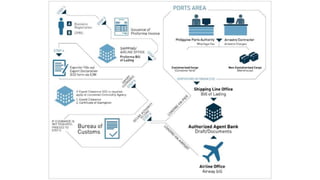
EXPORT PROCEDURE
FLOWCHART
Preliminary
Steps
STEP 1.
 Business Registration
 CPRS (Client Profile
Registration System)
SOLE
PROPRIETORSHIP
Department of
Trade and Industry
Securities and
Exchange Commission
COOPERATIVES
Cooperative
Development Authority
Step ii.
Register with the city or municipality
where you will operate to get a
business profit.
Step iii.
Register with the BIR.
PARTNERSHIPS AND
CORPORATION
STEP 2. CONFIRMATION
OF ORDER
When a foreign buyer
wants to buy an
exporter’s product*, the
exporter issues a
PROFORMA INVOICE (PI).
This should be signed by
the foreign buyer and
returned to the exporter.
*E.G. GIVING A PURCHASE ORDER
A pro forma invoice is a
document that states a
commitment on part of the
seller to deliver the
products or services as
notified to the buyer for a
specific price. It is, thus, not
a true invoice.
(INTERNATIONAL, 2002)
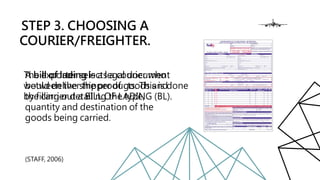
STEP 3. CHOOSING A
COURIER/FREIGHTER.
The exporter selects a courier who
would deliver the products. This is done
by filling out a BILL OF LADING (BL).
A bill of lading is a legal document
between the shipper of goods and
the carrier detailing the type,
quantity and destination of the
goods being carried.
(STAFF, 2006)
STEP 4. DECLARING THE EXPORTED PRODUCTS
The products to be exported are declared using the E2M
Internet System where you registered earlier. This online
form is called an EXPORT DECLARATION (ED).
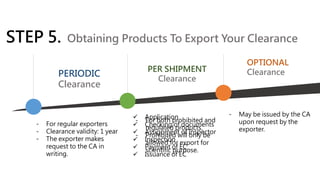
STEP 5. Obtaining Products To Export Your Clearance
Some products are regulated or
prohibited for export. Therefore an
EXPORT CLEARANCE (EC) is needed.
Regulated products will be allowed if
cleared by the Commodity Agency (CA)
regulating those specific export
products.
STEP 5. Obtaining Products To Export Your Clearance
PERIODIC
Clearance
PER SHIPMENT
Clearance
OPTIONAL
Clearance
 Application
 Checking of documents
 Assignment of Inspector
 Inspection
 Payment of EC
 Issuance of EC
- For regular exporters
- Clearance validity: 1 year
- The exporter makes
request to the CA in
writing.
- For both prohibited and
regulated products.
- Prohibited will only be
allowed for export for
scientific purpose.
- May be issued by the CA
upon request by the
exporter.
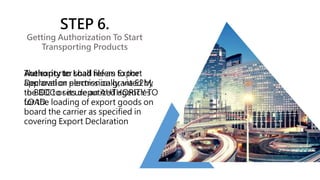
STEP 6.
Getting Authorization To Start
Transporting Products
The exporter shall file an Export
Declaration electronically, via E2M,
to BOC to secure an AUTHORITY TO
LOAD.
Authority to Load refers to the
approval or permission granted by
the BOC or its deputized agencies
for the loading of export goods on
board the carrier as specified in
covering Export Declaration
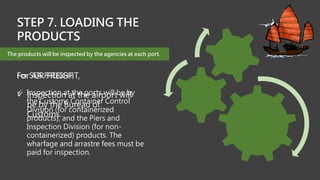
STEP 7. LOADING THE
PRODUCTS
For AIR FREIGHT,
 Inspection at the airport will
be by the Bureau of
Customs.
The products will be inspected by the agencies at each port.
For SEA FREIGHT,
 Inspection at the ports will be by
the Customs Container Control
Division (for containerized
products), and the Piers and
Inspection Division (for non-
containerized) products. The
wharfage and arrastre fees must be
paid for inspection.
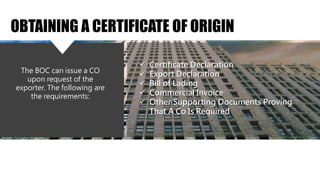
OBTAINING A CERTIFICATE OF ORIGIN
The BOC can issue a CO
upon request of the
exporter. The following are
the requirements:
 Certificate Declaration
 Export Declaration
 Bill of Lading
 Commercial Invoice
 Other Supporting Documents Proving
That A Co Is Required
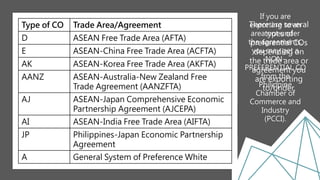
Type of CO Trade Area/Agreement
D ASEAN Free Trade Area (AFTA)
E ASEAN-China Free Trade Area (ACFTA)
AK ASEAN-Korea Free Trade Area (AKFTA)
AANZ ASEAN-Australia-New Zealand Free
Trade Agreement (AANZFTA)
AJ ASEAN-Japan Comprehensive Economic
Partnership Agreement (AJCEPA)
AI ASEAN-India Free Trade Area (AIFTA)
JP Philippines-Japan Economic Partnership
Agreement
A General System of Preference White
There are several
types of
preferential COs
depending on
the trade area or
agreement you
are exporting
to/under.
If you are
exporting to an
area not under
the agreements,
you may get a
NON-
PREFERENTIAL CO
from the
Philippine
Chamber of
Commerce and
Industry
(PCCI).
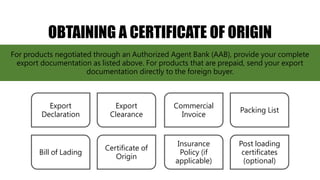
You know that you have completed the whole process of exporting when you have the
following documents:
OBTAINING A CERTIFICATE OF ORIGIN
Export
Declaration
Export
Clearance
Bill of Lading
Certificate of
Origin
Post loading
certificates
(optional)
Commercial
Invoice
Packing List
Insurance
Policy (if
applicable)
For products negotiated through an Authorized Agent Bank (AAB), provide your complete
export documentation as listed above. For products that are prepaid, send your export
documentation directly to the foreign buyer.
In order to put on record that you
have shipped your products, you may
provide a certificate of shipment.
OBTAINING A CERTIFICATE
OF SHIPMENT
PAYMENT
There are several methods
that foreign buyers can utilize
to pay you for your products.
These are as follows:
 Letters of credit (L/C)
 Documents against payment
(D/P)
 Documents against
acceptance (D/A)
 Open account (O/A)
 Cash against documents (C/D)
 Prepayment/Export Advance
 Intercompany open account
 Offset Arrangement
 Consignment
 Telegraphic Transfer
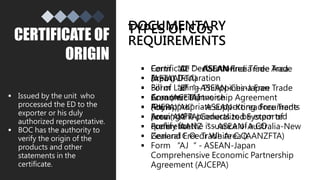
CERTIFICATE OF
ORIGIN
 Issued by the unit who
processed the ED to the
exporter or his duly
authorized representative.
 BOC has the authority to
verify the origin of the
products and other
statements in the
certificate.
DOCUMENTARY
REQUIREMENTS
 Certificate Declaration
 Export Declaration
 Bill of Lading
 Commercial Invoice
 Any appropriate supporting documents
proving the products to be exported
qualify for the issuance of a CO
TYPES OF COs
 Form “D” - ASEAN Free Trade Area
(AFTA)
 Form “E” - ASEAN-China Free Trade
Area (ACFTA)
 Form “AK” - ASEAN-Korea Free Trade
Area (AKFTA)
 Form “AANZ“ - ASEAN-Australia-New
Zealand Free Trade Area (AANZFTA)
 Form “AJ“ - ASEAN-Japan
Comprehensive Economic Partnership
Agreement (AJCEPA)
 Form “AI“ - ASEAN-India Free Trade
Area (AIFTA)
 Form “JP“ - Philippines-Japan
Economic Partnership Agreement
(PJEPA)
 Form “A“ - Generalized System of
Preference
 General C.O. or White C.O.
EXPORT PROCEDURES
AND DOCUMENTATIONS
Cristobal, Mary Anne
Donayre, Chastine
Mejares, Alfonso Abbe
Reyes, John Christian

Export Procedures and Documentations in the Philippines

  • 1.
  • 2.
    Introduction Is both challengingand rewarding. Export procedures are simple and requirements have been lessened. EXPORTING However, business registration itself does not ensure success unless the basic foundations for a viable export enterprise are present. These are:  Organizational Readiness  Product Readiness
  • 3.
  • 5.
    Preliminary Steps STEP 1.  BusinessRegistration  CPRS (Client Profile Registration System) SOLE PROPRIETORSHIP Department of Trade and Industry Securities and Exchange Commission COOPERATIVES Cooperative Development Authority Step ii. Register with the city or municipality where you will operate to get a business profit. Step iii. Register with the BIR. PARTNERSHIPS AND CORPORATION
  • 6.
    STEP 2. CONFIRMATION OFORDER When a foreign buyer wants to buy an exporter’s product*, the exporter issues a PROFORMA INVOICE (PI). This should be signed by the foreign buyer and returned to the exporter. *E.G. GIVING A PURCHASE ORDER A pro forma invoice is a document that states a commitment on part of the seller to deliver the products or services as notified to the buyer for a specific price. It is, thus, not a true invoice. (INTERNATIONAL, 2002)
  • 7.
    STEP 3. CHOOSINGA COURIER/FREIGHTER. The exporter selects a courier who would deliver the products. This is done by filling out a BILL OF LADING (BL). A bill of lading is a legal document between the shipper of goods and the carrier detailing the type, quantity and destination of the goods being carried. (STAFF, 2006)
  • 8.
    STEP 4. DECLARINGTHE EXPORTED PRODUCTS The products to be exported are declared using the E2M Internet System where you registered earlier. This online form is called an EXPORT DECLARATION (ED).
  • 9.
    STEP 5. ObtainingProducts To Export Your Clearance Some products are regulated or prohibited for export. Therefore an EXPORT CLEARANCE (EC) is needed. Regulated products will be allowed if cleared by the Commodity Agency (CA) regulating those specific export products.
  • 10.
    STEP 5. ObtainingProducts To Export Your Clearance PERIODIC Clearance PER SHIPMENT Clearance OPTIONAL Clearance  Application  Checking of documents  Assignment of Inspector  Inspection  Payment of EC  Issuance of EC - For regular exporters - Clearance validity: 1 year - The exporter makes request to the CA in writing. - For both prohibited and regulated products. - Prohibited will only be allowed for export for scientific purpose. - May be issued by the CA upon request by the exporter.
  • 11.
    STEP 6. Getting AuthorizationTo Start Transporting Products The exporter shall file an Export Declaration electronically, via E2M, to BOC to secure an AUTHORITY TO LOAD. Authority to Load refers to the approval or permission granted by the BOC or its deputized agencies for the loading of export goods on board the carrier as specified in covering Export Declaration
  • 12.
    STEP 7. LOADINGTHE PRODUCTS For AIR FREIGHT,  Inspection at the airport will be by the Bureau of Customs. The products will be inspected by the agencies at each port. For SEA FREIGHT,  Inspection at the ports will be by the Customs Container Control Division (for containerized products), and the Piers and Inspection Division (for non- containerized) products. The wharfage and arrastre fees must be paid for inspection.
  • 13.
    OBTAINING A CERTIFICATEOF ORIGIN The BOC can issue a CO upon request of the exporter. The following are the requirements:  Certificate Declaration  Export Declaration  Bill of Lading  Commercial Invoice  Other Supporting Documents Proving That A Co Is Required
  • 14.
    Type of COTrade Area/Agreement D ASEAN Free Trade Area (AFTA) E ASEAN-China Free Trade Area (ACFTA) AK ASEAN-Korea Free Trade Area (AKFTA) AANZ ASEAN-Australia-New Zealand Free Trade Agreement (AANZFTA) AJ ASEAN-Japan Comprehensive Economic Partnership Agreement (AJCEPA) AI ASEAN-India Free Trade Area (AIFTA) JP Philippines-Japan Economic Partnership Agreement A General System of Preference White There are several types of preferential COs depending on the trade area or agreement you are exporting to/under. If you are exporting to an area not under the agreements, you may get a NON- PREFERENTIAL CO from the Philippine Chamber of Commerce and Industry (PCCI).
  • 15.
    You know thatyou have completed the whole process of exporting when you have the following documents: OBTAINING A CERTIFICATE OF ORIGIN Export Declaration Export Clearance Bill of Lading Certificate of Origin Post loading certificates (optional) Commercial Invoice Packing List Insurance Policy (if applicable) For products negotiated through an Authorized Agent Bank (AAB), provide your complete export documentation as listed above. For products that are prepaid, send your export documentation directly to the foreign buyer.
  • 16.
    In order toput on record that you have shipped your products, you may provide a certificate of shipment. OBTAINING A CERTIFICATE OF SHIPMENT
  • 17.
    PAYMENT There are severalmethods that foreign buyers can utilize to pay you for your products. These are as follows:  Letters of credit (L/C)  Documents against payment (D/P)  Documents against acceptance (D/A)  Open account (O/A)  Cash against documents (C/D)  Prepayment/Export Advance  Intercompany open account  Offset Arrangement  Consignment  Telegraphic Transfer
  • 18.
    CERTIFICATE OF ORIGIN  Issuedby the unit who processed the ED to the exporter or his duly authorized representative.  BOC has the authority to verify the origin of the products and other statements in the certificate. DOCUMENTARY REQUIREMENTS  Certificate Declaration  Export Declaration  Bill of Lading  Commercial Invoice  Any appropriate supporting documents proving the products to be exported qualify for the issuance of a CO TYPES OF COs  Form “D” - ASEAN Free Trade Area (AFTA)  Form “E” - ASEAN-China Free Trade Area (ACFTA)  Form “AK” - ASEAN-Korea Free Trade Area (AKFTA)  Form “AANZ“ - ASEAN-Australia-New Zealand Free Trade Area (AANZFTA)  Form “AJ“ - ASEAN-Japan Comprehensive Economic Partnership Agreement (AJCEPA)  Form “AI“ - ASEAN-India Free Trade Area (AIFTA)  Form “JP“ - Philippines-Japan Economic Partnership Agreement (PJEPA)  Form “A“ - Generalized System of Preference  General C.O. or White C.O.
  • 19.
    EXPORT PROCEDURES AND DOCUMENTATIONS Cristobal,Mary Anne Donayre, Chastine Mejares, Alfonso Abbe Reyes, John Christian