Marketing Channels  and Supply Chain Management Chapter 12
Learning Goals Know why companies use distribution channels and understand the functions that these channels perform. Learn how channel members interact and how they organize to perform the work of the channel. Know the major channel alternatives that are open to a company. Comprehend how companies select, motivate, and evaluate channel members. Understand the nature and importance of marketing logistics and integrated supply chain management.
Case Study Caterpillar Dominates world’s markets for heavy construction and mining equipment. Independent dealers are key to success  Dealer network is linked via computers Caterpillar stresses dealer profitability, extraordinary dealer support, personal relationships, dealer performance and full, honest, and frequent communications
Definitions Value Delivery Network The network made up of the company, suppliers, distributors, and ultimately customers who “partner” with each other to improve the performance of the entire system. Marketing channel Set of interdependent organizations involved in the process of making a product or service available for use or consumption by the consumer or business user Goal 1:  Know why companies use channels and understand their functions
Nature & Importance of Marketing Channels Channel choices affect other decisions in the marketing mix Pricing, Marketing communications A strong distribution system can be a competitive advantage Channel decisions involve long-term commitments to other firms Goal 1:  Know why companies use channels and understand their functions
Nature & Importance of Marketing Channels How Channel Members Add Value Intermediaries require fewer contacts to move the product to the final purchaser. Intermediaries help match product assortment demand with supply.  Intermediaries help bridge major time, place, and possession gaps that separate products from those who would use them. Goal 1:  Know why companies use channels and understand their functions
Nature & Importance of Marketing Channels Information Promotion Contact Matching Negotiation Physical Distribution Financing Risk taking Key Functions Performed by  Channel Members Goal 1:  Know why companies use channels and understand their functions
Nature & Importance of Marketing Channels Number of Channel Levels The number of intermediary levels indicates the length of a marketing channel. Direct Channels Indirect Channels Producers lose more control and face greater channel complexity as additional channel levels are added. Goal 1:  Know why companies use channels and understand their functions
Nature & Importance of Marketing Channels Physical Flow Payment Flow Information Flow Promotion Flow Channel Members Are Connected  Via A Variety of Flows Flow of Ownership Goal 1:  Know why companies use channels and understand their functions
Channel Behavior and Organization Channel Conflict Occurs when channel members disagree on roles, activities, or rewards. Types of Conflict: Horizontal conflict: occurs among firms at the same channel level Vertical conflict:  occurs among firms at different channel levels Goal 1:  Know why companies use channels and understand their functions
Channel Behavior and Organization Conventional Distribution Channels Consists of one or more independent channel members Lack leadership and power Often result in poor performance Vertical Marketing Systems Consists of members acting as a unified system Use contracts, ownership or power Goal 1:  Know why companies use channels and understand their functions
Channel Behavior and Organization Corporate VMS Contractual VMS Administered VMS Corporation owns production and distribution Coordination and conflict through regular organizational channels Vertical Marketing Systems Goal 2:  Learn how channel members interact and how they organize
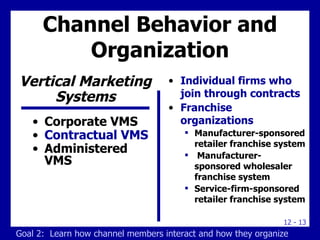
Channel Behavior and Organization Corporate VMS Contractual VMS Administered VMS Individual firms who join through contracts  Franchise organizations  Manufacturer-sponsored retailer franchise system Manufacturer-sponsored wholesaler franchise system Service-firm-sponsored retailer franchise system Vertical Marketing Systems Goal 2:  Learn how channel members interact and how they organize
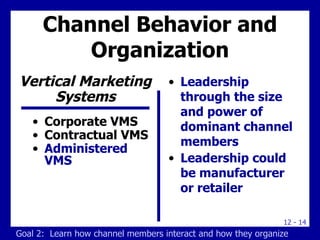
Channel Behavior and Organization Corporate VMS Contractual VMS Administered VMS Leadership through the size and power of dominant channel members Leadership could be manufacturer or retailer Vertical Marketing Systems Goal 2:  Learn how channel members interact and how they organize
Channel Behavior and Organization Horizontal Marketing Systems Companies at the same level work together with channel members Multichannel Distribution Systems Also called hybrid marketing channels Occurs when a firm uses two or more marketing channels  Changing Channel Organization Disintermediation Goal 2:  Learn how channel members interact and how they organize
Channel Design Decisions Step 1: Analyzing Consumer Needs Cost and feasibility of meeting needs must be considered  Step 2: Setting Channel Objectives Set channel objectives in terms of targeted level of customer service Many factors influence channel objectives Goal 3:  Know the major channel alternatives open to a company
Channel Design Decisions Step 3: Identifying Major Alternatives Types of intermediaries Company sales force, manufacturer’s agency, industrial distributors Number of marketing intermediaries Intensive, selective, and exclusive distribution Responsibilities of channel members Goal 3:  Know the major channel alternatives open to a company
Channel Design Decisions Step 4: Evaluating Major Alternatives Economic criteria Control issues Adaptive criteria Goal 3:  Know the major channel alternatives open to a company
Channel Design Decisions Designing International Distribution Channels Global marketers usually adapt their channel strategies to structures that exist within foreign countries Key challenges: May be complex or hard to penetrate May be scattered, inefficient, or totally lacking Goal 3:  Know the major channel alternatives open to a company
Channel Management Decisions Selecting Channel Members Identify characteristics that distinguish the best channel members Managing and Motivating Channel Members Partner relationship management (PRM) is key Evaluating Channel Members Performance should be checked against standards Channel members should be rewarded or replaced as dictated by performance Goal 4:  Comprehend how companies select, motivate and evaluate channels
Channel Management Decisions Selecting channel members Managing and motivating channel members Evaluating channel members Which characteristics are important?  Years in business Lines carried Growth and profit record Cooperativeness and reputation Type of customer location Decisions   Goal 4:  Comprehend how companies select, motivate and evaluate channels
Channel Management Decisions Selecting channel members Managing and motivating channel members Evaluating channel members Partner relationship management (PRM) for long-term partnerships Software available  to coordinate members Decisions   Goal 4:  Comprehend how companies select, motivate and evaluate channels
Channel Management Decisions Selecting channel members Managing and motivating channel members Evaluating channel members Check channel performance of: Sales Inventory Customer delivery Promotion and training Customer service Decisions   Goal 4:  Comprehend how companies select, motivate and evaluate channels
Exclusive distribution Only certain outlets are allowed to carry a firm’s products Exclusive dealing Exclusive territorial agreements Tying agreements Public Policy and Distribution Decisions Goal 4:  Comprehend how companies select, motivate and evaluate channels
Marketing Logistics  Outbound distribution Inbound distribution Reverse distribution Involves the entire supply chain management system Marketing Logistics and Supply Chain Management Goal 5:  Understand marketing logistics & integrated supply chain management
Why Greater Emphasis is Being Placed on Logistics: Offers firms a competitive advantage Can yield cost savings Greater product variety requires improved logistics Improvements in distribution efficiency are possible due to information technology Marketing Logistics and Supply Chain Management Goal 5:  Understand marketing logistics & integrated supply chain management
Goals of the Logistics System No system can both maximize customer service and minimize costs. Firms must first weigh the benefits of higher service against the costs. State goals in terms of a targeted level of customer service at the least cost. Marketing Logistics and Supply Chain Management Goal 5:  Understand marketing logistics & integrated supply chain management
Major Logistics Functions Warehousing Inventory Management Transportation Logistics Information Management Marketing Logistics and Supply Chain Management Goal 5:  Understand marketing logistics & integrated supply chain management
Marketing Logistics and Supply Chain Management Truck Rail Water Pipeline Air Internet Transportation Carrier Options Intermodal transportation is becoming  more common Goal 5:  Understand marketing logistics & integrated supply chain management
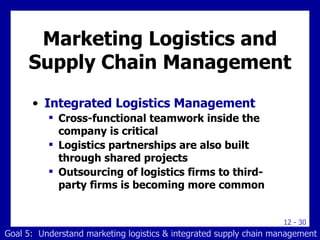
Integrated Logistics Management Cross-functional teamwork inside the company is critical Logistics partnerships are also built through shared projects Outsourcing of logistics firms to third-party firms is becoming more common Marketing Logistics and Supply Chain Management Goal 5:  Understand marketing logistics & integrated supply chain management

Kotler12 basic

  • 1.
    Marketing Channels and Supply Chain Management Chapter 12
  • 2.
    Learning Goals Knowwhy companies use distribution channels and understand the functions that these channels perform. Learn how channel members interact and how they organize to perform the work of the channel. Know the major channel alternatives that are open to a company. Comprehend how companies select, motivate, and evaluate channel members. Understand the nature and importance of marketing logistics and integrated supply chain management.
  • 3.
    Case Study CaterpillarDominates world’s markets for heavy construction and mining equipment. Independent dealers are key to success Dealer network is linked via computers Caterpillar stresses dealer profitability, extraordinary dealer support, personal relationships, dealer performance and full, honest, and frequent communications
  • 4.
    Definitions Value DeliveryNetwork The network made up of the company, suppliers, distributors, and ultimately customers who “partner” with each other to improve the performance of the entire system. Marketing channel Set of interdependent organizations involved in the process of making a product or service available for use or consumption by the consumer or business user Goal 1: Know why companies use channels and understand their functions
  • 5.
    Nature & Importanceof Marketing Channels Channel choices affect other decisions in the marketing mix Pricing, Marketing communications A strong distribution system can be a competitive advantage Channel decisions involve long-term commitments to other firms Goal 1: Know why companies use channels and understand their functions
  • 6.
    Nature & Importanceof Marketing Channels How Channel Members Add Value Intermediaries require fewer contacts to move the product to the final purchaser. Intermediaries help match product assortment demand with supply. Intermediaries help bridge major time, place, and possession gaps that separate products from those who would use them. Goal 1: Know why companies use channels and understand their functions
  • 7.
    Nature & Importanceof Marketing Channels Information Promotion Contact Matching Negotiation Physical Distribution Financing Risk taking Key Functions Performed by Channel Members Goal 1: Know why companies use channels and understand their functions
  • 8.
    Nature & Importanceof Marketing Channels Number of Channel Levels The number of intermediary levels indicates the length of a marketing channel. Direct Channels Indirect Channels Producers lose more control and face greater channel complexity as additional channel levels are added. Goal 1: Know why companies use channels and understand their functions
  • 9.
    Nature & Importanceof Marketing Channels Physical Flow Payment Flow Information Flow Promotion Flow Channel Members Are Connected Via A Variety of Flows Flow of Ownership Goal 1: Know why companies use channels and understand their functions
  • 10.
    Channel Behavior andOrganization Channel Conflict Occurs when channel members disagree on roles, activities, or rewards. Types of Conflict: Horizontal conflict: occurs among firms at the same channel level Vertical conflict: occurs among firms at different channel levels Goal 1: Know why companies use channels and understand their functions
  • 11.
    Channel Behavior andOrganization Conventional Distribution Channels Consists of one or more independent channel members Lack leadership and power Often result in poor performance Vertical Marketing Systems Consists of members acting as a unified system Use contracts, ownership or power Goal 1: Know why companies use channels and understand their functions
  • 12.
    Channel Behavior andOrganization Corporate VMS Contractual VMS Administered VMS Corporation owns production and distribution Coordination and conflict through regular organizational channels Vertical Marketing Systems Goal 2: Learn how channel members interact and how they organize
  • 13.
    Channel Behavior andOrganization Corporate VMS Contractual VMS Administered VMS Individual firms who join through contracts Franchise organizations Manufacturer-sponsored retailer franchise system Manufacturer-sponsored wholesaler franchise system Service-firm-sponsored retailer franchise system Vertical Marketing Systems Goal 2: Learn how channel members interact and how they organize
  • 14.
    Channel Behavior andOrganization Corporate VMS Contractual VMS Administered VMS Leadership through the size and power of dominant channel members Leadership could be manufacturer or retailer Vertical Marketing Systems Goal 2: Learn how channel members interact and how they organize
  • 15.
    Channel Behavior andOrganization Horizontal Marketing Systems Companies at the same level work together with channel members Multichannel Distribution Systems Also called hybrid marketing channels Occurs when a firm uses two or more marketing channels Changing Channel Organization Disintermediation Goal 2: Learn how channel members interact and how they organize
  • 16.
    Channel Design DecisionsStep 1: Analyzing Consumer Needs Cost and feasibility of meeting needs must be considered Step 2: Setting Channel Objectives Set channel objectives in terms of targeted level of customer service Many factors influence channel objectives Goal 3: Know the major channel alternatives open to a company
  • 17.
    Channel Design DecisionsStep 3: Identifying Major Alternatives Types of intermediaries Company sales force, manufacturer’s agency, industrial distributors Number of marketing intermediaries Intensive, selective, and exclusive distribution Responsibilities of channel members Goal 3: Know the major channel alternatives open to a company
  • 18.
    Channel Design DecisionsStep 4: Evaluating Major Alternatives Economic criteria Control issues Adaptive criteria Goal 3: Know the major channel alternatives open to a company
  • 19.
    Channel Design DecisionsDesigning International Distribution Channels Global marketers usually adapt their channel strategies to structures that exist within foreign countries Key challenges: May be complex or hard to penetrate May be scattered, inefficient, or totally lacking Goal 3: Know the major channel alternatives open to a company
  • 20.
    Channel Management DecisionsSelecting Channel Members Identify characteristics that distinguish the best channel members Managing and Motivating Channel Members Partner relationship management (PRM) is key Evaluating Channel Members Performance should be checked against standards Channel members should be rewarded or replaced as dictated by performance Goal 4: Comprehend how companies select, motivate and evaluate channels
  • 21.
    Channel Management DecisionsSelecting channel members Managing and motivating channel members Evaluating channel members Which characteristics are important? Years in business Lines carried Growth and profit record Cooperativeness and reputation Type of customer location Decisions Goal 4: Comprehend how companies select, motivate and evaluate channels
  • 22.
    Channel Management DecisionsSelecting channel members Managing and motivating channel members Evaluating channel members Partner relationship management (PRM) for long-term partnerships Software available to coordinate members Decisions Goal 4: Comprehend how companies select, motivate and evaluate channels
  • 23.
    Channel Management DecisionsSelecting channel members Managing and motivating channel members Evaluating channel members Check channel performance of: Sales Inventory Customer delivery Promotion and training Customer service Decisions Goal 4: Comprehend how companies select, motivate and evaluate channels
  • 24.
    Exclusive distribution Onlycertain outlets are allowed to carry a firm’s products Exclusive dealing Exclusive territorial agreements Tying agreements Public Policy and Distribution Decisions Goal 4: Comprehend how companies select, motivate and evaluate channels
  • 25.
    Marketing Logistics Outbound distribution Inbound distribution Reverse distribution Involves the entire supply chain management system Marketing Logistics and Supply Chain Management Goal 5: Understand marketing logistics & integrated supply chain management
  • 26.
    Why Greater Emphasisis Being Placed on Logistics: Offers firms a competitive advantage Can yield cost savings Greater product variety requires improved logistics Improvements in distribution efficiency are possible due to information technology Marketing Logistics and Supply Chain Management Goal 5: Understand marketing logistics & integrated supply chain management
  • 27.
    Goals of theLogistics System No system can both maximize customer service and minimize costs. Firms must first weigh the benefits of higher service against the costs. State goals in terms of a targeted level of customer service at the least cost. Marketing Logistics and Supply Chain Management Goal 5: Understand marketing logistics & integrated supply chain management
  • 28.
    Major Logistics FunctionsWarehousing Inventory Management Transportation Logistics Information Management Marketing Logistics and Supply Chain Management Goal 5: Understand marketing logistics & integrated supply chain management
  • 29.
    Marketing Logistics andSupply Chain Management Truck Rail Water Pipeline Air Internet Transportation Carrier Options Intermodal transportation is becoming more common Goal 5: Understand marketing logistics & integrated supply chain management
  • 30.
    Integrated Logistics ManagementCross-functional teamwork inside the company is critical Logistics partnerships are also built through shared projects Outsourcing of logistics firms to third-party firms is becoming more common Marketing Logistics and Supply Chain Management Goal 5: Understand marketing logistics & integrated supply chain management