FOREIGN EXCHANGE MARKET
Theforeign exchange market (also known as forex, FX, or the currencies market) is
an over-the-counter (OTC) global marketplace that determines the exchange rate for
currencies around the world. Participants in these markets can buy, sell, exchange,
and speculate on the relative exchange rates of various currency pairs.
MAIN FEATURES
The foreign exchange market is an over-the-counter (OTC) marketplace that
determines the exchange rate for global currencies.
It is, by far, the largest financial market in the world and is made up of a
global network of financial centers that transact 24 hours a day, closing only
on the weekends.
Currencies are always traded in pairs, so the "value" of one of the currencies
in that pair is relative to the value of the other.
Foreign exchange markets are made up of banks, forex dealers, commercial
companies, central banks, investment management firms, hedge funds, retail
forex dealers, and investors.
The size of the FX market in 2023 was $805 billion
The value of a country's currency depends on whether it is a "free float" or
"fixed float." Free-floating currencies are those whose relative value is
determined by free-market forces, such as supply-demand relationships.
A fixed float is where a country's governing body sets its currency's relative
value to other currencies, often by pegging it to some standard. Free-floating
currencies include the U.S. dollar, Japanese yen, and British pound, while
examples of fixed floating currencies include the Panamanian Balboa and the
Saudi Riyal.
One of the most unique features of the forex market is that it's made up of a
global network of financial centers that transact 24 hours a day, closing only
on the weekends. As one major forex hub closes, another hub in a different
part of the world remains open for business. This increases the liquidity
available in currency markets, which adds to its appeal as the largest asset
class available to investors.
The most liquid trading pairs are, in descending order of liquidity:
EUR/USD
USD/JPY
GBP/USD (GBP is British Pound Sterling)
Forex Leverage
The leverage available in FX markets is one of the highest that traders and
investors can find anywhere. Leverage is a loan given to an investor by their
broker. With this loan, investors can increase their trade size, which could
translate to greater profitability.
2.
For example,investors who have a $1,000 forex market account can trade
$100,000 worth of currency with a margin of 1%. This is referred to as having
a 100:1 leverage. Their profit or loss will be based on the $100,000 notional
amount.
The foreign exchange market size has grown strongly in recent years. It will
grow from $752.66 billion in 2023 to $795.91 billion in 2024 at a compound
annual growth rate (CAGR) of 5.7%.
Central Banks, Commercial Banks directly control the prices. However, there
are some MNCs and Big Giants that indirectly influence the forex market.
These big companies trade in large volumes as they are engaged in the
import and export of goods and services.
https://www.axi.com/int/trade/cfds/forex
Types of Foreign Exchange Markets
There are three main forex markets: the spot forex market, the forward forex
market, and the futures forex market.
Spot Forex Market: The spot market is the immediate exchange of currencies
at the current exchange. On the spot. This makes up a large portion of the
total forex market and involves buyers and sellers from across the entire
spectrum of the financial sector, as well as those individuals exchanging
currencies.
Forward Forex Market: The forward market involves an agreement between
the buyer and seller to exchange currencies at an agreed-upon price at a set
date in the future. No exchange of actual currencies takes place, just the
value. The forward market is often used for hedging.
Futures Forex Market: The futures market is similar to the forward market, in
that there is an agreed price at an agreed date. The primary difference is that
the futures market is regulated and happens on an exchange.
This removes the risk found in other markets. Futures are also used for
hedging
Functions of the Foreign Exchange Market
Transfer Function
The foreign exchange market’s basic function is to transfer funds or foreign
currencies between countries to settle their payments. The market converts
one currency into another.
Credit Function
3.
The foreign exchangemarket also provides short-term loans to people or
businesses who need to buy things from other countries. This helps the
smooth flow of goods and services across borders. Buyers can use these
loans to pay for stuff from other countries.
Hedging Function
A forex market hedges foreign exchange risks. It is common for parties in
foreign exchange to fear fluctuations in exchange rates, which are the price of
one currency compared to another currency. Depending on the
circumstances, the party may gain or lose money.
STRUCTURE OF FOREX MARKETS
Foreign exchange markets are decentralised. They are not coordinated or controlled
by any one power. Banks, central banks, commercial companies, investment
management firms, retail forex traders, and nonbank foreign exchange companies
are the main participants in this market.
The structure of the foreign exchange market, commonly known as the forex market,
is uniquely decentralised and operates over-the-counter (OTC). Unlike traditional
markets with a central exchange, forex is a vast network of dealers, brokers, and
financial institutions globally.
FOREIGN EXCHANGE MARKET PARTICIPANTS
Central Banks and Governments - Central banks directly buy or sell
their own currency in the foreign exchange market to influence its
value. If the bank wants to strengthen the domestic currency, they can
sell foreign currency and buy their own. If they want to weaken it, they
do the opposite. Central banks participate in the market to manage
their country's monetary policy and stabilize currency values.
Central banks intervene in the market when their currency becomes a
problem for the domestic economy, by either being too strong or too
weak. This applies to all exchange-rate regimes – the floating, pegged,
and fixed.
For example, the SNB (Swiss National Bank) has been very active
during the past few years, when it has tried to weaken the Swiss Franc
against the Euro. Furthermore, we can take the Hong Kong Dollar as
an example of the pegged exchange-rate regime. USD/HKD is allowed
to trade within a 7.75 to 7.85 range, which means that the Hong Kong
Monetary Authority (HKMA) will sell it when it gets too close to the
upper range and buy it when it gets too close to the lower range of the
band.
Central banks are also active in the market when they have to manage
their foreign currency reserves. For example, if the HKMA has bought
4.
US Dollars toweaken the Hong Kong Dollar, it may wish to exchange
those US Dollars for another currency, like the Euro or the Australian
Dollar. The Asian central banks are quite often doing this, as they have
to intervene much more than central banks in, say, Europe, where
most currencies are floating.
Commercial and Investment Banks. -Commercial banks act as
intermediaries, buying and selling currencies from brokers to meet
demand from customers.
Multinational Corporations - Multinational firms manage their currency
risk on the forex market, especially while engaging in international
trade.
Individual Investors - Individual traders who want to make money from
changes in currency prices can participate in the forex market through
online brokers.
Hedge Funds and Financial Institutions - These institutions trade in the
forex market to generate returns for their clients
Retail Forex Brokers - Forex brokers act as market makers as well and
may post bids and ask prices for a currency pair that differs from the
most competitive bid in the market. The forex market is an over-the-
counter (OTC) market. This means trading happens without a single
centralized exchange. In the institutional market, retail forex brokers
are referred to as retail aggregators. They're called this because retail
forex brokers typically aggregate the net positions of their customers
for hedging purposes. They then transact in the institutional FX market
to manage their exposure to market risk.
Types of Foreign Exchange Markets/Types of FOREX Transactions
1. Spot Forex Market
The fastest currency transactions occur in this market.
This forex market provides immediate payment to buyers and sellers based
on the current exchange rate.
Nearly one-third of all currency exchange takes place on the spot market, with
trades usually settling in one or two days
2. Forward Forex Market
In the forward market, two parties agree to exchange currencies at a set price
on a future date.
They don’t actually swap money right away, just the value of the currency.
This is often used to protect against future price changes.
Forward markets deal in over-the-counter (OTC) forward contracts. Forward
contracts are agreements between parties to exchange a particular quantity of
currency pair at a specific rate and on a given date. They help in hedging
currency risks i.e. the risk of changing values of currency assets due to
fluctuations in currency exchange rates. However, forward markets do not
have a central exchange for their operations. Therefore:
5.
They arehighly illiquid (hard to find buyers or sellers randomly)
They usually do not require any collateral and thus have counterparty
risk i.e. risk of parties not following through with an agreement
3. Futures Forex Market
Similar to the forward market, it’s regulated and happens on an official
exchange. This reduces the risk.
People use futures contracts for hedging, too.
The futures markets is basically the forward market, but with centralised
exchanges like the NSE. Therefore, they have higher liquidity and lower
counterparty risk than forward markets. Currency futures or FX futures or
currency derivatives are available on the NSE on INR and four currencies viz.
US Dollars (USD), Euro (EUR), Japanese Yen (JPY) and Great Britain Pound
(GBP). Cross Currency Futures & Options contracts on EUR-USD, USD-JPY
and GBP-USD are also available for trading in the currency derivatives
segment. Since all transactions are publicly available and settled in cash, it is
easier to trade, speculate and perform arbitrage in the futures market.
4. Option Market
An option is like a contract that gives an investor the choice (but not the
obligation) to buy or sell something like a stock, ETF, or index at a specific
price over a certain period. The options market allows traders the right to
buy/sell currency at a specified price on a specified date through a central
exchange. The currencies available are the same as that of the NSE
currency futures market.
People trade options in this market.
5. Swap Market
The swap contract involves two parties exchanging cash flows or liabilities
arising from two different financial instruments.
Currency swaps are agreements between two parties to exchange a principal
and interest amount in different currencies only to be re-exchanged at a
specific later date. At least one of the interest rates in the agreement is fixed.
Typically, swaps involve these cash flows based on a principal amount.
Settlement Dates
The settlement date is defined as the day on which the trade is finalised, and the
person purchasing (buyer) should complete the payment process to the person
selling (seller). On the settlement date, the seller will deliver the securities or assets
to the buyer.
6.
Settlement of aforeign exchange trade requires the payment of one currency and
the receipt of another. The principal risk in settlement of such trade is that one party
would pay out the currency it sold but not receive the currency it bought.
Settlement is when money actually lands in the account. Most currency pairs settle
T+2. This means if a trade occurs on Monday, it will settle on Wednesday. If a trade
occurs on Thursday and the next Monday is a non-settlement date for either
currency, then the trade will settle Tuesday.
Standard settlement periods for most currencies is 2 business days, with some pairs
such as CAD/USD (CAD – Canadian Dollar) settling next business day. In order for a
date to be a valid settlement date for an FX transaction, the central banks for both
currencies must be open for settlements.
EXCHANGE RATE ARITHMETIC
There are various types of exchange rates such as:
Spot rate,
Ready rate,
Tom rate, and
Forward rate.
VALUE DATE
The date on which currencies are delivered is called as value date.
In the case of spot transactions, delivery date is two days after the date of
transaction (provided the date is a working day in all the centers where transactions
are concluded). If that date is a holiday, in any one of the centers, then the
subsequent date is the value date.
In the case of Tom rate, the value date is one day after the Transaction. All other
conditions applicable as mentioned above will be common.
In Ready rate transaction value date is same as that of Transaction date.
Forward rates are rates at which a currency is allowed to be delivered at some future
date.
Card rates are rates quoted for a retail customer, while for corporates who deal in
bulk special rates are quoted. Card rate is not an exchange rate, it is an approximate
rate quoted.
Like in any other commodity, dealers in foreign exchange quote, buy, and sell rates
for foreign exchange also. A person dealing in any Commodity makes his money by
7.
buying at alow rate and selling at a high rate. Buying rate is called as bid rate and
selling rate is called as ask ate. Spread between buying and selling rate is the
dealer's profit which depends on volume traded and the nature of competitiveness. It
is called as bid ask spread or simply spread.
There are various other rates like Bill rate, TT rate, Mail rate, and Draft rate.
Exchange rate depends on the commission which the dealers build into the same. In
a Bill rate since the remitter or receiver is asked to verify documents maximum
commission is built. In clean transactions since no documents are required to be
verified and only amount is required to be remitted, minimum commission is built into
the same. Similarly, faster the transfer cheaper will be the exchange rate since
interest element to be built into the transaction is minimum and the fluctuation in
exchange due to time period is also minimum. Thus, TT rate is cheaper than Draft or
Mail rate. TT buying rate is the cheapest quote.
TYPES OF QUOTES
There are two types of quotes internationally-one is called as American Quote and
other is called as European Quote.
In American quote for one unit of other currency, number of units of US$ are quoted,
while in European quote for one unit of US$, number of units of other currency are
quoted.
In Asia direct and indirect quotes are being followed. In direct quote number of
units of domestic currency for one units of foreign currency is quoted, while in
indirect quote number of unit of foreign currency for predetermined amount of
domestic currency is quoted. India followed indirect quote till 1993 before switching
to direct quote. To facilitate exports Reserve Bank of India has fixed maximum transit
time for direct as well indirect transfer of export documents. Many criticize the RBI
Reserve policy. According to critics RBI is building high interest rate reserves which
earn very little interest, which is wasteful use of resource.
ILLUSTRATIONS
An exporter has to surrender $ 1,00,000 to a bank. Rate of Dollar against Rupee is
83/83.15, the bank charges a commission of .15%. If the transit time fixed by RBI is
20 days and the rate of interest charged by the bank is 10% p.a,
a. Find out the net proceeds to be credited to exporters account.
b. Find out what is the amount to be paid by the person if he is an importer instead of
exporter?
8.
Since the exportersells the dollar to bank bid rate of Rs. 83 per dollar to be taken.
Since it involves buying of dollar by bank, commission should be deducted from
exchange rate. Rate to be adopted is
83 – (83x.15%) = 82.8755
0.1245
Total amount is $ 100,000 * 82.8755 = Rs. 82,87,550
Interest charged is 10% pa for 20 days on the net proceeds.
Which is 82,87,550 * 10/100 * 20/365 = Rs 45,411
Net proceeds to be credited to the account of exporter = 82,87,550 – 45,411 =
Rs. 82,42,139
b) Find out what is the amount to be paid by the person if he is an importer instead of
exporter?
Since in this case the bank is selling the dollar to the importer, it charges the ask rate
of 83.15 and the commission is added instead of being deducted. Amount to be paid
by the importer.
Rs. 83.15 +(.15% x 83.15) = Rs. 83.2747
thus the amount to be paid by the importer to bank is, $ 100,000 x 83.2747 =
c) Transaction is concluded spot on March 17, 2024 for US $ 100,000 what is the
value date?
Value date is 19 (th) March 2024, if it is not a holiday in India or US.
9.
d) What willhappen if 19th March is a holiday in US?
Then 20 (th) March, if it is working day in both the centers will be adopted as value
date.
e) If an Indian bank sells to a German bank $ 100,000 for Belgian Franc what is the
value date in this case ?
Value date is 19 (th) March 2024, if it is not a holiday in any one of the transaction
centers/settlement centers like India, Germany, US or Belgium or next working day
in all the four transaction centers will be the value date.
f) If the above transaction is concluded on 29th March 2024 and 31 March 2024 is a
holiday in India, what will be the value date?
April 1st
will be value date. Next month rule applies for Forward and not for spot
transaction.
g) If Rupee $ rate is 46/46.15 $/ Pound rate is 1.71/1.74 what is Rupee Pound rate.
Rs./Pound rate is = Rs /$ * $/Pound rate
= 46 * 1.71/46.15 * 1.74
= 78.66/80.30
h) If French Franc $ is 10.17/ 10.20 and Swiss Franc $ rate is 1.73/1.75 find out
French Franc/Swiss Franc Rate?
Rate is = French Franc/$ * $/ Swiss Franc Rate.
$/ Swiss Franc rate is = 1/1.75 / 1/ 1.73
= 0.5714/0.578
French Franc/Swiss Franc Rate = 10.17*.5714/10.20*.5780
= 5.81/5.9
10.
i) If oneRupee can buy 3.23 Yen and if one rupee can buy .028 dollar how many
yens can one dollar buy?
.028$= 3.23Yen S = 3.23/0.028
= 115.35Yen .
j) In London a dealer quotes DM/POUND Spot = 3.255/55 Yen Pound spot is =
180/181 What do you expect Yen/DM rate in Frankfurt?
Yen/ DM spot rate is = Yen/ Pound spot Rate * Pound/ DM spot Rate.
DM/Pound Spot rate is = 3.2550/55
Pound/ DM Spot rate is = 1/3.2555 / 1 / 3.2550
= 0.3071/0.3072
Yen/DM Spot rate = 180 * .3071/181 * .3072
= 55.278/55.6032
Suppose that in Frankfurt you get a quote of Yen/DM spot 51.1530/51.2550 is there
an arbitrage opportunity?
Buy one DM in Frankfurt by selling 51.2550 yen sell one DM and get 55.278 yen
there by making profit of 55.278-51.2550= 4.023 Yen.
11.
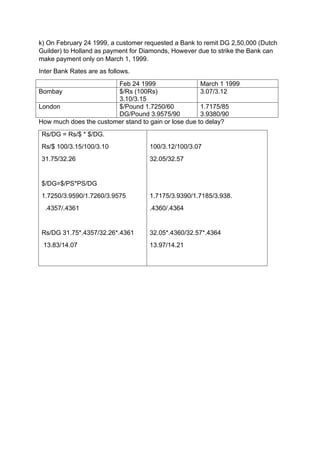
k) On February24 1999, a customer requested a Bank to remit DG 2,50,000 (Dutch
Guilder) to Holland as payment for Diamonds, However due to strike the Bank can
make payment only on March 1, 1999.
Inter Bank Rates are as follows.
Feb 24 1999 March 1 1999
Bombay $/Rs (100Rs)
3.10/3.15
3.07/3.12
London $/Pound 1.7250/60
DG/Pound 3.9575/90
1.7175/85
3.9380/90
How much does the customer stand to gain or lose due to delay?
Rs/DG = Rs/$ * $/DG.
Rs/$ 100/3.15/100/3.10
31.75/32.26
$/DG=$/PS*PS/DG
1.7250/3.9590/1.7260/3.9575
.4357/.4361
Rs/DG 31.75*.4357/32.26*.4361
13.83/14.07
100/3.12/100/3.07
32.05/32.57
1.7175/3.9390/1.7185/3.938.
.4360/.4364
32.05*.4360/32.57*.4364
13.97/14.21
12.
The importer haslost (14.21-14.07)*250,000 DG = Rs. 35000 due to delayed
remittance.
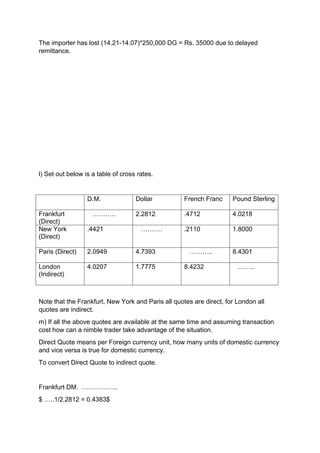
l) Set out below is a table of cross rates.
D.M. Dollar French Franc Pound Sterling
Frankfurt
(Direct)
……….. 2.2812 .4712 4.0218
New York
(Direct)
.4421 ………. .2110 1.8000
Paris (Direct) 2.0949 4.7393 ……….. 8.4301
London
(Indirect)
4.0207 1.7775 8.4232 ……..
Note that the Frankfurt, New York and Paris all quotes are direct, for London all
quotes are indirect.
m) If all the above quotes are available at the same time and assuming transaction
cost how can a nimble trader take advantage of the situation.
Direct Quote means per Foreign currency unit, how many units of domestic currency
and vice versa is true for domestic currency.
To convert Direct Quote to indirect quote.
Frankfurt DM. ……………..
$ …..1/2.2812 = 0.4383$
13.
FF …… 1/.4712= 2.1222(FF)
PS ….. 1/4.0218 = .2486(PS)
In Frankfurt pay .4383$ and get one DM sell DM in New York .4421$.
Buy DM in Paris by paying 2.0949 French Franc and sell same in Frankfurt at
1/.4712 FF 2.1222. In the same way others can also be done.
n) An Indian Bank has sold 1,00,000 AUD to Indian Importer. Quote for Rupee/$ in
Indian Interbank market = 50/50.5
AUD/$ Quoted in New York market is = 1.92/1.94
How much is the quote Indian Bank should make to Indian importer if it's commission
is .15%
Rs / AUD =Rs/$ * $/AUD
= (50 * 1 / 1.94) / 50.5 * 1 / 1.92 = 25.77/26.3
Rate to be quoted to Indian importer
26.30 * 1.0015 = 26.34 Rs / AUD
MADHU VIJ
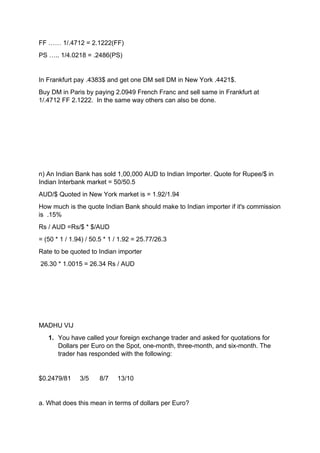
1. You have called your foreign exchange trader and asked for quotations for
Dollars per Euro on the Spot, one-month, three-month, and six-month. The
trader has responded with the following:
$0.2479/81 3/5 8/7 13/10
a. What does this mean in terms of dollars per Euro?
14.
b. If youwished to buy Spot euros, how much would you pay in dollars?
c. If you wanted to purchase Spot US dollars, how much would you have to pay in
Euro?
d. What is the premium or discount in the one, three, and six-month forward rates in
annual percentages? (Assume you are buying euros.)
Ans. a.
BID ASK
Spot rate $0.2479 $0.2481
1 Month Forward
Rate
$0.2482 $0.2486
3 Month FR $0.2471 $0.2474
6 Month FR $0.2466 $0.2471
b. $ 0.2481 (Ask rate)
c. 1 US dollars Spot = 1/ 0.2479 =4.034 Euro
d. Premium or discount rates in Forward Market (assume you are buying Euros)
% of premium/discount = Forward Rate – Spot Rate/Spot Rate x12/No. of months x
100
1 Month forward premium = (0.2486 - 0.2481)/0.2481 * 12 * 100 = 2.4296%
3 Month forward discount = (0.2474 - 0.2481)/0.2481 * 100 * 12/3 = 1.13%
6 Month Forward discount. = (0.2471 - 0.2481)/0.2481 * 100 * 12/6 = 0.8%
2. Spot Rate = Rs 44.0030= $1
6 month FR = Rs 45.0010=$1
Annualised interest rate on 6 month rupee 12%
Annualised interest rate on 6 month dollar 8%
Given the above data, is there an Arbitrage possibility?
Solution
6 month forward US$ is being quoted at a premium as follows
(45.0010 - 44.0030)/44.0030 * 12/6 * 100 = 4.5361%
Interest rate differential = 12% - 8% = 4%
15.
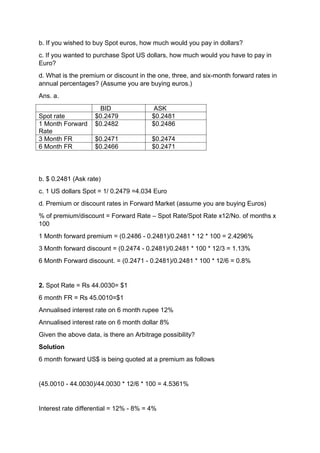
Since interest ratedifferential is smaller than the premium, it would be beneficial to
place money in US dollars as its 6 month interest rate is lower. An arbitrageur would
take the following steps.
i. Borrow Rs 10,000 at 12% for 6 months
ii. Convert this at Spot rate to obtain US $227.257 (10,000/44.0030)
iii. Invest dollars at 8% in Money Market for 6 months to receive
$227.257 *( 8x 6/12 * 1/100 +1) = $236.3473
iv. Sell US $ at 6 months forward to receive 236.3473 x 45.0010 = Rs 10635.865
v. Return the rupee debt borrowed at 12%. The amount to be refunded is Rs 10,600
Rs. 10,000 [ 1+12x 6/12 x 1/100 +1]- Rs 10600
Profit = Amount received - Amount borrowed 10,635.865-10,600 - 35.865
3. An Indian company, AB Ltd, imports machinery worth £ 2.0 million and is to
make the payment after 6 months. The current rates are
Spot rate Rs 66.96/pound
6 month forward rate Rs 67.50/pound
a. What should AB Ltd do if they expect that in six months time the pound will settle
at Rs 67.15/ pound?
b. What are the options available to the company in case of an expected
appreciation/depreciation in the rupee?
Solution
Spot rate £ 1= Rs 66.96
6 month forward rate £ 1 = Rs 67.50
Expected Spot rate after 6 months £1 Rs 67.15
a. Since AB Ltd has a liability in foreign Currency pound, they are importing a
machinery worth £2.0 million. Both the market and the company expect the pound to
appreciate. Company should estimate the relative cost of Hedging and if it is not too
high, the company should hedge its payments.
b. In case of depreciation of pound, the company need not do anything as it stands
to gain. In case of appreciation of pound it should hedge its payments as the
company will be exposed to Exchange Rate Risk.
16.
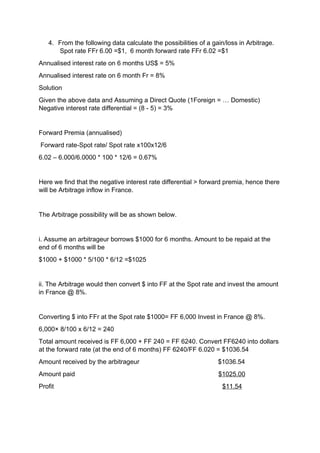
4. From thefollowing data calculate the possibilities of a gain/loss in Arbitrage.
Spot rate FFr 6.00 =$1, 6 month forward rate FFr 6.02 =$1
Annualised interest rate on 6 months US$ = 5%
Annualised interest rate on 6 month Fr = 8%
Solution
Given the above data and Assuming a Direct Quote (1Foreign = … Domestic)
Negative interest rate differential = (8 - 5) = 3%
Forward Premia (annualised)
Forward rate-Spot rate/ Spot rate x100x12/6
6.02 – 6.000/6.0000 * 100 * 12/6 = 0.67%
Here we find that the negative interest rate differential > forward premia, hence there
will be Arbitrage inflow in France.
The Arbitrage possibility will be as shown below.
i. Assume an arbitrageur borrows $1000 for 6 months. Amount to be repaid at the
end of 6 months will be
$1000 + $1000 * 5/100 * 6/12 =$1025
ii. The Arbitrage would then convert $ into FF at the Spot rate and invest the amount
in France @ 8%.
Converting $ into FFr at the Spot rate $1000= FF 6,000 Invest in France @ 8%.
6,000× 8/100 x 6/12 = 240
Total amount received is FF 6,000 + FF 240 = FF 6240. Convert FF6240 into dollars
at the forward rate (at the end of 6 months) FF 6240/FF 6.020 = $1036.54
Amount received by the arbitrageur $1036.54
Amount paid $1025.00
Profit $11.54
17.
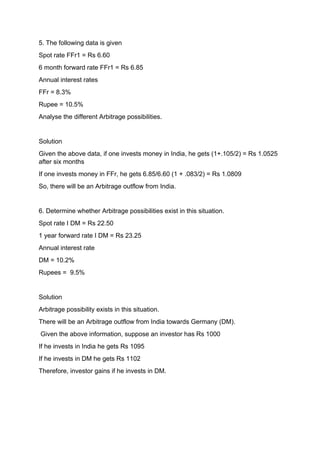
5. The followingdata is given
Spot rate FFr1 = Rs 6.60
6 month forward rate FFr1 = Rs 6.85
Annual interest rates
FFr = 8.3%
Rupee = 10.5%
Analyse the different Arbitrage possibilities.
Solution
Given the above data, if one invests money in India, he gets (1+.105/2) = Rs 1.0525
after six months
If one invests money in FFr, he gets 6.85/6.60 (1 + .083/2) = Rs 1.0809
So, there will be an Arbitrage outflow from India.
6. Determine whether Arbitrage possibilities exist in this situation.
Spot rate I DM = Rs 22.50
1 year forward rate I DM = Rs 23.25
Annual interest rate
DM = 10.2%
Rupees = 9.5%
Solution
Arbitrage possibility exists in this situation.
There will be an Arbitrage outflow from India towards Germany (DM).
Given the above information, suppose an investor has Rs 1000
If he invests in India he gets Rs 1095
If he invests in DM he gets Rs 1102
Therefore, investor gains if he invests in DM.
18.
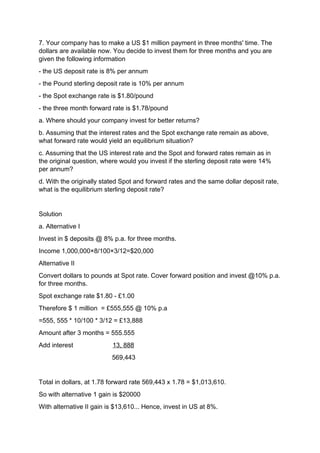
7. Your companyhas to make a US $1 million payment in three months' time. The
dollars are available now. You decide to invest them for three months and you are
given the following information
- the US deposit rate is 8% per annum
- the Pound sterling deposit rate is 10% per annum
- the Spot exchange rate is $1.80/pound
- the three month forward rate is $1.78/pound
a. Where should your company invest for better returns?
b. Assuming that the interest rates and the Spot exchange rate remain as above,
what forward rate would yield an equilibrium situation?
c. Assuming that the US interest rate and the Spot and forward rates remain as in
the original question, where would you invest if the sterling deposit rate were 14%
per annum?
d. With the originally stated Spot and forward rates and the same dollar deposit rate,
what is the equilibrium sterling deposit rate?
Solution
a. Alternative I
Invest in $ deposits @ 8% p.a. for three months.
Income 1,000,000×8/100×3/12=$20,000
Alternative II
Convert dollars to pounds at Spot rate. Cover forward position and invest @10% p.a.
for three months.
Spot exchange rate $1.80 - £1.00
Therefore $ 1 million = £555,555 @ 10% p.a
=555, 555 * 10/100 * 3/12 = £13,888
Amount after 3 months = 555.555
Add interest 13, 888
569,443
Total in dollars, at 1.78 forward rate 569,443 x 1.78 = $1,013,610.
So with alternative 1 gain is $20000
With alternative II gain is $13,610... Hence, invest in US at 8%.
19.
b. For anequilibrium situation, amount at the end of three months should be equal.
Hence,
Amount invested in sterling covered by forward rate = $1,020,000
Let forward rate be $x/£
At equilibrium, £ 569,443 equals $ 569,443x=1,020,000
Therefore x = 1,020,000/569443 = 1.791
Hence Forward rate = $1.791/£
c. Interest earned in pounds given same Spot and forward rates
= 555,555 x 14/100 x 3/12 =19,444
Total £ = 574 ,999
and total $ = 574 ,999*1.78=1,023,498
Gain = $23,498
Earlier gain = $ 20000
Hence at 14%, we should invest in sterling.
d. For equilibrium sterling deposit rate, amount invested in
sterling equals $ 1,020,000 after three months.
Now $ 1,020,000 converted to £ at forward rate 1,020,000
=1.78/£ 5,73,033
Let sterling rate be x % p.a.
[555, 555 * x/100 * 3/12 ]+555,555=573,033
Therefore x = 17, 478/555, 555 * 12/3 * 100 = 12.58%
Ans. 12.58% p.a.
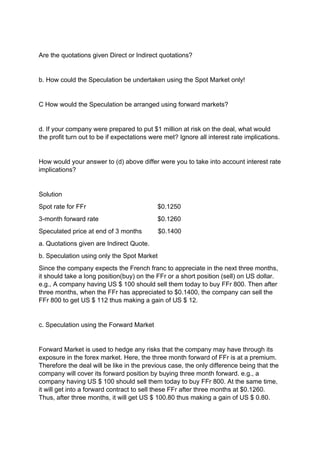
8. The Spot rate for the French franc is $0.1250 and the three month forward rate is
$0.1260. Your company is prepared to speculate that the French franc will move to
$0.1400 by the end of three months.
20.
Are the quotationsgiven Direct or Indirect quotations?
b. How could the Speculation be undertaken using the Spot Market only!
C How would the Speculation be arranged using forward markets?
d. If your company were prepared to put $1 million at risk on the deal, what would
the profit turn out to be if expectations were met? Ignore all interest rate implications.
How would your answer to (d) above differ were you to take into account interest rate
implications?
Solution
Spot rate for FFr $0.1250
3-month forward rate $0.1260
Speculated price at end of 3 months $0.1400
a. Quotations given are Indirect Quote.
b. Speculation using only the Spot Market
Since the company expects the French franc to appreciate in the next three months,
it should take a long position(buy) on the FFr or a short position (sell) on US dollar.
e.g., A company having US $ 100 should sell them today to buy FFr 800. Then after
three months, when the FFr has appreciated to $0.1400, the company can sell the
FFr 800 to get US $ 112 thus making a gain of US $ 12.
c. Speculation using the Forward Market
Forward Market is used to hedge any risks that the company may have through its
exposure in the forex market. Here, the three month forward of FFr is at a premium.
Therefore the deal will be like in the previous case, the only difference being that the
company will cover its forward position by buying three month forward. e.g., a
company having US $ 100 should sell them today to buy FFr 800. At the same time,
it will get into a forward contract to sell these FFr after three months at $0.1260.
Thus, after three months, it will get US $ 100.80 thus making a gain of US $ 0.80.
21.
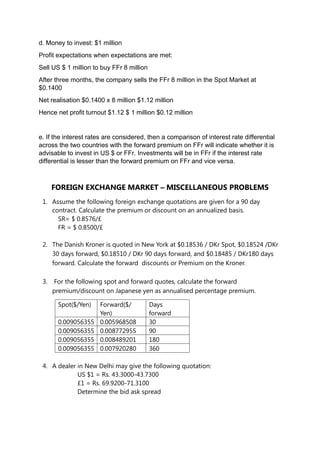
d. Money toinvest: $1 million
Profit expectations when expectations are met:
Sell US $ 1 million to buy FFr 8 million
After three months, the company sells the FFr 8 million in the Spot Market at
$0.1400
Net realisation $0.1400 x 8 million $1.12 million
Hence net profit turnout $1.12 $ 1 million $0.12 million
e. If the interest rates are considered, then a comparison of interest rate differential
across the two countries with the forward premium on FFr will indicate whether it is
advisable to invest in US $ or FFr. Investments will be in FFr if the interest rate
differential is lesser than the forward premium on FFr and vice versa.
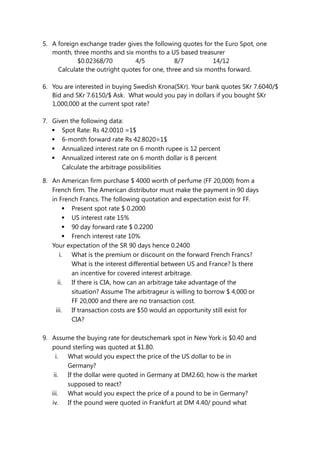
FOREIGN EXCHANGE MARKET – MISCELLANEOUS PROBLEMS
1. Assume the following foreign exchange quotations are given for a 90 day
contract. Calculate the premium or discount on an annualized basis.
SR= $ 0.8576/£
FR = $ 0.8500/£
2. The Danish Kroner is quoted in New York at $0.18536 / DKr Spot, $0.18524 /DKr
30 days forward, $0.18510 / DKr 90 days forward, and $0.18485 / DKr180 days
forward. Calculate the forward discounts or Premium on the Kroner.
3. For the following spot and forward quotes, calculate the forward
premium/discount on Japanese yen as annualised percentage premium.
Spot($/Yen) Forward($/
Yen)
Days
forward
0.009056355 0.005968508 30
0.009056355 0.008772955 90
0.009056355 0.008489201 180
0.009056355 0.007920280 360
4. A dealer in New Delhi may give the following quotation:
US $1 = Rs. 43.3000-43.7300
£1 = Rs. 69.9200-71.3100
Determine the bid ask spread
22.
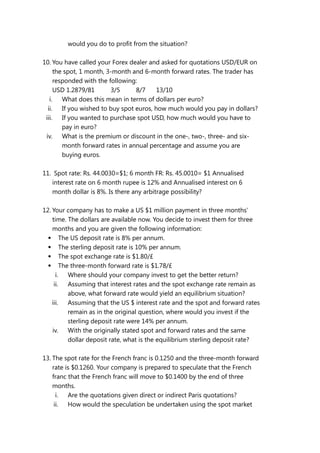
5. A foreignexchange trader gives the following quotes for the Euro Spot, one
month, three months and six months to a US based treasurer
$0.02368/70 4/5 8/7 14/12
Calculate the outright quotes for one, three and six months forward.
6. You are interested in buying Swedish Krona(SKr). Your bank quotes SKr 7.6040/$
Bid and SKr 7.6150/$ Ask. What would you pay in dollars if you bought SKr
1,000,000 at the current spot rate?
7. Given the following data:
Spot Rate: Rs 42.0010 =1$
6-month forward rate Rs 42.8020=1$
Annualized interest rate on 6 month rupee is 12 percent
Annualized interest rate on 6 month dollar is 8 percent
Calculate the arbitrage possibilities
8. An American firm purchase $ 4000 worth of perfume (FF 20,000) from a
French firm. The American distributor must make the payment in 90 days
in French Francs. The following quotation and expectation exist for FF.
Present spot rate $ 0.2000
US interest rate 15%
90 day forward rate $ 0.2200
French interest rate 10%
Your expectation of the SR 90 days hence 0.2400
i. What is the premium or discount on the forward French Francs?
What is the interest differential between US and France? Is there
an incentive for covered interest arbitrage.
ii. If there is CIA, how can an arbitrage take advantage of the
situation? Assume The arbitrageur is willing to borrow $ 4,000 or
FF 20,000 and there are no transaction cost.
iii. If transaction costs are $50 would an opportunity still exist for
CIA?
9. Assume the buying rate for deutschemark spot in New York is $0.40 and
pound sterling was quoted at $1.80.
i. What would you expect the price of the US dollar to be in
Germany?
ii. If the dollar were quoted in Germany at DM2.60, how is the market
supposed to react?
iii. What would you expect the price of a pound to be in Germany?
iv. If the pound were quoted in Frankfurt at DM 4.40/ pound what
23.
would you doto profit from the situation?
10. You have called your Forex dealer and asked for quotations USD/EUR on
the spot, 1 month, 3-month and 6-month forward rates. The trader has
responded with the following:
USD 1.2879/81 3/5 8/7 13/10
i. What does this mean in terms of dollars per euro?
ii. If you wished to buy spot euros, how much would you pay in dollars?
iii. If you wanted to purchase spot USD, how much would you have to
pay in euro?
iv. What is the premium or discount in the one-, two-, three- and six-
month forward rates in annual percentage and assume you are
buying euros.
11. Spot rate: Rs. 44.0030=$1; 6 month FR: Rs. 45.0010= $1 Annualised
interest rate on 6 month rupee is 12% and Annualised interest on 6
month dollar is 8%. Is there any arbitrage possibility?
12. Your company has to make a US $1 million payment in three months’
time. The dollars are available now. You decide to invest them for three
months and you are given the following information:
The US deposit rate is 8% per annum.
The sterling deposit rate is 10% per annum.
The spot exchange rate is $1.80/£
The three-month forward rate is $1.78/£
i. Where should your company invest to get the better return?
ii. Assuming that interest rates and the spot exchange rate remain as
above, what forward rate would yield an equilibrium situation?
iii. Assuming that the US $ interest rate and the spot and forward rates
remain as in the original question, where would you invest if the
sterling deposit rate were 14% per annum.
iv. With the originally stated spot and forward rates and the same
dollar deposit rate, what is the equilibrium sterling deposit rate?
13. The spot rate for the French franc is 0.1250 and the three-month forward
rate is $0.1260. Your company is prepared to speculate that the French
franc that the French franc will move to $0.1400 by the end of three
months.
i. Are the quotations given direct or indirect Paris quotations?
ii. How would the speculation be undertaken using the spot market
24.
only?
iii. How wouldthe speculation be arranged using forward market?
iv. If your company were prepared to put $1 million at risk on the deal,
what would the profit outturns be if expectations were met? Ignore
all interest rate implications.
v. How would your answer above (d) differ were you to take into
account interest rate implications?
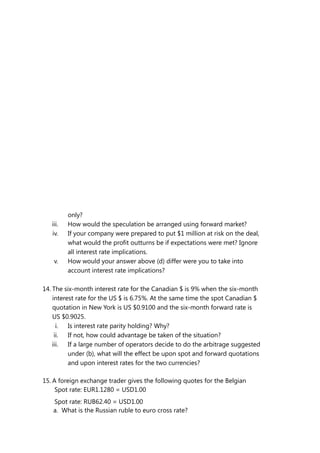
14. The six-month interest rate for the Canadian $ is 9% when the six-month
interest rate for the US $ is 6.75%. At the same time the spot Canadian $
quotation in New York is US $0.9100 and the six-month forward rate is
US $0.9025.
i. Is interest rate parity holding? Why?
ii. If not, how could advantage be taken of the situation?
iii. If a large number of operators decide to do the arbitrage suggested
under (b), what will the effect be upon spot and forward quotations
and upon interest rates for the two currencies?
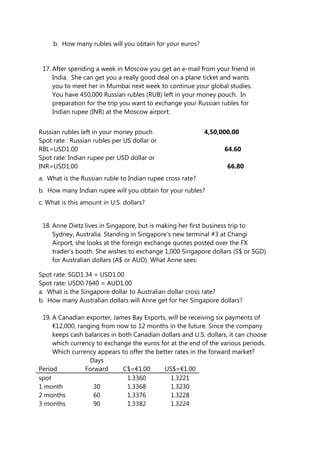
15. A foreign exchange trader gives the following quotes for the Belgian
Spot rate: EUR1.1280 = USD1.00
Spot rate: RUB62.40 = USD1.00
a. What is the Russian ruble to euro cross rate?
25.
b. How manyrubles will you obtain for your euros?
17. After spending a week in Moscow you get an e-mail from your friend in
India. She can get you a really good deal on a plane ticket and wants
you to meet her in Mumbai next week to continue your global studies.
You have 450,000 Russian rubles (RUB) left in your money pouch. In
preparation for the trip you want to exchange your Russian rubles for
Indian rupee (INR) at the Moscow airport:
Russian rubles left in your money pouch 4,50,000.00
Spot rate : Russian rubles per US dollar or
RBL=USD1.00 64.60
Spot rate: Indian rupee per USD dollar or
INR=USD1.00 66.80
a. What is the Russian ruble to Indian rupee cross rate?
b. How many Indian rupee will you obtain for your rubles?
c. What is this amount in U.S. dollars?
18. Anne Dietz lives in Singapore, but is making her first business trip to
Sydney, Australia. Standing in Singapore’s new terminal #3 at Changi
Airport, she looks at the foreign exchange quotes posted over the FX
trader’s booth. She wishes to exchange 1,000 Singapore dollars (S$ or SGD)
for Australian dollars (A$ or AUD). What Anne sees:
Spot rate: SGD1.34 = USD1.00
Spot rate: USD0.7640 = AUD1.00
a. What is the Singapore dollar to Australian dollar cross rate?
b. How many Australian dollars will Anne get for her Singapore dollars?
19. A Canadian exporter, James Bay Exports, will be receiving six payments of
€12,000, ranging from now to 12 months in the future. Since the company
keeps cash balances in both Canadian dollars and U.S. dollars, it can choose
which currency to exchange the euros for at the end of the various periods.
Which currency appears to offer the better rates in the forward market?
Days
Period Forward C$=€1.00 US$=€1.00
spot 1.3360 1.3221
1 month 30 1.3368 1.3230
2 months 60 1.3376 1.3228
3 months 90 1.3382 1.3224
26.
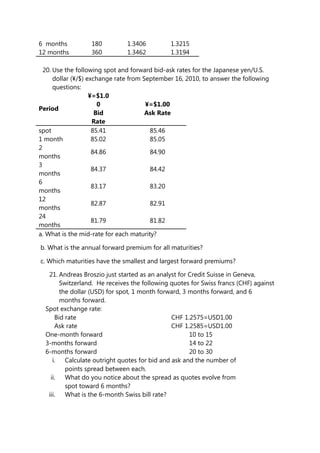
6 months 1801.3406 1.3215
12 months 360 1.3462 1.3194
20. Use the following spot and forward bid-ask rates for the Japanese yen/U.S.
dollar (¥/$) exchange rate from September 16, 2010, to answer the following
questions:
Period
¥=$1.0
0
Bid
Rate
¥=$1.00
Ask Rate
spot 85.41 85.46
1 month 85.02 85.05
2
months
84.86 84.90
3
months
84.37 84.42
6
months
83.17 83.20
12
months
82.87 82.91
24
months
81.79 81.82
a. What is the mid-rate for each maturity?
b. What is the annual forward premium for all maturities?
c. Which maturities have the smallest and largest forward premiums?
21. Andreas Broszio just started as an analyst for Credit Suisse in Geneva,
Switzerland. He receives the following quotes for Swiss francs (CHF) against
the dollar (USD) for spot, 1 month forward, 3 months forward, and 6
months forward.
Spot exchange rate:
Bid rate CHF 1.2575=USD1.00
Ask rate CHF 1.2585=USD1.00
One-month forward 10 to 15
3-months forward 14 to 22
6-months forward 20 to 30
i. Calculate outright quotes for bid and ask and the number of
points spread between each.
ii. What do you notice about the spread as quotes evolve from
spot toward 6 months?
iii. What is the 6-month Swiss bill rate?
27.
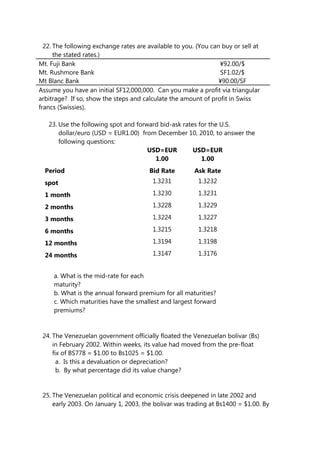
22. The followingexchange rates are available to you. (You can buy or sell at
the stated rates.)
Mt. Fuji Bank ¥92.00/$
Mt. Rushmore Bank SF1.02/$
Mt Blanc Bank ¥90.00/SF
Assume you have an initial SF12,000,000. Can you make a profit via triangular
arbitrage? If so, show the steps and calculate the amount of profit in Swiss
francs (Swissies).
23. Use the following spot and forward bid-ask rates for the U.S.
dollar/euro (USD = EUR1.00) from December 10, 2010, to answer the
following questions:
USD=EUR
1.00
USD=EUR
1.00
Period Bid Rate Ask Rate
spot 1.3231 1.3232
1 month 1.3230 1.3231
2 months 1.3228 1.3229
3 months 1.3224 1.3227
6 months 1.3215 1.3218
12 months 1.3194 1.3198
24 months 1.3147 1.3176
a. What is the mid-rate for each
maturity?
b. What is the annual forward premium for all maturities?
c. Which maturities have the smallest and largest forward
premiums?
24. The Venezuelan government officially floated the Venezuelan bolivar (Bs)
in February 2002. Within weeks, its value had moved from the pre-float
fix of BS778 = $1.00 to Bs1025 = $1.00.
a. Is this a devaluation or depreciation?
b. By what percentage did its value change?
25. The Venezuelan political and economic crisis deepened in late 2002 and
early 2003. On January 1, 2003, the bolivar was trading at Bs1400 = $1.00. By
28.
February 1, itsvalue had fallen to Bs1950 = $1.00. Many currency analysts
and forecasters were predicting that the bolivar would fall an additional 40%
a. What was the percentage change in January?
b. What is the forecast value for June 2003?
26. Calculate the forward premium on the dollar (the dollar is the
home currency) if the spot rate is €1.3300 = $1.00 and the 3-
month forward rate is €1.3400 = $1.00.
27. Calculate the forward discount on the dollar (the dollar is the
home currency) if the spot rate is $1.5800 = £1.00 and the 6-
month forward rate is $1.5550 = £1.00.
28. Inspired by his recent trip to the Great Pyramids, Citibank trader
Ruminder Dhillon wonders if he can make an intermarket arbitrage profit
using Libyan dinars (LYD) and Saudi riyals (SAR). He has USD1,000,000
to work with so he gathers the following quotes. Is there an opportunity
for an arbitrage profit?
Citibank quotes U.S. dollar per Libyan dinar:
USD1.9324 =
LYD1.00
National Bank of Kuwait quotes Saudi riyal per Libyan
dinar:
SAR 1.9405 =
LYD1.00
Barclay quotes U.S. dollar per Saudi riyal:
USD0.2667 =
SAR1.00
29. Calculate the cross rate between the Mexican peso (Ps) and the euro (€ )
from the following two spot rates: Ps12.45 = $1.00 and €0.7550 = $1.00.
30. Calculate the cross rate between the Costa Rican colón (CRC)
and the Canadian dollar (CAD) from the following spot rates:
CRC500.29 = USD1.00 and CAD1.02 = USD1.00.
31. Assuming the following quotes, calculate how a market trader at Citibank
with $1,000,000 can make an intermarket arbitrage profit.
Citibank quotes U.S. dollar per pound: $1.5900 = £1.00
National Westminster quotes euros per pound: €1.2000 = £1.00
Deutschebank quotes U.S. dollar per euro: $0.7550 = €1.00
32. The Siam Cement Group of Bangkok borrowed EUR12.5 million for one year
on February 14, 2020, short-term financing provided by a European customer.
29.
The interest ratewas a low 6.500%. The problem, however, was that the
exchange rate between the Thai baht (THB) and the euro (EUR) changed from
THB33.860 = EUR1.00 on February 14, 2020 to THB36.327 = EUR1.00 on
February 16, 2021, when the loan repayment was due. In the end, what was
the interest rate paid by Siam Cement in its own currency, Thai baht?

![Since interest rate differential is smaller than the premium, it would be beneficial to
place money in US dollars as its 6 month interest rate is lower. An arbitrageur would
take the following steps.
i. Borrow Rs 10,000 at 12% for 6 months
ii. Convert this at Spot rate to obtain US $227.257 (10,000/44.0030)
iii. Invest dollars at 8% in Money Market for 6 months to receive
$227.257 *( 8x 6/12 * 1/100 +1) = $236.3473
iv. Sell US $ at 6 months forward to receive 236.3473 x 45.0010 = Rs 10635.865
v. Return the rupee debt borrowed at 12%. The amount to be refunded is Rs 10,600
Rs. 10,000 [ 1+12x 6/12 x 1/100 +1]- Rs 10600
Profit = Amount received - Amount borrowed 10,635.865-10,600 - 35.865
3. An Indian company, AB Ltd, imports machinery worth £ 2.0 million and is to
make the payment after 6 months. The current rates are
Spot rate Rs 66.96/pound
6 month forward rate Rs 67.50/pound
a. What should AB Ltd do if they expect that in six months time the pound will settle
at Rs 67.15/ pound?
b. What are the options available to the company in case of an expected
appreciation/depreciation in the rupee?
Solution
Spot rate £ 1= Rs 66.96
6 month forward rate £ 1 = Rs 67.50
Expected Spot rate after 6 months £1 Rs 67.15
a. Since AB Ltd has a liability in foreign Currency pound, they are importing a
machinery worth £2.0 million. Both the market and the company expect the pound to
appreciate. Company should estimate the relative cost of Hedging and if it is not too
high, the company should hedge its payments.
b. In case of depreciation of pound, the company need not do anything as it stands
to gain. In case of appreciation of pound it should hedge its payments as the
company will be exposed to Exchange Rate Risk.](https://image.slidesharecdn.com/gfm-moduleiiforeignexchangemarket-250408095907-aefd670f/85/GFM-Module-II-Foreign-Exchange-Market-docx-15-320.jpg)
![b. For an equilibrium situation, amount at the end of three months should be equal.
Hence,
Amount invested in sterling covered by forward rate = $1,020,000
Let forward rate be $x/£
At equilibrium, £ 569,443 equals $ 569,443x=1,020,000
Therefore x = 1,020,000/569443 = 1.791
Hence Forward rate = $1.791/£
c. Interest earned in pounds given same Spot and forward rates
= 555,555 x 14/100 x 3/12 =19,444
Total £ = 574 ,999
and total $ = 574 ,999*1.78=1,023,498
Gain = $23,498
Earlier gain = $ 20000
Hence at 14%, we should invest in sterling.
d. For equilibrium sterling deposit rate, amount invested in
sterling equals $ 1,020,000 after three months.
Now $ 1,020,000 converted to £ at forward rate 1,020,000
=1.78/£ 5,73,033
Let sterling rate be x % p.a.
[555, 555 * x/100 * 3/12 ]+555,555=573,033
Therefore x = 17, 478/555, 555 * 12/3 * 100 = 12.58%
Ans. 12.58% p.a.
8. The Spot rate for the French franc is $0.1250 and the three month forward rate is
$0.1260. Your company is prepared to speculate that the French franc will move to
$0.1400 by the end of three months.](https://image.slidesharecdn.com/gfm-moduleiiforeignexchangemarket-250408095907-aefd670f/85/GFM-Module-II-Foreign-Exchange-Market-docx-19-320.jpg)