Presentation onWasimYousuf,MIB 3rd Sem.,Bangalore City College.
What is FOREX?The FOREX is the world’s biggest financial market.The FOREX or “FOReignEXchange” is the planets biggest most liquid financial marketplace hands down. “Foreign exchange” refers to money denominated in the currency of another nation or group of nations. Any person who exchanges money denominated in his own nation’s currency for money denominated in another nation’s currency acquires foreign exchange.
What is FOREX? (Contd.)Foreign exchange can be cash, funds available on credit cards and debit cards, traveler’s checks, bank deposits, or other short-term claims. It is still “foreign exchange” if it is a short-term negotiable financial claim denominated in a currency other than the U.S. dollar.” – Sam Cross – The Federal Reserve BankThe Foreign Exchange is made up of anyone who exchanges the currency of one country for that of another.The FOriegnEXchange does not have a centralized exchange like the stock market in New York or the commodities markets with centralized exchanges in cities like New York and Chicago.
Why do fluctuations occur in FOREX?There are many reasons but the most influential are:General condition of a country’s economy and economic influences like interest rates and inflation.Political FactorsTrade BalancePurchase Power Parity Social FactorsGovernment and central bank policies and policy changes
Currency trading Vs Stock TradingMany find trading currency much more attractive than trading stocks for the following reasons::Focused Attention –When you trade stocks, there are literally tens of thousands of companies to choose from when trying to decide which ones to invest in. That is a lot of information to assimilate and keep track of. With the Foreign Exchange the number of choices is dramatically reduced making it much easier to concentrate on trading. While many countries are traded, there are five main players in this global arena... The United States (USD) The European Union (EURO) Great Britain (GBP) Japan (JPY) Switzerland (CHF)
Currency trading Vs Stock Trading: (Contd.)Liquidity –Because FOREX is literally the biggest "market" on earth, whether you are entering or exiting, getting your order filled is almost instantaneous which is not always the case with stocks. Profit Potential – You can open a currency trading account for less than $500 but the profit potential is greater than stocks, with FOREX you can profit regardless of whether or not the value of a currency is rising or falling.
Currency trading Vs Stock Trading: (Contd.)Convenient –The FOReignEXchange is open for business 24 hours a day, 5 days a week offering trading opportunities for even the busiest people. Ample Trading Opportunities –     Because the currency process are always fluctuating up and down, there are plenty of trading opportunities.
Currency trading Vs Stock Trading: (Contd.)FREE Trading Aids -     There are plenty of free trading resources for anyone that wants to trade currency. Check out the resources section of this site to learn more. Practice Account –    You can open a practice account with most brokers that allow you to "play" with cyber cash until you are ready to trade real funds.
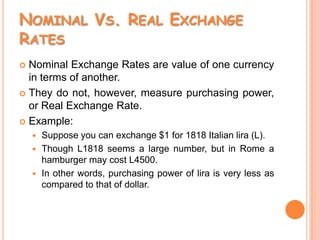
Nominal Vs. Real Exchange RatesNominal Exchange Rates are value of one currency in terms of another.They do not, however, measure purchasing power, or Real Exchange Rate.Example: Suppose you can exchange $1 for 1818 Italian lira (L).Though L1818 seems a large number, but in Rome a hamburger may cost L4500.In other words, purchasing power of lira is very less as compared to that of dollar.
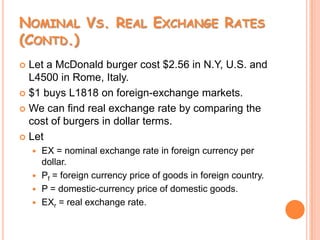
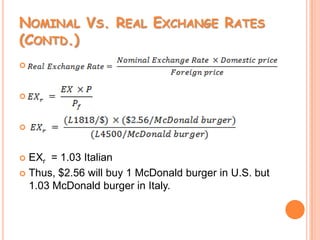
Nominal Vs. Real Exchange Rates (Contd.)Let a McDonald burger cost $2.56 in N.Y, U.S. and L4500 in Rome, Italy.$1 buys L1818 on foreign-exchange markets.We can find real exchange rate by comparing the cost of burgers in dollar terms.LetEX = nominal exchange rate in foreign currency per dollar.Pf = foreign currency price of goods in foreign country.P = domestic-currency price of domestic goods.EXr = real exchange rate.
Nominal Vs. Real Exchange Rates (Contd.)EXr 	= 1.03 ItalianThus, $2.56 will buy 1 McDonald burger in U.S. but 1.03 McDonald burger in Italy.
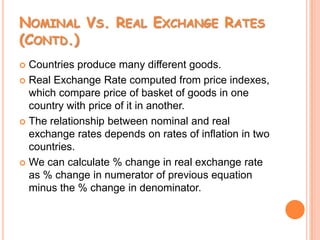
Nominal Vs. Real Exchange Rates (Contd.)Countries produce many different goods.Real Exchange Rate computed from price indexes, which compare price of basket of goods in one country with price of it in another.The relationship between nominal and real exchange rates depends on rates of inflation in two countries.We can calculate % change in real exchange rate as % change in numerator of previous equation minus the % change in denominator.
Nominal Vs. Real Exchange Rates (Contd.)The equation shows % change in nominal exchange rate has two parts:% change in real exchange rate.difference in foreign and domestic inflation rate.If exchange rate rises:rise in real exchange rate.or higher foreign inflation rate, or maybe both.If exchange rate falls:fall in real exchange rate.or higher domestic inflation rate, or maybe both.
Nominal Vs. Real Exchange Rates (Contd.)Suppose Peynolds and Barker are companies in two countries whose currencies are crown and royal.Peynolds makes ball pens sold at 2 crown each.Barker makes high-quality ink pens sold at 10 royals each.Real exchange rate between Peynolds and Barker pens is 10 ball pens per ink pen.What is the nominal Exchange rate?
Foreign Exchange MarketsFrom perspective of individual consumers or investors, exchange rates can be used to convert one currency into another.
International currencies are traded in foreign-exchange-markets around the world.
Market forces determine the exchange rate that prevails for consumers and investors.
Exchange rates affect the cost of acquiring foreign financial assets or foreign goods and services.
Major participants are importers and exporters, banks, investment portfolio managers, and central banks.Foreign Exchange Markets (Contd.)The worldwide volume of foreign exchange trading is enormous, and it has ballooned in recent years.New technologies, such as Internet links, are used among the major foreign exchange trading centres (London, New York, Tokyo, Frankfurt, and Singapore).The integration of financial centres implies that there can be no significant arbitrage.The process of buying a currency cheap and selling it dear.
Foreign Exchange Markets (Contd.)Two types of transactions take place in foreign exchange markets.Spot Market Transactions:Currencies or bank deposits are exchanged immediately (two day settlement period).
Spot rate is the price quote at which you can buy immediately.Forward Transactions:Currencies or bank deposits are exchanged  at a set date in the future.
Investors sign a contract for a given quantity of currency and exchange rate.
At future date, actual exchange takes place at rate known as forward rate.Determining Long Run Exchange RatesWe will look at four key factors that account for long-run trends in the supply of and demand for currencies in the foreign exchange markets:Price level differences.
Productivity differences.
Preference for domestic or foreign goods.
Trade barriersDetermining Long Run Exchange Rates: Price Level DifferencesWhen price levels rise in U.K. relative to price levels in U.S., then U.K. goods or financial assets become more costly as compared to similar U.S. goods or financial assets.
In such case where U.K. experiences higher inflation rate, pound is less useful as store of value than dollar.
All else being equal, relative increase in price levels lead to depreciation of domestic currency.
Example:
In late 1970’s excess growth of U.K.’s price levels over U.S. price levels lead pound to depreciate  against dollar.Determining Long Run Exchange Rates: Productivity DifferencesProductivity growth measures the increase in output level of a country for a given input level.
Higher productivity leads to cheaper production of domestic goods than foreign goods.
Hence domestic goods can be supplied at lower prices than foreign goods, leading to higher demand.
This higher demand for domestic goods leads to higher demand for domestic currency.
Thus higher productivity leads to appreciation of domestic currency.
Example:
In late 1970’s and early 1980’s U.S. productivity level was higher than U.K. leading to appreciation of dollar against pound.Determining Long Run Exchange Rates: Preference For Domestic Or Foreign Goods.If U.S. consumers prefer British-made goods, they will demand more pounds to buy these goods.It will put upward pressure on pound and depreciate the dollar.Example:In mid 1980’s U.S. consumers in second half of decade They preferred U.K. goods leading to depreciation of dollar.

Foreign exchange market

  • 1.
    Presentation onWasimYousuf,MIB 3rdSem.,Bangalore City College.
  • 2.
    What is FOREX?TheFOREX is the world’s biggest financial market.The FOREX or “FOReignEXchange” is the planets biggest most liquid financial marketplace hands down. “Foreign exchange” refers to money denominated in the currency of another nation or group of nations. Any person who exchanges money denominated in his own nation’s currency for money denominated in another nation’s currency acquires foreign exchange.
  • 3.
    What is FOREX?(Contd.)Foreign exchange can be cash, funds available on credit cards and debit cards, traveler’s checks, bank deposits, or other short-term claims. It is still “foreign exchange” if it is a short-term negotiable financial claim denominated in a currency other than the U.S. dollar.” – Sam Cross – The Federal Reserve BankThe Foreign Exchange is made up of anyone who exchanges the currency of one country for that of another.The FOriegnEXchange does not have a centralized exchange like the stock market in New York or the commodities markets with centralized exchanges in cities like New York and Chicago.
  • 4.
    Why do fluctuationsoccur in FOREX?There are many reasons but the most influential are:General condition of a country’s economy and economic influences like interest rates and inflation.Political FactorsTrade BalancePurchase Power Parity Social FactorsGovernment and central bank policies and policy changes
  • 5.
    Currency trading VsStock TradingMany find trading currency much more attractive than trading stocks for the following reasons::Focused Attention –When you trade stocks, there are literally tens of thousands of companies to choose from when trying to decide which ones to invest in. That is a lot of information to assimilate and keep track of. With the Foreign Exchange the number of choices is dramatically reduced making it much easier to concentrate on trading. While many countries are traded, there are five main players in this global arena... The United States (USD) The European Union (EURO) Great Britain (GBP) Japan (JPY) Switzerland (CHF)
  • 6.
    Currency trading VsStock Trading: (Contd.)Liquidity –Because FOREX is literally the biggest "market" on earth, whether you are entering or exiting, getting your order filled is almost instantaneous which is not always the case with stocks. Profit Potential – You can open a currency trading account for less than $500 but the profit potential is greater than stocks, with FOREX you can profit regardless of whether or not the value of a currency is rising or falling.
  • 7.
    Currency trading VsStock Trading: (Contd.)Convenient –The FOReignEXchange is open for business 24 hours a day, 5 days a week offering trading opportunities for even the busiest people. Ample Trading Opportunities – Because the currency process are always fluctuating up and down, there are plenty of trading opportunities.
  • 8.
    Currency trading VsStock Trading: (Contd.)FREE Trading Aids - There are plenty of free trading resources for anyone that wants to trade currency. Check out the resources section of this site to learn more. Practice Account – You can open a practice account with most brokers that allow you to "play" with cyber cash until you are ready to trade real funds.
  • 9.
    Nominal Vs. RealExchange RatesNominal Exchange Rates are value of one currency in terms of another.They do not, however, measure purchasing power, or Real Exchange Rate.Example: Suppose you can exchange $1 for 1818 Italian lira (L).Though L1818 seems a large number, but in Rome a hamburger may cost L4500.In other words, purchasing power of lira is very less as compared to that of dollar.
  • 10.
    Nominal Vs. RealExchange Rates (Contd.)Let a McDonald burger cost $2.56 in N.Y, U.S. and L4500 in Rome, Italy.$1 buys L1818 on foreign-exchange markets.We can find real exchange rate by comparing the cost of burgers in dollar terms.LetEX = nominal exchange rate in foreign currency per dollar.Pf = foreign currency price of goods in foreign country.P = domestic-currency price of domestic goods.EXr = real exchange rate.
  • 11.
    Nominal Vs. RealExchange Rates (Contd.)EXr = 1.03 ItalianThus, $2.56 will buy 1 McDonald burger in U.S. but 1.03 McDonald burger in Italy.
  • 12.
    Nominal Vs. RealExchange Rates (Contd.)Countries produce many different goods.Real Exchange Rate computed from price indexes, which compare price of basket of goods in one country with price of it in another.The relationship between nominal and real exchange rates depends on rates of inflation in two countries.We can calculate % change in real exchange rate as % change in numerator of previous equation minus the % change in denominator.
  • 13.
    Nominal Vs. RealExchange Rates (Contd.)The equation shows % change in nominal exchange rate has two parts:% change in real exchange rate.difference in foreign and domestic inflation rate.If exchange rate rises:rise in real exchange rate.or higher foreign inflation rate, or maybe both.If exchange rate falls:fall in real exchange rate.or higher domestic inflation rate, or maybe both.
  • 14.
    Nominal Vs. RealExchange Rates (Contd.)Suppose Peynolds and Barker are companies in two countries whose currencies are crown and royal.Peynolds makes ball pens sold at 2 crown each.Barker makes high-quality ink pens sold at 10 royals each.Real exchange rate between Peynolds and Barker pens is 10 ball pens per ink pen.What is the nominal Exchange rate?
  • 15.
    Foreign Exchange MarketsFromperspective of individual consumers or investors, exchange rates can be used to convert one currency into another.
  • 16.
    International currencies aretraded in foreign-exchange-markets around the world.
  • 17.
    Market forces determinethe exchange rate that prevails for consumers and investors.
  • 18.
    Exchange rates affectthe cost of acquiring foreign financial assets or foreign goods and services.
  • 19.
    Major participants areimporters and exporters, banks, investment portfolio managers, and central banks.Foreign Exchange Markets (Contd.)The worldwide volume of foreign exchange trading is enormous, and it has ballooned in recent years.New technologies, such as Internet links, are used among the major foreign exchange trading centres (London, New York, Tokyo, Frankfurt, and Singapore).The integration of financial centres implies that there can be no significant arbitrage.The process of buying a currency cheap and selling it dear.
  • 20.
    Foreign Exchange Markets(Contd.)Two types of transactions take place in foreign exchange markets.Spot Market Transactions:Currencies or bank deposits are exchanged immediately (two day settlement period).
  • 21.
    Spot rate isthe price quote at which you can buy immediately.Forward Transactions:Currencies or bank deposits are exchanged at a set date in the future.
  • 22.
    Investors sign acontract for a given quantity of currency and exchange rate.
  • 23.
    At future date,actual exchange takes place at rate known as forward rate.Determining Long Run Exchange RatesWe will look at four key factors that account for long-run trends in the supply of and demand for currencies in the foreign exchange markets:Price level differences.
  • 24.
  • 25.
    Preference for domesticor foreign goods.
  • 26.
    Trade barriersDetermining LongRun Exchange Rates: Price Level DifferencesWhen price levels rise in U.K. relative to price levels in U.S., then U.K. goods or financial assets become more costly as compared to similar U.S. goods or financial assets.
  • 27.
    In such casewhere U.K. experiences higher inflation rate, pound is less useful as store of value than dollar.
  • 28.
    All else beingequal, relative increase in price levels lead to depreciation of domestic currency.
  • 29.
  • 30.
    In late 1970’sexcess growth of U.K.’s price levels over U.S. price levels lead pound to depreciate against dollar.Determining Long Run Exchange Rates: Productivity DifferencesProductivity growth measures the increase in output level of a country for a given input level.
  • 31.
    Higher productivity leadsto cheaper production of domestic goods than foreign goods.
  • 32.
    Hence domestic goodscan be supplied at lower prices than foreign goods, leading to higher demand.
  • 33.
    This higher demandfor domestic goods leads to higher demand for domestic currency.
  • 34.
    Thus higher productivityleads to appreciation of domestic currency.
  • 35.
  • 36.
    In late 1970’sand early 1980’s U.S. productivity level was higher than U.K. leading to appreciation of dollar against pound.Determining Long Run Exchange Rates: Preference For Domestic Or Foreign Goods.If U.S. consumers prefer British-made goods, they will demand more pounds to buy these goods.It will put upward pressure on pound and depreciate the dollar.Example:In mid 1980’s U.S. consumers in second half of decade They preferred U.K. goods leading to depreciation of dollar.