GNED 500
WEEK 2
Image by Pixabay.com
Acknowledgement
Traditional Lands
Canada Map Vectors by Vecteezy
AGENDA
• COURSE
INTRODUCTION
• FREEWRITE
• WHAT IS CITIZENSHIP?
• COSMOPOLITANISM:
A BRIEF HISTORY
• GLOBALIZATION: PAST
AND FUTURE
Artwork by Hi Profile is licensed under
a CC BY-NC-SA 4.0 International License.
ABOUT ME
• Born in Calgary, lived in Toronto since 2012
• Sociology PhD, University of Toronto
• studies markets and diaspora-making
• Professional Cooking diploma, SAIT
• gardens, cooks, eats
LEARNING
OBJECTIVE
S
Upon completing this course,
students will be able to do the
following:
• Reflect critically about one’s
role as a global citizen in
personal and professional life
• Analyze the ways we come to
understand the world, our
perceptions of ourselves and
others
• Critically analyze social issues
considering different
perspectives and historical
roots
• Develop recommendations for
a social action plan
GNED 500
Learning
Outcomes
ASSESSMENT
Personal
Reflection
Social
Analysis
project
Reading
critique
Presentation
Weekly
Quizzes
• Identity and
Ideology (15%)
• Media Literacy
(15%)
• Proposal
(10%)
• Report (25%)
• Apply course
concepts to
analysing media
(15%)
• Multiple
choice, based
on assigned
text and
lectures
(20%)
POLICI
ES
COMMUNICATIONS
I will respond to email within 48 hours (but I don’t
check email after 8 pm)
Please use my.centennialcollege.ca address
ACADEMIC INTEGRITY
Plagiarism will be investigated and referred to the
Chair’s office
GROUP WORK
Students are accountable for their individual
contributions to group work. Group conflicts should
be brought to my attention if they can’t be resolved
internally.
LATE/MISSED ASSIGNMENTS
Arrange extensions in advance
Documentation required for any missed assessments
USING eCENTENNIAL
Freewrite
• Freewriting is unstructured reflective writing
to help you work out your unfiltered
thoughts on a topic.
• Take 5 minutes to respond to the prompts
below. Write in whichever language you are
most comfortable. Spelling, grammar, and
coherence don’t matter. The only rules are
DO NOT STOP WRITING and DO NOT CROSS
ANYTHING OUT
PROMPTS:
1) What’s the importance of global
citizenship to me?
2) What do I do that makes me a good global
citizen?
Brainstorm:
What does the word
“citizen” make you think
of?
Citizenship
• Citizenship = National Identity.
• Acknowledgement of belonging to a particular country.
• Belonging carries citizenship
• Set of rights and responsibilities.
How are Canadians recognized?
What are the Rights
and Responsibilities
of a Canadian citizen?
Photo by Cedric Fauntleroy from Pexels
Graphic created by upklyak - freepik.com
Rights and
Responsibilities
Rights:
• Voting
• Freedom of conscience and
religion
• Freedom of thought, belief,
opinion, and expression
• Freedom of peaceful assembly
• Freedom of association
Responsibilities:
• Voting
• Obeying the law
• Taking responsibility for oneself
and one’s family
• Protecting the nation’s heritage
and environment
• Defending Canada
How is a global citizen different from a national
citizen?
• Who recognizes global citizens, and how?
• What are the rights and responsibilities of
global citizenship?
Rights and
Responsibilities
Artwork by Hi Profile is licensed under
a CC BY-NC-SA 4.0 International License.
Cosmopolitanism
• Global citizenship traced to
cosmopolitanism.
• From Ancient Greek:
Kosmos (world/universe) +
Polites (citizen)
• Rejects local attachments & ideas
• Associated with travel, cultural
curiosity, syncretism
By rawpixel.com - freepik.com
Diogenes (412-323 BCE)
• Greek philosopher, founder of
Cynicism
• Born in Sinope (Turkey), exiled for
counterfeiting
• Shunned all possessions, lived in a
large clay pot in the marketplace of
ancient Athens.
• Used this lifestyle to criticize
“decadent”, “corrupt” values of
Athens
• Self-declared “citizen of the world.”
Alexander and Diogenes|Gaetano Gandolfi, 1792 – Public
Voltaire (1694 – 1778)
“Cosmopolitans… regard all the
peoples of the earth as so many
branches of a single family, and
the universe as a state, of which
they, with innumerable other
rational beings, are citizens,
promoting together under the
general laws of nature the
perfection of the whole, while
each in his own fashion is busy
about his own well-being”
(qt. in Appiah, 2006, p. xv).
Image Public Domain Wikimedia
Immanuel Kant (1724 –
1809)
• 18th century German philosopher, argued
that all human beings have ‘intrinsic worth’
and a ‘dignity’ that must be respected.
• The notion of universal hospitality as a right
– “the right of a stranger not to be treated as
an enemy.”
• It is a right we have as fellow inhabitants of
the earth.
• Hospitality requires us to be kind and
accommodating towards strangers.
Image Public Domain Wikimedia
Discussion
In groups of 3 – 4, discuss the slogan “Think globally, act
locally”
What does this statement mean? How is it similar or
different from the philosophy of Diogenes? Of Voltaire?
Of Kant?
Are there times where you have thought globally and acted
locally? Be prepared to present your experiences to the
class.
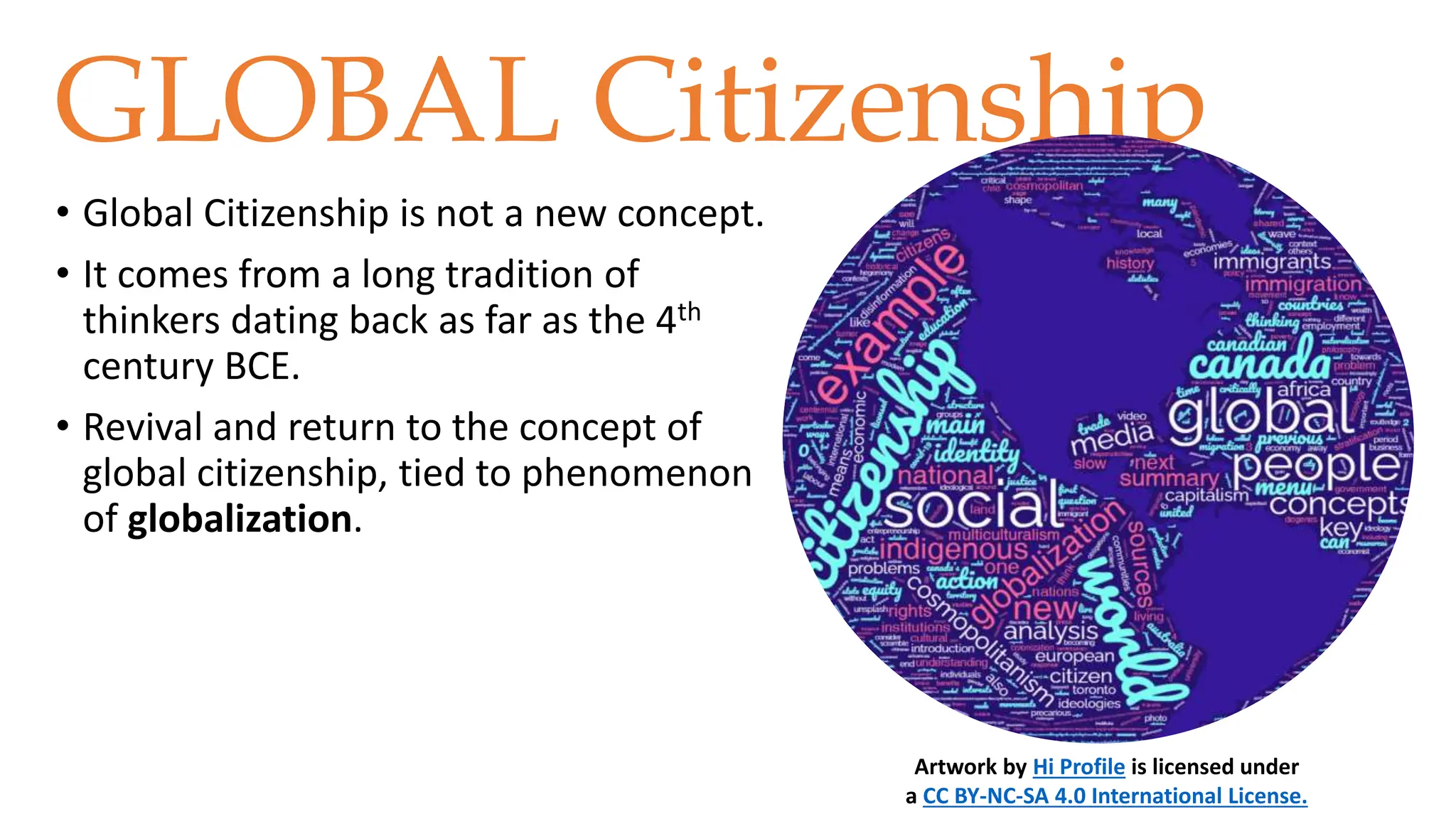
• Global Citizenship is not a new concept.
• It comes from a long tradition of
thinkers dating back as far as the 4th
century BCE.
• Revival and return to the concept of
global citizenship, tied to phenomenon
of globalization.
GLOBAL Citizenship
Artwork by Hi Profile is licensed under
a CC BY-NC-SA 4.0 International License.
BREAK
Photo by Angela Roma from Pexels.com
ATTENDAN
CE
Image by pch.vector - freepik.com
Temperature
Check Line up according to your response to the
statements below. If you STRONGLY AGREE,
stand to the right; if you STRONGLY
DISAGREE, stand to the left. If you’re unsure,
stand in the middle.
Overall, my life is better for living in a
globalized world.
Overall, globalization makes the world a
better place.
Globalization
• Globalization refers to the
increasing integration of
nations’ economies, trade,
products, ideas, norms, and
cultures.
• Movement of …
• Transportation
• Telecommunications
• People
Image by Gerd Altmann from Pixabay
3 waves of
globalization
1870-1920
European
empires colonize
Americas/
Africa/
Asia
1945-1980s
Post WW2
decolonization
Cold War
Non-Aligned
Movement
1994
–
2020?
Collapse of USSR
– US as global
superpower
WTO & Global
trade Blocs
Internet & digital
revolution
Global Citizenship in an era
of Globalization
• Globalization has benefited our lives,
however no guarantee that it will
improve our lives
• In subsequent units, we will explore
some of the human, environmental,
and economic costs of our increasingly
interconnected world.
• Globalization contains no moral
imperative to deal with societal issues
• Global citizenship, on the other hand,
requires an ethical and moral
commitment to principles of fairness
and justice.
Image by Darwin Laganzon from Pixabay
WK2 - Global Citizenship Section 710 b.pptx

WK2 - Global Citizenship Section 710 b.pptx

  • 1.
    GNED 500 WEEK 2 Imageby Pixabay.com
  • 2.
  • 3.
    AGENDA • COURSE INTRODUCTION • FREEWRITE •WHAT IS CITIZENSHIP? • COSMOPOLITANISM: A BRIEF HISTORY • GLOBALIZATION: PAST AND FUTURE Artwork by Hi Profile is licensed under a CC BY-NC-SA 4.0 International License.
  • 4.
    ABOUT ME • Bornin Calgary, lived in Toronto since 2012 • Sociology PhD, University of Toronto • studies markets and diaspora-making • Professional Cooking diploma, SAIT • gardens, cooks, eats
  • 5.
    LEARNING OBJECTIVE S Upon completing thiscourse, students will be able to do the following: • Reflect critically about one’s role as a global citizen in personal and professional life • Analyze the ways we come to understand the world, our perceptions of ourselves and others • Critically analyze social issues considering different perspectives and historical roots • Develop recommendations for a social action plan GNED 500 Learning Outcomes
  • 6.
    ASSESSMENT Personal Reflection Social Analysis project Reading critique Presentation Weekly Quizzes • Identity and Ideology(15%) • Media Literacy (15%) • Proposal (10%) • Report (25%) • Apply course concepts to analysing media (15%) • Multiple choice, based on assigned text and lectures (20%)
  • 7.
    POLICI ES COMMUNICATIONS I will respondto email within 48 hours (but I don’t check email after 8 pm) Please use my.centennialcollege.ca address ACADEMIC INTEGRITY Plagiarism will be investigated and referred to the Chair’s office GROUP WORK Students are accountable for their individual contributions to group work. Group conflicts should be brought to my attention if they can’t be resolved internally. LATE/MISSED ASSIGNMENTS Arrange extensions in advance Documentation required for any missed assessments
  • 8.
  • 9.
    Freewrite • Freewriting isunstructured reflective writing to help you work out your unfiltered thoughts on a topic. • Take 5 minutes to respond to the prompts below. Write in whichever language you are most comfortable. Spelling, grammar, and coherence don’t matter. The only rules are DO NOT STOP WRITING and DO NOT CROSS ANYTHING OUT PROMPTS: 1) What’s the importance of global citizenship to me? 2) What do I do that makes me a good global citizen?
  • 10.
    Brainstorm: What does theword “citizen” make you think of?
  • 11.
    Citizenship • Citizenship =National Identity. • Acknowledgement of belonging to a particular country. • Belonging carries citizenship • Set of rights and responsibilities. How are Canadians recognized? What are the Rights and Responsibilities of a Canadian citizen? Photo by Cedric Fauntleroy from Pexels
  • 12.
    Graphic created byupklyak - freepik.com Rights and Responsibilities Rights: • Voting • Freedom of conscience and religion • Freedom of thought, belief, opinion, and expression • Freedom of peaceful assembly • Freedom of association Responsibilities: • Voting • Obeying the law • Taking responsibility for oneself and one’s family • Protecting the nation’s heritage and environment • Defending Canada
  • 13.
    How is aglobal citizen different from a national citizen? • Who recognizes global citizens, and how? • What are the rights and responsibilities of global citizenship? Rights and Responsibilities Artwork by Hi Profile is licensed under a CC BY-NC-SA 4.0 International License.
  • 14.
    Cosmopolitanism • Global citizenshiptraced to cosmopolitanism. • From Ancient Greek: Kosmos (world/universe) + Polites (citizen) • Rejects local attachments & ideas • Associated with travel, cultural curiosity, syncretism By rawpixel.com - freepik.com
  • 15.
    Diogenes (412-323 BCE) •Greek philosopher, founder of Cynicism • Born in Sinope (Turkey), exiled for counterfeiting • Shunned all possessions, lived in a large clay pot in the marketplace of ancient Athens. • Used this lifestyle to criticize “decadent”, “corrupt” values of Athens • Self-declared “citizen of the world.” Alexander and Diogenes|Gaetano Gandolfi, 1792 – Public
  • 16.
    Voltaire (1694 –1778) “Cosmopolitans… regard all the peoples of the earth as so many branches of a single family, and the universe as a state, of which they, with innumerable other rational beings, are citizens, promoting together under the general laws of nature the perfection of the whole, while each in his own fashion is busy about his own well-being” (qt. in Appiah, 2006, p. xv). Image Public Domain Wikimedia
  • 17.
    Immanuel Kant (1724– 1809) • 18th century German philosopher, argued that all human beings have ‘intrinsic worth’ and a ‘dignity’ that must be respected. • The notion of universal hospitality as a right – “the right of a stranger not to be treated as an enemy.” • It is a right we have as fellow inhabitants of the earth. • Hospitality requires us to be kind and accommodating towards strangers. Image Public Domain Wikimedia
  • 18.
    Discussion In groups of3 – 4, discuss the slogan “Think globally, act locally” What does this statement mean? How is it similar or different from the philosophy of Diogenes? Of Voltaire? Of Kant? Are there times where you have thought globally and acted locally? Be prepared to present your experiences to the class.
  • 19.
    • Global Citizenshipis not a new concept. • It comes from a long tradition of thinkers dating back as far as the 4th century BCE. • Revival and return to the concept of global citizenship, tied to phenomenon of globalization. GLOBAL Citizenship Artwork by Hi Profile is licensed under a CC BY-NC-SA 4.0 International License.
  • 20.
    BREAK Photo by AngelaRoma from Pexels.com
  • 21.
  • 22.
    Temperature Check Line upaccording to your response to the statements below. If you STRONGLY AGREE, stand to the right; if you STRONGLY DISAGREE, stand to the left. If you’re unsure, stand in the middle. Overall, my life is better for living in a globalized world. Overall, globalization makes the world a better place.
  • 23.
    Globalization • Globalization refersto the increasing integration of nations’ economies, trade, products, ideas, norms, and cultures. • Movement of … • Transportation • Telecommunications • People Image by Gerd Altmann from Pixabay
  • 24.
    3 waves of globalization 1870-1920 European empirescolonize Americas/ Africa/ Asia 1945-1980s Post WW2 decolonization Cold War Non-Aligned Movement 1994 – 2020? Collapse of USSR – US as global superpower WTO & Global trade Blocs Internet & digital revolution
  • 27.
    Global Citizenship inan era of Globalization • Globalization has benefited our lives, however no guarantee that it will improve our lives • In subsequent units, we will explore some of the human, environmental, and economic costs of our increasingly interconnected world. • Globalization contains no moral imperative to deal with societal issues • Global citizenship, on the other hand, requires an ethical and moral commitment to principles of fairness and justice. Image by Darwin Laganzon from Pixabay
Editor's Notes

  • #4 At its most basic level, Global Citizenship is the idea that we belong to a shared community of human beings. This means that we think of ourselves not strictly as citizens of a particular nation, but as citizens of the whole world. To understand the concept of global citizenship we need to begin with its foundations First we need to consider: what is a citizen?
  • #21 15 Minute Break This slide can be moved to where you have your class break(s)
  • #22 This attendance slide can be moved to wherever in your class that you take attendance. Usually attendance is taken around class breaks, or at the beginning or at the end of class.
  • #27 https://youtu.be/KJhlo6DtJIk