Government of
Niger

Landscape approach
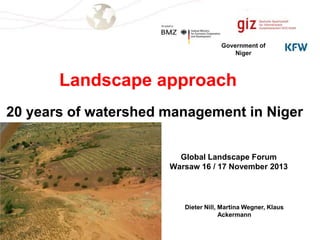
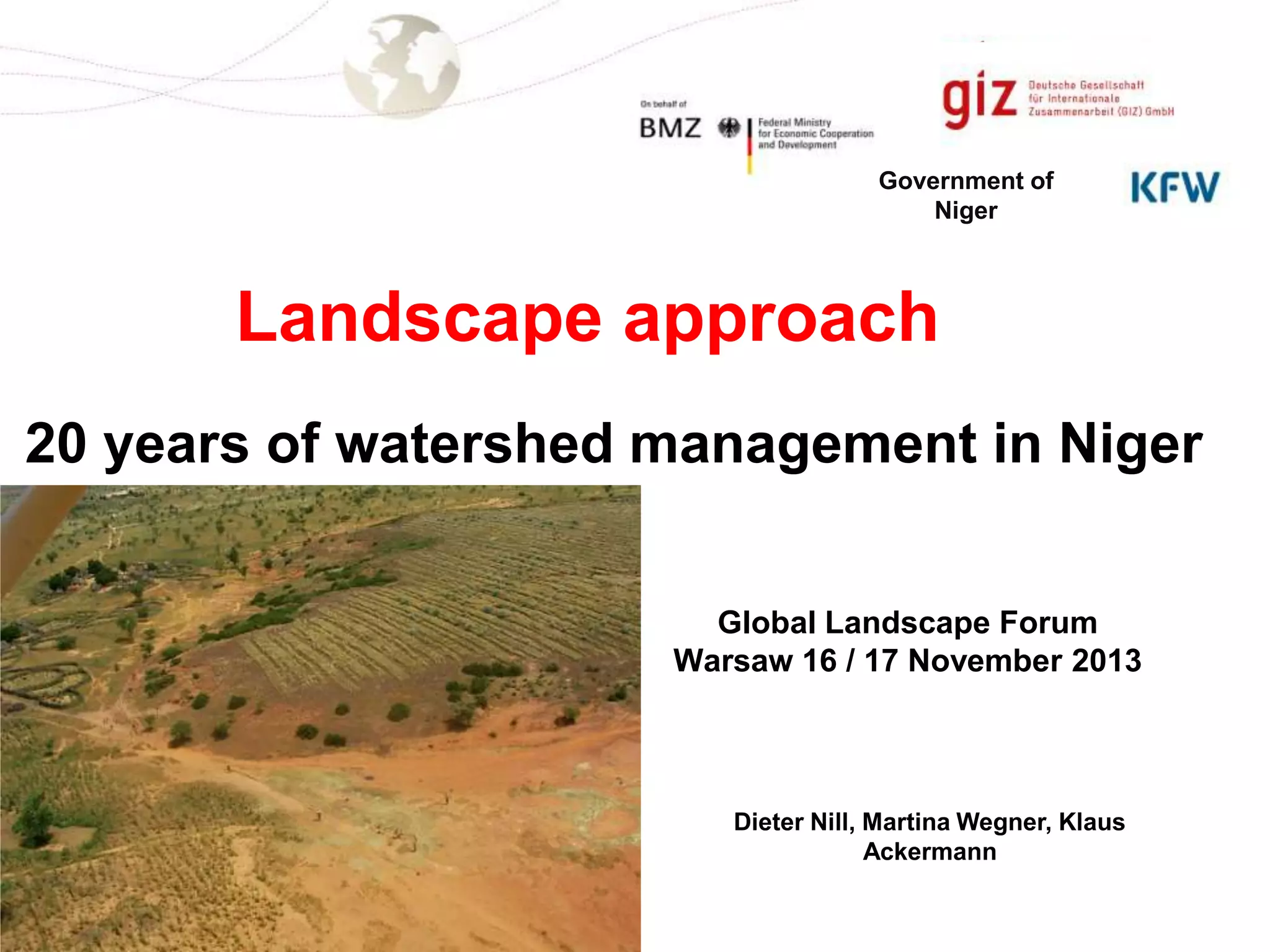
20 years of watershed management in Niger
Global Landscape Forum
Warsaw 16 / 17 November 2013

Dieter Nill, Martina Wegner, Klaus
Ackermann
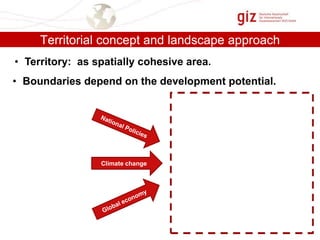
Territorial concept and landscape approach
• Territory: as spatially cohesive area.
• Boundaries depend on the development potential.

Economic
activities

Climate change

Social
setting

Institutional
setting
Natural
resources
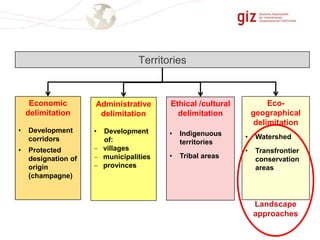
Territories

Economic
delimitation
•

Development
corridors

•

Protected
designation of
origin
(champagne)

Administrative
delimitation
•

•

Indigenuous
territories

•

Tribal areas

Ecogeographical
delimitation

Ethical /cultural
delimitation

Development
of:
villages
municipalities
provinces

•

Watershed

•

Transfrontier
conservation
areas

Landscape
approaches
Example: 20 years of watershed management in Niger
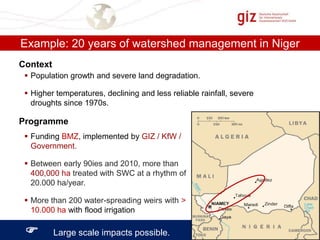
Context
 Population growth and severe land degradation.
 Higher temperatures, declining and less reliable rainfall, severe
droughts since 1970s.

Programme
 Funding BMZ, implemented by GIZ / KfW /
Government.
 Between early 90ies and 2010, more than
400,000 ha treated with SWC at a rhythm of
20.000 ha/year.
 More than 200 water-spreading weirs with >
10.000 ha with flood irrigation



Large scale impacts possible.
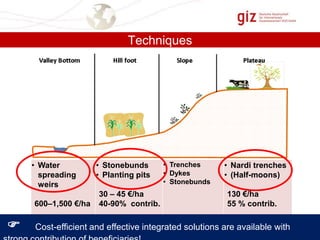
Techniques

• Water
spreading
weirs
600–1,500 €/ha



• Stonebunds
• Planting pits
30 – 45 €/ha
40-90% contrib.

• Trenches
• Dykes
• Stonebunds

• Nardi trenches
• (Half-moons)
130 €/ha
55 % contrib.

Cost-efficient and effective integrated solutions are available with
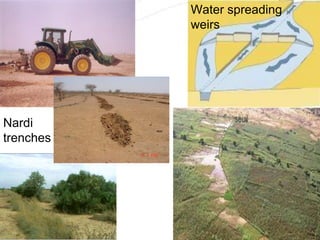
Water spreading
weirs

Nardi
trenches
Work approach
 Programme support only after active request and approval.
 Rolling approach to work with about 100 villages in parallel.
 Year 1: organizing population, training, pilot activities.
 Years 2 to 5: Intensive implementation.
 Years 5 and 6: Progressive shift of responsibilities to the
communities. End of support  autonomy.
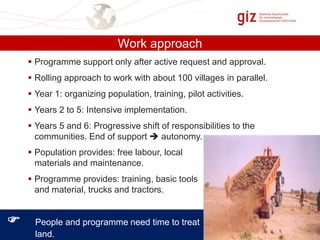
 Population provides: free labour, local
materials and maintenance.
 Programme provides: training, basic tools
and material, trucks and tractors.



People and programme need time to treat
land.
Important results
Plateaus:
• Yields of herbaceous biomass from ~ 0 to 600/700 kg/ha*yr.
• Production of wood generally around 1 stere/ha*yr.
• Improved biodiversity and protection of lower areas.
Fields:
• Increased / more stable yields i.e. millet > x 2 (200 kg/ha*yr more).
• Straw increased by x 1.6 (520 kg/ha*yr more).
Valleys:
• Increase of millet yields x 2 and increase of production x 5.8
• Strong increase in vegetable production, employment and income
• Heightening of groundwater levels



Significant positive effects on food security and stability, income,
ecology and living conditions.
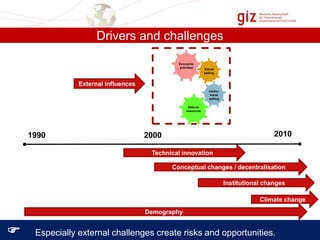
Drivers and challenges
Economic
activities

Social
setting

External influences
Institutional
setting
Natural
resources

1990

2010

2000
Technical innovation

Conceptual changes / decentralisation
Institutional changes
Climate change
Demography



Especially external challenges create risks and opportunities.
Conclusions
Landscape approaches offer multiple benefits:
• A powerful and low-cost concept to improve food security and incomes;
• They have positive environmental effects i.e. on biodiversity and water
cycle;
• Very suitable to mainstream CC adaptation and mitigation;
• They have large scale impact potential;

• They improve governance in rural areas by implying all stakeholders
and integrate know-how across sectors;
• They mobilise and strengthen the local population;
Requirements / succces factors
Successful landscape approaches need:
• A participatory, bottom-up approach with involvement of all stakeholders;
• A multi-level approach seeking favorable policy and legal frame works at
macro-level to strongy implement at meso- and micro-level;
• Medium- to long-term implementation, which requires a strong political
will;

• Suitable medium- to long-term funding mechanisms;
• Food availability per capita only improved if population growth not too
high.
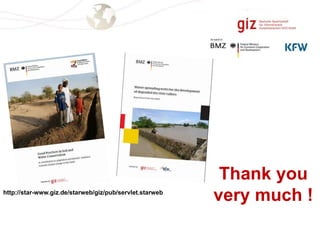
http://star-www.giz.de/starweb/giz/pub/servlet.starweb

Thank you
very much !

Landscape approach

 - 20 years of watershed management in Niger

  • 1.
    Government of Niger Landscape approach 20years of watershed management in Niger Global Landscape Forum Warsaw 16 / 17 November 2013 Dieter Nill, Martina Wegner, Klaus Ackermann
  • 2.
    Territorial concept andlandscape approach • Territory: as spatially cohesive area. • Boundaries depend on the development potential. Economic activities Climate change Social setting Institutional setting Natural resources
  • 3.
  • 4.
    Example: 20 yearsof watershed management in Niger Context  Population growth and severe land degradation.  Higher temperatures, declining and less reliable rainfall, severe droughts since 1970s. Programme  Funding BMZ, implemented by GIZ / KfW / Government.  Between early 90ies and 2010, more than 400,000 ha treated with SWC at a rhythm of 20.000 ha/year.  More than 200 water-spreading weirs with > 10.000 ha with flood irrigation  Large scale impacts possible.
  • 5.
    Techniques • Water spreading weirs 600–1,500 €/ha  •Stonebunds • Planting pits 30 – 45 €/ha 40-90% contrib. • Trenches • Dykes • Stonebunds • Nardi trenches • (Half-moons) 130 €/ha 55 % contrib. Cost-efficient and effective integrated solutions are available with
  • 6.
  • 7.
    Work approach  Programmesupport only after active request and approval.  Rolling approach to work with about 100 villages in parallel.  Year 1: organizing population, training, pilot activities.  Years 2 to 5: Intensive implementation.  Years 5 and 6: Progressive shift of responsibilities to the communities. End of support  autonomy.  Population provides: free labour, local materials and maintenance.  Programme provides: training, basic tools and material, trucks and tractors.  People and programme need time to treat land.
  • 8.
    Important results Plateaus: • Yieldsof herbaceous biomass from ~ 0 to 600/700 kg/ha*yr. • Production of wood generally around 1 stere/ha*yr. • Improved biodiversity and protection of lower areas. Fields: • Increased / more stable yields i.e. millet > x 2 (200 kg/ha*yr more). • Straw increased by x 1.6 (520 kg/ha*yr more). Valleys: • Increase of millet yields x 2 and increase of production x 5.8 • Strong increase in vegetable production, employment and income • Heightening of groundwater levels  Significant positive effects on food security and stability, income, ecology and living conditions.
  • 9.
    Drivers and challenges Economic activities Social setting Externalinfluences Institutional setting Natural resources 1990 2010 2000 Technical innovation Conceptual changes / decentralisation Institutional changes Climate change Demography  Especially external challenges create risks and opportunities.
  • 10.
    Conclusions Landscape approaches offermultiple benefits: • A powerful and low-cost concept to improve food security and incomes; • They have positive environmental effects i.e. on biodiversity and water cycle; • Very suitable to mainstream CC adaptation and mitigation; • They have large scale impact potential; • They improve governance in rural areas by implying all stakeholders and integrate know-how across sectors; • They mobilise and strengthen the local population;
  • 11.
    Requirements / succcesfactors Successful landscape approaches need: • A participatory, bottom-up approach with involvement of all stakeholders; • A multi-level approach seeking favorable policy and legal frame works at macro-level to strongy implement at meso- and micro-level; • Medium- to long-term implementation, which requires a strong political will; • Suitable medium- to long-term funding mechanisms; • Food availability per capita only improved if population growth not too high.
  • 12.