Glass is the only packaging material rated “GRAS” by the U.S. Food & Drug Administration. maintains the purity of food and beverages preserves a product’s taste or flavor  - No other packaging material matches the shelf impact of glass. maintains the integrity or healthiness of foods and beverages  Glass is 100% recyclable and can be recycled endlessly with no loss in quality or purity. -Recycling glass reduces consumption of raw materials, extends the life of plant equipment, such as furnaces, and saves energy FOR FOODS container of choice for processing high moisture foods withstands exposure to acid food for an extended period of time For Pasteurized foods- glass withstands the temperature and provides needed protection
-analyzing each new shipment of raw materials  -monitor certain easily measured physical properties of the glass Eg. a.Density   b.Softening Point
 
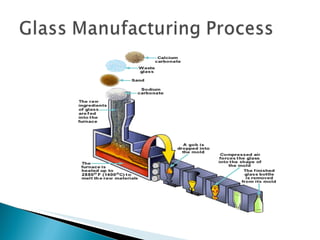
Silica  An Alkali  Network Stabilizers -soda (Na 2 O) or Potash (finer glass) Limestone Cullet (waste glass) Na 2 O - CaO - Al 2 O 3  - SiO 2  Glass
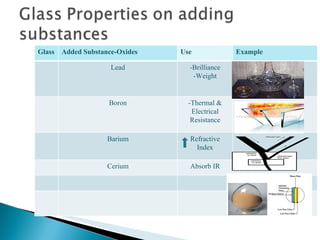
Glass Added Substance-Oxides Use Example Lead -Brilliance -Weight Boron -Thermal & Electrical Resistance Barium Refractive  Index Cerium Absorb IR
Glass Added Substance-Oxides Use Example Metallic Oxides Add color Manganese De-colorization
 
 
Because glass is  chemically inert , it is the consumer's perfect protection for food and beverages.  Glass is one of the  most sustainable packaging  materials on earth, taking into consideration  all  carbon footprint factors . Glass is true  "cradle-to-cradle" packaging  - meaning it can be recycled infinitely to be re-made into bottles, jars or containers that are equally pure as the original. The recycled product is so pure that it can again touch food or beverages.  Glass' impervious nature also makes it difficult to tamper with the package contents protects delicate flavors and defend against oxidation Increased visibility and shelf impact Ability to act as decoration Flexibility in size, shape, and closure
Marketers Rely on Glass Packaging to Deliver Consumer Convenience  Microwavable convenience (for many glass jars) Ease in resealing Flexible design Extreme portability Reusable
 
Lug or Twist Cap Lug is an inward protrusion from the curl of the cap side or skirt Lug caps are secured to the finish by twisting the cap onto the finish which seats the lugs of the cap with the threads of the glass Vacuum maintains the seal
Plastisol-Lined Continuous Thread Cap This cap consists of a metal shell with a threaded skirt Cap contains a flowed-in plastisol gasket and is applied by screwing the closure onto the glass finish
Press On-Twist-Off Cap Gasket is molded Plastisol that covers the sealing area that extends from the top down the side
Body  of Glass Package: Largest portion of the glass container  Lies between the Finish and the Bottom of the package Body can be in different shapes and sizes Bottom  of Glass Package Bottom has the bearing surface or the portion of container upon which it rests Bottom or bearing surface may  have special configuration (Stacking feature) designed to provide a degree of interlocking
Two properties of design:  Significance  Utility Glass container manufacturing quality is a direct correlation to the process controls in place and to standards in which these controls are held: Batching Melting Conditioning Forming Packaging Warehouse Shipping
Glass Enhancements  Applied Ceramic Labeling (ACL) or Silk Screening Heat Transfer Labeling: Shrink Sleeve Pressure Sensitive Labeling Cut and Stack Labeling Glass Surface Treatments Acid Etching  Embossing Specialty Colors Debossing  Surface Treatment At the hot end of the glass making process, a very thin coating of tin oxide is applied to the containers.
THANKYOU!

Glass Packaging

  • 1.
  • 2.
    Glass is theonly packaging material rated “GRAS” by the U.S. Food & Drug Administration. maintains the purity of food and beverages preserves a product’s taste or flavor - No other packaging material matches the shelf impact of glass. maintains the integrity or healthiness of foods and beverages Glass is 100% recyclable and can be recycled endlessly with no loss in quality or purity. -Recycling glass reduces consumption of raw materials, extends the life of plant equipment, such as furnaces, and saves energy FOR FOODS container of choice for processing high moisture foods withstands exposure to acid food for an extended period of time For Pasteurized foods- glass withstands the temperature and provides needed protection
  • 3.
    -analyzing each newshipment of raw materials -monitor certain easily measured physical properties of the glass Eg. a.Density b.Softening Point
  • 4.
  • 5.
    Silica AnAlkali Network Stabilizers -soda (Na 2 O) or Potash (finer glass) Limestone Cullet (waste glass) Na 2 O - CaO - Al 2 O 3 - SiO 2 Glass
  • 6.
    Glass Added Substance-OxidesUse Example Lead -Brilliance -Weight Boron -Thermal & Electrical Resistance Barium Refractive Index Cerium Absorb IR
  • 7.
    Glass Added Substance-OxidesUse Example Metallic Oxides Add color Manganese De-colorization
  • 8.
  • 9.
  • 10.
    Because glass is chemically inert , it is the consumer's perfect protection for food and beverages. Glass is one of the most sustainable packaging materials on earth, taking into consideration all carbon footprint factors . Glass is true "cradle-to-cradle" packaging - meaning it can be recycled infinitely to be re-made into bottles, jars or containers that are equally pure as the original. The recycled product is so pure that it can again touch food or beverages. Glass' impervious nature also makes it difficult to tamper with the package contents protects delicate flavors and defend against oxidation Increased visibility and shelf impact Ability to act as decoration Flexibility in size, shape, and closure
  • 11.
    Marketers Rely onGlass Packaging to Deliver Consumer Convenience Microwavable convenience (for many glass jars) Ease in resealing Flexible design Extreme portability Reusable
  • 12.
  • 13.
    Lug or TwistCap Lug is an inward protrusion from the curl of the cap side or skirt Lug caps are secured to the finish by twisting the cap onto the finish which seats the lugs of the cap with the threads of the glass Vacuum maintains the seal
  • 14.
    Plastisol-Lined Continuous ThreadCap This cap consists of a metal shell with a threaded skirt Cap contains a flowed-in plastisol gasket and is applied by screwing the closure onto the glass finish
  • 15.
    Press On-Twist-Off CapGasket is molded Plastisol that covers the sealing area that extends from the top down the side
  • 16.
    Body ofGlass Package: Largest portion of the glass container Lies between the Finish and the Bottom of the package Body can be in different shapes and sizes Bottom of Glass Package Bottom has the bearing surface or the portion of container upon which it rests Bottom or bearing surface may have special configuration (Stacking feature) designed to provide a degree of interlocking
  • 17.
    Two properties ofdesign: Significance Utility Glass container manufacturing quality is a direct correlation to the process controls in place and to standards in which these controls are held: Batching Melting Conditioning Forming Packaging Warehouse Shipping
  • 18.
    Glass Enhancements Applied Ceramic Labeling (ACL) or Silk Screening Heat Transfer Labeling: Shrink Sleeve Pressure Sensitive Labeling Cut and Stack Labeling Glass Surface Treatments Acid Etching Embossing Specialty Colors Debossing Surface Treatment At the hot end of the glass making process, a very thin coating of tin oxide is applied to the containers.
  • 19.