Course file Index
Name of the Course: Glass Metal and Textile Based packaging
Program: Printing and Packaging Technology
Class: S.E PPT Semester: (Sem III)
Course In charge: Mrs. Katyayini T
Academic Year:
S. No Content Page No
1 Syllabus copy
2 Extended syllabus copy
1. Pre requisite text books
2. Advanced topics
3. Extra books
4. Audios
5. Web references etc.
3 Course outcomes
Mapping of CO, PO and PSOs without attainment levels.
4 List of content gaps
1. Gap analysis and listing.
2. Proposed action plan for the Industry expert talk/ Guest
lecturers/ Mini project etc. to bridge the gap.
This needs to be approved by DAB.
5 Session plan ( Detailed)
6 Lecture Notes
1. Detailed lecture wise notes with problems and example
etc. (Mention about LOs of chapter)
2. At the end of the each chapter include
a) University questions
b) Gate exam Questions
c) Other exam questions
7 Evaluation
1. Pre test for classification of Weaker and Bright students.
2. Assignments, UT1, UT2, Prelims Question papers.
8 List of other evaluation techniques, documents and analysis.
9 Remedial lectures, Attendance reports and Impact analysis.
10 Session plan with Attainment level calculations and mapping of
LO-CO, CO-PO and PSO.
Chapter
No.
Learning Objectives CO Mapping
1. LO1: understand the different packaging materials and their
applications
CO1, CO2
LO2: Explain about the classification of glass and their
composition
LO3: Describe the raw materials and flowchart of glass
manufacturing process.
LO4: Analyze the best method of glass manufacturing process
LO5: Visualize the container making process
LO6: differentiate between the different methods of production of
glass containers
LO7: Able to analyze the parts of the glass containers and bottles.
LO8: able to find out the defects in the glass containers by
employing different testing mathods
LO9: Able to understand the current glass manufacturing industry
market in India and also understand the impact of glass industry
on environment.
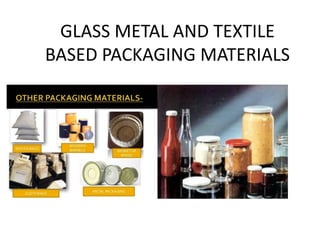
GLASS METAL AND TEXTILE
BASED PACKAGING MATERIALS
Packaging Definition
• Packaging is the technology of enclosing or protecting
products for distribution, storage, sale, and use.
• Packaging also refers to the process of designing,
evaluating, and producing packages.
• Packaging can be described as a coordinated system of
preparing goods for transport, warehousing, logistics, sale,
and end use.
• Packaging contains, protects, preserves, transports,
informs, and sells. (functions of Packaging)
Glass as Packaging Material
• Glass is used as the container for the product packaging.
• They are quite strong and rigid.
• They are transparent which allows the visual inspection of the contents;
especially in ampoules and vials.
• They are available in various shapes and sizes. Visually elegant containers
attracts the patients.
• Borosilicate (Type-I) and Neutral glasses are resistant to heat so they can
be readily sterilised by heat.
• Glass containers can be easily cleaned without any damage to its surface
e.g. scratching or bruising.
Metal as Packaging Material
• Different types of metals like aluminium, steel, tin etc are used a packaging
material for various applications of food and pharmaceutical packaging.
• Foods filled in metal packaging do not need any additives. Foods filled in metal
packaging do not loose their nourishing properties and keep their original taste for
long.
• Weight of metal packaging is low and its resistance is high. Metal packaging is
resistant to physical shocks. Therefore metal packaging has a low cost of storing,
loading and shipping.
• Application of multi colour printing increases the preference of metal packaging,
supporting the marketing activities of food products.
• It is possible to produce metal packaging at almost any dimensions and form, thus
making possible packaging of food products at desired weights.
• Metal Packaging can be hermatically closed and heat treated enabling sterile food
products.
Syllabus
• B.E. PPT Rev 2016.pdf
THANK YOU
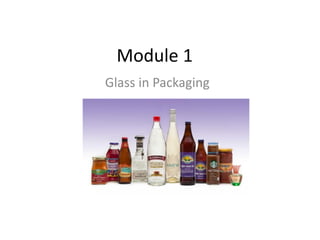
Module 1
Glass in Packaging
What is Glass?
• A hard, brittle substance, typically transparent or
translucent, made by fusing sand with soda and lime and
cooling rapidly.
• Glass is an amorphous material that lacks a long range
periodic crystalline structure.
• What is amorphous substance?
In condensed matter physics and materials science,
an amorphous (from the Greek a, without, morphé, shape,
form) or non-crystalline solid is a solid that lacks the long-
range order that is characteristic of a crystal.
History
• Sailors used block of soda from their cargo to
make a fire place on the beach and discovered
that the soda fused with sand to form glass.
• Egyptians using glass as early as 3000 B.C.
• The commercial success of the Venetian glass
blowers is known in 16th century.
• Around 1870 the shop system of making glass
containers was introduced in United States.
• Mechanization first introduced in 1892.
History continued….
• Atlas Glass Works used semi automatic
machines for wide mouth jars in 1896.
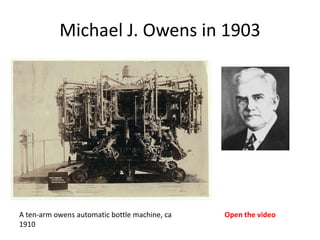
• The first fully automatic machines built by
Michael J. Owens in 1903.
• In 1925 Hartford Empire – Blow & Blow
Machine. The principle dropping a gob of glass
into the mold from top started to replace
owens method of feeding from bottom.
Michael J. Owens in 1903
A ten-arm owens automatic bottle machine, ca
1910
Open the video
• The American Heritage dictionary
defines glass as a large class of materials with
highly variable mechanical and optical
properties, which solidify from the molten
state without crystallization, that are
typically based on silicon dioxide, boric oxide,
aluminum oxide, or phosphorous pentoxide,
that are generally transparent or translucent,
and that are regarded physically as
supercooled liquids rather than fine liquids.
• American Society for Testing and Materials (ASTM)
defines glass as an inorganic product of fusion that has
cooled to a rigid condition without crystallizing. ASTM
further states that glass is typically hard and brittle and
has a conchoidal fracture.
• Conchoidal fracture is a smoothly curving fracture
surface of fine-grained materials which have no planar
surfaces of internal weakness or planes of separation
(no cleavage). Such a curving fracture surface is
characteristic of glass and other brittle materials with
no crystal structure.
Properties of Glass
• May be colorless or colored.
• Glass is non-crystalline, is amorphous in structure.
• May be formed from both organic and inorganic materials.
• Glass is manufactured at very high temperatures, and it has the
properties of a viscous liquid. With the properties of a viscous
liquid, hot glass can be formed into many commonly used forms
with precision and accuracy.
• excellent resistance to attack by most liquids, and, therefore, it
resists interaction with contained products.
• It is totally impermeable to gases.
• it can be sterilized with any appropriate process.
• Glass, when properly colored, also provides protection to a product
from light.
Advantages of Glass:
• Strong, Durable, transparent and chemically
inert.
• Impervious to transmission of gases and
products. (extensively used for flavors and
perfume essence)
• Used for microwave oven.
Disadvantages of Glass:
• Energy intensive production.
• Heavier than other plastic and aluminium
containers hence high transportation cost.
• Easily breakable.
Manufacturing of glass
General Characteristics of Glassy State:
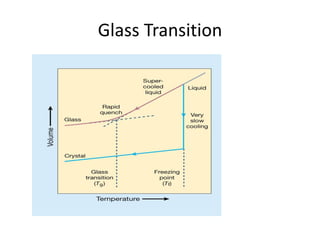
• All glasses are energetically unstable
compared to the crystals of same
composition.
• Slow cooling of molten mixture results in
systematic arrangement if Lattice Structure.
• The same system becomes glass upon rapid
cooling.
• Pic to be added
Glass Transition
Mechanical Properties of Glass:
• Even though tensile strength is of the order of 104
N/mm2 , the technical strength is very less and
depends on its surface conditions.
• Glass Corrosion:
It is defined as the behaviour and eventual
changes of glass subsequent to the attack of
aggressive substances.
1. Complete dissolution of glass
2. Leaching (Dissolution of sodium and potassium
ions)
Leaching:
• When the pH value is changed by the
implantation of hydrogenous ions in the glass,
water molecules infiltrate the glass while alkali
ions go into solution.
• A thin gel layer of low alkali and poor water
content is formed.
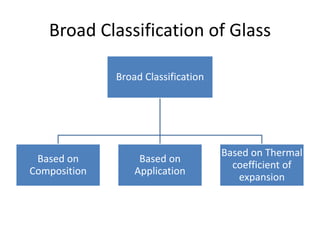
CLASSIFICATION OF GLASS
Broad Classification of Glass
Broad Classification
Based on
Composition
Based on
Application
Based on Thermal
coefficient of
expansion
Classification Based on Composition:
1.Soda Lime Glass
• Soda, Lime and sand are main components.
• Composition:
71-75% by wt Sand (SiO2)
12-16% Soda (Sodium oxide from raw material soda
ash or sodium carbonate)
10 – 15% Lime ( Calcium oxide from lime stone or
calcium carbonate)
And a low percent of other materials for the specific
properties.
Sometimes Mg replaces a portion of Ca and K replaces
Na.
Soda Lime Glass Continued...
• Primarily used for bottles, jars, everyday
drinking glasses and window glass.
• Its smooth and non porous surface allows
bottles and packaging glass to be cleaned
easily.
2. Lead Glass:
• If lime is replaced by lead oxide the resulting glass
is known as lead crystal.
• Composition: 54-65% Silica, 18-38% lead oxide
(PbO), 13-15% Soda or Potash, and various
oxides.
• Glass with less than 18% lead is called as crystal
glass.
• Different amounts of barium, zinc and potassium
oxides can be added to the composition to
partially replace some of the lead oxides.
• They have high Refractive Index.
3. Borosilicate Glass:
• Silicate glasses containing boric oxide is
borosilicate glass.
• Higher % of silica ( 70-80%).
• Composition: 70-80% silica, 7-13% boric oxide, 4-
8% Na2O and K2O, and 2-7% aluminium oxide.
• Show high resistance to corrosion and
temperature change.
• They are used in process plants in chemical
industries, in laboratories, as ampules and vials.
4. Special Glasses:
• Glasses used for special technical and
scientific purposes form a mixed group.
• Their compositions differ greatly and involve
numerous chemical constituents.
• This group includes: optical glasses, glass for
electro technology and electronics and glass
ceramics.
Classification based on application:
1. Container Glass:
• These are used for packaging, storage,
preserving and transportation of beverages,
foods, chemicals, pharmaceuticals and other
cosmetics.
• Always manufactured from molten glass as
opposed to vials and ampules manufactured
in hollowware finishing sector.
Container glass continued….
• Mostly made of soda lime glass.
• Relatively pure raw materials are used to get
colorless glass.
• Most frequently used green and brown
colored glass bottles.
• Green glass transmits UV light obtained by
adding Chromium Oxide.
• Brown glass absorbs all UV light obtained by
adding iron sulphides.
Container Glass
1. Beverage Bottles
2. Bottling Jars
2. Flat Glass:
• The term flat glass pertains to all glasses
produced in a flat form regardless of the
method of manufacture.
• Mechanical production effectively developed
much later 1920.
• Mostly consists of soda lime glass.
• Average ingredients: 72% Silica, 14% Na2O
(K2O), 9% CaO, 3-4% MgO and 1% Al2O3.
Flat Glass Continued…
• The iron content gives a thick soda lime flat
glasses a green tint.
• Different glass tints for special purpose are
produced by adding coloring oxides.
Production of flat glass:
3. Special Glasses:
• The composition and properties vary
depending upon the applications.
• They have high chemical stability, thermal
durability and with a variety of optical,
electrochemical or special application tailored
properties.
Applications of Special Glass:
In the fields of
• Chemistry
• Pharmacy
• Electrotechnology
• Electronics
• Apparatus and instrument construction
• Optics
• Illumination engineering
4. Glass Fibre:
• It is a collective term for glass processed into
fibres with diameters of between one tenth
and a few thousands of a milli meter.
• Two main types:
1. Insulating fiberglass
2. textile fiberglass
Insulating fiberglass:
• Made of sodalime glass in a centrifugal
process using rotating discs.
• Glass droplets are drawn into fibers of certain
length by centrifugal force. The fibers cool in
air and solidify.
• Glass wool is a type of insulating fiberglass.
Textile fibre glass:
• They are fine fibres produced from molten glass.
• The fibres are uniform, usually have a circular
cross section and can be further processed into
threads.
• The diameter of the fibres is less than 18 micro
meters.
• They are subdivided according to length and
manufacturing method as:
1. glass filaments
2. glass staple fibres
1. Glass filaments (Glass silk):
• This consists of individual glass fibres
(filaments) with the diameters between 5 to
18 micro meter.
• It is manufactured by flowing the molten glass
in conduits from where it is downward drawn
at a high speed into very fine threads through
an array of platinum nozzles and then rolled
onto a drum.
2. Glass staple fibres:
• These are glass fibres of certain length and
diameter.
• It is produced by airblast process. In this the
molten glass flows through platinum nozzles in
the bottom of a platinum melting tank.
• Compressed air directed over the nozzle opening
blows the glass into filaments between 3 to 60
mm long.
• They are sucked into perforated drums from
which they are drawn into glass staple fibers.
Raw Materials for Glass
Manufacture
1. Sand
• Most important raw material.
• Main component of sand and rocks. Consists
of almost half of the earth’s solid surface.
• Most of the sands cannot be used as they
contain many colouring oxides especially iron
oxides.
• Sand containing even 0.1% Iron oxides cannot
be used as it gives glass a greenish tint.
• Natural sources for sand containing 0.01 –
0.03% iron oxide for the production of special
technical glasses are very rare.
• Iron is even a greater problem for quartz sand.
• The content of other coloring oxides such as
chromium, copper, nickel, cobalt and other
undesirable impurities in optical quartz sand
must be reduced.
• For these stringent demands, the crushed
material is subjected to an additional chemical
purification, using suitable acids at high
temperature.
• In order to lower the melting temperature of
sand and to be able to use appropriate melting
containers, a fluxing agent, usually sodium oxide
is required.
• Normally added in the form of carbonate or
sometimes nitrate or sulphate.
2. Soda Ash
• Sodium carbonate is introduced to the glass
batch as soda ash.
• During the melting, the sodium oxide
becomes a part of glass; carbon di oxide is
freed and escapes through chimney.
3. Glauber’s Salt (Sodium Sulphate)
• Sodium sulphate in its anhydrous form is
mixed with pulvarized coal and added to the
batch instead of soda ash.
• The sulfurus acid is freed and sodium
becomes part of the glass as in the case of
soda ash.
4. Potash
• Potassium carbonate (K2CO3) is a grainy,
white powder formerly obtained by leaching
of wood ashes in large containers.
• The potash decomposes into potassium oxide
which goes into the glass and carbon di oxide
which escapes into the atmosphere.
Stabilizers to increase resistance,
strength and hardness:
• There are a number of oxides derived from
multivalent metals that can be added to the
glass melt in order to give the glass physical
and chemical properties that are important for
its usability.
• Some substances can reinforce the structural
network resulting in improved chemical
resistance and mechanical properties.
• To this, the oxides of calcium, magnesium,
aluminium, boron tri oxide, and zinc play an
important role.
• Replacing sodium with potassium oxide
usually makes glass more chemically resistant.
5. Lime (Calcium carbonate)
• It is found naturally as limestone, marble or chalk.
• At a temperature of about 1000 C, the carbon di oxide escapes from
the lime and calcium oxide remains and it enters the glass
structure.
• Lime is added to the batch to improve the hardness and chemical
resistance of glass.
• In flat glass, the lime is partially replaced by magnesium oxide
which is found combined with lime in raw material dolomite
(CaCO3+MgCO3).
• It lowers the melting temperature.
6. Alumina
• Usually added to the glass batch in the form of
alkali containing feldspars abundant in many
places.
Feldspar:
An abundant rock-forming mineral typically
occurring as colourless or pale-coloured crystals
and consisting of aluminosilicates of potassium,
sodium, and calcium.
• The trivalent aluminium forms AlO4-groupings
in the glass which by inclusion of an alkali ion
place themselves in the network of the SiO4
tetrahedrons, thereby filling gaps.
• This leads to the improved chemical resistance
and increased viscosity in the lower
temperature ranges.
7. Lead Oxides
• The oxides, PbO (Yellow lead) and Pb3O4 (Red
Lead) are used to introduce lead into the glass.
• However it is always present in glass as bivalent
Pb2+.
• Moderate additions of PbO into glass increase
chemical resistance.
• High lead content lowers the melting
temperature and results in decreased hardness,
but increased refractive index of the glass.
8. Barium Oxide
• Barium oxide derived from Barium Carbonate
is primarily used in optical glass and crystal
glass instead of lime or red lead.
• Glass containing barium is not as heavy as
lead crystal, but achieves similar brilliance due
to its high refractive index.
9. Boron Compounds
• Boron trioxide which is so important in special
glass is found naturally in very few places.
• Sodium and calcium borates occur much more
frequently.
• Usually these compounds must be chemically
converted into pure boric acid, especially for
optical glass.
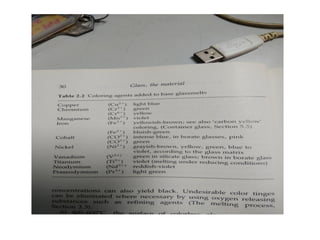
10. Coloring Agents
• Only pure chemicals are used as glass coloring
agents.
• Different colors are obtained by adding oxides
of the transition elements.
• The coloring agents added to base glass melts
are given in table
11. Opacifiers
• By mixing fluorine containing materials, such
as a fluorspar in glass resulting in cloudy and
opaque form of glass.
12. Glass Cullet
• Cullet acts as a fluxing agent and accelerates
the melting of the sand.
• This conserves both energy and raw materials.
The Glassmelt
• It is the central phase of production process.
• The quality of raw material, type of heat
energy, and the type of melting process used
are determined by the glass type to be melted
and the product to be made.
Melting Furnaces and Melting Tanks:
• Originally, only crucible and pot furnaces were
used. They could hold one or more containers
to melt the batch material.
• From these continuous melting tanks evolved
as an integral part of furnace.
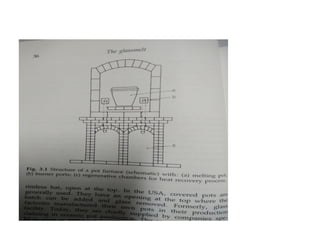
Pot Melting:
• It consists of a refractory brick for the inner
wall, silica brick for the vaulted roof (crown)
and insulating brick for the external walls.
• It consists of the lower section to preheat the
fuel gas and the upper furnace which takes
the pots and serves the melting chamber.
• Nowadays it is used to manufacture the
mouth blown glass products and special
glasses.
• Construction:
1. the glass-containing bath of thick (8 in.-15 in.)
2. fireclay blocks for sides and bottom
3. the upper walls of fireclay bricks and
4. the crown of silica bricks.
• They average 100-200 tons in deadweight capacity for
bottle glass.
• The working end is usually divided from the melting
end by a double-walled bridge, the glass flowing into
the working end through a passage (called the "throat"
or "dog-hole") near or at the tank bottom.
• The refining zone lies immediately in front of the
bridge and in window glass tanks may be divided from
the melting zone by a floating fireclay barrier or bridge.
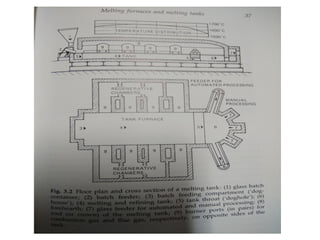
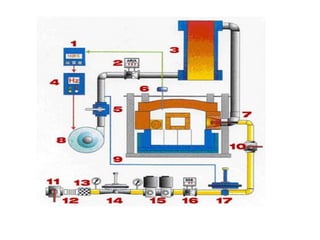
Tank Melting:
• For large amounts of glass production.
• For automated glass production.
• It consists of lower and upper sections as well
as the section for preheating of combustion
chamber.
• The lower section is actual melting container
lined with a high quality refractory material.
• The size depends on the glass product
manufactured.
Two Types of Tanks:
• Day Tank
• Continuous Tank
1. Day Tank:
• Developed from the traditional furnaces from small
capacities.
• They are refilled with batch daily.
• The melting is done at night and the glass goes into the
production the next as pot furnace.
• They allow change in glass type to be melted on short
notice.
• Primarily used for colored glass, crystal glass and soft
special glass.
2. Continuous Tank:
• Prerequisite for industrial mass production.
• Exclusively used for production of flat glass,
container glass, and certain mass produced
optical glass types.
• 10 -40 mtrs long and 3 – 6 mtrs wide.
• Output lies between 100 to 400 tons per day.
• Largest furnaces after blast furnace.
Tank Construction:
• The most common type are regenerative side
burner tanks with preheating of fuel and
combustion air.
• Regeneratively heated small U tanks for small
output and unit melters and long tanks for
bottle manufacturing.
Materials for furnace construction:
• Refractory materials for all the types of
furnaces.
• Most critical furnace components are
currently made of cast fused corundum –
zirconium oxide refractory.
• The life of tank furnace is called furnace
journey and is about eight years currently.
• The normal life span of pot furnace is
approximately five years.
• Contamination of the melt by dissolved lining
material is particularly critical in optical
glasses.
• Thus, tanks and pots are lined with platinum.
• Platinum and its alloys are insoluble in molten
glass, have high melting point and maintain
consistently the same properties in a constant
composition.
Lecture 2: Melting and Fining processes in industrial
glass furnaces
IMI-NFG Course on Processing in Glass
Spring 2015
(available online www.lehigh.edu/imi)
Mathieu Hubert, PhD
CelSian Glass & Solar
Eindhoven, The Netherlands
mathieu.hubert@celsian.nl
IMI-NFG Course on Processing of Glass - Lecture 2: Industrial glass melting and fining processes
mathieu.hubert@celsian.nl 2
• In Lecture 1, the preparation of the batch has been described, from
the selection of the raw materials to the charging of the batch in the
furnace via the doghouse (or day-hopper)
• The batch is introduced in the furnace at high temperature, and the
energy provided to the batch is used to convert the batch into a
glass melt
• The batch-to-melt conversion implies a series of chemical
reactions (decarbonation, dehydration, solid-state reactions,
formation of low-melting eutectics, dissolutions)
• This lecture will highlight these different reactions and processes,
from the introduced batch to an homogeneous and bubble-free glass
melt (before the forming processes)
Introduction
IMI-NFG Course on Processing of Glass - Lecture 2: Industrial glass melting and fining processes
mathieu.hubert@celsian.nl 3
1. Melting of the batch
 From the batch to the melt
 Chemical reactions
 Sand dissolution
2. Fining of the melt
 Dissolved gases
 Fining mechanisms
 Removal of bubbles and seeds
Outline of this lecture
IMI-NFG Course on Processing of Glass - Lecture 2: Industrial glass melting and fining processes
mathieu.hubert@celsian.nl 4
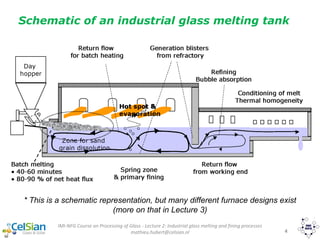
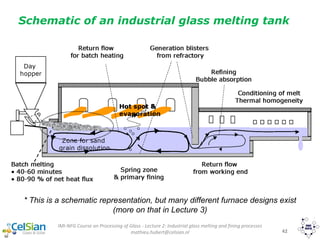
Schematic of an industrial glass melting tank
* This is a schematic representation, but many different furnace designs exist
(more on that in Lecture 3)
IMI-NFG Course on Processing of Glass - Lecture 2: Industrial glass melting and fining processes
mathieu.hubert@celsian.nl 5
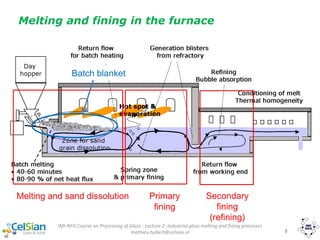
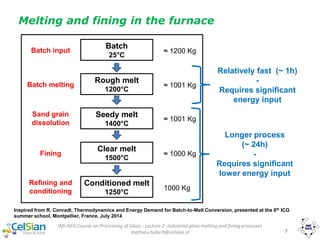
Melting and fining in the furnace
Melting and sand dissolution Primary
fining
Secondary
fining
(refining)
Batch blanket
IMI-NFG Course on Processing of Glass - Lecture 2: Industrial glass melting and fining processes
mathieu.hubert@celsian.nl 6
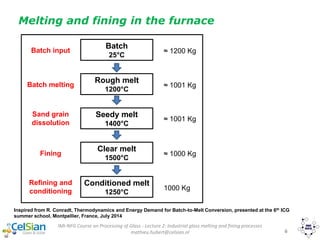
Melting and fining in the furnace
Inspired from R. Conradt, Thermodynamics and Energy Demand for Batch-to-Melt Conversion, presented at the 6th ICG
summer school, Montpellier, France, July 2014
Batch
25°C
Rough melt
1200°C
Seedy melt
1400°C
Clear melt
1500°C
Conditioned melt
1250°C
≈ 1200 Kg
≈ 1001 Kg
≈ 1001 Kg
≈ 1000 Kg
1000 Kg
Batch input
Batch melting
Sand grain
dissolution
Fining
Refining and
conditioning
IMI-NFG Course on Processing of Glass - Lecture 2: Industrial glass melting and fining processes
mathieu.hubert@celsian.nl 7
Melting and fining in the furnace
Inspired from R. Conradt, Thermodynamics and Energy Demand for Batch-to-Melt Conversion, presented at the 6th ICG
summer school, Montpellier, France, July 2014
Batch
25°C
Rough melt
1200°C
Seedy melt
1400°C
Clear melt
1500°C
Conditioned melt
1250°C
≈ 1200 Kg
≈ 1001 Kg
≈ 1001 Kg
≈ 1000 Kg
1000 Kg
Batch input
Batch melting
Sand grain
dissolution
Fining
Refining and
conditioning
Relatively fast (~ 1h)
-
Requires significant
energy input
Longer process
(~ 24h)
-
Requires significant
lower energy input
IMI-NFG Course on Processing of Glass - Lecture 2: Industrial glass melting and fining processes
mathieu.hubert@celsian.nl 8
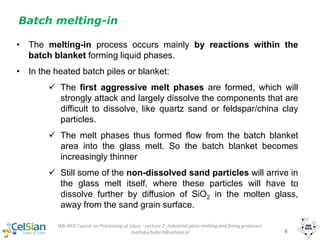
Batch melting-in
• The melting-in process occurs mainly by reactions within the
batch blanket forming liquid phases.
• In the heated batch piles or blanket:
 The first aggressive melt phases are formed, which will
strongly attack and largely dissolve the components that are
difficult to dissolve, like quartz sand or feldspar/china clay
particles.
 The melt phases thus formed flow from the batch blanket
area into the glass melt. So the batch blanket becomes
increasingly thinner
 Still some of the non-dissolved sand particles will arrive in
the glass melt itself, where these particles will have to
dissolve further by diffusion of SiO2 in the molten glass,
away from the sand grain surface.
IMI-NFG Course on Processing of Glass - Lecture 2: Industrial glass melting and fining processes
mathieu.hubert@celsian.nl 9
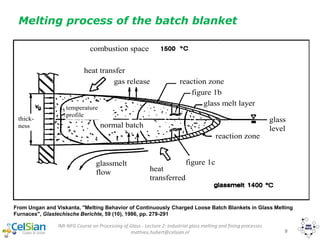
heat transfer
gas release
combustion space
reaction zone
thick-
ness normal batch
temperature
profile
reaction zone
glass melt layer
figure 1b
glassmelt
flow heat
transferred
figure 1c
glass
level
From Ungan and Viskanta, "Melting Behavior of Continuously Charged Loose Batch Blankets in Glass Melting
Furnaces", Glastechische Berichte, 59 (10), 1986, pp. 279-291
Melting process of the batch blanket
IMI-NFG Course on Processing of Glass - Lecture 2: Industrial glass melting and fining processes
mathieu.hubert@celsian.nl 10
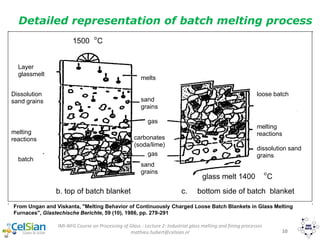
batch
b. top of batch blanket c. bottom side of batch blanket
glass melt 1400 o
C
melting
reactionsmelting
reactions
Dissolution
sand grains sand
grains
carbonates
(soda/lime)
dissolution sand
grains
sand
grains
gas
gas
melts
Layer
glassmelt
loose batch
1500 o
C
From Ungan and Viskanta, "Melting Behavior of Continuously Charged Loose Batch Blankets in Glass Melting
Furnaces", Glastechische Berichte, 59 (10), 1986, pp. 279-291
Detailed representation of batch melting process
IMI-NFG Course on Processing of Glass - Lecture 2: Industrial glass melting and fining processes
mathieu.hubert@celsian.nl 11
Different steps of the melting process
• Melt reactions
• Melt energy (enthalpy of heating the batch and decomposition
melting/fusion reactions)
• Melting kinetics / heat transfer
• Melting parameters:
 effect of the temperature
 grain size (especially for sand and alumina raw materials)
 glass composition
IMI-NFG Course on Processing of Glass - Lecture 2: Industrial glass melting and fining processes
mathieu.hubert@celsian.nl 12
Melt reactions
IMI-NFG Course on Processing of Glass - Lecture 2: Industrial glass melting and fining processes
mathieu.hubert@celsian.nl 13
Melting reactions
• De-hydration of some raw materials and water evaporation
• Solid state reactions between individual raw materials
• Formation of primary melt phases and melting of alkali rich
carbonates. (typically in the temperature range: 700-900°C)
• Dissociation or decomposition reactions of Ca- and Mg-
containing carbonates (e.g. limestone and dolomite), resulting in
development of CO2-gas. (Temperature range 500-1000°C)
(Na2CO3 will not decompose spontaneously, but reacts with sand or
limestone).
• Dissolving of the SiO2 in the alkali rich carbonate melt phases,
typically above 1000°C. Sand reacts between about 750-1000°C
with sodium silicates or soda to form liquid sodium silicates
(associated with the release of CO2-gas when limestone or soda or
dolomite is reacting with sand)
IMI-NFG Course on Processing of Glass - Lecture 2: Industrial glass melting and fining processes
mathieu.hubert@celsian.nl 14
Dehydration
• Takes place at ± 100°C for physically bonded water
• In case of clay in the batch, de-hydration may occur up to 650-
700°C
• Dehydration (water evaporation) is very energy intensive, and it is
represents an important part of the total energy consumption
IMI-NFG Course on Processing of Glass - Lecture 2: Industrial glass melting and fining processes
mathieu.hubert@celsian.nl 15
Sand dissolution
• Pure silica melts at very high temperature (> 1700°C)
• In standard glasses (except e.g. pure silica glass) sand is
incorporated in the glass melt by dissolution, and not by melting
• Sand dissolution is a critical step in industrial melting process
• It is highly dependent on the initial grain size distribution of the
sand grains in the batch, as well as the presence of aggressive
molten phases (e.g. alkaline phases)
• Sand grains react with other batch components or dissolve in the
obtained melt in most glass melting processes. The optimum grain
size depends on the glass type.
16
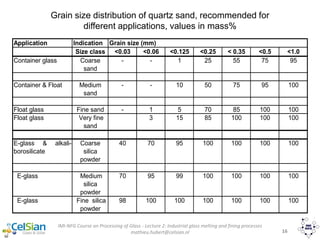
Application Indication
Size class <0.03 <0.06 <0.125 <0.25 < 0.35 <0.5 <1.0
Container glass Coarse
sand
- - 1 25 55 75 95
Container & Float Medium
sand
- - 10 50 75 95 100
Float glass Fine sand - 1 5 70 85 100 100
Float glass Very fine
sand
3 15 85 100 100 100
E-glass & alkali-
borosilicate
Coarse
silica
powder
40 70 95 100 100 100 100
E-glass Medium
silica
powder
70 95 99 100 100 100 100
E-glass Fine silica
powder
98 100 100 100 100 100 100
Grain size (mm)
Grain size distribution of quartz sand, recommended for
different applications, values in mass%
IMI-NFG Course on Processing of Glass - Lecture 2: Industrial glass melting and fining processes
mathieu.hubert@celsian.nl
IMI-NFG Course on Processing of Glass - Lecture 2: Industrial glass melting and fining processes
mathieu.hubert@celsian.nl 17
Solid-state reactions in the batch
• Solid-state reactions can be divided into two routes: the carbonate
route and the silicate route
• The carbonate route (path) is characterized by reactive
dissolution of silica sand with a binary melt phase of soda ash
and limestone below about 900°C. Soda ash and limestone, in
contact with each other, may form a double carbonate by a solid
state reaction forming the species Na2Ca(CO3)2
• At about 820°C, this intermediate reaction product starts to melt and
becomes suddenly more reactive (better contact) towards silica
sand grains.
• Silica reaction with Na2Ca(CO3)2 forms a viscous Na2O·CaO·SiO2
melt plus CO2 gas.
IMI-NFG Course on Processing of Glass - Lecture 2: Industrial glass melting and fining processes
mathieu.hubert@celsian.nl 18
Solid-state reactions in the batch
• The silica/silicate route is based on eutectic melting of a mixture
of components, including the sodium disilicate phase, formed by
solid state reactions between sand and soda.
• The eutectic melting of SiO2 and Na2O·2SiO2 takes place at 799°C
and silicate rich melts are formed.
• The degree to which these reactions occur depends on the mutual
contact between the components.
 Within a compacted batch (pellets, granules) the reactions
will be more intensive than in a loose powder batch.
 Finer powders may give a better contact between the
interacting raw material grains compared to coarse
powders. Thus finer powdered batch is often more reactive
and may give a better glass homogeneity
IMI-NFG Course on Processing of Glass - Lecture 2: Industrial glass melting and fining processes
mathieu.hubert@celsian.nl 19
• Solid state reactions, formation of silicates, e.g.:
Carbonate route < 900oC at fast heating rate
Na2CO3 + CaCO3  Na2Ca(CO3)2 (melts at ±820oC) (550-850oC)
Na2Ca(CO3)2 +2SiO2  Na2SiO3/CaSiO3 + 2CO2 reaction enhances > 820oC
Na2CO3 + 2SiO2  Na2Si2O5 + CO2 (silica route) (700-860oC)
forms eutectic
melt with SiO2
Na2CO3 + SiO2  Na2SiO3 + CO2 (silica route)
The rate of the reactive calcination of soda ash with silica increases sharply
when heating above 825oC up to about 855oC.
• Formation of primary melt phases (alkali rich carbonates), e.g.:
Tm Na2CO3 = 850oC
Tm Na2Ca(CO3)2 = 820oC
High amount of
heat required
Carbonate
route
Silicate
routeMelting reactions – Silicate route for SLS batch
IMI-NFG Course on Processing of Glass - Lecture 2: Industrial glass melting and fining processes
mathieu.hubert@celsian.nl 20
• The main part of the limestone or dolomite will decompose above
the thermodynamic calcination temperature of limestone, this
depends on the CO2 partial pressure in the batch. Some limestone
may react directly with silica:
2 CaCO3 + SiO2  Ca2SiO4 + 2 CO2  (600 - 900C)
• These reactions occur only on the contacting interfaces and they are
much slower than solid state/liquid reactions.
Limestone –sand solid-state reactions
IMI-NFG Course on Processing of Glass - Lecture 2: Industrial glass melting and fining processes
mathieu.hubert@celsian.nl 21
• Reactive calcination:
Na2CO3 + 2SiO2  Na2O·2SiO2 + CO2↑ T > 790oC
 forms with SiO2 an eutectic melt
• Or at further heating
 fast Na2O·SiO2 formation (850oC) plus limestone decomposes and:
2CaO + (SiO2 + Na2O·2SiO2 )eutectic melt  Na2O·2CaO·3SiO2 (> 900oC)
• Silicate route:
Silicate melt + SiO2  silica enriched melt T > 1000-1100oC
Eutectic melt phases are formed above ±800-840oC
Melting reactions – Silicate route for SLS batch
IMI-NFG Course on Processing of Glass - Lecture 2: Industrial glass melting and fining processes
mathieu.hubert@celsian.nl 22
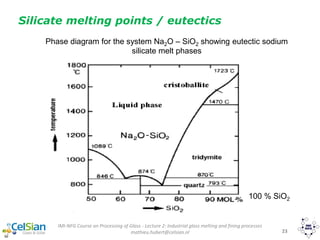
Silicate melting points / eutectics
The melting points of the meta-silicate Na2SiO3 and of the di-silicate
Na2Si2O5 are:
• Ts (Na2SiO3) = 1089oC,
• Ts (Na2Si2O5) = 874oC.
Eutectics:
• Teut (Na2O  2SiO2 + SiO2) = 793oC.
• Teut (Na2O  2SiO2 + Na2O  SiO2) = 846oC.
• Teut (2Na2O  SiO2 + Na2O  SiO2) = 1020oC.
In combination with calcium oxide, an even lower (ternary) eutectic
temperature may occur:
• Teut (Na2O3CaO  6SiO2 + SiO2 + Na2O  2SiO2) = 725 oC.
IMI-NFG Course on Processing of Glass - Lecture 2: Industrial glass melting and fining processes
mathieu.hubert@celsian.nl 23
Silicate melting points / eutectics
100 % SiO2
Phase diagram for the system Na2O – SiO2 showing eutectic sodium
silicate melt phases
IMI-NFG Course on Processing of Glass - Lecture 2: Industrial glass melting and fining processes
mathieu.hubert@celsian.nl 24
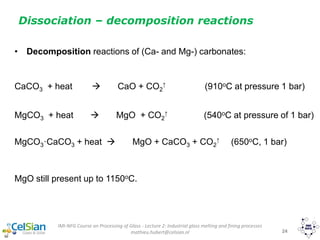
Dissociation – decomposition reactions
• Decomposition reactions of (Ca- and Mg-) carbonates:
CaCO3 + heat  CaO + CO2
↑ (910oC at pressure 1 bar)
MgCO3 + heat  MgO + CO2
↑ (540oC at pressure of 1 bar)
MgCO3·CaCO3 + heat  MgO + CaCO3 + CO2
↑ (650oC, 1 bar)
MgO still present up to 1150oC.
IMI-NFG Course on Processing of Glass - Lecture 2: Industrial glass melting and fining processes
mathieu.hubert@celsian.nl 25
Gas release during melting-in
• During these initial (melting) reactions in most batches, much CO2-
gas is released.
• About 14 - 20 % of the mass of normal soda-lime-silica batches
is transferred into volatile CO2
• This means that from 1 kg of normal batch about 100 liters of gas
at normal pressure and room temperature (or about 500 liters gas,
at the furnace temperature level), will be released in the furnace.
• Besides CO2-gas, the melting loss consists of water vapor (several
mass percents, depending on: batch humidity, water content in cullet
and presence of hydrated raw materials) and any possible
evaporation products
(SO2, HBO2, HCl, NaCl, HCl, KOH, PbO, Pb, NaOH, Se-components).
IMI-NFG Course on Processing of Glass - Lecture 2: Industrial glass melting and fining processes
mathieu.hubert@celsian.nl 26
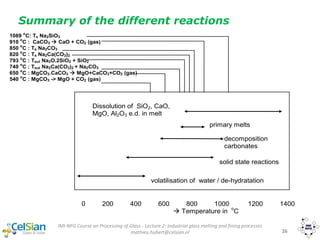
1089 o
C: Ts Na2SiO3
910 o
C : CaCO3  CaO + CO2 (gas)
850 o
C : Ts Na2CO3
820 o
C : Ts Na2Ca(CO3)2
793 o
C : Teut Na2O.2SiO2 + SiO2
740 o
C : Teut Na2Ca(CO3)2 + Na2CO3
650 o
C : MgCO3.CaCO3  MgO+CaCO3+CO2 (gas)
540 o
C : MgCO3 -> MgO + CO2 (gas)
0 200 400 600 800 1000 1200 1400
 Temperature in
o
C
volatilisation of water / de-hydratation
solid state reactions
decomposition
carbonates
primary melts
Dissolution of SiO2, CaO,
MgO, Al2O3 e.d. in melt
phases
Summary of the different reactions
IMI-NFG Course on Processing of Glass - Lecture 2: Industrial glass melting and fining processes
mathieu.hubert@celsian.nl 27
Energy demand (enthalpy)
The quantity of required energy (excluding energy losses) is
determined by:
• the heat needed to bring the raw materials up to the reaction
temperatures
• the net heat required for the fusion reactions (determined by both
endothermic reactions, requiring energy and exothermic reactions
that generate thermal energy)
• the heat required for the further heating of the melt phases and the
volatile reaction products up to the temperature at the furnace exit
(throat, canal, exhaust ports).
IMI-NFG Course on Processing of Glass - Lecture 2: Industrial glass melting and fining processes
mathieu.hubert@celsian.nl 28
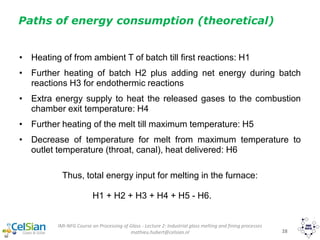
Paths of energy consumption (theoretical)
• Heating of from ambient T of batch till first reactions: H1
• Further heating of batch H2 plus adding net energy during batch
reactions H3 for endothermic reactions
• Extra energy supply to heat the released gases to the combustion
chamber exit temperature: H4
• Further heating of the melt till maximum temperature: H5
• Decrease of temperature for melt from maximum temperature to
outlet temperature (throat, canal), heat delivered: H6
Thus, total energy input for melting in the furnace:
H1 + H2 + H3 + H4 + H5 - H6.
IMI-NFG Course on Processing of Glass - Lecture 2: Industrial glass melting and fining processes
mathieu.hubert@celsian.nl 29
-2
0
2
4
6
8
10
600 650 700 750 800 850 900 950 1000
Temperature [°C]
Chemicalenergyconsumptionrate[kJ·kgbatch
-1
·K
-1
]
Overall chemical energy demand
MgCO3·CaCO3(s) -> MgO(s) + CO2(g) + CaCO3(s)
CaCO3(s) -> CaO(s) + CO2(g)
Na2CO3(s) + SiO2(q) -> Na2O·SiO2(s) + CO2(g)
Na2CO3(s) -> Na2CO3(l)
Na2CO3(l) + SiO2(q) -> Na2O·SiO2(s) + CO2(g)
Na2O·SiO2(s) + SiO2(q) -> NS(l)
CaO(s) + melt
Chemical energy demand
IMI-NFG Course on Processing of Glass - Lecture 2: Industrial glass melting and fining processes
mathieu.hubert@celsian.nl 30
Effect of cullet on required energy:
• Less reaction energy and less gaseous reaction products
• Faster batch heating due to better heat transfer
Soda lime
glass
[kJ/kg]
Lead glass
(19 % PbO)
[kJ/kg]
Sodium boro-
silicate glass
(8 % B2O3)
[kJ/kg]
E-glass
[kJ/kg]
Tangible heat of melt
(0 - 1400 oC)
Reaction heat
Tangible heat volatile
reaction products
(0 - 1500 oC)
1775
487
293
1603
403
166
1609
412
140
1588
roughly 400
577
TOTAL 2555 2172 2161 2565
Typical values for theoretical heat demand of
several batch types (without cullet)
IMI-NFG Course on Processing of Glass - Lecture 2: Industrial glass melting and fining processes
mathieu.hubert@celsian.nl 31
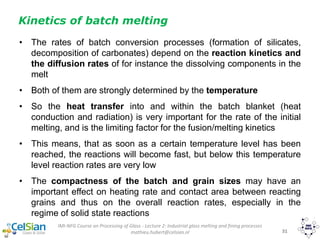
Kinetics of batch melting
• The rates of batch conversion processes (formation of silicates,
decomposition of carbonates) depend on the reaction kinetics and
the diffusion rates of for instance the dissolving components in the
melt
• Both of them are strongly determined by the temperature
• So the heat transfer into and within the batch blanket (heat
conduction and radiation) is very important for the rate of the initial
melting, and is the limiting factor for the fusion/melting kinetics
• This means, that as soon as a certain temperature level has been
reached, the reactions will become fast, but below this temperature
level reaction rates are very low
• The compactness of the batch and grain sizes may have an
important effect on heating rate and contact area between reacting
grains and thus on the overall reaction rates, especially in the
regime of solid state reactions
IMI-NFG Course on Processing of Glass - Lecture 2: Industrial glass melting and fining processes
mathieu.hubert@celsian.nl 32
Dissolution rate of sand grains in silicate melt
• The dissolution rates of single silica grains in silicate melts are
diffusion-controlled
• The SiO2 at the grain surface dissolved in the surrounding melt has
to be transferred into the melt by diffusion.
• The driving force for the
diffusion process is the
difference of the
equilibrium concentration
of SiO2 in the molten glass
(maximum SiO2 solubility in
the glass melt at that
temperature) that exists
at the interface of the silica
quartz sand
grain
glass melt
Ce is maximum SiO2 solubility (depends
on glass composition and temperature)
reaction SiO2 with molten glass
Ws = concentration SiO2 in melt =
about 72 mass%
dissolution of SiO2
SiO2-diffusion
We= concentration SiO2 at
interface
85 mass%
[SiO2] = C in mass%
IMI-NFG Course on Processing of Glass - Lecture 2: Industrial glass melting and fining processes
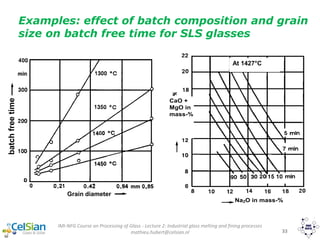
mathieu.hubert@celsian.nl 33
Grain diameter
batchfreetime
CaO +
MgO in
mass-%
Na2O in mass-%
At 1427°C
Examples: effect of batch composition and grain
size on batch free time for SLS glasses
IMI-NFG Course on Processing of Glass - Lecture 2: Industrial glass melting and fining processes
mathieu.hubert@celsian.nl 34
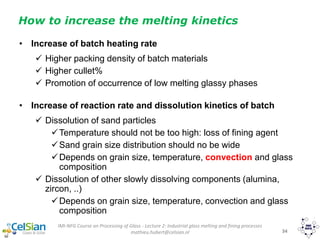
How to increase the melting kinetics
• Increase of batch heating rate
 Higher packing density of batch materials
 Higher cullet%
 Promotion of occurrence of low melting glassy phases
• Increase of reaction rate and dissolution kinetics of batch
 Dissolution of sand particles
Temperature should not be too high: loss of fining agent
Sand grain size distribution should no be wide
Depends on grain size, temperature, convection and glass
composition
 Dissolution of other slowly dissolving components (alumina,
zircon, ..)
Depends on grain size, temperature, convection and glass
composition
IMI-NFG Course on Processing of Glass - Lecture 2: Industrial glass melting and fining processes
mathieu.hubert@celsian.nl 35
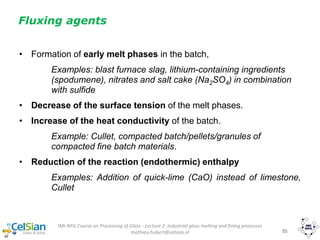
Fluxing agents
• Formation of early melt phases in the batch,
Examples: blast furnace slag, lithium-containing ingredients
(spodumene), nitrates and salt cake (Na2SO4) in combination
with sulfide
• Decrease of the surface tension of the melt phases.
• Increase of the heat conductivity of the batch.
Example: Cullet, compacted batch/pellets/granules of
compacted fine batch materials.
• Reduction of the reaction (endothermic) enthalpy
Examples: Addition of quick-lime (CaO) instead of limestone,
Cullet
IMI-NFG Course on Processing of Glass - Lecture 2: Industrial glass melting and fining processes
mathieu.hubert@celsian.nl 36
Fining of the glass melts
IMI-NFG Course on Processing of Glass - Lecture 2: Industrial glass melting and fining processes
mathieu.hubert@celsian.nl 37
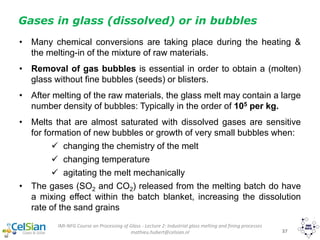
Gases in glass (dissolved) or in bubbles
• Many chemical conversions are taking place during the heating &
the melting-in of the mixture of raw materials.
• Removal of gas bubbles is essential in order to obtain a (molten)
glass without fine bubbles (seeds) or blisters.
• After melting of the raw materials, the glass melt may contain a large
number density of bubbles: Typically in the order of 105 per kg.
• Melts that are almost saturated with dissolved gases are sensitive
for formation of new bubbles or growth of very small bubbles when:
 changing the chemistry of the melt
 changing temperature
 agitating the melt mechanically
• The gases (SO2 and CO2) released from the melting batch do have
a mixing effect within the batch blanket, increasing the dissolution
rate of the sand grains
IMI-NFG Course on Processing of Glass - Lecture 2: Industrial glass melting and fining processes
mathieu.hubert@celsian.nl 38
Glass just after batch melting
- sample thickness ± 5 mm
10 mm
IMI-NFG Course on Processing of Glass - Lecture 2: Industrial glass melting and fining processes
mathieu.hubert@celsian.nl 39
Gases in glass (dissolved) or in bubbles
• Besides formation of the desired silicate melt phases, a large
amount of gases is produced:
 From carbonates: CO2 gas is formed
 From carbonates and cokes: CO gas
 Hydrated ingredients give water vapor
 From nitrates: O2 gas, N2/NOx gases;
 Sulfates and sulfides can give sulfur gases, such as
SO2, S2, H2S or even COS.
• Degassing the glass melt and removing all bubbles including also
all very small bubbles (seeds) from the molten glass.
• The very small bubbles (D=0.1-0.4 mm) are called seeds, the larger
bubbles are called blisters. Bubbles with diameters smaller than 0.1
are often called micro-seeds.
IMI-NFG Course on Processing of Glass - Lecture 2: Industrial glass melting and fining processes
mathieu.hubert@celsian.nl 40
Other gases
• Air (volume concentration Ar:N2 = 0.9 : 80)
 Inclusions of air (pores) in batch blanket
 From open cracks in refractory walls
 Oxygen from, air is generally dissolved in glass melt
• Furnace atmosphere gases (N2, Ar, H2O, CO2)
 Oxygen from furnace atmosphere generally dissolves
completely in glass
• Volatile glass & batch components or decomposition gases:
 NOx, CO2, H2O, SeO2, …
• Refractory gases (CO, N2, CO2, oxygen bubbles)
 Refractory-glass melt interaction
 Blistering of refractory
• Contamination of melt by corrosion products of electrodes, carbon
(soot) deposits etc.
IMI-NFG Course on Processing of Glass - Lecture 2: Industrial glass melting and fining processes
mathieu.hubert@celsian.nl 41
Fining agents
• To promote the removal of bubbles from the glass melt, fining
agents are added
• The function of a fining agent is the production of fining gases at
the temperatures, being achieved by all glass melt trajectories in
the tank at lowest level of its viscosity.
• The process of high temperature decomposition of a fining agent in
a low viscous melt will result in simultaneous bubble growth,
gas stripping plus high ascension rates.
• NB: Excessive fining may lead to formation of foam (may lead to
defects in the glass, may be detrimental for heat transfers in the
glass furnace => Lecture 4)
IMI-NFG Course on Processing of Glass - Lecture 2: Industrial glass melting and fining processes
mathieu.hubert@celsian.nl 42
Schematic of an industrial glass melting tank
* This is a schematic representation, but many different furnace designs exist
(more on that in Lecture 3)
IMI-NFG Course on Processing of Glass - Lecture 2: Industrial glass melting and fining processes
mathieu.hubert@celsian.nl 43
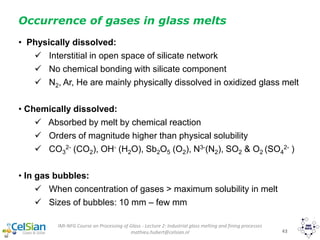
• Physically dissolved:
 Interstitial in open space of silicate network
 No chemical bonding with silicate component
 N2, Ar, He are mainly physically dissolved in oxidized glass melt
• Chemically dissolved:
 Absorbed by melt by chemical reaction
 Orders of magnitude higher than physical solubility
 CO3
2- (CO2), OH- (H2O), Sb2O5 (O2), N3-(N2), SO2 & O2 (SO4
2- )
• In gas bubbles:
 When concentration of gases > maximum solubility in melt
 Sizes of bubbles: 10 mm – few mm
Occurrence of gases in glass melts
IMI-NFG Course on Processing of Glass - Lecture 2: Industrial glass melting and fining processes
mathieu.hubert@celsian.nl 44
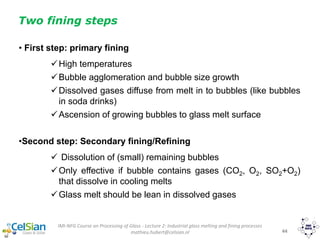
Two fining steps
• First step: primary fining
High temperatures
Bubble agglomeration and bubble size growth
Dissolved gases diffuse from melt in to bubbles (like bubbles
in soda drinks)
Ascension of growing bubbles to glass melt surface
•Second step: Secondary fining/Refining
 Dissolution of (small) remaining bubbles
Only effective if bubble contains gases (CO2, O2, SO2+O2)
that dissolve in cooling melts
Glass melt should be lean in dissolved gases
IMI-NFG Course on Processing of Glass - Lecture 2: Industrial glass melting and fining processes
mathieu.hubert@celsian.nl 45
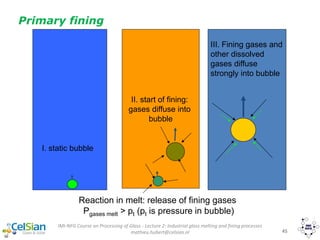
II. start of fining:
gases diffuse into
bubble
I. static bubble
Reaction in melt: release of fining gases
Pgases melt > pt (pt is pressure in bubble)
III. Fining gases and
other dissolved
gases diffuse
strongly into bubble
Primary fining
IMI-NFG Course on Processing of Glass - Lecture 2: Industrial glass melting and fining processes
mathieu.hubert@celsian.nl 46
Often used fining agent: Sodium sulfate Na2SO4 (salt cake)
Primary fining – Example sulfate fining
Fining reaction: T > TFining onset
Na2SO4(m)  Na2O(m)+SO2 (gas)+1/2 O2 (gas)
Dilution of N2 & CO2 in bubble by fining gases
SO2
CO2
O2
N2
Stripping of CO2
and N2 from melt
Cm CO2
Cm N2
][SO
pOpSO
K
3
22'

=
IMI-NFG Course on Processing of Glass - Lecture 2: Industrial glass melting and fining processes
mathieu.hubert@celsian.nl 47
Acceleration of bubble ascension
𝑣 𝑎𝑠𝑐𝑒𝑛𝑠𝑖𝑜𝑛 =
𝑐. 𝜌. 𝑔. 𝑅2
η
ρ : density of the glass melt [Kg/m3]
η : viscosity of the glass melt [Pa.s]
R : bubble radius [m]
g : gravity [9.81 m/s2]
c : factor (e.g. Stokes c =2/9)
IMI-NFG Course on Processing of Glass - Lecture 2: Industrial glass melting and fining processes
mathieu.hubert@celsian.nl 48
Primary fining
Time to reach glass surface (1 meter)
0
50
100
150
200
250
0 100 200 300 400 500
Bubble diameter [μm]
Timetoreachglasslevelat1meter[h]
1350 OC
1400 OC
1450 OC
1500 OC
Float glass melt
At higher temperatures
=> melt with lower viscosity
IMI-NFG Course on Processing of Glass - Lecture 2: Industrial glass melting and fining processes
mathieu.hubert@celsian.nl 49
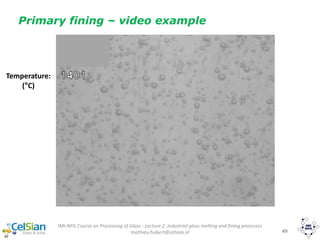
Primary fining – video example
Temperature:
(°C)
IMI-NFG Course on Processing of Glass - Lecture 2: Industrial glass melting and fining processes
mathieu.hubert@celsian.nl 50
Secondary fining – during controlled cooling
• The secondary fining (or refining) corresponds to the dissolution
of the remaining bubbles in the melt
• It takes place in a rather narrow temperature window
• The solubility of the gases in the melt increases with decreasing
temperature
• Because a temperature decrease will reverse the fining reactions
(meaning that the fining gases will be chemically absorbed again),
the fining gases (e.g. O2, SO2) can re-dissolve into the melt during
controlled cooling down of the melt (refining) if the melt is
sufficiently lean of dissolved gases after the primary fining process.
• The gases of the bubbles will dissolve into the glass melt. The
bubble shrinks and disappears (it “dissolves”). This mechanism is
especially important for the remaining smaller bubbles (< 100 μm),
which are hardly able to rise.
IMI-NFG Course on Processing of Glass - Lecture 2: Industrial glass melting and fining processes
mathieu.hubert@celsian.nl 51
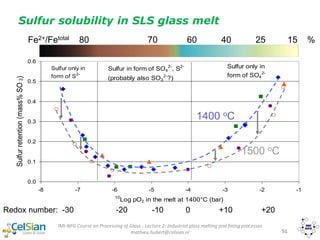
0.0
0.1
0.2
0.3
0.4
0.5
0.6
-8 -7 -6 -5 -4 -3 -2 -1
10
Log pO2 in the melt at 1400°C (bar)
Sulfurretention(mass%SO3)
Sulfur only in
form of S2-
Sulfur in form of SO4
2-
, S2-
(probably also SO3
2-
?)
Sulfur only in
form of SO4
2-
-30 -20 -10 0 +10 +20
Fe2+/Fetotal 80 70 60 40 25 15 %
1400 oC
1500 oC
Redox number:
Sulfur solubility in SLS glass melt
IMI-NFG Course on Processing of Glass - Lecture 2: Industrial glass melting and fining processes
mathieu.hubert@celsian.nl 52
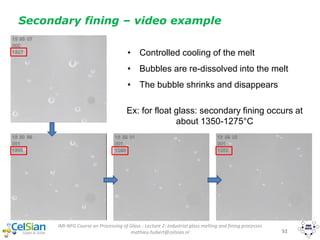
Secondary fining – video example
Ex: for float glass: secondary fining occurs at
about 1350-1275°C
• Controlled cooling of the melt
• Bubbles are re-dissolved into the melt
• The bubble shrinks and disappears
IMI-NFG Course on Processing of Glass - Lecture 2: Industrial glass melting and fining processes
mathieu.hubert@celsian.nl 53
• Depending on the type of glass produced, the temperatures involved
and/or potential limitations on the composition of the glass, different
fining agents may be emloyed
• The most commonly used fining agents include:
Sodium sulfate (with/without cokes)
Arsenic oxide
Antimony oxide
Tin oxide
Sodium chloride
Fining agents
IMI-NFG Course on Processing of Glass - Lecture 2: Industrial glass melting and fining processes
mathieu.hubert@celsian.nl 54
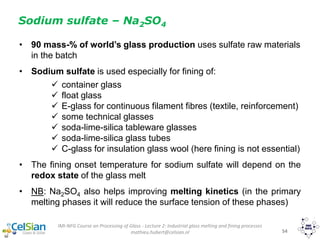
• 90 mass-% of world’s glass production uses sulfate raw materials
in the batch
• Sodium sulfate is used especially for fining of:
 container glass
 float glass
 E-glass for continuous filament fibres (textile, reinforcement)
 some technical glasses
 soda-lime-silica tableware glasses
 soda-lime-silica glass tubes
 C-glass for insulation glass wool (here fining is not essential)
• The fining onset temperature for sodium sulfate will depend on the
redox state of the glass melt
• NB: Na2SO4 also helps improving melting kinetics (in the primary
melting phases it will reduce the surface tension of these phases)
Sodium sulfate – Na2SO4
IMI-NFG Course on Processing of Glass - Lecture 2: Industrial glass melting and fining processes
mathieu.hubert@celsian.nl 55
Sodium sulfate in oxidized melts
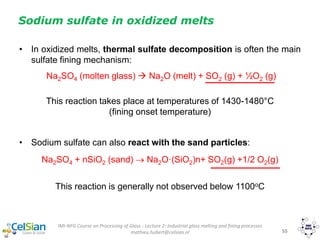
• In oxidized melts, thermal sulfate decomposition is often the main
sulfate fining mechanism:
Na2SO4 (molten glass)  Na2O (melt) + SO2 (g) + ½O2 (g)
This reaction takes place at temperatures of 1430-1480°C
(fining onset temperature)
• Sodium sulfate can also react with the sand particles:
Na2SO4 + nSiO2 (sand)  Na2O·(SiO2)n+ SO2(g) +1/2 O2(g)
This reaction is generally not observed below 1100oC
IMI-NFG Course on Processing of Glass - Lecture 2: Industrial glass melting and fining processes
mathieu.hubert@celsian.nl 56
Sodium sulfate in reduced melts
• Some sulfate reacts with reducing agents in batch (cokes or oganic
contamination, i.e. carbon). Examples of reactions:
 2 C + Na2SO4 → 2 CO + Na2S
 4 CO + Na2SO4 → 4 CO2 + Na2S
 4C + Na2SO4 → 4 CO + Na2S
• Then, sulfate-sulfide reactions occur in the temperature interval
1140-1350°C (one example below, but other reactions are also
possible)
xNa2S + yNa2SO4 + pSiO2  (Na2O)(x+y)·(SiO2)p+ (x+y) SO2 + [(y-3x)/2] O2
formation of sulfides S2-
around 700-800°C
IMI-NFG Course on Processing of Glass - Lecture 2: Industrial glass melting and fining processes
mathieu.hubert@celsian.nl 57
Sodium sulfate in reduced melts
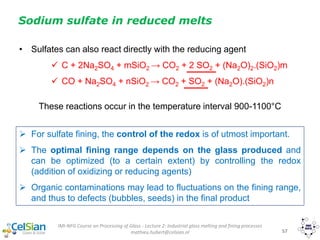
• Sulfates can also react directly with the reducing agent
 C + 2Na2SO4 + mSiO2 → CO2 + 2 SO2 + (Na2O)2.(SiO2)m
 CO + Na2SO4 + nSiO2 → CO2 + SO2 + (Na2O).(SiO2)n
These reactions occur in the temperature interval 900-1100°C
 For sulfate fining, the control of the redox is of utmost important.
 The optimal fining range depends on the glass produced and
can be optimized (to a certain extent) by controlling the redox
(addition of oxidizing or reducing agents)
 Organic contaminations may lead to fluctuations on the fining range,
and thus to defects (bubbles, seeds) in the final product
IMI-NFG Course on Processing of Glass - Lecture 2: Industrial glass melting and fining processes
mathieu.hubert@celsian.nl 58
0
2
4
6
8
10
500 600 700 800 900 1000 1100 1200 1300 1400 1500
Temperature [°C]
ConcentrationCO2inpurge
gas[vol%]
0
200
400
600
800
1000
ConcentrationCO,O2&SO2
inpurgegas[volppm]
CO2
CO
SO2
O2
Gas evolution for an oxidized batch with sulfates
Reaction of sulfide
and sulfate
Thermal sulfate
decomposition
IMI-NFG Course on Processing of Glass - Lecture 2: Industrial glass melting and fining processes
mathieu.hubert@celsian.nl 59
Gas evolution for an reduced batch with sulfates
0
2
4
6
8
10
500 600 700 800 900 1000 1100 1200 1300 1400 1500
Temperature [°C]
ConcentrationCO2inpurge
gas[vol%]
0
200
400
600
800
1000
ConcentrationCO&SO2in
purgegas[volppm]
CO2
CO
SO2
Direct reaction
sulfate with
reducing
component
2n242
2422
4SO)(SiOO)(Na
nSiOSO3NaSNa


IMI-NFG Course on Processing of Glass - Lecture 2: Industrial glass melting and fining processes
mathieu.hubert@celsian.nl 60
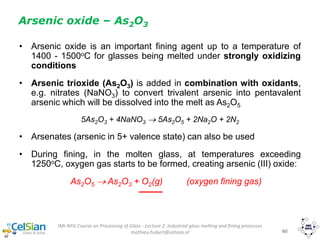
• Arsenic oxide is an important fining agent up to a temperature of
1400 - 1500oC for glasses being melted under strongly oxidizing
conditions
• Arsenic trioxide (As2O3) is added in combination with oxidants,
e.g. nitrates (NaNO3) to convert trivalent arsenic into pentavalent
arsenic which will be dissolved into the melt as As2O5
5As2O3 + 4NaNO3  5As2O5 + 2Na2O + 2N2
• Arsenates (arsenic in 5+ valence state) can also be used
• During fining, in the molten glass, at temperatures exceeding
1250oC, oxygen gas starts to be formed, creating arsenic (III) oxide:
As2O5  As2O3 + O2(g) (oxygen fining gas)
Arsenic oxide – As2O3
IMI-NFG Course on Processing of Glass - Lecture 2: Industrial glass melting and fining processes
mathieu.hubert@celsian.nl 61
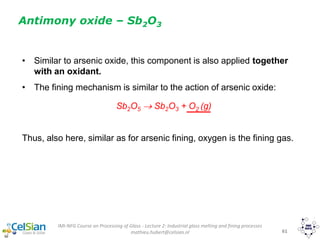
• Similar to arsenic oxide, this component is also applied together
with an oxidant.
• The fining mechanism is similar to the action of arsenic oxide:
Sb2O5  Sb2O3 + O2 (g)
Thus, also here, similar as for arsenic fining, oxygen is the fining gas.
Antimony oxide – Sb2O3
IMI-NFG Course on Processing of Glass - Lecture 2: Industrial glass melting and fining processes
mathieu.hubert@celsian.nl 62
Temperature in
o
C
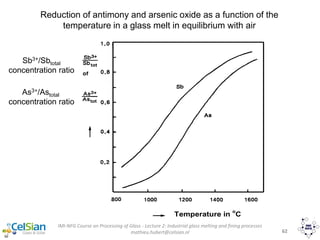
Reduction of antimony and arsenic oxide as a function of the
temperature in a glass melt in equilibrium with air
Sb3+/Sbtotal
concentration ratio
As3+/Astotal
concentration ratio
IMI-NFG Course on Processing of Glass - Lecture 2: Industrial glass melting and fining processes
mathieu.hubert@celsian.nl 63
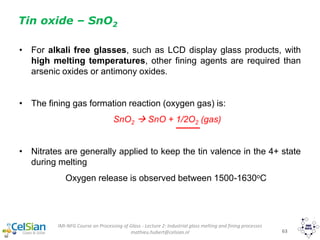
Tin oxide – SnO2
• For alkali free glasses, such as LCD display glass products, with
high melting temperatures, other fining agents are required than
arsenic oxides or antimony oxides.
• The fining gas formation reaction (oxygen gas) is:
SnO2  SnO + 1/2O2 (gas)
• Nitrates are generally applied to keep the tin valence in the 4+ state
during melting
Oxygen release is observed between 1500-1630oC
IMI-NFG Course on Processing of Glass - Lecture 2: Industrial glass melting and fining processes
mathieu.hubert@celsian.nl 64
• For glass types, which can only be melted at relatively high
temperatures (like some borosilicate glasses), the application of
sodium sulfate is less effective, because fining gases are released
at temperatures where the viscosity of the glass melt still is too high
• In such situations often NaCl is used as a fining agent. Addition of
halogenide salts (NaCl, NaBr, NaI, KCl, KBr, KI) to a raw material
batch will lead to limited solubility of these salts in the molten glass
obtained
• The fining temperature will depend on the type of glass and the
amount of fining agent added
• Important: in NaCl-fined glasses, the emissions of environmentally
hazardous chlorides from the melter in the form of HCl-gas may
cause problems (increased particulates emissions, corrosion of
refractories and/or mold materials)
Halogenides (Sodium Chloride NaCl)
IMI-NFG Course on Processing of Glass - Lecture 2: Industrial glass melting and fining processes
mathieu.hubert@celsian.nl 65
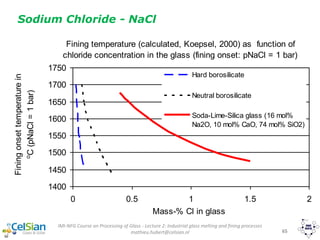
Fining temperature (calculated, Koepsel, 2000) as function of
chloride concentration in the glass (fining onset: pNaCl = 1 bar)
1400
1450
1500
1550
1600
1650
1700
1750
0 0.5 1 1.5 2
Mass-% Cl in glass
Finingonsettemperaturein
o
C(pNaCl=1bar)
Hard borosilicate
Neutral borosilicate
Soda-Lime-Silica glass (16 mol%
Na2O, 10 mol% CaO, 74 mol% SiO2)
Sodium Chloride - NaCl
IMI-NFG Course on Processing of Glass - Lecture 2: Industrial glass melting and fining processes
mathieu.hubert@celsian.nl 66
• In case of high levels of reject caused by large bubbles or
unacceptable large numbers of bubbles/seeds in the glass, it is
important to find to origin/cause of these bubbles.
• Important information is:
size of bubbles,
distribution / location of bubbles in the product,
internal bubble pressure and gas composition.
base level and type of bubbles during normal production
sometimes bubbles contain deposits (often very small
droplets of condensation products) that can be observed by
using light microscopy.
• Based on these information (collected on a sufficiently high number
of bubbles analyzed), the origin of the problem can be identified
(requires experienced analysts) and corrected
Bubbles in glass and origin of the bubbles
IMI-NFG Course on Processing of Glass - Lecture 2: Industrial glass melting and fining processes
mathieu.hubert@celsian.nl 67
Conclusions - 1/2
• During industrial glass melting, a multitude of reactions occur to go
from the introduced batch to the molten glass (dehydration, solid-
state reactions, formation of primary molten phases,
decompositions, dissolution of sand grains...)
• Glass melting is an energy intensive process, and effort is put to
reduce the amount of energy required
• The kinetics of glass melting are often determined by the sand
dissolution, which requires a long time
• Optimization of grain size, primary molten phase formation,
increased heat transfer, good convection of the glass melt can help
increase the sand dissolution rate
IMI-NFG Course on Processing of Glass - Lecture 2: Industrial glass melting and fining processes
mathieu.hubert@celsian.nl 68
Conclusions - 2/2
• The reactions involved in glass melting lead to the formation of a
very high amount of bubbles in the melt, which have to be
removed by the fining process
• The fining process can be divided into primary fining (growth and
ascension of bubbles) and secondary fining (refining) (dissolution
of the remaining seeds).
• The fining efficiency will notably depend on the type of fining agent
used and the viscosity of the glass melt at fining temperature
• The choice of fining agent will depend on the desired fining range
(and thus on the type of glass produced)
• Redox plays a major role in the efficiency of the fining process, and
should be carefully controlled
69
References and further reading
IMI-NFG Course on Processing of Glass - Lecture 2: Industrial glass melting and fining processes
mathieu.hubert@celsian.nl
• Book “Introduction to Glass Science and Technology”, J. Shelby (RSC
publishing, 2nd edition 2005)
• Book “Fundamentals of Inorganic Glasses”, A. Varshneya (Elsevier, 1993)
• Glass Technology journals (e.g. European Journal of Glass Science and
Technology)
• NCNG’s Glass Technology course and handbook 2013
• Proceedings of GlassTrend meetings and seminars (www.glasstrend.nl)
• Proceedings of “Glass Problem Conferences” (Wiley, every year)
• Youtube video: Production of Glass Bottles - How it's made
IMI-NFG Course on Processing of Glass - Lecture 2: Industrial glass melting and fining processes
mathieu.hubert@celsian.nl 70
• A multiple choice questionnaire (MCQ) including questions on
industrial glass melting and fining processes is provided with this
lecture
• The MCQ will be available online on IMI’s website
Home assignment
IMI-NFG Course on Processing of Glass - Lecture 2: Industrial glass melting and fining processes
mathieu.hubert@celsian.nl 71
Questions ?
Visit us in Eindhoven
Contact me via email:
mathieu.hubert@celsian.nl
Thank you for your attention
GLASS
IN
PACKAGINGC.S.Purushothaman
1CSP TRG AIDS - AUG 2008
BASICS
MANUFACTURE
DESIGN FEATURES
TYPES & PROPERTIES
PERFORMANCE & TESTING
2CSP TRG AIDS - AUG 2008
SCOPE
BASICS
What is Glass?
4CSP TRG AIDS - AUG 2008
SUPERCOOLED LIQUID
LIQUID WHICH IS COOLED TO A STAGE
WHERE ITS VISCOSITY IS SO GREAT
THAT THE MOLECULES DO NOT MOVE
FREELY ENOUGH TO FORM CRYSTALS
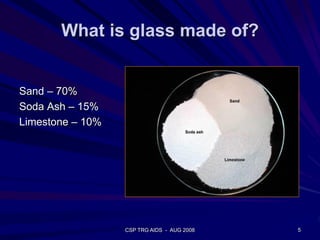
What is glass made of?
Sand – 70%
Soda Ash – 15%
Limestone – 10%
5CSP TRG AIDS - AUG 2008
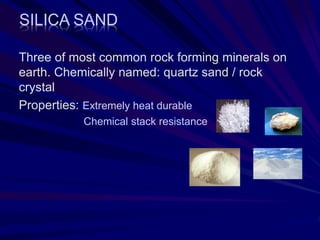
SILICA SAND
SILICA SAND
Three of most common rock forming minerals on
earth. Chemically named: quartz sand / rock
crystal
Properties: Extremely heat durable
Chemical stack resistance
FORMATION OF SILICA SAND
Naturally:
Mechanical & chemical weathering of quartz-bearing
igneous & metamorphic rocks
Chemically weathering:
Less stable minerals
• break down to become silica sand
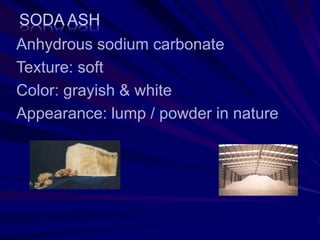
SODA ASH
SODA ASH
Anhydrous sodium carbonate
Texture: soft
Color: grayish & white
Appearance: lump / powder in nature
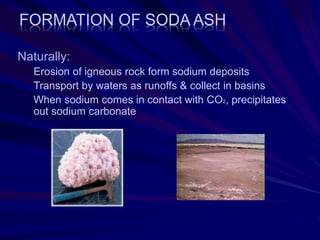
FORMATION OF SODA ASH
Naturally:
Erosion of igneous rock form sodium deposits
Transport by waters as runoffs & collect in basins
When sodium comes in contact with CO2, precipitates
out sodium carbonate
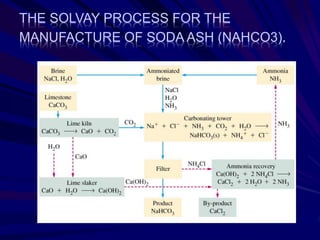
THE SOLVAY PROCESS FOR THE
MANUFACTURE OF SODA ASH (NAHCO3).
LIME
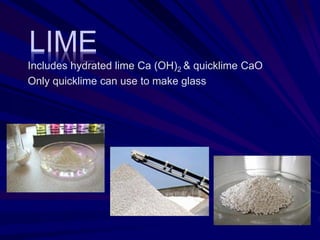
LIME
Includes hydrated lime Ca (OH)2 & quicklime CaO
Only quicklime can use to make glass
MANUFACTURE
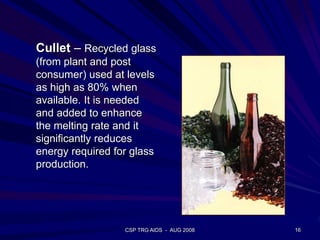
Cullet – Recycled glass
(from plant and post
consumer) used at levels
as high as 80% when
available. It is needed
and added to enhance
the melting rate and it
significantly reduces
energy required for glass
production.
16CSP TRG AIDS - AUG 2008
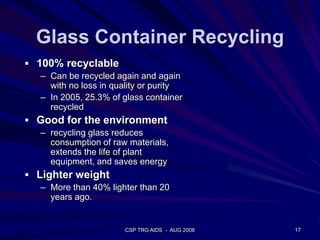
Glass Container Recycling
 100% recyclable
– Can be recycled again and again
with no loss in quality or purity
– In 2005, 25.3% of glass container
recycled
 Good for the environment
– recycling glass reduces
consumption of raw materials,
extends the life of plant
equipment, and saves energy
 Lighter weight
– More than 40% lighter than 20
years ago.
17CSP TRG AIDS - AUG 2008
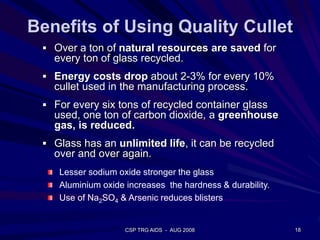
Benefits of Using Quality Cullet
 Over a ton of natural resources are saved for
every ton of glass recycled.
 Energy costs drop about 2-3% for every 10%
cullet used in the manufacturing process.
 For every six tons of recycled container glass
used, one ton of carbon dioxide, a greenhouse
gas, is reduced.
 Glass has an unlimited life, it can be recycled
over and over again.
18CSP TRG AIDS - AUG 2008
Lesser sodium oxide stronger the glass
Aluminium oxide increases the hardness & durability.
Use of Na2SO4 & Arsenic reduces blisters
CSP TRG AIDS - AUG 2008 19
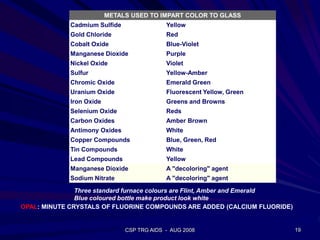
METALS USED TO IMPART COLOR TO GLASS
Cadmium Sulfide Yellow
Gold Chloride Red
Cobalt Oxide Blue-Violet
Manganese Dioxide Purple
Nickel Oxide Violet
Sulfur Yellow-Amber
Chromic Oxide Emerald Green
Uranium Oxide Fluorescent Yellow, Green
Iron Oxide Greens and Browns
Selenium Oxide Reds
Carbon Oxides Amber Brown
Antimony Oxides White
Copper Compounds Blue, Green, Red
Tin Compounds White
Lead Compounds Yellow
Manganese Dioxide A "decoloring" agent
Sodium Nitrate A "decoloring" agent
Three standard furnace colours are Flint, Amber and Emerald
Blue coloured bottle make product look white
OPAL: MINUTE CRYSTALS OF FLUORINE COMPOUNDS ARE ADDED (CALCIUM FLUORIDE)
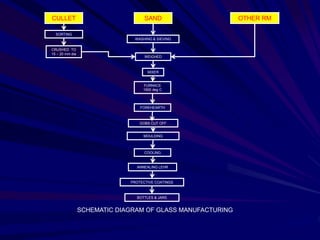
CULLET SAND OTHER RM
WASHING & SIEVING
CRUSHED TO
15 – 20 mm dia
SORTING
WEIGHED
MIXER
FURNACE
1500 deg C
FOREHEARTH
GOBS CUT OFF
MOULDING
COOLING
ANNEALING LEHR
PROTECTIVE COATINGS
BOTTLES & JARS
SCHEMATIC DIAGRAM OF GLASS MANUFACTURING
CSP TRG AIDS - AUG 2008 21
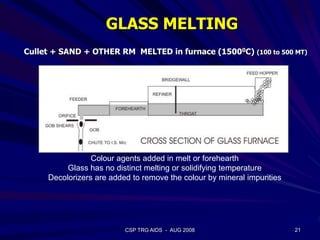
Colour agents added in melt or forehearth
Glass has no distinct melting or solidifying temperature
Decolorizers are added to remove the colour by mineral impurities
Cullet + SAND + OTHER RM MELTED in furnace (15000C) (100 to 500 MT)
GLASS MELTING
CSP TRG AIDS - AUG 2008 22
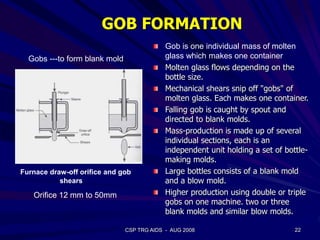
Orifice 12 mm to 50mm
Furnace draw-off orifice and gob
shears
Gob is one individual mass of molten
glass which makes one container
Molten glass flows depending on the
bottle size.
Mechanical shears snip off "gobs" of
molten glass. Each makes one container.
Falling gob is caught by spout and
directed to blank molds.
Mass-production is made up of several
individual sections, each is an
independent unit holding a set of bottle-
making molds.
Large bottles consists of a blank mold
and a blow mold.
Higher production using double or triple
gobs on one machine. two or three
blank molds and similar blow molds.
Gobs ---to form blank mold
GOB FORMATION
23CSP TRG AIDS - AUG 2008
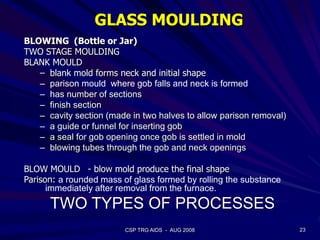
GLASS MOULDING
BLOWING (Bottle or Jar)
TWO STAGE MOULDING
BLANK MOULD
– blank mold forms neck and initial shape
– parison mould where gob falls and neck is formed
– has number of sections
– finish section
– cavity section (made in two halves to allow parison removal)
– a guide or funnel for inserting gob
– a seal for gob opening once gob is settled in mold
– blowing tubes through the gob and neck openings
BLOW MOULD - blow mold produce the final shape
Parison: a rounded mass of glass formed by rolling the substance
immediately after removal from the furnace.
TWO TYPES OF PROCESSES
24CSP TRG AIDS - AUG 2008
GLASS MOULDING
TWO TYPES OF PROCESSES
BLOW & BLOW PRESS & BLOW
25CSP TRG AIDS - AUG 2008
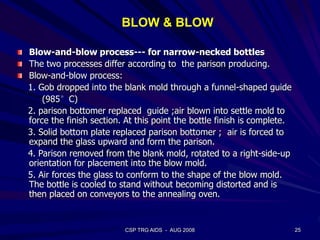
BLOW & BLOW
Blow-and-blow process--- for narrow-necked bottles
The two processes differ according to the parison producing.
Blow-and-blow process:
1. Gob dropped into the blank mold through a funnel-shaped guide
(985°C)
2. parison bottomer replaced guide ;air blown into settle mold to
force the finish section. At this point the bottle finish is complete.
3. Solid bottom plate replaced parison bottomer ; air is forced to
expand the glass upward and form the parison.
4. Parison removed from the blank mold, rotated to a right-side-up
orientation for placement into the blow mold.
5. Air forces the glass to conform to the shape of the blow mold.
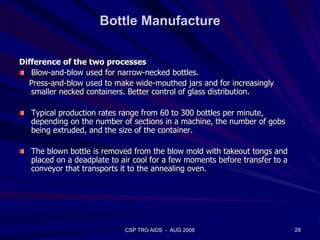
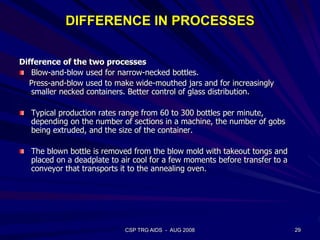
The bottle is cooled to stand without becoming distorted and is
then placed on conveyors to the annealing oven.
26CSP TRG AIDS - AUG 2008
BLOW & BLOW
Press and blow forms
the parison by mechanical action
Gob delivery and settle-blow steps are
similar to blow-and-blow forming.
Parison is pressed into shape with a metal
plunger rather than blown into shape
The final blowing step is identical to the
blow-and-blow process.
Used for smaller necked containers.
Better control of glass distribution
press-and-blow process--- for wide-mouthed jars
27CSP TRG AIDS - AUG 2008
PRESS & BLOW
Bottle Manufacture
Difference of the two processes
Blow-and-blow used for narrow-necked bottles.
Press-and-blow used to make wide-mouthed jars and for increasingly
smaller necked containers. Better control of glass distribution.
Typical production rates range from 60 to 300 bottles per minute,
depending on the number of sections in a machine, the number of gobs
being extruded, and the size of the container.
The blown bottle is removed from the blow mold with takeout tongs and
placed on a deadplate to air cool for a few moments before transfer to a
conveyor that transports it to the annealing oven.
28CSP TRG AIDS - AUG 2008
DIFFERENCE IN PROCESSES
Difference of the two processes
Blow-and-blow used for narrow-necked bottles.
Press-and-blow used to make wide-mouthed jars and for increasingly
smaller necked containers. Better control of glass distribution.
Typical production rates range from 60 to 300 bottles per minute,
depending on the number of sections in a machine, the number of gobs
being extruded, and the size of the container.
The blown bottle is removed from the blow mold with takeout tongs and
placed on a deadplate to air cool for a few moments before transfer to a
conveyor that transports it to the annealing oven.
29CSP TRG AIDS - AUG 2008
ANNEALING
ANNEALING
to reduce internal stresses; in annealing oven
- Walls are comparatively thick and cooling will not be even.
- The inner and outer skins of a glass become rigid
- The still-contracting inner portion build up internal stresses
- Uneven cooling develop substantial stresses in the glass.
- Bottle passes through an lehr after removal from the blow mold.
- LEHR is a belt passing through the controlled temperature oven at a rate
of about 200mm to 300mm per minute. Glass temp is raised to 5650 C and then
gradually cooled to room temperature with all internal stresses reduced to safe
levels in about an hour as they exit
Improperly annealed bottles are fragile and high breakage
Hot-filling also produce unacceptable breakage levels.
30CSP TRG AIDS - AUG 2008
SURFACE COATINGS
SURFACE COATINGS
Purpose--- to reduce the coefficient of friction
Reasons---The inner and outer surfaces have different characteristics
The outer surface comes in contact with the mold and takes
the grain of the mold surface
Both surfaces are PRISTINE, MONOLITHIC, STERILE,
CHEMICALLY INERT.
Pristine glass has high COF, surface scratchinhg and brusing can
occur when surface rub. Surface scratching has lower breakage
resistance
Methods--- hot-end coating ; cold-end coatings
The hot-end coating applied at the entrance to the annealing lehr
to strength the glass surface
Cold-end coatings depending on the filling process and end use.
Typical cold-end coatings---oleic acid, monostearates, waxes,
silicones, polyethylenes
The label adhesive as one cold-end coating.
31CSP TRG AIDS - AUG 2008
INSPECTION & PACKAGING
INSPECTION AND PACKING
Use mechanical and electronic means.
1) Squeeze testers subject the container walls to a compressive force
( between two rollers)
2) Plug gauges check height, perpendicularity, inside and outside finish
diameters.
3) Optical devices inspect for stones, blisters, checks, bird swings, and
other blemishes and irregularities by rotating the container past a bank of
photocells (Figure 6.4).
Faulty containers crushing into cullet.
Transported in reusable corrugated shippers;
Shipped on pallets
Automatic equipment used to clear tiers off the pallet and feed into the
filling machine.
32CSP TRG AIDS - AUG 2008
DECORATION
Frosting –
Etching by Hydrofluric Acid (HF) / sand blasting – expensive
Printing
Screen Printing – inks are fired. – APPLIED CERAMIC LABEL
Ceramic Frosting
spray with ceramic paint ( ground glass + oil mixture) – fire –
oil evaporates and ground glass fuses on surface.
DESIGN FEATURES
BOTTLE PARTS
Smooth round shapes---easily formed
Suitable on filling lines
Labeled at relatively high speeds
Accurately positioned in spot-labeler
Greater strength-to-weight ratios
Better material utilization
35CSP TRG AIDS - AUG 2008
Finish is that part which receives the
closure
BOTTLE DEFECTS
Flat shapes inherent problems.
“bird swing” and “spike” defects.
Spikes --- glass projections inside
the bottle
Bird swing--- glass thread joining the
two walls
Careful design to avoid stress points.
angular shapes---difficult to form
36CSP TRG AIDS - AUG 2008
FINISH & CLOSURES
FINISH AND CLOSURES
Finishes are broadly classified according to diameter ,sealing method, and
special features.
Continuous-thread (CT), lug, crown, threaded-crown, and roll-
on are common finish designs.
Closures are based on the cost, utility, and decoration
thread profile has a curved or partially semicircular profile
COLOURING
Flint – Clear & Transpareent
Green – Chrome oxide for emerald green upto 5%
Brown – Iron and sulphur for amber
Blue – Cobalt oxide for Blue
Opal – Opaque white
37CSP TRG AIDS - AUG 2008
Continuous Threads:
CSP TRG AIDS - AUG 2008 38
Lug:
CSP TRG AIDS - AUG 2008 39
Crown:
CSP TRG AIDS - AUG 2008 40
Roll On:
CSP TRG AIDS - AUG 2008 41
NECK & SHOULDER AREAS
Neck and Shoulder Areas
The impact on filling, air displacement, and dispensing.
Fill level in long narrow necks
Headspace for thermal expansion and facilitate filling.
Manufacturing defect ---choke neck
Ridge on the sealing surface---overpress
Upper shoulder --- below the neck.
Shoulder and neck blending ---important design and production.
lower shoulder--- the integration point between the upper shoulder
and the body.
Contact area
42CSP TRG AIDS - AUG 2008
SIDES
Sides
The most generalized areas of the bottle.
Labeling styles and preventing scuffing must be considered. Bottles
designed with label panels to prevent scuffing.
The panel may have prominent base and shoulder ridges.
In angular bottles, rounded corners are preferable for wraparound
or three-side labeling.
Spot labeling is normally a one- or two-sided application.
Labeling of non-round shapes is slower than for round shapes.
43CSP TRG AIDS - AUG 2008
HEEL & BASE
Heel and Base
High-abuse area--- start high from the base curving into the base to a
suitable base diameter.
Body-to-base curve should combine 3 radii.
The largest blends body to heel, the smallest blends heel to base.
Diameter as large as possible as a good design.
Center of the base ensure a flat, stable bottom .
Stippled or knurled on the circular bearing surface to protect the scratches
not to weaken the body during handling and usage.
Ketchup bottles and other sauce bottles require:
heel and base be heavier and contoured when expelling the contents.
Wide-mouthed jar bases have designed-in stacking features.
·Container base fits into recessed cap.
· Indented container base fits over cap.
Heel tap --- excess glass distributed to the heel.
44CSP TRG AIDS - AUG 2008
STABILITY & MACHINABILITY
Stability and Machinability
bottle's stability
the center of gravity ; the base surface area
problem in manufacturing ---tall and narrow bottles
handling and labeling in packaging line --- high center
Short round oval bodies --- efficient for machine handling and
labeling problems.
baby food ; cold cream jars.
As much as possible, bottles should be designed to be all-around
trouble free to manufacture, fill, close, and ship. Some designs are
inherently weaker or more prone to cause trouble in their filling and
the distribution cycle than others.
45CSP TRG AIDS - AUG 2008
VIALS & AMPOULES
Vials and ampoules
Vials and ampoules--- mainly for pharmaceuticals and sera
Preformed tubing stock
Sealed glass containers
Constriction--- easy fracture stress concentration
coated with a ceramic paint
Standard sizes ---1, 2, 5, 10, and 20 ml.
Serum vials
a rubber septum ; an aluminum neck ring.
a needle cannula to withdraw serum
can be accessed several times.
standard sizes--- 1, 2, 3, 5, 10, and 20 ml.
Tumblers --- wide-mouthed containers
Carboys ---bulk containment for acids or chemicals.
46CSP TRG AIDS - AUG 2008
BONATED BEVERAGES
Carbonated Beverages
The pressure
factors: gas dissolved in the product. Beverage producers express
this as the number of volumes of gas dissolved in a unit volume of
the product. For example, if a 48 oz. volume of carbon dioxide at
standard conditions is dissolved in 12 oz. of beverage, then the
beverage is said to yield 4 gas volumes.
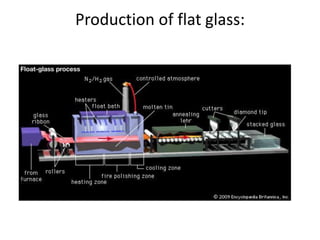
Carbonated beverage and beer bottles
internal gas pressure : soft drink 0.34 millipascal (50 psi),
beer 0.83 millipascal (120 psi).
capped well
The loss of bottle strength
Bottle designs ---round in cross section
gently curving radii to maximize strength.
47CSP TRG AIDS - AUG 2008
TYPES &
PROPERTIES
Benefits of Glass Packaging
 Inert
 Regal
 Ensures freshness and taste
 Nontoxic
 FDA-approved
 2.5 g/cc
49CSP TRG AIDS - AUG 2008
Glass Types and General Properties
inorganic substance fused at high temperatures and
cooled quickly
principle component ---silica (quartz),
Ingredients of components makes different formulations.
Mineral compounds used to achieve improved properties:
decolorizeration, Clarity, Colouring…
Other glass types used for special packaging purposes.
lead compounds, boron compounds, borosilicate
glasses…
50CSP TRG AIDS - AUG 2008
Glass Types and General Properties
Advantages as a packaging material:
inert
perfect food container.
impermeability
clarity
regal image
rigidity
stable at high temperatures
Disadvantages :
fragility
high weight
high energy costs
51CSP TRG AIDS - AUG 2008
CSP TRG AIDS - AUG 2008 52
Although INERT Sodium and other ions can leach out on
ceratin solution.
USP Type-I Borosilicate Flint (clear), Amber (brown) glass
vials,
USP Type-II De Alkalized Soda Lime Glass(type3) that has
been treated in the lehr with sulphur to reduce alkali
solubility. The treatment produces a disccoloured
appearance.
USP Type-III conventional soda glass
TYPES OF GLASS
CSP TRG AIDS - AUG 2008 53
TYPE 1
ADDITION OF 6% BORON REDUCES LEACHING ACTION
Least reactive glass available for containers.
It can be used for all applications and is most commonly
used to packaged water for injection, UN-buffered products,
chemicals, sensitive lab samples, and samples requiring
sterilization. All lab glass apparatus is generally Type I
borosilicate glass. Type I glass is used to package products
which are alkaline or will become alkaline prior to their
expiration date
USP TYPE I BOROSILICATE (neutral) GLASS
CSP TRG AIDS - AUG 2008 54
USP TYPE II DE ALKALIZED SODA LIME GLASS
Has higher levels of sodium hydroxide and
calcium oxide.
It is less resistant to leaching than Type I but
more resistant than Type III.
GOOD ALKALI RESISTANCE
It can be used for products that remain below
pH 7 for their shelf life
CSP TRG AIDS - AUG 2008 55
USP TYPE III SODA LIME GLASS
Acceptable in packaging some dry powders which are
subsequently dissolved to make solutions or buffers.
It is also suitable for packaging liquid formulations that
prove to be insensitive to alkali.
Type III glass should not be used for products that are to be
autoclaved, but can be used in dry heat sterilization
CSP TRG AIDS - AUG 2008 56
USP TYPE NP SODA LIME GLASS
Is a general purpose glass and is used for non-
parenteral applications where chemical durability
and heat shock are not factors.
These containers are frequently used for capsules,
tablets and topical products.
PERFORMANCE
& TESTING
CSP TRG AIDS - AUG 2008 58
It is important that containers comply with
specification and general industry guidelines
in order to withstand the normal stresses and
mechanical abuse right through until the end
user has finished using it.
PERFORMANCE
& TESTING
CSP TRG AIDS - AUG 2008 59
VERTICAL LOAD
Forces of this nature might be produced
during capping or through
stacking products on top of each other. To
help ensure glass containers
have adequate vertical load strength, we
test to BS EN ISO 8113-2004
using a Universal Testing Machine.
CSP TRG AIDS - AUG 2008 60
IMPACT TESTING
To help ensure glass containers have an
adequate impact resistance,
we can test to standard manufacturing
codes of practice using an
industry standard Pendulum Impact
Tester.
CSP TRG AIDS - AUG 2008 61
THERMAL SHOCK
Hot-fill or heat-treated glassware can be tested for thermal shock
resistance to ensure the
product is fit for the intended purpose. Testing can be carried out to
ASTM C149 and BS EN ISO 7459 either as pass/fail test typically
at 42OC downshock or progressive testing to complete sample
failure.
EFFECT OF SUDDEN TEMPERATURE CHANGE
EFFECT IS MINIMAL IF BOTH SIDES ARE HEATED OR COOLED
SIMULTANEOUSLY
EFFECTI IS PROMINENT WHEN ONE SURFACE IS HOT AND THE OTHER
SURFACE IS CHILLED
CSP TRG AIDS - AUG 2008 62
COATING PERFORMANCE
Assessment of surface protection can be
carried out by use of slip
tables and hot end coating technology.
The longevity of the
coating performance can be assessed
using line simulator, whereby bottle to
bottle abrasion damage which may
be expected to occur on a filling line can be
replicated and the
subsequent damage of the container
tested. This is of particular
use for returnable glassware.
CSP TRG AIDS - AUG 2008 63
INTERNAL PRESSURE RESISTANCE
Carbonated beverage bottles need to be
able to withstand without failure the
pressure produced by their contents over
long periods.
CSP TRG AIDS - AUG 2008 64
RESIDUAL STRAIN
Measurement of annealing
stresses/residual strain to ASTM C148;
CSP TRG AIDS - AUG 2008 65
ON-LINE INSPECTION OF GLASS BOTTLES
1.Bottle Spacer. This machine is pre-set to create a space
between the bottles on the conveyer to avoid bottle to bottle
contract.
2.Squeeze Tester. Each bottle is passed between discs that exert
a force to the body of the container. Any obvious weakness or
crack in the bottle will cause it to fail completely with the resulting
cullet being collected by a return conveyor running underneath.
3.Bore Gauger. The internal and external diameter at the neck
finish entrance to the bottle and the bottle height are measured.
Bottles outside specification are automatically rejected by means
of a pusher positioned downstream from the gauger.
CSP TRG AIDS - AUG 2008 66
4.Check Detector. Focuses a beam of light onto areas of the
container where defects are known to occur from previous visual
examinations, any crack will reflect the light to a detector, which
will trigger a mechanism to reject the bottle.
5.Wall Thickness Detector. This test uses dielectric properties of
the glass, the wall thickness can be determined by means of a
sensitive head which traverses the body section of the container.
A trace of the wall thickness is then obtained and bottles falling
below a specified minimum will be automatically rejected.
6.Hydraulic Pressure Tester. A test carried out on bottles which will
be filled with carbonated beverages and gauges the internal
pressure of every bottle before it is packed.
CSP TRG AIDS - AUG 2008 67
7.Visual Check. Bottles are passed in front of a viewing screen as a
final inspection.
Glass failure is usually as a result of thermal shock or impact stresses.
Each glass container has a maximum thermal expansion threshold
and a maximum vertical load stress, which it can withstand without
cracking. These values should be known before it is used for a
particular application.
The shape of the container will influence its strength, smooth edges
result in the formation of a stronger container than one with
rectangular or sharp edges
CSP TRG AIDS - AUG 2008 68
There are 6 broad classifications of glass defects
1.Checks
2.Seams
3.Non-glass inclusions
4.Dirt, dope, adhering particles or oil parks
5.Freaks and malformations, and
6.Marks
CSP TRG AIDS - AUG 2008 69
Defects are classified as
•Critical, those that are hazardous to the
user and those that make the container
completely unusable.
•Major, those that materially reduce the
usability of the container or its contents
•Minor, those that do not affect the usability
of the container, but detract from its
appearance or acceptability to the customer.
CSP TRG AIDS - AUG 2008 70
Critical Defects in Glass Bottles or Containers
1.Stuck Plug. A piece of glass, usually very sharp, projecting inwards
just inside the neck bore
2.Overpress. Is a defect where a small ridge of glass has been formed
on the sealing surface of the finish
3.Split. An open crack starting at the top of the finish and extending
downward.
4.Check. A small, shallow surface crack, usually at the bore of the
container
5.Freaks. Odd shapes and conditions that render the container
completely unusable. Bent or cocked necks are a common defect of this
type.
6.Poor Distribution. Thin shoulder, slug neck, choke neck, heavy bottom
are terms used to describe the uneven distribution of glass.
7.Soft Blister. A thin blister, usually found on or near the sealing surface.
It can however show up anywhere on the glass container.
CSP TRG AIDS - AUG 2008 71
8.Choked Bore. Here excess of glass has been distributed to the
inside of the finish or opening
9.Cracks. Partial fractures, usually found in the heel area.
10.Pinhole. Any opening causing leakage. It occurs most often in
bottles with pointed corners.
11.Filament. A hair-like string inside the bottle.
12.Spike. Spikes are glass projections inside the bottle.
13.Bird Swing. Is a glass thread joining the two walls of the container
CSP TRG AIDS - AUG 2008 72
Some Major Defects Commonly Found in Glass Containers
1.Chipped Finish. Pieces broken out of the top edge in the
manufacturing process.
2.Stone. Small inclusion of any non-glass material
3.Rocker Bottom. A sunken centre portion on in base of the
container
4.Flanged Bottom. A rim of glass around the bottom at the parting
line
CSP TRG AIDS - AUG 2008 73
Some Minor Defects Commonly Found in Glass Containers
1.Suncker Shoulder. Not fully blown, or sagged after blowing
2.Tear. Similar to a check, but opened up. A tear will not break
when tapped, a check will.
3.Washboard. A wavy condition of horizontal lines in the body of
the bottle.
4.Hard Blister. A deeply embedded blister that is not easily broken.
5.Dirt. Scaly or granular nonglass material.
6.Heel Tap. A manufacturing defect where excess glass has been
distributed into the heel
7.Mark. A brush mark is composed of fine vertical laps, e.g. oil
marks from moulds.
8.Wavy bottle. A wavy surface on the inside of the bottle.
9.Seeds. Small bubbles in the glass
10.Neck ring seam. A bulge at the parting line between the neck
and the body.
TOLERANCE
CSP TRG AIDS - AUG 2008 75
Tolerances as per GLASS PACKAGING INSTITUTE
CAPACITY 1% for large bottles and
upto 15% for small bottles
WEIGHT generally 5%
HEIGHT 0.5 to 0.8% overall HEIGHT
DIAMETER 1.5% for 200mm & 3% for 25mm
TOLERANCE
CSP TRG AIDS - AUG 2008 76
Glass bottle Vertical load
Refillable 6000N
Non-refillable 4000N
The following are examples of some permitted tolerances:
Vertical load control values
TOLERANCE
CSP TRG AIDS - AUG 2008 77
Nominal
Capacity (ml)
up to and
including
Tolerances
(ml)
±
Nominal
capacity (ml)
up to and
including
Tolerances
(ml)
±
100 2.7 450 5.7
125 3.0 500 6.0
150 3.3 600 6.5
175 3.5 700 7.1
200 3.8 800 7.6
250 4.2 900 8.0
300 4.6 1000 8.4
350 5.0 1250 12.5
400 5.3 1500 15.0
CAPACITY
CSP TRG AIDS - AUG 2008 78
Body/Diameter
Height Tolerances
Tolerances
D (mm) up to and
including
TD (mm)
±
H (mm) up to and
including
TH (mm)
±
25.0 0.8 25 0.7
36.5 0.9 50 0.8
50.0 1.1 75 0.9
62.5 1.2 100 1.0
75.0 1.4 125 1.1
87.5 1.5 150 1.2
100.0 1.7 175 1.3
112.5 1.8 200 1.4
125.0 2.0 225 1.5
137.5 2.1 250 1.6
150.0 2.3 275 1.7
300 1.8
BODY AND HEIGHT DIMENSIONS
CSP TRG AIDS - AUG 2008 79
Height H (mm)
up to and
including
Tv (mm)
±
120 2.2
150 2.7
175 3.1
200 3.4
225 3.9
250 4.2
VERTICALITY CONTROL VALUES FOR VERTICALITY
CSP TRG AIDS - AUG 2008 80
Body overall
Diameter (mm) Minimum glass thickness (mm)
Non-refillable
bottles
Refillable bottles Surface protected
non-refillable bottles
Up to 60 1.1 1.5 0.8
>61 to 71 1.4 1.8 0.9
>71 to 81 1.5 1.9 1.0
>81 to 96 1.7 2.0 1.1
>96 to 110 1.8 2.2 1.3
MINIMUM GLASS THICKNESS VALUES
CSP TRG AIDS - AUG 2008 81
THINK
Indian Glass Industry
• Recent years have represented the best of times in the
industry’s history.
• Huge growth in flat glass consumption has been driven
primarily by India’s fast expanding automotive and
construction sectors, while rising disposable income,
urbanisation and the onset of modern retail formats
have helped the glass container sector.
• Incidentally, despite the industry’s significant growth
over this period, per capita consumption for glass
packaging (1.6kg) and flat glass (1.1kg) are almost at
the bottom of the pyramid.
• The past 18 months have been especially challenging.
• Profitability has been impacted by increased raw
materials and fuel costs.
• In particular, the past eight months have not been
especially good for the Indian economy.
• In general and glass
production has been
sluggish.
• Investment projects in
both main and sub-sectors
are on hold due to the
global and domestic
Economic situation.
In the past eight months, the
Indian economy in general and
glass production has been
sluggish.
Container Sector Overview:
• At first glance, an industry recording a turnover of
US$1.2 billion looks mammoth in size. But when
viewed in the prism of its equally large population of
1.2 billion, it seems a pigmy, especially when compared
to the glass industry of a country with a comparable
population (China).
• True, glass container industry growth trends of 12% +
over the past decade are impressive but per capita
consumption of 1.6kg is well below even some of the
world’s least developed countries.
Company Installed Capacity in TPD
HNG 4235
HSIL 1550
Piramal Glass 860
Haldyn Glass 320
MBDL 240
Universal 220
Excel 220
Janta 220
Surat Glass 155
Vitrum 130
Others 600
Main glass container producers in India.

Glass as Packaging Materials

  • 1.
    Course file Index Nameof the Course: Glass Metal and Textile Based packaging Program: Printing and Packaging Technology Class: S.E PPT Semester: (Sem III) Course In charge: Mrs. Katyayini T Academic Year: S. No Content Page No 1 Syllabus copy 2 Extended syllabus copy 1. Pre requisite text books 2. Advanced topics 3. Extra books 4. Audios 5. Web references etc. 3 Course outcomes Mapping of CO, PO and PSOs without attainment levels. 4 List of content gaps 1. Gap analysis and listing. 2. Proposed action plan for the Industry expert talk/ Guest lecturers/ Mini project etc. to bridge the gap. This needs to be approved by DAB. 5 Session plan ( Detailed) 6 Lecture Notes 1. Detailed lecture wise notes with problems and example etc. (Mention about LOs of chapter) 2. At the end of the each chapter include a) University questions b) Gate exam Questions c) Other exam questions 7 Evaluation 1. Pre test for classification of Weaker and Bright students. 2. Assignments, UT1, UT2, Prelims Question papers. 8 List of other evaluation techniques, documents and analysis. 9 Remedial lectures, Attendance reports and Impact analysis. 10 Session plan with Attainment level calculations and mapping of LO-CO, CO-PO and PSO.
  • 2.
    Chapter No. Learning Objectives COMapping 1. LO1: understand the different packaging materials and their applications CO1, CO2 LO2: Explain about the classification of glass and their composition LO3: Describe the raw materials and flowchart of glass manufacturing process. LO4: Analyze the best method of glass manufacturing process LO5: Visualize the container making process LO6: differentiate between the different methods of production of glass containers LO7: Able to analyze the parts of the glass containers and bottles. LO8: able to find out the defects in the glass containers by employing different testing mathods LO9: Able to understand the current glass manufacturing industry market in India and also understand the impact of glass industry on environment.
  • 3.
    GLASS METAL ANDTEXTILE BASED PACKAGING MATERIALS
  • 4.
    Packaging Definition • Packagingis the technology of enclosing or protecting products for distribution, storage, sale, and use. • Packaging also refers to the process of designing, evaluating, and producing packages. • Packaging can be described as a coordinated system of preparing goods for transport, warehousing, logistics, sale, and end use. • Packaging contains, protects, preserves, transports, informs, and sells. (functions of Packaging)
  • 5.
    Glass as PackagingMaterial • Glass is used as the container for the product packaging. • They are quite strong and rigid. • They are transparent which allows the visual inspection of the contents; especially in ampoules and vials. • They are available in various shapes and sizes. Visually elegant containers attracts the patients. • Borosilicate (Type-I) and Neutral glasses are resistant to heat so they can be readily sterilised by heat. • Glass containers can be easily cleaned without any damage to its surface e.g. scratching or bruising.
  • 6.
    Metal as PackagingMaterial • Different types of metals like aluminium, steel, tin etc are used a packaging material for various applications of food and pharmaceutical packaging. • Foods filled in metal packaging do not need any additives. Foods filled in metal packaging do not loose their nourishing properties and keep their original taste for long. • Weight of metal packaging is low and its resistance is high. Metal packaging is resistant to physical shocks. Therefore metal packaging has a low cost of storing, loading and shipping. • Application of multi colour printing increases the preference of metal packaging, supporting the marketing activities of food products. • It is possible to produce metal packaging at almost any dimensions and form, thus making possible packaging of food products at desired weights. • Metal Packaging can be hermatically closed and heat treated enabling sterile food products.
  • 7.
  • 8.
  • 9.
  • 10.
    What is Glass? •A hard, brittle substance, typically transparent or translucent, made by fusing sand with soda and lime and cooling rapidly. • Glass is an amorphous material that lacks a long range periodic crystalline structure. • What is amorphous substance? In condensed matter physics and materials science, an amorphous (from the Greek a, without, morphé, shape, form) or non-crystalline solid is a solid that lacks the long- range order that is characteristic of a crystal.
  • 11.
    History • Sailors usedblock of soda from their cargo to make a fire place on the beach and discovered that the soda fused with sand to form glass. • Egyptians using glass as early as 3000 B.C. • The commercial success of the Venetian glass blowers is known in 16th century. • Around 1870 the shop system of making glass containers was introduced in United States. • Mechanization first introduced in 1892.
  • 12.
    History continued…. • AtlasGlass Works used semi automatic machines for wide mouth jars in 1896. • The first fully automatic machines built by Michael J. Owens in 1903. • In 1925 Hartford Empire – Blow & Blow Machine. The principle dropping a gob of glass into the mold from top started to replace owens method of feeding from bottom.
  • 13.
    Michael J. Owensin 1903 A ten-arm owens automatic bottle machine, ca 1910 Open the video
  • 14.
    • The AmericanHeritage dictionary defines glass as a large class of materials with highly variable mechanical and optical properties, which solidify from the molten state without crystallization, that are typically based on silicon dioxide, boric oxide, aluminum oxide, or phosphorous pentoxide, that are generally transparent or translucent, and that are regarded physically as supercooled liquids rather than fine liquids.
  • 15.
    • American Societyfor Testing and Materials (ASTM) defines glass as an inorganic product of fusion that has cooled to a rigid condition without crystallizing. ASTM further states that glass is typically hard and brittle and has a conchoidal fracture. • Conchoidal fracture is a smoothly curving fracture surface of fine-grained materials which have no planar surfaces of internal weakness or planes of separation (no cleavage). Such a curving fracture surface is characteristic of glass and other brittle materials with no crystal structure.
  • 16.
    Properties of Glass •May be colorless or colored. • Glass is non-crystalline, is amorphous in structure. • May be formed from both organic and inorganic materials. • Glass is manufactured at very high temperatures, and it has the properties of a viscous liquid. With the properties of a viscous liquid, hot glass can be formed into many commonly used forms with precision and accuracy. • excellent resistance to attack by most liquids, and, therefore, it resists interaction with contained products. • It is totally impermeable to gases. • it can be sterilized with any appropriate process. • Glass, when properly colored, also provides protection to a product from light.
  • 17.
    Advantages of Glass: •Strong, Durable, transparent and chemically inert. • Impervious to transmission of gases and products. (extensively used for flavors and perfume essence) • Used for microwave oven.
  • 18.
    Disadvantages of Glass: •Energy intensive production. • Heavier than other plastic and aluminium containers hence high transportation cost. • Easily breakable.
  • 19.
  • 20.
    General Characteristics ofGlassy State: • All glasses are energetically unstable compared to the crystals of same composition. • Slow cooling of molten mixture results in systematic arrangement if Lattice Structure. • The same system becomes glass upon rapid cooling.
  • 21.
    • Pic tobe added
  • 22.
  • 23.
    Mechanical Properties ofGlass: • Even though tensile strength is of the order of 104 N/mm2 , the technical strength is very less and depends on its surface conditions. • Glass Corrosion: It is defined as the behaviour and eventual changes of glass subsequent to the attack of aggressive substances. 1. Complete dissolution of glass 2. Leaching (Dissolution of sodium and potassium ions)
  • 24.
    Leaching: • When thepH value is changed by the implantation of hydrogenous ions in the glass, water molecules infiltrate the glass while alkali ions go into solution. • A thin gel layer of low alkali and poor water content is formed.
  • 25.
  • 26.
    Broad Classification ofGlass Broad Classification Based on Composition Based on Application Based on Thermal coefficient of expansion
  • 27.
    Classification Based onComposition: 1.Soda Lime Glass • Soda, Lime and sand are main components. • Composition: 71-75% by wt Sand (SiO2) 12-16% Soda (Sodium oxide from raw material soda ash or sodium carbonate) 10 – 15% Lime ( Calcium oxide from lime stone or calcium carbonate) And a low percent of other materials for the specific properties. Sometimes Mg replaces a portion of Ca and K replaces Na.
  • 28.
    Soda Lime GlassContinued... • Primarily used for bottles, jars, everyday drinking glasses and window glass. • Its smooth and non porous surface allows bottles and packaging glass to be cleaned easily.
  • 29.
    2. Lead Glass: •If lime is replaced by lead oxide the resulting glass is known as lead crystal. • Composition: 54-65% Silica, 18-38% lead oxide (PbO), 13-15% Soda or Potash, and various oxides. • Glass with less than 18% lead is called as crystal glass. • Different amounts of barium, zinc and potassium oxides can be added to the composition to partially replace some of the lead oxides. • They have high Refractive Index.
  • 30.
    3. Borosilicate Glass: •Silicate glasses containing boric oxide is borosilicate glass. • Higher % of silica ( 70-80%). • Composition: 70-80% silica, 7-13% boric oxide, 4- 8% Na2O and K2O, and 2-7% aluminium oxide. • Show high resistance to corrosion and temperature change. • They are used in process plants in chemical industries, in laboratories, as ampules and vials.
  • 31.
    4. Special Glasses: •Glasses used for special technical and scientific purposes form a mixed group. • Their compositions differ greatly and involve numerous chemical constituents. • This group includes: optical glasses, glass for electro technology and electronics and glass ceramics.
  • 32.
    Classification based onapplication: 1. Container Glass: • These are used for packaging, storage, preserving and transportation of beverages, foods, chemicals, pharmaceuticals and other cosmetics. • Always manufactured from molten glass as opposed to vials and ampules manufactured in hollowware finishing sector.
  • 33.
    Container glass continued…. •Mostly made of soda lime glass. • Relatively pure raw materials are used to get colorless glass. • Most frequently used green and brown colored glass bottles. • Green glass transmits UV light obtained by adding Chromium Oxide. • Brown glass absorbs all UV light obtained by adding iron sulphides.
  • 34.
    Container Glass 1. BeverageBottles 2. Bottling Jars
  • 35.
    2. Flat Glass: •The term flat glass pertains to all glasses produced in a flat form regardless of the method of manufacture. • Mechanical production effectively developed much later 1920. • Mostly consists of soda lime glass. • Average ingredients: 72% Silica, 14% Na2O (K2O), 9% CaO, 3-4% MgO and 1% Al2O3.
  • 36.
    Flat Glass Continued… •The iron content gives a thick soda lime flat glasses a green tint. • Different glass tints for special purpose are produced by adding coloring oxides.
  • 37.
  • 38.
    3. Special Glasses: •The composition and properties vary depending upon the applications. • They have high chemical stability, thermal durability and with a variety of optical, electrochemical or special application tailored properties.
  • 39.
    Applications of SpecialGlass: In the fields of • Chemistry • Pharmacy • Electrotechnology • Electronics • Apparatus and instrument construction • Optics • Illumination engineering
  • 40.
    4. Glass Fibre: •It is a collective term for glass processed into fibres with diameters of between one tenth and a few thousands of a milli meter. • Two main types: 1. Insulating fiberglass 2. textile fiberglass
  • 41.
    Insulating fiberglass: • Madeof sodalime glass in a centrifugal process using rotating discs. • Glass droplets are drawn into fibers of certain length by centrifugal force. The fibers cool in air and solidify. • Glass wool is a type of insulating fiberglass.
  • 42.
    Textile fibre glass: •They are fine fibres produced from molten glass. • The fibres are uniform, usually have a circular cross section and can be further processed into threads. • The diameter of the fibres is less than 18 micro meters. • They are subdivided according to length and manufacturing method as: 1. glass filaments 2. glass staple fibres
  • 43.
    1. Glass filaments(Glass silk): • This consists of individual glass fibres (filaments) with the diameters between 5 to 18 micro meter. • It is manufactured by flowing the molten glass in conduits from where it is downward drawn at a high speed into very fine threads through an array of platinum nozzles and then rolled onto a drum.
  • 44.
    2. Glass staplefibres: • These are glass fibres of certain length and diameter. • It is produced by airblast process. In this the molten glass flows through platinum nozzles in the bottom of a platinum melting tank. • Compressed air directed over the nozzle opening blows the glass into filaments between 3 to 60 mm long. • They are sucked into perforated drums from which they are drawn into glass staple fibers.
  • 45.
    Raw Materials forGlass Manufacture
  • 46.
    1. Sand • Mostimportant raw material. • Main component of sand and rocks. Consists of almost half of the earth’s solid surface. • Most of the sands cannot be used as they contain many colouring oxides especially iron oxides. • Sand containing even 0.1% Iron oxides cannot be used as it gives glass a greenish tint.
  • 47.
    • Natural sourcesfor sand containing 0.01 – 0.03% iron oxide for the production of special technical glasses are very rare. • Iron is even a greater problem for quartz sand. • The content of other coloring oxides such as chromium, copper, nickel, cobalt and other undesirable impurities in optical quartz sand must be reduced.
  • 48.
    • For thesestringent demands, the crushed material is subjected to an additional chemical purification, using suitable acids at high temperature. • In order to lower the melting temperature of sand and to be able to use appropriate melting containers, a fluxing agent, usually sodium oxide is required. • Normally added in the form of carbonate or sometimes nitrate or sulphate.
  • 49.
    2. Soda Ash •Sodium carbonate is introduced to the glass batch as soda ash. • During the melting, the sodium oxide becomes a part of glass; carbon di oxide is freed and escapes through chimney.
  • 50.
    3. Glauber’s Salt(Sodium Sulphate) • Sodium sulphate in its anhydrous form is mixed with pulvarized coal and added to the batch instead of soda ash. • The sulfurus acid is freed and sodium becomes part of the glass as in the case of soda ash.
  • 51.
    4. Potash • Potassiumcarbonate (K2CO3) is a grainy, white powder formerly obtained by leaching of wood ashes in large containers. • The potash decomposes into potassium oxide which goes into the glass and carbon di oxide which escapes into the atmosphere.
  • 52.
    Stabilizers to increaseresistance, strength and hardness: • There are a number of oxides derived from multivalent metals that can be added to the glass melt in order to give the glass physical and chemical properties that are important for its usability. • Some substances can reinforce the structural network resulting in improved chemical resistance and mechanical properties.
  • 53.
    • To this,the oxides of calcium, magnesium, aluminium, boron tri oxide, and zinc play an important role. • Replacing sodium with potassium oxide usually makes glass more chemically resistant.
  • 54.
    5. Lime (Calciumcarbonate) • It is found naturally as limestone, marble or chalk. • At a temperature of about 1000 C, the carbon di oxide escapes from the lime and calcium oxide remains and it enters the glass structure. • Lime is added to the batch to improve the hardness and chemical resistance of glass. • In flat glass, the lime is partially replaced by magnesium oxide which is found combined with lime in raw material dolomite (CaCO3+MgCO3). • It lowers the melting temperature.
  • 55.
    6. Alumina • Usuallyadded to the glass batch in the form of alkali containing feldspars abundant in many places. Feldspar: An abundant rock-forming mineral typically occurring as colourless or pale-coloured crystals and consisting of aluminosilicates of potassium, sodium, and calcium.
  • 56.
    • The trivalentaluminium forms AlO4-groupings in the glass which by inclusion of an alkali ion place themselves in the network of the SiO4 tetrahedrons, thereby filling gaps. • This leads to the improved chemical resistance and increased viscosity in the lower temperature ranges.
  • 57.
    7. Lead Oxides •The oxides, PbO (Yellow lead) and Pb3O4 (Red Lead) are used to introduce lead into the glass. • However it is always present in glass as bivalent Pb2+. • Moderate additions of PbO into glass increase chemical resistance. • High lead content lowers the melting temperature and results in decreased hardness, but increased refractive index of the glass.
  • 58.
    8. Barium Oxide •Barium oxide derived from Barium Carbonate is primarily used in optical glass and crystal glass instead of lime or red lead. • Glass containing barium is not as heavy as lead crystal, but achieves similar brilliance due to its high refractive index.
  • 59.
    9. Boron Compounds •Boron trioxide which is so important in special glass is found naturally in very few places. • Sodium and calcium borates occur much more frequently. • Usually these compounds must be chemically converted into pure boric acid, especially for optical glass.
  • 60.
    10. Coloring Agents •Only pure chemicals are used as glass coloring agents. • Different colors are obtained by adding oxides of the transition elements. • The coloring agents added to base glass melts are given in table
  • 62.
    11. Opacifiers • Bymixing fluorine containing materials, such as a fluorspar in glass resulting in cloudy and opaque form of glass.
  • 63.
    12. Glass Cullet •Cullet acts as a fluxing agent and accelerates the melting of the sand. • This conserves both energy and raw materials.
  • 64.
  • 65.
    • It isthe central phase of production process. • The quality of raw material, type of heat energy, and the type of melting process used are determined by the glass type to be melted and the product to be made.
  • 66.
    Melting Furnaces andMelting Tanks: • Originally, only crucible and pot furnaces were used. They could hold one or more containers to melt the batch material. • From these continuous melting tanks evolved as an integral part of furnace.
  • 67.
    Pot Melting: • Itconsists of a refractory brick for the inner wall, silica brick for the vaulted roof (crown) and insulating brick for the external walls. • It consists of the lower section to preheat the fuel gas and the upper furnace which takes the pots and serves the melting chamber. • Nowadays it is used to manufacture the mouth blown glass products and special glasses.
  • 70.
    • Construction: 1. theglass-containing bath of thick (8 in.-15 in.) 2. fireclay blocks for sides and bottom 3. the upper walls of fireclay bricks and 4. the crown of silica bricks. • They average 100-200 tons in deadweight capacity for bottle glass. • The working end is usually divided from the melting end by a double-walled bridge, the glass flowing into the working end through a passage (called the "throat" or "dog-hole") near or at the tank bottom. • The refining zone lies immediately in front of the bridge and in window glass tanks may be divided from the melting zone by a floating fireclay barrier or bridge.
  • 71.
    Tank Melting: • Forlarge amounts of glass production. • For automated glass production. • It consists of lower and upper sections as well as the section for preheating of combustion chamber. • The lower section is actual melting container lined with a high quality refractory material. • The size depends on the glass product manufactured.
  • 73.
    Two Types ofTanks: • Day Tank • Continuous Tank 1. Day Tank: • Developed from the traditional furnaces from small capacities. • They are refilled with batch daily. • The melting is done at night and the glass goes into the production the next as pot furnace. • They allow change in glass type to be melted on short notice. • Primarily used for colored glass, crystal glass and soft special glass.
  • 74.
    2. Continuous Tank: •Prerequisite for industrial mass production. • Exclusively used for production of flat glass, container glass, and certain mass produced optical glass types. • 10 -40 mtrs long and 3 – 6 mtrs wide. • Output lies between 100 to 400 tons per day. • Largest furnaces after blast furnace.
  • 75.
    Tank Construction: • Themost common type are regenerative side burner tanks with preheating of fuel and combustion air. • Regeneratively heated small U tanks for small output and unit melters and long tanks for bottle manufacturing.
  • 76.
    Materials for furnaceconstruction: • Refractory materials for all the types of furnaces. • Most critical furnace components are currently made of cast fused corundum – zirconium oxide refractory. • The life of tank furnace is called furnace journey and is about eight years currently. • The normal life span of pot furnace is approximately five years.
  • 77.
    • Contamination ofthe melt by dissolved lining material is particularly critical in optical glasses. • Thus, tanks and pots are lined with platinum. • Platinum and its alloys are insoluble in molten glass, have high melting point and maintain consistently the same properties in a constant composition.
  • 78.
    Lecture 2: Meltingand Fining processes in industrial glass furnaces IMI-NFG Course on Processing in Glass Spring 2015 (available online www.lehigh.edu/imi) Mathieu Hubert, PhD CelSian Glass & Solar Eindhoven, The Netherlands mathieu.hubert@celsian.nl
  • 79.
    IMI-NFG Course onProcessing of Glass - Lecture 2: Industrial glass melting and fining processes mathieu.hubert@celsian.nl 2 • In Lecture 1, the preparation of the batch has been described, from the selection of the raw materials to the charging of the batch in the furnace via the doghouse (or day-hopper) • The batch is introduced in the furnace at high temperature, and the energy provided to the batch is used to convert the batch into a glass melt • The batch-to-melt conversion implies a series of chemical reactions (decarbonation, dehydration, solid-state reactions, formation of low-melting eutectics, dissolutions) • This lecture will highlight these different reactions and processes, from the introduced batch to an homogeneous and bubble-free glass melt (before the forming processes) Introduction
  • 80.
    IMI-NFG Course onProcessing of Glass - Lecture 2: Industrial glass melting and fining processes mathieu.hubert@celsian.nl 3 1. Melting of the batch  From the batch to the melt  Chemical reactions  Sand dissolution 2. Fining of the melt  Dissolved gases  Fining mechanisms  Removal of bubbles and seeds Outline of this lecture
  • 81.
    IMI-NFG Course onProcessing of Glass - Lecture 2: Industrial glass melting and fining processes mathieu.hubert@celsian.nl 4 Schematic of an industrial glass melting tank * This is a schematic representation, but many different furnace designs exist (more on that in Lecture 3)
  • 82.
    IMI-NFG Course onProcessing of Glass - Lecture 2: Industrial glass melting and fining processes mathieu.hubert@celsian.nl 5 Melting and fining in the furnace Melting and sand dissolution Primary fining Secondary fining (refining) Batch blanket
  • 83.
    IMI-NFG Course onProcessing of Glass - Lecture 2: Industrial glass melting and fining processes mathieu.hubert@celsian.nl 6 Melting and fining in the furnace Inspired from R. Conradt, Thermodynamics and Energy Demand for Batch-to-Melt Conversion, presented at the 6th ICG summer school, Montpellier, France, July 2014 Batch 25°C Rough melt 1200°C Seedy melt 1400°C Clear melt 1500°C Conditioned melt 1250°C ≈ 1200 Kg ≈ 1001 Kg ≈ 1001 Kg ≈ 1000 Kg 1000 Kg Batch input Batch melting Sand grain dissolution Fining Refining and conditioning
  • 84.
    IMI-NFG Course onProcessing of Glass - Lecture 2: Industrial glass melting and fining processes mathieu.hubert@celsian.nl 7 Melting and fining in the furnace Inspired from R. Conradt, Thermodynamics and Energy Demand for Batch-to-Melt Conversion, presented at the 6th ICG summer school, Montpellier, France, July 2014 Batch 25°C Rough melt 1200°C Seedy melt 1400°C Clear melt 1500°C Conditioned melt 1250°C ≈ 1200 Kg ≈ 1001 Kg ≈ 1001 Kg ≈ 1000 Kg 1000 Kg Batch input Batch melting Sand grain dissolution Fining Refining and conditioning Relatively fast (~ 1h) - Requires significant energy input Longer process (~ 24h) - Requires significant lower energy input
  • 85.
    IMI-NFG Course onProcessing of Glass - Lecture 2: Industrial glass melting and fining processes mathieu.hubert@celsian.nl 8 Batch melting-in • The melting-in process occurs mainly by reactions within the batch blanket forming liquid phases. • In the heated batch piles or blanket:  The first aggressive melt phases are formed, which will strongly attack and largely dissolve the components that are difficult to dissolve, like quartz sand or feldspar/china clay particles.  The melt phases thus formed flow from the batch blanket area into the glass melt. So the batch blanket becomes increasingly thinner  Still some of the non-dissolved sand particles will arrive in the glass melt itself, where these particles will have to dissolve further by diffusion of SiO2 in the molten glass, away from the sand grain surface.
  • 86.
    IMI-NFG Course onProcessing of Glass - Lecture 2: Industrial glass melting and fining processes mathieu.hubert@celsian.nl 9 heat transfer gas release combustion space reaction zone thick- ness normal batch temperature profile reaction zone glass melt layer figure 1b glassmelt flow heat transferred figure 1c glass level From Ungan and Viskanta, "Melting Behavior of Continuously Charged Loose Batch Blankets in Glass Melting Furnaces", Glastechische Berichte, 59 (10), 1986, pp. 279-291 Melting process of the batch blanket
  • 87.
    IMI-NFG Course onProcessing of Glass - Lecture 2: Industrial glass melting and fining processes mathieu.hubert@celsian.nl 10 batch b. top of batch blanket c. bottom side of batch blanket glass melt 1400 o C melting reactionsmelting reactions Dissolution sand grains sand grains carbonates (soda/lime) dissolution sand grains sand grains gas gas melts Layer glassmelt loose batch 1500 o C From Ungan and Viskanta, "Melting Behavior of Continuously Charged Loose Batch Blankets in Glass Melting Furnaces", Glastechische Berichte, 59 (10), 1986, pp. 279-291 Detailed representation of batch melting process
  • 88.
    IMI-NFG Course onProcessing of Glass - Lecture 2: Industrial glass melting and fining processes mathieu.hubert@celsian.nl 11 Different steps of the melting process • Melt reactions • Melt energy (enthalpy of heating the batch and decomposition melting/fusion reactions) • Melting kinetics / heat transfer • Melting parameters:  effect of the temperature  grain size (especially for sand and alumina raw materials)  glass composition
  • 89.
    IMI-NFG Course onProcessing of Glass - Lecture 2: Industrial glass melting and fining processes mathieu.hubert@celsian.nl 12 Melt reactions
  • 90.
    IMI-NFG Course onProcessing of Glass - Lecture 2: Industrial glass melting and fining processes mathieu.hubert@celsian.nl 13 Melting reactions • De-hydration of some raw materials and water evaporation • Solid state reactions between individual raw materials • Formation of primary melt phases and melting of alkali rich carbonates. (typically in the temperature range: 700-900°C) • Dissociation or decomposition reactions of Ca- and Mg- containing carbonates (e.g. limestone and dolomite), resulting in development of CO2-gas. (Temperature range 500-1000°C) (Na2CO3 will not decompose spontaneously, but reacts with sand or limestone). • Dissolving of the SiO2 in the alkali rich carbonate melt phases, typically above 1000°C. Sand reacts between about 750-1000°C with sodium silicates or soda to form liquid sodium silicates (associated with the release of CO2-gas when limestone or soda or dolomite is reacting with sand)
  • 91.
    IMI-NFG Course onProcessing of Glass - Lecture 2: Industrial glass melting and fining processes mathieu.hubert@celsian.nl 14 Dehydration • Takes place at ± 100°C for physically bonded water • In case of clay in the batch, de-hydration may occur up to 650- 700°C • Dehydration (water evaporation) is very energy intensive, and it is represents an important part of the total energy consumption
  • 92.
    IMI-NFG Course onProcessing of Glass - Lecture 2: Industrial glass melting and fining processes mathieu.hubert@celsian.nl 15 Sand dissolution • Pure silica melts at very high temperature (> 1700°C) • In standard glasses (except e.g. pure silica glass) sand is incorporated in the glass melt by dissolution, and not by melting • Sand dissolution is a critical step in industrial melting process • It is highly dependent on the initial grain size distribution of the sand grains in the batch, as well as the presence of aggressive molten phases (e.g. alkaline phases) • Sand grains react with other batch components or dissolve in the obtained melt in most glass melting processes. The optimum grain size depends on the glass type.
  • 93.
    16 Application Indication Size class<0.03 <0.06 <0.125 <0.25 < 0.35 <0.5 <1.0 Container glass Coarse sand - - 1 25 55 75 95 Container & Float Medium sand - - 10 50 75 95 100 Float glass Fine sand - 1 5 70 85 100 100 Float glass Very fine sand 3 15 85 100 100 100 E-glass & alkali- borosilicate Coarse silica powder 40 70 95 100 100 100 100 E-glass Medium silica powder 70 95 99 100 100 100 100 E-glass Fine silica powder 98 100 100 100 100 100 100 Grain size (mm) Grain size distribution of quartz sand, recommended for different applications, values in mass% IMI-NFG Course on Processing of Glass - Lecture 2: Industrial glass melting and fining processes mathieu.hubert@celsian.nl
  • 94.
    IMI-NFG Course onProcessing of Glass - Lecture 2: Industrial glass melting and fining processes mathieu.hubert@celsian.nl 17 Solid-state reactions in the batch • Solid-state reactions can be divided into two routes: the carbonate route and the silicate route • The carbonate route (path) is characterized by reactive dissolution of silica sand with a binary melt phase of soda ash and limestone below about 900°C. Soda ash and limestone, in contact with each other, may form a double carbonate by a solid state reaction forming the species Na2Ca(CO3)2 • At about 820°C, this intermediate reaction product starts to melt and becomes suddenly more reactive (better contact) towards silica sand grains. • Silica reaction with Na2Ca(CO3)2 forms a viscous Na2O·CaO·SiO2 melt plus CO2 gas.
  • 95.
    IMI-NFG Course onProcessing of Glass - Lecture 2: Industrial glass melting and fining processes mathieu.hubert@celsian.nl 18 Solid-state reactions in the batch • The silica/silicate route is based on eutectic melting of a mixture of components, including the sodium disilicate phase, formed by solid state reactions between sand and soda. • The eutectic melting of SiO2 and Na2O·2SiO2 takes place at 799°C and silicate rich melts are formed. • The degree to which these reactions occur depends on the mutual contact between the components.  Within a compacted batch (pellets, granules) the reactions will be more intensive than in a loose powder batch.  Finer powders may give a better contact between the interacting raw material grains compared to coarse powders. Thus finer powdered batch is often more reactive and may give a better glass homogeneity
  • 96.
    IMI-NFG Course onProcessing of Glass - Lecture 2: Industrial glass melting and fining processes mathieu.hubert@celsian.nl 19 • Solid state reactions, formation of silicates, e.g.: Carbonate route < 900oC at fast heating rate Na2CO3 + CaCO3  Na2Ca(CO3)2 (melts at ±820oC) (550-850oC) Na2Ca(CO3)2 +2SiO2  Na2SiO3/CaSiO3 + 2CO2 reaction enhances > 820oC Na2CO3 + 2SiO2  Na2Si2O5 + CO2 (silica route) (700-860oC) forms eutectic melt with SiO2 Na2CO3 + SiO2  Na2SiO3 + CO2 (silica route) The rate of the reactive calcination of soda ash with silica increases sharply when heating above 825oC up to about 855oC. • Formation of primary melt phases (alkali rich carbonates), e.g.: Tm Na2CO3 = 850oC Tm Na2Ca(CO3)2 = 820oC High amount of heat required Carbonate route Silicate routeMelting reactions – Silicate route for SLS batch
  • 97.
    IMI-NFG Course onProcessing of Glass - Lecture 2: Industrial glass melting and fining processes mathieu.hubert@celsian.nl 20 • The main part of the limestone or dolomite will decompose above the thermodynamic calcination temperature of limestone, this depends on the CO2 partial pressure in the batch. Some limestone may react directly with silica: 2 CaCO3 + SiO2  Ca2SiO4 + 2 CO2  (600 - 900C) • These reactions occur only on the contacting interfaces and they are much slower than solid state/liquid reactions. Limestone –sand solid-state reactions
  • 98.
    IMI-NFG Course onProcessing of Glass - Lecture 2: Industrial glass melting and fining processes mathieu.hubert@celsian.nl 21 • Reactive calcination: Na2CO3 + 2SiO2  Na2O·2SiO2 + CO2↑ T > 790oC  forms with SiO2 an eutectic melt • Or at further heating  fast Na2O·SiO2 formation (850oC) plus limestone decomposes and: 2CaO + (SiO2 + Na2O·2SiO2 )eutectic melt  Na2O·2CaO·3SiO2 (> 900oC) • Silicate route: Silicate melt + SiO2  silica enriched melt T > 1000-1100oC Eutectic melt phases are formed above ±800-840oC Melting reactions – Silicate route for SLS batch
  • 99.
    IMI-NFG Course onProcessing of Glass - Lecture 2: Industrial glass melting and fining processes mathieu.hubert@celsian.nl 22 Silicate melting points / eutectics The melting points of the meta-silicate Na2SiO3 and of the di-silicate Na2Si2O5 are: • Ts (Na2SiO3) = 1089oC, • Ts (Na2Si2O5) = 874oC. Eutectics: • Teut (Na2O  2SiO2 + SiO2) = 793oC. • Teut (Na2O  2SiO2 + Na2O  SiO2) = 846oC. • Teut (2Na2O  SiO2 + Na2O  SiO2) = 1020oC. In combination with calcium oxide, an even lower (ternary) eutectic temperature may occur: • Teut (Na2O3CaO  6SiO2 + SiO2 + Na2O  2SiO2) = 725 oC.
  • 100.
    IMI-NFG Course onProcessing of Glass - Lecture 2: Industrial glass melting and fining processes mathieu.hubert@celsian.nl 23 Silicate melting points / eutectics 100 % SiO2 Phase diagram for the system Na2O – SiO2 showing eutectic sodium silicate melt phases
  • 101.
    IMI-NFG Course onProcessing of Glass - Lecture 2: Industrial glass melting and fining processes mathieu.hubert@celsian.nl 24 Dissociation – decomposition reactions • Decomposition reactions of (Ca- and Mg-) carbonates: CaCO3 + heat  CaO + CO2 ↑ (910oC at pressure 1 bar) MgCO3 + heat  MgO + CO2 ↑ (540oC at pressure of 1 bar) MgCO3·CaCO3 + heat  MgO + CaCO3 + CO2 ↑ (650oC, 1 bar) MgO still present up to 1150oC.
  • 102.
    IMI-NFG Course onProcessing of Glass - Lecture 2: Industrial glass melting and fining processes mathieu.hubert@celsian.nl 25 Gas release during melting-in • During these initial (melting) reactions in most batches, much CO2- gas is released. • About 14 - 20 % of the mass of normal soda-lime-silica batches is transferred into volatile CO2 • This means that from 1 kg of normal batch about 100 liters of gas at normal pressure and room temperature (or about 500 liters gas, at the furnace temperature level), will be released in the furnace. • Besides CO2-gas, the melting loss consists of water vapor (several mass percents, depending on: batch humidity, water content in cullet and presence of hydrated raw materials) and any possible evaporation products (SO2, HBO2, HCl, NaCl, HCl, KOH, PbO, Pb, NaOH, Se-components).
  • 103.
    IMI-NFG Course onProcessing of Glass - Lecture 2: Industrial glass melting and fining processes mathieu.hubert@celsian.nl 26 1089 o C: Ts Na2SiO3 910 o C : CaCO3  CaO + CO2 (gas) 850 o C : Ts Na2CO3 820 o C : Ts Na2Ca(CO3)2 793 o C : Teut Na2O.2SiO2 + SiO2 740 o C : Teut Na2Ca(CO3)2 + Na2CO3 650 o C : MgCO3.CaCO3  MgO+CaCO3+CO2 (gas) 540 o C : MgCO3 -> MgO + CO2 (gas) 0 200 400 600 800 1000 1200 1400  Temperature in o C volatilisation of water / de-hydratation solid state reactions decomposition carbonates primary melts Dissolution of SiO2, CaO, MgO, Al2O3 e.d. in melt phases Summary of the different reactions
  • 104.
    IMI-NFG Course onProcessing of Glass - Lecture 2: Industrial glass melting and fining processes mathieu.hubert@celsian.nl 27 Energy demand (enthalpy) The quantity of required energy (excluding energy losses) is determined by: • the heat needed to bring the raw materials up to the reaction temperatures • the net heat required for the fusion reactions (determined by both endothermic reactions, requiring energy and exothermic reactions that generate thermal energy) • the heat required for the further heating of the melt phases and the volatile reaction products up to the temperature at the furnace exit (throat, canal, exhaust ports).
  • 105.
    IMI-NFG Course onProcessing of Glass - Lecture 2: Industrial glass melting and fining processes mathieu.hubert@celsian.nl 28 Paths of energy consumption (theoretical) • Heating of from ambient T of batch till first reactions: H1 • Further heating of batch H2 plus adding net energy during batch reactions H3 for endothermic reactions • Extra energy supply to heat the released gases to the combustion chamber exit temperature: H4 • Further heating of the melt till maximum temperature: H5 • Decrease of temperature for melt from maximum temperature to outlet temperature (throat, canal), heat delivered: H6 Thus, total energy input for melting in the furnace: H1 + H2 + H3 + H4 + H5 - H6.
  • 106.
    IMI-NFG Course onProcessing of Glass - Lecture 2: Industrial glass melting and fining processes mathieu.hubert@celsian.nl 29 -2 0 2 4 6 8 10 600 650 700 750 800 850 900 950 1000 Temperature [°C] Chemicalenergyconsumptionrate[kJ·kgbatch -1 ·K -1 ] Overall chemical energy demand MgCO3·CaCO3(s) -> MgO(s) + CO2(g) + CaCO3(s) CaCO3(s) -> CaO(s) + CO2(g) Na2CO3(s) + SiO2(q) -> Na2O·SiO2(s) + CO2(g) Na2CO3(s) -> Na2CO3(l) Na2CO3(l) + SiO2(q) -> Na2O·SiO2(s) + CO2(g) Na2O·SiO2(s) + SiO2(q) -> NS(l) CaO(s) + melt Chemical energy demand
  • 107.
    IMI-NFG Course onProcessing of Glass - Lecture 2: Industrial glass melting and fining processes mathieu.hubert@celsian.nl 30 Effect of cullet on required energy: • Less reaction energy and less gaseous reaction products • Faster batch heating due to better heat transfer Soda lime glass [kJ/kg] Lead glass (19 % PbO) [kJ/kg] Sodium boro- silicate glass (8 % B2O3) [kJ/kg] E-glass [kJ/kg] Tangible heat of melt (0 - 1400 oC) Reaction heat Tangible heat volatile reaction products (0 - 1500 oC) 1775 487 293 1603 403 166 1609 412 140 1588 roughly 400 577 TOTAL 2555 2172 2161 2565 Typical values for theoretical heat demand of several batch types (without cullet)
  • 108.
    IMI-NFG Course onProcessing of Glass - Lecture 2: Industrial glass melting and fining processes mathieu.hubert@celsian.nl 31 Kinetics of batch melting • The rates of batch conversion processes (formation of silicates, decomposition of carbonates) depend on the reaction kinetics and the diffusion rates of for instance the dissolving components in the melt • Both of them are strongly determined by the temperature • So the heat transfer into and within the batch blanket (heat conduction and radiation) is very important for the rate of the initial melting, and is the limiting factor for the fusion/melting kinetics • This means, that as soon as a certain temperature level has been reached, the reactions will become fast, but below this temperature level reaction rates are very low • The compactness of the batch and grain sizes may have an important effect on heating rate and contact area between reacting grains and thus on the overall reaction rates, especially in the regime of solid state reactions
  • 109.
    IMI-NFG Course onProcessing of Glass - Lecture 2: Industrial glass melting and fining processes mathieu.hubert@celsian.nl 32 Dissolution rate of sand grains in silicate melt • The dissolution rates of single silica grains in silicate melts are diffusion-controlled • The SiO2 at the grain surface dissolved in the surrounding melt has to be transferred into the melt by diffusion. • The driving force for the diffusion process is the difference of the equilibrium concentration of SiO2 in the molten glass (maximum SiO2 solubility in the glass melt at that temperature) that exists at the interface of the silica quartz sand grain glass melt Ce is maximum SiO2 solubility (depends on glass composition and temperature) reaction SiO2 with molten glass Ws = concentration SiO2 in melt = about 72 mass% dissolution of SiO2 SiO2-diffusion We= concentration SiO2 at interface 85 mass% [SiO2] = C in mass%
  • 110.
    IMI-NFG Course onProcessing of Glass - Lecture 2: Industrial glass melting and fining processes mathieu.hubert@celsian.nl 33 Grain diameter batchfreetime CaO + MgO in mass-% Na2O in mass-% At 1427°C Examples: effect of batch composition and grain size on batch free time for SLS glasses
  • 111.
    IMI-NFG Course onProcessing of Glass - Lecture 2: Industrial glass melting and fining processes mathieu.hubert@celsian.nl 34 How to increase the melting kinetics • Increase of batch heating rate  Higher packing density of batch materials  Higher cullet%  Promotion of occurrence of low melting glassy phases • Increase of reaction rate and dissolution kinetics of batch  Dissolution of sand particles Temperature should not be too high: loss of fining agent Sand grain size distribution should no be wide Depends on grain size, temperature, convection and glass composition  Dissolution of other slowly dissolving components (alumina, zircon, ..) Depends on grain size, temperature, convection and glass composition
  • 112.
    IMI-NFG Course onProcessing of Glass - Lecture 2: Industrial glass melting and fining processes mathieu.hubert@celsian.nl 35 Fluxing agents • Formation of early melt phases in the batch, Examples: blast furnace slag, lithium-containing ingredients (spodumene), nitrates and salt cake (Na2SO4) in combination with sulfide • Decrease of the surface tension of the melt phases. • Increase of the heat conductivity of the batch. Example: Cullet, compacted batch/pellets/granules of compacted fine batch materials. • Reduction of the reaction (endothermic) enthalpy Examples: Addition of quick-lime (CaO) instead of limestone, Cullet
  • 113.
    IMI-NFG Course onProcessing of Glass - Lecture 2: Industrial glass melting and fining processes mathieu.hubert@celsian.nl 36 Fining of the glass melts
  • 114.
    IMI-NFG Course onProcessing of Glass - Lecture 2: Industrial glass melting and fining processes mathieu.hubert@celsian.nl 37 Gases in glass (dissolved) or in bubbles • Many chemical conversions are taking place during the heating & the melting-in of the mixture of raw materials. • Removal of gas bubbles is essential in order to obtain a (molten) glass without fine bubbles (seeds) or blisters. • After melting of the raw materials, the glass melt may contain a large number density of bubbles: Typically in the order of 105 per kg. • Melts that are almost saturated with dissolved gases are sensitive for formation of new bubbles or growth of very small bubbles when:  changing the chemistry of the melt  changing temperature  agitating the melt mechanically • The gases (SO2 and CO2) released from the melting batch do have a mixing effect within the batch blanket, increasing the dissolution rate of the sand grains
  • 115.
    IMI-NFG Course onProcessing of Glass - Lecture 2: Industrial glass melting and fining processes mathieu.hubert@celsian.nl 38 Glass just after batch melting - sample thickness ± 5 mm 10 mm
  • 116.
    IMI-NFG Course onProcessing of Glass - Lecture 2: Industrial glass melting and fining processes mathieu.hubert@celsian.nl 39 Gases in glass (dissolved) or in bubbles • Besides formation of the desired silicate melt phases, a large amount of gases is produced:  From carbonates: CO2 gas is formed  From carbonates and cokes: CO gas  Hydrated ingredients give water vapor  From nitrates: O2 gas, N2/NOx gases;  Sulfates and sulfides can give sulfur gases, such as SO2, S2, H2S or even COS. • Degassing the glass melt and removing all bubbles including also all very small bubbles (seeds) from the molten glass. • The very small bubbles (D=0.1-0.4 mm) are called seeds, the larger bubbles are called blisters. Bubbles with diameters smaller than 0.1 are often called micro-seeds.
  • 117.
    IMI-NFG Course onProcessing of Glass - Lecture 2: Industrial glass melting and fining processes mathieu.hubert@celsian.nl 40 Other gases • Air (volume concentration Ar:N2 = 0.9 : 80)  Inclusions of air (pores) in batch blanket  From open cracks in refractory walls  Oxygen from, air is generally dissolved in glass melt • Furnace atmosphere gases (N2, Ar, H2O, CO2)  Oxygen from furnace atmosphere generally dissolves completely in glass • Volatile glass & batch components or decomposition gases:  NOx, CO2, H2O, SeO2, … • Refractory gases (CO, N2, CO2, oxygen bubbles)  Refractory-glass melt interaction  Blistering of refractory • Contamination of melt by corrosion products of electrodes, carbon (soot) deposits etc.
  • 118.
    IMI-NFG Course onProcessing of Glass - Lecture 2: Industrial glass melting and fining processes mathieu.hubert@celsian.nl 41 Fining agents • To promote the removal of bubbles from the glass melt, fining agents are added • The function of a fining agent is the production of fining gases at the temperatures, being achieved by all glass melt trajectories in the tank at lowest level of its viscosity. • The process of high temperature decomposition of a fining agent in a low viscous melt will result in simultaneous bubble growth, gas stripping plus high ascension rates. • NB: Excessive fining may lead to formation of foam (may lead to defects in the glass, may be detrimental for heat transfers in the glass furnace => Lecture 4)
  • 119.
    IMI-NFG Course onProcessing of Glass - Lecture 2: Industrial glass melting and fining processes mathieu.hubert@celsian.nl 42 Schematic of an industrial glass melting tank * This is a schematic representation, but many different furnace designs exist (more on that in Lecture 3)
  • 120.
    IMI-NFG Course onProcessing of Glass - Lecture 2: Industrial glass melting and fining processes mathieu.hubert@celsian.nl 43 • Physically dissolved:  Interstitial in open space of silicate network  No chemical bonding with silicate component  N2, Ar, He are mainly physically dissolved in oxidized glass melt • Chemically dissolved:  Absorbed by melt by chemical reaction  Orders of magnitude higher than physical solubility  CO3 2- (CO2), OH- (H2O), Sb2O5 (O2), N3-(N2), SO2 & O2 (SO4 2- ) • In gas bubbles:  When concentration of gases > maximum solubility in melt  Sizes of bubbles: 10 mm – few mm Occurrence of gases in glass melts
  • 121.
    IMI-NFG Course onProcessing of Glass - Lecture 2: Industrial glass melting and fining processes mathieu.hubert@celsian.nl 44 Two fining steps • First step: primary fining High temperatures Bubble agglomeration and bubble size growth Dissolved gases diffuse from melt in to bubbles (like bubbles in soda drinks) Ascension of growing bubbles to glass melt surface •Second step: Secondary fining/Refining  Dissolution of (small) remaining bubbles Only effective if bubble contains gases (CO2, O2, SO2+O2) that dissolve in cooling melts Glass melt should be lean in dissolved gases
  • 122.
    IMI-NFG Course onProcessing of Glass - Lecture 2: Industrial glass melting and fining processes mathieu.hubert@celsian.nl 45 II. start of fining: gases diffuse into bubble I. static bubble Reaction in melt: release of fining gases Pgases melt > pt (pt is pressure in bubble) III. Fining gases and other dissolved gases diffuse strongly into bubble Primary fining
  • 123.
    IMI-NFG Course onProcessing of Glass - Lecture 2: Industrial glass melting and fining processes mathieu.hubert@celsian.nl 46 Often used fining agent: Sodium sulfate Na2SO4 (salt cake) Primary fining – Example sulfate fining Fining reaction: T > TFining onset Na2SO4(m)  Na2O(m)+SO2 (gas)+1/2 O2 (gas) Dilution of N2 & CO2 in bubble by fining gases SO2 CO2 O2 N2 Stripping of CO2 and N2 from melt Cm CO2 Cm N2 ][SO pOpSO K 3 22'  =
  • 124.
    IMI-NFG Course onProcessing of Glass - Lecture 2: Industrial glass melting and fining processes mathieu.hubert@celsian.nl 47 Acceleration of bubble ascension 𝑣 𝑎𝑠𝑐𝑒𝑛𝑠𝑖𝑜𝑛 = 𝑐. 𝜌. 𝑔. 𝑅2 η ρ : density of the glass melt [Kg/m3] η : viscosity of the glass melt [Pa.s] R : bubble radius [m] g : gravity [9.81 m/s2] c : factor (e.g. Stokes c =2/9)
  • 125.
    IMI-NFG Course onProcessing of Glass - Lecture 2: Industrial glass melting and fining processes mathieu.hubert@celsian.nl 48 Primary fining Time to reach glass surface (1 meter) 0 50 100 150 200 250 0 100 200 300 400 500 Bubble diameter [μm] Timetoreachglasslevelat1meter[h] 1350 OC 1400 OC 1450 OC 1500 OC Float glass melt At higher temperatures => melt with lower viscosity
  • 126.
    IMI-NFG Course onProcessing of Glass - Lecture 2: Industrial glass melting and fining processes mathieu.hubert@celsian.nl 49 Primary fining – video example Temperature: (°C)
  • 127.
    IMI-NFG Course onProcessing of Glass - Lecture 2: Industrial glass melting and fining processes mathieu.hubert@celsian.nl 50 Secondary fining – during controlled cooling • The secondary fining (or refining) corresponds to the dissolution of the remaining bubbles in the melt • It takes place in a rather narrow temperature window • The solubility of the gases in the melt increases with decreasing temperature • Because a temperature decrease will reverse the fining reactions (meaning that the fining gases will be chemically absorbed again), the fining gases (e.g. O2, SO2) can re-dissolve into the melt during controlled cooling down of the melt (refining) if the melt is sufficiently lean of dissolved gases after the primary fining process. • The gases of the bubbles will dissolve into the glass melt. The bubble shrinks and disappears (it “dissolves”). This mechanism is especially important for the remaining smaller bubbles (< 100 μm), which are hardly able to rise.
  • 128.
    IMI-NFG Course onProcessing of Glass - Lecture 2: Industrial glass melting and fining processes mathieu.hubert@celsian.nl 51 0.0 0.1 0.2 0.3 0.4 0.5 0.6 -8 -7 -6 -5 -4 -3 -2 -1 10 Log pO2 in the melt at 1400°C (bar) Sulfurretention(mass%SO3) Sulfur only in form of S2- Sulfur in form of SO4 2- , S2- (probably also SO3 2- ?) Sulfur only in form of SO4 2- -30 -20 -10 0 +10 +20 Fe2+/Fetotal 80 70 60 40 25 15 % 1400 oC 1500 oC Redox number: Sulfur solubility in SLS glass melt
  • 129.
    IMI-NFG Course onProcessing of Glass - Lecture 2: Industrial glass melting and fining processes mathieu.hubert@celsian.nl 52 Secondary fining – video example Ex: for float glass: secondary fining occurs at about 1350-1275°C • Controlled cooling of the melt • Bubbles are re-dissolved into the melt • The bubble shrinks and disappears
  • 130.
    IMI-NFG Course onProcessing of Glass - Lecture 2: Industrial glass melting and fining processes mathieu.hubert@celsian.nl 53 • Depending on the type of glass produced, the temperatures involved and/or potential limitations on the composition of the glass, different fining agents may be emloyed • The most commonly used fining agents include: Sodium sulfate (with/without cokes) Arsenic oxide Antimony oxide Tin oxide Sodium chloride Fining agents
  • 131.
    IMI-NFG Course onProcessing of Glass - Lecture 2: Industrial glass melting and fining processes mathieu.hubert@celsian.nl 54 • 90 mass-% of world’s glass production uses sulfate raw materials in the batch • Sodium sulfate is used especially for fining of:  container glass  float glass  E-glass for continuous filament fibres (textile, reinforcement)  some technical glasses  soda-lime-silica tableware glasses  soda-lime-silica glass tubes  C-glass for insulation glass wool (here fining is not essential) • The fining onset temperature for sodium sulfate will depend on the redox state of the glass melt • NB: Na2SO4 also helps improving melting kinetics (in the primary melting phases it will reduce the surface tension of these phases) Sodium sulfate – Na2SO4
  • 132.
    IMI-NFG Course onProcessing of Glass - Lecture 2: Industrial glass melting and fining processes mathieu.hubert@celsian.nl 55 Sodium sulfate in oxidized melts • In oxidized melts, thermal sulfate decomposition is often the main sulfate fining mechanism: Na2SO4 (molten glass)  Na2O (melt) + SO2 (g) + ½O2 (g) This reaction takes place at temperatures of 1430-1480°C (fining onset temperature) • Sodium sulfate can also react with the sand particles: Na2SO4 + nSiO2 (sand)  Na2O·(SiO2)n+ SO2(g) +1/2 O2(g) This reaction is generally not observed below 1100oC
  • 133.
    IMI-NFG Course onProcessing of Glass - Lecture 2: Industrial glass melting and fining processes mathieu.hubert@celsian.nl 56 Sodium sulfate in reduced melts • Some sulfate reacts with reducing agents in batch (cokes or oganic contamination, i.e. carbon). Examples of reactions:  2 C + Na2SO4 → 2 CO + Na2S  4 CO + Na2SO4 → 4 CO2 + Na2S  4C + Na2SO4 → 4 CO + Na2S • Then, sulfate-sulfide reactions occur in the temperature interval 1140-1350°C (one example below, but other reactions are also possible) xNa2S + yNa2SO4 + pSiO2  (Na2O)(x+y)·(SiO2)p+ (x+y) SO2 + [(y-3x)/2] O2 formation of sulfides S2- around 700-800°C
  • 134.
    IMI-NFG Course onProcessing of Glass - Lecture 2: Industrial glass melting and fining processes mathieu.hubert@celsian.nl 57 Sodium sulfate in reduced melts • Sulfates can also react directly with the reducing agent  C + 2Na2SO4 + mSiO2 → CO2 + 2 SO2 + (Na2O)2.(SiO2)m  CO + Na2SO4 + nSiO2 → CO2 + SO2 + (Na2O).(SiO2)n These reactions occur in the temperature interval 900-1100°C  For sulfate fining, the control of the redox is of utmost important.  The optimal fining range depends on the glass produced and can be optimized (to a certain extent) by controlling the redox (addition of oxidizing or reducing agents)  Organic contaminations may lead to fluctuations on the fining range, and thus to defects (bubbles, seeds) in the final product
  • 135.
    IMI-NFG Course onProcessing of Glass - Lecture 2: Industrial glass melting and fining processes mathieu.hubert@celsian.nl 58 0 2 4 6 8 10 500 600 700 800 900 1000 1100 1200 1300 1400 1500 Temperature [°C] ConcentrationCO2inpurge gas[vol%] 0 200 400 600 800 1000 ConcentrationCO,O2&SO2 inpurgegas[volppm] CO2 CO SO2 O2 Gas evolution for an oxidized batch with sulfates Reaction of sulfide and sulfate Thermal sulfate decomposition
  • 136.
    IMI-NFG Course onProcessing of Glass - Lecture 2: Industrial glass melting and fining processes mathieu.hubert@celsian.nl 59 Gas evolution for an reduced batch with sulfates 0 2 4 6 8 10 500 600 700 800 900 1000 1100 1200 1300 1400 1500 Temperature [°C] ConcentrationCO2inpurge gas[vol%] 0 200 400 600 800 1000 ConcentrationCO&SO2in purgegas[volppm] CO2 CO SO2 Direct reaction sulfate with reducing component 2n242 2422 4SO)(SiOO)(Na nSiOSO3NaSNa  
  • 137.
    IMI-NFG Course onProcessing of Glass - Lecture 2: Industrial glass melting and fining processes mathieu.hubert@celsian.nl 60 • Arsenic oxide is an important fining agent up to a temperature of 1400 - 1500oC for glasses being melted under strongly oxidizing conditions • Arsenic trioxide (As2O3) is added in combination with oxidants, e.g. nitrates (NaNO3) to convert trivalent arsenic into pentavalent arsenic which will be dissolved into the melt as As2O5 5As2O3 + 4NaNO3  5As2O5 + 2Na2O + 2N2 • Arsenates (arsenic in 5+ valence state) can also be used • During fining, in the molten glass, at temperatures exceeding 1250oC, oxygen gas starts to be formed, creating arsenic (III) oxide: As2O5  As2O3 + O2(g) (oxygen fining gas) Arsenic oxide – As2O3
  • 138.
    IMI-NFG Course onProcessing of Glass - Lecture 2: Industrial glass melting and fining processes mathieu.hubert@celsian.nl 61 • Similar to arsenic oxide, this component is also applied together with an oxidant. • The fining mechanism is similar to the action of arsenic oxide: Sb2O5  Sb2O3 + O2 (g) Thus, also here, similar as for arsenic fining, oxygen is the fining gas. Antimony oxide – Sb2O3
  • 139.
    IMI-NFG Course onProcessing of Glass - Lecture 2: Industrial glass melting and fining processes mathieu.hubert@celsian.nl 62 Temperature in o C Reduction of antimony and arsenic oxide as a function of the temperature in a glass melt in equilibrium with air Sb3+/Sbtotal concentration ratio As3+/Astotal concentration ratio
  • 140.
    IMI-NFG Course onProcessing of Glass - Lecture 2: Industrial glass melting and fining processes mathieu.hubert@celsian.nl 63 Tin oxide – SnO2 • For alkali free glasses, such as LCD display glass products, with high melting temperatures, other fining agents are required than arsenic oxides or antimony oxides. • The fining gas formation reaction (oxygen gas) is: SnO2  SnO + 1/2O2 (gas) • Nitrates are generally applied to keep the tin valence in the 4+ state during melting Oxygen release is observed between 1500-1630oC
  • 141.
    IMI-NFG Course onProcessing of Glass - Lecture 2: Industrial glass melting and fining processes mathieu.hubert@celsian.nl 64 • For glass types, which can only be melted at relatively high temperatures (like some borosilicate glasses), the application of sodium sulfate is less effective, because fining gases are released at temperatures where the viscosity of the glass melt still is too high • In such situations often NaCl is used as a fining agent. Addition of halogenide salts (NaCl, NaBr, NaI, KCl, KBr, KI) to a raw material batch will lead to limited solubility of these salts in the molten glass obtained • The fining temperature will depend on the type of glass and the amount of fining agent added • Important: in NaCl-fined glasses, the emissions of environmentally hazardous chlorides from the melter in the form of HCl-gas may cause problems (increased particulates emissions, corrosion of refractories and/or mold materials) Halogenides (Sodium Chloride NaCl)
  • 142.
    IMI-NFG Course onProcessing of Glass - Lecture 2: Industrial glass melting and fining processes mathieu.hubert@celsian.nl 65 Fining temperature (calculated, Koepsel, 2000) as function of chloride concentration in the glass (fining onset: pNaCl = 1 bar) 1400 1450 1500 1550 1600 1650 1700 1750 0 0.5 1 1.5 2 Mass-% Cl in glass Finingonsettemperaturein o C(pNaCl=1bar) Hard borosilicate Neutral borosilicate Soda-Lime-Silica glass (16 mol% Na2O, 10 mol% CaO, 74 mol% SiO2) Sodium Chloride - NaCl
  • 143.
    IMI-NFG Course onProcessing of Glass - Lecture 2: Industrial glass melting and fining processes mathieu.hubert@celsian.nl 66 • In case of high levels of reject caused by large bubbles or unacceptable large numbers of bubbles/seeds in the glass, it is important to find to origin/cause of these bubbles. • Important information is: size of bubbles, distribution / location of bubbles in the product, internal bubble pressure and gas composition. base level and type of bubbles during normal production sometimes bubbles contain deposits (often very small droplets of condensation products) that can be observed by using light microscopy. • Based on these information (collected on a sufficiently high number of bubbles analyzed), the origin of the problem can be identified (requires experienced analysts) and corrected Bubbles in glass and origin of the bubbles
  • 144.
    IMI-NFG Course onProcessing of Glass - Lecture 2: Industrial glass melting and fining processes mathieu.hubert@celsian.nl 67 Conclusions - 1/2 • During industrial glass melting, a multitude of reactions occur to go from the introduced batch to the molten glass (dehydration, solid- state reactions, formation of primary molten phases, decompositions, dissolution of sand grains...) • Glass melting is an energy intensive process, and effort is put to reduce the amount of energy required • The kinetics of glass melting are often determined by the sand dissolution, which requires a long time • Optimization of grain size, primary molten phase formation, increased heat transfer, good convection of the glass melt can help increase the sand dissolution rate
  • 145.
    IMI-NFG Course onProcessing of Glass - Lecture 2: Industrial glass melting and fining processes mathieu.hubert@celsian.nl 68 Conclusions - 2/2 • The reactions involved in glass melting lead to the formation of a very high amount of bubbles in the melt, which have to be removed by the fining process • The fining process can be divided into primary fining (growth and ascension of bubbles) and secondary fining (refining) (dissolution of the remaining seeds). • The fining efficiency will notably depend on the type of fining agent used and the viscosity of the glass melt at fining temperature • The choice of fining agent will depend on the desired fining range (and thus on the type of glass produced) • Redox plays a major role in the efficiency of the fining process, and should be carefully controlled
  • 146.
    69 References and furtherreading IMI-NFG Course on Processing of Glass - Lecture 2: Industrial glass melting and fining processes mathieu.hubert@celsian.nl • Book “Introduction to Glass Science and Technology”, J. Shelby (RSC publishing, 2nd edition 2005) • Book “Fundamentals of Inorganic Glasses”, A. Varshneya (Elsevier, 1993) • Glass Technology journals (e.g. European Journal of Glass Science and Technology) • NCNG’s Glass Technology course and handbook 2013 • Proceedings of GlassTrend meetings and seminars (www.glasstrend.nl) • Proceedings of “Glass Problem Conferences” (Wiley, every year) • Youtube video: Production of Glass Bottles - How it's made
  • 147.
    IMI-NFG Course onProcessing of Glass - Lecture 2: Industrial glass melting and fining processes mathieu.hubert@celsian.nl 70 • A multiple choice questionnaire (MCQ) including questions on industrial glass melting and fining processes is provided with this lecture • The MCQ will be available online on IMI’s website Home assignment
  • 148.
    IMI-NFG Course onProcessing of Glass - Lecture 2: Industrial glass melting and fining processes mathieu.hubert@celsian.nl 71 Questions ? Visit us in Eindhoven Contact me via email: mathieu.hubert@celsian.nl Thank you for your attention
  • 149.
  • 150.
    BASICS MANUFACTURE DESIGN FEATURES TYPES &PROPERTIES PERFORMANCE & TESTING 2CSP TRG AIDS - AUG 2008 SCOPE
  • 151.
  • 152.
    What is Glass? 4CSPTRG AIDS - AUG 2008 SUPERCOOLED LIQUID LIQUID WHICH IS COOLED TO A STAGE WHERE ITS VISCOSITY IS SO GREAT THAT THE MOLECULES DO NOT MOVE FREELY ENOUGH TO FORM CRYSTALS
  • 153.
    What is glassmade of? Sand – 70% Soda Ash – 15% Limestone – 10% 5CSP TRG AIDS - AUG 2008
  • 154.
  • 155.
    SILICA SAND Three ofmost common rock forming minerals on earth. Chemically named: quartz sand / rock crystal Properties: Extremely heat durable Chemical stack resistance
  • 156.
    FORMATION OF SILICASAND Naturally: Mechanical & chemical weathering of quartz-bearing igneous & metamorphic rocks Chemically weathering: Less stable minerals • break down to become silica sand
  • 157.
  • 158.
    SODA ASH Anhydrous sodiumcarbonate Texture: soft Color: grayish & white Appearance: lump / powder in nature
  • 159.
    FORMATION OF SODAASH Naturally: Erosion of igneous rock form sodium deposits Transport by waters as runoffs & collect in basins When sodium comes in contact with CO2, precipitates out sodium carbonate
  • 160.
    THE SOLVAY PROCESSFOR THE MANUFACTURE OF SODA ASH (NAHCO3).
  • 161.
  • 162.
    LIME Includes hydrated limeCa (OH)2 & quicklime CaO Only quicklime can use to make glass
  • 163.
  • 164.
    Cullet – Recycledglass (from plant and post consumer) used at levels as high as 80% when available. It is needed and added to enhance the melting rate and it significantly reduces energy required for glass production. 16CSP TRG AIDS - AUG 2008
  • 165.
    Glass Container Recycling 100% recyclable – Can be recycled again and again with no loss in quality or purity – In 2005, 25.3% of glass container recycled  Good for the environment – recycling glass reduces consumption of raw materials, extends the life of plant equipment, and saves energy  Lighter weight – More than 40% lighter than 20 years ago. 17CSP TRG AIDS - AUG 2008
  • 166.
    Benefits of UsingQuality Cullet  Over a ton of natural resources are saved for every ton of glass recycled.  Energy costs drop about 2-3% for every 10% cullet used in the manufacturing process.  For every six tons of recycled container glass used, one ton of carbon dioxide, a greenhouse gas, is reduced.  Glass has an unlimited life, it can be recycled over and over again. 18CSP TRG AIDS - AUG 2008 Lesser sodium oxide stronger the glass Aluminium oxide increases the hardness & durability. Use of Na2SO4 & Arsenic reduces blisters
  • 167.
    CSP TRG AIDS- AUG 2008 19 METALS USED TO IMPART COLOR TO GLASS Cadmium Sulfide Yellow Gold Chloride Red Cobalt Oxide Blue-Violet Manganese Dioxide Purple Nickel Oxide Violet Sulfur Yellow-Amber Chromic Oxide Emerald Green Uranium Oxide Fluorescent Yellow, Green Iron Oxide Greens and Browns Selenium Oxide Reds Carbon Oxides Amber Brown Antimony Oxides White Copper Compounds Blue, Green, Red Tin Compounds White Lead Compounds Yellow Manganese Dioxide A "decoloring" agent Sodium Nitrate A "decoloring" agent Three standard furnace colours are Flint, Amber and Emerald Blue coloured bottle make product look white OPAL: MINUTE CRYSTALS OF FLUORINE COMPOUNDS ARE ADDED (CALCIUM FLUORIDE)
  • 168.
    CULLET SAND OTHERRM WASHING & SIEVING CRUSHED TO 15 – 20 mm dia SORTING WEIGHED MIXER FURNACE 1500 deg C FOREHEARTH GOBS CUT OFF MOULDING COOLING ANNEALING LEHR PROTECTIVE COATINGS BOTTLES & JARS SCHEMATIC DIAGRAM OF GLASS MANUFACTURING
  • 169.
    CSP TRG AIDS- AUG 2008 21 Colour agents added in melt or forehearth Glass has no distinct melting or solidifying temperature Decolorizers are added to remove the colour by mineral impurities Cullet + SAND + OTHER RM MELTED in furnace (15000C) (100 to 500 MT) GLASS MELTING
  • 170.
    CSP TRG AIDS- AUG 2008 22 Orifice 12 mm to 50mm Furnace draw-off orifice and gob shears Gob is one individual mass of molten glass which makes one container Molten glass flows depending on the bottle size. Mechanical shears snip off "gobs" of molten glass. Each makes one container. Falling gob is caught by spout and directed to blank molds. Mass-production is made up of several individual sections, each is an independent unit holding a set of bottle- making molds. Large bottles consists of a blank mold and a blow mold. Higher production using double or triple gobs on one machine. two or three blank molds and similar blow molds. Gobs ---to form blank mold GOB FORMATION
  • 171.
    23CSP TRG AIDS- AUG 2008 GLASS MOULDING BLOWING (Bottle or Jar) TWO STAGE MOULDING BLANK MOULD – blank mold forms neck and initial shape – parison mould where gob falls and neck is formed – has number of sections – finish section – cavity section (made in two halves to allow parison removal) – a guide or funnel for inserting gob – a seal for gob opening once gob is settled in mold – blowing tubes through the gob and neck openings BLOW MOULD - blow mold produce the final shape Parison: a rounded mass of glass formed by rolling the substance immediately after removal from the furnace. TWO TYPES OF PROCESSES
  • 172.
    24CSP TRG AIDS- AUG 2008 GLASS MOULDING TWO TYPES OF PROCESSES BLOW & BLOW PRESS & BLOW
  • 173.
    25CSP TRG AIDS- AUG 2008 BLOW & BLOW Blow-and-blow process--- for narrow-necked bottles The two processes differ according to the parison producing. Blow-and-blow process: 1. Gob dropped into the blank mold through a funnel-shaped guide (985°C) 2. parison bottomer replaced guide ;air blown into settle mold to force the finish section. At this point the bottle finish is complete. 3. Solid bottom plate replaced parison bottomer ; air is forced to expand the glass upward and form the parison. 4. Parison removed from the blank mold, rotated to a right-side-up orientation for placement into the blow mold. 5. Air forces the glass to conform to the shape of the blow mold. The bottle is cooled to stand without becoming distorted and is then placed on conveyors to the annealing oven.
  • 174.
    26CSP TRG AIDS- AUG 2008 BLOW & BLOW
  • 175.
    Press and blowforms the parison by mechanical action Gob delivery and settle-blow steps are similar to blow-and-blow forming. Parison is pressed into shape with a metal plunger rather than blown into shape The final blowing step is identical to the blow-and-blow process. Used for smaller necked containers. Better control of glass distribution press-and-blow process--- for wide-mouthed jars 27CSP TRG AIDS - AUG 2008 PRESS & BLOW
  • 176.
    Bottle Manufacture Difference ofthe two processes Blow-and-blow used for narrow-necked bottles. Press-and-blow used to make wide-mouthed jars and for increasingly smaller necked containers. Better control of glass distribution. Typical production rates range from 60 to 300 bottles per minute, depending on the number of sections in a machine, the number of gobs being extruded, and the size of the container. The blown bottle is removed from the blow mold with takeout tongs and placed on a deadplate to air cool for a few moments before transfer to a conveyor that transports it to the annealing oven. 28CSP TRG AIDS - AUG 2008
  • 177.
    DIFFERENCE IN PROCESSES Differenceof the two processes Blow-and-blow used for narrow-necked bottles. Press-and-blow used to make wide-mouthed jars and for increasingly smaller necked containers. Better control of glass distribution. Typical production rates range from 60 to 300 bottles per minute, depending on the number of sections in a machine, the number of gobs being extruded, and the size of the container. The blown bottle is removed from the blow mold with takeout tongs and placed on a deadplate to air cool for a few moments before transfer to a conveyor that transports it to the annealing oven. 29CSP TRG AIDS - AUG 2008
  • 178.
    ANNEALING ANNEALING to reduce internalstresses; in annealing oven - Walls are comparatively thick and cooling will not be even. - The inner and outer skins of a glass become rigid - The still-contracting inner portion build up internal stresses - Uneven cooling develop substantial stresses in the glass. - Bottle passes through an lehr after removal from the blow mold. - LEHR is a belt passing through the controlled temperature oven at a rate of about 200mm to 300mm per minute. Glass temp is raised to 5650 C and then gradually cooled to room temperature with all internal stresses reduced to safe levels in about an hour as they exit Improperly annealed bottles are fragile and high breakage Hot-filling also produce unacceptable breakage levels. 30CSP TRG AIDS - AUG 2008
  • 179.
    SURFACE COATINGS SURFACE COATINGS Purpose---to reduce the coefficient of friction Reasons---The inner and outer surfaces have different characteristics The outer surface comes in contact with the mold and takes the grain of the mold surface Both surfaces are PRISTINE, MONOLITHIC, STERILE, CHEMICALLY INERT. Pristine glass has high COF, surface scratchinhg and brusing can occur when surface rub. Surface scratching has lower breakage resistance Methods--- hot-end coating ; cold-end coatings The hot-end coating applied at the entrance to the annealing lehr to strength the glass surface Cold-end coatings depending on the filling process and end use. Typical cold-end coatings---oleic acid, monostearates, waxes, silicones, polyethylenes The label adhesive as one cold-end coating. 31CSP TRG AIDS - AUG 2008
  • 180.
    INSPECTION & PACKAGING INSPECTIONAND PACKING Use mechanical and electronic means. 1) Squeeze testers subject the container walls to a compressive force ( between two rollers) 2) Plug gauges check height, perpendicularity, inside and outside finish diameters. 3) Optical devices inspect for stones, blisters, checks, bird swings, and other blemishes and irregularities by rotating the container past a bank of photocells (Figure 6.4). Faulty containers crushing into cullet. Transported in reusable corrugated shippers; Shipped on pallets Automatic equipment used to clear tiers off the pallet and feed into the filling machine. 32CSP TRG AIDS - AUG 2008
  • 181.
    DECORATION Frosting – Etching byHydrofluric Acid (HF) / sand blasting – expensive Printing Screen Printing – inks are fired. – APPLIED CERAMIC LABEL Ceramic Frosting spray with ceramic paint ( ground glass + oil mixture) – fire – oil evaporates and ground glass fuses on surface.
  • 182.
  • 183.
    BOTTLE PARTS Smooth roundshapes---easily formed Suitable on filling lines Labeled at relatively high speeds Accurately positioned in spot-labeler Greater strength-to-weight ratios Better material utilization 35CSP TRG AIDS - AUG 2008 Finish is that part which receives the closure
  • 184.
    BOTTLE DEFECTS Flat shapesinherent problems. “bird swing” and “spike” defects. Spikes --- glass projections inside the bottle Bird swing--- glass thread joining the two walls Careful design to avoid stress points. angular shapes---difficult to form 36CSP TRG AIDS - AUG 2008
  • 185.
    FINISH & CLOSURES FINISHAND CLOSURES Finishes are broadly classified according to diameter ,sealing method, and special features. Continuous-thread (CT), lug, crown, threaded-crown, and roll- on are common finish designs. Closures are based on the cost, utility, and decoration thread profile has a curved or partially semicircular profile COLOURING Flint – Clear & Transpareent Green – Chrome oxide for emerald green upto 5% Brown – Iron and sulphur for amber Blue – Cobalt oxide for Blue Opal – Opaque white 37CSP TRG AIDS - AUG 2008
  • 186.
    Continuous Threads: CSP TRGAIDS - AUG 2008 38
  • 187.
    Lug: CSP TRG AIDS- AUG 2008 39
  • 188.
    Crown: CSP TRG AIDS- AUG 2008 40
  • 189.
    Roll On: CSP TRGAIDS - AUG 2008 41
  • 190.
    NECK & SHOULDERAREAS Neck and Shoulder Areas The impact on filling, air displacement, and dispensing. Fill level in long narrow necks Headspace for thermal expansion and facilitate filling. Manufacturing defect ---choke neck Ridge on the sealing surface---overpress Upper shoulder --- below the neck. Shoulder and neck blending ---important design and production. lower shoulder--- the integration point between the upper shoulder and the body. Contact area 42CSP TRG AIDS - AUG 2008
  • 191.
    SIDES Sides The most generalizedareas of the bottle. Labeling styles and preventing scuffing must be considered. Bottles designed with label panels to prevent scuffing. The panel may have prominent base and shoulder ridges. In angular bottles, rounded corners are preferable for wraparound or three-side labeling. Spot labeling is normally a one- or two-sided application. Labeling of non-round shapes is slower than for round shapes. 43CSP TRG AIDS - AUG 2008
  • 192.
    HEEL & BASE Heeland Base High-abuse area--- start high from the base curving into the base to a suitable base diameter. Body-to-base curve should combine 3 radii. The largest blends body to heel, the smallest blends heel to base. Diameter as large as possible as a good design. Center of the base ensure a flat, stable bottom . Stippled or knurled on the circular bearing surface to protect the scratches not to weaken the body during handling and usage. Ketchup bottles and other sauce bottles require: heel and base be heavier and contoured when expelling the contents. Wide-mouthed jar bases have designed-in stacking features. ·Container base fits into recessed cap. · Indented container base fits over cap. Heel tap --- excess glass distributed to the heel. 44CSP TRG AIDS - AUG 2008
  • 193.
    STABILITY & MACHINABILITY Stabilityand Machinability bottle's stability the center of gravity ; the base surface area problem in manufacturing ---tall and narrow bottles handling and labeling in packaging line --- high center Short round oval bodies --- efficient for machine handling and labeling problems. baby food ; cold cream jars. As much as possible, bottles should be designed to be all-around trouble free to manufacture, fill, close, and ship. Some designs are inherently weaker or more prone to cause trouble in their filling and the distribution cycle than others. 45CSP TRG AIDS - AUG 2008
  • 194.
    VIALS & AMPOULES Vialsand ampoules Vials and ampoules--- mainly for pharmaceuticals and sera Preformed tubing stock Sealed glass containers Constriction--- easy fracture stress concentration coated with a ceramic paint Standard sizes ---1, 2, 5, 10, and 20 ml. Serum vials a rubber septum ; an aluminum neck ring. a needle cannula to withdraw serum can be accessed several times. standard sizes--- 1, 2, 3, 5, 10, and 20 ml. Tumblers --- wide-mouthed containers Carboys ---bulk containment for acids or chemicals. 46CSP TRG AIDS - AUG 2008
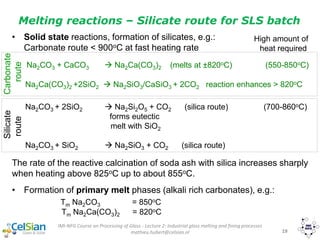
  • 195.
    BONATED BEVERAGES Carbonated Beverages Thepressure factors: gas dissolved in the product. Beverage producers express this as the number of volumes of gas dissolved in a unit volume of the product. For example, if a 48 oz. volume of carbon dioxide at standard conditions is dissolved in 12 oz. of beverage, then the beverage is said to yield 4 gas volumes. Carbonated beverage and beer bottles internal gas pressure : soft drink 0.34 millipascal (50 psi), beer 0.83 millipascal (120 psi). capped well The loss of bottle strength Bottle designs ---round in cross section gently curving radii to maximize strength. 47CSP TRG AIDS - AUG 2008
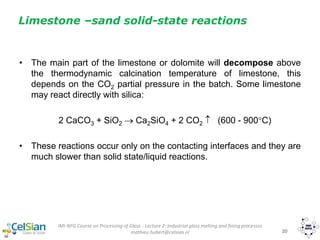
  • 196.
  • 197.
    Benefits of GlassPackaging  Inert  Regal  Ensures freshness and taste  Nontoxic  FDA-approved  2.5 g/cc 49CSP TRG AIDS - AUG 2008
  • 198.
    Glass Types andGeneral Properties inorganic substance fused at high temperatures and cooled quickly principle component ---silica (quartz), Ingredients of components makes different formulations. Mineral compounds used to achieve improved properties: decolorizeration, Clarity, Colouring… Other glass types used for special packaging purposes. lead compounds, boron compounds, borosilicate glasses… 50CSP TRG AIDS - AUG 2008
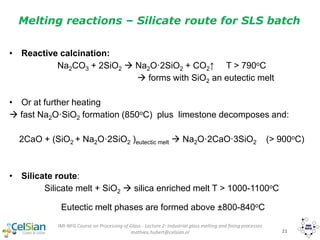
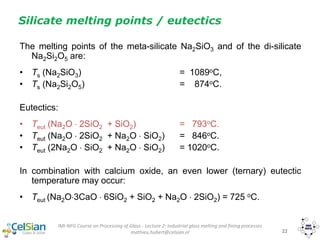
  • 199.
    Glass Types andGeneral Properties Advantages as a packaging material: inert perfect food container. impermeability clarity regal image rigidity stable at high temperatures Disadvantages : fragility high weight high energy costs 51CSP TRG AIDS - AUG 2008
  • 200.
    CSP TRG AIDS- AUG 2008 52 Although INERT Sodium and other ions can leach out on ceratin solution. USP Type-I Borosilicate Flint (clear), Amber (brown) glass vials, USP Type-II De Alkalized Soda Lime Glass(type3) that has been treated in the lehr with sulphur to reduce alkali solubility. The treatment produces a disccoloured appearance. USP Type-III conventional soda glass TYPES OF GLASS
  • 201.
    CSP TRG AIDS- AUG 2008 53 TYPE 1 ADDITION OF 6% BORON REDUCES LEACHING ACTION Least reactive glass available for containers. It can be used for all applications and is most commonly used to packaged water for injection, UN-buffered products, chemicals, sensitive lab samples, and samples requiring sterilization. All lab glass apparatus is generally Type I borosilicate glass. Type I glass is used to package products which are alkaline or will become alkaline prior to their expiration date USP TYPE I BOROSILICATE (neutral) GLASS
  • 202.
    CSP TRG AIDS- AUG 2008 54 USP TYPE II DE ALKALIZED SODA LIME GLASS Has higher levels of sodium hydroxide and calcium oxide. It is less resistant to leaching than Type I but more resistant than Type III. GOOD ALKALI RESISTANCE It can be used for products that remain below pH 7 for their shelf life
  • 203.
    CSP TRG AIDS- AUG 2008 55 USP TYPE III SODA LIME GLASS Acceptable in packaging some dry powders which are subsequently dissolved to make solutions or buffers. It is also suitable for packaging liquid formulations that prove to be insensitive to alkali. Type III glass should not be used for products that are to be autoclaved, but can be used in dry heat sterilization
  • 204.
    CSP TRG AIDS- AUG 2008 56 USP TYPE NP SODA LIME GLASS Is a general purpose glass and is used for non- parenteral applications where chemical durability and heat shock are not factors. These containers are frequently used for capsules, tablets and topical products.
  • 205.
  • 206.
    CSP TRG AIDS- AUG 2008 58 It is important that containers comply with specification and general industry guidelines in order to withstand the normal stresses and mechanical abuse right through until the end user has finished using it. PERFORMANCE & TESTING
  • 207.
    CSP TRG AIDS- AUG 2008 59 VERTICAL LOAD Forces of this nature might be produced during capping or through stacking products on top of each other. To help ensure glass containers have adequate vertical load strength, we test to BS EN ISO 8113-2004 using a Universal Testing Machine.
  • 208.
    CSP TRG AIDS- AUG 2008 60 IMPACT TESTING To help ensure glass containers have an adequate impact resistance, we can test to standard manufacturing codes of practice using an industry standard Pendulum Impact Tester.
  • 209.
    CSP TRG AIDS- AUG 2008 61 THERMAL SHOCK Hot-fill or heat-treated glassware can be tested for thermal shock resistance to ensure the product is fit for the intended purpose. Testing can be carried out to ASTM C149 and BS EN ISO 7459 either as pass/fail test typically at 42OC downshock or progressive testing to complete sample failure. EFFECT OF SUDDEN TEMPERATURE CHANGE EFFECT IS MINIMAL IF BOTH SIDES ARE HEATED OR COOLED SIMULTANEOUSLY EFFECTI IS PROMINENT WHEN ONE SURFACE IS HOT AND THE OTHER SURFACE IS CHILLED
  • 210.
    CSP TRG AIDS- AUG 2008 62 COATING PERFORMANCE Assessment of surface protection can be carried out by use of slip tables and hot end coating technology. The longevity of the coating performance can be assessed using line simulator, whereby bottle to bottle abrasion damage which may be expected to occur on a filling line can be replicated and the subsequent damage of the container tested. This is of particular use for returnable glassware.
  • 211.
    CSP TRG AIDS- AUG 2008 63 INTERNAL PRESSURE RESISTANCE Carbonated beverage bottles need to be able to withstand without failure the pressure produced by their contents over long periods.
  • 212.
    CSP TRG AIDS- AUG 2008 64 RESIDUAL STRAIN Measurement of annealing stresses/residual strain to ASTM C148;
  • 213.
    CSP TRG AIDS- AUG 2008 65 ON-LINE INSPECTION OF GLASS BOTTLES 1.Bottle Spacer. This machine is pre-set to create a space between the bottles on the conveyer to avoid bottle to bottle contract. 2.Squeeze Tester. Each bottle is passed between discs that exert a force to the body of the container. Any obvious weakness or crack in the bottle will cause it to fail completely with the resulting cullet being collected by a return conveyor running underneath. 3.Bore Gauger. The internal and external diameter at the neck finish entrance to the bottle and the bottle height are measured. Bottles outside specification are automatically rejected by means of a pusher positioned downstream from the gauger.
  • 214.
    CSP TRG AIDS- AUG 2008 66 4.Check Detector. Focuses a beam of light onto areas of the container where defects are known to occur from previous visual examinations, any crack will reflect the light to a detector, which will trigger a mechanism to reject the bottle. 5.Wall Thickness Detector. This test uses dielectric properties of the glass, the wall thickness can be determined by means of a sensitive head which traverses the body section of the container. A trace of the wall thickness is then obtained and bottles falling below a specified minimum will be automatically rejected. 6.Hydraulic Pressure Tester. A test carried out on bottles which will be filled with carbonated beverages and gauges the internal pressure of every bottle before it is packed.
  • 215.
    CSP TRG AIDS- AUG 2008 67 7.Visual Check. Bottles are passed in front of a viewing screen as a final inspection. Glass failure is usually as a result of thermal shock or impact stresses. Each glass container has a maximum thermal expansion threshold and a maximum vertical load stress, which it can withstand without cracking. These values should be known before it is used for a particular application. The shape of the container will influence its strength, smooth edges result in the formation of a stronger container than one with rectangular or sharp edges
  • 216.
    CSP TRG AIDS- AUG 2008 68 There are 6 broad classifications of glass defects 1.Checks 2.Seams 3.Non-glass inclusions 4.Dirt, dope, adhering particles or oil parks 5.Freaks and malformations, and 6.Marks
  • 217.
    CSP TRG AIDS- AUG 2008 69 Defects are classified as •Critical, those that are hazardous to the user and those that make the container completely unusable. •Major, those that materially reduce the usability of the container or its contents •Minor, those that do not affect the usability of the container, but detract from its appearance or acceptability to the customer.
  • 218.
    CSP TRG AIDS- AUG 2008 70 Critical Defects in Glass Bottles or Containers 1.Stuck Plug. A piece of glass, usually very sharp, projecting inwards just inside the neck bore 2.Overpress. Is a defect where a small ridge of glass has been formed on the sealing surface of the finish 3.Split. An open crack starting at the top of the finish and extending downward. 4.Check. A small, shallow surface crack, usually at the bore of the container 5.Freaks. Odd shapes and conditions that render the container completely unusable. Bent or cocked necks are a common defect of this type. 6.Poor Distribution. Thin shoulder, slug neck, choke neck, heavy bottom are terms used to describe the uneven distribution of glass. 7.Soft Blister. A thin blister, usually found on or near the sealing surface. It can however show up anywhere on the glass container.
  • 219.
    CSP TRG AIDS- AUG 2008 71 8.Choked Bore. Here excess of glass has been distributed to the inside of the finish or opening 9.Cracks. Partial fractures, usually found in the heel area. 10.Pinhole. Any opening causing leakage. It occurs most often in bottles with pointed corners. 11.Filament. A hair-like string inside the bottle. 12.Spike. Spikes are glass projections inside the bottle. 13.Bird Swing. Is a glass thread joining the two walls of the container
  • 220.
    CSP TRG AIDS- AUG 2008 72 Some Major Defects Commonly Found in Glass Containers 1.Chipped Finish. Pieces broken out of the top edge in the manufacturing process. 2.Stone. Small inclusion of any non-glass material 3.Rocker Bottom. A sunken centre portion on in base of the container 4.Flanged Bottom. A rim of glass around the bottom at the parting line
  • 221.
    CSP TRG AIDS- AUG 2008 73 Some Minor Defects Commonly Found in Glass Containers 1.Suncker Shoulder. Not fully blown, or sagged after blowing 2.Tear. Similar to a check, but opened up. A tear will not break when tapped, a check will. 3.Washboard. A wavy condition of horizontal lines in the body of the bottle. 4.Hard Blister. A deeply embedded blister that is not easily broken. 5.Dirt. Scaly or granular nonglass material. 6.Heel Tap. A manufacturing defect where excess glass has been distributed into the heel 7.Mark. A brush mark is composed of fine vertical laps, e.g. oil marks from moulds. 8.Wavy bottle. A wavy surface on the inside of the bottle. 9.Seeds. Small bubbles in the glass 10.Neck ring seam. A bulge at the parting line between the neck and the body.
  • 222.
  • 223.
    CSP TRG AIDS- AUG 2008 75 Tolerances as per GLASS PACKAGING INSTITUTE CAPACITY 1% for large bottles and upto 15% for small bottles WEIGHT generally 5% HEIGHT 0.5 to 0.8% overall HEIGHT DIAMETER 1.5% for 200mm & 3% for 25mm TOLERANCE
  • 224.
    CSP TRG AIDS- AUG 2008 76 Glass bottle Vertical load Refillable 6000N Non-refillable 4000N The following are examples of some permitted tolerances: Vertical load control values TOLERANCE
  • 225.
    CSP TRG AIDS- AUG 2008 77 Nominal Capacity (ml) up to and including Tolerances (ml) ± Nominal capacity (ml) up to and including Tolerances (ml) ± 100 2.7 450 5.7 125 3.0 500 6.0 150 3.3 600 6.5 175 3.5 700 7.1 200 3.8 800 7.6 250 4.2 900 8.0 300 4.6 1000 8.4 350 5.0 1250 12.5 400 5.3 1500 15.0 CAPACITY
  • 226.
    CSP TRG AIDS- AUG 2008 78 Body/Diameter Height Tolerances Tolerances D (mm) up to and including TD (mm) ± H (mm) up to and including TH (mm) ± 25.0 0.8 25 0.7 36.5 0.9 50 0.8 50.0 1.1 75 0.9 62.5 1.2 100 1.0 75.0 1.4 125 1.1 87.5 1.5 150 1.2 100.0 1.7 175 1.3 112.5 1.8 200 1.4 125.0 2.0 225 1.5 137.5 2.1 250 1.6 150.0 2.3 275 1.7 300 1.8 BODY AND HEIGHT DIMENSIONS
  • 227.
    CSP TRG AIDS- AUG 2008 79 Height H (mm) up to and including Tv (mm) ± 120 2.2 150 2.7 175 3.1 200 3.4 225 3.9 250 4.2 VERTICALITY CONTROL VALUES FOR VERTICALITY
  • 228.
    CSP TRG AIDS- AUG 2008 80 Body overall Diameter (mm) Minimum glass thickness (mm) Non-refillable bottles Refillable bottles Surface protected non-refillable bottles Up to 60 1.1 1.5 0.8 >61 to 71 1.4 1.8 0.9 >71 to 81 1.5 1.9 1.0 >81 to 96 1.7 2.0 1.1 >96 to 110 1.8 2.2 1.3 MINIMUM GLASS THICKNESS VALUES
  • 229.
    CSP TRG AIDS- AUG 2008 81 THINK
  • 230.
  • 231.
    • Recent yearshave represented the best of times in the industry’s history. • Huge growth in flat glass consumption has been driven primarily by India’s fast expanding automotive and construction sectors, while rising disposable income, urbanisation and the onset of modern retail formats have helped the glass container sector. • Incidentally, despite the industry’s significant growth over this period, per capita consumption for glass packaging (1.6kg) and flat glass (1.1kg) are almost at the bottom of the pyramid.
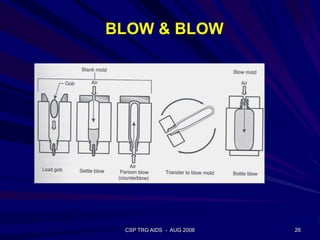
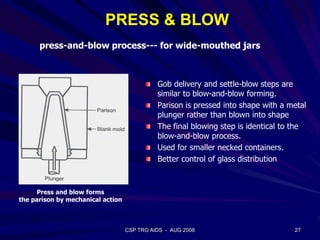
  • 232.
    • The past18 months have been especially challenging. • Profitability has been impacted by increased raw materials and fuel costs. • In particular, the past eight months have not been especially good for the Indian economy. • In general and glass production has been sluggish. • Investment projects in both main and sub-sectors are on hold due to the global and domestic Economic situation. In the past eight months, the Indian economy in general and glass production has been sluggish.
  • 233.
    Container Sector Overview: •At first glance, an industry recording a turnover of US$1.2 billion looks mammoth in size. But when viewed in the prism of its equally large population of 1.2 billion, it seems a pigmy, especially when compared to the glass industry of a country with a comparable population (China). • True, glass container industry growth trends of 12% + over the past decade are impressive but per capita consumption of 1.6kg is well below even some of the world’s least developed countries.
  • 234.
    Company Installed Capacityin TPD HNG 4235 HSIL 1550 Piramal Glass 860 Haldyn Glass 320 MBDL 240 Universal 220 Excel 220 Janta 220 Surat Glass 155 Vitrum 130 Others 600 Main glass container producers in India.