GLASGOWCOMA SCALE
Presentedby:
Muhammad Hussain
(In charge of medicine ward)
3/25/2024 1
Glasgow Coma Scale:
• The Glasgow Coma Scale (GCS) is used to objectively describe the
extent of impaired consciousness in all types of acute medical and
trauma patients. The scale assesses patients according to three
aspects of responsiveness: eye-opening, motor, and verbal responses.
3/25/2024 2
Glasgow Coma Scale:
• The GCS uses a triple criteria scoring system:
• Best eye opening (maximum 4 points)
• Best verbal response (maximum 5 points)
• Best motor response (maximum 6 points)
(These scores are added together to provide a total score between 3
and 15)
3/25/2024 3
1- Eye Opening
• Spontaneous: The patient opens their eyes without any external
stimulation. (Score: 4)
• To speech: The patient opens their eyes in response to verbal
stimulation. (Score: 3)
• To pain: The patient opens their eyes in response to painful stimuli,
such as a pinch. (Score: 2)
• No response: The patient does not open their eyes. (Score: 1)
3/25/2024 4
2.Verbal Response
• Oriented: The patient responds coherently and appropriately to
questions about their name, location, and time. (Score: 5)
• Confused conversation: The patient responds, but their answers are
disoriented and inappropriate. (Score: 4)
• Inappropriate words: The patient's speech is nonsensical and
unrelated to the questions asked. (Score: 3)
• Incomprehensible sounds: The patient makes sounds, but they
cannot be understood. (Score: 2)
• No response: The patient does not make any verbal sounds. (Score: 1)
3/25/2024 5
Motor Response:
• Obeys commands: The patient follows simple commands, such as "squeeze
my hand" or "raise your eyebrows." (Score: 6)
• Localizes pain: The patient moves their body towards the source of a
painful stimulus. (Score: 5)
• Withdraws from pain: The patient withdraws their body part when a
painful stimulus is applied. (Score: 4)
• Abnormal flexion (decorticate posture): The patient exhibits abnormal
posturing, with arms flexed towards the body and legs extended. (Score: 3)
• Extension (decerebrate posture): The patient exhibits abnormal posturing,
with arms and legs extended. (Score: 2)
• No response: The patient does not exhibit any motor response. (Score: 1)
3/25/2024 6
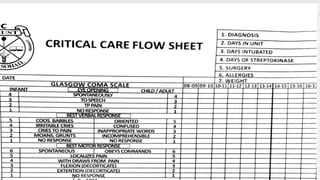
GCS CHART:
3/25/2024 7
Difference b/w Adult and Child GCS Score:
• The main difference between the adult and child versions of the
Glasgow Coma Scale (GCS) lies in the scoring criteria for the verbal
response component. The child version has modified scoring options
that are more appropriate for assessing the verbal abilities of children
at different developmental stages.
3/25/2024 8
3/25/2024 9
Modifications:
• In certain cases, when a patient is intubated (ETT: Endotracheal Tube)
and on mechanical ventilation, and when they are under the
influence of sedatives, the Glasgow Coma Scale (GCS) score may be
modified to account for the sedation. This is known as the "Modified
GCS score - ETT + vent - Sedative."
3/25/2024 10
ACTIVITY TIME
3/25/2024 11
Scenario 1:
• A 45-year-old man is brought to the emergency room after a motorcycle accident. Upon arrival, his
level of consciousness is assessed using the Glasgow Coma Scale (GCS).
Choose the correct answer for each question.
1. The patient opens his eyes spontaneously. What score would you assign for his eye opening?
a)1 b) 2 c) 3 d) 4
2. When asked his name, the patient responds with inappropriate words. How would you score his verbal
response?
a) 1 b) 2 c) 3 d) 4
3. The patient withdraws his arm when a painful stimulus is applied. What score would you assign for his
motor
responses?
a) 3 b) 4 c) 5 d) 6
3/25/2024 12
ANSWER IS 12/15
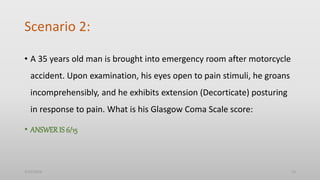
Scenario 2:
• A 35 years old man is brought into emergency room after motorcycle
accident. Upon examination, his eyes open to pain stimuli, he groans
incomprehensibly, and he exhibits extension (Decorticate) posturing
in response to pain. What is his Glasgow Coma Scale score:
• ANSWER IS 6/15
3/25/2024 13
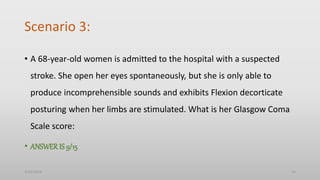
Scenario 3:
• A 68-year-old women is admitted to the hospital with a suspected
stroke. She open her eyes spontaneously, but she is only able to
produce incomprehensible sounds and exhibits Flexion decorticate
posturing when her limbs are stimulated. What is her Glasgow Coma
Scale score:
• ANSWERIS 9/15
3/25/2024 14
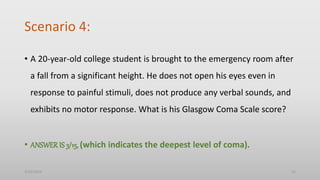
Scenario 4:
• A 20-year-old college student is brought to the emergency room after
a fall from a significant height. He does not open his eyes even in
response to painful stimuli, does not produce any verbal sounds, and
exhibits no motor response. What is his Glasgow Coma Scale score?
• ANSWER IS 3/15, (which indicates the deepest level of coma).
3/25/2024 15
Scenario 5:
• A 42-year-old women is admitted to the hospital following a motor
vehicle accident. She open her eyes in response to verbal commands,
is able to speak coherently and answer questions appropriately, and
obeys commands to move her limbs. What is her Glasgow Coma Scale
score?
• ANSWERIS 14/15
3/25/2024 16
3/25/2024 17
3/25/2024 18

Glasgow Coma Scale (GCS) presentation .pptx

  • 1.
    GLASGOWCOMA SCALE Presentedby: Muhammad Hussain (Incharge of medicine ward) 3/25/2024 1
  • 2.
    Glasgow Coma Scale: •The Glasgow Coma Scale (GCS) is used to objectively describe the extent of impaired consciousness in all types of acute medical and trauma patients. The scale assesses patients according to three aspects of responsiveness: eye-opening, motor, and verbal responses. 3/25/2024 2
  • 3.
    Glasgow Coma Scale: •The GCS uses a triple criteria scoring system: • Best eye opening (maximum 4 points) • Best verbal response (maximum 5 points) • Best motor response (maximum 6 points) (These scores are added together to provide a total score between 3 and 15) 3/25/2024 3
  • 4.
    1- Eye Opening •Spontaneous: The patient opens their eyes without any external stimulation. (Score: 4) • To speech: The patient opens their eyes in response to verbal stimulation. (Score: 3) • To pain: The patient opens their eyes in response to painful stimuli, such as a pinch. (Score: 2) • No response: The patient does not open their eyes. (Score: 1) 3/25/2024 4
  • 5.
    2.Verbal Response • Oriented:The patient responds coherently and appropriately to questions about their name, location, and time. (Score: 5) • Confused conversation: The patient responds, but their answers are disoriented and inappropriate. (Score: 4) • Inappropriate words: The patient's speech is nonsensical and unrelated to the questions asked. (Score: 3) • Incomprehensible sounds: The patient makes sounds, but they cannot be understood. (Score: 2) • No response: The patient does not make any verbal sounds. (Score: 1) 3/25/2024 5
  • 6.
    Motor Response: • Obeyscommands: The patient follows simple commands, such as "squeeze my hand" or "raise your eyebrows." (Score: 6) • Localizes pain: The patient moves their body towards the source of a painful stimulus. (Score: 5) • Withdraws from pain: The patient withdraws their body part when a painful stimulus is applied. (Score: 4) • Abnormal flexion (decorticate posture): The patient exhibits abnormal posturing, with arms flexed towards the body and legs extended. (Score: 3) • Extension (decerebrate posture): The patient exhibits abnormal posturing, with arms and legs extended. (Score: 2) • No response: The patient does not exhibit any motor response. (Score: 1) 3/25/2024 6
  • 7.
  • 8.
    Difference b/w Adultand Child GCS Score: • The main difference between the adult and child versions of the Glasgow Coma Scale (GCS) lies in the scoring criteria for the verbal response component. The child version has modified scoring options that are more appropriate for assessing the verbal abilities of children at different developmental stages. 3/25/2024 8
  • 9.
  • 10.
    Modifications: • In certaincases, when a patient is intubated (ETT: Endotracheal Tube) and on mechanical ventilation, and when they are under the influence of sedatives, the Glasgow Coma Scale (GCS) score may be modified to account for the sedation. This is known as the "Modified GCS score - ETT + vent - Sedative." 3/25/2024 10
  • 11.
  • 12.
    Scenario 1: • A45-year-old man is brought to the emergency room after a motorcycle accident. Upon arrival, his level of consciousness is assessed using the Glasgow Coma Scale (GCS). Choose the correct answer for each question. 1. The patient opens his eyes spontaneously. What score would you assign for his eye opening? a)1 b) 2 c) 3 d) 4 2. When asked his name, the patient responds with inappropriate words. How would you score his verbal response? a) 1 b) 2 c) 3 d) 4 3. The patient withdraws his arm when a painful stimulus is applied. What score would you assign for his motor responses? a) 3 b) 4 c) 5 d) 6 3/25/2024 12 ANSWER IS 12/15
  • 13.
    Scenario 2: • A35 years old man is brought into emergency room after motorcycle accident. Upon examination, his eyes open to pain stimuli, he groans incomprehensibly, and he exhibits extension (Decorticate) posturing in response to pain. What is his Glasgow Coma Scale score: • ANSWER IS 6/15 3/25/2024 13
  • 14.
    Scenario 3: • A68-year-old women is admitted to the hospital with a suspected stroke. She open her eyes spontaneously, but she is only able to produce incomprehensible sounds and exhibits Flexion decorticate posturing when her limbs are stimulated. What is her Glasgow Coma Scale score: • ANSWERIS 9/15 3/25/2024 14
  • 15.
    Scenario 4: • A20-year-old college student is brought to the emergency room after a fall from a significant height. He does not open his eyes even in response to painful stimuli, does not produce any verbal sounds, and exhibits no motor response. What is his Glasgow Coma Scale score? • ANSWER IS 3/15, (which indicates the deepest level of coma). 3/25/2024 15
  • 16.
    Scenario 5: • A42-year-old women is admitted to the hospital following a motor vehicle accident. She open her eyes in response to verbal commands, is able to speak coherently and answer questions appropriately, and obeys commands to move her limbs. What is her Glasgow Coma Scale score? • ANSWERIS 14/15 3/25/2024 16
  • 17.
  • 18.