
Short Note Discussion
To
Dr. Md. Shohidullah
Resident (Phase A)
Dept. of Orthopaedics
Bangabandhu Sheikh Mujib Medical University
Glasgow coma scale is a neurological scale that aims
to give a reliable,objective way of recording the
consciousness level of a person for initial assessment
as well as subsequent management.
● The glasgow coma scale was published in 1977 by
Graham Teasdale and Bryan J. Jennett.
● They are Professors of Neurosurgery at Institute of
Neurological Science in the University of Glasgow.
It composed of 3 components--
-Eye opening
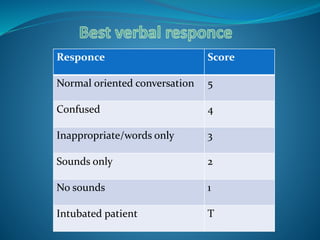
-Best verbal response
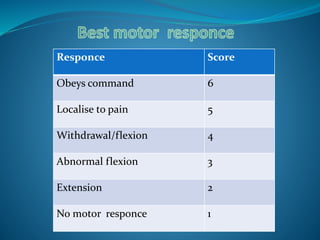
-Best motor responce
Responce Score
Spontaneously 4
To verbal command 3
To pain stimulus 2
Do not open 1
Responce Score
Normal oriented conversation 5
Confused 4
Inappropriate/words only 3
Sounds only 2
No sounds 1
Intubated patient T
Responce Score
Obeys command 6
Localise to pain 5
Withdrawal/flexion 4
Abnormal flexion 3
Extension 2
No motor responce 1
Type Score
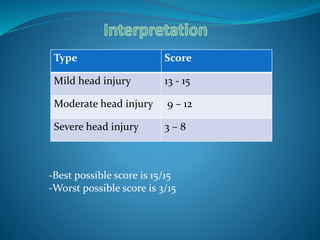
Mild head injury 13 - 15
Moderate head injury 9 – 12
Severe head injury 3 – 8
-Best possible score is 15/15
-Worst possible score is 3/15
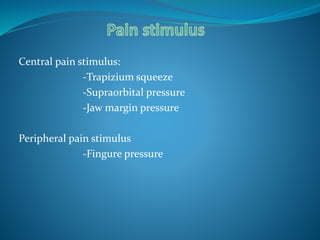
Central pain stimulus:
-Trapizium squeeze
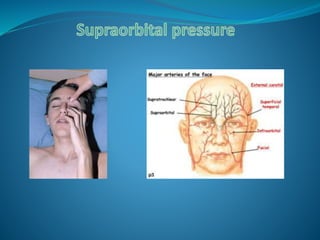
-Supraorbital pressure
-Jaw margin pressure
Peripheral pain stimulus
-Fingure pressure
Obeys commands:
-Highest level of motor response
-Accurate response to instruction
-raise eyebrows
-stick out tongue
-Let go
Localising pain:
Response to pain stimulus - moves hand to the
point of stimulation
-Supra orbital pressure
-Jaw margin pressure
-Trapezius squeeze
-Sternal rub
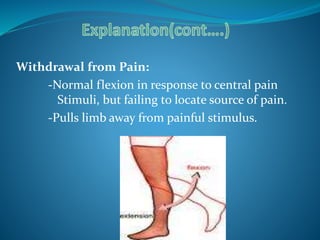
Withdrawal from Pain:
-Normal flexion in response to central pain
Stimuli, but failing to locate source of pain.
-Pulls limb away from painful stimulus.
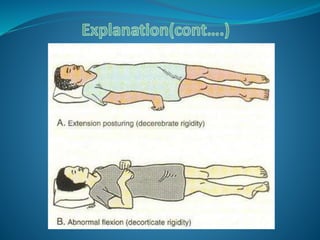
Abnormal flexion(Decorticate response):
-Adduction of arm
-Internal rotation of shoulder
-Pronation of forearm
-Flexion at elbow and wrist
Extension(Decerebrate response):
-Abduction of arm
-External rotation of shoulder
-Supination of forearm
-Extension of elbow and wrist
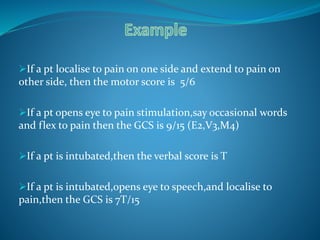
If a pt localise to pain on one side and extend to pain on
other side, then the motor score is 5/6
If a pt opens eye to pain stimulation,say occasional words
and flex to pain then the GCS is 9/15 (E2,V3,M4)
If a pt is intubated,then the verbal score is T
If a pt is intubated,opens eye to speech,and localise to
pain,then the GCS is 7T/15
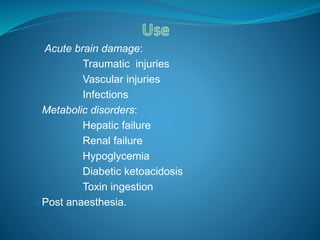
 Acute brain damage:
Traumatic injuries
Vascular injuries
Infections
Metabolic disorders:
Hepatic failure
Renal failure
Hypoglycemia
Diabetic ketoacidosis
Toxin ingestion
Post anaesthesia.
Assess initial level of consciousness
Quantifies level of consciousness
Assess changes in level of consciousness
Helps in treatment
Predict outcome
GCS less than 13 at any time
GCS 13 0r 14 at 2 hours
Focal neurologival deficit
Seizure
Vomiting
Suspected open,depressed or basal skull fracture
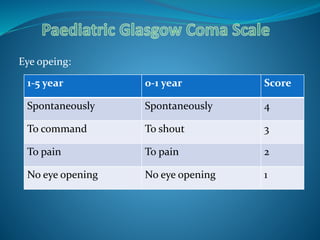
Eye opeing:
1-5 year 0-1 year Score
Spontaneously Spontaneously 4
To command To shout 3
To pain To pain 2
No eye opening No eye opening 1
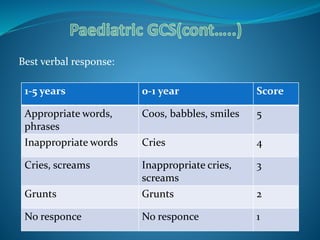
Best verbal response:
1-5 years 0-1 year Score
Appropriate words,
phrases
Coos, babbles, smiles 5
Inappropriate words Cries 4
Cries, screams Inappropriate cries,
screams
3
Grunts Grunts 2
No responce No responce 1
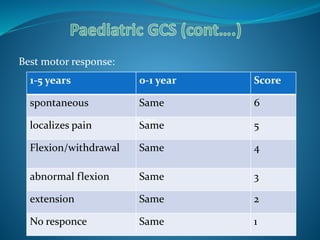
Best motor response:
1-5 years 0-1 year Score
spontaneous Same 6
localizes pain Same 5
Flexion/withdrawal Same 4
abnormal flexion Same 3
extension Same 2
No responce Same 1
Same
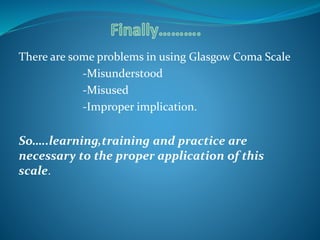
There are some problems in using Glasgow Coma Scale
-Misunderstood
-Misused
-Improper implication.
So…..learning,training and practice are
necessary to the proper application of this
scale.
Gcs

Gcs

  • 1.
  • 2.
    Dr. Md. Shohidullah Resident(Phase A) Dept. of Orthopaedics Bangabandhu Sheikh Mujib Medical University
  • 3.
    Glasgow coma scaleis a neurological scale that aims to give a reliable,objective way of recording the consciousness level of a person for initial assessment as well as subsequent management.
  • 4.
    ● The glasgowcoma scale was published in 1977 by Graham Teasdale and Bryan J. Jennett. ● They are Professors of Neurosurgery at Institute of Neurological Science in the University of Glasgow.
  • 5.
    It composed of3 components-- -Eye opening -Best verbal response -Best motor responce
  • 6.
    Responce Score Spontaneously 4 Toverbal command 3 To pain stimulus 2 Do not open 1
  • 7.
    Responce Score Normal orientedconversation 5 Confused 4 Inappropriate/words only 3 Sounds only 2 No sounds 1 Intubated patient T
  • 8.
    Responce Score Obeys command6 Localise to pain 5 Withdrawal/flexion 4 Abnormal flexion 3 Extension 2 No motor responce 1
  • 9.
    Type Score Mild headinjury 13 - 15 Moderate head injury 9 – 12 Severe head injury 3 – 8 -Best possible score is 15/15 -Worst possible score is 3/15
  • 10.
    Central pain stimulus: -Trapiziumsqueeze -Supraorbital pressure -Jaw margin pressure Peripheral pain stimulus -Fingure pressure
  • 13.
    Obeys commands: -Highest levelof motor response -Accurate response to instruction -raise eyebrows -stick out tongue -Let go
  • 14.
    Localising pain: Response topain stimulus - moves hand to the point of stimulation -Supra orbital pressure -Jaw margin pressure -Trapezius squeeze -Sternal rub
  • 15.
    Withdrawal from Pain: -Normalflexion in response to central pain Stimuli, but failing to locate source of pain. -Pulls limb away from painful stimulus.
  • 16.
    Abnormal flexion(Decorticate response): -Adductionof arm -Internal rotation of shoulder -Pronation of forearm -Flexion at elbow and wrist Extension(Decerebrate response): -Abduction of arm -External rotation of shoulder -Supination of forearm -Extension of elbow and wrist
  • 18.
    If a ptlocalise to pain on one side and extend to pain on other side, then the motor score is 5/6 If a pt opens eye to pain stimulation,say occasional words and flex to pain then the GCS is 9/15 (E2,V3,M4) If a pt is intubated,then the verbal score is T If a pt is intubated,opens eye to speech,and localise to pain,then the GCS is 7T/15
  • 20.
     Acute braindamage: Traumatic injuries Vascular injuries Infections Metabolic disorders: Hepatic failure Renal failure Hypoglycemia Diabetic ketoacidosis Toxin ingestion Post anaesthesia.
  • 21.
    Assess initial levelof consciousness Quantifies level of consciousness Assess changes in level of consciousness Helps in treatment Predict outcome
  • 22.
    GCS less than13 at any time GCS 13 0r 14 at 2 hours Focal neurologival deficit Seizure Vomiting Suspected open,depressed or basal skull fracture
  • 23.
    Eye opeing: 1-5 year0-1 year Score Spontaneously Spontaneously 4 To command To shout 3 To pain To pain 2 No eye opening No eye opening 1
  • 24.
    Best verbal response: 1-5years 0-1 year Score Appropriate words, phrases Coos, babbles, smiles 5 Inappropriate words Cries 4 Cries, screams Inappropriate cries, screams 3 Grunts Grunts 2 No responce No responce 1
  • 25.
    Best motor response: 1-5years 0-1 year Score spontaneous Same 6 localizes pain Same 5 Flexion/withdrawal Same 4 abnormal flexion Same 3 extension Same 2 No responce Same 1 Same
  • 26.
    There are someproblems in using Glasgow Coma Scale -Misunderstood -Misused -Improper implication. So…..learning,training and practice are necessary to the proper application of this scale.