Gastrointestinal PhysiologyGastrointestinal Physiology
(Digestive System)(Digestive System)
Dr. G. AHMADDr. G. AHMAD
Assistant Professor PhysiologyAssistant Professor Physiology
Functions of the Digestive SystemFunctions of the Digestive System
 Ingest foodIngest food
 Break down food into nutrient moleculesBreak down food into nutrient molecules
 Absorb molecules into the bloodstreamAbsorb molecules into the bloodstream
 Rid the body of indigestible remainsRid the body of indigestible remains
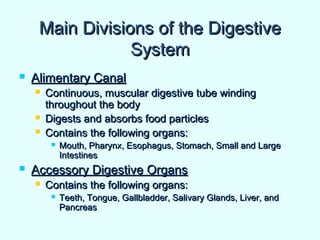
Main Divisions of the DigestiveMain Divisions of the Digestive
SystemSystem
 Alimentary CanalAlimentary Canal
 Continuous, muscular digestive tube windingContinuous, muscular digestive tube winding
throughout the bodythroughout the body
 Digests and absorbs food particlesDigests and absorbs food particles
 Contains the following organs:Contains the following organs:
 Mouth, Pharynx, Esophagus, Stomach, Small and LargeMouth, Pharynx, Esophagus, Stomach, Small and Large
IntestinesIntestines
 Accessory Digestive OrgansAccessory Digestive Organs
 Contains the following organs:Contains the following organs:
 Teeth, Tongue, Gallbladder, Salivary Glands, Liver, andTeeth, Tongue, Gallbladder, Salivary Glands, Liver, and
PancreasPancreas
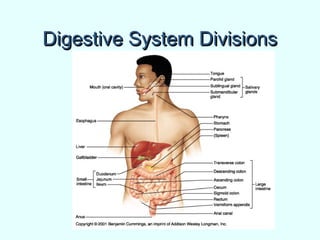
Digestive System DivisionsDigestive System Divisions
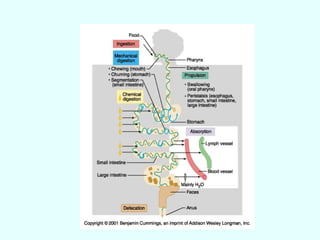
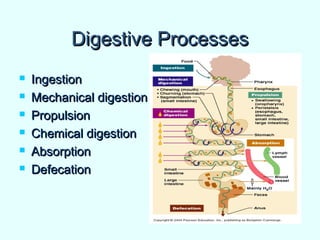
Digestive ProcessesDigestive Processes
 IngestionIngestion
 Mechanical digestionMechanical digestion
 PropulsionPropulsion
 Chemical digestionChemical digestion
 AbsorptionAbsorption
 DefecationDefecation
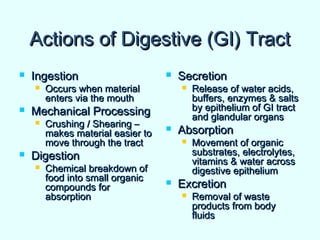
Actions of Digestive (GI) TractActions of Digestive (GI) Tract
 IngestionIngestion
 Occurs when materialOccurs when material
enters via the mouthenters via the mouth
 Mechanical ProcessingMechanical Processing
 Crushing / Shearing –Crushing / Shearing –
makes material easier tomakes material easier to
move through the tractmove through the tract
 DigestionDigestion
 Chemical breakdown ofChemical breakdown of
food into small organicfood into small organic
compounds forcompounds for
absorptionabsorption
 SecretionSecretion
 Release of water acids,Release of water acids,
buffers, enzymes & saltsbuffers, enzymes & salts
by epithelium of GI tractby epithelium of GI tract
and glandular organsand glandular organs
 AbsorptionAbsorption
 Movement of organicMovement of organic
substrates, electrolytes,substrates, electrolytes,
vitamins & water acrossvitamins & water across
digestive epitheliumdigestive epithelium
 ExcretionExcretion
 Removal of wasteRemoval of waste
products from bodyproducts from body
fluidsfluids
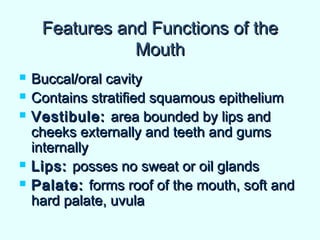
Features and Functions of theFeatures and Functions of the
MouthMouth
 Buccal/oral cavityBuccal/oral cavity
 Contains stratified squamous epitheliumContains stratified squamous epithelium
 Vestibule:Vestibule: area bounded by lips andarea bounded by lips and
cheeks externally and teeth and gumscheeks externally and teeth and gums
internallyinternally
 Lips:Lips: posses no sweat or oil glandsposses no sweat or oil glands
 Palate:Palate: forms roof of the mouth, soft andforms roof of the mouth, soft and
hard palate, uvulahard palate, uvula
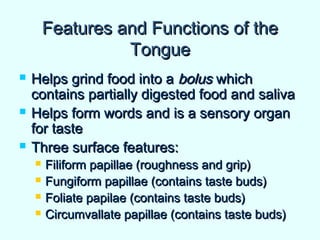
Features and Functions of theFeatures and Functions of the
TongueTongue
 Helps grind food into aHelps grind food into a bolusbolus whichwhich
contains partially digested food and salivacontains partially digested food and saliva
 Helps form words and is a sensory organHelps form words and is a sensory organ
for tastefor taste
 Three surface features:Three surface features:
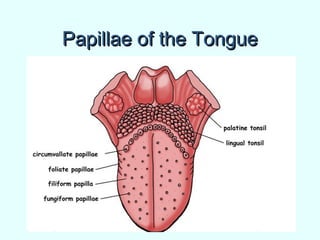
 Filiform papillae (roughness and grip)Filiform papillae (roughness and grip)
 Fungiform papillae (contains taste buds)Fungiform papillae (contains taste buds)
 Foliate papilae (contains taste buds)Foliate papilae (contains taste buds)
 Circumvallate papillae (contains taste buds)Circumvallate papillae (contains taste buds)
Papillae of the TonguePapillae of the Tongue
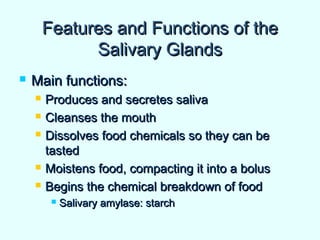
Features and Functions of theFeatures and Functions of the
Salivary GlandsSalivary Glands
 Main functions:Main functions:
 Produces and secretes salivaProduces and secretes saliva
 Cleanses the mouthCleanses the mouth
 Dissolves food chemicals so they can beDissolves food chemicals so they can be
tastedtasted
 Moistens food, compacting it into a bolusMoistens food, compacting it into a bolus
 Begins the chemical breakdown of foodBegins the chemical breakdown of food
 Salivary amylase: starchSalivary amylase: starch
Types of Salivary GlandsTypes of Salivary Glands
 Submandibular GlandsSubmandibular Glands
 Found underneath the mandibleFound underneath the mandible
 Sublingual GlandsSublingual Glands
 Found underneath the tongueFound underneath the tongue
 Parotid GlandsParotid Glands
 Found anterior to the ear between masseter and skinFound anterior to the ear between masseter and skin
 Saliva travels to oral orifice via ducts from allSaliva travels to oral orifice via ducts from all
three glandsthree glands
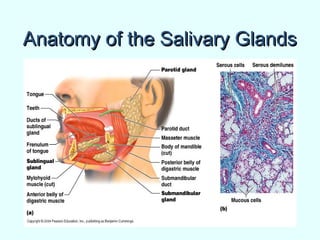
Anatomy of the Salivary GlandsAnatomy of the Salivary Glands
 Composition of Saliva: 97-99.5% waterComposition of Saliva: 97-99.5% water
 0.5 % electrolytes0.5 % electrolytes
 Sodium, potassium, chloride, phosphate,Sodium, potassium, chloride, phosphate,
and bicarbonateand bicarbonate
 Most important proteins are salivaryMost important proteins are salivary
amylase, mucus and lysozymesamylase, mucus and lysozymes
Features and Functions of theFeatures and Functions of the
TeethTeeth
 Break food into smaller parts, increasingBreak food into smaller parts, increasing
surface area for digestionsurface area for digestion
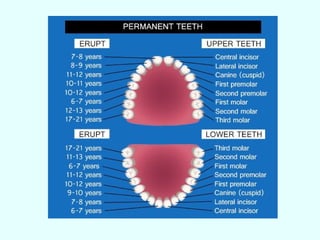
 Types of TeethTypes of Teeth
 Deciduous Teeth (“baby” teeth)Deciduous Teeth (“baby” teeth)
 Permanent TeethPermanent Teeth
 Incisors- cutting and shreddingIncisors- cutting and shredding
 Canines- piercing and tearingCanines- piercing and tearing
 Molars- grindingMolars- grinding
 Premolars- grinding and crushingPremolars- grinding and crushing
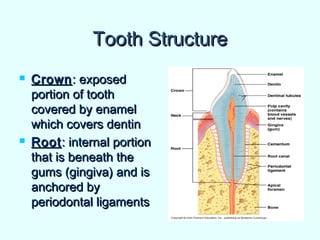
Tooth StructureTooth Structure
 CrownCrown: exposed: exposed
portion of toothportion of tooth
covered by enamelcovered by enamel
which covers dentinwhich covers dentin
 RootRoot: internal portion: internal portion
that is beneath thethat is beneath the
gums (gingiva) and isgums (gingiva) and is
anchored byanchored by
periodontal ligamentsperiodontal ligaments
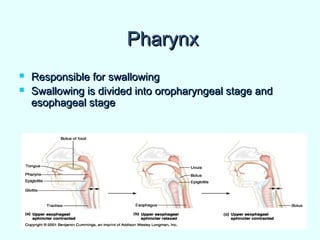
PharynxPharynx
 Responsible for swallowingResponsible for swallowing
 Swallowing is divided into oropharyngeal stage andSwallowing is divided into oropharyngeal stage and
esophageal stageesophageal stage
Features and Functions of theFeatures and Functions of the
EsophagusEsophagus
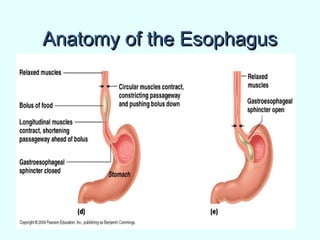
 Muscular tube that propels food to stomach;Muscular tube that propels food to stomach;
bolus enters stomach throughbolus enters stomach through esophageal hiatusesophageal hiatus
 Esophageal glands – produce mucus to lubricateEsophageal glands – produce mucus to lubricate
bolusbolus
 Esophageal sphincter – prevents backflow intoEsophageal sphincter – prevents backflow into
oral cavityoral cavity
 Cardiac sphincter- prevents backflow intoCardiac sphincter- prevents backflow into
esophagusesophagus
Features and Functions of theFeatures and Functions of the
EsophagusEsophagus
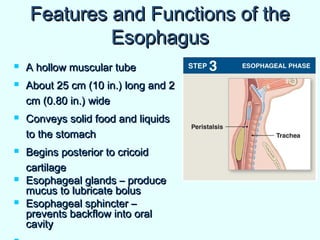
 A hollow muscular tubeA hollow muscular tube
 About 25 cm (10 in.) long and 2About 25 cm (10 in.) long and 2
cm (0.80 in.) widecm (0.80 in.) wide
 Conveys solid food and liquidsConveys solid food and liquids
to the stomachto the stomach
 Begins posterior to cricoidBegins posterior to cricoid
cartilagecartilage
 Esophageal glands – produceEsophageal glands – produce
mucus to lubricate bolusmucus to lubricate bolus
 Esophageal sphincter –Esophageal sphincter –
prevents backflow into oralprevents backflow into oral
cavitycavity
Anatomy of the EsophagusAnatomy of the Esophagus
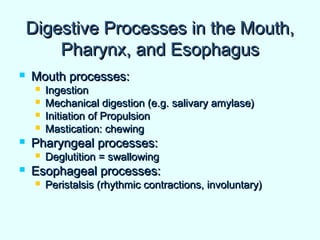
Digestive Processes in the Mouth,Digestive Processes in the Mouth,
Pharynx, and EsophagusPharynx, and Esophagus
 Mouth processes:Mouth processes:
 IngestionIngestion
 Mechanical digestion (e.g. salivary amylase)Mechanical digestion (e.g. salivary amylase)
 Initiation of PropulsionInitiation of Propulsion
 Mastication: chewingMastication: chewing
 Pharyngeal processes:Pharyngeal processes:
 Deglutition = swallowingDeglutition = swallowing
 Esophageal processes:Esophageal processes:
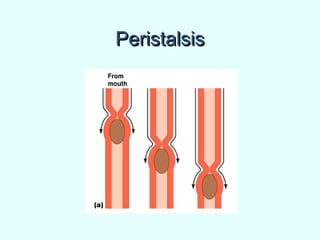
 Peristalsis (rhythmic contractions, involuntary)Peristalsis (rhythmic contractions, involuntary)
PeristalsisPeristalsis
Features and Functions of theFeatures and Functions of the
StomachStomach
 Temporary storage area for food and allows it toTemporary storage area for food and allows it to
mix with gastric juice to producemix with gastric juice to produce chymechyme
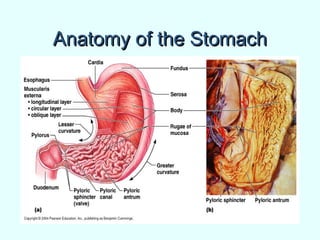
 Regions: cardiac, fundus, body, and pyloricRegions: cardiac, fundus, body, and pyloric
Stomach FunctionStomach Function
 Major Functions of the StomachMajor Functions of the Stomach
 Storage of ingested foodStorage of ingested food
 Mechanical breakdown of ingested foodMechanical breakdown of ingested food
 Disruption of chemical bonds in food material by acidDisruption of chemical bonds in food material by acid
and enzymesand enzymes
 Production ofProduction of intrinsic factorintrinsic factor , a glycoprotein, a glycoprotein
required for absorption of vitamin Brequired for absorption of vitamin B1212 in small intestinein small intestine
Anatomy of the StomachAnatomy of the Stomach
Gastric Juices (hormones)Gastric Juices (hormones)
 Simple columnar epithelium – containsSimple columnar epithelium – contains gastricgastric
pitspits that secretethat secrete gastric juicesgastric juices
 Goblet cellsGoblet cells – secrete mucus that coats– secrete mucus that coats
stomach and prevents it from being digestedstomach and prevents it from being digested
itselfitself
 Parietal cellsParietal cells – secrete– secrete hydrochloric acidhydrochloric acid
(converts pepsinogen into pepsin) and(converts pepsinogen into pepsin) and intrinsicintrinsic
factorfactor (necessary for absorption of vitamin B(necessary for absorption of vitamin B12)12)
 Chief cellsChief cells – secrete pepsinogen which is– secrete pepsinogen which is
converted to pepsin to aid in protein digestionconverted to pepsin to aid in protein digestion
 Enteroendocrine cellsEnteroendocrine cells – release hormones– release hormones
such as:such as:
 Histamine, Serotonin, Gastrin, Endorphins, andHistamine, Serotonin, Gastrin, Endorphins, and
SomatostatinSomatostatin
 HistamineHistamine
- activates parietal cells to release HCl- activates parietal cells to release HCl
 SerotoninSerotonin
- contraction of stomach muscle- contraction of stomach muscle
 GastrinGastrin
- gastric glands to increase secretion- gastric glands to increase secretion
 EndorphinsEndorphins
- natural opiates- natural opiates
 SomatostatinSomatostatin
- inhibits gastric secretion- inhibits gastric secretion
- inhibits gastric emptying- inhibits gastric emptying
Digestive Processes in theDigestive Processes in the
StomachStomach Three PhasesThree Phases
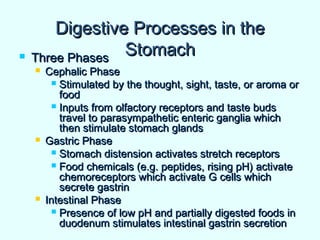
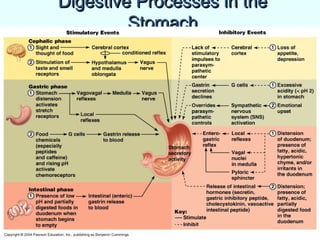
 Cephalic PhaseCephalic Phase
 Stimulated by the thought, sight, taste, or aroma orStimulated by the thought, sight, taste, or aroma or
foodfood
 Inputs from olfactory receptors and taste budsInputs from olfactory receptors and taste buds
travel to parasympathetic enteric ganglia whichtravel to parasympathetic enteric ganglia which
then stimulate stomach glandsthen stimulate stomach glands
 Gastric PhaseGastric Phase
 Stomach distension activates stretch receptorsStomach distension activates stretch receptors
 Food chemicals (e.g. peptides, rising pH) activateFood chemicals (e.g. peptides, rising pH) activate
chemoreceptors which activate G cells whichchemoreceptors which activate G cells which
secrete gastrinsecrete gastrin
 Intestinal PhaseIntestinal Phase
 Presence of low pH and partially digested foods inPresence of low pH and partially digested foods in
duodenum stimulates intestinal gastrin secretionduodenum stimulates intestinal gastrin secretion
Digestive Processes in theDigestive Processes in the
StomachStomach
Gastric Motility and EmptyingGastric Motility and Emptying
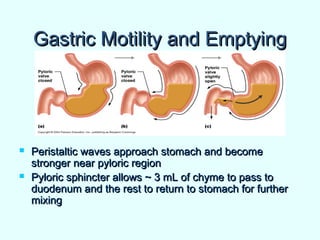
 Peristaltic waves approach stomach and becomePeristaltic waves approach stomach and become
stronger near pyloric regionstronger near pyloric region
 Pyloric sphincter allows ~ 3 mL of chyme to pass toPyloric sphincter allows ~ 3 mL of chyme to pass to
duodenum and the rest to return to stomach for furtherduodenum and the rest to return to stomach for further
mixingmixing
Small IntestineSmall Intestine
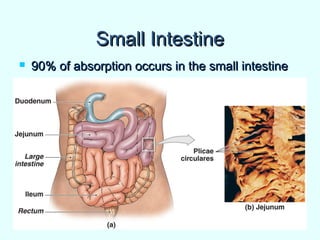
 90% of absorption occurs in the small intestine90% of absorption occurs in the small intestine
Small IntestineSmall Intestine
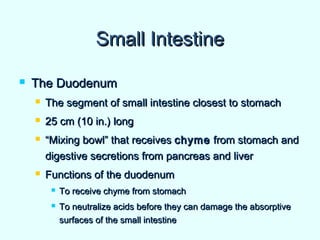
 The DuodenumThe Duodenum
 The segment of small intestine closest to stomachThe segment of small intestine closest to stomach
 25 cm (10 in.) long25 cm (10 in.) long
 ““Mixing bowl” that receivesMixing bowl” that receives chymechyme from stomach andfrom stomach and
digestive secretions from pancreas and liverdigestive secretions from pancreas and liver
 Functions of the duodenumFunctions of the duodenum
 To receive chyme from stomachTo receive chyme from stomach
 To neutralize acids before they can damage the absorptiveTo neutralize acids before they can damage the absorptive
surfaces of the small intestinesurfaces of the small intestine
Small IntestineSmall Intestine
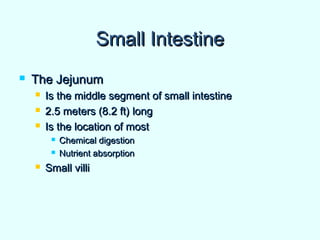
 The JejunumThe Jejunum
 Is the middle segment of small intestineIs the middle segment of small intestine
 2.5 meters (8.2 ft) long2.5 meters (8.2 ft) long
 Is the location of mostIs the location of most
 Chemical digestionChemical digestion
 Nutrient absorptionNutrient absorption
 Small villiSmall villi
Small IntestineSmall Intestine
 The IleumThe Ileum
 The final segment of small intestineThe final segment of small intestine
 3.5 meters (11.48 ft) long3.5 meters (11.48 ft) long
 Ends at theEnds at the ileocecal valveileocecal valve, a sphincter that, a sphincter that
controls flow of material from the ileum intocontrols flow of material from the ileum into
the large intestinethe large intestine
Small IntestineSmall Intestine
 Intestinal SecretionsIntestinal Secretions
 Watery intestinal juiceWatery intestinal juice
 1.8 liters per day enter1.8 liters per day enter
intestinal lumenintestinal lumen
 Moisten chymeMoisten chyme
 Assist in buffering acidsAssist in buffering acids
 Keep digestive enzymesKeep digestive enzymes
and products of digestionand products of digestion
in solutionin solution
 Intestinal MovementsIntestinal Movements
 Chyme arrives inChyme arrives in
duodenumduodenum
 Weak peristalticWeak peristaltic
contractions move it slowlycontractions move it slowly
toward jejunumtoward jejunum
Microscopic Anatomy of SmallMicroscopic Anatomy of Small
IntestineIntestine
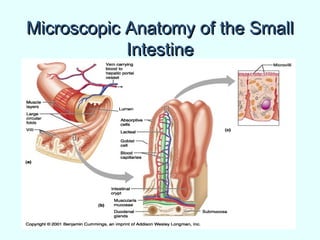
 VilliVilli: fingerlike projections that increase the: fingerlike projections that increase the
surface area of the SIsurface area of the SI
 MicrovilliMicrovilli: tiny projections on the plasma: tiny projections on the plasma
membranes of columnar cells that appear fuzzymembranes of columnar cells that appear fuzzy
(i.e. brush border cells)(i.e. brush border cells)
 Crypts of LieberkuhnCrypts of Lieberkuhn : secrete intestinal juice: secrete intestinal juice
and special lysozymes that protect againstand special lysozymes that protect against
bacteriabacteria
 Peyer’s PatchesPeyer’s Patches: aggregated lymphoid: aggregated lymphoid
tissues containing lymphocytestissues containing lymphocytes
Microscopic Anatomy of the SmallMicroscopic Anatomy of the Small
IntestineIntestine
Secretions of the Small IntestineSecretions of the Small Intestine
 SecretinSecretin: released by enteroendocrine cells when: released by enteroendocrine cells when
acidic chyme enters SI; causes release of bicarbonate-acidic chyme enters SI; causes release of bicarbonate-
rich pancreatic juicesrich pancreatic juices
 SomatostatinSomatostatin: slows gastric motility and emptying and: slows gastric motility and emptying and
inhibits production of gastric secretionsinhibits production of gastric secretions
 Cholecystokinin (CCK)Cholecystokinin (CCK) : released when fatty, protein-: released when fatty, protein-
rich chyme enters SI; causes release of enzyme-richrich chyme enters SI; causes release of enzyme-rich
pancreatic juices and bilepancreatic juices and bile
 Brush border enzymesBrush border enzymes: process long peptides,: process long peptides,
nucleic acids, and sugars into smaller onesnucleic acids, and sugars into smaller ones
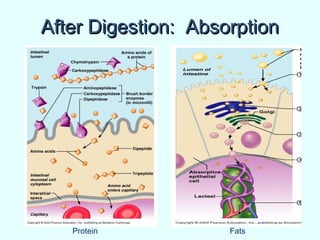
After Digestion: AbsorptionAfter Digestion: Absorption
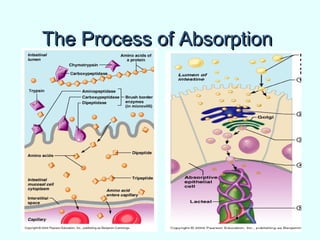
Protein Fats
Functions of the LiverFunctions of the Liver
 Largest internal organLargest internal organ
 Functions:Functions:
 Filters and processes nutrient-rich blood ofFilters and processes nutrient-rich blood of
carbohydrates, proteins, and lipids fromcarbohydrates, proteins, and lipids from
intestineintestine
 Production and regulation of cholesterolProduction and regulation of cholesterol
 Production ofProduction of bilebile which emulsifies fatswhich emulsifies fats
 Removes drugs and hormones fromRemoves drugs and hormones from
circulationcirculation
 Storage of vitamins and mineralsStorage of vitamins and minerals
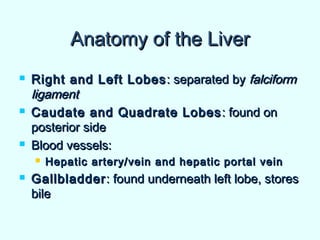
Anatomy of the LiverAnatomy of the Liver
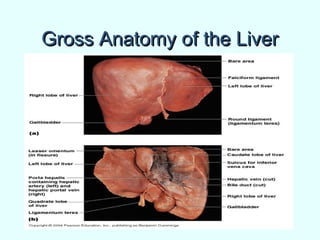
 Right and Left LobesRight and Left Lobes : separated by: separated by falciformfalciform
ligamentligament
 Caudate and Quadrate LobesCaudate and Quadrate Lobes : found on: found on
posterior sideposterior side
 Blood vessels:Blood vessels:
 Hepatic artery/vein and hepatic portal veinHepatic artery/vein and hepatic portal vein
 GallbladderGallbladder: found underneath left lobe, stores: found underneath left lobe, stores
bilebile
Gross Anatomy of the LiverGross Anatomy of the Liver
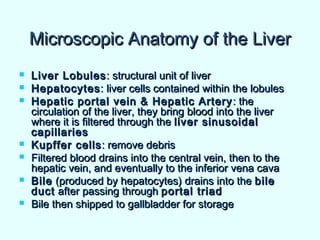
Microscopic Anatomy of the LiverMicroscopic Anatomy of the Liver
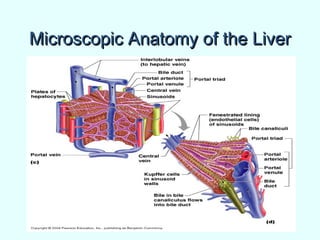
 Liver LobulesLiver Lobules : structural unit of liver: structural unit of liver
 HepatocytesHepatocytes: liver cells contained within the lobules: liver cells contained within the lobules
 Hepatic portal vein & Hepatic ArteryHepatic portal vein & Hepatic Artery : the: the
circulation of the liver, they bring blood into the livercirculation of the liver, they bring blood into the liver
where it is filtered through thewhere it is filtered through the liver sinusoidalliver sinusoidal
capillariescapillaries
 Kupffer cellsKupffer cells: remove debris: remove debris
 Filtered blood drains into the central vein, then to theFiltered blood drains into the central vein, then to the
hepatic vein, and eventually to the inferior vena cavahepatic vein, and eventually to the inferior vena cava
 BileBile (produced by hepatocytes) drains into the(produced by hepatocytes) drains into the bilebile
ductduct after passing throughafter passing through portal triadportal triad
 Bile then shipped to gallbladder for storageBile then shipped to gallbladder for storage
Microscopic Anatomy of the LiverMicroscopic Anatomy of the Liver
Function and Regulation of BileFunction and Regulation of Bile
 Bile ducts are present at every portal triadBile ducts are present at every portal triad
 Bile flows downBile flows down bile canaliculibile canaliculi (tiny canals)(tiny canals)
between adjacent hepatocytes towards bile ductbetween adjacent hepatocytes towards bile duct
branches at every portal triadbranches at every portal triad
 Bile enters the bile ducts which drain into theBile enters the bile ducts which drain into the
common hepatic ductcommon hepatic duct
 BileBile emulsifiesemulsifies fats, separating them into smallerfats, separating them into smaller
partsparts
 BilirubinBilirubin: the chief bile pigment, a waste product: the chief bile pigment, a waste product
of the heme of hemoglobin formed during theof the heme of hemoglobin formed during the
breakdown of worn-out erythrocytesbreakdown of worn-out erythrocytes
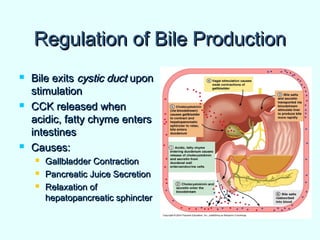
Regulation of Bile ProductionRegulation of Bile Production
 Bile exitsBile exits cystic ductcystic duct uponupon
stimulationstimulation
 CCK released whenCCK released when
acidic, fatty chyme entersacidic, fatty chyme enters
intestinesintestines
 Causes:Causes:
 Gallbladder ContractionGallbladder Contraction
 Pancreatic Juice SecretionPancreatic Juice Secretion
 Relaxation ofRelaxation of
hepatopancreatic sphincterhepatopancreatic sphincter
Features and Functions of theFeatures and Functions of the
PancreasPancreas
 Pancreatic Juice secreted byPancreatic Juice secreted by acinaracinar cellscells
 Islets of LangerhansIslets of Langerhans releaserelease insulininsulin andand
glucagonglucagon (important in glucose metabolism)(important in glucose metabolism)
 Pancreatic Juice contains:Pancreatic Juice contains:
 Sodium Bicarbonate (buffers HCl in stomach)Sodium Bicarbonate (buffers HCl in stomach)
 Proteases (break down polypeptides)Proteases (break down polypeptides)
 Pancreatic amylase (digests oligosaccarides andPancreatic amylase (digests oligosaccarides and
disaccharides into monosaccharides)disaccharides into monosaccharides)
 Pancreatic lipases (break down lipids into fatty acidsPancreatic lipases (break down lipids into fatty acids
and glycerol)and glycerol)
 Pancreatic nucleases (break down nucleic acids)Pancreatic nucleases (break down nucleic acids)
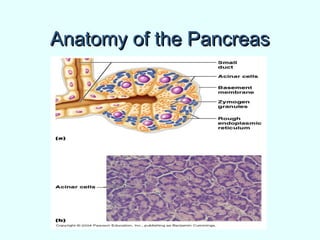
Anatomy of the PancreasAnatomy of the Pancreas
Features and Functions of theFeatures and Functions of the
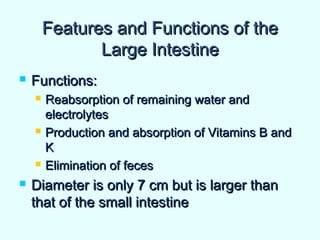
Large IntestineLarge Intestine
 Functions:Functions:
 Reabsorption of remaining water andReabsorption of remaining water and
electrolyteselectrolytes
 Production and absorption of Vitamins B andProduction and absorption of Vitamins B and
KK
 Elimination of fecesElimination of feces
 Diameter is only 7 cm but is larger thanDiameter is only 7 cm but is larger than
that of the small intestinethat of the small intestine
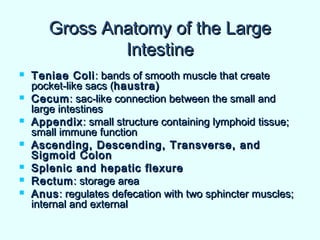
Gross Anatomy of the LargeGross Anatomy of the Large
IntestineIntestine
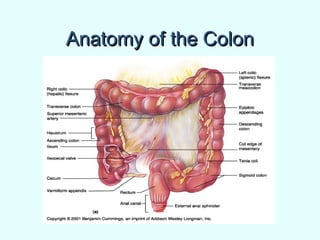
 Teniae ColiTeniae Coli: bands of smooth muscle that create: bands of smooth muscle that create
pocket-like sacs (pocket-like sacs (haustra)haustra)
 CecumCecum: sac-like connection between the small and: sac-like connection between the small and
large intestineslarge intestines
 AppendixAppendix: small structure containing lymphoid tissue;: small structure containing lymphoid tissue;
small immune functionsmall immune function
 Ascending, Descending, Transverse, andAscending, Descending, Transverse, and
Sigmoid ColonSigmoid Colon
 Splenic and hepatic flexureSplenic and hepatic flexure
 RectumRectum: storage area: storage area
 AnusAnus: regulates defecation with two sphincter muscles;: regulates defecation with two sphincter muscles;
internal and externalinternal and external
Anatomy of the ColonAnatomy of the Colon
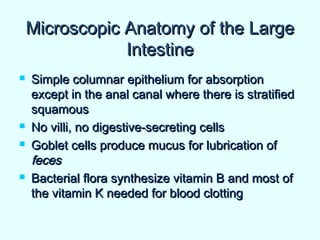
Microscopic Anatomy of the LargeMicroscopic Anatomy of the Large
IntestineIntestine
 Simple columnar epithelium for absorptionSimple columnar epithelium for absorption
except in the anal canal where there is stratifiedexcept in the anal canal where there is stratified
squamoussquamous
 No villi, no digestive-secreting cellsNo villi, no digestive-secreting cells
 Goblet cells produce mucus for lubrication ofGoblet cells produce mucus for lubrication of
fecesfeces
 Bacterial flora synthesize vitamin B and most ofBacterial flora synthesize vitamin B and most of
the vitamin K needed for blood clottingthe vitamin K needed for blood clotting
The Process of AbsorptionThe Process of Absorption
Clinical CornerClinical Corner
 GastritisGastritis- Inflammation of gastric mucosa- Inflammation of gastric mucosa
 Caused by chronic bacterial infectionCaused by chronic bacterial infection
 Ingestion of irritating substances e.g. alcohol/asprineIngestion of irritating substances e.g. alcohol/asprine
 AchlorhydriaAchlorhydria :absence of HCL secretion:absence of HCL secretion
 HypochlorhydriaHypochlorhydria: diminished acid secretions: diminished acid secretions
 Pernicious AnemiaPernicious Anemia : occurs when intrinsic: occurs when intrinsic
factor is not secreted. Absorption of Vit B12 doesfactor is not secreted. Absorption of Vit B12 does
not occur leading to Pernicious anemia (largenot occur leading to Pernicious anemia (large
immature red blood ells)immature red blood ells)
Clinical CornerClinical Corner
 Peptic Ulcer:Peptic Ulcer: The damaged are of stomach orThe damaged are of stomach or
upper part of small intestine mucosa caused by theupper part of small intestine mucosa caused by the
digestive action of gastric or small intestinaldigestive action of gastric or small intestinal
secretions.secretions.
 Causes:Causes:
 i) imbalance between gastric and intestinali) imbalance between gastric and intestinal
secretion and the protective coating of mucosasecretion and the protective coating of mucosa
 ii)Helicobacter bacterial infectionii)Helicobacter bacterial infection
 iii) smoking, alcohol and aspirineiii) smoking, alcohol and aspirine
Clinical CornerClinical Corner
 SprueSprue: Decreased or malabsorption of nutrients: Decreased or malabsorption of nutrients
 CirrohsisCirrohsis - scarred liver due to chronic- scarred liver due to chronic
inflammationinflammation
 Hepatitis - A,B,C,D, and EHepatitis - A,B,C,D, and E
 Biliary calculiBiliary calculi - gall stones - crystals of- gall stones - crystals of
cholesterol in bilecholesterol in bile
 BorborygmusBorborygmus - rumbling noise caused by gas- rumbling noise caused by gas
through intestinesthrough intestines
 Cholecystitis - inflammation of gall bladderCholecystitis - inflammation of gall bladder
 Colitis - inflammation of colonColitis - inflammation of colon
 Dysphagia - difficulty in swallowingDysphagia - difficulty in swallowing
 Enteritis - inflammation of the intestinesEnteritis - inflammation of the intestines
 ConstipationConstipation
 DiarrheaDiarrhea
Clinical corner

Git physiology ga

  • 1.
    Gastrointestinal PhysiologyGastrointestinal Physiology (DigestiveSystem)(Digestive System) Dr. G. AHMADDr. G. AHMAD Assistant Professor PhysiologyAssistant Professor Physiology
  • 2.
    Functions of theDigestive SystemFunctions of the Digestive System  Ingest foodIngest food  Break down food into nutrient moleculesBreak down food into nutrient molecules  Absorb molecules into the bloodstreamAbsorb molecules into the bloodstream  Rid the body of indigestible remainsRid the body of indigestible remains
  • 4.
    Main Divisions ofthe DigestiveMain Divisions of the Digestive SystemSystem  Alimentary CanalAlimentary Canal  Continuous, muscular digestive tube windingContinuous, muscular digestive tube winding throughout the bodythroughout the body  Digests and absorbs food particlesDigests and absorbs food particles  Contains the following organs:Contains the following organs:  Mouth, Pharynx, Esophagus, Stomach, Small and LargeMouth, Pharynx, Esophagus, Stomach, Small and Large IntestinesIntestines  Accessory Digestive OrgansAccessory Digestive Organs  Contains the following organs:Contains the following organs:  Teeth, Tongue, Gallbladder, Salivary Glands, Liver, andTeeth, Tongue, Gallbladder, Salivary Glands, Liver, and PancreasPancreas
  • 5.
  • 6.
    Digestive ProcessesDigestive Processes IngestionIngestion  Mechanical digestionMechanical digestion  PropulsionPropulsion  Chemical digestionChemical digestion  AbsorptionAbsorption  DefecationDefecation
  • 7.
    Actions of Digestive(GI) TractActions of Digestive (GI) Tract  IngestionIngestion  Occurs when materialOccurs when material enters via the mouthenters via the mouth  Mechanical ProcessingMechanical Processing  Crushing / Shearing –Crushing / Shearing – makes material easier tomakes material easier to move through the tractmove through the tract  DigestionDigestion  Chemical breakdown ofChemical breakdown of food into small organicfood into small organic compounds forcompounds for absorptionabsorption  SecretionSecretion  Release of water acids,Release of water acids, buffers, enzymes & saltsbuffers, enzymes & salts by epithelium of GI tractby epithelium of GI tract and glandular organsand glandular organs  AbsorptionAbsorption  Movement of organicMovement of organic substrates, electrolytes,substrates, electrolytes, vitamins & water acrossvitamins & water across digestive epitheliumdigestive epithelium  ExcretionExcretion  Removal of wasteRemoval of waste products from bodyproducts from body fluidsfluids
  • 8.
    Features and Functionsof theFeatures and Functions of the MouthMouth  Buccal/oral cavityBuccal/oral cavity  Contains stratified squamous epitheliumContains stratified squamous epithelium  Vestibule:Vestibule: area bounded by lips andarea bounded by lips and cheeks externally and teeth and gumscheeks externally and teeth and gums internallyinternally  Lips:Lips: posses no sweat or oil glandsposses no sweat or oil glands  Palate:Palate: forms roof of the mouth, soft andforms roof of the mouth, soft and hard palate, uvulahard palate, uvula
  • 9.
    Features and Functionsof theFeatures and Functions of the TongueTongue  Helps grind food into aHelps grind food into a bolusbolus whichwhich contains partially digested food and salivacontains partially digested food and saliva  Helps form words and is a sensory organHelps form words and is a sensory organ for tastefor taste  Three surface features:Three surface features:  Filiform papillae (roughness and grip)Filiform papillae (roughness and grip)  Fungiform papillae (contains taste buds)Fungiform papillae (contains taste buds)  Foliate papilae (contains taste buds)Foliate papilae (contains taste buds)  Circumvallate papillae (contains taste buds)Circumvallate papillae (contains taste buds)
  • 10.
    Papillae of theTonguePapillae of the Tongue
  • 11.
    Features and Functionsof theFeatures and Functions of the Salivary GlandsSalivary Glands  Main functions:Main functions:  Produces and secretes salivaProduces and secretes saliva  Cleanses the mouthCleanses the mouth  Dissolves food chemicals so they can beDissolves food chemicals so they can be tastedtasted  Moistens food, compacting it into a bolusMoistens food, compacting it into a bolus  Begins the chemical breakdown of foodBegins the chemical breakdown of food  Salivary amylase: starchSalivary amylase: starch
  • 12.
    Types of SalivaryGlandsTypes of Salivary Glands  Submandibular GlandsSubmandibular Glands  Found underneath the mandibleFound underneath the mandible  Sublingual GlandsSublingual Glands  Found underneath the tongueFound underneath the tongue  Parotid GlandsParotid Glands  Found anterior to the ear between masseter and skinFound anterior to the ear between masseter and skin  Saliva travels to oral orifice via ducts from allSaliva travels to oral orifice via ducts from all three glandsthree glands
  • 13.
    Anatomy of theSalivary GlandsAnatomy of the Salivary Glands
  • 14.
     Composition ofSaliva: 97-99.5% waterComposition of Saliva: 97-99.5% water  0.5 % electrolytes0.5 % electrolytes  Sodium, potassium, chloride, phosphate,Sodium, potassium, chloride, phosphate, and bicarbonateand bicarbonate  Most important proteins are salivaryMost important proteins are salivary amylase, mucus and lysozymesamylase, mucus and lysozymes
  • 15.
    Features and Functionsof theFeatures and Functions of the TeethTeeth  Break food into smaller parts, increasingBreak food into smaller parts, increasing surface area for digestionsurface area for digestion  Types of TeethTypes of Teeth  Deciduous Teeth (“baby” teeth)Deciduous Teeth (“baby” teeth)  Permanent TeethPermanent Teeth  Incisors- cutting and shreddingIncisors- cutting and shredding  Canines- piercing and tearingCanines- piercing and tearing  Molars- grindingMolars- grinding  Premolars- grinding and crushingPremolars- grinding and crushing
  • 17.
    Tooth StructureTooth Structure CrownCrown: exposed: exposed portion of toothportion of tooth covered by enamelcovered by enamel which covers dentinwhich covers dentin  RootRoot: internal portion: internal portion that is beneath thethat is beneath the gums (gingiva) and isgums (gingiva) and is anchored byanchored by periodontal ligamentsperiodontal ligaments
  • 18.
    PharynxPharynx  Responsible forswallowingResponsible for swallowing  Swallowing is divided into oropharyngeal stage andSwallowing is divided into oropharyngeal stage and esophageal stageesophageal stage
  • 19.
    Features and Functionsof theFeatures and Functions of the EsophagusEsophagus  Muscular tube that propels food to stomach;Muscular tube that propels food to stomach; bolus enters stomach throughbolus enters stomach through esophageal hiatusesophageal hiatus  Esophageal glands – produce mucus to lubricateEsophageal glands – produce mucus to lubricate bolusbolus  Esophageal sphincter – prevents backflow intoEsophageal sphincter – prevents backflow into oral cavityoral cavity  Cardiac sphincter- prevents backflow intoCardiac sphincter- prevents backflow into esophagusesophagus
  • 20.
    Features and Functionsof theFeatures and Functions of the EsophagusEsophagus  A hollow muscular tubeA hollow muscular tube  About 25 cm (10 in.) long and 2About 25 cm (10 in.) long and 2 cm (0.80 in.) widecm (0.80 in.) wide  Conveys solid food and liquidsConveys solid food and liquids to the stomachto the stomach  Begins posterior to cricoidBegins posterior to cricoid cartilagecartilage  Esophageal glands – produceEsophageal glands – produce mucus to lubricate bolusmucus to lubricate bolus  Esophageal sphincter –Esophageal sphincter – prevents backflow into oralprevents backflow into oral cavitycavity
  • 21.
    Anatomy of theEsophagusAnatomy of the Esophagus
  • 22.
    Digestive Processes inthe Mouth,Digestive Processes in the Mouth, Pharynx, and EsophagusPharynx, and Esophagus  Mouth processes:Mouth processes:  IngestionIngestion  Mechanical digestion (e.g. salivary amylase)Mechanical digestion (e.g. salivary amylase)  Initiation of PropulsionInitiation of Propulsion  Mastication: chewingMastication: chewing  Pharyngeal processes:Pharyngeal processes:  Deglutition = swallowingDeglutition = swallowing  Esophageal processes:Esophageal processes:  Peristalsis (rhythmic contractions, involuntary)Peristalsis (rhythmic contractions, involuntary)
  • 23.
  • 24.
    Features and Functionsof theFeatures and Functions of the StomachStomach  Temporary storage area for food and allows it toTemporary storage area for food and allows it to mix with gastric juice to producemix with gastric juice to produce chymechyme  Regions: cardiac, fundus, body, and pyloricRegions: cardiac, fundus, body, and pyloric
  • 25.
    Stomach FunctionStomach Function Major Functions of the StomachMajor Functions of the Stomach  Storage of ingested foodStorage of ingested food  Mechanical breakdown of ingested foodMechanical breakdown of ingested food  Disruption of chemical bonds in food material by acidDisruption of chemical bonds in food material by acid and enzymesand enzymes  Production ofProduction of intrinsic factorintrinsic factor , a glycoprotein, a glycoprotein required for absorption of vitamin Brequired for absorption of vitamin B1212 in small intestinein small intestine
  • 26.
    Anatomy of theStomachAnatomy of the Stomach
  • 27.
    Gastric Juices (hormones)GastricJuices (hormones)  Simple columnar epithelium – containsSimple columnar epithelium – contains gastricgastric pitspits that secretethat secrete gastric juicesgastric juices  Goblet cellsGoblet cells – secrete mucus that coats– secrete mucus that coats stomach and prevents it from being digestedstomach and prevents it from being digested itselfitself  Parietal cellsParietal cells – secrete– secrete hydrochloric acidhydrochloric acid (converts pepsinogen into pepsin) and(converts pepsinogen into pepsin) and intrinsicintrinsic factorfactor (necessary for absorption of vitamin B(necessary for absorption of vitamin B12)12)  Chief cellsChief cells – secrete pepsinogen which is– secrete pepsinogen which is converted to pepsin to aid in protein digestionconverted to pepsin to aid in protein digestion  Enteroendocrine cellsEnteroendocrine cells – release hormones– release hormones such as:such as:  Histamine, Serotonin, Gastrin, Endorphins, andHistamine, Serotonin, Gastrin, Endorphins, and SomatostatinSomatostatin
  • 28.
     HistamineHistamine - activatesparietal cells to release HCl- activates parietal cells to release HCl  SerotoninSerotonin - contraction of stomach muscle- contraction of stomach muscle  GastrinGastrin - gastric glands to increase secretion- gastric glands to increase secretion  EndorphinsEndorphins - natural opiates- natural opiates  SomatostatinSomatostatin - inhibits gastric secretion- inhibits gastric secretion - inhibits gastric emptying- inhibits gastric emptying
  • 29.
    Digestive Processes intheDigestive Processes in the StomachStomach Three PhasesThree Phases  Cephalic PhaseCephalic Phase  Stimulated by the thought, sight, taste, or aroma orStimulated by the thought, sight, taste, or aroma or foodfood  Inputs from olfactory receptors and taste budsInputs from olfactory receptors and taste buds travel to parasympathetic enteric ganglia whichtravel to parasympathetic enteric ganglia which then stimulate stomach glandsthen stimulate stomach glands  Gastric PhaseGastric Phase  Stomach distension activates stretch receptorsStomach distension activates stretch receptors  Food chemicals (e.g. peptides, rising pH) activateFood chemicals (e.g. peptides, rising pH) activate chemoreceptors which activate G cells whichchemoreceptors which activate G cells which secrete gastrinsecrete gastrin  Intestinal PhaseIntestinal Phase  Presence of low pH and partially digested foods inPresence of low pH and partially digested foods in duodenum stimulates intestinal gastrin secretionduodenum stimulates intestinal gastrin secretion
  • 30.
    Digestive Processes intheDigestive Processes in the StomachStomach
  • 31.
    Gastric Motility andEmptyingGastric Motility and Emptying  Peristaltic waves approach stomach and becomePeristaltic waves approach stomach and become stronger near pyloric regionstronger near pyloric region  Pyloric sphincter allows ~ 3 mL of chyme to pass toPyloric sphincter allows ~ 3 mL of chyme to pass to duodenum and the rest to return to stomach for furtherduodenum and the rest to return to stomach for further mixingmixing
  • 32.
    Small IntestineSmall Intestine 90% of absorption occurs in the small intestine90% of absorption occurs in the small intestine
  • 33.
    Small IntestineSmall Intestine The DuodenumThe Duodenum  The segment of small intestine closest to stomachThe segment of small intestine closest to stomach  25 cm (10 in.) long25 cm (10 in.) long  ““Mixing bowl” that receivesMixing bowl” that receives chymechyme from stomach andfrom stomach and digestive secretions from pancreas and liverdigestive secretions from pancreas and liver  Functions of the duodenumFunctions of the duodenum  To receive chyme from stomachTo receive chyme from stomach  To neutralize acids before they can damage the absorptiveTo neutralize acids before they can damage the absorptive surfaces of the small intestinesurfaces of the small intestine
  • 34.
    Small IntestineSmall Intestine The JejunumThe Jejunum  Is the middle segment of small intestineIs the middle segment of small intestine  2.5 meters (8.2 ft) long2.5 meters (8.2 ft) long  Is the location of mostIs the location of most  Chemical digestionChemical digestion  Nutrient absorptionNutrient absorption  Small villiSmall villi
  • 35.
    Small IntestineSmall Intestine The IleumThe Ileum  The final segment of small intestineThe final segment of small intestine  3.5 meters (11.48 ft) long3.5 meters (11.48 ft) long  Ends at theEnds at the ileocecal valveileocecal valve, a sphincter that, a sphincter that controls flow of material from the ileum intocontrols flow of material from the ileum into the large intestinethe large intestine
  • 36.
    Small IntestineSmall Intestine Intestinal SecretionsIntestinal Secretions  Watery intestinal juiceWatery intestinal juice  1.8 liters per day enter1.8 liters per day enter intestinal lumenintestinal lumen  Moisten chymeMoisten chyme  Assist in buffering acidsAssist in buffering acids  Keep digestive enzymesKeep digestive enzymes and products of digestionand products of digestion in solutionin solution  Intestinal MovementsIntestinal Movements  Chyme arrives inChyme arrives in duodenumduodenum  Weak peristalticWeak peristaltic contractions move it slowlycontractions move it slowly toward jejunumtoward jejunum
  • 37.
    Microscopic Anatomy ofSmallMicroscopic Anatomy of Small IntestineIntestine  VilliVilli: fingerlike projections that increase the: fingerlike projections that increase the surface area of the SIsurface area of the SI  MicrovilliMicrovilli: tiny projections on the plasma: tiny projections on the plasma membranes of columnar cells that appear fuzzymembranes of columnar cells that appear fuzzy (i.e. brush border cells)(i.e. brush border cells)  Crypts of LieberkuhnCrypts of Lieberkuhn : secrete intestinal juice: secrete intestinal juice and special lysozymes that protect againstand special lysozymes that protect against bacteriabacteria  Peyer’s PatchesPeyer’s Patches: aggregated lymphoid: aggregated lymphoid tissues containing lymphocytestissues containing lymphocytes
  • 38.
    Microscopic Anatomy ofthe SmallMicroscopic Anatomy of the Small IntestineIntestine
  • 39.
    Secretions of theSmall IntestineSecretions of the Small Intestine  SecretinSecretin: released by enteroendocrine cells when: released by enteroendocrine cells when acidic chyme enters SI; causes release of bicarbonate-acidic chyme enters SI; causes release of bicarbonate- rich pancreatic juicesrich pancreatic juices  SomatostatinSomatostatin: slows gastric motility and emptying and: slows gastric motility and emptying and inhibits production of gastric secretionsinhibits production of gastric secretions  Cholecystokinin (CCK)Cholecystokinin (CCK) : released when fatty, protein-: released when fatty, protein- rich chyme enters SI; causes release of enzyme-richrich chyme enters SI; causes release of enzyme-rich pancreatic juices and bilepancreatic juices and bile  Brush border enzymesBrush border enzymes: process long peptides,: process long peptides, nucleic acids, and sugars into smaller onesnucleic acids, and sugars into smaller ones
  • 40.
    After Digestion: AbsorptionAfterDigestion: Absorption Protein Fats
  • 41.
    Functions of theLiverFunctions of the Liver  Largest internal organLargest internal organ  Functions:Functions:  Filters and processes nutrient-rich blood ofFilters and processes nutrient-rich blood of carbohydrates, proteins, and lipids fromcarbohydrates, proteins, and lipids from intestineintestine  Production and regulation of cholesterolProduction and regulation of cholesterol  Production ofProduction of bilebile which emulsifies fatswhich emulsifies fats  Removes drugs and hormones fromRemoves drugs and hormones from circulationcirculation  Storage of vitamins and mineralsStorage of vitamins and minerals
  • 42.
    Anatomy of theLiverAnatomy of the Liver  Right and Left LobesRight and Left Lobes : separated by: separated by falciformfalciform ligamentligament  Caudate and Quadrate LobesCaudate and Quadrate Lobes : found on: found on posterior sideposterior side  Blood vessels:Blood vessels:  Hepatic artery/vein and hepatic portal veinHepatic artery/vein and hepatic portal vein  GallbladderGallbladder: found underneath left lobe, stores: found underneath left lobe, stores bilebile
  • 43.
    Gross Anatomy ofthe LiverGross Anatomy of the Liver
  • 44.
    Microscopic Anatomy ofthe LiverMicroscopic Anatomy of the Liver  Liver LobulesLiver Lobules : structural unit of liver: structural unit of liver  HepatocytesHepatocytes: liver cells contained within the lobules: liver cells contained within the lobules  Hepatic portal vein & Hepatic ArteryHepatic portal vein & Hepatic Artery : the: the circulation of the liver, they bring blood into the livercirculation of the liver, they bring blood into the liver where it is filtered through thewhere it is filtered through the liver sinusoidalliver sinusoidal capillariescapillaries  Kupffer cellsKupffer cells: remove debris: remove debris  Filtered blood drains into the central vein, then to theFiltered blood drains into the central vein, then to the hepatic vein, and eventually to the inferior vena cavahepatic vein, and eventually to the inferior vena cava  BileBile (produced by hepatocytes) drains into the(produced by hepatocytes) drains into the bilebile ductduct after passing throughafter passing through portal triadportal triad  Bile then shipped to gallbladder for storageBile then shipped to gallbladder for storage
  • 45.
    Microscopic Anatomy ofthe LiverMicroscopic Anatomy of the Liver
  • 46.
    Function and Regulationof BileFunction and Regulation of Bile  Bile ducts are present at every portal triadBile ducts are present at every portal triad  Bile flows downBile flows down bile canaliculibile canaliculi (tiny canals)(tiny canals) between adjacent hepatocytes towards bile ductbetween adjacent hepatocytes towards bile duct branches at every portal triadbranches at every portal triad  Bile enters the bile ducts which drain into theBile enters the bile ducts which drain into the common hepatic ductcommon hepatic duct  BileBile emulsifiesemulsifies fats, separating them into smallerfats, separating them into smaller partsparts  BilirubinBilirubin: the chief bile pigment, a waste product: the chief bile pigment, a waste product of the heme of hemoglobin formed during theof the heme of hemoglobin formed during the breakdown of worn-out erythrocytesbreakdown of worn-out erythrocytes
  • 47.
    Regulation of BileProductionRegulation of Bile Production  Bile exitsBile exits cystic ductcystic duct uponupon stimulationstimulation  CCK released whenCCK released when acidic, fatty chyme entersacidic, fatty chyme enters intestinesintestines  Causes:Causes:  Gallbladder ContractionGallbladder Contraction  Pancreatic Juice SecretionPancreatic Juice Secretion  Relaxation ofRelaxation of hepatopancreatic sphincterhepatopancreatic sphincter
  • 48.
    Features and Functionsof theFeatures and Functions of the PancreasPancreas  Pancreatic Juice secreted byPancreatic Juice secreted by acinaracinar cellscells  Islets of LangerhansIslets of Langerhans releaserelease insulininsulin andand glucagonglucagon (important in glucose metabolism)(important in glucose metabolism)  Pancreatic Juice contains:Pancreatic Juice contains:  Sodium Bicarbonate (buffers HCl in stomach)Sodium Bicarbonate (buffers HCl in stomach)  Proteases (break down polypeptides)Proteases (break down polypeptides)  Pancreatic amylase (digests oligosaccarides andPancreatic amylase (digests oligosaccarides and disaccharides into monosaccharides)disaccharides into monosaccharides)  Pancreatic lipases (break down lipids into fatty acidsPancreatic lipases (break down lipids into fatty acids and glycerol)and glycerol)  Pancreatic nucleases (break down nucleic acids)Pancreatic nucleases (break down nucleic acids)
  • 49.
    Anatomy of thePancreasAnatomy of the Pancreas
  • 50.
    Features and Functionsof theFeatures and Functions of the Large IntestineLarge Intestine  Functions:Functions:  Reabsorption of remaining water andReabsorption of remaining water and electrolyteselectrolytes  Production and absorption of Vitamins B andProduction and absorption of Vitamins B and KK  Elimination of fecesElimination of feces  Diameter is only 7 cm but is larger thanDiameter is only 7 cm but is larger than that of the small intestinethat of the small intestine
  • 51.
    Gross Anatomy ofthe LargeGross Anatomy of the Large IntestineIntestine  Teniae ColiTeniae Coli: bands of smooth muscle that create: bands of smooth muscle that create pocket-like sacs (pocket-like sacs (haustra)haustra)  CecumCecum: sac-like connection between the small and: sac-like connection between the small and large intestineslarge intestines  AppendixAppendix: small structure containing lymphoid tissue;: small structure containing lymphoid tissue; small immune functionsmall immune function  Ascending, Descending, Transverse, andAscending, Descending, Transverse, and Sigmoid ColonSigmoid Colon  Splenic and hepatic flexureSplenic and hepatic flexure  RectumRectum: storage area: storage area  AnusAnus: regulates defecation with two sphincter muscles;: regulates defecation with two sphincter muscles; internal and externalinternal and external
  • 52.
    Anatomy of theColonAnatomy of the Colon
  • 53.
    Microscopic Anatomy ofthe LargeMicroscopic Anatomy of the Large IntestineIntestine  Simple columnar epithelium for absorptionSimple columnar epithelium for absorption except in the anal canal where there is stratifiedexcept in the anal canal where there is stratified squamoussquamous  No villi, no digestive-secreting cellsNo villi, no digestive-secreting cells  Goblet cells produce mucus for lubrication ofGoblet cells produce mucus for lubrication of fecesfeces  Bacterial flora synthesize vitamin B and most ofBacterial flora synthesize vitamin B and most of the vitamin K needed for blood clottingthe vitamin K needed for blood clotting
  • 54.
    The Process ofAbsorptionThe Process of Absorption
  • 55.
    Clinical CornerClinical Corner GastritisGastritis- Inflammation of gastric mucosa- Inflammation of gastric mucosa  Caused by chronic bacterial infectionCaused by chronic bacterial infection  Ingestion of irritating substances e.g. alcohol/asprineIngestion of irritating substances e.g. alcohol/asprine  AchlorhydriaAchlorhydria :absence of HCL secretion:absence of HCL secretion  HypochlorhydriaHypochlorhydria: diminished acid secretions: diminished acid secretions  Pernicious AnemiaPernicious Anemia : occurs when intrinsic: occurs when intrinsic factor is not secreted. Absorption of Vit B12 doesfactor is not secreted. Absorption of Vit B12 does not occur leading to Pernicious anemia (largenot occur leading to Pernicious anemia (large immature red blood ells)immature red blood ells)
  • 56.
    Clinical CornerClinical Corner Peptic Ulcer:Peptic Ulcer: The damaged are of stomach orThe damaged are of stomach or upper part of small intestine mucosa caused by theupper part of small intestine mucosa caused by the digestive action of gastric or small intestinaldigestive action of gastric or small intestinal secretions.secretions.  Causes:Causes:  i) imbalance between gastric and intestinali) imbalance between gastric and intestinal secretion and the protective coating of mucosasecretion and the protective coating of mucosa  ii)Helicobacter bacterial infectionii)Helicobacter bacterial infection  iii) smoking, alcohol and aspirineiii) smoking, alcohol and aspirine
  • 57.
    Clinical CornerClinical Corner SprueSprue: Decreased or malabsorption of nutrients: Decreased or malabsorption of nutrients  CirrohsisCirrohsis - scarred liver due to chronic- scarred liver due to chronic inflammationinflammation  Hepatitis - A,B,C,D, and EHepatitis - A,B,C,D, and E  Biliary calculiBiliary calculi - gall stones - crystals of- gall stones - crystals of cholesterol in bilecholesterol in bile  BorborygmusBorborygmus - rumbling noise caused by gas- rumbling noise caused by gas through intestinesthrough intestines
  • 58.
     Cholecystitis -inflammation of gall bladderCholecystitis - inflammation of gall bladder  Colitis - inflammation of colonColitis - inflammation of colon  Dysphagia - difficulty in swallowingDysphagia - difficulty in swallowing  Enteritis - inflammation of the intestinesEnteritis - inflammation of the intestines  ConstipationConstipation  DiarrheaDiarrhea Clinical corner

Editor's Notes

  • #21 Swallowing Also called deglutition Can be initiated voluntarily Proceeds automatically Is divided into three phases Buccal phase Pharyngeal phase Esophageal phase