Presented- Atul Jain
Introduction
 It is a major cause of cancer mortality worldwide.
 Cure rates little better than 5–10%.
 5-year survival rate is only 20 %.
 Early diagnosis is the key to success.
 The only treatment modality able to cure the disease is
resectional surgery.
Incidence and Epidemiology
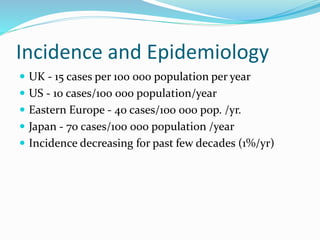
 UK - 15 cases per 100 000 population per year
 US - 10 cases/100 000 population/year
 Eastern Europe - 40 cases/100 000 pop. /yr.
 Japan - 70 cases/100 000 population /year
 Incidence decreasing for past few decades (1%/yr)
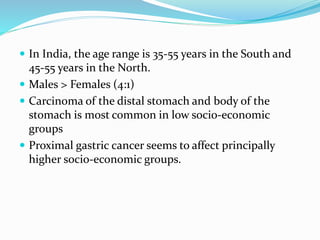
 In India, the age range is 35-55 years in the South and
45-55 years in the North.
 Males > Females (4:1)
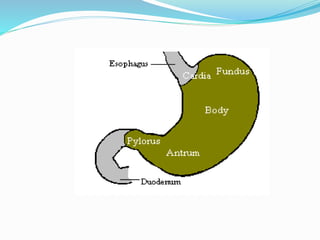
 Carcinoma of the distal stomach and body of the
stomach is most common in low socio-economic
groups
 Proximal gastric cancer seems to affect principally
higher socio-economic groups.
Aetiology
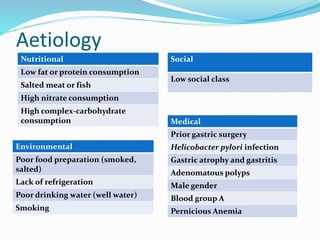
Nutritional
Low fat or protein consumption
Salted meat or fish
High nitrate consumption
High complex-carbohydrate
consumption
Environmental
Poor food preparation (smoked,
salted)
Lack of refrigeration
Poor drinking water (well water)
Smoking
Social
Low social class
Medical
Prior gastric surgery
Helicobacter pylori infection
Gastric atrophy and gastritis
Adenomatous polyps
Male gender
Blood group A
Pernicious Anemia
H. pylori
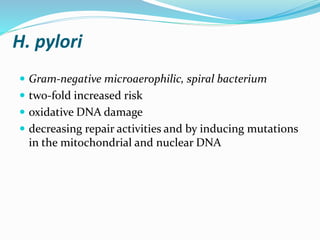
 Gram-negative microaerophilic, spiral bacterium
 two-fold increased risk
 oxidative DNA damage
 decreasing repair activities and by inducing mutations
in the mitochondrial and nuclear DNA
Dietary factors
 Diets rich in starch and poor in protein
 Less fruit intake
 Excessive salt intake
 High dietary nitrate
 Consumption of large amount of salted fish, soy sauce,
pickled vegetables, cured meat and other salt-
preserved foods
Family history and Genetic
alterations
 90 per cent of gastric cancers are sporadic, whereas 10
per cent are hereditary
 Chromosomal instability (CIN)- loss of heterozygosity
(LOH), translocations, and amplifications – APC
gene, BCL2 gene,β-catenin
 Microsatellite instability (MSI)- inactivation of the
mismatch repair gene hMLH1
 Tumor suppressor genes alteration - p53 gene, RUNX3
 Overexpression of cyclin E and CDK together with
aberrant p53 expression & downregulation of p27, a
common event in gastric cancer.
 E-cadherin, a product of the CDH1 gene play an
important role in cell motility, growth, and invasion of
gastric cancer.
 Vascular endothelial growth factor (VEGF) expression
correlate with poor survival
PATHOLOGY
 It refers to any malignant neoplasm that arises from
the region extending between the gastroesophageal
junction and the pylorus.
 95 % are epithelial in origin- adenocarcinomas
 Adenosquamous, squamous, and undifferentiated
carcinomas are however rare.
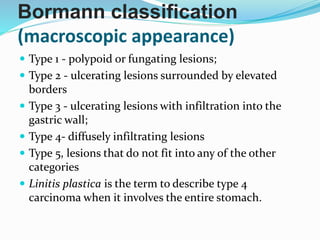
Bormann classification
(macroscopic appearance)
 Type 1 - polypoid or fungating lesions;
 Type 2 - ulcerating lesions surrounded by elevated
borders
 Type 3 - ulcerating lesions with infiltration into the
gastric wall;
 Type 4- diffusely infiltrating lesions
 Type 5, lesions that do not fit into any of the other
categories
 Linitis plastica is the term to describe type 4
carcinoma when it involves the entire stomach.
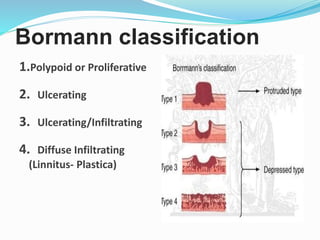
Bormann classification
1.Polypoid or Proliferative
2. Ulcerating
3. Ulcerating/Infiltrating
4. Diffuse Infiltrating
(Linnitus- Plastica)
Lauren classification
(Histological)
 Intestinal gastric cancer - the tumour resembles
carcinomas found elsewhere in the tubular
gastrointestinal tract and forms polypoid tumours or
ulcers.
 Diffuse gastric cancer infiltrates deeply into the
stomach without forming obvious mass lesions but
spreading widely in the gastric wall. has a much worse
prognosis.
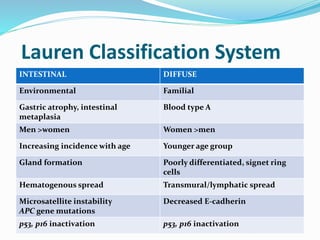
Lauren Classification System
INTESTINAL DIFFUSE
Environmental Familial
Gastric atrophy, intestinal
metaplasia
Blood type A
Men >women Women >men
Increasing incidence with age Younger age group
Gland formation Poorly differentiated, signet ring
cells
Hematogenous spread Transmural/lymphatic spread
Microsatellite instability
APC gene mutations
Decreased E-cadherin
p53, p16 inactivation p53, p16 inactivation
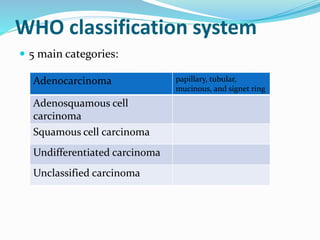
WHO classification system
 5 main categories:
Adenocarcinoma papillary, tubular,
mucinous, and signet ring
Adenosquamous cell
carcinoma
Squamous cell carcinoma
Undifferentiated carcinoma
Unclassified carcinoma
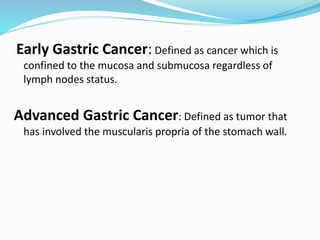
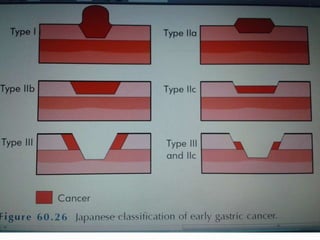
Early Gastric Cancer: Defined as cancer which is
confined to the mucosa and submucosa regardless of
lymph nodes status.
Advanced Gastric Cancer: Defined as tumor that
has involved the muscularis propria of the stomach wall.
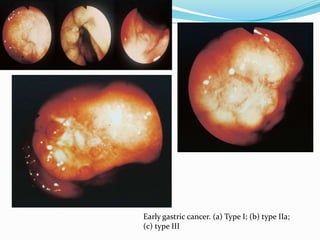
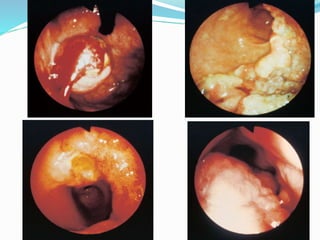
Early gastric cancer. (a) Type I; (b) type IIa;
(c) type III
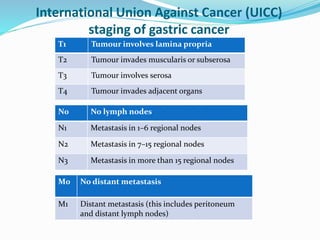
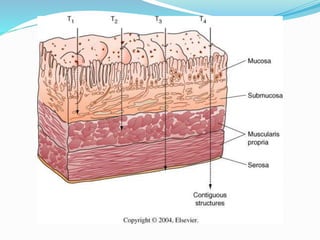
International Union Against Cancer (UICC)
staging of gastric cancer
T1 Tumour involves lamina propria
T2 Tumour invades muscularis or subserosa
T3 Tumour involves serosa
T4 Tumour invades adjacent organs
N0 No lymph nodes
N1 Metastasis in 1–6 regional nodes
N2 Metastasis in 7–15 regional nodes
N3 Metastasis in more than 15 regional nodes
M0 No distant metastasis
M1 Distant metastasis (this includes peritoneum
and distant lymph nodes)
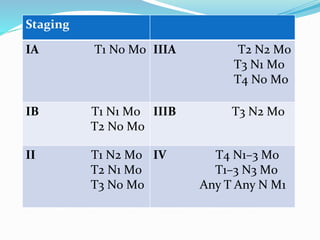
Staging
IA T1 N0 M0 IIIA T2 N2 M0
T3 N1 M0
T4 N0 M0
IB T1 N1 M0
T2 N0 M0
IIIB T3 N2 M0
II T1 N2 M0
T2 N1 M0
T3 N0 M0
IV T4 N1–3 M0
T1–3 N3 M0
Any T Any N M1
SPREAD OF GASTRIC CANCER:
 The diffuse type spreads rapidly through the
submucosal and serosal lymphatic and penetrates
the gastric wall at early stage, the intestinal variety
remains localized for a while and has less tendency to
disseminate.
The spread by:
1. Direct (loco regional)
2. Lymphatic
3. Blood (Haematogenous)
4. Transcoelomic
Clinical Presentation
 Vague epigastric discomfort and indigestion
 Early satiety, anorexia
 weight loss, fatigue, or vomiting
 iron-deficiency anaemia ,
 palpable abdominal mass
 a palpable supraclavicular (Virchow's) or
 periumbilical (Sister Mary Joseph's) lymph node,
 peritoneal metastasis palpable by rectal
examination (Blummer's shelf)
 palpable ovarian mass (Krukenberg's tumor).
INVESTIGATIONS
 CBC identifies anemia, with may be caused by
bleeding, liver dysfunction, or poor nutrition.
 30% have anemia.
 Electrolyte panels and
 LFT
 coagulation studies
Diagnosis:
1. UGI Radiography (double contrast)
2. Endoscopy (Biopsy / Ultrasound)
 GOLD STANDARD
 Best pre-operative staging
 Needle aspiration of LN w/ ultrasound guidance
 Can even give preop neoadjuvant tx
3. CT scan (intravenous and oral contrast):
 For pre-operative staging
4. Whole body Positron Emission Tomography
scanning (PET):
 Tumor cell preferentially accumulate positron-emitting
18F fluorodeoxyglucose.
Laparoscopy
 Inspect peritoneal surfaces, liver surface.
 Identification of advanced disease avoids non-
therapeutic laparotomy in 25%.
 Patients with small volume metastases in peritoneum
or liver have a life expectancy of 3-9 months, thus
rarely benefit from palliative resection.
Screening of Gastric Cancer
 Patients at risk for gastric CA should undergo
yearly endoscopy and biopsy:
1. Familial adenomatous polyposis
2. Hereditary nonpolyposis colorectal cancer
3. Gastric adenomas
4. Menetrier’s disease
5. Intestinal metaplasia or dysplasia
6. Remote gastrectomy or gastrojejunostomy
TREATMENT:
SURGERY:
 The only curative tx for gastric cancer
 Except:
1. Can’t tolerate abdominal surgery
2. Overwhelming metastasis
 Palliation is poor with non-resective
operations
 GOAL: resect all tumors, with negative
margins (5cm) and adequate
lymphadenectomy
 Enbloc resection of adjacent organ is done if
needed.
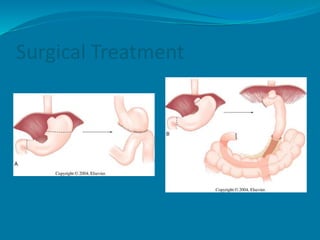
Treatment
 Total gastrectomy
 Subtotal gastrectomy
 Palliative surgery
Surgical Treatment
Other treatment modalities
 Radiotherapy - role in the palliative treatment of
painful bony metastases.
 Chemotherapy -combination of epirubicin, cis-
platinum and infusional 5-fluorouracil (5-FU) or an
oral analogue such as capecitabine.

Carcinoma stomach

  • 1.
  • 3.
    Introduction  It isa major cause of cancer mortality worldwide.  Cure rates little better than 5–10%.  5-year survival rate is only 20 %.  Early diagnosis is the key to success.  The only treatment modality able to cure the disease is resectional surgery.
  • 4.
    Incidence and Epidemiology UK - 15 cases per 100 000 population per year  US - 10 cases/100 000 population/year  Eastern Europe - 40 cases/100 000 pop. /yr.  Japan - 70 cases/100 000 population /year  Incidence decreasing for past few decades (1%/yr)
  • 5.
     In India,the age range is 35-55 years in the South and 45-55 years in the North.  Males > Females (4:1)  Carcinoma of the distal stomach and body of the stomach is most common in low socio-economic groups  Proximal gastric cancer seems to affect principally higher socio-economic groups.
  • 6.
    Aetiology Nutritional Low fat orprotein consumption Salted meat or fish High nitrate consumption High complex-carbohydrate consumption Environmental Poor food preparation (smoked, salted) Lack of refrigeration Poor drinking water (well water) Smoking Social Low social class Medical Prior gastric surgery Helicobacter pylori infection Gastric atrophy and gastritis Adenomatous polyps Male gender Blood group A Pernicious Anemia
  • 7.
    H. pylori  Gram-negativemicroaerophilic, spiral bacterium  two-fold increased risk  oxidative DNA damage  decreasing repair activities and by inducing mutations in the mitochondrial and nuclear DNA
  • 8.
    Dietary factors  Dietsrich in starch and poor in protein  Less fruit intake  Excessive salt intake  High dietary nitrate  Consumption of large amount of salted fish, soy sauce, pickled vegetables, cured meat and other salt- preserved foods
  • 9.
    Family history andGenetic alterations  90 per cent of gastric cancers are sporadic, whereas 10 per cent are hereditary  Chromosomal instability (CIN)- loss of heterozygosity (LOH), translocations, and amplifications – APC gene, BCL2 gene,β-catenin  Microsatellite instability (MSI)- inactivation of the mismatch repair gene hMLH1  Tumor suppressor genes alteration - p53 gene, RUNX3
  • 10.
     Overexpression ofcyclin E and CDK together with aberrant p53 expression & downregulation of p27, a common event in gastric cancer.  E-cadherin, a product of the CDH1 gene play an important role in cell motility, growth, and invasion of gastric cancer.  Vascular endothelial growth factor (VEGF) expression correlate with poor survival
  • 11.
    PATHOLOGY  It refersto any malignant neoplasm that arises from the region extending between the gastroesophageal junction and the pylorus.  95 % are epithelial in origin- adenocarcinomas  Adenosquamous, squamous, and undifferentiated carcinomas are however rare.
  • 12.
    Bormann classification (macroscopic appearance) Type 1 - polypoid or fungating lesions;  Type 2 - ulcerating lesions surrounded by elevated borders  Type 3 - ulcerating lesions with infiltration into the gastric wall;  Type 4- diffusely infiltrating lesions  Type 5, lesions that do not fit into any of the other categories  Linitis plastica is the term to describe type 4 carcinoma when it involves the entire stomach.
  • 13.
    Bormann classification 1.Polypoid orProliferative 2. Ulcerating 3. Ulcerating/Infiltrating 4. Diffuse Infiltrating (Linnitus- Plastica)
  • 14.
    Lauren classification (Histological)  Intestinalgastric cancer - the tumour resembles carcinomas found elsewhere in the tubular gastrointestinal tract and forms polypoid tumours or ulcers.  Diffuse gastric cancer infiltrates deeply into the stomach without forming obvious mass lesions but spreading widely in the gastric wall. has a much worse prognosis.
  • 15.
    Lauren Classification System INTESTINALDIFFUSE Environmental Familial Gastric atrophy, intestinal metaplasia Blood type A Men >women Women >men Increasing incidence with age Younger age group Gland formation Poorly differentiated, signet ring cells Hematogenous spread Transmural/lymphatic spread Microsatellite instability APC gene mutations Decreased E-cadherin p53, p16 inactivation p53, p16 inactivation
  • 16.
    WHO classification system 5 main categories: Adenocarcinoma papillary, tubular, mucinous, and signet ring Adenosquamous cell carcinoma Squamous cell carcinoma Undifferentiated carcinoma Unclassified carcinoma
  • 17.
    Early Gastric Cancer:Defined as cancer which is confined to the mucosa and submucosa regardless of lymph nodes status. Advanced Gastric Cancer: Defined as tumor that has involved the muscularis propria of the stomach wall.
  • 19.
    Early gastric cancer.(a) Type I; (b) type IIa; (c) type III
  • 21.
    International Union AgainstCancer (UICC) staging of gastric cancer T1 Tumour involves lamina propria T2 Tumour invades muscularis or subserosa T3 Tumour involves serosa T4 Tumour invades adjacent organs N0 No lymph nodes N1 Metastasis in 1–6 regional nodes N2 Metastasis in 7–15 regional nodes N3 Metastasis in more than 15 regional nodes M0 No distant metastasis M1 Distant metastasis (this includes peritoneum and distant lymph nodes)
  • 23.
    Staging IA T1 N0M0 IIIA T2 N2 M0 T3 N1 M0 T4 N0 M0 IB T1 N1 M0 T2 N0 M0 IIIB T3 N2 M0 II T1 N2 M0 T2 N1 M0 T3 N0 M0 IV T4 N1–3 M0 T1–3 N3 M0 Any T Any N M1
  • 24.
    SPREAD OF GASTRICCANCER:  The diffuse type spreads rapidly through the submucosal and serosal lymphatic and penetrates the gastric wall at early stage, the intestinal variety remains localized for a while and has less tendency to disseminate. The spread by: 1. Direct (loco regional) 2. Lymphatic 3. Blood (Haematogenous) 4. Transcoelomic
  • 25.
    Clinical Presentation  Vagueepigastric discomfort and indigestion  Early satiety, anorexia  weight loss, fatigue, or vomiting  iron-deficiency anaemia ,  palpable abdominal mass  a palpable supraclavicular (Virchow's) or  periumbilical (Sister Mary Joseph's) lymph node,  peritoneal metastasis palpable by rectal examination (Blummer's shelf)  palpable ovarian mass (Krukenberg's tumor).
  • 26.
    INVESTIGATIONS  CBC identifiesanemia, with may be caused by bleeding, liver dysfunction, or poor nutrition.  30% have anemia.  Electrolyte panels and  LFT  coagulation studies
  • 27.
    Diagnosis: 1. UGI Radiography(double contrast) 2. Endoscopy (Biopsy / Ultrasound)  GOLD STANDARD  Best pre-operative staging  Needle aspiration of LN w/ ultrasound guidance  Can even give preop neoadjuvant tx 3. CT scan (intravenous and oral contrast):  For pre-operative staging 4. Whole body Positron Emission Tomography scanning (PET):  Tumor cell preferentially accumulate positron-emitting 18F fluorodeoxyglucose.
  • 28.
    Laparoscopy  Inspect peritonealsurfaces, liver surface.  Identification of advanced disease avoids non- therapeutic laparotomy in 25%.  Patients with small volume metastases in peritoneum or liver have a life expectancy of 3-9 months, thus rarely benefit from palliative resection.
  • 29.
    Screening of GastricCancer  Patients at risk for gastric CA should undergo yearly endoscopy and biopsy: 1. Familial adenomatous polyposis 2. Hereditary nonpolyposis colorectal cancer 3. Gastric adenomas 4. Menetrier’s disease 5. Intestinal metaplasia or dysplasia 6. Remote gastrectomy or gastrojejunostomy
  • 30.
    TREATMENT: SURGERY:  The onlycurative tx for gastric cancer  Except: 1. Can’t tolerate abdominal surgery 2. Overwhelming metastasis  Palliation is poor with non-resective operations  GOAL: resect all tumors, with negative margins (5cm) and adequate lymphadenectomy  Enbloc resection of adjacent organ is done if needed.
  • 31.
    Treatment  Total gastrectomy Subtotal gastrectomy  Palliative surgery
  • 32.
  • 33.
    Other treatment modalities Radiotherapy - role in the palliative treatment of painful bony metastases.  Chemotherapy -combination of epirubicin, cis- platinum and infusional 5-fluorouracil (5-FU) or an oral analogue such as capecitabine.