MMS (17-19)
Welingkar Institute Of Management
The remarkable history of GIS
• In 1854, Cholera hit the city of London, England.
• British physician John Snow began mapping outbreak locations, roads, property
boundaries and water lines.
• When he added these features to a map, he saw that Cholera cases were
commonly found along the water line.
• John Snow’s Cholera map was a major event connecting geography and public
health safety.
• The work of John Snow demonstrated that GIS is a problem-solving tool. He put
geographic layers on a paper map and made a life-saving discovery.
• We go from static paper maps to dynamic digital maps.
• We go from basic analysis to more complex problem solving.
GIS
• GIS software is designed to capture, manage, analyze, and display all forms
of geographically referenced information.
• It allows us to view, understand, question, interpret, and visualize our world
in ways that reveal relationships, patterns, and trends in the form of maps,
globes, reports, and charts.
• Resulting patterns and trends seen on a digital map much easier than
viewing the data on spreadsheets
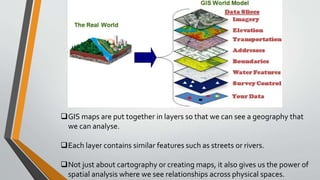
GIS maps are put together in layers so that we can see a geography that
we can analyse.
Each layer contains similar features such as streets or rivers.
Not just about cartography or creating maps, it also gives us the power of
spatial analysis where we see relationships across physical spaces.
Application of GIS
CONSERVATION ORGANIZATIONS:
• Predict the likely consequences of global warming.
• Manage conservation in national parks.
• Maintain the biodiversity of our landscape.
POLICE FORCES
• To discover patterns in criminal activities and plan operations much more
strategically
Department of Education
• to make sure they provide the right number of school places for children in
the right locations
GIS in Retail
Retailers like Nike and Levis use GIS:
• To pinpoint the best locations for new stores and stock items that
match local customers needs
• To avoid making costly mistakes while opening new retail locations.
• Complex analysis become simple and decisions become clear because
Knowing where things happen matter to a business.
Thank you!!

Gis

  • 1.
  • 3.
    The remarkable historyof GIS • In 1854, Cholera hit the city of London, England. • British physician John Snow began mapping outbreak locations, roads, property boundaries and water lines. • When he added these features to a map, he saw that Cholera cases were commonly found along the water line. • John Snow’s Cholera map was a major event connecting geography and public health safety. • The work of John Snow demonstrated that GIS is a problem-solving tool. He put geographic layers on a paper map and made a life-saving discovery. • We go from static paper maps to dynamic digital maps. • We go from basic analysis to more complex problem solving.
  • 5.
    GIS • GIS softwareis designed to capture, manage, analyze, and display all forms of geographically referenced information. • It allows us to view, understand, question, interpret, and visualize our world in ways that reveal relationships, patterns, and trends in the form of maps, globes, reports, and charts. • Resulting patterns and trends seen on a digital map much easier than viewing the data on spreadsheets
  • 6.
    GIS maps areput together in layers so that we can see a geography that we can analyse. Each layer contains similar features such as streets or rivers. Not just about cartography or creating maps, it also gives us the power of spatial analysis where we see relationships across physical spaces.
  • 7.
    Application of GIS CONSERVATIONORGANIZATIONS: • Predict the likely consequences of global warming. • Manage conservation in national parks. • Maintain the biodiversity of our landscape. POLICE FORCES • To discover patterns in criminal activities and plan operations much more strategically Department of Education • to make sure they provide the right number of school places for children in the right locations
  • 8.
    GIS in Retail Retailerslike Nike and Levis use GIS: • To pinpoint the best locations for new stores and stock items that match local customers needs • To avoid making costly mistakes while opening new retail locations. • Complex analysis become simple and decisions become clear because Knowing where things happen matter to a business.
  • 9.

Editor's Notes

  • #3 A collection of maps on a computer. Maps are important decision making tools. They help us get to places. And they are becoming more immersed in our everyday lives. In the past, we’ve used paper and ink to draw and visualize our world. Today, we’re using computer technology to draw and manipulate our different maps
  • #5 If John Snow would have been alive today, those layers would have been stored in a database. He could’ve turned them on and off to visualize possible contamination causes. He could have even used spatial statistics to solve London’s problem.
  • #6 Make better decisions using geography.