
GINGIVAL ENLARGEMENT &
ITS MANAGEMENT
DR. ANTARLEENA SENGUPTA
I MDS, DEPTT. OF PERIODONTOLOGY,
MCODS MANGALORE
2020
CONTENTS
1. INTRODUCTION
2. CLASSIFICATION
3. INDICES
4. INFLAMMATORY ENLARGEMENT
5. DRUG-INDUCED GINGIVAL
OVERGROWTH
6. IDIOPATHIC ENLARGEMENT
7. SYSTEMIC DISEASES LEADING TO
GINGIVAL ENLARGEMENT
A. CONDITIONED ENLARGEMENT
B. ENLARGEMENT ASSOCIATED WITH
SYSTEMIC DISEASES
8. NEOPLASTIC ENLARGEMENT (GINGIVAL
TUMORS)
9. FALSE ENLARGEMENTS
10. CONCLUSION
11. REFERENCES
INTRODUCTION
 Increase in size of the gingiva is a common feature of gingival disease.
 Accepted current terminology for this condition is gingival enlargement or gingival over-
growth (GO).
 Strictly clinical descriptive terms
 Previously: “hypertrophic gingivitis” or “gingival hyperplasia.”
CLASSIFICATION
A. According to etiologic factors and pathologic
changes:
I. Inflammatory enlargement
 Acute
 Chronic
I. Drug-induced enlargement
II. Enlargements associated with systemic diseases or
conditions
III. Conditioned enlargement
 Pregnancy
 Puberty
 Vitamin C deficiency
 Plasma cell gingivitis
 Nonspecific conditioned enlargement (pyogenic
granuloma)
IV. Systemic diseases causing gingival enlargement
 Leukemia
 Granulomatous diseases (e.g., Wegener’s
granulomatosis, sarcoidosis)
V. Neoplastic enlargement (gingival tumors)
 Benign tumors
 Malignant tumors
VI. False enlargement
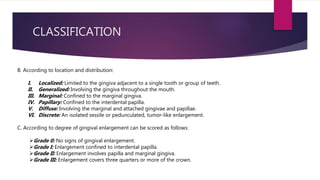
B. According to location and distribution:
I. Localized: Limited to the gingiva adjacent to a single tooth or group of teeth.
II. Generalized: Involving the gingiva throughout the mouth.
III. Marginal: Confined to the marginal gingiva.
IV. Papillary: Confined to the interdental papilla.
V. Diffuse: Involving the marginal and attached gingivae and papillae.
VI. Discrete: An isolated sessile or pedunculated, tumor-like enlargement.
C. According to degree of gingival enlargement can be scored as follows:
Grade 0: No signs of gingival enlargement.
Grade I: Enlargement confined to interdental papilla.
Grade II: Enlargement involves papilla and marginal gingiva.
Grade III: Enlargement covers three quarters or more of the crown.
INDICES
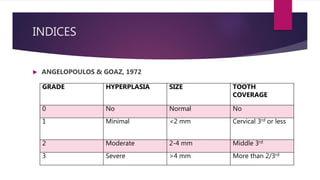
 ANGELOPOULOS & GOAZ, 1972
GRADE HYPERPLASIA SIZE TOOTH
COVERAGE
0 No Normal No
1 Minimal <2 mm Cervical 3rd or less
2 Moderate 2-4 mm Middle 3rd
3 Severe >4 mm More than 2/3rd
INDICES
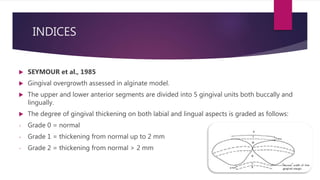
 SEYMOUR et al., 1985
 Gingival overgrowth assessed in alginate model.
 The upper and lower anterior segments are divided into 5 gingival units both buccally and
lingually.
 The degree of gingival thickening on both labial and lingual aspects is graded as follows:
- Grade 0 = normal
- Grade 1 = thickening from normal up to 2 mm
- Grade 2 = thickening from normal > 2 mm
INDICES
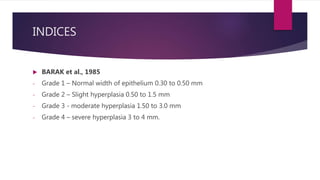
 BARAK et al., 1985
- Grade 1 – Normal width of epithelium 0.30 to 0.50 mm
- Grade 2 – Slight hyperplasia 0.50 to 1.5 mm
- Grade 3 - moderate hyperplasia 1.50 to 3.0 mm
- Grade 4 – severe hyperplasia 3 to 4 mm.
INDICES
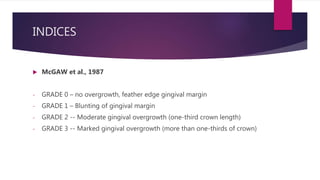
 McGAW et al., 1987
- GRADE 0 – no overgrowth, feather edge gingival margin
- GRADE 1 – Blunting of gingival margin
- GRADE 2 -- Moderate gingival overgrowth (one-third crown length)
- GRADE 3 -- Marked gingival overgrowth (more than one-thirds of crown)
INDICES
 VERTICAL GINGIVAL OVERGROWTH INDEX
[GOI] :
- Originally described by Angelopoulos & Goaz
(1972) & later modified by Miller & Damm
(1992)
- Measures the overgrowth/ht. of gingival
tissues vertically in apico-coronal direction
from CEJ line to free gingival margin.
- The index grades the ht. of enlarged gingiva
covering the clinical crown & the non-visible
crown surface at 6 points around each tooth
acc. to following criterion----
VALUE INFERENCE
0 Normal gingiva
1 Slight, <2 mm increase &
gingiva covering the cervical
1/3 or less of anatomic
crown
2 Moderate, 2-4 mm increase
&/or gingiva extended upto
the middle 1/3 of the clinical
crown
3 Severe, >4 mm increase &/or
gingiva covering more than
2/3 of the clinical crown
INDICES
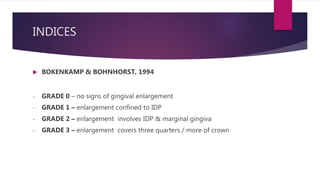
 BOKENKAMP & BOHNHORST, 1994
- GRADE 0 – no signs of gingival enlargement
- GRADE 1 – enlargement confined to IDP
- GRADE 2 – enlargement involves IDP & marginal gingiva
- GRADE 3 – enlargement covers three quarters / more of crown
INDICES
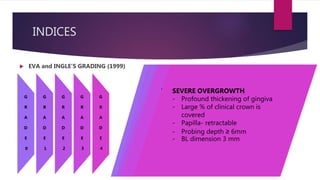
 EVA and INGLE’S GRADING (1999)
G
R
A
D
E
0
G
R
A
D
E
1
G
R
A
D
E
2
G
R
A
D
E
3
G
R
A
D
E
4
NO OVERGROWTH
- firm adaptation of attached
gingiva to underlying
alveolar bone
- slight stippling
- no to slightly granular
appearance.
- Knife edged papilla present
towards the occlusal surface.
- no increase in density or size
of the gingiva.
EARLY OVERGROWTH
- increase in density of
gingiva
- marked stippling and
granular appearance.
- The tip of the papilla is
rounded.
- The probing depth < 3mm.
MODERATE OVERGROWTH –
- increase in the size of the papilla
and/or
- rolled gingival margins.
- contour of the gingival margin--
concave / straight.
- GO has a BL dimension of upto
2mm, measured from the tip of the
papilla outward.
- The probing depth < 6mm.
- Papilla is somewhat retractable.
MARKED OVERGROWTH
- Encroachment of gingiva onto
clinical crown
- Convex gingival contour
- GO has BL dimension ~3 mm or
more
- Probing depth >6 mm
- Papilla is clearly retractable
SEVERE OVERGROWTH
- Profound thickening of gingiva
- Large % of clinical crown is
covered
- Papilla- retractable
- Probing depth ≥ 6mm
- BL dimension 3 mm
INDICES
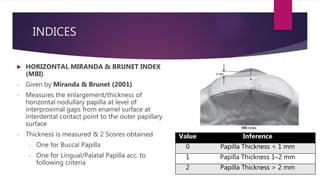
 HORIZONTAL MIRANDA & BRUNET INDEX
(MBI)
- Given by Miranda & Brunet (2001)
- Measures the enlargement/thickness of
horizontal nodullary papilla at level of
interproximal gaps from enamel surface at
interdental contact point to the outer papillary
surface
- Thickness is measured & 2 Scores obtained
- One for Buccal Papilla
- One for Lingual/Palatal Papilla acc. to
following criteria
Value Inference
0 Papilla Thickness < 1 mm
1 Papilla Thickness 1–2 mm
2 Papilla Thickness > 2 mm
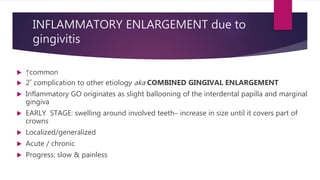
INFLAMMATORY ENLARGEMENT due to
gingivitis
 ↑common
 2˚ complication to other etiology aka COMBINED GINGIVAL ENLARGEMENT
 Inflammatory GO originates as slight ballooning of the interdental papilla and marginal
gingiva
 EARLY STAGE: swelling around involved teeth– increase in size until it covers part of
crowns
 Localized/generalized
 Acute / chronic
 Progress: slow & painless
INFLAMMATORY ENLARGEMENT due to
gingivitis
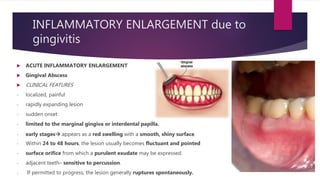
 ACUTE INFLAMMATORY ENLARGEMENT
 Gingival Abscess
 CLINICAL FEATURES
- localized, painful
- rapidly expanding lesion
- sudden onset
- limited to the marginal gingiva or interdental papilla.
- early stages appears as a red swelling with a smooth, shiny surface.
- Within 24 to 48 hours, the lesion usually becomes fluctuant and pointed
- surface orifice from which a purulent exudate may be expressed.
- adjacent teeth– sensitive to percussion.
- If permitted to progress, the lesion generally ruptures spontaneously.
INFLAMMATORY ENLARGEMENT due to
gingivitis
 ACUTE INFLAMMATORY ENLARGEMENT
- ETIOLOGY:
- mechanical/chemical/physical irritation
- resolved by removal of irritant—main etiologic factor is trauma
(toothbrushing, etc.)
- Enlargement may result from chronic or acute inflammatory
changes
- Inflammatory enlargements usually are a secondary complication to
any of the other types of enlargement, creating a combined
gingival enlargement.
- double etiology-- treat them adequately.
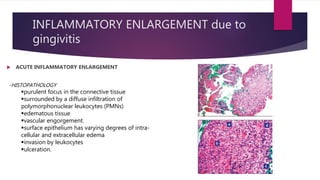
-HISTOPATHOLOGY
purulent focus in the connective tissue
surrounded by a diffuse infiltration of
polymorphonuclear leukocytes (PMNs)
edematous tissue
vascular engorgement.
surface epithelium has varying degrees of intra-
cellular and extracellular edema
invasion by leukocytes
ulceration.
INFLAMMATORY ENLARGEMENT due to
gingivitis
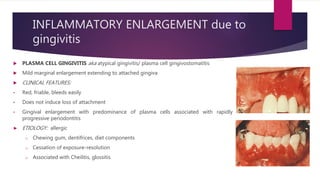
 PLASMA CELL GINGIVITIS aka atypical gingivitis/ plasma cell gingivostomatitis
 Mild marginal enlargement extending to attached gingiva
 CLINICAL FEATURES:
• Red, friable, bleeds easily
• Does not induce loss of attachment
• Gingival enlargement with predominance of plasma cells associated with rapidly
progressive periodontitis
► ETIOLOGY: allergic
o Chewing gum, dentifrices, diet components
o Cessation of exposure-resolution
o Associated with Cheilitis, glossitis
INFLAMMATORY ENLARGEMENT due to
gingivitis
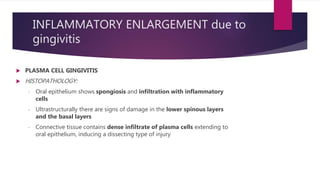
 PLASMA CELL GINGIVITIS
 HISTOPATHOLOGY:
- Oral epithelium shows spongiosis and infiltration with inflammatory
cells
- Ultrastructurally there are signs of damage in the lower spinous layers
and the basal layers
- Connective tissue contains dense infiltrate of plasma cells extending to
oral epithelium, inducing a dissecting type of injury
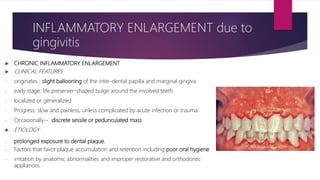
 CHRONIC INFLAMMATORY ENLARGEMENT
 CLINICAL FEATURES
- originates : slight ballooning of the inter-dental papilla and marginal gingiva.
- early stage: life preserver-shaped bulge around the involved teeth.
- localized or generalized
- Progress: slow and painless, unless complicated by acute infection or trauma
- Occasionally-- discrete sessile or pedunculated mass
 ETIOLOGY
- prolonged exposure to dental plaque.
- Factors that favor plaque accumulation and retention including poor oral hygiene
- irritation by anatomic abnormalities and improper restorative and orthodontic
appliances.
INFLAMMATORY ENLARGEMENT due to
gingivitis
 CHRONIC INFLAMMATORY ENLARGEMENT
 HISTOPATHOLOGY
- Exudative / proliferative
- Lesions are clinically deep red or bluish red -- soft and friable lesions:
 Lesions that are relatively firm, resilient, and pink have a greater fibrotic component with an abundance of fibroblasts and
collagen fibers.
INFLAMMATORY ENLARGEMENT due to
gingivitis
- preponderance of inflammatory cells and fluid
- vascular engorgement
- new capillary formation
- associated degenerative changes
 GINGIVAL CHANGES ASSOCIATED WITH MOUTH
BREATHING
- Gingivitis and gingival enlargement are often seen in mouth breathers.
[LITE et al., 1955]
- maxillary anterior region
- red and edematous gingiva
- diffuse surface shininess of the exposed area.
- clearly demarcated from the adjacent unexposed normal gingiva.
- ETIOLOGY : irritation from surface dehydration.
Klingsberg et al., 1961
INFLAMMATORY ENLARGEMENT due to
gingivitis
INFLAMMATORY ENLARGEMENT due to
gingivitis
 MANAGEMENT
- Scaling and root planing – when the size of the enlargement does not interfere with the
complete removal of the deposits
- Surgical removal – enlargement obscures deposits on the tooth surface
- Gingivectomy
- Soft and friable gingiva
- Tumor-like enlargement
- Flap surgery
DRUG-INDUCED GINGIVAL
OVERGROWTH (DIGO)
 Anticonvulsants
 Ca+ channel blockers
 Immunosuppressants
Clinical Features
- Develop rapidly– chronic over time
- 1st signs– 3 months of drug use– localized nodular enlargement of interdental papilla
- Progresses to form massive tissue fold—covers crown
- Interference with occlusion
• PHENYTOIN
• NIFEDIPINE
• CYCLOSPORINE
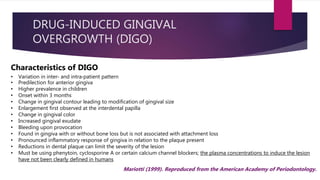
Characteristics of DIGO
• Variation in inter‐ and intra‐patient pattern
• Predilection for anterior gingiva
• Higher prevalence in children
• Onset within 3 months
• Change in gingival contour leading to modification of gingival size
• Enlargement first observed at the interdental papilla
• Change in gingival color
• Increased gingival exudate
• Bleeding upon provocation
• Found in gingiva with or without bone loss but is not associated with attachment loss
• Pronounced inflammatory response of gingiva in relation to the plaque present
• Reductions in dental plaque can limit the severity of the lesion
• Must be using phenytoin, cyclosporine A or certain calcium channel blockers; the plasma concentrations to induce the lesion
have not been clearly defined in humans
Mariotti (1999). Reproduced from the American Academy of Periodontology.
[BHARTI et al., 2013]
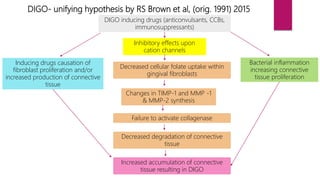
DIGO- unifying hypothesis by RS Brown et al, (orig. 1991) 2015
DIGO inducing drugs (anticonvulsants, CCBs,
immunosuppressants)
Inhibitory effects upon
cation channels
Decreased cellular folate uptake within
gingival fibroblasts
Changes in TIMP-1 and MMP -1
& MMP-2 synthesis
Failure to activate collagenase
Decreased degradation of connective
tissue
Increased accumulation of connective
tissue resulting in DIGO
Inducing drugs causation of
fibroblast proliferation and/or
increased production of connective
tissue
Bacterial inflammation
increasing connective
tissue proliferation
 PHENYTOIN (Anticonvulsant)
- 1st incidence of DIGO: viz., HYDANTOIN used to treat all forms of epilepsy except petit mal. [GLICKMAN et al., 1941]
- Ethotoin [PAGANONE], Mephenytoin [MESANTOIN], ZERONTIN, CELONTIN, DEPAKENE
- Rate of incidence of DIGO = ~50% patients [SEYMOUR et al., 1996]
- Younger patients
- Phenytoin appears in the saliva
- MODE OF ACTION:
- Phenytoin ↠
- May result from genetically determined ability or inability of the host to deal effectively with prolonged administration of phenytoin. [HASSEL & PAGE, 1994]
DRUG-INDUCED GINGIVAL
OVERGROWTH (DIGO)
↑ 𝑛𝑜. 𝑜𝑓 fibroblast-like cells and epithelium
↓
↑ synthesis of sulfated glycosaminoglycans (𝑖𝑛 𝑣𝑖𝑡𝑟𝑜)
++↓
↓ collagen degradation
production of inactive fibroblastic collagenase
↓
 PHENYTOIN (Anticonvulsant)
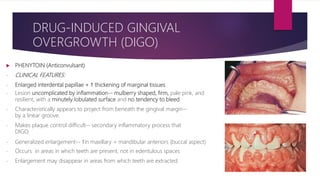
- CLINICAL FEATURES:
- Enlarged interdental papillae + ↑ thickening of marginal tissues
- Lesion uncomplicated by inflammation-- mulberry shaped, firm, pale pink, and
resilient, with a minutely lobulated surface and no tendency to bleed.
- Characteristically appears to project from beneath the gingival margin--
by a linear groove.
- Makes plaque control difficult-- secondary inflammatory process that
DIGO.
- Generalized enlargement-- ↑in maxillary + mandibular anteriors (buccal aspect)
- Occurs in areas in which teeth are present, not in edentulous spaces
- Enlargement may disappear in areas from which teeth are extracted
DRUG-INDUCED GINGIVAL
OVERGROWTH (DIGO)
 PHENYTOIN (Anticonvulsant)
- HISTOPATHOLOGY:
- Hyperplasia and acanthosis of the epithelium
- Densely collagenous connective tissue
- Inflammation in the area adjacent to the gingival sulcus (pocket).
- Extension of deep rete pegs into the connective tissue.
- Increase in the number of fibroblasts and new blood vessels.
- Abundant amorphous ground substance.
- Oxytalan fibers are numerous beneath the epithelium and in areas of inflammation.
- “Mature” phenytoin enlargement-- fibroblast/ collagen ratio equal to that of normal
gingiva
- Recurring phenytoin enlargements-- appear as granulation tissue composed of
young capillaries and fibroblasts and irregularly arranged collagen fibrils with occasional
lymphocytes.
-
DRUG-INDUCED GINGIVAL
OVERGROWTH (DIGO)
ALTERNATIVE TO PHENYTOIN: Valproic acid
- broad spectrum of action
- effective on all forms of absence spells (simple as well as complex)
- useful as an adjunctive therapy for other seizures types when they occur in conjunction with absence spells
- more effective in the generalized than in the partial epilepsies– requires adjunct therapy with primidone to maintain a broad coverage.
- Side effects: transient gastric complaints, weight gain, occasional transient thinning of hair and rare mild thrombocytopenia.
- plasma half-life (8-15 hours) is shorter than phenytoin (13-24 hours)
- may increase the plasma concentration of phenobarbital 30 to 40% which produces ↑sedation
- can displace phenytoin from protein binding sites and provide toxic tissue levels despite measured therapeutic blood levels.
In the process of changing medications from phenytoin to valproic acid, a worsening of hyperplasia might be misconstrued as a direct effect of
valproic acid on the hyperplastic tissue.
- MANAGEMENT OF PHENYTOIN-INDUCED DIGO:
 A discontinuation of phenytoin should not be recommended simply on the basis of moderate to severe hyperplasia.
 Conservative periodontal measures include vigorous gingival massage coupled with efficient toothbrushing and gum stimulators.[BARATIERI,
1967]
 When surgical measures are indicated, the drug treatment plan of the physician managing the epilepsy should be discussed and the date of
surgery postponed if the physician is planning to discontinue the phenytoin.
[Reynolds & Kirkham, 1980]
 Calcium Channel Blockers
- drugs developed for the treatment of cardiovascular conditions
(hypertension, angina pectoris, coronary artery spasms, and cardiac
arrhythmias.
- Prevalence is highly variable: 6- 83% [SLAVIN et al., 1987]
- CLINICAL FEATURES:
- Affects interdental papillae
- GO limited to marginal and attached gingiva
- Typically presents on anterior region
- Nifedipine-induced GO can coexist with periodontitis– different from other
forms of DIGO
- Nifedipine is also used with cyclosporine in kidney transplant recipients,
the combined use of both drugs induces larger overgrowths. [BÖKENKAMP
et al., 1994]
DRUG-INDUCED GINGIVAL
OVERGROWTH (DIGO)
• AMLODIPINE
• NIFEDIPINE
• NICARDIPINE
• FELODIPINE
• NITRENDIPINE
• DILTIAZEM
• VERAPAMIL
 Calcium channel blockers
- MECHANISM OF ACTION:
DRUG-INDUCED GINGIVAL
OVERGROWTH (DIGO)
NON-INFLAMMATORY PATHWAY INFLAMMATORY PATHWAY
- ↓ uptake of folic acid
- blockage of aldosterone
synthesis in adrenal cortex
- feedback ↑ACTH level
- upregulation of keratinocyte
growth factor (KGF)
Defective collagenase activity
- ↑local concentration of drug in
GCF/bacterial plaque
- Upregulation of cytokines viz.,
TGF-β1
- Degradation of periodontal
tissues
Vertical growth of gingiva–
PSEUDOPOCKET formation
Calcium channel blocker-induced
DIGO
[LAFZI et al., 2006]
 Calcium channel blockers
- ALTERNATIVES FOR NIFEDIPINE/AMLODIPINE:
- ISRADIPINE– dihydropyridine derivative; can replace existing drugs for DIGO
- Does not induce gingival overgrowth [WESTBROOK et al., 1997]
DRUG-INDUCED GINGIVAL
OVERGROWTH (DIGO)
[SAMUDRALA et al., 2016]
 CYCLOSPORINE (Immunosuppressant)
- Potent immunosuppressive agent-- prevent organ transplant rejection and to treat several diseases of autoimmune origin
- 1st case reported– 1983 (HEFTI et al.)
- Cyclosporin A (Sandimmune, Neoral)– I.V. or p.o., and dosages >500 mg/day have been reported to induce gingival overgrowth. [DALEY,
1986]
- Cyclosporine-induced gingival enlargement is more vascularized than phenytoin enlargement
- occurrence varies according to different studies from 25% to 70%, [ROMITO, 2004]
- MECHANISM OF ACTION: Cyclosporine A
 directly impairs collagen synthesis by gingival fibroblasts+ incr. levels of type I collagen
 decreases expression of MMPs 1 and 3
 leads to reduced metabolism of glycosaminoglycans
 selectively and reversibly inhibit helper T cells, which play a role in cellular and humoral immune responses.
- In addition to gingival enlargement, cyclosporine induces other major side effects, such as nephrotoxicity, hypertension, and hypertrichosis.
DRUG-INDUCED GINGIVAL
OVERGROWTH (DIGO)
 CYCLOSPORINE (Immunosuppressant)
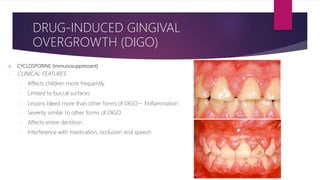
- CLINICAL FEATURES:
- Affects children more frequently
- Limited to buccal surfaces
- Lesions bleed more than other forms of DIGO-- ↑inflammation
- Severity similar to other forms of DIGO
- Affects entire dentition
- Interference with mastication, occlusion and speech
DRUG-INDUCED GINGIVAL
OVERGROWTH (DIGO)
- HISTOPATHOLOGY:
- microscopic finding of many plasma cells
- abundant amorphous extracellular substance
- suggests that the enlargement is a hypersensitivity response to the
cyclosporine. [MARIANI et al., 1993]
- Thickened epithelium
- Formation of retepegs
- Irregular collagen formation
Another immunosuppressive drug, TACROLIMUS, has been used effectively and is also nephrotoxic, but it results in
much less severe hypertension, hypertrichosis, and gingival overgrowth. [SPENCER et al., 1997]
DRUG-INDUCED GINGIVAL
OVERGROWTH (DIGO)
[SAMUDRALA et al., 2016]
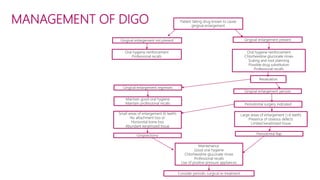
MANAGEMENT OF DIGO Patient taking drug known to cause
gingival enlargement
Gingival enlargement not present Gingival enlargement present
Oral hygiene reinforcement
Professional recalls
Oral hygiene reinforcement
Chlorhexidine gluconate rinses
Scaling and root planning
Possible drug substitution
Professional recalls
Revaluation
Gingival enlargement regresses
Maintain good oral hygiene
Maintain professional recalls
Gingival enlargement persists
Periodontal surgery indicated
Small areas of enlargement (6 teeth)
No attachment loss or
Horizontal bone loss
Abundant keratinized tissue
Gingivectomy
Large areas of enlargement (>6 teeth)
Presence of osseous defects
Limited keratinized tissue
Periodontal flap
Maintenance:
Good oral hygiene
Chlorhexidine gluconate rinses
Professional recalls
Use of positive pressure appliances
Consider periodic surgical re-treatment
IDIOPATHIC GINGIVAL ENLARGEMENT
 aka gingivomatosis, elephantiasis, idiopathic fibromatosis, hereditary gingival hyperplasia, and congenital familial fibromatosis
 rare condition
 undetermined cause
 ETIOLOGY:
- Unknown
- hereditary basis [ZISKIN et al., 1943] but the genetic mechanisms involved are not well understood.
- mode of inheritance to be autosomal recessive in some cases and autosomal dominant in others [RAESTE et al, 1978]
 CLINICAL FEATURES:
- Affects the attached gingiva, as well as the gingival margin and interdental papillae
- Affects the facial and lingual surfaces of the mandible and maxilla
- Involvement may be limited to either jaw
- The enlarged gingiva is pink, firm, and almost leathery in consistency and has a characteristic minutely pebbled surface
- Severe cases – teeth are almost completely covered, and the enlargement projects into the oral vestibule.
- The jaws appear distorted because of the bulbous enlargement of the gingiva.
- Secondary inflammatory changes are common at the gingival margin.
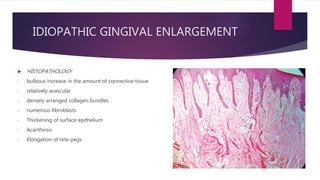
 HISTOPATHOLOGY
- bulbous increase in the amount of connective tissue
- relatively avascular
- densely arranged collagen bundles
- numerous fibroblasts
- Thickening of surface epithelium
- Acanthosis
- Elongation of rete pegs
IDIOPATHIC GINGIVAL ENLARGEMENT
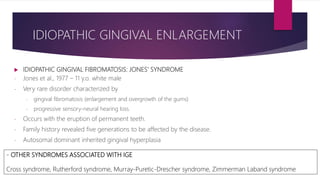
 IDIOPATHIC GINGIVAL FIBROMATOSIS: JONES’ SYNDROME
- Jones et al., 1977 – 11 y.o. white male
- Very rare disorder characterized by
- gingival fibromatosis (enlargement and overgrowth of the gums)
- progressive sensory-neural hearing loss.
- Occurs with the eruption of permanent teeth.
- Family history revealed five generations to be affected by the disease.
- Autosomal dominant inherited gingival hyperplasia
IDIOPATHIC GINGIVAL ENLARGEMENT
- OTHER SYNDROMES ASSOCIATED WITH IGE
Cross syndrome, Rutherford syndrome, Murray-Puretic-Drescher syndrome, Zimmerman Laband syndrome
ENLARGEMENTS ASSOCIATED WITH
SYSTEMIC DISEASES
 Systemic diseases→ oral manifestations (including gingival enlargement→ affect the periodontium
1. Magnification of an existing inflammation initiated by dental plaque.
aka Gingival overgrowth associated with systemic conditions/ conditioned enlargements
2. Manifestation of the systemic disease independently of the inflammatory status of the gingiva.
aka GO associated with systemic diseases/ Systemic Diseases Causing Gingival Enlargement
GO associated with SYSTEMIC CONDITIONS/
CONDITIONED ENLARGEMENT
 Conditioned enlargement occurs when the systemic condition of the patient exaggerates or distorts the
usual gingival response to dental plaque.
 depends on the nature of the modifying systemic influence
- Hormonal (Pregnancy, Puberty)
- Nutritional deficiency-related (Vit.C)
- Nonspecified conditioned enlargement
 PREGNANCY-ASSOCIATED GINGIVAL OVERGROWTH
- common pathology in pregnancy
- marginal and generalized
- single or multiple tumor-like masses
- ETIOLOGY:
 Marginal Enlargement
- results from the aggravation of previous inflammation – does not occur without the presence of bacterial plaque
- clinical picture varies considerably-- usually generalized
- tends to be more prominent interproximally than on the facial and lingual surfaces
- bright red or magenta, soft, and friable and has a smooth, shiny surface.
- Bleeding occurs spontaneously or on slight provocation.
GO associated with SYSTEMIC CONDITIONS/
CONDITIONED ENLARGEMENT
- ↑ levels of PROGESTERONE (10x) and ESTROGEN (30x) by the end of the third trimester
- These hormonal changes induce changes in vascular permeability-- gingival edema, ↑ inflammatory response
to dental plaque.
- changes in subgingival microbiota -- ↑ Prevotella intermedia [RABER-DURLACHER et al., 1994]
Susceptibility to periodontal infection increases during early gestation due to:
- suppressed T-cell activity
- decreased neutrophil chemotaxis and phagocytosis
- altered lymphocyte response
- depressed antibody production
- chronic maternal stress
- down- regulation of IL-6 production, rendering the gingiva less efficient at resisting the
inflammatory challenges produced by the bacteria
- decreased levels of IgG
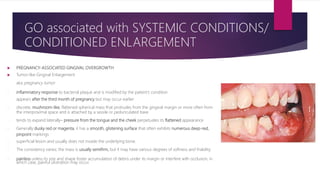
 PREGNANCY-ASSOCIATED GINGIVAL OVERGROWTH
 Tumor-like Gingival Enlargement
- aka pregnancy tumor
- inflammatory response to bacterial plaque and is modified by the patient’s condition
- appears after the third month of pregnancy but may occur earlier
- discrete, mushroom-like, flattened spherical mass that protrudes from the gingival margin or more often from
the interproximal space and is attached by a sessile or pedunculated base
- tends to expand laterally– pressure from the tongue and the cheek perpetuates its flattened appearance
- Generally dusky red or magenta, it has a smooth, glistening surface that often exhibits numerous deep-red,
pinpoint markings
- superficial lesion and usually does not invade the underlying bone.
- The consistency varies; the mass is usually semifirm, but it may have various degrees of softness and friability
- painless unless its size and shape foster accumulation of debris under its margin or interfere with occlusion, in
which case, painful ulceration may occur.
GO associated with SYSTEMIC CONDITIONS/
CONDITIONED ENLARGEMENT
 PREGNANCY-ASSOCIATED GINGIVAL OVERGROWTH
 HISTOPATHOLOGY
- central mass of connective tissue
- numerous, diffusely arranged, newly formed, and engorged capillaries lined by cuboid
endothelial cells
- moderately fibrous stroma with varying degrees of edema & chronic inflammatory infiltrate
- thickening of stratified squamous epithelium
- prominent rete pegs
- some degree of intracellular and extracellular edema
- leukocytic infiltration
- prominent intercellular bridges
GO associated with SYSTEMIC CONDITIONS/
CONDITIONED ENLARGEMENT
 PREGNANCY-ASSOCIATED GINGIVAL OVERGROWTH
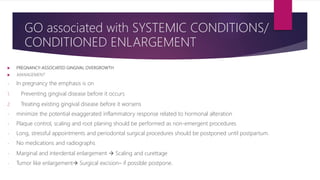
 MANAGEMENT
- In pregnancy the emphasis is on
1. Preventing gingival disease before it occurs
2. Treating existing gingival disease before it worsens
- minimize the potential exaggerated inflammatory response related to hormonal alteration
- Plaque control, scaling and root planing should be performed as non-emergent procedures
- Long, stressful appointments and periodontal surgical procedures should be postponed until postpartum.
- No medications and radiographs
- Marginal and interdental enlargement  Scaling and curettage
- Tumor like enlargement Surgical excision– if possible postpone.
GO associated with SYSTEMIC CONDITIONS/
CONDITIONED ENLARGEMENT
 PUBERTY- ASSOCIATED GINGIVAL OVERGROWTH
- occurs in both male and female adolescents – areas of plaque accumulation.
 CLINICAL FEATURES:
- size of the gingival enlargement greatly exceeds that usually seen in association with
comparable local factors
- marginal and interdental
- characterized by prominent bulbous interproximal papillae
- Capnocytophaga and P. intermedia [MOMBELLI et al., 1990; WOJCICKI CJ, 1987]
- mechanical action of the tongue and the excursion of food prevent a heavy
accumulation of local irritants on the lingual surface.
- tendency to develop massive recurrence in the presence of relatively scant plaque
deposits
- undergoes spontaneous reduction but does not disappear until plaque and calculus
are removed.
GO associated with SYSTEMIC CONDITIONS/
CONDITIONED ENLARGEMENT
 HISTOPATHOLOGY
- chronic inflammation
- prominent edema
- associated degenerative changes
 MANAGEMENT
- Scaling and oral hygiene instructions.
- Surgical removal may be performed in severe cases.
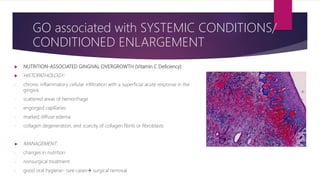
 NUTRITION-ASSOCIATED GINGIVAL OVERGROWTH (Vitamin C Deficiency)
- classic descriptions of scurvy
- Acute vitamin C deficiency – hemorrhage, collagen degeneration, and edema of
the gingival connective tissue.
- modify the response of the gingiva to plaque
- CLINICAL FEATURES:
- marginal
- bluish red, soft, and friable and has a smooth, shiny surface.
- Hemorrhage– spontaneously/slight provocation
- surface necrosis with pseudomembrane formation
GO associated with SYSTEMIC CONDITIONS/
CONDITIONED ENLARGEMENT
 NUTRITION-ASSOCIATED GINGIVAL OVERGROWTH (Vitamin C Deficiency)
 HISTOPATHOLOGY:
- chronic inflammatory cellular infiltration with a superficial acute response in the
gingiva
- scattered areas of hemorrhage
- engorged capillaries
- marked diffuse edema
- collagen degeneration, and scarcity of collagen fibrils or fibroblasts
► MANAGEMENT:
- changes in nutrition
- nonsurgical treatment
- good oral hygiene– rare cases surgical removal
GO associated with SYSTEMIC CONDITIONS/
CONDITIONED ENLARGEMENT
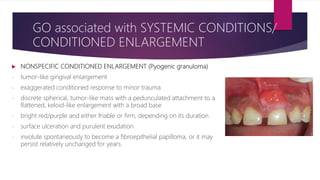
 NONSPECIFIC CONDITIONED ENLARGEMENT (Pyogenic granuloma)
- tumor-like gingival enlargement
- exaggerated conditioned response to minor trauma
- discrete spherical, tumor-like mass with a pedunculated attachment to a
flattened, keloid-like enlargement with a broad base
- bright red/purple and either friable or firm, depending on its duration
- surface ulceration and purulent exudation
- involute spontaneously to become a fibroepithelial papilloma, or it may
persist relatively unchanged for years.
GO associated with SYSTEMIC CONDITIONS/
CONDITIONED ENLARGEMENT
 NONSPECIFIC CONDITIONED ENLARGEMENT (Pyogenic granuloma)
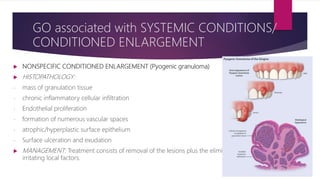
 HISTOPATHOLOGY:
- mass of granulation tissue
- chronic inflammatory cellular infiltration
- Endothelial proliferation
- formation of numerous vascular spaces
- atrophic/hyperplastic surface epithelium
- Surface ulceration and exudation
 MANAGEMENT: Treatment consists of removal of the lesions plus the elimination of
irritating local factors.
GO associated with SYSTEMIC CONDITIONS/
CONDITIONED ENLARGEMENT
GO associated with SYSTEMIC DISEASES
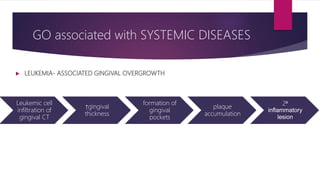
 LEUKEMIA- ASSOCIATED GINGIVAL OVERGROWTH
Leukemic cell
infiltration of
gingival CT
↑gingival
thickness
formation of
gingival
pockets
plaque
accumulation
2⁰
inflammatory
lesion
GO associated with SYSTEMIC DISEASES
 LEUKEMIA- ASSOCIATED GINGIVAL OVERGROWTH
 CLINICAL FEATURES:
- diffuse or marginal
- localized or generalized
- diffuse enlargement of the gingival mucosa/ oversized
extension of the marginal gingiva
- discrete tumor-like inter-proximal mass
- bluish red, shiny surface.
- firm consistency, tendency toward friability and
hemorrhage
- spontaneous/ slight irritation
- painful necrotizing ulcerative inflammation
GO associated with SYSTEMIC DISEASES
 LEUKEMIA- ASSOCIATED GINGIVAL OVERGROWTH
 HISTOPATHOLOGY:
- Epithelium - varying degree of leukocytic infiltration &
edema
- Pseudomembranous meshwork of fibrins, necrotic
epithelial cells
- PMNS & bacteria.
- Connective Tissue - infiltrated with a dense mass of
immature & proliferating leukocytes
- engorged capillaries.
GO associated with SYSTEMIC DISEASES
 LEUKEMIA- ASSOCIATED GINGIVAL OVERGROWTH
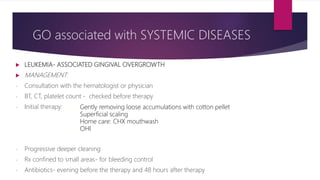
 MANAGEMENT:
- Consultation with the hematologist or physician
- BT, CT, platelet count - checked before therapy
- Initial therapy:
- Progressive deeper cleaning
- Rx confined to small areas- for bleeding control
- Antibiotics- evening before the therapy and 48 hours after therapy
- Gently removing loose accumulations with cotton pellet
- Superficial scaling
- Home care: CHX mouthwash
- OHI
 GRANULOMATOUS DISEASES
 WEGENER’S GRANULOMATOSIS
- rare disease
- acute granulomatous necrotizing lesions of the respiratory tract, including nasal and oral defects
- Renal lesions develop, and acute necrotizing vasculitis affects the blood vessels
- initial manifestations
- oral mucosal ulceration
- gingival enlargement
- abnormal tooth mobility, exfoliation of teeth, and delayed healing response
- Leukemic gingival enlargement (Acute myelocytic leukemia). The granulomatous papillary enlargement is reddish
purple and bleeds easily on stimulation
GO associated with SYSTEMIC DISEASES
 GRANULOMATOUS DISEASES
 WEGENER’S GRANULOMATOSIS
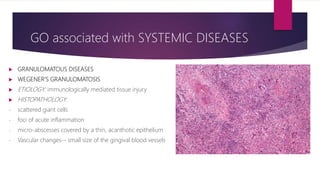
 ETIOLOGY: immunologically mediated tissue injury
 HISTOPATHOLOGY:
- scattered giant cells
- foci of acute inflammation
- micro-abscesses covered by a thin, acanthotic epithelium
- Vascular changes-- small size of the gingival blood vessels
GO associated with SYSTEMIC DISEASES
 GRANULOMATOUS DISEASES
 SARCOIDOSIS
• granulomatous disease of unknown etiology
• starts in individuals in their 20s or 30s
• predominantly affects blacks
• can involve almost any organ, including the gingiva
• red, smooth, painless enlargement
• HISTOPATHOLOGY: Sarcoid granulomas consist of discrete, non-
caseating whorls of epithelioid cells and multinucleated, foreign
body-type giant cells with peripheral mononuclear cells.
GO associated with SYSTEMIC DISEASES
NEOPLASTIC ENLARGEMENT
(GINGIVAL TUMORS)
 BENIGN TUMORS OF THE GINGIVA
 FIBROMAS
- Arise from the gingival connective tissue or from the
periodontal ligament
- They are slow-growing, spherical tumors that tend to be
firm and nodular but may be soft and vascular.
- Fibromas are usually pedunculated
- HISTOPATHOLOGY
- Well formed collagen bundles with scattering of fibrocytes
- Variable vascularity
- so-called giant cell fibroma contains multinucleated
fibroblasts
 BENIGN TUMORS OF THE GINGIVA
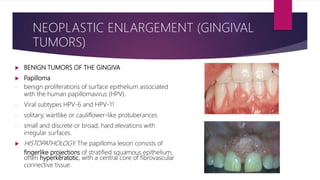
 Papilloma
- benign proliferations of surface epithelium associated
with the human papillomavirus (HPV).
- Viral subtypes HPV-6 and HPV-11
- solitary, wartlike or cauliflower-like protuberances
- small and discrete or broad, hard elevations with
irregular surfaces.
 HISTOPATHOLOGY. The papilloma lesion consists of
fingerlike projections of stratified squamous epithelium,
often hyperkeratotic, with a central core of fibrovascular
connective tissue.
NEOPLASTIC ENLARGEMENT (GINGIVAL
TUMORS)
 BENIGN TUMORS OF THE GINGIVA
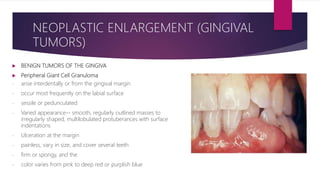
 Peripheral Giant Cell Granuloma
- arise interdentally or from the gingival margin
- occur most frequently on the labial surface
- sessile or pedunculated
- Varied appearance-- smooth, regularly outlined masses to
irregularly shaped, multilobulated protuberances with surface
indentations
- Ulceration at the margin
- painless, vary in size, and cover several teeth
- firm or spongy, and the
- color varies from pink to deep red or purplish blue
NEOPLASTIC ENLARGEMENT (GINGIVAL
TUMORS)
 BENIGN TUMORS OF THE GINGIVA
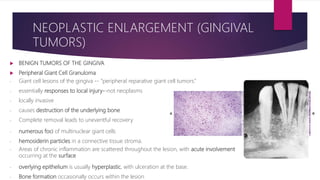
 Peripheral Giant Cell Granuloma
‐ Giant cell lesions of the gingiva -- “peripheral reparative giant cell tumors.”
‐ essentially responses to local injury--not neoplasms
‐ locally invasive
‐ causes destruction of the underlying bone
‐ Complete removal leads to uneventful recovery
‐ numerous foci of multinuclear giant cells
‐ hemosiderin particles in a connective tissue stroma.
‐ Areas of chronic inflammation are scattered throughout the lesion, with acute involvement
occurring at the surface
‐ overlying epithelium is usually hyperplastic, with ulceration at the base.
‐ Bone formation occasionally occurs within the lesion
NEOPLASTIC ENLARGEMENT (GINGIVAL
TUMORS)
 BENIGN TUMORS OF THE GINGIVA
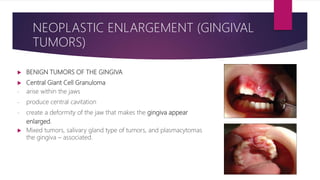
 Central Giant Cell Granuloma
- arise within the jaws
- produce central cavitation
- create a deformity of the jaw that makes the gingiva appear
enlarged.
 Mixed tumors, salivary gland type of tumors, and plasmacytomas
the gingiva – associated.
NEOPLASTIC ENLARGEMENT (GINGIVAL
TUMORS)
 BENIGN TUMORS OF THE GINGIVA
 Leukoplakia
 (WHO): a white patch or plaque that does not rub off and cannot be
diagnosed as any other disease.
 Cause-- obscure
 Associated/probable factors:
 use of tobacco (smoke or smokeless)
 Candida albicans, HPV-16 and HPV-18,
 trauma.
 Leukoplakia of the gingiva varies in appearance from a
 grayish white, flattened, scaly lesion to a thick, irregularly shaped, keratinous
plaque.
NEOPLASTIC ENLARGEMENT (GINGIVAL
TUMORS)
 BENIGN TUMORS OF THE GINGIVA
 Leukoplakia
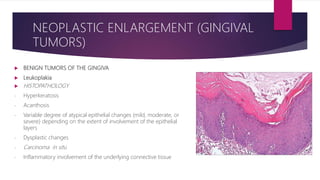
 HISTOPATHOLOGY
- Hyperkeratosis
- Acanthosis
- Variable degree of atypical epithelial changes (mild, moderate, or
severe) depending on the extent of involvement of the epithelial
layers
- Dysplastic changes
- Carcinoma in situ
- Inflammatory involvement of the underlying connective tissue
NEOPLASTIC ENLARGEMENT (GINGIVAL
TUMORS)
 BENIGN TUMORS OF THE GINGIVA
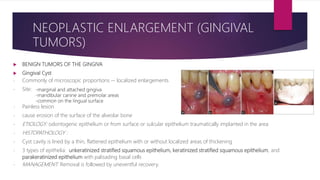
 Gingival Cyst
- Commonly of microscopic proportions -- localized enlargements
- Site:
- Painless lesion
- cause erosion of the surface of the alveolar bone
- ETIOLOGY: odontogenic epithelium or from surface or sulcular epithelium traumatically implanted in the area
- HISTOPATHOLOGY :
- Cyst cavity is lined by a thin, flattened epithelium with or without localized areas of thickening
- 3 types of epithelia: unkeratinized stratified squamous epithelium, keratinized stratified squamous epithelium, and
parakeratinized epithelium with palisading basal cells
- MANAGEMENT: Removal is followed by uneventful recovery.
NEOPLASTIC ENLARGEMENT (GINGIVAL
TUMORS)
-marginal and attached gingiva
-mandibular canine and premolar areas
-common on the lingual surface
 MALIGNANT TUMORS OF GINGIVA
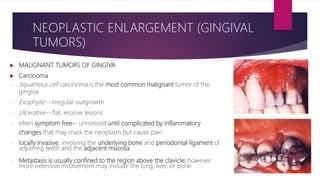
 Carcinoma
- Squamous cell carcinoma is the most common malignant tumor of the
gingiva.
- Exophytic-- irregular outgrowth
- Ulcerative-- flat, erosive lesions
- often symptom free-- unnoticed until complicated by inflammatory
changes that may mask the neoplasm but cause pain
- locally invasive, involving the underlying bone and periodontal ligament of
adjoining teeth and the adjacent mucosa
- Metastasis is usually confined to the region above the clavicle; however,
more extensive involvement may include the lung, liver, or bone
NEOPLASTIC ENLARGEMENT (GINGIVAL
TUMORS)
 MALIGNANT TUMORS OF GINGIVA
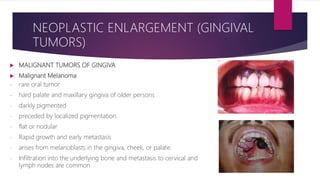
 Malignant Melanoma
- rare oral tumor
- hard palate and maxillary gingiva of older persons
- darkly pigmented
- preceded by localized pigmentation
- flat or nodular
- Rapid growth and early metastasis
- arises from melanoblasts in the gingiva, cheek, or palate.
- Infiltration into the underlying bone and metastasis to cervical and
lymph nodes are common
NEOPLASTIC ENLARGEMENT (GINGIVAL
TUMORS)
 MALIGNANT TUMORS OF GINGIVA
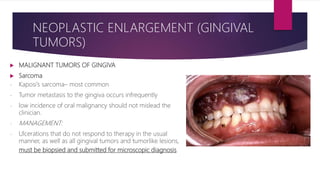
 Sarcoma
- Kaposi’s sarcoma– most common
- Tumor metastasis to the gingiva occurs infrequently
- low incidence of oral malignancy should not mislead the
clinician.
- MANAGEMENT:
- Ulcerations that do not respond to therapy in the usual
manner, as well as all gingival tumors and tumorlike lesions,
must be biopsied and submitted for microscopic diagnosis
NEOPLASTIC ENLARGEMENT (GINGIVAL
TUMORS)
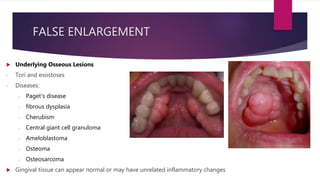
FALSE ENLARGEMENT
 Underlying Osseous Lesions
- Tori and exostoses
- Diseases:
‐ Paget's disease
‐ fibrous dysplasia
‐ Cherubism
‐ Central giant cell granuloma
‐ Ameloblastoma
‐ Osteoma
‐ Osteosarcoma
 Gingival tissue can appear normal or may have unrelated inflammatory changes
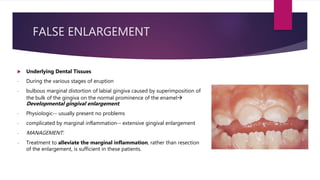
FALSE ENLARGEMENT
 Underlying Dental Tissues
- During the various stages of eruption
- bulbous marginal distortion of labial gingiva caused by superimposition of
the bulk of the gingiva on the normal prominence of the enamel
Developmental gingival enlargement.
- Physiologic-- usually present no problems
- complicated by marginal inflammation-- extensive gingival enlargement
- MANAGEMENT:
- Treatment to alleviate the marginal inflammation, rather than resection
of the enlargement, is sufficient in these patients.
RECURRENCE OF GINGIVAL ENLARGEMENT
 Recurrence of chronic inflammatory enlargements immediately after treatment indicates
that all irritants have not been removed.
 If the enlargement recurs after healing is complete and normal contour is attained,
inadequate plaque control by the patient is the most common cause.
 Recurrence during the healing period is manifested as red, beadlike, granulomatous
masses that bleed on slight provocation.
 Treatment consists of removal of the lesions plus the elimination of irritating local
factors.
AN OVERVIEW OF SURGICAL
MANAGEMENT OF GINGIVAL
ENLARGEMENT
GINGIVECTOMY
The dotted line represents the external bevel
incision, and the shaded area corresponds to the
tissue to be excised.
Gingivectomy incision may not remove the entire
hyperplastic tissue
(shaded area) and may leave a wide wound of
exposed connective tissue.
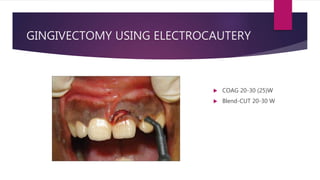
GINGIVECTOMY USING ELECTROCAUTERY
 COAG 20-30 (25)W
 Blend-CUT 20-30 W
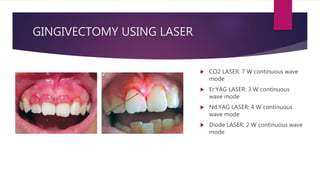
GINGIVECTOMY USING LASER
 CO2 LASER: 7 W continuous wave
mode
 Er:YAG LASER: 3 W continuous
wave mode
 Nd:YAG LASER: 4 W continuous
wave mode
 Diode LASER: 2 W continuous wave
mode
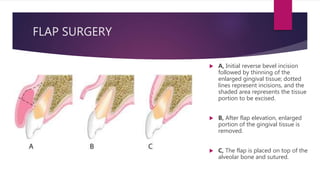
FLAP SURGERY
 A, Initial reverse bevel incision
followed by thinning of the
enlarged gingival tissue; dotted
lines represent incisions, and the
shaded area represents the tissue
portion to be excised.
 B, After flap elevation, enlarged
portion of the gingival tissue is
removed.
 C, The flap is placed on top of the
alveolar bone and sutured.
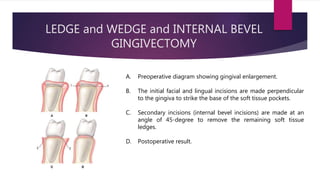
LEDGE and WEDGE and INTERNAL BEVEL
GINGIVECTOMY
A. Preoperative diagram showing gingival enlargement.
B. The initial facial and lingual incisions are made perpendicular
to the gingiva to strike the base of the soft tissue pockets.
C. Secondary incisions (internal bevel incisions) are made at an
angle of 45-degree to remove the remaining soft tissue
ledges.
D. Postoperative result.
CONCLUSION
[AGRAWAL et al., 2015]
CONCLUSION
[BHATNAGAR et al., 2018]
REFERENCES
1. CARRANZA 10th edition
2. CARRANZA 13th edition
3. LINDHE 7th edition
4. Glickman I. A basic classification of
“gingival enlargement”. The Journal of
Periodontology. 1950
5. Camargo PM, Melnick PR, Pirih FQ,
Lagos R, Takei HH. Treatment of
drug‐induced gingival enlargement:
aesthetic and functional considerations.
Periodontology 2000. 2001
6. Perio 2000, 2004 vol 34 217-229
THANK YOU

GINGIVAL ENLARGEMENT+MGMT

  • 1.
    GINGIVAL ENLARGEMENT & ITSMANAGEMENT DR. ANTARLEENA SENGUPTA I MDS, DEPTT. OF PERIODONTOLOGY, MCODS MANGALORE 2020
  • 2.
    CONTENTS 1. INTRODUCTION 2. CLASSIFICATION 3.INDICES 4. INFLAMMATORY ENLARGEMENT 5. DRUG-INDUCED GINGIVAL OVERGROWTH 6. IDIOPATHIC ENLARGEMENT 7. SYSTEMIC DISEASES LEADING TO GINGIVAL ENLARGEMENT A. CONDITIONED ENLARGEMENT B. ENLARGEMENT ASSOCIATED WITH SYSTEMIC DISEASES 8. NEOPLASTIC ENLARGEMENT (GINGIVAL TUMORS) 9. FALSE ENLARGEMENTS 10. CONCLUSION 11. REFERENCES
  • 3.
    INTRODUCTION  Increase insize of the gingiva is a common feature of gingival disease.  Accepted current terminology for this condition is gingival enlargement or gingival over- growth (GO).  Strictly clinical descriptive terms  Previously: “hypertrophic gingivitis” or “gingival hyperplasia.”
  • 4.
    CLASSIFICATION A. According toetiologic factors and pathologic changes: I. Inflammatory enlargement  Acute  Chronic I. Drug-induced enlargement II. Enlargements associated with systemic diseases or conditions III. Conditioned enlargement  Pregnancy  Puberty  Vitamin C deficiency  Plasma cell gingivitis  Nonspecific conditioned enlargement (pyogenic granuloma) IV. Systemic diseases causing gingival enlargement  Leukemia  Granulomatous diseases (e.g., Wegener’s granulomatosis, sarcoidosis) V. Neoplastic enlargement (gingival tumors)  Benign tumors  Malignant tumors VI. False enlargement B. According to location and distribution: I. Localized: Limited to the gingiva adjacent to a single tooth or group of teeth. II. Generalized: Involving the gingiva throughout the mouth. III. Marginal: Confined to the marginal gingiva. IV. Papillary: Confined to the interdental papilla. V. Diffuse: Involving the marginal and attached gingivae and papillae. VI. Discrete: An isolated sessile or pedunculated, tumor-like enlargement. C. According to degree of gingival enlargement can be scored as follows: Grade 0: No signs of gingival enlargement. Grade I: Enlargement confined to interdental papilla. Grade II: Enlargement involves papilla and marginal gingiva. Grade III: Enlargement covers three quarters or more of the crown.
  • 5.
    INDICES  ANGELOPOULOS &GOAZ, 1972 GRADE HYPERPLASIA SIZE TOOTH COVERAGE 0 No Normal No 1 Minimal <2 mm Cervical 3rd or less 2 Moderate 2-4 mm Middle 3rd 3 Severe >4 mm More than 2/3rd
  • 6.
    INDICES  SEYMOUR etal., 1985  Gingival overgrowth assessed in alginate model.  The upper and lower anterior segments are divided into 5 gingival units both buccally and lingually.  The degree of gingival thickening on both labial and lingual aspects is graded as follows: - Grade 0 = normal - Grade 1 = thickening from normal up to 2 mm - Grade 2 = thickening from normal > 2 mm
  • 7.
    INDICES  BARAK etal., 1985 - Grade 1 – Normal width of epithelium 0.30 to 0.50 mm - Grade 2 – Slight hyperplasia 0.50 to 1.5 mm - Grade 3 - moderate hyperplasia 1.50 to 3.0 mm - Grade 4 – severe hyperplasia 3 to 4 mm.
  • 8.
    INDICES  McGAW etal., 1987 - GRADE 0 – no overgrowth, feather edge gingival margin - GRADE 1 – Blunting of gingival margin - GRADE 2 -- Moderate gingival overgrowth (one-third crown length) - GRADE 3 -- Marked gingival overgrowth (more than one-thirds of crown)
  • 9.
    INDICES  VERTICAL GINGIVALOVERGROWTH INDEX [GOI] : - Originally described by Angelopoulos & Goaz (1972) & later modified by Miller & Damm (1992) - Measures the overgrowth/ht. of gingival tissues vertically in apico-coronal direction from CEJ line to free gingival margin. - The index grades the ht. of enlarged gingiva covering the clinical crown & the non-visible crown surface at 6 points around each tooth acc. to following criterion---- VALUE INFERENCE 0 Normal gingiva 1 Slight, <2 mm increase & gingiva covering the cervical 1/3 or less of anatomic crown 2 Moderate, 2-4 mm increase &/or gingiva extended upto the middle 1/3 of the clinical crown 3 Severe, >4 mm increase &/or gingiva covering more than 2/3 of the clinical crown
  • 10.
    INDICES  BOKENKAMP &BOHNHORST, 1994 - GRADE 0 – no signs of gingival enlargement - GRADE 1 – enlargement confined to IDP - GRADE 2 – enlargement involves IDP & marginal gingiva - GRADE 3 – enlargement covers three quarters / more of crown
  • 11.
    INDICES  EVA andINGLE’S GRADING (1999) G R A D E 0 G R A D E 1 G R A D E 2 G R A D E 3 G R A D E 4 NO OVERGROWTH - firm adaptation of attached gingiva to underlying alveolar bone - slight stippling - no to slightly granular appearance. - Knife edged papilla present towards the occlusal surface. - no increase in density or size of the gingiva. EARLY OVERGROWTH - increase in density of gingiva - marked stippling and granular appearance. - The tip of the papilla is rounded. - The probing depth < 3mm. MODERATE OVERGROWTH – - increase in the size of the papilla and/or - rolled gingival margins. - contour of the gingival margin-- concave / straight. - GO has a BL dimension of upto 2mm, measured from the tip of the papilla outward. - The probing depth < 6mm. - Papilla is somewhat retractable. MARKED OVERGROWTH - Encroachment of gingiva onto clinical crown - Convex gingival contour - GO has BL dimension ~3 mm or more - Probing depth >6 mm - Papilla is clearly retractable SEVERE OVERGROWTH - Profound thickening of gingiva - Large % of clinical crown is covered - Papilla- retractable - Probing depth ≥ 6mm - BL dimension 3 mm
  • 12.
    INDICES  HORIZONTAL MIRANDA& BRUNET INDEX (MBI) - Given by Miranda & Brunet (2001) - Measures the enlargement/thickness of horizontal nodullary papilla at level of interproximal gaps from enamel surface at interdental contact point to the outer papillary surface - Thickness is measured & 2 Scores obtained - One for Buccal Papilla - One for Lingual/Palatal Papilla acc. to following criteria Value Inference 0 Papilla Thickness < 1 mm 1 Papilla Thickness 1–2 mm 2 Papilla Thickness > 2 mm
  • 13.
    INFLAMMATORY ENLARGEMENT dueto gingivitis  ↑common  2˚ complication to other etiology aka COMBINED GINGIVAL ENLARGEMENT  Inflammatory GO originates as slight ballooning of the interdental papilla and marginal gingiva  EARLY STAGE: swelling around involved teeth– increase in size until it covers part of crowns  Localized/generalized  Acute / chronic  Progress: slow & painless
  • 14.
    INFLAMMATORY ENLARGEMENT dueto gingivitis  ACUTE INFLAMMATORY ENLARGEMENT  Gingival Abscess  CLINICAL FEATURES - localized, painful - rapidly expanding lesion - sudden onset - limited to the marginal gingiva or interdental papilla. - early stages appears as a red swelling with a smooth, shiny surface. - Within 24 to 48 hours, the lesion usually becomes fluctuant and pointed - surface orifice from which a purulent exudate may be expressed. - adjacent teeth– sensitive to percussion. - If permitted to progress, the lesion generally ruptures spontaneously.
  • 15.
    INFLAMMATORY ENLARGEMENT dueto gingivitis  ACUTE INFLAMMATORY ENLARGEMENT - ETIOLOGY: - mechanical/chemical/physical irritation - resolved by removal of irritant—main etiologic factor is trauma (toothbrushing, etc.) - Enlargement may result from chronic or acute inflammatory changes - Inflammatory enlargements usually are a secondary complication to any of the other types of enlargement, creating a combined gingival enlargement. - double etiology-- treat them adequately. -HISTOPATHOLOGY purulent focus in the connective tissue surrounded by a diffuse infiltration of polymorphonuclear leukocytes (PMNs) edematous tissue vascular engorgement. surface epithelium has varying degrees of intra- cellular and extracellular edema invasion by leukocytes ulceration.
  • 16.
    INFLAMMATORY ENLARGEMENT dueto gingivitis  PLASMA CELL GINGIVITIS aka atypical gingivitis/ plasma cell gingivostomatitis  Mild marginal enlargement extending to attached gingiva  CLINICAL FEATURES: • Red, friable, bleeds easily • Does not induce loss of attachment • Gingival enlargement with predominance of plasma cells associated with rapidly progressive periodontitis ► ETIOLOGY: allergic o Chewing gum, dentifrices, diet components o Cessation of exposure-resolution o Associated with Cheilitis, glossitis
  • 17.
    INFLAMMATORY ENLARGEMENT dueto gingivitis  PLASMA CELL GINGIVITIS  HISTOPATHOLOGY: - Oral epithelium shows spongiosis and infiltration with inflammatory cells - Ultrastructurally there are signs of damage in the lower spinous layers and the basal layers - Connective tissue contains dense infiltrate of plasma cells extending to oral epithelium, inducing a dissecting type of injury
  • 18.
     CHRONIC INFLAMMATORYENLARGEMENT  CLINICAL FEATURES - originates : slight ballooning of the inter-dental papilla and marginal gingiva. - early stage: life preserver-shaped bulge around the involved teeth. - localized or generalized - Progress: slow and painless, unless complicated by acute infection or trauma - Occasionally-- discrete sessile or pedunculated mass  ETIOLOGY - prolonged exposure to dental plaque. - Factors that favor plaque accumulation and retention including poor oral hygiene - irritation by anatomic abnormalities and improper restorative and orthodontic appliances. INFLAMMATORY ENLARGEMENT due to gingivitis
  • 19.
     CHRONIC INFLAMMATORYENLARGEMENT  HISTOPATHOLOGY - Exudative / proliferative - Lesions are clinically deep red or bluish red -- soft and friable lesions:  Lesions that are relatively firm, resilient, and pink have a greater fibrotic component with an abundance of fibroblasts and collagen fibers. INFLAMMATORY ENLARGEMENT due to gingivitis - preponderance of inflammatory cells and fluid - vascular engorgement - new capillary formation - associated degenerative changes
  • 20.
     GINGIVAL CHANGESASSOCIATED WITH MOUTH BREATHING - Gingivitis and gingival enlargement are often seen in mouth breathers. [LITE et al., 1955] - maxillary anterior region - red and edematous gingiva - diffuse surface shininess of the exposed area. - clearly demarcated from the adjacent unexposed normal gingiva. - ETIOLOGY : irritation from surface dehydration. Klingsberg et al., 1961 INFLAMMATORY ENLARGEMENT due to gingivitis
  • 21.
    INFLAMMATORY ENLARGEMENT dueto gingivitis  MANAGEMENT - Scaling and root planing – when the size of the enlargement does not interfere with the complete removal of the deposits - Surgical removal – enlargement obscures deposits on the tooth surface - Gingivectomy - Soft and friable gingiva - Tumor-like enlargement - Flap surgery
  • 22.
    DRUG-INDUCED GINGIVAL OVERGROWTH (DIGO) Anticonvulsants  Ca+ channel blockers  Immunosuppressants Clinical Features - Develop rapidly– chronic over time - 1st signs– 3 months of drug use– localized nodular enlargement of interdental papilla - Progresses to form massive tissue fold—covers crown - Interference with occlusion • PHENYTOIN • NIFEDIPINE • CYCLOSPORINE Characteristics of DIGO • Variation in inter‐ and intra‐patient pattern • Predilection for anterior gingiva • Higher prevalence in children • Onset within 3 months • Change in gingival contour leading to modification of gingival size • Enlargement first observed at the interdental papilla • Change in gingival color • Increased gingival exudate • Bleeding upon provocation • Found in gingiva with or without bone loss but is not associated with attachment loss • Pronounced inflammatory response of gingiva in relation to the plaque present • Reductions in dental plaque can limit the severity of the lesion • Must be using phenytoin, cyclosporine A or certain calcium channel blockers; the plasma concentrations to induce the lesion have not been clearly defined in humans Mariotti (1999). Reproduced from the American Academy of Periodontology.
  • 23.
  • 24.
    DIGO- unifying hypothesisby RS Brown et al, (orig. 1991) 2015 DIGO inducing drugs (anticonvulsants, CCBs, immunosuppressants) Inhibitory effects upon cation channels Decreased cellular folate uptake within gingival fibroblasts Changes in TIMP-1 and MMP -1 & MMP-2 synthesis Failure to activate collagenase Decreased degradation of connective tissue Increased accumulation of connective tissue resulting in DIGO Inducing drugs causation of fibroblast proliferation and/or increased production of connective tissue Bacterial inflammation increasing connective tissue proliferation
  • 25.
     PHENYTOIN (Anticonvulsant) -1st incidence of DIGO: viz., HYDANTOIN used to treat all forms of epilepsy except petit mal. [GLICKMAN et al., 1941] - Ethotoin [PAGANONE], Mephenytoin [MESANTOIN], ZERONTIN, CELONTIN, DEPAKENE - Rate of incidence of DIGO = ~50% patients [SEYMOUR et al., 1996] - Younger patients - Phenytoin appears in the saliva - MODE OF ACTION: - Phenytoin ↠ - May result from genetically determined ability or inability of the host to deal effectively with prolonged administration of phenytoin. [HASSEL & PAGE, 1994] DRUG-INDUCED GINGIVAL OVERGROWTH (DIGO) ↑ 𝑛𝑜. 𝑜𝑓 fibroblast-like cells and epithelium ↓ ↑ synthesis of sulfated glycosaminoglycans (𝑖𝑛 𝑣𝑖𝑡𝑟𝑜) ++↓ ↓ collagen degradation production of inactive fibroblastic collagenase ↓
  • 26.
     PHENYTOIN (Anticonvulsant) -CLINICAL FEATURES: - Enlarged interdental papillae + ↑ thickening of marginal tissues - Lesion uncomplicated by inflammation-- mulberry shaped, firm, pale pink, and resilient, with a minutely lobulated surface and no tendency to bleed. - Characteristically appears to project from beneath the gingival margin-- by a linear groove. - Makes plaque control difficult-- secondary inflammatory process that DIGO. - Generalized enlargement-- ↑in maxillary + mandibular anteriors (buccal aspect) - Occurs in areas in which teeth are present, not in edentulous spaces - Enlargement may disappear in areas from which teeth are extracted DRUG-INDUCED GINGIVAL OVERGROWTH (DIGO)
  • 27.
     PHENYTOIN (Anticonvulsant) -HISTOPATHOLOGY: - Hyperplasia and acanthosis of the epithelium - Densely collagenous connective tissue - Inflammation in the area adjacent to the gingival sulcus (pocket). - Extension of deep rete pegs into the connective tissue. - Increase in the number of fibroblasts and new blood vessels. - Abundant amorphous ground substance. - Oxytalan fibers are numerous beneath the epithelium and in areas of inflammation. - “Mature” phenytoin enlargement-- fibroblast/ collagen ratio equal to that of normal gingiva - Recurring phenytoin enlargements-- appear as granulation tissue composed of young capillaries and fibroblasts and irregularly arranged collagen fibrils with occasional lymphocytes. - DRUG-INDUCED GINGIVAL OVERGROWTH (DIGO) ALTERNATIVE TO PHENYTOIN: Valproic acid - broad spectrum of action - effective on all forms of absence spells (simple as well as complex) - useful as an adjunctive therapy for other seizures types when they occur in conjunction with absence spells - more effective in the generalized than in the partial epilepsies– requires adjunct therapy with primidone to maintain a broad coverage. - Side effects: transient gastric complaints, weight gain, occasional transient thinning of hair and rare mild thrombocytopenia. - plasma half-life (8-15 hours) is shorter than phenytoin (13-24 hours) - may increase the plasma concentration of phenobarbital 30 to 40% which produces ↑sedation - can displace phenytoin from protein binding sites and provide toxic tissue levels despite measured therapeutic blood levels. In the process of changing medications from phenytoin to valproic acid, a worsening of hyperplasia might be misconstrued as a direct effect of valproic acid on the hyperplastic tissue. - MANAGEMENT OF PHENYTOIN-INDUCED DIGO:  A discontinuation of phenytoin should not be recommended simply on the basis of moderate to severe hyperplasia.  Conservative periodontal measures include vigorous gingival massage coupled with efficient toothbrushing and gum stimulators.[BARATIERI, 1967]  When surgical measures are indicated, the drug treatment plan of the physician managing the epilepsy should be discussed and the date of surgery postponed if the physician is planning to discontinue the phenytoin. [Reynolds & Kirkham, 1980]
  • 28.
     Calcium ChannelBlockers - drugs developed for the treatment of cardiovascular conditions (hypertension, angina pectoris, coronary artery spasms, and cardiac arrhythmias. - Prevalence is highly variable: 6- 83% [SLAVIN et al., 1987] - CLINICAL FEATURES: - Affects interdental papillae - GO limited to marginal and attached gingiva - Typically presents on anterior region - Nifedipine-induced GO can coexist with periodontitis– different from other forms of DIGO - Nifedipine is also used with cyclosporine in kidney transplant recipients, the combined use of both drugs induces larger overgrowths. [BÖKENKAMP et al., 1994] DRUG-INDUCED GINGIVAL OVERGROWTH (DIGO) • AMLODIPINE • NIFEDIPINE • NICARDIPINE • FELODIPINE • NITRENDIPINE • DILTIAZEM • VERAPAMIL
  • 29.
     Calcium channelblockers - MECHANISM OF ACTION: DRUG-INDUCED GINGIVAL OVERGROWTH (DIGO) NON-INFLAMMATORY PATHWAY INFLAMMATORY PATHWAY - ↓ uptake of folic acid - blockage of aldosterone synthesis in adrenal cortex - feedback ↑ACTH level - upregulation of keratinocyte growth factor (KGF) Defective collagenase activity - ↑local concentration of drug in GCF/bacterial plaque - Upregulation of cytokines viz., TGF-β1 - Degradation of periodontal tissues Vertical growth of gingiva– PSEUDOPOCKET formation Calcium channel blocker-induced DIGO [LAFZI et al., 2006]
  • 30.
     Calcium channelblockers - ALTERNATIVES FOR NIFEDIPINE/AMLODIPINE: - ISRADIPINE– dihydropyridine derivative; can replace existing drugs for DIGO - Does not induce gingival overgrowth [WESTBROOK et al., 1997] DRUG-INDUCED GINGIVAL OVERGROWTH (DIGO)
  • 31.
  • 32.
     CYCLOSPORINE (Immunosuppressant) -Potent immunosuppressive agent-- prevent organ transplant rejection and to treat several diseases of autoimmune origin - 1st case reported– 1983 (HEFTI et al.) - Cyclosporin A (Sandimmune, Neoral)– I.V. or p.o., and dosages >500 mg/day have been reported to induce gingival overgrowth. [DALEY, 1986] - Cyclosporine-induced gingival enlargement is more vascularized than phenytoin enlargement - occurrence varies according to different studies from 25% to 70%, [ROMITO, 2004] - MECHANISM OF ACTION: Cyclosporine A  directly impairs collagen synthesis by gingival fibroblasts+ incr. levels of type I collagen  decreases expression of MMPs 1 and 3  leads to reduced metabolism of glycosaminoglycans  selectively and reversibly inhibit helper T cells, which play a role in cellular and humoral immune responses. - In addition to gingival enlargement, cyclosporine induces other major side effects, such as nephrotoxicity, hypertension, and hypertrichosis. DRUG-INDUCED GINGIVAL OVERGROWTH (DIGO)
  • 33.
     CYCLOSPORINE (Immunosuppressant) -CLINICAL FEATURES: - Affects children more frequently - Limited to buccal surfaces - Lesions bleed more than other forms of DIGO-- ↑inflammation - Severity similar to other forms of DIGO - Affects entire dentition - Interference with mastication, occlusion and speech DRUG-INDUCED GINGIVAL OVERGROWTH (DIGO)
  • 34.
    - HISTOPATHOLOGY: - microscopicfinding of many plasma cells - abundant amorphous extracellular substance - suggests that the enlargement is a hypersensitivity response to the cyclosporine. [MARIANI et al., 1993] - Thickened epithelium - Formation of retepegs - Irregular collagen formation Another immunosuppressive drug, TACROLIMUS, has been used effectively and is also nephrotoxic, but it results in much less severe hypertension, hypertrichosis, and gingival overgrowth. [SPENCER et al., 1997] DRUG-INDUCED GINGIVAL OVERGROWTH (DIGO)
  • 35.
  • 36.
    MANAGEMENT OF DIGOPatient taking drug known to cause gingival enlargement Gingival enlargement not present Gingival enlargement present Oral hygiene reinforcement Professional recalls Oral hygiene reinforcement Chlorhexidine gluconate rinses Scaling and root planning Possible drug substitution Professional recalls Revaluation Gingival enlargement regresses Maintain good oral hygiene Maintain professional recalls Gingival enlargement persists Periodontal surgery indicated Small areas of enlargement (6 teeth) No attachment loss or Horizontal bone loss Abundant keratinized tissue Gingivectomy Large areas of enlargement (>6 teeth) Presence of osseous defects Limited keratinized tissue Periodontal flap Maintenance: Good oral hygiene Chlorhexidine gluconate rinses Professional recalls Use of positive pressure appliances Consider periodic surgical re-treatment
  • 37.
    IDIOPATHIC GINGIVAL ENLARGEMENT aka gingivomatosis, elephantiasis, idiopathic fibromatosis, hereditary gingival hyperplasia, and congenital familial fibromatosis  rare condition  undetermined cause  ETIOLOGY: - Unknown - hereditary basis [ZISKIN et al., 1943] but the genetic mechanisms involved are not well understood. - mode of inheritance to be autosomal recessive in some cases and autosomal dominant in others [RAESTE et al, 1978]  CLINICAL FEATURES: - Affects the attached gingiva, as well as the gingival margin and interdental papillae - Affects the facial and lingual surfaces of the mandible and maxilla - Involvement may be limited to either jaw - The enlarged gingiva is pink, firm, and almost leathery in consistency and has a characteristic minutely pebbled surface - Severe cases – teeth are almost completely covered, and the enlargement projects into the oral vestibule. - The jaws appear distorted because of the bulbous enlargement of the gingiva. - Secondary inflammatory changes are common at the gingival margin.
  • 38.
     HISTOPATHOLOGY - bulbousincrease in the amount of connective tissue - relatively avascular - densely arranged collagen bundles - numerous fibroblasts - Thickening of surface epithelium - Acanthosis - Elongation of rete pegs IDIOPATHIC GINGIVAL ENLARGEMENT
  • 39.
     IDIOPATHIC GINGIVALFIBROMATOSIS: JONES’ SYNDROME - Jones et al., 1977 – 11 y.o. white male - Very rare disorder characterized by - gingival fibromatosis (enlargement and overgrowth of the gums) - progressive sensory-neural hearing loss. - Occurs with the eruption of permanent teeth. - Family history revealed five generations to be affected by the disease. - Autosomal dominant inherited gingival hyperplasia IDIOPATHIC GINGIVAL ENLARGEMENT - OTHER SYNDROMES ASSOCIATED WITH IGE Cross syndrome, Rutherford syndrome, Murray-Puretic-Drescher syndrome, Zimmerman Laband syndrome
  • 40.
    ENLARGEMENTS ASSOCIATED WITH SYSTEMICDISEASES  Systemic diseases→ oral manifestations (including gingival enlargement→ affect the periodontium 1. Magnification of an existing inflammation initiated by dental plaque. aka Gingival overgrowth associated with systemic conditions/ conditioned enlargements 2. Manifestation of the systemic disease independently of the inflammatory status of the gingiva. aka GO associated with systemic diseases/ Systemic Diseases Causing Gingival Enlargement
  • 41.
    GO associated withSYSTEMIC CONDITIONS/ CONDITIONED ENLARGEMENT  Conditioned enlargement occurs when the systemic condition of the patient exaggerates or distorts the usual gingival response to dental plaque.  depends on the nature of the modifying systemic influence - Hormonal (Pregnancy, Puberty) - Nutritional deficiency-related (Vit.C) - Nonspecified conditioned enlargement
  • 42.
     PREGNANCY-ASSOCIATED GINGIVALOVERGROWTH - common pathology in pregnancy - marginal and generalized - single or multiple tumor-like masses - ETIOLOGY:  Marginal Enlargement - results from the aggravation of previous inflammation – does not occur without the presence of bacterial plaque - clinical picture varies considerably-- usually generalized - tends to be more prominent interproximally than on the facial and lingual surfaces - bright red or magenta, soft, and friable and has a smooth, shiny surface. - Bleeding occurs spontaneously or on slight provocation. GO associated with SYSTEMIC CONDITIONS/ CONDITIONED ENLARGEMENT - ↑ levels of PROGESTERONE (10x) and ESTROGEN (30x) by the end of the third trimester - These hormonal changes induce changes in vascular permeability-- gingival edema, ↑ inflammatory response to dental plaque. - changes in subgingival microbiota -- ↑ Prevotella intermedia [RABER-DURLACHER et al., 1994] Susceptibility to periodontal infection increases during early gestation due to: - suppressed T-cell activity - decreased neutrophil chemotaxis and phagocytosis - altered lymphocyte response - depressed antibody production - chronic maternal stress - down- regulation of IL-6 production, rendering the gingiva less efficient at resisting the inflammatory challenges produced by the bacteria - decreased levels of IgG
  • 43.
     PREGNANCY-ASSOCIATED GINGIVALOVERGROWTH  Tumor-like Gingival Enlargement - aka pregnancy tumor - inflammatory response to bacterial plaque and is modified by the patient’s condition - appears after the third month of pregnancy but may occur earlier - discrete, mushroom-like, flattened spherical mass that protrudes from the gingival margin or more often from the interproximal space and is attached by a sessile or pedunculated base - tends to expand laterally– pressure from the tongue and the cheek perpetuates its flattened appearance - Generally dusky red or magenta, it has a smooth, glistening surface that often exhibits numerous deep-red, pinpoint markings - superficial lesion and usually does not invade the underlying bone. - The consistency varies; the mass is usually semifirm, but it may have various degrees of softness and friability - painless unless its size and shape foster accumulation of debris under its margin or interfere with occlusion, in which case, painful ulceration may occur. GO associated with SYSTEMIC CONDITIONS/ CONDITIONED ENLARGEMENT
  • 44.
     PREGNANCY-ASSOCIATED GINGIVALOVERGROWTH  HISTOPATHOLOGY - central mass of connective tissue - numerous, diffusely arranged, newly formed, and engorged capillaries lined by cuboid endothelial cells - moderately fibrous stroma with varying degrees of edema & chronic inflammatory infiltrate - thickening of stratified squamous epithelium - prominent rete pegs - some degree of intracellular and extracellular edema - leukocytic infiltration - prominent intercellular bridges GO associated with SYSTEMIC CONDITIONS/ CONDITIONED ENLARGEMENT
  • 45.
     PREGNANCY-ASSOCIATED GINGIVALOVERGROWTH  MANAGEMENT - In pregnancy the emphasis is on 1. Preventing gingival disease before it occurs 2. Treating existing gingival disease before it worsens - minimize the potential exaggerated inflammatory response related to hormonal alteration - Plaque control, scaling and root planing should be performed as non-emergent procedures - Long, stressful appointments and periodontal surgical procedures should be postponed until postpartum. - No medications and radiographs - Marginal and interdental enlargement  Scaling and curettage - Tumor like enlargement Surgical excision– if possible postpone. GO associated with SYSTEMIC CONDITIONS/ CONDITIONED ENLARGEMENT
  • 46.
     PUBERTY- ASSOCIATEDGINGIVAL OVERGROWTH - occurs in both male and female adolescents – areas of plaque accumulation.  CLINICAL FEATURES: - size of the gingival enlargement greatly exceeds that usually seen in association with comparable local factors - marginal and interdental - characterized by prominent bulbous interproximal papillae - Capnocytophaga and P. intermedia [MOMBELLI et al., 1990; WOJCICKI CJ, 1987] - mechanical action of the tongue and the excursion of food prevent a heavy accumulation of local irritants on the lingual surface. - tendency to develop massive recurrence in the presence of relatively scant plaque deposits - undergoes spontaneous reduction but does not disappear until plaque and calculus are removed. GO associated with SYSTEMIC CONDITIONS/ CONDITIONED ENLARGEMENT  HISTOPATHOLOGY - chronic inflammation - prominent edema - associated degenerative changes  MANAGEMENT - Scaling and oral hygiene instructions. - Surgical removal may be performed in severe cases.
  • 47.
     NUTRITION-ASSOCIATED GINGIVALOVERGROWTH (Vitamin C Deficiency) - classic descriptions of scurvy - Acute vitamin C deficiency – hemorrhage, collagen degeneration, and edema of the gingival connective tissue. - modify the response of the gingiva to plaque - CLINICAL FEATURES: - marginal - bluish red, soft, and friable and has a smooth, shiny surface. - Hemorrhage– spontaneously/slight provocation - surface necrosis with pseudomembrane formation GO associated with SYSTEMIC CONDITIONS/ CONDITIONED ENLARGEMENT
  • 48.
     NUTRITION-ASSOCIATED GINGIVALOVERGROWTH (Vitamin C Deficiency)  HISTOPATHOLOGY: - chronic inflammatory cellular infiltration with a superficial acute response in the gingiva - scattered areas of hemorrhage - engorged capillaries - marked diffuse edema - collagen degeneration, and scarcity of collagen fibrils or fibroblasts ► MANAGEMENT: - changes in nutrition - nonsurgical treatment - good oral hygiene– rare cases surgical removal GO associated with SYSTEMIC CONDITIONS/ CONDITIONED ENLARGEMENT
  • 49.
     NONSPECIFIC CONDITIONEDENLARGEMENT (Pyogenic granuloma) - tumor-like gingival enlargement - exaggerated conditioned response to minor trauma - discrete spherical, tumor-like mass with a pedunculated attachment to a flattened, keloid-like enlargement with a broad base - bright red/purple and either friable or firm, depending on its duration - surface ulceration and purulent exudation - involute spontaneously to become a fibroepithelial papilloma, or it may persist relatively unchanged for years. GO associated with SYSTEMIC CONDITIONS/ CONDITIONED ENLARGEMENT
  • 50.
     NONSPECIFIC CONDITIONEDENLARGEMENT (Pyogenic granuloma)  HISTOPATHOLOGY: - mass of granulation tissue - chronic inflammatory cellular infiltration - Endothelial proliferation - formation of numerous vascular spaces - atrophic/hyperplastic surface epithelium - Surface ulceration and exudation  MANAGEMENT: Treatment consists of removal of the lesions plus the elimination of irritating local factors. GO associated with SYSTEMIC CONDITIONS/ CONDITIONED ENLARGEMENT
  • 51.
    GO associated withSYSTEMIC DISEASES  LEUKEMIA- ASSOCIATED GINGIVAL OVERGROWTH Leukemic cell infiltration of gingival CT ↑gingival thickness formation of gingival pockets plaque accumulation 2⁰ inflammatory lesion
  • 52.
    GO associated withSYSTEMIC DISEASES  LEUKEMIA- ASSOCIATED GINGIVAL OVERGROWTH  CLINICAL FEATURES: - diffuse or marginal - localized or generalized - diffuse enlargement of the gingival mucosa/ oversized extension of the marginal gingiva - discrete tumor-like inter-proximal mass - bluish red, shiny surface. - firm consistency, tendency toward friability and hemorrhage - spontaneous/ slight irritation - painful necrotizing ulcerative inflammation
  • 53.
    GO associated withSYSTEMIC DISEASES  LEUKEMIA- ASSOCIATED GINGIVAL OVERGROWTH  HISTOPATHOLOGY: - Epithelium - varying degree of leukocytic infiltration & edema - Pseudomembranous meshwork of fibrins, necrotic epithelial cells - PMNS & bacteria. - Connective Tissue - infiltrated with a dense mass of immature & proliferating leukocytes - engorged capillaries.
  • 54.
    GO associated withSYSTEMIC DISEASES  LEUKEMIA- ASSOCIATED GINGIVAL OVERGROWTH  MANAGEMENT: - Consultation with the hematologist or physician - BT, CT, platelet count - checked before therapy - Initial therapy: - Progressive deeper cleaning - Rx confined to small areas- for bleeding control - Antibiotics- evening before the therapy and 48 hours after therapy - Gently removing loose accumulations with cotton pellet - Superficial scaling - Home care: CHX mouthwash - OHI
  • 55.
     GRANULOMATOUS DISEASES WEGENER’S GRANULOMATOSIS - rare disease - acute granulomatous necrotizing lesions of the respiratory tract, including nasal and oral defects - Renal lesions develop, and acute necrotizing vasculitis affects the blood vessels - initial manifestations - oral mucosal ulceration - gingival enlargement - abnormal tooth mobility, exfoliation of teeth, and delayed healing response - Leukemic gingival enlargement (Acute myelocytic leukemia). The granulomatous papillary enlargement is reddish purple and bleeds easily on stimulation GO associated with SYSTEMIC DISEASES
  • 56.
     GRANULOMATOUS DISEASES WEGENER’S GRANULOMATOSIS  ETIOLOGY: immunologically mediated tissue injury  HISTOPATHOLOGY: - scattered giant cells - foci of acute inflammation - micro-abscesses covered by a thin, acanthotic epithelium - Vascular changes-- small size of the gingival blood vessels GO associated with SYSTEMIC DISEASES
  • 57.
     GRANULOMATOUS DISEASES SARCOIDOSIS • granulomatous disease of unknown etiology • starts in individuals in their 20s or 30s • predominantly affects blacks • can involve almost any organ, including the gingiva • red, smooth, painless enlargement • HISTOPATHOLOGY: Sarcoid granulomas consist of discrete, non- caseating whorls of epithelioid cells and multinucleated, foreign body-type giant cells with peripheral mononuclear cells. GO associated with SYSTEMIC DISEASES
  • 58.
    NEOPLASTIC ENLARGEMENT (GINGIVAL TUMORS) BENIGN TUMORS OF THE GINGIVA  FIBROMAS - Arise from the gingival connective tissue or from the periodontal ligament - They are slow-growing, spherical tumors that tend to be firm and nodular but may be soft and vascular. - Fibromas are usually pedunculated - HISTOPATHOLOGY - Well formed collagen bundles with scattering of fibrocytes - Variable vascularity - so-called giant cell fibroma contains multinucleated fibroblasts
  • 59.
     BENIGN TUMORSOF THE GINGIVA  Papilloma - benign proliferations of surface epithelium associated with the human papillomavirus (HPV). - Viral subtypes HPV-6 and HPV-11 - solitary, wartlike or cauliflower-like protuberances - small and discrete or broad, hard elevations with irregular surfaces.  HISTOPATHOLOGY. The papilloma lesion consists of fingerlike projections of stratified squamous epithelium, often hyperkeratotic, with a central core of fibrovascular connective tissue. NEOPLASTIC ENLARGEMENT (GINGIVAL TUMORS)
  • 60.
     BENIGN TUMORSOF THE GINGIVA  Peripheral Giant Cell Granuloma - arise interdentally or from the gingival margin - occur most frequently on the labial surface - sessile or pedunculated - Varied appearance-- smooth, regularly outlined masses to irregularly shaped, multilobulated protuberances with surface indentations - Ulceration at the margin - painless, vary in size, and cover several teeth - firm or spongy, and the - color varies from pink to deep red or purplish blue NEOPLASTIC ENLARGEMENT (GINGIVAL TUMORS)
  • 61.
     BENIGN TUMORSOF THE GINGIVA  Peripheral Giant Cell Granuloma ‐ Giant cell lesions of the gingiva -- “peripheral reparative giant cell tumors.” ‐ essentially responses to local injury--not neoplasms ‐ locally invasive ‐ causes destruction of the underlying bone ‐ Complete removal leads to uneventful recovery ‐ numerous foci of multinuclear giant cells ‐ hemosiderin particles in a connective tissue stroma. ‐ Areas of chronic inflammation are scattered throughout the lesion, with acute involvement occurring at the surface ‐ overlying epithelium is usually hyperplastic, with ulceration at the base. ‐ Bone formation occasionally occurs within the lesion NEOPLASTIC ENLARGEMENT (GINGIVAL TUMORS)
  • 62.
     BENIGN TUMORSOF THE GINGIVA  Central Giant Cell Granuloma - arise within the jaws - produce central cavitation - create a deformity of the jaw that makes the gingiva appear enlarged.  Mixed tumors, salivary gland type of tumors, and plasmacytomas the gingiva – associated. NEOPLASTIC ENLARGEMENT (GINGIVAL TUMORS)
  • 63.
     BENIGN TUMORSOF THE GINGIVA  Leukoplakia  (WHO): a white patch or plaque that does not rub off and cannot be diagnosed as any other disease.  Cause-- obscure  Associated/probable factors:  use of tobacco (smoke or smokeless)  Candida albicans, HPV-16 and HPV-18,  trauma.  Leukoplakia of the gingiva varies in appearance from a  grayish white, flattened, scaly lesion to a thick, irregularly shaped, keratinous plaque. NEOPLASTIC ENLARGEMENT (GINGIVAL TUMORS)
  • 64.
     BENIGN TUMORSOF THE GINGIVA  Leukoplakia  HISTOPATHOLOGY - Hyperkeratosis - Acanthosis - Variable degree of atypical epithelial changes (mild, moderate, or severe) depending on the extent of involvement of the epithelial layers - Dysplastic changes - Carcinoma in situ - Inflammatory involvement of the underlying connective tissue NEOPLASTIC ENLARGEMENT (GINGIVAL TUMORS)
  • 65.
     BENIGN TUMORSOF THE GINGIVA  Gingival Cyst - Commonly of microscopic proportions -- localized enlargements - Site: - Painless lesion - cause erosion of the surface of the alveolar bone - ETIOLOGY: odontogenic epithelium or from surface or sulcular epithelium traumatically implanted in the area - HISTOPATHOLOGY : - Cyst cavity is lined by a thin, flattened epithelium with or without localized areas of thickening - 3 types of epithelia: unkeratinized stratified squamous epithelium, keratinized stratified squamous epithelium, and parakeratinized epithelium with palisading basal cells - MANAGEMENT: Removal is followed by uneventful recovery. NEOPLASTIC ENLARGEMENT (GINGIVAL TUMORS) -marginal and attached gingiva -mandibular canine and premolar areas -common on the lingual surface
  • 66.
     MALIGNANT TUMORSOF GINGIVA  Carcinoma - Squamous cell carcinoma is the most common malignant tumor of the gingiva. - Exophytic-- irregular outgrowth - Ulcerative-- flat, erosive lesions - often symptom free-- unnoticed until complicated by inflammatory changes that may mask the neoplasm but cause pain - locally invasive, involving the underlying bone and periodontal ligament of adjoining teeth and the adjacent mucosa - Metastasis is usually confined to the region above the clavicle; however, more extensive involvement may include the lung, liver, or bone NEOPLASTIC ENLARGEMENT (GINGIVAL TUMORS)
  • 67.
     MALIGNANT TUMORSOF GINGIVA  Malignant Melanoma - rare oral tumor - hard palate and maxillary gingiva of older persons - darkly pigmented - preceded by localized pigmentation - flat or nodular - Rapid growth and early metastasis - arises from melanoblasts in the gingiva, cheek, or palate. - Infiltration into the underlying bone and metastasis to cervical and lymph nodes are common NEOPLASTIC ENLARGEMENT (GINGIVAL TUMORS)
  • 68.
     MALIGNANT TUMORSOF GINGIVA  Sarcoma - Kaposi’s sarcoma– most common - Tumor metastasis to the gingiva occurs infrequently - low incidence of oral malignancy should not mislead the clinician. - MANAGEMENT: - Ulcerations that do not respond to therapy in the usual manner, as well as all gingival tumors and tumorlike lesions, must be biopsied and submitted for microscopic diagnosis NEOPLASTIC ENLARGEMENT (GINGIVAL TUMORS)
  • 69.
    FALSE ENLARGEMENT  UnderlyingOsseous Lesions - Tori and exostoses - Diseases: ‐ Paget's disease ‐ fibrous dysplasia ‐ Cherubism ‐ Central giant cell granuloma ‐ Ameloblastoma ‐ Osteoma ‐ Osteosarcoma  Gingival tissue can appear normal or may have unrelated inflammatory changes
  • 70.
    FALSE ENLARGEMENT  UnderlyingDental Tissues - During the various stages of eruption - bulbous marginal distortion of labial gingiva caused by superimposition of the bulk of the gingiva on the normal prominence of the enamel Developmental gingival enlargement. - Physiologic-- usually present no problems - complicated by marginal inflammation-- extensive gingival enlargement - MANAGEMENT: - Treatment to alleviate the marginal inflammation, rather than resection of the enlargement, is sufficient in these patients.
  • 71.
    RECURRENCE OF GINGIVALENLARGEMENT  Recurrence of chronic inflammatory enlargements immediately after treatment indicates that all irritants have not been removed.  If the enlargement recurs after healing is complete and normal contour is attained, inadequate plaque control by the patient is the most common cause.  Recurrence during the healing period is manifested as red, beadlike, granulomatous masses that bleed on slight provocation.  Treatment consists of removal of the lesions plus the elimination of irritating local factors.
  • 72.
    AN OVERVIEW OFSURGICAL MANAGEMENT OF GINGIVAL ENLARGEMENT
  • 73.
    GINGIVECTOMY The dotted linerepresents the external bevel incision, and the shaded area corresponds to the tissue to be excised. Gingivectomy incision may not remove the entire hyperplastic tissue (shaded area) and may leave a wide wound of exposed connective tissue.
  • 74.
    GINGIVECTOMY USING ELECTROCAUTERY COAG 20-30 (25)W  Blend-CUT 20-30 W
  • 75.
    GINGIVECTOMY USING LASER CO2 LASER: 7 W continuous wave mode  Er:YAG LASER: 3 W continuous wave mode  Nd:YAG LASER: 4 W continuous wave mode  Diode LASER: 2 W continuous wave mode
  • 76.
    FLAP SURGERY  A,Initial reverse bevel incision followed by thinning of the enlarged gingival tissue; dotted lines represent incisions, and the shaded area represents the tissue portion to be excised.  B, After flap elevation, enlarged portion of the gingival tissue is removed.  C, The flap is placed on top of the alveolar bone and sutured.
  • 77.
    LEDGE and WEDGEand INTERNAL BEVEL GINGIVECTOMY A. Preoperative diagram showing gingival enlargement. B. The initial facial and lingual incisions are made perpendicular to the gingiva to strike the base of the soft tissue pockets. C. Secondary incisions (internal bevel incisions) are made at an angle of 45-degree to remove the remaining soft tissue ledges. D. Postoperative result.
  • 78.
  • 79.
  • 80.
    REFERENCES 1. CARRANZA 10thedition 2. CARRANZA 13th edition 3. LINDHE 7th edition 4. Glickman I. A basic classification of “gingival enlargement”. The Journal of Periodontology. 1950 5. Camargo PM, Melnick PR, Pirih FQ, Lagos R, Takei HH. Treatment of drug‐induced gingival enlargement: aesthetic and functional considerations. Periodontology 2000. 2001 6. Perio 2000, 2004 vol 34 217-229
  • 81.