Addiction:
Disease or Choice?
Presented by Michael Coughlin RN
October 18, 2012
Introduced by
Melanie Willows B.Sc. M.D. C.C.F.P. C.A.S.A.M. C.C.S.A.M.
Assistant Professor University Of Ottawa
Clinical Director
Substance Use and Concurrent Disorders Program
Royal Ottawa Mental Health Centre
• How we understand addictions here at The Royal and
why understanding (the model) is important
• Addiction Disease of Choice
• Concurrent Disorders
• Treatment or How People Get Sober
• Recovery or How People Stay Sober
• What Does This Mean?
- for the Individual
- for the Family
Discussion Points
Disease does not mean not
capable of responsibility
The individual retains responsibility for correcting
his or her behavior, even if he or she has a disease
such as addiction”(Vaillant,1983,1990)
Models of Addiction
• Dispositional disease model – somehow the
individual is different (allergic)
• Educational model – lack of knowledge
• Characteralogical model – abnormal personality
• General systems models – social systems models
• Moral model - choice
• Medical model – Primarily genetic predisposition
• Spiritual model – lost their path
Final Common Pathway Model
• Holds that addiction to chemicals is an end-
stage or a common end-point
• States that there is no single cause of
addiction
Final Common Pathway Model
Addiction starts from biological, psychological
and social factors but results in a permanently
re-wired brain
American Society of Addiction Medicine
(ASAM)
Addiction is a primary, chronic disease of brain
reward, motivation, memory and related circuitry.
Dysfunction in these circuits leads to characteristic
biological psychological, social and spiritual
manifestation. This is reflected in an individual
pathologically pursuing reward and/or relief by
substance use and other behaviours.
www.asam.org Adopted by the ASAM Board of Directors4/12/2011.
ASAM
Addiction is characterized by inability to consistently
abstain, impairment in behavioural control, craving,
diminished recognition of significant problems with
one’s behaviours and interpersonal relationships,
and a dysfunctional emotional response…
Adopted by the ASAM Board of Directors 4/12/2011.
www.asam.org
9
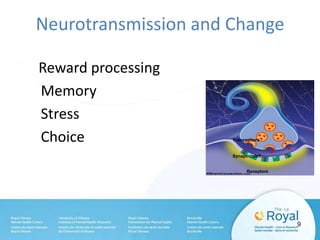
Transmitters
Synaptic cleft
Receptors
Neurotransmission and Change
Reward processing
Memory
Stress
Choice
Addiction-Disease of Choice
• Altered reward, motivation, memory, stress, &
judgment
• “The breathtaking lack of judgment” that is
one of the hallmarks of addiction
Co-occurring Disorders - the Norm in
Medicine
• Concurrent Disorders – two mental health
diagnosis
• A substance use disorder
• And one other mental health disorder
Concurrent Disorders
• General population 3-4%
• Mental health tx programs 40-60% had co-
occurring substance use disorder
• Substance abuse tx program 50-60% had co-
occurring mental health disorder
• Suicide 30 times as common in alcohol
dependant persons
• 35% of IV drug users commit suicide
Concurrent Disorders
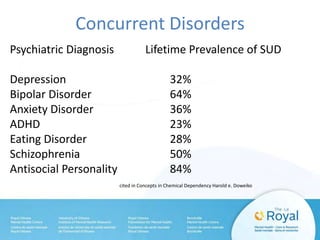
Psychiatric Diagnosis Lifetime Prevalence of SUD
Depression 32%
Bipolar Disorder 64%
Anxiety Disorder 36%
ADHD 23%
Eating Disorder 28%
Schizophrenia 50%
Antisocial Personality 84%
cited in Concepts in Chemical Dependency Harold e. Doweiko
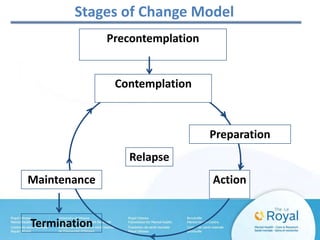
Precontemplation
Contemplation
Action
Termination
Stages of Change Model
Relapse
Maintenance
Preparation
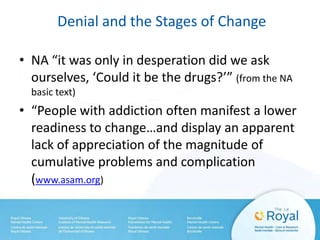
Denial and the Stages of Change
• NA “it was only in desperation did we ask
ourselves, ‘Could it be the drugs?’” (from the NA
basic text)
• “People with addiction often manifest a lower
readiness to change…and display an apparent
lack of appreciation of the magnitude of
cumulative problems and complication
(www.asam.org)
Treatment or How the Addicted Get
Sober – the Kickstart
• First helping to stabilize the individual.
• Treatment starts as process of helping the
individual see the truth of their use clearly.
• Then to understand what happened – the
disease.
Treatment
• To help the person develop the skills and
understanding that will help them stay
abstinent.
• To help the individual to understand the
importance of relapse prevention.
• And thru the whole process to model Hope
Recovery - The Lifelong Journey
• AA Step 12 Having had a spiritual awakening as a
result of these steps we tried to carry this message
to alcoholics, and to practice these principles in all
our affairs.
• www.samhsa.gov (substance abuse & mental health services
administration) recovery from alcohol and drug problems
is a process of change through which an individual
achieves abstinence and improved health wellness
and quality of life
Recovery the supports
• Components of recovery - the supports
– maintenance of the structure
– management of mental health issues
– reintegration into the community. Ex. Work family
So what does this mean?
• For the individual
• For the family

Getting the Low Down on Substance Abuse

  • 1.
    Addiction: Disease or Choice? Presentedby Michael Coughlin RN October 18, 2012 Introduced by Melanie Willows B.Sc. M.D. C.C.F.P. C.A.S.A.M. C.C.S.A.M. Assistant Professor University Of Ottawa Clinical Director Substance Use and Concurrent Disorders Program Royal Ottawa Mental Health Centre
  • 2.
    • How weunderstand addictions here at The Royal and why understanding (the model) is important • Addiction Disease of Choice • Concurrent Disorders • Treatment or How People Get Sober • Recovery or How People Stay Sober • What Does This Mean? - for the Individual - for the Family Discussion Points
  • 3.
    Disease does notmean not capable of responsibility The individual retains responsibility for correcting his or her behavior, even if he or she has a disease such as addiction”(Vaillant,1983,1990)
  • 4.
    Models of Addiction •Dispositional disease model – somehow the individual is different (allergic) • Educational model – lack of knowledge • Characteralogical model – abnormal personality • General systems models – social systems models • Moral model - choice • Medical model – Primarily genetic predisposition • Spiritual model – lost their path
  • 5.
    Final Common PathwayModel • Holds that addiction to chemicals is an end- stage or a common end-point • States that there is no single cause of addiction
  • 6.
    Final Common PathwayModel Addiction starts from biological, psychological and social factors but results in a permanently re-wired brain
  • 7.
    American Society ofAddiction Medicine (ASAM) Addiction is a primary, chronic disease of brain reward, motivation, memory and related circuitry. Dysfunction in these circuits leads to characteristic biological psychological, social and spiritual manifestation. This is reflected in an individual pathologically pursuing reward and/or relief by substance use and other behaviours. www.asam.org Adopted by the ASAM Board of Directors4/12/2011.
  • 8.
    ASAM Addiction is characterizedby inability to consistently abstain, impairment in behavioural control, craving, diminished recognition of significant problems with one’s behaviours and interpersonal relationships, and a dysfunctional emotional response… Adopted by the ASAM Board of Directors 4/12/2011. www.asam.org
  • 9.
    9 Transmitters Synaptic cleft Receptors Neurotransmission andChange Reward processing Memory Stress Choice
  • 10.
    Addiction-Disease of Choice •Altered reward, motivation, memory, stress, & judgment • “The breathtaking lack of judgment” that is one of the hallmarks of addiction
  • 11.
    Co-occurring Disorders -the Norm in Medicine • Concurrent Disorders – two mental health diagnosis • A substance use disorder • And one other mental health disorder
  • 12.
    Concurrent Disorders • Generalpopulation 3-4% • Mental health tx programs 40-60% had co- occurring substance use disorder • Substance abuse tx program 50-60% had co- occurring mental health disorder • Suicide 30 times as common in alcohol dependant persons • 35% of IV drug users commit suicide
  • 13.
    Concurrent Disorders Psychiatric DiagnosisLifetime Prevalence of SUD Depression 32% Bipolar Disorder 64% Anxiety Disorder 36% ADHD 23% Eating Disorder 28% Schizophrenia 50% Antisocial Personality 84% cited in Concepts in Chemical Dependency Harold e. Doweiko
  • 14.
  • 15.
    Denial and theStages of Change • NA “it was only in desperation did we ask ourselves, ‘Could it be the drugs?’” (from the NA basic text) • “People with addiction often manifest a lower readiness to change…and display an apparent lack of appreciation of the magnitude of cumulative problems and complication (www.asam.org)
  • 16.
    Treatment or Howthe Addicted Get Sober – the Kickstart • First helping to stabilize the individual. • Treatment starts as process of helping the individual see the truth of their use clearly. • Then to understand what happened – the disease.
  • 17.
    Treatment • To helpthe person develop the skills and understanding that will help them stay abstinent. • To help the individual to understand the importance of relapse prevention. • And thru the whole process to model Hope
  • 18.
    Recovery - TheLifelong Journey • AA Step 12 Having had a spiritual awakening as a result of these steps we tried to carry this message to alcoholics, and to practice these principles in all our affairs. • www.samhsa.gov (substance abuse & mental health services administration) recovery from alcohol and drug problems is a process of change through which an individual achieves abstinence and improved health wellness and quality of life
  • 19.
    Recovery the supports •Components of recovery - the supports – maintenance of the structure – management of mental health issues – reintegration into the community. Ex. Work family
  • 20.
    So what doesthis mean? • For the individual • For the family