Elder Abuse – Public Health Nurses’ experiences
Authors:
P.J. Cooke, MSc, BSc, RPHN, RGN, PG Dip Health Service Management 1.
Dr. Helen Mulcahy, DN, MSc (Research), BSc, Hdip PHN, RPHN, RM, RGN 2.
Dr. Mary Rose Day, DN, MA, BSc, Hdip PHN, RPHN, RM, RGN 2.
1. Health Service Executive, 2. University College Cork
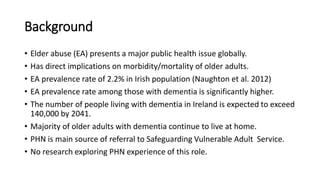
Objectives
Elder Abuse – Public Health
Nurses’ (PHN) Experiences
1. Definitions
and Background
2. Aim
3. Methodology 4. Findings
5. Conclusion
6. Implications for Practice,
Education & Research
Definition
• “Elder abuse is a single or repeated act or lack of appropriate action,
occurring within any relationship where there is an expectation of
trust, which causes harm or distress to an older person” (World Health
Organisation 2008, p.6)
• Types: Physical, Sexual, Psychological, Financial, Neglect, Discriminatory & Institutional
Background
• Elder abuse (EA) presents a major public health issue globally.
• Has direct implications on morbidity/mortality of older adults.
• EA prevalence rate of 2.2% in Irish population (Naughton et al. 2012)
• EA prevalence rate among those with dementia is significantly higher.
• The number of people living with dementia in Ireland is expected to exceed
140,000 by 2041.
• Majority of older adults with dementia continue to live at home.
• PHN is main source of referral to Safeguarding Vulnerable Adult Service.
• No research exploring PHN experience of this role.
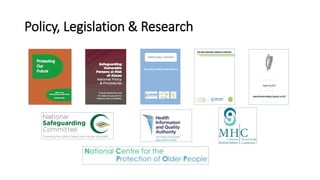
Policy, Legislation & Research
Aim
• To gain insight into the experiences of PHN in identifying and
managing cases of EA perpetrated by informal caregivers against
community dwelling older adults living with dementia.
• To generate better understanding of the complex phenomenon of EA.
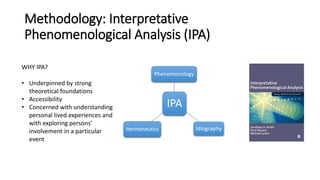
Methodology: Interpretative
Phenomenological Analysis (IPA)
WHY IPA?
• Underpinned by strong
theoretical foundations
• Accessibility
• Concerned with understanding
personal lived experiences and
with exploring persons’
involvement in a particular
event
IPA
Phenomenology
IdiographyHermeneutics
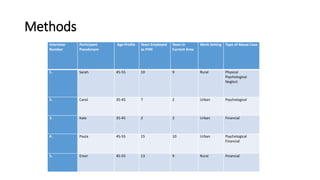
Methods
Interview
Number
Participant
Pseudonym
Age Profile Years Employed
as PHN
Years in
Current Area
Work Setting Type of Abuse Case
1. Sarah 45-55 10 9 Rural Physical
Psychological
Neglect
2. Carol 35-45 7 2 Urban Psychological
3. Kate 35-45 2 2 Urban Financial
4. Paula 45-55 15 10 Urban Psychological
Financial
5. Emer 45-55 13 9 Rural Financial
Methods
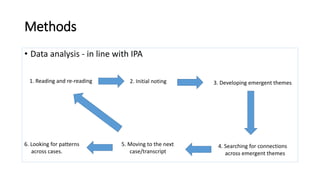
• Data analysis - in line with IPA
1. Reading and re-reading 2. Initial noting 3. Developing emergent themes
4. Searching for connections
across emergent themes
5. Moving to the next
case/transcript
6. Looking for patterns
across cases.
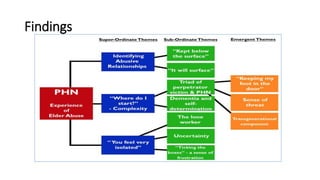
Findings
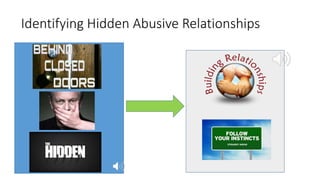
Identifying Hidden Abusive Relationships
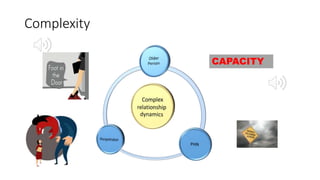
Complexity
CAPACITY
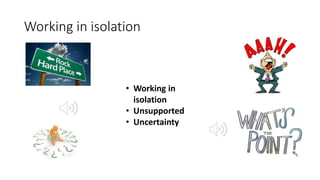
Working in isolation
• Working in
isolation
• Unsupported
• Uncertainty
Conclusion
• Elder abuse is a growing and complex public health issue.
• PHNs experience of elder abuse presented a range of issues.
• Ethical decision making approach needs to do justice to the lived
experience of both client and professional.
• Moral reasoning processes need to be reflective and encompass
the complexities of situation and relationship(s).
• Clinical and peer supervision to support professional practice in
safeguarding vulnerable adults.
• Strengthening of multi-disciplinary collaboration in safeguarding
vulnerable adults.
Implications for Practice/Education & Research
• Continued research to develop a reliable instrument that will assist
healthcare professionals screen for abuse among older adults living
with dementia.
• The legislative framework for safeguarding vulnerable adults needs to
be strengthened and the Decision Support Service within the Mental
Health Commission needs to be progressed.
• PHNs need access to education and training that is cross-disciplinary.
• Development of clinical supervision programmes to support PHNs
manage complex cases of elder abuse.
• Develop integrated and consolidated model of service delivery.
References
• Clancy M., McDaid B., O’Neill D. & O’Brien J. (2011) National profiling of elder abuse
referrals. Age and Ageing 40, 346-352.
• Cooper C., Selwood A., Blanchard M., Walker Z., Blizard R. & Livingston G. (2009) Abuse
of people with dementia by family carers: representative cross sectional survey. British
Medical Journal 338(2), b155.
• Day M., Mulcahy H. & Leahy-Warren P. (2016) Prevalence of self-neglect in the caseloads
of public health nurses. British Journal of Community Nursing 21(1), 31-35.
• Department of Health (2014) The Irish National Dementia Strategy. Department of
Health, Dublin.
• Department of Health (2013) The National Positive Ageing Strategy. Department of
Health, Dublin.
• Dong X. (2015) Elder Abuse: Systematic Review and Implications for Practice. Journal of
the American Geriatric Society 63(6), 1214-1238.
• Government of Ireland (2015) The Assisted Decision-Making (Capacity) Act 2015. Number 64
of 2015, Government of Ireland, Dublin.
• Health Service Executive (2014) Safeguarding Vulnerable Persons At Risk of Abuse Social Care
Division, HSE, Dublin.
http://www.hse.ie/eng/services/publications/corporate/personsatriskofabuse.pdf
• Naughton C., Drennan J., Lyons I., Lafferty A., Treacy M., Phelan A., O’Loughlin A. & Delaney
L.(2012) Elder abuse and neglect in Ireland: results from a national prevalence survey. Age
and Ageing 41, 98-103.
• Smith J., Flowers P. & Larkin P. (2009) Interpretative Phenomenological Analysis: Theory,
Method and Research. Sage, London.
• World Health Organisation (2008) A global response to elder abuse and neglect:
Building primary health care capacity to deal with the problem worldwide. WHO,
Geneva.
Questions?

Elder Abuse - Public Health Nurses' Experiences

  • 1.
    Elder Abuse –Public Health Nurses’ experiences Authors: P.J. Cooke, MSc, BSc, RPHN, RGN, PG Dip Health Service Management 1. Dr. Helen Mulcahy, DN, MSc (Research), BSc, Hdip PHN, RPHN, RM, RGN 2. Dr. Mary Rose Day, DN, MA, BSc, Hdip PHN, RPHN, RM, RGN 2. 1. Health Service Executive, 2. University College Cork
  • 2.
    Objectives Elder Abuse –Public Health Nurses’ (PHN) Experiences 1. Definitions and Background 2. Aim 3. Methodology 4. Findings 5. Conclusion 6. Implications for Practice, Education & Research
  • 3.
    Definition • “Elder abuseis a single or repeated act or lack of appropriate action, occurring within any relationship where there is an expectation of trust, which causes harm or distress to an older person” (World Health Organisation 2008, p.6) • Types: Physical, Sexual, Psychological, Financial, Neglect, Discriminatory & Institutional
  • 4.
    Background • Elder abuse(EA) presents a major public health issue globally. • Has direct implications on morbidity/mortality of older adults. • EA prevalence rate of 2.2% in Irish population (Naughton et al. 2012) • EA prevalence rate among those with dementia is significantly higher. • The number of people living with dementia in Ireland is expected to exceed 140,000 by 2041. • Majority of older adults with dementia continue to live at home. • PHN is main source of referral to Safeguarding Vulnerable Adult Service. • No research exploring PHN experience of this role.
  • 5.
  • 6.
    Aim • To gaininsight into the experiences of PHN in identifying and managing cases of EA perpetrated by informal caregivers against community dwelling older adults living with dementia. • To generate better understanding of the complex phenomenon of EA.
  • 7.
    Methodology: Interpretative Phenomenological Analysis(IPA) WHY IPA? • Underpinned by strong theoretical foundations • Accessibility • Concerned with understanding personal lived experiences and with exploring persons’ involvement in a particular event IPA Phenomenology IdiographyHermeneutics
  • 8.
    Methods Interview Number Participant Pseudonym Age Profile YearsEmployed as PHN Years in Current Area Work Setting Type of Abuse Case 1. Sarah 45-55 10 9 Rural Physical Psychological Neglect 2. Carol 35-45 7 2 Urban Psychological 3. Kate 35-45 2 2 Urban Financial 4. Paula 45-55 15 10 Urban Psychological Financial 5. Emer 45-55 13 9 Rural Financial
  • 9.
    Methods • Data analysis- in line with IPA 1. Reading and re-reading 2. Initial noting 3. Developing emergent themes 4. Searching for connections across emergent themes 5. Moving to the next case/transcript 6. Looking for patterns across cases.
  • 10.
  • 11.
  • 12.
  • 13.
    Working in isolation •Working in isolation • Unsupported • Uncertainty
  • 14.
    Conclusion • Elder abuseis a growing and complex public health issue. • PHNs experience of elder abuse presented a range of issues. • Ethical decision making approach needs to do justice to the lived experience of both client and professional. • Moral reasoning processes need to be reflective and encompass the complexities of situation and relationship(s). • Clinical and peer supervision to support professional practice in safeguarding vulnerable adults. • Strengthening of multi-disciplinary collaboration in safeguarding vulnerable adults.
  • 15.
    Implications for Practice/Education& Research • Continued research to develop a reliable instrument that will assist healthcare professionals screen for abuse among older adults living with dementia. • The legislative framework for safeguarding vulnerable adults needs to be strengthened and the Decision Support Service within the Mental Health Commission needs to be progressed. • PHNs need access to education and training that is cross-disciplinary. • Development of clinical supervision programmes to support PHNs manage complex cases of elder abuse. • Develop integrated and consolidated model of service delivery.
  • 16.
    References • Clancy M.,McDaid B., O’Neill D. & O’Brien J. (2011) National profiling of elder abuse referrals. Age and Ageing 40, 346-352. • Cooper C., Selwood A., Blanchard M., Walker Z., Blizard R. & Livingston G. (2009) Abuse of people with dementia by family carers: representative cross sectional survey. British Medical Journal 338(2), b155. • Day M., Mulcahy H. & Leahy-Warren P. (2016) Prevalence of self-neglect in the caseloads of public health nurses. British Journal of Community Nursing 21(1), 31-35. • Department of Health (2014) The Irish National Dementia Strategy. Department of Health, Dublin. • Department of Health (2013) The National Positive Ageing Strategy. Department of Health, Dublin. • Dong X. (2015) Elder Abuse: Systematic Review and Implications for Practice. Journal of the American Geriatric Society 63(6), 1214-1238.
  • 17.
    • Government ofIreland (2015) The Assisted Decision-Making (Capacity) Act 2015. Number 64 of 2015, Government of Ireland, Dublin. • Health Service Executive (2014) Safeguarding Vulnerable Persons At Risk of Abuse Social Care Division, HSE, Dublin. http://www.hse.ie/eng/services/publications/corporate/personsatriskofabuse.pdf • Naughton C., Drennan J., Lyons I., Lafferty A., Treacy M., Phelan A., O’Loughlin A. & Delaney L.(2012) Elder abuse and neglect in Ireland: results from a national prevalence survey. Age and Ageing 41, 98-103. • Smith J., Flowers P. & Larkin P. (2009) Interpretative Phenomenological Analysis: Theory, Method and Research. Sage, London. • World Health Organisation (2008) A global response to elder abuse and neglect: Building primary health care capacity to deal with the problem worldwide. WHO, Geneva.
  • 18.