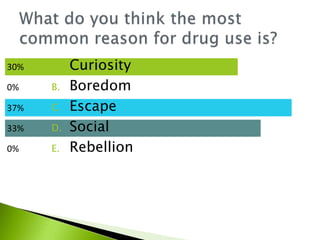
30% A. Curiosity
0%
37%
33%
0%
B. Boredom
C. Escape
D. Social
E. Rebellion
3.
We alldo things we know we shouldn’t do.
Why?
Characteristics of drugs can reinforce their
use
◦ Altered states of consciousness
Societal, community, and family factors play
an important role in whether an individual
tries a drug
Drug factors play an important role in
whether an individual continues to use a
drug
4.
Experimentation:
◦Especially among young people, curiosity is a
natural phenomenon that easily leads to
experimentation
Pleasure/Escape from Boredom:
◦ An individual who is bored will engage in
something pleasurable to relieve the boredom
◦ Drugs used to increase pleasure or reduce boredom
provide positive reinforcement
◦ Drugs taken to alleviate discomfort provide
negative reinforcement
5.
Peer Influence:
◦ Many young people use drugs to gain peer
acceptance or approval
◦ Basic values, life goals, and aspirations still are
influenced more by parents
Spiritual Purposes:
◦ People have used drugs to communicate with
something or someone greater than themselves
◦ Psychoactive plants have roles in many religious
and spiritual practices
6.
Self-Discovery:
◦Drugs sometimes are used to fill a void in one’s life
Social Interaction:
◦ Drugs are used to facilitate interactions with others
◦ Certain social groups determine how a drug is used
Rebelliousness:
◦ Young people rebel against the conventions of
society, including warnings about drugs
8.
◦ Community, parental,
and peer attitudes
and behaviors
◦ Antisocial/problem
behaviors
◦ Poor school
performance
◦ Perception that use is
prevalent
9.
◦ Involvement inreligious activities
◦ Commitment to school,
involvement in extracurricular
activities
◦ Perceived risk
of drug use
◦ Parents as social
support
13.
U.S. Departmentof Health and Human
Services: Addiction is a “chronic, life-threatening
condition that has roots in
genetic susceptibility, social circumstance
and personal behavior”
No single theory adequately covers every
aspect of drug addiction – elements of
various theories provide insight into drug
addiction
14.
Delayed behavioralor emotional development
may be a factor in substance abuse
Personality characteristics associated with drug
abuse:
◦ Low self-esteem
◦ Poor interpersonal skills
◦ Need for immediate gratification
◦ Defiant feelings toward authority
◦ Little tolerance for anxiety, frustration, and depression
◦ Impulsivity
◦ Risk taking
◦ Low regard for personal health
15.
A. Impulsivity
B.Lack of
intelligence
C. Need for
immediate
gratification
D. Defiance
3% 3% 3%
Impulsivity
Lack of intelligence
Need for immediate grati...
Defiance
90%
16.
Reinforcers arestimuli or events that increase the
likelihood of a particular behavior
Primary reinforcers reduce physiological needs or are
inherently pleasurable; examples are food, water, and
sex
Secondary reinforcers act as signals for the increased
probability of obtaining primary reinforcers; example:
money
Drugs can be primary or secondary reinforcers
17.
A. Things that
reward us
B. Things that are
correlated with
drug use
C. Things that
make a behavior
more likely
10%
Things that reward us
Things that make a beha...
Things that are correlate...
83%
7%
18.
Biological theoryis a view of addiction
holding that it is based on genetics and
metabolic imbalances
Genetic theory: a person is predisposed to
drug addiction, including addiction to
alcohol, by hereditary influence
Metabolic imbalance: Narcotics help addicts
stabilize the metabolic deficiency caused by
absence of the drug
19.
A. The biologyof
the individual
B. Genetics
C. Metabolic
imbalances
D. All of the above
The biology of the indivi...
Genetics
Metabolic imbalances
All of the above
3%
97%
0% 0%
21.
Social theoryis the hypothesis that drug use
is determined by cultural and social
influences
Rewards of drug use may be derived from
groups and others with whom we associate
Drug abuse may arise from antisocial
behavior
Social theory does not explain drug addiction
22.
A. Attribute drug
use to cultural
and social
influences
B. Explain the
phenomenon of
addiction
C. Discount the
importance of
family influence
Explain the phenomenon ..
Attribute drug use to cu...
Discount the importance ..
89%
0%
11%
59% A. Yes
7%
33%
0%
B. No
C. In some situations
D. I don’t really know
25.
The impactof the media on drug use is hard
to determine
Many forms of
mass media feature
drugs:
◦ Movies
◦ Advertisements
◦ Billboards
◦ Television
◦ Music
◦ Celebrities
26.
1. Discusswhat factors are most important in one’s
decision to use or not use alcohol, tobacco, and/or
illegal drugs.
2. Peers are cited frequently as an important
influence on whether one uses drugs. At what age is
the influence of peers most significant? Are males or
females more affected by peer influence?
3. The depiction of alcohol use and smoking is
prominent in movies, music videos, and television
shows. Do you feel that alcohol use and smoking
rates are affected by how alcohol and smoking are
shown in videos? If yes, would you try to ban all
alcohol and tobacco use in the media?
Editor's Notes
#4 Motives for Drug Use
1. Personal and social variables such as identifying with a deviant subculture increase the likelihood of drug use.
2. Rebellious behavior can serve as a way to demand attention or to make a particular impression.
3. Drug use may be reinforced by the effects of the drug.
4. Drug users are often seeking an altered state of consciousness.
5. Societal, community, and family factors play an important role in determining whether a person tries a drug, but the individual’s experiences with a drug become more important with increasing use.
#5 We all do things that we know, logically, we should not do
Eating too much
Driving too fast
Drinking too much
Identification with a deviant subculture is a key factor
Fads and cultural trends influence what drugs are used
Characteristics of drugs can reinforce their use
Altered states of consciousness
Societal, community, and family factors play an important role in whether an individual tries a drug
Drug factors play an important role in whether an individual continues to use a drug
Motives for Drug Use
1. Personal and social variables such as identifying with a deviant subculture increase the likelihood of drug use.
2. Rebellious behavior can serve as a way to demand attention or to make a particular impression.
3. Drug use may be reinforced by the effects of the drug.
4. Drug users are often seeking an altered state of consciousness.
5. Societal, community, and family factors play an important role in determining whether a person tries a drug, but the individual’s experiences with a drug become more important with increasing use.
#8 Risk and Protective Factors
1. Risk factors are correlated with higher rates of drug use.
2. Risk factors for drug use include having friends who use drugs, engaging in fighting or stealing, perceiving that substance use is prevalent at school, knowing adults who use drugs, and having a positive attitude towards drugs.
3. The kids most likely to use marijuana frequently live in a rough neighborhood, have little parental monitoring, steal and get into fights, may not be involved in religious activities, and do poorly in school.
4. Protective factors are correlated with lower rates of drug use.
5. Protective factors for drug use include perceiving strong sanctions against drug use at school, having supportive parents, being committed to school, being involved in religious activities, and participating in two or more extracurricular activities.
6. Overall, studies of risk and protective factors suggest that adolescents who are more likely to smoke cigarettes, drink heavily, and smoke marijuana are also more likely to engage in other deviant behaviors, such as stealing, fighting, and early sexual behaviors.
#14 What do “addicts” look like?
What drug do they take or what behavior do they engage in (alcohol, cigarettes, illicit drugs, food, sex, gambling, shopping, computer time)?
How much time do they spend on their habit?
How much of a drug do they take?
How do you decide on the definition of dependence?
Three basic processes
Tolerance
Physical dependence
Psychological dependence
Diminished effect on the body after repeated use of the same drug
The body develops ways to compensate for the chemical imbalance caused by the drug
Regular drug users may build up tolerance to the extent that their dosage would kill a novice user
Physical dependence is defined by the occurrence of a withdrawal syndrome
Tolerance typically precedes physical dependence
If drug use is stopped suddenly, withdrawal symptoms occur, ranging from mild to severe
Physical dependence means the body has adapted to the drug’s presence
Psychological or behavioral dependence
High frequency of drug use
Craving for the drug
Tendency to relapse after stopping use
Behavior is reinforced by the consequences
Over time, this becomes the biggest reason users report they continue to use
Early medical model = true addiction involves physical dependence; key is treatment of withdrawal symptoms
Positive reinforcement model = drugs can reinforce behavior without physical dependence
Psychological dependence is increasingly viewed as the driving force behind repeated drug use
This refutes the sometimes common belief that drugs that aren’t as strongly physically addicting are less dangerous
Some drugs are more likely than others to lead to dependence
Method of use, as well as other factors, influences risk of dependence
The “war on drugs” reflects the perspective that drugs are themselves evil
Is dependence due to biochemical or physiological actions in the brain?
Still no way to scan the brain and know if a person has/had developed dependence
Genetic physiological or biochemical markers have been sought as well, but none has proven reliable
No way to know if the drug or the drug use changes a person’s personality
Many other factors affect personality
Sensation-seeking = a personality characteristic statistically associated with early substance use and abuse
Alcohol dependence often exists within a dysfunctional family
Evidence suggests that dysfunctional relationships play a role in dependence, but they aren’t the only factor
Founders of AA characterized alcohol dependence as a disease
Others argue that dependence doesn’t have all the characteristics of a disease
There are ways to test and treat the effects of alcoholism but not the disease itself
There is some disagreement over how to define disease as well
Dependence is related to dysfunctions of:
Biology
Personality
Social interactions
#21 Figure 3.4 A Medical College of Virginia study involving 949 female twin pairs found genetic factors to be more influential than environmental factors in smoking initiation and nicotine dependence. Likewise, a St. Louis
University study of 3,356 male twin pairs found genetic factors to be more influential for dependence on nicotine and alcohol.
#26
An estimated $25 billion is spent on advertising tobacco, alcohol, and prescription drugs
One study of alcohol marketing worldwide showed that young people are influenced by marketing
Advertisements for cigarettes play on many themes, particularly independence
After cigarette ads were prohibited from television in 1971, the void was filled with advertisements for smokeless tobacco