© 2021 NVIDIA
Getting Started with Vision AI
Model Training
Ekaterina Sirazitdinova
NVIDIA
© 2021 NVIDIA
Agenda
• Introduction to deep learning training
• How it works and how neural networks learn
• What affects training
• Important training parameters and problem mitigation
• Data preparation
• Essential steps for creating a deep learning data set
• Where to start
• Deep learning frameworks and community resources
2
© 2021 NVIDIA
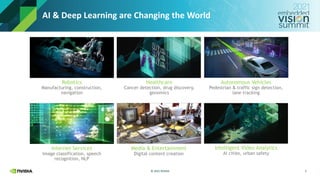
AI & Deep Learning are Changing the World
3
Robotics
Manufacturing, construction,
navigation
Healthcare
Cancer detection, drug discovery,
genomics
Internet Services
Image classification, speech
recognition, NLP
Media & Entertainment
Digital content creation
Autonomous Vehicles
Pedestrian & traffic sign detection,
lane tracking
Intelligent Video Analytics
AI cities, urban safety
© 2021 NVIDIA
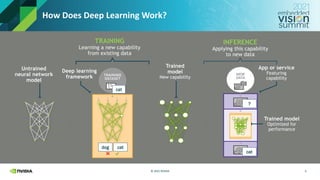
How Does Deep Learning Work?
4
Trained
model
New capability
Untrained
neural network
model
Deep learning
framework
TRAINING
Learning a new capability
from existing data
cat
cat
dog
App or service
Featuring
capability
INFERENCE
Applying this capability
to new data
Trained model
Optimized for
performance
cat
?
© 2021 NVIDIA
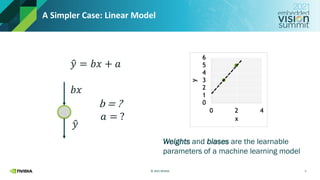
A Simpler Case: Linear Model
5
ො
𝑦
𝑏𝑥
ො
𝑦 = 𝑏𝑥 + 𝑎
b = ?
𝑎 = ?
Weights and biases are the learnable
parameters of a machine learning model
© 2021 NVIDIA
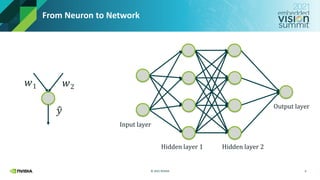
From Neuron to Network
6
ො
𝑦
𝑤1 𝑤2
Input layer
Hidden layer 1 Hidden layer 2
Output layer
© 2021 NVIDIA
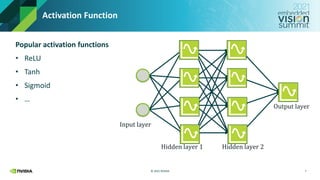
Activation Function
Popular activation functions
• ReLU
• Tanh
• Sigmoid
• …
7
Input layer
Hidden layer 1 Hidden layer 2
Output layer
How Does a Neural Network Learn?
8
© 2021 NVIDIA
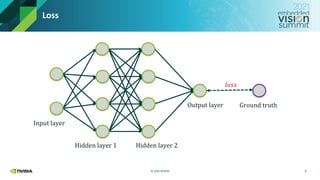
Loss
9
Input layer
Hidden layer 1 Hidden layer 2
Output layer Ground truth
𝑙𝑜𝑠𝑠
© 2021 NVIDIA
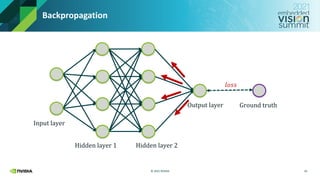
Backpropagation
10
Input layer
Hidden layer 1 Hidden layer 2
Output layer Ground truth
𝑙𝑜𝑠𝑠
© 2021 NVIDIA
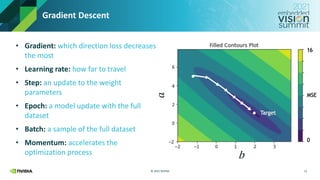
Gradient Descent
• Gradient: which direction loss decreases
the most
• Learning rate: how far to travel
• Step: an update to the weight
parameters
• Epoch: a model update with the full
dataset
• Batch: a sample of the full dataset
• Momentum: accelerates the
optimization process
11
b
𝑎
© 2021 NVIDIA
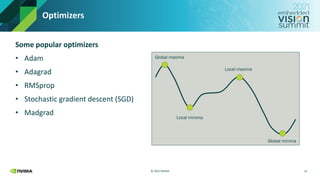
Optimizers
Some popular optimizers
• Adam
• Adagrad
• RMSprop
• Stochastic gradient descent (SGD)
• Madgrad
12
Global maxima
Local minima
Local maxima
Global minima
What Can Go Wrong and How to Make it Right?
13
© 2021 NVIDIA
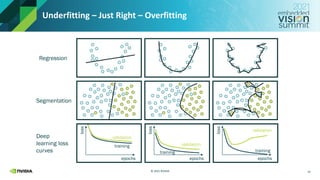
Underfitting – Just Right – Overfitting
Regression
Segmentation
Deep
learning loss
curves
loss
epochs
training
validation
loss
epochs
training
validation
loss
epochs
training
validation
14
© 2021 NVIDIA
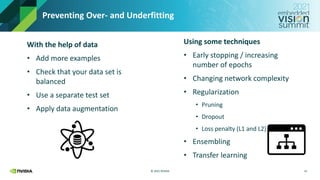
Preventing Over- and Underfitting
With the help of data
• Add more examples
• Check that your data set is
balanced
• Use a separate test set
• Apply data augmentation
15
Using some techniques
• Early stopping / increasing
number of epochs
• Changing network complexity
• Regularization
• Pruning
• Dropout
• Loss penalty (L1 and L2)
• Ensembling
• Transfer learning
It’s All About Data
16
© 2021 NVIDIA
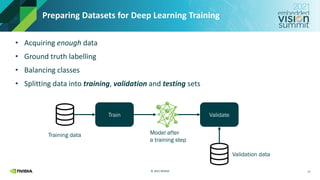
Preparing Datasets for Deep Learning Training
• Acquiring enough data
• Ground truth labelling
• Balancing classes
• Splitting data into training, validation and testing sets
Train Validate
Training data
Validation data
Model after
a training step
17
What’s Next?
18
© 2021 NVIDIA
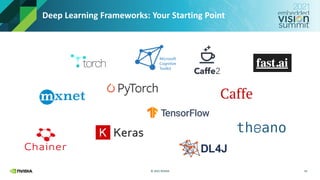
Deep Learning Frameworks: Your Starting Point
19
© 2021 NVIDIA
Summary: In This Talk You Have Learned
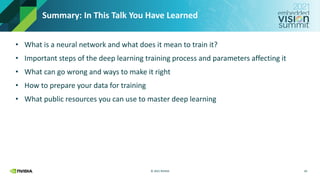
• What is a neural network and what does it mean to train it?
• Important steps of the deep learning training process and parameters affecting it
• What can go wrong and ways to make it right
• How to prepare your data for training
• What public resources you can use to master deep learning
20
© 2021 NVIDIA
Resources
21
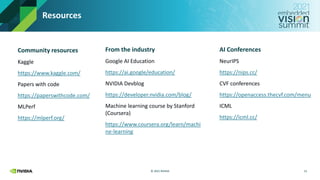
Community resources
Kaggle
https://www.kaggle.com/
Papers with code
https://paperswithcode.com/
MLPerf
https://mlperf.org/
From the industry
Google AI Education
https://ai.google/education/
NVIDIA Devblog
https://developer.nvidia.com/blog/
Machine learning course by Stanford
(Coursera)
https://www.coursera.org/learn/machi
ne-learning
AI Conferences
NeurIPS
https://nips.cc/
CVF conferences
https://openaccess.thecvf.com/menu
ICML
https://icml.cc/
Thank you!
22

“Getting Started with Vision AI Model Training,” a Presentation from NVIDIA

  • 1.
    © 2021 NVIDIA GettingStarted with Vision AI Model Training Ekaterina Sirazitdinova NVIDIA
  • 2.
    © 2021 NVIDIA Agenda •Introduction to deep learning training • How it works and how neural networks learn • What affects training • Important training parameters and problem mitigation • Data preparation • Essential steps for creating a deep learning data set • Where to start • Deep learning frameworks and community resources 2
  • 3.
    © 2021 NVIDIA AI& Deep Learning are Changing the World 3 Robotics Manufacturing, construction, navigation Healthcare Cancer detection, drug discovery, genomics Internet Services Image classification, speech recognition, NLP Media & Entertainment Digital content creation Autonomous Vehicles Pedestrian & traffic sign detection, lane tracking Intelligent Video Analytics AI cities, urban safety
  • 4.
    © 2021 NVIDIA HowDoes Deep Learning Work? 4 Trained model New capability Untrained neural network model Deep learning framework TRAINING Learning a new capability from existing data cat cat dog App or service Featuring capability INFERENCE Applying this capability to new data Trained model Optimized for performance cat ?
  • 5.
    © 2021 NVIDIA ASimpler Case: Linear Model 5 ො 𝑦 𝑏𝑥 ො 𝑦 = 𝑏𝑥 + 𝑎 b = ? 𝑎 = ? Weights and biases are the learnable parameters of a machine learning model
  • 6.
    © 2021 NVIDIA FromNeuron to Network 6 ො 𝑦 𝑤1 𝑤2 Input layer Hidden layer 1 Hidden layer 2 Output layer
  • 7.
    © 2021 NVIDIA ActivationFunction Popular activation functions • ReLU • Tanh • Sigmoid • … 7 Input layer Hidden layer 1 Hidden layer 2 Output layer
  • 8.
    How Does aNeural Network Learn? 8
  • 9.
    © 2021 NVIDIA Loss 9 Inputlayer Hidden layer 1 Hidden layer 2 Output layer Ground truth 𝑙𝑜𝑠𝑠
  • 10.
    © 2021 NVIDIA Backpropagation 10 Inputlayer Hidden layer 1 Hidden layer 2 Output layer Ground truth 𝑙𝑜𝑠𝑠
  • 11.
    © 2021 NVIDIA GradientDescent • Gradient: which direction loss decreases the most • Learning rate: how far to travel • Step: an update to the weight parameters • Epoch: a model update with the full dataset • Batch: a sample of the full dataset • Momentum: accelerates the optimization process 11 b 𝑎
  • 12.
    © 2021 NVIDIA Optimizers Somepopular optimizers • Adam • Adagrad • RMSprop • Stochastic gradient descent (SGD) • Madgrad 12 Global maxima Local minima Local maxima Global minima
  • 13.
    What Can GoWrong and How to Make it Right? 13
  • 14.
    © 2021 NVIDIA Underfitting– Just Right – Overfitting Regression Segmentation Deep learning loss curves loss epochs training validation loss epochs training validation loss epochs training validation 14
  • 15.
    © 2021 NVIDIA PreventingOver- and Underfitting With the help of data • Add more examples • Check that your data set is balanced • Use a separate test set • Apply data augmentation 15 Using some techniques • Early stopping / increasing number of epochs • Changing network complexity • Regularization • Pruning • Dropout • Loss penalty (L1 and L2) • Ensembling • Transfer learning
  • 16.
  • 17.
    © 2021 NVIDIA PreparingDatasets for Deep Learning Training • Acquiring enough data • Ground truth labelling • Balancing classes • Splitting data into training, validation and testing sets Train Validate Training data Validation data Model after a training step 17
  • 18.
  • 19.
    © 2021 NVIDIA DeepLearning Frameworks: Your Starting Point 19
  • 20.
    © 2021 NVIDIA Summary:In This Talk You Have Learned • What is a neural network and what does it mean to train it? • Important steps of the deep learning training process and parameters affecting it • What can go wrong and ways to make it right • How to prepare your data for training • What public resources you can use to master deep learning 20
  • 21.
    © 2021 NVIDIA Resources 21 Communityresources Kaggle https://www.kaggle.com/ Papers with code https://paperswithcode.com/ MLPerf https://mlperf.org/ From the industry Google AI Education https://ai.google/education/ NVIDIA Devblog https://developer.nvidia.com/blog/ Machine learning course by Stanford (Coursera) https://www.coursera.org/learn/machi ne-learning AI Conferences NeurIPS https://nips.cc/ CVF conferences https://openaccess.thecvf.com/menu ICML https://icml.cc/
  • 22.