Introduction:
Srinivasa Ramanujan was an Indian
mathematician born on December 22, 1887, in
Erode, Tamil Nadu, India. Despite growing up in
relative obscurity and facing numerous
challenges, Ramanujan displayed an
extraordinary talent for mathematics from a
young age. His mathematical abilities were
largely self-taught, and he made significant
contributions to several areas of pure
mathematics.
Ramanujan's most notable
achievements include:
• Infinite Series and Continued Fractions:
• Number Theory:
• Mock Theta Functions:
• Ramanujan-Hardy Number (1729):
• Modular Forms:
• Elliptic Integrals:
An overview of Vedic Mathematics
• Vedic Mathematics is a system of
mathematical knowledge that originated in
ancient India, particularly in the Vedas, which
are ancient sacred texts of Hinduism.
• The term "Vedic Mathematics" was coined by
Bharati Krishna Tirthaji Maharaja, a Hindu
scholar, and mathematician, in the early 20th
century.
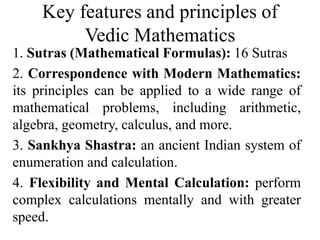
Key features and principles of
Vedic Mathematics
1. Sutras (Mathematical Formulas): 16 Sutras
2. Correspondence with Modern Mathematics:
its principles can be applied to a wide range of
mathematical problems, including arithmetic,
algebra, geometry, calculus, and more.
3. Sankhya Shastra: an ancient Indian system of
enumeration and calculation.
4. Flexibility and Mental Calculation: perform
complex calculations mentally and with greater
speed.
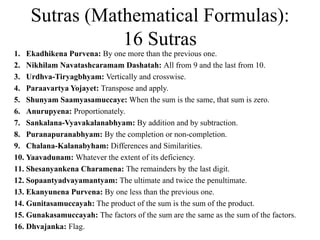
Sutras (Mathematical Formulas):
16 Sutras
1. Ekadhikena Purvena: By one more than the previous one.
2. Nikhilam Navatashcaramam Dashatah: All from 9 and the last from 10.
3. Urdhva-Tiryagbhyam: Vertically and crosswise.
4. Paraavartya Yojayet: Transpose and apply.
5. Shunyam Saamyasamuccaye: When the sum is the same, that sum is zero.
6. Anurupyena: Proportionately.
7. Sankalana-Vyavakalanabhyam: By addition and by subtraction.
8. Puranapuranabhyam: By the completion or non-completion.
9. Chalana-Kalanabyham: Differences and Similarities.
10. Yaavadunam: Whatever the extent of its deficiency.
11. Shesanyankena Charamena: The remainders by the last digit.
12. Sopaantyadvayamantyam: The ultimate and twice the penultimate.
13. Ekanyunena Purvena: By one less than the previous one.
14. Gunitasamuccayah: The product of the sum is the sum of the product.
15. Gunakasamuccayah: The factors of the sum are the same as the sum of the factors.
16. Dhvajanka: Flag.
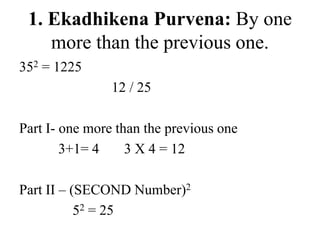
1. Ekadhikena Purvena: By one
more than the previous one.
352 = 1225
12 / 25
Part I- one more than the previous one
3+1= 4 3 X 4 = 12
Part II – (SECOND Number)2
52 = 25
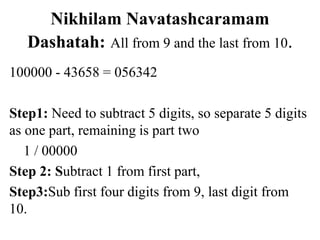
Nikhilam Navatashcaramam
Dashatah: All from 9 and the last from 10.
100000 - 43658 = 056342
Step1: Need to subtract 5 digits, so separate 5 digits
as one part, remaining is part two
1 / 00000
Step 2: Subtract 1 from first part,
Step3:Sub first four digits from 9, last digit from
10.
3. Urdhva-Tiryagbhyam:
Vertically and crosswise.
24 x 36 = 864
2 4
3 6
Step1: Last digits : (right) multiply vertically
4 x 6 = 24 . keep 4 carry over 2
Step2: Cross product (2x6)+(3x4) = 24.
keep 4 & add the last carry over
Step3: First digits: (left) multiply vertically and
add the last carry over (2x3)+2 =8
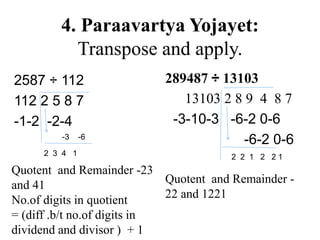
4. Paraavartya Yojayet:
Transpose and apply.
2587 ÷ 112
112 2 5 8 7
-1-2 -2-4
289487 ÷ 13103
13103 2 8 9 4 8 7
-3-10-3 -6-2 0-6
-6-2 0-6
Quotent and Remainder -
22 and 1221
2 3 4 1
-3 -6
Quotent and Remainder -23
and 41
No.of digits in quotient
= (diff .b/t no.of digits in
dividend and divisor ) + 1
2 2 1 2 2 1
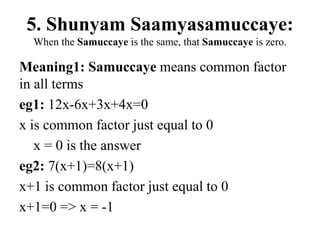
5. Shunyam Saamyasamuccaye:
When the Samuccaye is the same, that Samuccaye is zero.
Meaning1: Samuccaye means common factor
in all terms
eg1: 12x-6x+3x+4x=0
x is common factor just equal to 0
x = 0 is the answer
eg2: 7(x+1)=8(x+1)
x+1 is common factor just equal to 0
x+1=0 => x = -1
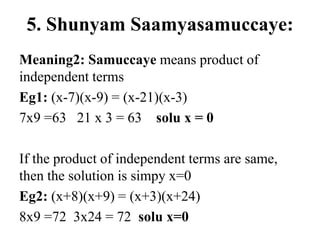
5. Shunyam Saamyasamuccaye:
Meaning2: Samuccaye means product of
independent terms
Eg1: (x-7)(x-9) = (x-21)(x-3)
7x9 =63 21 x 3 = 63 solu x = 0
If the product of independent terms are same,
then the solution is simpy x=0
Eg2: (x+8)(x+9) = (x+3)(x+24)
8x9 =72 3x24 = 72 solu x=0
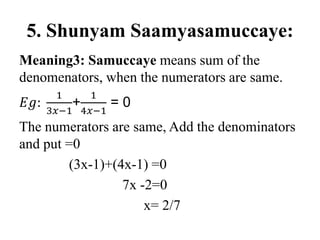
5. Shunyam Saamyasamuccaye:
Meaning3: Samuccaye means sum of the
denomenators, when the numerators are same.
𝐸𝑔:
1
3𝑥−1
+
1
4𝑥−1
= 0
The numerators are same, Add the denominators
and put =0
(3x-1)+(4x-1) =0
7x -2=0
x= 2/7
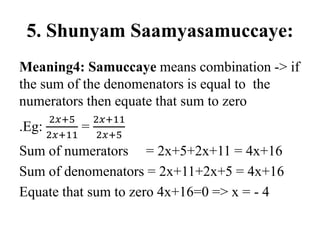
5. Shunyam Saamyasamuccaye:
Meaning4: Samuccaye means combination -> if
the sum of the denomenators is equal to the
numerators then equate that sum to zero
.Eg:
2𝑥+5
2𝑥+11
=
2𝑥+11
2𝑥+5
Sum of numerators = 2x+5+2x+11 = 4x+16
Sum of denomenators = 2x+11+2x+5 = 4x+16
Equate that sum to zero 4x+16=0 => x = - 4
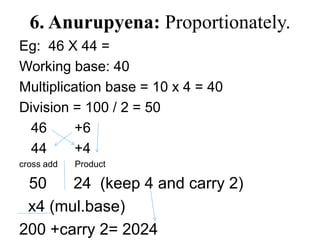
6. Anurupyena: Proportionately.
Eg: 46 X 44 =
Working base: 40
Multiplication base = 10 x 4 = 40
Division = 100 / 2 = 50
46 +6
44 +4
cross add Product
50 24 (keep 4 and carry 2)
x4 (mul.base)
200 +carry 2= 2024
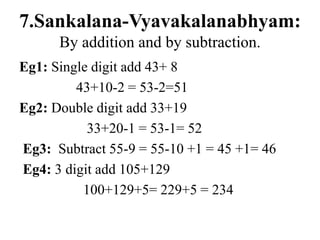
7.Sankalana-Vyavakalanabhyam:
By addition and by subtraction.
Eg1: Single digit add 43+ 8
43+10-2 = 53-2=51
Eg2: Double digit add 33+19
33+20-1 = 53-1= 52
Eg3: Subtract 55-9 = 55-10 +1 = 45 +1= 46
Eg4: 3 digit add 105+129
100+129+5= 229+5 = 234
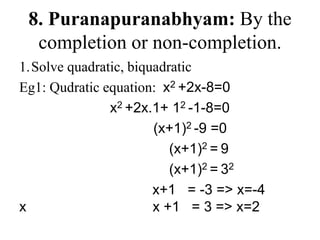
8. Puranapuranabhyam: By the
completion or non-completion.
1.Solve quadratic, biquadratic
Eg1: Qudratic equation: x2 +2x-8=0
x2 +2x.1+ 12 -1-8=0
(x+1)2 -9 =0
(x+1)2 = 9
(x+1)2 = 32
x+1 = -3 => x=-4
x x +1 = 3 => x=2
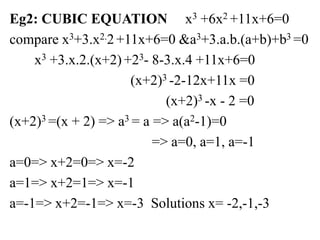
Eg2: CUBIC EQUATION x3 +6x2 +11x+6=0
compare x3+3.x2.2 +11x+6=0 &a3+3.a.b.(a+b)+b3 =0
x3 +3.x.2.(x+2) +23- 8-3.x.4 +11x+6=0
(x+2)3 -2-12x+11x =0
(x+2)3 -x - 2 =0
(x+2)3 =(x + 2) => a3 = a => a(a2-1)=0
=> a=0, a=1, a=-1
a=0=> x+2=0=> x=-2
a=1=> x+2=1=> x=-1
a=-1=> x+2=-1=> x=-3 Solutions x= -2,-1,-3
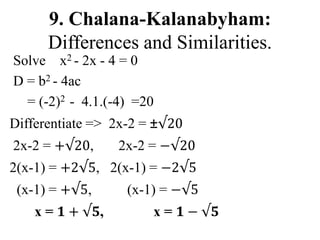
9. Chalana-Kalanabyham:
Differences and Similarities.
Solve x2 - 2x - 4 = 0
D = b2 - 4ac
= (-2)2 - 4.1.(-4) =20
Differentiate => 2x-2 = ±√20
2x-2 = +√20, 2x-2 = −√20
2(x-1) = +2√5, 2(x-1) = −2√5
(x-1) = +√5, (x-1) = −√5
x = 𝟏 + √𝟓, x = 𝟏 − √𝟓
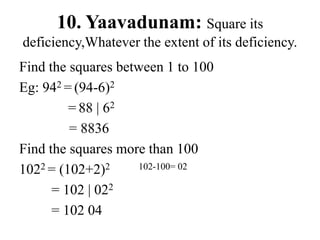
10. Yaavadunam: Square its
deficiency,Whatever the extent of its deficiency.
Find the squares between 1 to 100
Eg: 942 = (94-6)2
= 88 | 62
= 8836
Find the squares more than 100
1022 = (102+2)2 102-100= 02
= 102 | 022
= 102 04
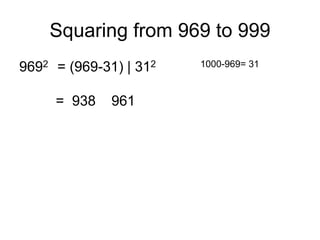
Squaring from 969 to 999
9692 = (969-31) | 312 1000-969= 31
= 938 961
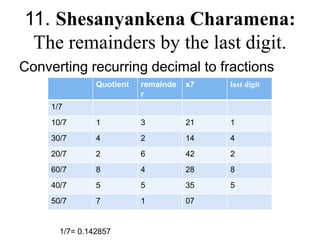
11. Shesanyankena Charamena:
The remainders by the last digit.
Converting recurring decimal to fractions
Quotient remainde
r
x7 last digit
1/7
10/7 1 3 21 1
30/7 4 2 14 4
20/7 2 6 42 2
60/7 8 4 28 8
40/7 5 5 35 5
50/7 7 1 07
1/7= 0.142857
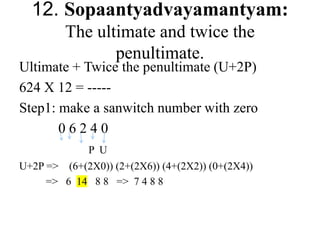
12. Sopaantyadvayamantyam:
The ultimate and twice the
penultimate.
Ultimate + Twice the penultimate (U+2P)
624 X 12 = -----
Step1: make a sanwitch number with zero
0 6 2 4 0
P U
U+2P => (6+(2X0)) (2+(2X6)) (4+(2X2)) (0+(2X4))
=> 6 14 8 8 => 7 4 8 8
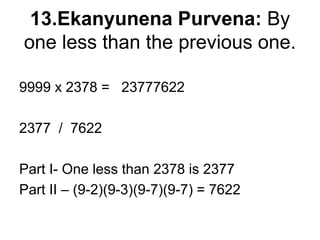
13.Ekanyunena Purvena: By
one less than the previous one.
9999 x 2378 = 23777622
2377 / 7622
Part I- One less than 2378 is 2377
Part II – (9-2)(9-3)(9-7)(9-7) = 7622
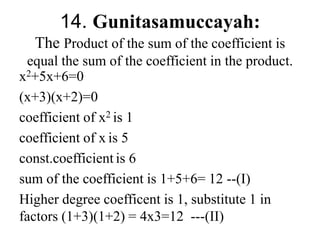
14. Gunitasamuccayah:
The Product of the sum of the coefficient is
equal the sum of the coefficient in the product.
x2+5x+6=0
(x+3)(x+2)=0
coefficient of x2 is 1
coefficient of x is 5
const.coefficient is 6
sum of the coefficient is 1+5+6= 12 --(I)
Higher degree coefficent is 1, substitute 1 in
factors (1+3)(1+2) = 4x3=12 ---(II)
15. Gunakasamuccayah:
The factors of the sum are the same
as the sum of the factors.
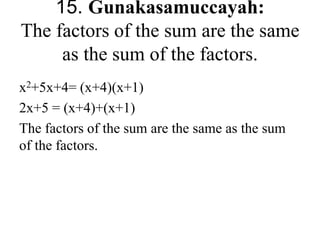
x2+5x+4= (x+4)(x+1)
2x+5 = (x+4)+(x+1)
The factors of the sum are the same as the sum
of the factors.
16. Dhvajanka: Flag.
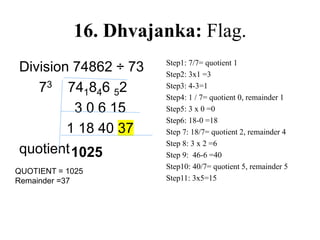
Division 74862 ÷ 73
73 741846 52
3 0 6 15
1 18 40 37
quotient
Step1: 7/7= quotient 1
Step2: 3x1 =3
Step3: 4-3=1
Step4: 1 / 7= quotient 0, remainder 1
Step5: 3 x 0 =0
Step6: 18-0 =18
Step 7: 18/7= quotient 2, remainder 4
Step 8: 3 x 2 =6
Step 9: 46-6 =40
Step10: 40/7= quotient 5, remainder 5
Step11: 3x5=15
1025
QUOTIENT = 1025
Remainder =37
Vedic Mathematics 16 sutras with example problems

Vedic Mathematics 16 sutras with example problems

  • 2.
    Introduction: Srinivasa Ramanujan wasan Indian mathematician born on December 22, 1887, in Erode, Tamil Nadu, India. Despite growing up in relative obscurity and facing numerous challenges, Ramanujan displayed an extraordinary talent for mathematics from a young age. His mathematical abilities were largely self-taught, and he made significant contributions to several areas of pure mathematics.

  • 3.
    Ramanujan's most notable achievementsinclude: • Infinite Series and Continued Fractions: • Number Theory: • Mock Theta Functions: • Ramanujan-Hardy Number (1729): • Modular Forms: • Elliptic Integrals:
  • 4.
    An overview ofVedic Mathematics • Vedic Mathematics is a system of mathematical knowledge that originated in ancient India, particularly in the Vedas, which are ancient sacred texts of Hinduism. • The term "Vedic Mathematics" was coined by Bharati Krishna Tirthaji Maharaja, a Hindu scholar, and mathematician, in the early 20th century.
  • 5.
    Key features andprinciples of Vedic Mathematics 1. Sutras (Mathematical Formulas): 16 Sutras 2. Correspondence with Modern Mathematics: its principles can be applied to a wide range of mathematical problems, including arithmetic, algebra, geometry, calculus, and more. 3. Sankhya Shastra: an ancient Indian system of enumeration and calculation. 4. Flexibility and Mental Calculation: perform complex calculations mentally and with greater speed.
  • 6.
    Sutras (Mathematical Formulas): 16Sutras 1. Ekadhikena Purvena: By one more than the previous one. 2. Nikhilam Navatashcaramam Dashatah: All from 9 and the last from 10. 3. Urdhva-Tiryagbhyam: Vertically and crosswise. 4. Paraavartya Yojayet: Transpose and apply. 5. Shunyam Saamyasamuccaye: When the sum is the same, that sum is zero. 6. Anurupyena: Proportionately. 7. Sankalana-Vyavakalanabhyam: By addition and by subtraction. 8. Puranapuranabhyam: By the completion or non-completion. 9. Chalana-Kalanabyham: Differences and Similarities. 10. Yaavadunam: Whatever the extent of its deficiency. 11. Shesanyankena Charamena: The remainders by the last digit. 12. Sopaantyadvayamantyam: The ultimate and twice the penultimate. 13. Ekanyunena Purvena: By one less than the previous one. 14. Gunitasamuccayah: The product of the sum is the sum of the product. 15. Gunakasamuccayah: The factors of the sum are the same as the sum of the factors. 16. Dhvajanka: Flag.
  • 7.
    1. Ekadhikena Purvena:By one more than the previous one. 352 = 1225 12 / 25 Part I- one more than the previous one 3+1= 4 3 X 4 = 12 Part II – (SECOND Number)2 52 = 25
  • 8.
    Nikhilam Navatashcaramam Dashatah: Allfrom 9 and the last from 10. 100000 - 43658 = 056342 Step1: Need to subtract 5 digits, so separate 5 digits as one part, remaining is part two 1 / 00000 Step 2: Subtract 1 from first part, Step3:Sub first four digits from 9, last digit from 10.
  • 9.
    3. Urdhva-Tiryagbhyam: Vertically andcrosswise. 24 x 36 = 864 2 4 3 6 Step1: Last digits : (right) multiply vertically 4 x 6 = 24 . keep 4 carry over 2 Step2: Cross product (2x6)+(3x4) = 24. keep 4 & add the last carry over Step3: First digits: (left) multiply vertically and add the last carry over (2x3)+2 =8
  • 10.
    4. Paraavartya Yojayet: Transposeand apply. 2587 ÷ 112 112 2 5 8 7 -1-2 -2-4 289487 ÷ 13103 13103 2 8 9 4 8 7 -3-10-3 -6-2 0-6 -6-2 0-6 Quotent and Remainder - 22 and 1221 2 3 4 1 -3 -6 Quotent and Remainder -23 and 41 No.of digits in quotient = (diff .b/t no.of digits in dividend and divisor ) + 1 2 2 1 2 2 1
  • 11.
    5. Shunyam Saamyasamuccaye: Whenthe Samuccaye is the same, that Samuccaye is zero. Meaning1: Samuccaye means common factor in all terms eg1: 12x-6x+3x+4x=0 x is common factor just equal to 0 x = 0 is the answer eg2: 7(x+1)=8(x+1) x+1 is common factor just equal to 0 x+1=0 => x = -1
  • 12.
    5. Shunyam Saamyasamuccaye: Meaning2:Samuccaye means product of independent terms Eg1: (x-7)(x-9) = (x-21)(x-3) 7x9 =63 21 x 3 = 63 solu x = 0 If the product of independent terms are same, then the solution is simpy x=0 Eg2: (x+8)(x+9) = (x+3)(x+24) 8x9 =72 3x24 = 72 solu x=0
  • 13.
    5. Shunyam Saamyasamuccaye: Meaning3:Samuccaye means sum of the denomenators, when the numerators are same. 𝐸𝑔: 1 3𝑥−1 + 1 4𝑥−1 = 0 The numerators are same, Add the denominators and put =0 (3x-1)+(4x-1) =0 7x -2=0 x= 2/7
  • 14.
    5. Shunyam Saamyasamuccaye: Meaning4:Samuccaye means combination -> if the sum of the denomenators is equal to the numerators then equate that sum to zero .Eg: 2𝑥+5 2𝑥+11 = 2𝑥+11 2𝑥+5 Sum of numerators = 2x+5+2x+11 = 4x+16 Sum of denomenators = 2x+11+2x+5 = 4x+16 Equate that sum to zero 4x+16=0 => x = - 4
  • 15.
    6. Anurupyena: Proportionately. Eg:46 X 44 = Working base: 40 Multiplication base = 10 x 4 = 40 Division = 100 / 2 = 50 46 +6 44 +4 cross add Product 50 24 (keep 4 and carry 2) x4 (mul.base) 200 +carry 2= 2024
  • 16.
    7.Sankalana-Vyavakalanabhyam: By addition andby subtraction. Eg1: Single digit add 43+ 8 43+10-2 = 53-2=51 Eg2: Double digit add 33+19 33+20-1 = 53-1= 52 Eg3: Subtract 55-9 = 55-10 +1 = 45 +1= 46 Eg4: 3 digit add 105+129 100+129+5= 229+5 = 234
  • 17.
    8. Puranapuranabhyam: Bythe completion or non-completion. 1.Solve quadratic, biquadratic Eg1: Qudratic equation: x2 +2x-8=0 x2 +2x.1+ 12 -1-8=0 (x+1)2 -9 =0 (x+1)2 = 9 (x+1)2 = 32 x+1 = -3 => x=-4 x x +1 = 3 => x=2
  • 18.
    Eg2: CUBIC EQUATIONx3 +6x2 +11x+6=0 compare x3+3.x2.2 +11x+6=0 &a3+3.a.b.(a+b)+b3 =0 x3 +3.x.2.(x+2) +23- 8-3.x.4 +11x+6=0 (x+2)3 -2-12x+11x =0 (x+2)3 -x - 2 =0 (x+2)3 =(x + 2) => a3 = a => a(a2-1)=0 => a=0, a=1, a=-1 a=0=> x+2=0=> x=-2 a=1=> x+2=1=> x=-1 a=-1=> x+2=-1=> x=-3 Solutions x= -2,-1,-3
  • 19.
    9. Chalana-Kalanabyham: Differences andSimilarities. Solve x2 - 2x - 4 = 0 D = b2 - 4ac = (-2)2 - 4.1.(-4) =20 Differentiate => 2x-2 = ±√20 2x-2 = +√20, 2x-2 = −√20 2(x-1) = +2√5, 2(x-1) = −2√5 (x-1) = +√5, (x-1) = −√5 x = 𝟏 + √𝟓, x = 𝟏 − √𝟓
  • 20.
    10. Yaavadunam: Squareits deficiency,Whatever the extent of its deficiency. Find the squares between 1 to 100 Eg: 942 = (94-6)2 = 88 | 62 = 8836 Find the squares more than 100 1022 = (102+2)2 102-100= 02 = 102 | 022 = 102 04
  • 21.
    Squaring from 969to 999 9692 = (969-31) | 312 1000-969= 31 = 938 961
  • 22.
    11. Shesanyankena Charamena: Theremainders by the last digit. Converting recurring decimal to fractions Quotient remainde r x7 last digit 1/7 10/7 1 3 21 1 30/7 4 2 14 4 20/7 2 6 42 2 60/7 8 4 28 8 40/7 5 5 35 5 50/7 7 1 07 1/7= 0.142857
  • 23.
    12. Sopaantyadvayamantyam: The ultimateand twice the penultimate. Ultimate + Twice the penultimate (U+2P) 624 X 12 = ----- Step1: make a sanwitch number with zero 0 6 2 4 0 P U U+2P => (6+(2X0)) (2+(2X6)) (4+(2X2)) (0+(2X4)) => 6 14 8 8 => 7 4 8 8
  • 24.
    13.Ekanyunena Purvena: By oneless than the previous one. 9999 x 2378 = 23777622 2377 / 7622 Part I- One less than 2378 is 2377 Part II – (9-2)(9-3)(9-7)(9-7) = 7622
  • 25.
    14. Gunitasamuccayah: The Productof the sum of the coefficient is equal the sum of the coefficient in the product. x2+5x+6=0 (x+3)(x+2)=0 coefficient of x2 is 1 coefficient of x is 5 const.coefficient is 6 sum of the coefficient is 1+5+6= 12 --(I) Higher degree coefficent is 1, substitute 1 in factors (1+3)(1+2) = 4x3=12 ---(II)
  • 26.
    15. Gunakasamuccayah: The factorsof the sum are the same as the sum of the factors. x2+5x+4= (x+4)(x+1) 2x+5 = (x+4)+(x+1) The factors of the sum are the same as the sum of the factors.
  • 27.
    16. Dhvajanka: Flag. Division74862 ÷ 73 73 741846 52 3 0 6 15 1 18 40 37 quotient Step1: 7/7= quotient 1 Step2: 3x1 =3 Step3: 4-3=1 Step4: 1 / 7= quotient 0, remainder 1 Step5: 3 x 0 =0 Step6: 18-0 =18 Step 7: 18/7= quotient 2, remainder 4 Step 8: 3 x 2 =6 Step 9: 46-6 =40 Step10: 40/7= quotient 5, remainder 5 Step11: 3x5=15 1025 QUOTIENT = 1025 Remainder =37