Courtney HuffJulie BastowMeaghan GauthierGettingExplicitAboutReading
GEAR - Setting/Environment9 Elementary SchoolsAvg. Free & Reduced Lunch – 65%~15 Title 1 TeachersEnvironmental Challenges: Lack of consistency in Title 1 ProgramsNot all Title 1 teachers have a literacy backgroundAlpenaHillmanAlconaBingham Arts
GEAR – Relevant DataAll elementary schools completed a survey entitled, “STARS Framework for  Interventions”  To detail schools’ current framework for interventions To identify strengths & weaknessesResults provide rationale for GEAR
GEAR – Relevant Data	Survey Question 1: What data is used to determine who needs literacy intervention?DIBELS is the primary assessment used in all schoolsTwo out of ten schools mentioned using MLPP as a diagnostic assessment in the early gradesMEAP is only additional data used in upper grades
GEAR – Relevant Data	Essential component of RTI – Use data for three purposesScreenDiagnoseProgress MonitorProblem identified in survey results: Reliance on the DIBELS screening assessment to make diagnostic decisions.
GEAR - Guiding Beliefs#1A diagnostic reading assessment is needed in order to determine an individual student’s intervention needs.
GEAR – Relevant Data	Survey Question 2: Describe the format of intervention in your school(number of students in a group, push-in or pull-out, person responsible for facilitating intervention, etc.) The format is primarily the same across schools: Title 1 teacher provides interventions to groups of students ranging from 3-5 mostly outside the classroom.None of the schools reported the role of the general education teacher in the intervention process.
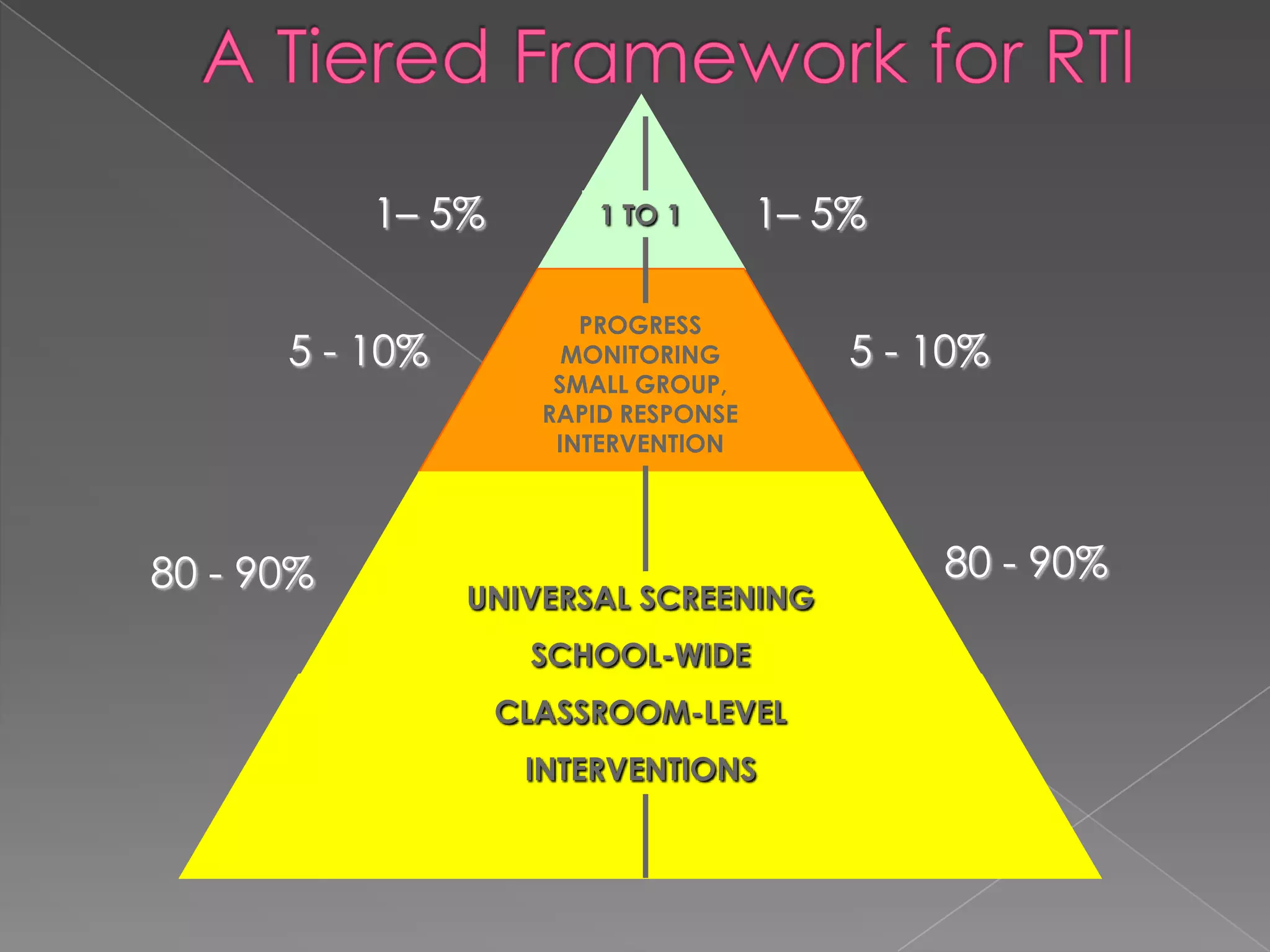
A Tiered Framework for RTI1– 5%1– 5%1 TO 1PROGRESS MONITORING SMALL GROUP, RAPID RESPONSE INTERVENTION5 - 10%5 - 10%80 - 90%80 - 90%UNIVERSAL SCREENINGSCHOOL-WIDECLASSROOM-LEVELINTERVENTIONS
GEAR – Guiding Beliefs#2Explicit Tier 1 literacy instruction provides a strong base in a framework for RTI
GEAR – Relevant DataSurvey Question 3: Describe the typical interventions within your school.Every school implements research-based interventions with varying levels of fidelity in fluency, phonics, and phonemic awareness.Fluency is the most common area for interventionNone of the schools reported interventions in the area of comprehension
GEAR – Guiding Beliefs#3Comprehension is the ultimate goal of reading.
GEAR – Relevant DataSurvey Question 4: How is student learning monitored and how often is it monitored?All schools reported using DIBELS as a progress monitoring tool once every 2-3 weeks. 3 out of 10 schools reported using a more specific tool for progress monitoring.
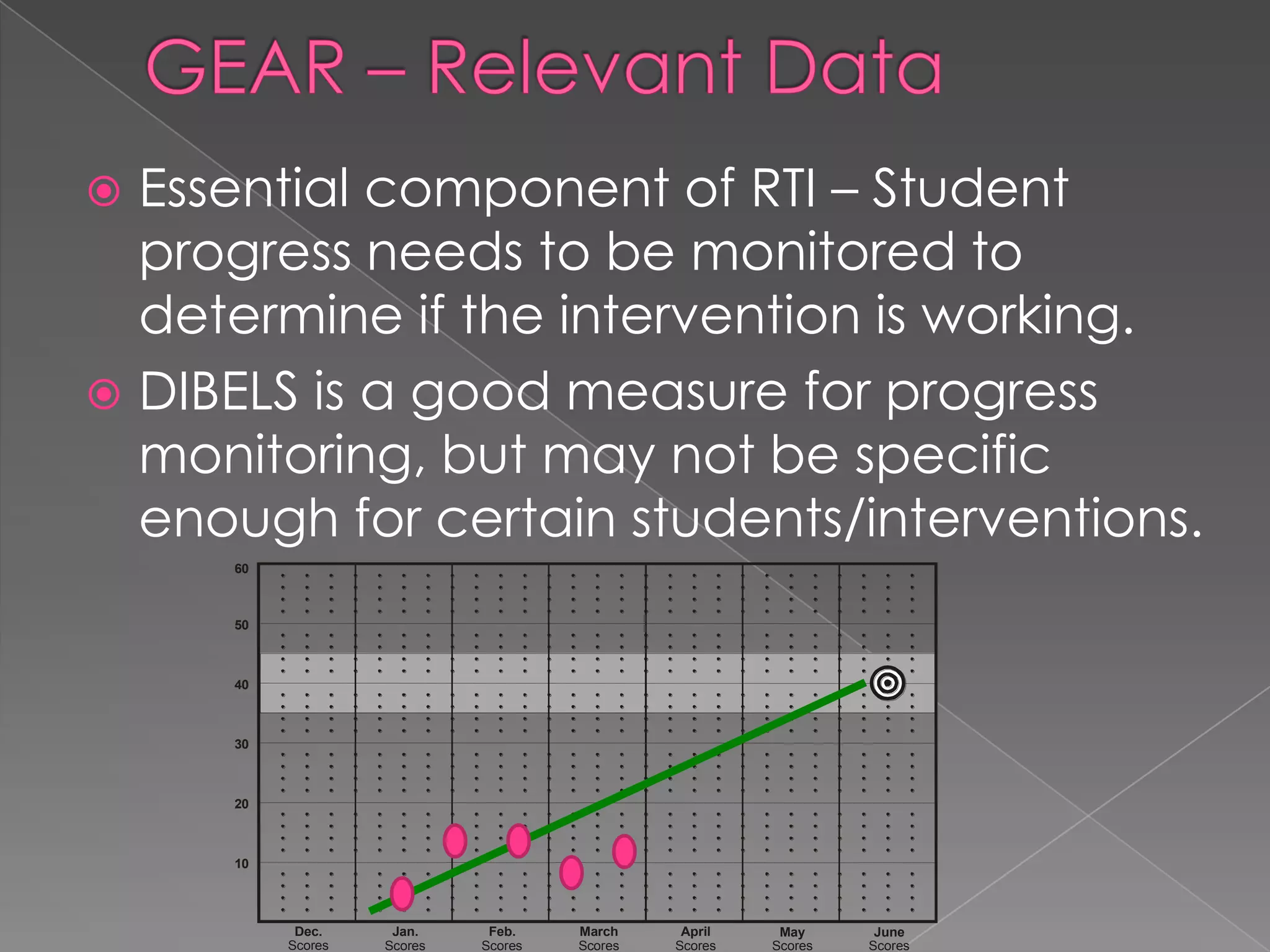
GEAR – Relevant DataEssential component of RTI – Student progress needs to be monitored to determine if the intervention is working. DIBELS is a good measure for progress monitoring, but may not be specific enough for certain students/interventions.
GEAR – Guiding Beliefs#4Progress monitoring tools should be specific to the intervention in order to effectively guide instruction
GEAR – Urgent NeedSchools seem to be lacking a systems approach to a vital area of intervention – comprehension.A strong RTI framework includes a systematic approach to intervention in all areas. A varied approach may cause students to “slip through the cracks.”
GEAR – Urgent Needhttp://www.youtube.com/watch?v=qIudAL5oDdo&feature=email
GEAR – Current RealityTwo concerns about current cultureOverreliance on DIBELSTargeted comprehension strategy instruction and intervention arenot being implemented
GEAR – Preferred FutureTitle 1 teachers as literacy leadersAccurately diagnose struggling readers with the Diagnostic Reading Assessment (DRA)Design explicit comprehension strategy lessonsCoach classroom teachers through the same processSchool
GEAR – Preferred FutureCommon language in regards to diagnostic reading assessments and comprehension instruction.Consistency in instruction, intervention, and data. District
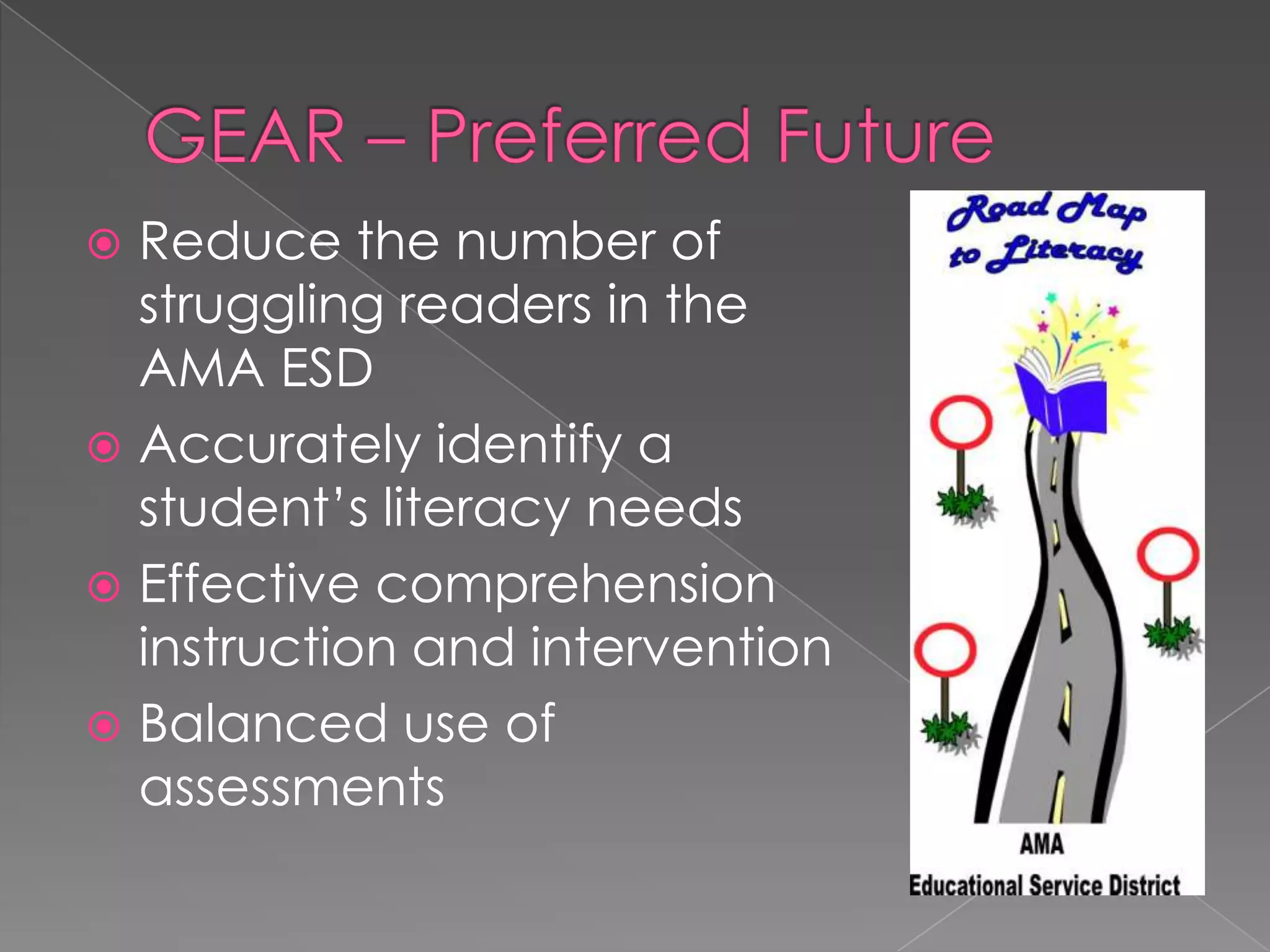
GEAR – Preferred FutureReduce the number of struggling readers in the AMA ESDAccurately identify a student’s literacy needs Effective comprehension instruction and interventionBalanced use of assessments
GEAR – Vision StatementTo strengthen schools’ current Response to Intervention framework, the AMA ESD will provide training, resources, and support in diagnostic reading assessment and explicit comprehension instruction K-5.
GEAR – Strategic Plan1.  Will the AMA ESDhave adequate support from its constituent districts to provide training in the Diagnostic Reading Assessment (DRA) and Strategies that Work (an approach to comprehension instruction) in the 2010-2011 school year?
GEAR – Strategic Plan2.  Will there be enough time for Title 1 teachers to research, implement, and collaborate in a PLC format?
GEAR – Strategic Plan	3. Will general education teachers be willing to implement the DRA and comprehension strategy instruction?
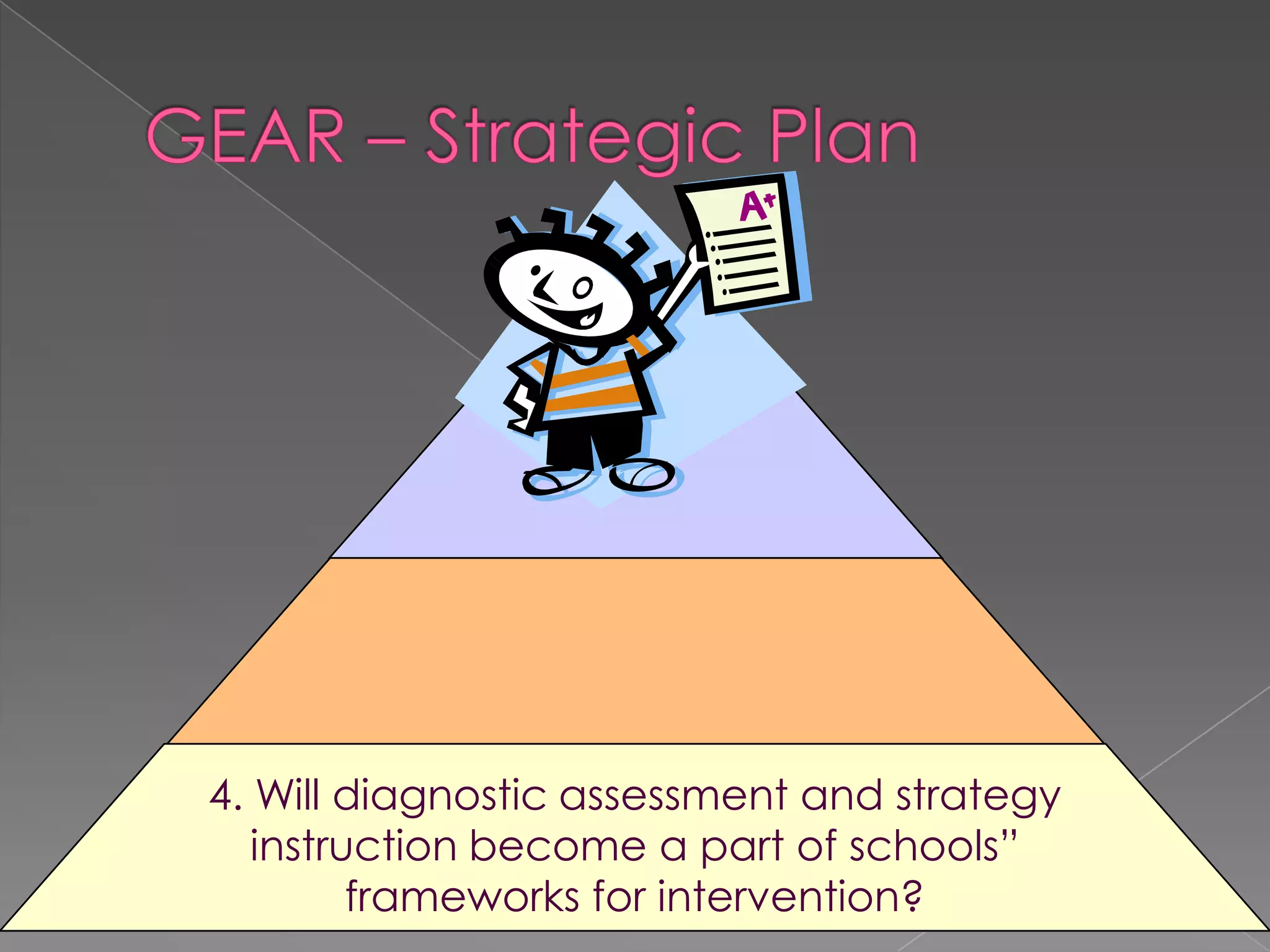
GEAR – Strategic Plan4. Will diagnostic assessment and strategy instruction become a part of schools” frameworks for intervention?
GEAR – Communication PlanConditions needed to implement this initiativeMonthly Title 1 meetings3 consultants act as coaches for individual schoolsAdministrative update led by consultants
GEAR – The Big Picturehttp://www.youtube.com/watch?v=T_4D7h-Nzvg&feature=email

Getting explicit about reading

  • 1.
    Courtney HuffJulie BastowMeaghanGauthierGettingExplicitAboutReading
  • 2.
    GEAR - Setting/Environment9Elementary SchoolsAvg. Free & Reduced Lunch – 65%~15 Title 1 TeachersEnvironmental Challenges: Lack of consistency in Title 1 ProgramsNot all Title 1 teachers have a literacy backgroundAlpenaHillmanAlconaBingham Arts
  • 3.
    GEAR – RelevantDataAll elementary schools completed a survey entitled, “STARS Framework for Interventions” To detail schools’ current framework for interventions To identify strengths & weaknessesResults provide rationale for GEAR
  • 4.
    GEAR – RelevantData Survey Question 1: What data is used to determine who needs literacy intervention?DIBELS is the primary assessment used in all schoolsTwo out of ten schools mentioned using MLPP as a diagnostic assessment in the early gradesMEAP is only additional data used in upper grades
  • 5.
    GEAR – RelevantData Essential component of RTI – Use data for three purposesScreenDiagnoseProgress MonitorProblem identified in survey results: Reliance on the DIBELS screening assessment to make diagnostic decisions.
  • 6.
    GEAR - GuidingBeliefs#1A diagnostic reading assessment is needed in order to determine an individual student’s intervention needs.
  • 7.
    GEAR – RelevantData Survey Question 2: Describe the format of intervention in your school(number of students in a group, push-in or pull-out, person responsible for facilitating intervention, etc.) The format is primarily the same across schools: Title 1 teacher provides interventions to groups of students ranging from 3-5 mostly outside the classroom.None of the schools reported the role of the general education teacher in the intervention process.
  • 8.
    A Tiered Frameworkfor RTI1– 5%1– 5%1 TO 1PROGRESS MONITORING SMALL GROUP, RAPID RESPONSE INTERVENTION5 - 10%5 - 10%80 - 90%80 - 90%UNIVERSAL SCREENINGSCHOOL-WIDECLASSROOM-LEVELINTERVENTIONS
  • 9.
    GEAR – GuidingBeliefs#2Explicit Tier 1 literacy instruction provides a strong base in a framework for RTI
  • 10.
    GEAR – RelevantDataSurvey Question 3: Describe the typical interventions within your school.Every school implements research-based interventions with varying levels of fidelity in fluency, phonics, and phonemic awareness.Fluency is the most common area for interventionNone of the schools reported interventions in the area of comprehension
  • 11.
    GEAR – GuidingBeliefs#3Comprehension is the ultimate goal of reading.
  • 12.
    GEAR – RelevantDataSurvey Question 4: How is student learning monitored and how often is it monitored?All schools reported using DIBELS as a progress monitoring tool once every 2-3 weeks. 3 out of 10 schools reported using a more specific tool for progress monitoring.
  • 13.
    GEAR – RelevantDataEssential component of RTI – Student progress needs to be monitored to determine if the intervention is working. DIBELS is a good measure for progress monitoring, but may not be specific enough for certain students/interventions.
  • 14.
    GEAR – GuidingBeliefs#4Progress monitoring tools should be specific to the intervention in order to effectively guide instruction
  • 15.
    GEAR – UrgentNeedSchools seem to be lacking a systems approach to a vital area of intervention – comprehension.A strong RTI framework includes a systematic approach to intervention in all areas. A varied approach may cause students to “slip through the cracks.”
  • 16.
    GEAR – UrgentNeedhttp://www.youtube.com/watch?v=qIudAL5oDdo&feature=email
  • 17.
    GEAR – CurrentRealityTwo concerns about current cultureOverreliance on DIBELSTargeted comprehension strategy instruction and intervention arenot being implemented
  • 18.
    GEAR – PreferredFutureTitle 1 teachers as literacy leadersAccurately diagnose struggling readers with the Diagnostic Reading Assessment (DRA)Design explicit comprehension strategy lessonsCoach classroom teachers through the same processSchool
  • 19.
    GEAR – PreferredFutureCommon language in regards to diagnostic reading assessments and comprehension instruction.Consistency in instruction, intervention, and data. District
  • 20.
    GEAR – PreferredFutureReduce the number of struggling readers in the AMA ESDAccurately identify a student’s literacy needs Effective comprehension instruction and interventionBalanced use of assessments
  • 21.
    GEAR – VisionStatementTo strengthen schools’ current Response to Intervention framework, the AMA ESD will provide training, resources, and support in diagnostic reading assessment and explicit comprehension instruction K-5.
  • 22.
    GEAR – StrategicPlan1. Will the AMA ESDhave adequate support from its constituent districts to provide training in the Diagnostic Reading Assessment (DRA) and Strategies that Work (an approach to comprehension instruction) in the 2010-2011 school year?
  • 23.
    GEAR – StrategicPlan2. Will there be enough time for Title 1 teachers to research, implement, and collaborate in a PLC format?
  • 24.
    GEAR – StrategicPlan 3. Will general education teachers be willing to implement the DRA and comprehension strategy instruction?
  • 25.
    GEAR – StrategicPlan4. Will diagnostic assessment and strategy instruction become a part of schools” frameworks for intervention?
  • 26.
    GEAR – CommunicationPlanConditions needed to implement this initiativeMonthly Title 1 meetings3 consultants act as coaches for individual schoolsAdministrative update led by consultants
  • 27.
    GEAR – TheBig Picturehttp://www.youtube.com/watch?v=T_4D7h-Nzvg&feature=email

Editor's Notes