Response to Intervention
(RtI) in Practice
A focus on technology for selecting
research-based interventions, monitoring
progress, and representing results.
Goals of this training…
 Review RtI principles
 Examine steps for planning and bringing/strengthening RtI in
your district
 To look at online research-based interventions resources
 Look at Data Collection resources, procedures, and
technology.
 Examine technology for graphing data and data analysis.
Response to Intervention (RtI)
 “Response to Intervention is the practice
of a) providing high-quality instruction
and intervention matched to student
needs, b) monitoring progress frequently
to make decisions about changes in
instruction or goals, and c) applying child
response data to important educational
decisions.”
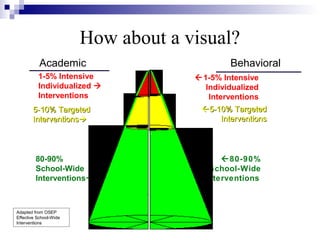
How about a visual?
Academic Behavioral
1-5% Intensive
Individualized
Interventions
Adapted from OSEP
Effective School-Wide
Interventions
5-10% Targeted5-10% Targeted
InterventionsInterventions
5-10% Targeted5-10% Targeted
InterventionsInterventions
1-5% Intensive
Individualized 
Interventions
80-90%
School-Wide
Interventions
80-90%
School-Wide
Interventions
An Application of the Tiered Model
http://www.youtube.com/watch?v=nkK1bT8ls0M
<object width="425" height="344"><param
name="movie"
value="http://www.youtube.com/v/nkK1bT8ls0M&hl=e
n&fs=1"></param><param name="allowFullScreen"
value="true"></param><param
name="allowscriptaccess"
value="always"></param><embed
src="http://www.youtube.com/v/nkK1bT8ls0M&hl=en
&fs=1" type="application/x-shockwave-flash"
allowscriptaccess="always" allowfullscreen="true"
width="425" height="344"></embed></object>
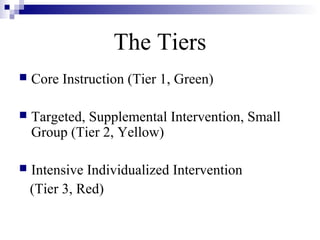
The Tiers
 Core Instruction (Tier 1, Green)
 Targeted, Supplemental Intervention, Small
Group (Tier 2, Yellow)
 Intensive Individualized Intervention
(Tier 3, Red)
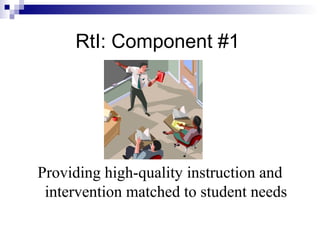
RtI: Component #1
Providing high-quality instruction and
intervention matched to student needs
Providing high-quality instruction and
intervention matched to student needs
 Instruction-Curriculum and educational interventions
that are research-based and have been proven to be
effective for most students
 Interventions-A change in instructing a student in the
area of learning or behavioral difficulty to try and
improve performance and achieve adequate progress
 Scientifically-based- Curriculum and educational
interventions that are research-based and have been
proven to be effective for most students.
It’s Important to Remember…
 Practices that are NOT considered instructional
interventions include:
 Special or re-assigned seating in the classroom
 Shortened assignments
 Communications with the parent about the child at regular
conferences or other informal communications
 Classroom Observations
 Suspension
 Retention
 More of the same/general classroom instruction and/or
assignments
RtI: Component #2
Monitoring progress frequently to make
decisions about changes in instruction or
goals
Monitoring progress frequently to make
decisions about changes in instruction or goals
 Universal Screening- catching problems
early and examining the effectiveness of
practices
 Continued Progress Monitoring-
assessing individuals’ progress in closing
achievement gaps
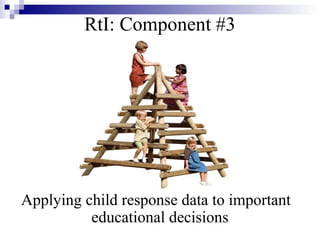
RtI: Component #3
Applying child response data to important
educational decisions
Progression Through the Tiers
Dayne 
RtI in Action: A Best Practice Example
 http://www.youtube.com/watch?v=IsAqh2Pxg0A
<object width="425" height="349"><param name="movie"
value="http://www.youtube.com/v/IsAqh2Pxg0A&hl=en&fs=1&color1
=0x2b405b&color2=0x6b8ab6&border=1"></param><param
name="allowFullScreen" value="true"></param><param
name="allowscriptaccess" value="always"></param><embed
src="http://www.youtube.com/v/IsAqh2Pxg0A&hl=en&fs=1&color1=0
x2b405b&color2=0x6b8ab6&border=1" type="application/x-
shockwave-flash" allowscriptaccess="always" allowfullscreen="true"
width="425" height="349"></embed></object>
Intervention Resources
 www.interventioncentral.org
The RtI Bible. Your will not find better resources for implementing RtI anyway…hands
down.
 www.ldonline.org
Premier website for information on ADHD and Learning Disabilities. This site features
great resources for both parents and teachers.
 www.whatworks.ed.gov
A great resources from the federal government about what the research says works in
education. Features information on effective teaching and interventions.
 www.fcrr.org
The Florida Center For Reading Research
 www.rtinetwork.org
This site is dedicated to the effective implementation of Response to Intervention (RTI)
in school districts nationwide. Our goal is to guide educators and families in the large-
scale implementation of RTI so that each child has access to quality instruction and that
struggling students – including those with learning disabilities – are identified early and
receive the necessary supports to be successful.
More Intervention Resources
 www.reading.org
Offers free tools in help school staff & parents to promote positive classroom
behavior & foster effective learning for all children
 www.rti4success.org
RtI one-stop shop featuring webinars and steps for planning and
implementing RtI in your schools
 www.ncld.org
Features information on the definition and assessment of Learning
Disabilities. Looks at federal law and RtI.
 www.aimsweb.com & dibels.uoregon.edu
These tools are progress monitoring systems based on direct, frequent and
continuous student assessment. The results are reported to students, parents,
teachers and administrators via a web-based data management and reporting
system to determine response to intervention.
 www.studentprogress.org
A comprehensive resource on student progress monitoring. It features case
studies as well as exploratory activities.

Response to intervention in practice (rti)

  • 1.
    Response to Intervention (RtI)in Practice A focus on technology for selecting research-based interventions, monitoring progress, and representing results.
  • 2.
    Goals of thistraining…  Review RtI principles  Examine steps for planning and bringing/strengthening RtI in your district  To look at online research-based interventions resources  Look at Data Collection resources, procedures, and technology.  Examine technology for graphing data and data analysis.
  • 3.
    Response to Intervention(RtI)  “Response to Intervention is the practice of a) providing high-quality instruction and intervention matched to student needs, b) monitoring progress frequently to make decisions about changes in instruction or goals, and c) applying child response data to important educational decisions.”
  • 4.
    How about avisual? Academic Behavioral 1-5% Intensive Individualized Interventions Adapted from OSEP Effective School-Wide Interventions 5-10% Targeted5-10% Targeted InterventionsInterventions 5-10% Targeted5-10% Targeted InterventionsInterventions 1-5% Intensive Individualized  Interventions 80-90% School-Wide Interventions 80-90% School-Wide Interventions
  • 5.
    An Application ofthe Tiered Model http://www.youtube.com/watch?v=nkK1bT8ls0M <object width="425" height="344"><param name="movie" value="http://www.youtube.com/v/nkK1bT8ls0M&hl=e n&fs=1"></param><param name="allowFullScreen" value="true"></param><param name="allowscriptaccess" value="always"></param><embed src="http://www.youtube.com/v/nkK1bT8ls0M&hl=en &fs=1" type="application/x-shockwave-flash" allowscriptaccess="always" allowfullscreen="true" width="425" height="344"></embed></object>
  • 6.
    The Tiers  CoreInstruction (Tier 1, Green)  Targeted, Supplemental Intervention, Small Group (Tier 2, Yellow)  Intensive Individualized Intervention (Tier 3, Red)
  • 7.
    RtI: Component #1 Providinghigh-quality instruction and intervention matched to student needs
  • 8.
    Providing high-quality instructionand intervention matched to student needs  Instruction-Curriculum and educational interventions that are research-based and have been proven to be effective for most students  Interventions-A change in instructing a student in the area of learning or behavioral difficulty to try and improve performance and achieve adequate progress  Scientifically-based- Curriculum and educational interventions that are research-based and have been proven to be effective for most students.
  • 9.
    It’s Important toRemember…  Practices that are NOT considered instructional interventions include:  Special or re-assigned seating in the classroom  Shortened assignments  Communications with the parent about the child at regular conferences or other informal communications  Classroom Observations  Suspension  Retention  More of the same/general classroom instruction and/or assignments
  • 10.
    RtI: Component #2 Monitoringprogress frequently to make decisions about changes in instruction or goals
  • 11.
    Monitoring progress frequentlyto make decisions about changes in instruction or goals  Universal Screening- catching problems early and examining the effectiveness of practices  Continued Progress Monitoring- assessing individuals’ progress in closing achievement gaps
  • 12.
    RtI: Component #3 Applyingchild response data to important educational decisions
  • 13.
    Progression Through theTiers Dayne 
  • 14.
    RtI in Action:A Best Practice Example  http://www.youtube.com/watch?v=IsAqh2Pxg0A <object width="425" height="349"><param name="movie" value="http://www.youtube.com/v/IsAqh2Pxg0A&hl=en&fs=1&color1 =0x2b405b&color2=0x6b8ab6&border=1"></param><param name="allowFullScreen" value="true"></param><param name="allowscriptaccess" value="always"></param><embed src="http://www.youtube.com/v/IsAqh2Pxg0A&hl=en&fs=1&color1=0 x2b405b&color2=0x6b8ab6&border=1" type="application/x- shockwave-flash" allowscriptaccess="always" allowfullscreen="true" width="425" height="349"></embed></object>
  • 15.
    Intervention Resources  www.interventioncentral.org TheRtI Bible. Your will not find better resources for implementing RtI anyway…hands down.  www.ldonline.org Premier website for information on ADHD and Learning Disabilities. This site features great resources for both parents and teachers.  www.whatworks.ed.gov A great resources from the federal government about what the research says works in education. Features information on effective teaching and interventions.  www.fcrr.org The Florida Center For Reading Research  www.rtinetwork.org This site is dedicated to the effective implementation of Response to Intervention (RTI) in school districts nationwide. Our goal is to guide educators and families in the large- scale implementation of RTI so that each child has access to quality instruction and that struggling students – including those with learning disabilities – are identified early and receive the necessary supports to be successful.
  • 16.
    More Intervention Resources www.reading.org Offers free tools in help school staff & parents to promote positive classroom behavior & foster effective learning for all children  www.rti4success.org RtI one-stop shop featuring webinars and steps for planning and implementing RtI in your schools  www.ncld.org Features information on the definition and assessment of Learning Disabilities. Looks at federal law and RtI.  www.aimsweb.com & dibels.uoregon.edu These tools are progress monitoring systems based on direct, frequent and continuous student assessment. The results are reported to students, parents, teachers and administrators via a web-based data management and reporting system to determine response to intervention.  www.studentprogress.org A comprehensive resource on student progress monitoring. It features case studies as well as exploratory activities.