Interventions to Learning Ron Acheson
Can all kids learn?  Most school districts have the mantra that all students can learn ” The district focuses on the belief that  every child   can learn  and proudly offers a comprehensive, visionary curriculum with coordinated, sequential outcomes, goals, and objectives, K through 12.”
All kids can learn Many schools/educators have different assumptions as to the validity of this belief
The Charles Darwin School “ We believe all kids can learn…based on their ability.”
The Pontius Pilate School  “ We believe all kids can learn…if they take advantage of the opportunity we give them to learn.”
The Chicago Cub Fan School “ We believe all kids can learn… something, and we will help all students experience academic growth in a warm and nurturing environment.”
The Henry Higgins School “ We believe all kids can learn… and we will work to help all students achieve high standards of learning.”
NCLB   “All kids will learn or else…” Attempts to ensure high levels of learning for all students Imposed sanctions if NCLB standards are not met (motivation through fear)
How does a school effectively ensure that all kids can learn?  Focus has to change from “All kids can learn” to “Learning for all”
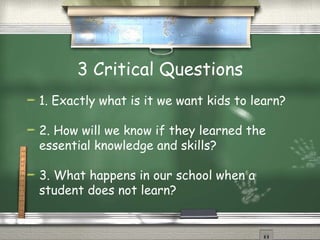
3 Critical Questions 1. Exactly what is it we want kids to learn? 2. How will we know if they learned the essential knowledge and skills? 3. What happens in our school when a student does not learn?
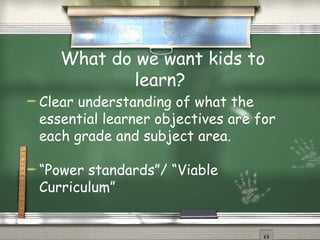
What do we want kids to learn? Clear understanding of what the essential learner objectives are for each grade and subject area. “ Power standards”/ “Viable Curriculum”
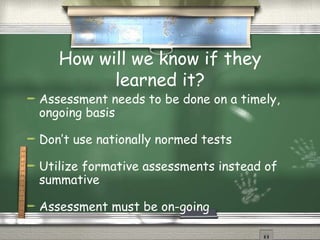
How will we know if they learned it? Assessment needs to be done on a timely, ongoing basis Don’t use nationally normed tests Utilize formative assessments instead of summative Assessment must be on-going
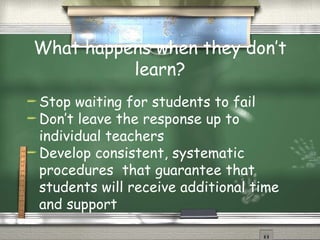
What happens when they don’t learn? Stop waiting for students to fail Don’t leave the response up to individual teachers Develop consistent, systematic procedures  that guarantee that students will receive additional time and support
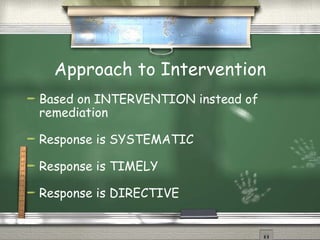
Approach to Intervention Based on INTERVENTION instead of remediation Response is SYSTEMATIC Response is TIMELY Response is DIRECTIVE
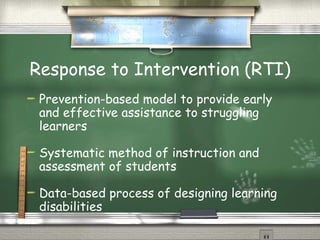
Response to Intervention (RTI) Prevention-based model to provide early and effective assistance to struggling learners Systematic method of instruction and assessment of students Data-based process of designing learning disabilities
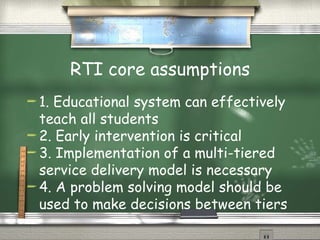
RTI core assumptions 1. Educational system can effectively teach all students 2. Early intervention is critical 3. Implementation of a multi-tiered service delivery model is necessary 4. A problem solving model should be used to make decisions between tiers
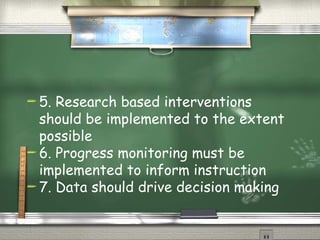
5. Research based interventions should be implemented to the extent possible 6. Progress monitoring must be implemented to inform instruction 7. Data should drive decision making
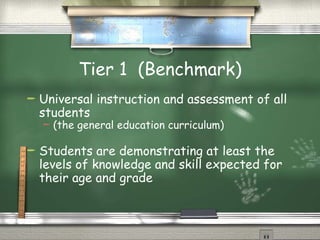
Tier 1  (Benchmark) Universal instruction and assessment of all students  (the general education curriculum) Students are demonstrating at least the levels of knowledge and skill expected for their age and grade
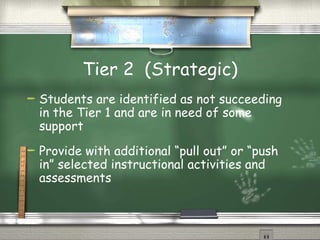
Tier 2  (Strategic) Students are identified as not succeeding in the Tier 1 and are in need of some support Provide with additional “pull out” or “push in” selected instructional activities and assessments
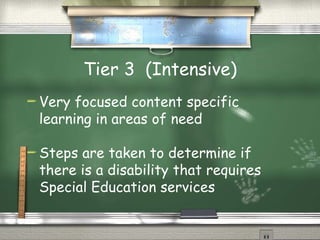
Tier 3  (Intensive) Very focused content specific learning in areas of need Steps are taken to determine if there is a disability that requires Special Education services
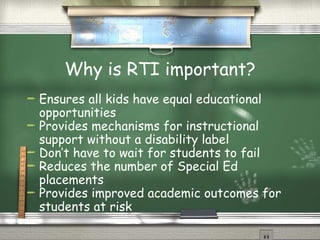
Why is RTI important? Ensures all kids have equal educational opportunities Provides mechanisms for instructional support without a disability label Don’t have to wait for students to fail Reduces the number of Special Ed placements Provides improved academic outcomes for students at risk
IDEA 2004 The use of the discrepancy formula is no longer required for qualification for Special Education services Schools can use evidence of failure to respond to instructional interventions as part of the data documenting a specific learning disability
Logistical Challenges  Time and Money Expectations for staff Rethink approach to Special Education From a Focus on Teaching to a Focus on Learning
From working in isolation to working collaboratively From focusing on Activities to focusing on Results From Fixed Time to Flexible Time  From Average Learning to Individual Learning From Punitive to Positive
Failure is not an option

Interventions

  • 1.
  • 2.
    Can all kidslearn? Most school districts have the mantra that all students can learn ” The district focuses on the belief that every child can learn and proudly offers a comprehensive, visionary curriculum with coordinated, sequential outcomes, goals, and objectives, K through 12.”
  • 3.
    All kids canlearn Many schools/educators have different assumptions as to the validity of this belief
  • 4.
    The Charles DarwinSchool “ We believe all kids can learn…based on their ability.”
  • 5.
    The Pontius PilateSchool “ We believe all kids can learn…if they take advantage of the opportunity we give them to learn.”
  • 6.
    The Chicago CubFan School “ We believe all kids can learn… something, and we will help all students experience academic growth in a warm and nurturing environment.”
  • 7.
    The Henry HigginsSchool “ We believe all kids can learn… and we will work to help all students achieve high standards of learning.”
  • 8.
    NCLB “All kids will learn or else…” Attempts to ensure high levels of learning for all students Imposed sanctions if NCLB standards are not met (motivation through fear)
  • 9.
    How does aschool effectively ensure that all kids can learn? Focus has to change from “All kids can learn” to “Learning for all”
  • 10.
    3 Critical Questions1. Exactly what is it we want kids to learn? 2. How will we know if they learned the essential knowledge and skills? 3. What happens in our school when a student does not learn?
  • 11.
    What do wewant kids to learn? Clear understanding of what the essential learner objectives are for each grade and subject area. “ Power standards”/ “Viable Curriculum”
  • 12.
    How will weknow if they learned it? Assessment needs to be done on a timely, ongoing basis Don’t use nationally normed tests Utilize formative assessments instead of summative Assessment must be on-going
  • 13.
    What happens whenthey don’t learn? Stop waiting for students to fail Don’t leave the response up to individual teachers Develop consistent, systematic procedures that guarantee that students will receive additional time and support
  • 14.
    Approach to InterventionBased on INTERVENTION instead of remediation Response is SYSTEMATIC Response is TIMELY Response is DIRECTIVE
  • 15.
    Response to Intervention(RTI) Prevention-based model to provide early and effective assistance to struggling learners Systematic method of instruction and assessment of students Data-based process of designing learning disabilities
  • 16.
    RTI core assumptions1. Educational system can effectively teach all students 2. Early intervention is critical 3. Implementation of a multi-tiered service delivery model is necessary 4. A problem solving model should be used to make decisions between tiers
  • 17.
    5. Research basedinterventions should be implemented to the extent possible 6. Progress monitoring must be implemented to inform instruction 7. Data should drive decision making
  • 18.
    Tier 1 (Benchmark) Universal instruction and assessment of all students (the general education curriculum) Students are demonstrating at least the levels of knowledge and skill expected for their age and grade
  • 19.
    Tier 2 (Strategic) Students are identified as not succeeding in the Tier 1 and are in need of some support Provide with additional “pull out” or “push in” selected instructional activities and assessments
  • 20.
    Tier 3 (Intensive) Very focused content specific learning in areas of need Steps are taken to determine if there is a disability that requires Special Education services
  • 21.
    Why is RTIimportant? Ensures all kids have equal educational opportunities Provides mechanisms for instructional support without a disability label Don’t have to wait for students to fail Reduces the number of Special Ed placements Provides improved academic outcomes for students at risk
  • 22.
    IDEA 2004 Theuse of the discrepancy formula is no longer required for qualification for Special Education services Schools can use evidence of failure to respond to instructional interventions as part of the data documenting a specific learning disability
  • 23.
    Logistical Challenges Time and Money Expectations for staff Rethink approach to Special Education From a Focus on Teaching to a Focus on Learning
  • 24.
    From working inisolation to working collaboratively From focusing on Activities to focusing on Results From Fixed Time to Flexible Time From Average Learning to Individual Learning From Punitive to Positive
  • 25.
    Failure is notan option