Gesture-based information systems: from DesignOps to DevOps
Jean Vanderdonckt
ISD’2021 (Online, September 8th, 2021)
2
Summary
1. Goals and Some Definitions
2. Motivations
3. The Seven I’s: An Overview
4. First case study: gesture-based application
5. Second case study: collaborative real-time GUI dev
6. The Seven I’s: Examplification
7. Conclusion
Goals and Some Definitions
• Overall goal: to reduce the time elapsed between a change
request and its delivery while ensuring software quality
• DevOps (initiated at DevOpsDays ‘09, Ghent, Belgium!)
• “Makes up a model in which development, quality assurance,
releasing, deployment, operation with infrastructure management,
and maintenance are integrated and automated as much as
possible” [Benni, 2019]
• “A software development methodology, under which a tight
coupling between operation teams and software developers takes
place” [Kuusinen, 2018]
• “A collaboration in the end-to-end delivery process of software
products or services” [Diaz, 2019]
• “Including end-users themselves” [Heistand, 2019]
Goals and Some Definitions
• Overall goal: to reduce the time elapsed between a change
request and its delivery while ensuring software quality
• DesignOps
• “They help grow and evolve design teams by operationalizing
workflows, managing projects, budgets and hiring. But most
importantly, they help improve the quality of the designs being
produced by allowing designers to do what they do best: design.”
[SuperSide, 2021]
• “The orchestration and optimization of people, processes, and craft
in order to amplify design's value and impact at scale” [Nielsen,
2021]
• “refers to the practice of integrating the design team’s workflow
into the company’s larger development context” [ProductPlan,
2021]
46%
30%
28%
28%
24%
0% 5% 10% 15% 20% 25% 30% 35% 40% 45% 50%
Reduce development costs
Increasing technological complexity
Need to increase revenue
Increasing data requirements
Move to hybrid and multicloud infrastructure
Top Pressures to Improve Application Performance Monitoring
Motivations
• To reduce development costs, etc.
Source: Aberdeen report, 2020
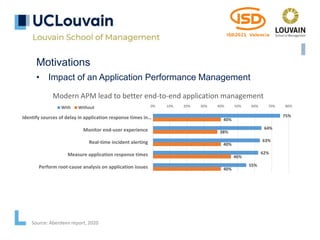
75%
64%
63%
62%
55%
40%
38%
40%
46%
40%
0% 10% 20% 30% 40% 50% 60% 70% 80%
Identify sources of delay in application response times in…
Monitor end-user experience
Real-time incident alerting
Measure application response times
Perform root-cause analysis on application issues
Modern APM lead to better end-to-end application management
With Without
Motivations
• Impact of an Application Performance Management
Source: Aberdeen report, 2020
 SDLC efficiency
Prioritize software
quality factors
Quickly respond to
end-users requests
Guarantee that requests
are properly addressed
 Time-to-market delivery
 Software quality
Break the waterfall
workflow
 Benefits from agile
methods
 Participatory design
Accommodate needs
for change management
Meet customer satisfaction
Identify KPI to address
Need to incorporate
new aspects
 Organizational flexibility
 User eXpercience
Measurability
Capability to innovate
Computer Science Management Sciences
Overlapping
Goals
Means
 = Maximize,  = Minimize
The Seven I’s
1. Implementation continuity
2. Inclusion of end-users
3. Interaction first
4. Integration among stakeholders
5. Iteration short, not fast
6. Incremental progress
7. Innovation openness
First case study: gesture-based application
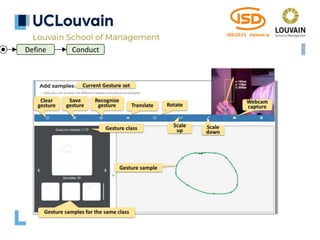
• Aims and goals: to collect gesture proposals from
end-users based on designer suggestions, reach
consensus, and transfer to development
• Stakeholders: distributed in time and space
Define Conduct Classify Measure Discuss Export
Gesture Mapping Command
COPY
Log files on all steps!
Source: Magrofuoco & Vanderdonckt, Gelicit: A Cloud Platform for Distributed Gesture Elicitation Studies, EICS 2020
Define
Define Conduct
Define
Define Conduct Classify
Define
Define Conduct Classify Measure
Define
Define Conduct Classify Measure Discuss
Define
Define Conduct Classify Measure Discuss Export
Second case study: collaborative real-time GUI dev
• Aims and goals: to collaboratively design and develop
a GUI for a web site
• Stakeholders: distributed in time and space
Source: Moldovan et al., OpenUIDL, A User Interface Description Language for Runtime Omni-Channel User Interfaces, EICS 2020
Initiate Customize Collaborate Measure Discuss Export
See http://teleporthq.io
Initiate
See http://teleporthq.io
Initiate Customize Collaborate Measure
See http://teleporthq.io
Initiate Customize Collaborate Measure
See http://teleporthq.io
Discuss Export
I1: Implementation continuity
• Continuous integration (CI): early and continuous integration of
coe, enable faster feedback cycles and reduced workload
[Debroy, 2018]
• Continuous Delivery (CDE): process in which new development
is brought into production [Düllman, 2018]
Poor examples
• Separation between design and development
• What I designed is what you have to develop (but not really!)
• Throw-away prototypes
I1: Implementation continuity
Poor example
Source: https://www.smashingmagazine.com/2010/05/resurrecting-user-interface-prototypes-without-creating-zombies/
I1: Implementation continuity
Poor example
Source: https://www.smashingmagazine.com/2010/05/resurrecting-user-interface-prototypes-without-creating-zombies/
I1: Implementation continuity
Poor example
I1: Implementation continuity
Better example
• Continuity between prototyping steps
Generic design Specific design
All stakeholders Development team
User Interface
mockups with
comments
UI design
specifications
UI Screen shots
with call-outs on
specific elements
1
2
3
UI flow
document
I1: Implementation continuity
Better example
• Continuity between prototypes of different levels of fidelity
Level of fidelity
Low
Check box
Identification label
Medium High Final
I1: Implementation continuity
Better example
• Continuity between prototypes of different levels of fidelity
I1: Implementation continuity
Better example
• Continuity between prototypes of different levels of fidelity
I2: Inclusion of end-users
Poor example
• Leave an interface builder in the hand of any end-user
• Tables with dynamic data
• Gantt chart
• Direct manipulation of tasks
Desired UI Obtained UI
• Window with menu bar
• Toolboar with icons
• Static controls: list boxes, push buttons,
• No navigation
I2: Inclusion of end-users
Better example
• Provide end-users with a prototyping tool that preserves
continuity and ensure integration (I4)
Source: Vanderdonckt & Grolaux, End-User Composition of Graphical User Interfaces by Composite Pattern, EICS ‘19
I2: Interaction first
Poor examples
Controller
Functional core
Presentation
Global
navigation
Local
navigation
Presentational prototype first
Controller
Functional core
Presentation
Global
navigation
Local
navigation
Local navigation prototype first
Controller
Functional core
Presentation
Global
navigation
Local
navigation
Global navigation prototype first
I2: Interaction first
Better example
User interface
Controller
Functional core
Complete
Interactive
application
Horizontal prototype
Vertical prototype
User interface
Controller
Functional core
Complete
interactive
application
Diagonal prototype
Scenario = script
of particular fixed
uses of the
system; no
deviation allowed
I2: Interaction first
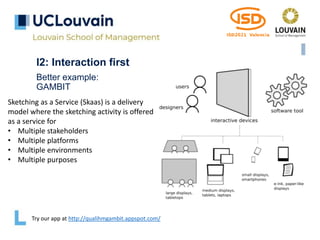
Better example:
GAMBIT
Try our app at http://qualihmgambit.appspot.com/
Sketching as a Service (Skaas) is a delivery
model where the sketching activity is offered
as a service for
• Multiple stakeholders
• Multiple platforms
• Multiple environments
• Multiple purposes
I2: Interaction first
Better example: Step1 = define structure
GAMBIT
I2: Interaction first
Better example: Step2 = define behavior
GAMBIT
I2: Interaction first
Better example: Step3 = test in lab
GAMBIT
I2: Interaction first
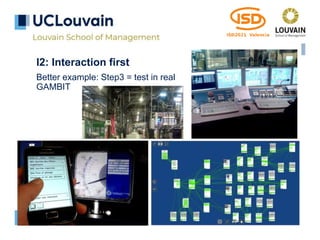
Better example: Step3 = test in real
GAMBIT
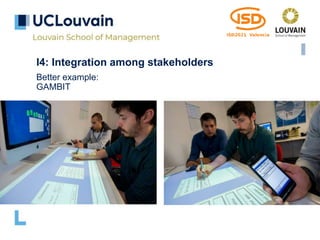
I4: Integration among stakeholders
Better example:
GAMBIT
I4: Integration among stakeholders
Better example:
GAMBIT
I5: Iteration short
Better example:
GAMBIT
I6: Incremental progress
Some example: MUI
I7: Innovation openness
Some example: MUI
Acquisition Recognition Frontend
Sensor
interface
Static
recognizer
MUI
application
Dynamic
recognizer
Segmenter
Segmentation
Conclusion: The Seven I’s
1. Implementation continuity
2. Inclusion of end-users
3. Interaction first
4. Integration among stakeholders
5. Iteration short, not fast
6. Incremental progress
7. Innovation openness
DesignOps DevOps
4 4
4 1
4 2
3 3
4 4
3 2
1 2
Importance
Thank you very much
for your attention

Gesture-based information systems: from DesignOps to DevOps

  • 1.
    Gesture-based information systems:from DesignOps to DevOps Jean Vanderdonckt ISD’2021 (Online, September 8th, 2021)
  • 2.
    2 Summary 1. Goals andSome Definitions 2. Motivations 3. The Seven I’s: An Overview 4. First case study: gesture-based application 5. Second case study: collaborative real-time GUI dev 6. The Seven I’s: Examplification 7. Conclusion
  • 3.
    Goals and SomeDefinitions • Overall goal: to reduce the time elapsed between a change request and its delivery while ensuring software quality • DevOps (initiated at DevOpsDays ‘09, Ghent, Belgium!) • “Makes up a model in which development, quality assurance, releasing, deployment, operation with infrastructure management, and maintenance are integrated and automated as much as possible” [Benni, 2019] • “A software development methodology, under which a tight coupling between operation teams and software developers takes place” [Kuusinen, 2018] • “A collaboration in the end-to-end delivery process of software products or services” [Diaz, 2019] • “Including end-users themselves” [Heistand, 2019]
  • 4.
    Goals and SomeDefinitions • Overall goal: to reduce the time elapsed between a change request and its delivery while ensuring software quality • DesignOps • “They help grow and evolve design teams by operationalizing workflows, managing projects, budgets and hiring. But most importantly, they help improve the quality of the designs being produced by allowing designers to do what they do best: design.” [SuperSide, 2021] • “The orchestration and optimization of people, processes, and craft in order to amplify design's value and impact at scale” [Nielsen, 2021] • “refers to the practice of integrating the design team’s workflow into the company’s larger development context” [ProductPlan, 2021]
  • 5.
    46% 30% 28% 28% 24% 0% 5% 10%15% 20% 25% 30% 35% 40% 45% 50% Reduce development costs Increasing technological complexity Need to increase revenue Increasing data requirements Move to hybrid and multicloud infrastructure Top Pressures to Improve Application Performance Monitoring Motivations • To reduce development costs, etc. Source: Aberdeen report, 2020
  • 6.
    75% 64% 63% 62% 55% 40% 38% 40% 46% 40% 0% 10% 20%30% 40% 50% 60% 70% 80% Identify sources of delay in application response times in… Monitor end-user experience Real-time incident alerting Measure application response times Perform root-cause analysis on application issues Modern APM lead to better end-to-end application management With Without Motivations • Impact of an Application Performance Management Source: Aberdeen report, 2020
  • 7.
     SDLC efficiency Prioritizesoftware quality factors Quickly respond to end-users requests Guarantee that requests are properly addressed  Time-to-market delivery  Software quality Break the waterfall workflow  Benefits from agile methods  Participatory design Accommodate needs for change management Meet customer satisfaction Identify KPI to address Need to incorporate new aspects  Organizational flexibility  User eXpercience Measurability Capability to innovate Computer Science Management Sciences Overlapping Goals Means  = Maximize,  = Minimize
  • 8.
    The Seven I’s 1.Implementation continuity 2. Inclusion of end-users 3. Interaction first 4. Integration among stakeholders 5. Iteration short, not fast 6. Incremental progress 7. Innovation openness
  • 9.
    First case study:gesture-based application • Aims and goals: to collect gesture proposals from end-users based on designer suggestions, reach consensus, and transfer to development • Stakeholders: distributed in time and space Define Conduct Classify Measure Discuss Export Gesture Mapping Command COPY Log files on all steps! Source: Magrofuoco & Vanderdonckt, Gelicit: A Cloud Platform for Distributed Gesture Elicitation Studies, EICS 2020
  • 10.
  • 11.
  • 12.
  • 13.
  • 14.
  • 15.
    Define Define Conduct ClassifyMeasure Discuss Export
  • 16.
    Second case study:collaborative real-time GUI dev • Aims and goals: to collaboratively design and develop a GUI for a web site • Stakeholders: distributed in time and space Source: Moldovan et al., OpenUIDL, A User Interface Description Language for Runtime Omni-Channel User Interfaces, EICS 2020 Initiate Customize Collaborate Measure Discuss Export See http://teleporthq.io
  • 17.
  • 18.
    Initiate Customize CollaborateMeasure See http://teleporthq.io
  • 19.
    Initiate Customize CollaborateMeasure See http://teleporthq.io Discuss Export
  • 20.
    I1: Implementation continuity •Continuous integration (CI): early and continuous integration of coe, enable faster feedback cycles and reduced workload [Debroy, 2018] • Continuous Delivery (CDE): process in which new development is brought into production [Düllman, 2018] Poor examples • Separation between design and development • What I designed is what you have to develop (but not really!) • Throw-away prototypes
  • 21.
    I1: Implementation continuity Poorexample Source: https://www.smashingmagazine.com/2010/05/resurrecting-user-interface-prototypes-without-creating-zombies/
  • 22.
    I1: Implementation continuity Poorexample Source: https://www.smashingmagazine.com/2010/05/resurrecting-user-interface-prototypes-without-creating-zombies/
  • 23.
  • 24.
    I1: Implementation continuity Betterexample • Continuity between prototyping steps Generic design Specific design All stakeholders Development team User Interface mockups with comments UI design specifications UI Screen shots with call-outs on specific elements 1 2 3 UI flow document
  • 25.
    I1: Implementation continuity Betterexample • Continuity between prototypes of different levels of fidelity Level of fidelity Low Check box Identification label Medium High Final
  • 26.
    I1: Implementation continuity Betterexample • Continuity between prototypes of different levels of fidelity
  • 27.
    I1: Implementation continuity Betterexample • Continuity between prototypes of different levels of fidelity
  • 28.
    I2: Inclusion ofend-users Poor example • Leave an interface builder in the hand of any end-user • Tables with dynamic data • Gantt chart • Direct manipulation of tasks Desired UI Obtained UI • Window with menu bar • Toolboar with icons • Static controls: list boxes, push buttons, • No navigation
  • 29.
    I2: Inclusion ofend-users Better example • Provide end-users with a prototyping tool that preserves continuity and ensure integration (I4) Source: Vanderdonckt & Grolaux, End-User Composition of Graphical User Interfaces by Composite Pattern, EICS ‘19
  • 30.
    I2: Interaction first Poorexamples Controller Functional core Presentation Global navigation Local navigation Presentational prototype first Controller Functional core Presentation Global navigation Local navigation Local navigation prototype first Controller Functional core Presentation Global navigation Local navigation Global navigation prototype first
  • 31.
    I2: Interaction first Betterexample User interface Controller Functional core Complete Interactive application Horizontal prototype Vertical prototype User interface Controller Functional core Complete interactive application Diagonal prototype Scenario = script of particular fixed uses of the system; no deviation allowed
  • 32.
    I2: Interaction first Betterexample: GAMBIT Try our app at http://qualihmgambit.appspot.com/ Sketching as a Service (Skaas) is a delivery model where the sketching activity is offered as a service for • Multiple stakeholders • Multiple platforms • Multiple environments • Multiple purposes
  • 33.
    I2: Interaction first Betterexample: Step1 = define structure GAMBIT
  • 34.
    I2: Interaction first Betterexample: Step2 = define behavior GAMBIT
  • 35.
    I2: Interaction first Betterexample: Step3 = test in lab GAMBIT
  • 36.
    I2: Interaction first Betterexample: Step3 = test in real GAMBIT
  • 37.
    I4: Integration amongstakeholders Better example: GAMBIT
  • 38.
    I4: Integration amongstakeholders Better example: GAMBIT
  • 39.
  • 40.
  • 41.
    I7: Innovation openness Someexample: MUI Acquisition Recognition Frontend Sensor interface Static recognizer MUI application Dynamic recognizer Segmenter Segmentation
  • 42.
    Conclusion: The SevenI’s 1. Implementation continuity 2. Inclusion of end-users 3. Interaction first 4. Integration among stakeholders 5. Iteration short, not fast 6. Incremental progress 7. Innovation openness DesignOps DevOps 4 4 4 1 4 2 3 3 4 4 3 2 1 2 Importance
  • 43.
    Thank you verymuch for your attention