Software products that serve the users’ needs and goals:  CS820 Usability and Interaction
Course Overview Investigates what qualities of a software product make it usable  How does one include usability concerns throughout the software lifecycle How does one design for usability  Determine experimentally the usability of a product, and the importance of early usability testing on a simple prototype
Course Objectives Qualify and quantify what is commonly meant by “usable” Identify a means to inject usability attributes into each phase of the software development lifecycle in a way that is appropriate for that phase Develop usability criteria for a product Discuss and develop ethical guidelines for products and user testing Design a usability experiment for a product. Analyze data collected from a usability experiment. Interpret usability data that indicates a potential problem with a product. List and discuss the fundamentals of Human-Computer Interaction   and the application of those fundamentals to the design of a product.
Your Objectives Apply learning about usability to work products (security, plant operations, government contract, etc.) Weigh usability vs. investment and assess  Be involved with “Next, Next” products and think out of the box Find proper place for usability in sw development cycle Discover difference between functionality, acceptability and usability Reduce complexity; find more pleasant user experiences
Usability Principles Learnability Memorability Efficiency Jakob Nielsen Technology needs to be tied to   how  users work (play, communicate) not just to what the work (game, message) is.  (anonymous student, 2011)
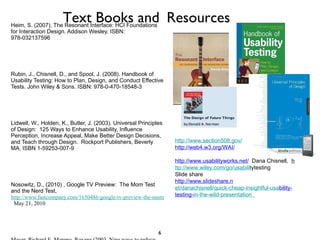
Norman, Donald, The Design of Future Things, (download from Amazon for Kindle, Kindle for PC or Kindle for Mac) Basic Books, New York Heim, S. (2007). The Resonant Interface: HCI Foundations for Interaction Design. Addison Wesley. ISBN: 978-032137596 Rubin, J., Chisnell, D., and Spool, J. (2008). Handbook of Usability Testing: How to Plan, Design, and Conduct Effective Tests. John Wiley & Sons. ISBN: 978-0-470-18548-3 Lidwell, W., Holden, K., Butler, J. (2003). Universal Principles of Design:  125 Ways to Enhance Usability, Influence Perception, Increase Appeal, Make Better Design Decisions, and Teach through Design.  Rockport Publishers, Beverly MA, ISBN 1-59253-007-9 Nosowitz, D., (2010) , Google TV Preview:  The Mom Test and the Nerd Test,  http://www.fastcompany.com/1650486/google-tv-preview-the-mom-test-and-thenerd-test   May 21, 2010 Mayer, Richard E, Moreno, Roxana (2003, Nine ways to reduce cognitive load in multimedia learning,  EDUCATIONAL PSYCHOLOGIST,  38 (1), 43–52 Text Books and   Resources http://www.section508.gov/   http://web4.w3.org/WAI/   http://www.usabilityworks.net/   Dana Chisnell,  h ttp://www.wiley.com/go /usabili tytesting  Slide share  http://www.slideshare.n et/danachisnell/quick-cheap-insightful-usa bility-testing- in-the-wild-presentation
Videos Next 5000 days of internet.    http://www.youtube.com/watch?v=yDYCf4ONh5M&feature=player_embedded# !  http://www.ted.com/talks/lang/eng/kevin_kelly_on_the_next_5_000_days_of_the_web.html New interfaces, Minority Report science adviser and inventor John Underkoffler demos  http://www.ted.com/talks/john_underkoffler_drive_3d_data_with_a_gesture.html?utm_source=newsletter_weekly_2010-06-02 Jeremy Lyons on Usability Testing at Stanford,  http://www.youtube.com/watch?v=SEwCRpTEgA0   Holographic Interface – round interface – Ringo  http://vimeo.com/1416530   Augmented City 3D  http://vimeo.com/14294054 Paper Prototyping  http://www.youtube.com/watch?v=ppnRQD06ggY Wired Conference on disruption Disruptive by Design  http://fora.tv/live/wired/wired_business_conference_2011#
Other Resources What Technology Wants , Kevin Kelly (2010) Viking, New York ISBN-10: 0670022152 ISBN-13: 978-0670022151 http://bit.ly/aU9t8y    link to article on importance of mobile interfaces in daily life. https://uscannenberg.qualtrics.com/SE/?SID=SV_cwLRMymkLMboa3O  Survey on media literacy, check out the consent form In this conceptual work, I tried to use augmented reality as a tool for an easy way to locate a 3D-Model in a book. The user can easily thumb through the book and the specific 3D-Model appears directly, when the webcam recognizes the pattern on the page.   http://vimeo.com/10956863    http://www.youtube.com/watch?v=t9M0RPNr9qg#t=6m30   Vint Cerf http://www.adobemuseum.com/index.php#   Adobe Museum About Face 3 , (2007) Cooper, Reiman, Cronin,  Wiley,  www.cooper.com Ginsburg, S. (2011)  Designing the iPhone User Experience,  Addison-Wesley, NJ, ISBN 13: 978-0-321-69943-5, OR 10: 978-0-321-69943-2 Johnson, J. (2010)  Designing with the Mind in Mind , Morgan Kaufman Amsterdam, ISBN 978-0-12-375030-3 Clark, J. (2010), Tapworthy:   Designing Great iPhone Apps , O’Reilly, Beijing, ISBN 978-1-449-38165-3 Designing for the Digital Age: How to Create Human-Centered Products and Services [Paperback]   Kim Goodwin  (Author),  Alan Cooper  (Foreword)  (2009)
Points in Interface Design/Development ...”people’s experiences with technology should be structured in accordance with their abilities of perception, cognition and movement (Cooper, et al., 2007)
Mental Models Mental Models:  M of X M is a good model of X to the extent that it is useful in answering questions about X (Minsky, 1985) People understand and interact with systems and environments based on mental representations developed from experience (Lidwell, et al., 2003) p. 154
Interaction Design The What:  “... you want to rigorously define the human and business needs that your product must satisfy.”  (Cooper, et al., 2007) Goal directed  “Why is a user performing an activity, task, action or operation in the first place?”  (Cooper, et al., 2007)
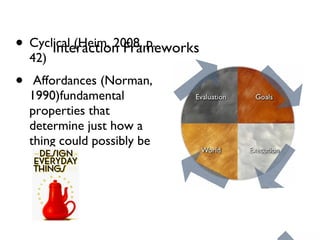
Interaction Frameworks Cyclical (Heim, 2008, p. 42) Affordances (Norman, 1990)fundamental properties that determine just how a thing could possibly be used
Platforms for Interactive Devices Physical form, posture, display size, resolution, input method, connectivity, capacity, environment desktop, portable, handheld,  web sites, web applications entertainment  and educational systems  Automobiles, Appliances, Robots, etc. Professional devices Kiosks
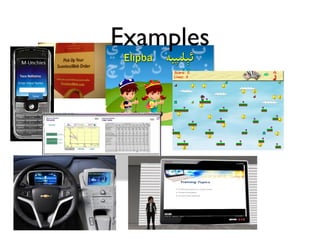
Examples
Postures for Interactive Devices Behavior of the program Sovereign (up and running continuously, e.g, word) Transient (comes and goes, invoked when needed, e.g., widgets) Daemonic (in background, e.g., printer driver)
Flow, Orchestration Follow user mental models Users direct Tools close Less is more Modeless feedback Design for probable Provide comparisons Provide graphical input/output Reflect object & app status Avoid unnecessary reporting, blank slates Provide choices Hide ejector seat levers Optimize for responsiveness Harmonious Interactions (Cooper, 2007, pp. 215-216)
Displays Metaphoric, visual relationship to real-world Idiomatic, easily learned
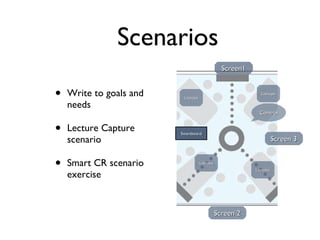
Scenarios Write to goals and needs  Lecture Capture scenario Smart CR scenario exercise Control Screen1 Screen 2 Screen 3 Laptops Laptops Laptops Laptops Smartboard
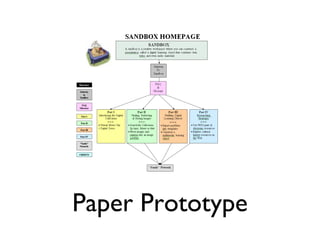
Paper Prototype
 
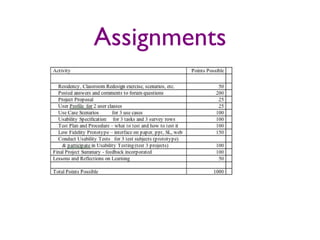
Course Activities Residency  July 13-17, 2011 Class will use a  discussion format  with  extensive  student involvement.  July 3 - September 19, 2011 IRB proposal, Week 6, August 7-13, 2011 Students are also expected to demonstrate their knowledge and learning in the final project.  September 19, 2011 Final project will consist of:  Usability testing results for a new software product or changes made to an existing software product  the simulation/execution and analysis of a usability experiment for that product
Important Dates Term begins  July 3, 2011 Assignments/readings begin  July 3, 2011 First Forum due by  January 10, 2011 Residency Begins July 13, 2011 Usability Tests conducted beginning Week 9,  August 28, 2011 Post final project, Week of September 11, 2011
Usability and Accessibility User centered needs, goals, motivations Models Personas Interactions Design principles Section 508 Which users? physical, psychological, cognitive age (Game day) Screen readers Universal design
Interaction Event Driven On Demand Anticipate Needs hyperlink
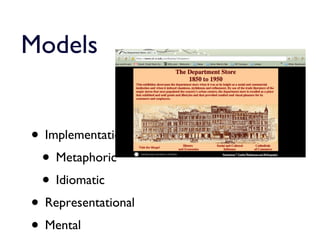
Models Implementation Metaphoric Idiomatic Representational Mental
 
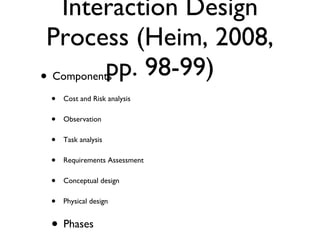
Interaction Design Process (Heim, 2008, pp. 98-99) Components Cost and Risk analysis Observation Task analysis Requirements Assessment Conceptual design Physical design Phases Discovery Design Evaluation
Assignments
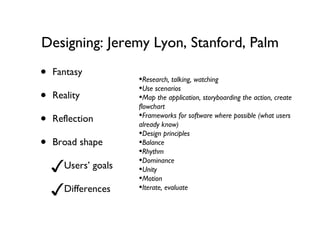
Designing: Jeremy Lyon, Stanford, Palm Fantasy Reality Reflection Broad shape Users’ goals Differences  Research, talking, watching Use scenarios Map the application, storyboarding the action, create flowchart Frameworks for software where possible (what users already know) Design principles Balance Rhythm Dominance Unity Motion Iterate, evaluate
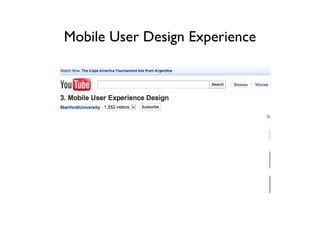
Mobile User Design Experience Text

Summ11 useinterx

  • 1.
    Software products thatserve the users’ needs and goals: CS820 Usability and Interaction
  • 2.
    Course Overview Investigateswhat qualities of a software product make it usable How does one include usability concerns throughout the software lifecycle How does one design for usability Determine experimentally the usability of a product, and the importance of early usability testing on a simple prototype
  • 3.
    Course Objectives Qualifyand quantify what is commonly meant by “usable” Identify a means to inject usability attributes into each phase of the software development lifecycle in a way that is appropriate for that phase Develop usability criteria for a product Discuss and develop ethical guidelines for products and user testing Design a usability experiment for a product. Analyze data collected from a usability experiment. Interpret usability data that indicates a potential problem with a product. List and discuss the fundamentals of Human-Computer Interaction and the application of those fundamentals to the design of a product.
  • 4.
    Your Objectives Applylearning about usability to work products (security, plant operations, government contract, etc.) Weigh usability vs. investment and assess Be involved with “Next, Next” products and think out of the box Find proper place for usability in sw development cycle Discover difference between functionality, acceptability and usability Reduce complexity; find more pleasant user experiences
  • 5.
    Usability Principles LearnabilityMemorability Efficiency Jakob Nielsen Technology needs to be tied to how users work (play, communicate) not just to what the work (game, message) is. (anonymous student, 2011)
  • 6.
    Norman, Donald, TheDesign of Future Things, (download from Amazon for Kindle, Kindle for PC or Kindle for Mac) Basic Books, New York Heim, S. (2007). The Resonant Interface: HCI Foundations for Interaction Design. Addison Wesley. ISBN: 978-032137596 Rubin, J., Chisnell, D., and Spool, J. (2008). Handbook of Usability Testing: How to Plan, Design, and Conduct Effective Tests. John Wiley & Sons. ISBN: 978-0-470-18548-3 Lidwell, W., Holden, K., Butler, J. (2003). Universal Principles of Design: 125 Ways to Enhance Usability, Influence Perception, Increase Appeal, Make Better Design Decisions, and Teach through Design. Rockport Publishers, Beverly MA, ISBN 1-59253-007-9 Nosowitz, D., (2010) , Google TV Preview: The Mom Test and the Nerd Test, http://www.fastcompany.com/1650486/google-tv-preview-the-mom-test-and-thenerd-test May 21, 2010 Mayer, Richard E, Moreno, Roxana (2003, Nine ways to reduce cognitive load in multimedia learning, EDUCATIONAL PSYCHOLOGIST, 38 (1), 43–52 Text Books and Resources http://www.section508.gov/ http://web4.w3.org/WAI/ http://www.usabilityworks.net/ Dana Chisnell, h ttp://www.wiley.com/go /usabili tytesting Slide share http://www.slideshare.n et/danachisnell/quick-cheap-insightful-usa bility-testing- in-the-wild-presentation
  • 7.
    Videos Next 5000days of internet.    http://www.youtube.com/watch?v=yDYCf4ONh5M&feature=player_embedded# !  http://www.ted.com/talks/lang/eng/kevin_kelly_on_the_next_5_000_days_of_the_web.html New interfaces, Minority Report science adviser and inventor John Underkoffler demos http://www.ted.com/talks/john_underkoffler_drive_3d_data_with_a_gesture.html?utm_source=newsletter_weekly_2010-06-02 Jeremy Lyons on Usability Testing at Stanford, http://www.youtube.com/watch?v=SEwCRpTEgA0 Holographic Interface – round interface – Ringo http://vimeo.com/1416530 Augmented City 3D http://vimeo.com/14294054 Paper Prototyping http://www.youtube.com/watch?v=ppnRQD06ggY Wired Conference on disruption Disruptive by Design http://fora.tv/live/wired/wired_business_conference_2011#
  • 8.
    Other Resources WhatTechnology Wants , Kevin Kelly (2010) Viking, New York ISBN-10: 0670022152 ISBN-13: 978-0670022151 http://bit.ly/aU9t8y   link to article on importance of mobile interfaces in daily life. https://uscannenberg.qualtrics.com/SE/?SID=SV_cwLRMymkLMboa3O Survey on media literacy, check out the consent form In this conceptual work, I tried to use augmented reality as a tool for an easy way to locate a 3D-Model in a book. The user can easily thumb through the book and the specific 3D-Model appears directly, when the webcam recognizes the pattern on the page. http://vimeo.com/10956863   http://www.youtube.com/watch?v=t9M0RPNr9qg#t=6m30  Vint Cerf http://www.adobemuseum.com/index.php#  Adobe Museum About Face 3 , (2007) Cooper, Reiman, Cronin, Wiley, www.cooper.com Ginsburg, S. (2011) Designing the iPhone User Experience, Addison-Wesley, NJ, ISBN 13: 978-0-321-69943-5, OR 10: 978-0-321-69943-2 Johnson, J. (2010) Designing with the Mind in Mind , Morgan Kaufman Amsterdam, ISBN 978-0-12-375030-3 Clark, J. (2010), Tapworthy:   Designing Great iPhone Apps , O’Reilly, Beijing, ISBN 978-1-449-38165-3 Designing for the Digital Age: How to Create Human-Centered Products and Services [Paperback] Kim Goodwin (Author), Alan Cooper (Foreword)  (2009)
  • 9.
    Points in InterfaceDesign/Development ...”people’s experiences with technology should be structured in accordance with their abilities of perception, cognition and movement (Cooper, et al., 2007)
  • 10.
    Mental Models MentalModels: M of X M is a good model of X to the extent that it is useful in answering questions about X (Minsky, 1985) People understand and interact with systems and environments based on mental representations developed from experience (Lidwell, et al., 2003) p. 154
  • 11.
    Interaction Design TheWhat: “... you want to rigorously define the human and business needs that your product must satisfy.” (Cooper, et al., 2007) Goal directed “Why is a user performing an activity, task, action or operation in the first place?” (Cooper, et al., 2007)
  • 12.
    Interaction Frameworks Cyclical(Heim, 2008, p. 42) Affordances (Norman, 1990)fundamental properties that determine just how a thing could possibly be used
  • 13.
    Platforms for InteractiveDevices Physical form, posture, display size, resolution, input method, connectivity, capacity, environment desktop, portable, handheld, web sites, web applications entertainment and educational systems Automobiles, Appliances, Robots, etc. Professional devices Kiosks
  • 14.
  • 15.
    Postures for InteractiveDevices Behavior of the program Sovereign (up and running continuously, e.g, word) Transient (comes and goes, invoked when needed, e.g., widgets) Daemonic (in background, e.g., printer driver)
  • 16.
    Flow, Orchestration Followuser mental models Users direct Tools close Less is more Modeless feedback Design for probable Provide comparisons Provide graphical input/output Reflect object & app status Avoid unnecessary reporting, blank slates Provide choices Hide ejector seat levers Optimize for responsiveness Harmonious Interactions (Cooper, 2007, pp. 215-216)
  • 17.
    Displays Metaphoric, visualrelationship to real-world Idiomatic, easily learned
  • 18.
    Scenarios Write togoals and needs Lecture Capture scenario Smart CR scenario exercise Control Screen1 Screen 2 Screen 3 Laptops Laptops Laptops Laptops Smartboard
  • 19.
  • 20.
  • 21.
    Course Activities Residency July 13-17, 2011 Class will use a discussion format with extensive student involvement. July 3 - September 19, 2011 IRB proposal, Week 6, August 7-13, 2011 Students are also expected to demonstrate their knowledge and learning in the final project. September 19, 2011 Final project will consist of: Usability testing results for a new software product or changes made to an existing software product the simulation/execution and analysis of a usability experiment for that product
  • 22.
    Important Dates Termbegins July 3, 2011 Assignments/readings begin July 3, 2011 First Forum due by January 10, 2011 Residency Begins July 13, 2011 Usability Tests conducted beginning Week 9, August 28, 2011 Post final project, Week of September 11, 2011
  • 23.
    Usability and AccessibilityUser centered needs, goals, motivations Models Personas Interactions Design principles Section 508 Which users? physical, psychological, cognitive age (Game day) Screen readers Universal design
  • 24.
    Interaction Event DrivenOn Demand Anticipate Needs hyperlink
  • 25.
    Models Implementation MetaphoricIdiomatic Representational Mental
  • 26.
  • 27.
    Interaction Design Process(Heim, 2008, pp. 98-99) Components Cost and Risk analysis Observation Task analysis Requirements Assessment Conceptual design Physical design Phases Discovery Design Evaluation
  • 28.
  • 29.
    Designing: Jeremy Lyon,Stanford, Palm Fantasy Reality Reflection Broad shape Users’ goals Differences Research, talking, watching Use scenarios Map the application, storyboarding the action, create flowchart Frameworks for software where possible (what users already know) Design principles Balance Rhythm Dominance Unity Motion Iterate, evaluate
  • 30.
    Mobile User DesignExperience Text