new data
same
method
new
method
same participants new participants
Vatavu &Wobbrock
(2015, 2016),
Tsandilas (2018)
5
Nacenta et al.
(2013), Schipor &
Vatavu (2019)
3
6
Nebeling et al.
(2014), Hoff et al.
(2016)
n/a
(and unlikely)
4
Repeatability
Reproducibility
Replicability
not yet done
new data
1
2
by the virtue of the
method itself
same data
Repurposability
10
9
Gheran et al. (2018)b,
Soni et al. (2020)
same data
REPL
ICA
TE REPURPOSE
new population
same population
checking of analysis
reanalysis of data
EX
TEND&GENERA
L
IZ
E
new goal
new
population
conceptual extension
exact replication,
same method
Replicability
Generalizability
Extensibility
Leiva et al.
(2017)
exact replication,
new method
same
population
exact replication,
same method
new data
7
8
Rust et al. (2014)
empirical
generalization
generalization and
extension
repurposing and
extension
empirical
repurposing
Soni et al. (2019)
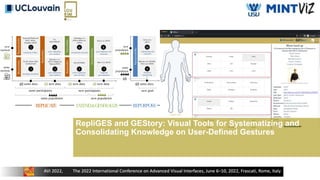
RepliGES and GEStory: Visual Tools for Systematizing and
Consolidating Knowledge on User-Defined Gestures
RepliGES and GEStory: Visual Tools for Systematizing and
Consolidating Knowledge on User-Defined Gestures
Jean Vanderdonckt
Université catholique
de Louvain (UCLouvain),
Belgium
Radu-Daniel Vatavu
Machine Intelligence &
Information Visualization Lab
University of Suceava, Romania
Santiago Villarreal-Narvaez
Université catholique
de Louvain (UCLouvain),
Belgium
Bogdan-Florin Gheran
Machine Intelligence &
Information Visualization Lab
University of Suceava,
Romania
Introduction
A Critical aspect of designing gesture user interfaces
• Mapping between gestures
• System functions
Scientific knowledge
I. Findings from experiments examining the factors that impact the user experience
of gesture-based interaction (social acceptability, memorability, perceived
difficulty, and naturalness)
II. Insights into users' preferences for gestures elicited in gesture elicitation studies.
Introduction
Gesture Elicitation Studies (GESs).
• A powerful method in the toolbox of HCI researchers and practitioners to unveil
users' preferences for and mental models of gesture-based interaction
• Participants propose gestures they would like to use to effect the system functions of
interactive systems
Zooming in on a map with touch input
Turning on/off the TV set with a smart ring
• The practitioner analyzes the elicited gestures to develop an understanding of users'
preferences for gesture commands that are perceived:
Intuitive
Low effort
Memorable
• Consequently, likely to reflect the preferences of the larger user population
Introduction
Gesture Elicitation Studies (GESs).
• Several shortcomings about the body of knowledge accumulated on user-defined
gestures in the scientific literature:
S1. Scattered literature: GESs are published at various venues
S2. Heterogeneous findings: GESs employ different methods of analysis
S3. Partial coverage of context: Some GESs lack a full description of the context of use
S4. Partial evidence: Some GESs do not provide any indication whether the user-defined gestures
they report are representative
S5. Difficulty of cross-checking findings: Findings from different GESs are difficult to structure and
put in correspondence
Introduction
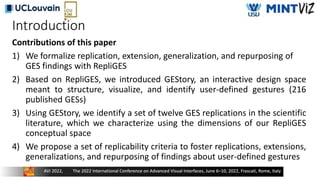
Contributions of this paper
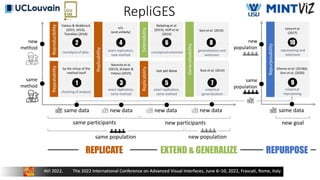
1) We formalize replication, extension, generalization, and repurposing of
GES findings with RepliGES
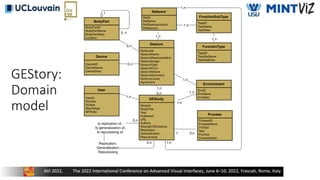
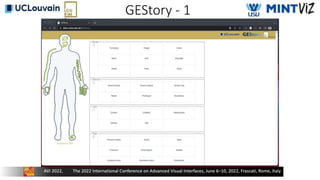
2) Based on RepliGES, we introduced GEStory, an interactive design space
meant to structure, visualize, and identify user-defined gestures (216
published GESs)
3) Using GEStory, we identify a set of twelve GES replications in the scientific
literature, which we characterize using the dimensions of our RepliGES
conceptual space
4) We propose a set of replicability criteria to foster replications, extensions,
generalizations, and repurposing of findings about user-defined gestures
RepliGES: A conceptual space
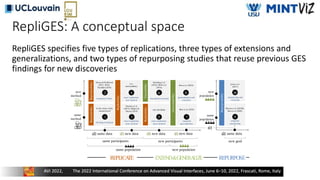
RepliGES specifies five types of replications, three types of extensions and
generalizations, and two types of repurposing studies that reuse previous GES
findings for new discoveries
new data
same
method
new
method
same participants new participants
Vatavu &Wobbrock
(2015, 2016),
Tsandilas (2018)
5
Nacenta et al.
(2013), Schipor &
Vatavu (2019)
3
6
Nebeling et al.
(2014), Hoff et al.
(2016)
n/a
(and unlikely)
4
Repeatability
Reproducibility
Replicability
not yet done
new data
1
2
by the virtue of the
method itself
same data
Repurposability
10
9
Gheran et al. (2018)b,
Soni et al. (2020)
same data
REPL
ICA
TE REPURPOSE
new population
same population
checking of analysis
reanalysis of data
EX
TEND&GENERA
L
IZ
E
new goal
new
population
conceptual extension
exact replication,
same method
Replicability
Generalizability
Extensibility
Leiva et al.
(2017)
exact replication,
new method
same
population
exact replication,
same method
new data
7
8
Rust et al. (2014)
empirical
generalization
generalization and
extension
repurposing and
extension
empirical
repurposing
Soni et al. (2019)
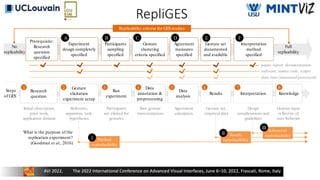
RepliGES
Method
reproducibility
Research
question
Gesture
elicitation
experiment setup
Run
experiment
Data
annotation &
preprocessing
Data
analysis
K
nowledge
Initial observation,
prior work,
application domain
Gesture input
reflective of
user behavior
Results
reproducibility
Inferential
reproducibility
Results Interpretation
Design
considerations and
guidelines
What is the purpose of the
replication experiment?
(Goodman et al., 2016)
Referents,
apparatus, task,
hypotheses
Participants
are elicited for
gestures
Raw gesture
representations
Agreement
calculation
Gesture set,
empirical data
Prerequisite:
Research
question
specified
Experiment
design completely
specified
Participants
sampling
specified
Gesture
clustering
criteria specified
Agreement
measures
specified
Gesture set
documented
and available
Interpretation
method
specified
Replicability criteria for GES studies
paper, report, documentation
software, source code, scripts
data (raw/annotated/processed)
Full
replicability
No
replicability
1 2 3 4 5 6 7 8
I
II
III
A B C D E F
Steps
of GES
RepliGES
new data
same
method
new
method
same participants new participants
Vatavu & Wobbrock
(2015, 2016),
Tsandilas (2018)
5
Nacenta et al.
(2013), Schipor &
Vatavu (2019)
3
6
Nebeling et al.
(2014), Hoff et al.
(2016)
n/a
(and unlikely)
4
Repeatability
Reproducibility
Replicability
not yet done
new data
1
2
by the virtue of the
method itself
same data
Repurposability
10
9
Gheran et al. (2018)b,
Soni et al. (2020)
same data
REPLICATE REPURPOSE
new population
same population
checking of analysis
reanalysis of data
EXTEND & GENERALIZE
new goal
new
population
conceptual extension
exact replication,
same method
Replicability
Generalizability
Extensibility
Leiva et al.
(2017)
exact replication,
new method
same
population
exact replication,
same method
new data
7
8
Rust et al. (2014)
empirical
generalization
generalization and
extension
repurposing and
extension
empirical
repurposing
Soni et al. (2019)
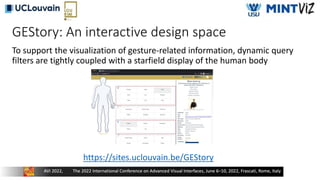
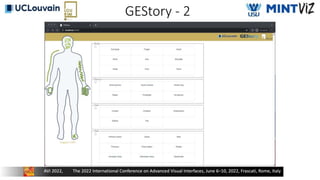
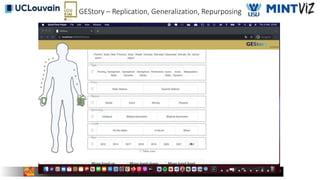
GEStory: An interactive design space
To support the visualization of gesture-related information, dynamic query
filters are tightly coupled with a starfield display of the human body
https://sites.uclouvain.be/GEStory
GEStory:
Domain
model
GEStory - 1
GEStory - 2
GEStory – Replication, Generalization, Repurposing
A Scientific Literature Review of GES replications
Gher
an et al. (2018) Gher
an et al. (2018)b
9
Ts
andil
as(2018)
L
aheyet al. (2011), Bail
l
yet al. (2013),
Chan et al. (2016), Weigelet al. (2014) 2
Vatav
u &Wobbr
ock
(2016)
Vatav
u (2013), P
ium som boon et al. (2013),
Bail
l
yet al. (2013), Vatav
u and Zaiț
i(2014) 2
Nacentaet al. (2013) 3 3
Schipor&
Vatav
u (2018)
Vatav
u &Wobbr
ock
(2015)
Vatav
u (2012), P
ium s
om boon et al. (2013),
Bail
l
yet al. (2013), Vatav
u and Zaiț
i(2014) 2
REPL
ICA
TION
Wobbr
ocket al. (2009) Rus
tet al. (2014)
7
Soniet al. (2019) Soniet al. (2020)
9
GENERA
L
IZA
TION
Vatav
u (2017) L
eiv
aet al. (2017)
10
Mor
ris(2012) Nebel
ing et al. (2014)
6
Morr
iset al. (2014) Hof
fet al. (2016)
6
Rus
tet al. (2014), Wobbr
ocket al. (2009) Soniet al. (2019)
8
REPURPOSING
Conclusion
• We introduced the RepliGES conceptual space to address several
shortcomings (S1-S5) about the body of knowledge accumulated on user-
defined gestures in the scientific literature.
• Based on RepliGES, we developed GEStory, an interactive design space to
structure, visualize, and query user-defined gestures reported by 216 GESs,
which we demonstrated by identifying a set of replicated GESs.
• Our results have implications for the practice of end-user gesture elicitation,
in support of which we provide replicability criteria and recommendations
for researchers and practitioners
Conclusion
• With these tools, the body of knowledge on user-defined gestures is
concentrated in one single point of contact
• Gestures are systematically specified with a unified format in a consistent manner
• It is structured according to a domain model to identify RepliGES links between
different published GESs.
Thank you very much
for your attention

RepliGES and GEStory: Visual Tools for Systematizing and Consolidating Knowledge on User-Defined Gestures

  • 1.
    new data same method new method same participantsnew participants Vatavu &Wobbrock (2015, 2016), Tsandilas (2018) 5 Nacenta et al. (2013), Schipor & Vatavu (2019) 3 6 Nebeling et al. (2014), Hoff et al. (2016) n/a (and unlikely) 4 Repeatability Reproducibility Replicability not yet done new data 1 2 by the virtue of the method itself same data Repurposability 10 9 Gheran et al. (2018)b, Soni et al. (2020) same data REPL ICA TE REPURPOSE new population same population checking of analysis reanalysis of data EX TEND&GENERA L IZ E new goal new population conceptual extension exact replication, same method Replicability Generalizability Extensibility Leiva et al. (2017) exact replication, new method same population exact replication, same method new data 7 8 Rust et al. (2014) empirical generalization generalization and extension repurposing and extension empirical repurposing Soni et al. (2019) RepliGES and GEStory: Visual Tools for Systematizing and Consolidating Knowledge on User-Defined Gestures
  • 2.
    RepliGES and GEStory:Visual Tools for Systematizing and Consolidating Knowledge on User-Defined Gestures Jean Vanderdonckt Université catholique de Louvain (UCLouvain), Belgium Radu-Daniel Vatavu Machine Intelligence & Information Visualization Lab University of Suceava, Romania Santiago Villarreal-Narvaez Université catholique de Louvain (UCLouvain), Belgium Bogdan-Florin Gheran Machine Intelligence & Information Visualization Lab University of Suceava, Romania
  • 3.
    Introduction A Critical aspectof designing gesture user interfaces • Mapping between gestures • System functions Scientific knowledge I. Findings from experiments examining the factors that impact the user experience of gesture-based interaction (social acceptability, memorability, perceived difficulty, and naturalness) II. Insights into users' preferences for gestures elicited in gesture elicitation studies.
  • 4.
    Introduction Gesture Elicitation Studies(GESs). • A powerful method in the toolbox of HCI researchers and practitioners to unveil users' preferences for and mental models of gesture-based interaction • Participants propose gestures they would like to use to effect the system functions of interactive systems Zooming in on a map with touch input Turning on/off the TV set with a smart ring • The practitioner analyzes the elicited gestures to develop an understanding of users' preferences for gesture commands that are perceived: Intuitive Low effort Memorable • Consequently, likely to reflect the preferences of the larger user population
  • 5.
    Introduction Gesture Elicitation Studies(GESs). • Several shortcomings about the body of knowledge accumulated on user-defined gestures in the scientific literature: S1. Scattered literature: GESs are published at various venues S2. Heterogeneous findings: GESs employ different methods of analysis S3. Partial coverage of context: Some GESs lack a full description of the context of use S4. Partial evidence: Some GESs do not provide any indication whether the user-defined gestures they report are representative S5. Difficulty of cross-checking findings: Findings from different GESs are difficult to structure and put in correspondence
  • 6.
    Introduction Contributions of thispaper 1) We formalize replication, extension, generalization, and repurposing of GES findings with RepliGES 2) Based on RepliGES, we introduced GEStory, an interactive design space meant to structure, visualize, and identify user-defined gestures (216 published GESs) 3) Using GEStory, we identify a set of twelve GES replications in the scientific literature, which we characterize using the dimensions of our RepliGES conceptual space 4) We propose a set of replicability criteria to foster replications, extensions, generalizations, and repurposing of findings about user-defined gestures
  • 7.
    RepliGES: A conceptualspace RepliGES specifies five types of replications, three types of extensions and generalizations, and two types of repurposing studies that reuse previous GES findings for new discoveries new data same method new method same participants new participants Vatavu &Wobbrock (2015, 2016), Tsandilas (2018) 5 Nacenta et al. (2013), Schipor & Vatavu (2019) 3 6 Nebeling et al. (2014), Hoff et al. (2016) n/a (and unlikely) 4 Repeatability Reproducibility Replicability not yet done new data 1 2 by the virtue of the method itself same data Repurposability 10 9 Gheran et al. (2018)b, Soni et al. (2020) same data REPL ICA TE REPURPOSE new population same population checking of analysis reanalysis of data EX TEND&GENERA L IZ E new goal new population conceptual extension exact replication, same method Replicability Generalizability Extensibility Leiva et al. (2017) exact replication, new method same population exact replication, same method new data 7 8 Rust et al. (2014) empirical generalization generalization and extension repurposing and extension empirical repurposing Soni et al. (2019)
  • 8.
    RepliGES Method reproducibility Research question Gesture elicitation experiment setup Run experiment Data annotation & preprocessing Data analysis K nowledge Initialobservation, prior work, application domain Gesture input reflective of user behavior Results reproducibility Inferential reproducibility Results Interpretation Design considerations and guidelines What is the purpose of the replication experiment? (Goodman et al., 2016) Referents, apparatus, task, hypotheses Participants are elicited for gestures Raw gesture representations Agreement calculation Gesture set, empirical data Prerequisite: Research question specified Experiment design completely specified Participants sampling specified Gesture clustering criteria specified Agreement measures specified Gesture set documented and available Interpretation method specified Replicability criteria for GES studies paper, report, documentation software, source code, scripts data (raw/annotated/processed) Full replicability No replicability 1 2 3 4 5 6 7 8 I II III A B C D E F Steps of GES
  • 9.
    RepliGES new data same method new method same participantsnew participants Vatavu & Wobbrock (2015, 2016), Tsandilas (2018) 5 Nacenta et al. (2013), Schipor & Vatavu (2019) 3 6 Nebeling et al. (2014), Hoff et al. (2016) n/a (and unlikely) 4 Repeatability Reproducibility Replicability not yet done new data 1 2 by the virtue of the method itself same data Repurposability 10 9 Gheran et al. (2018)b, Soni et al. (2020) same data REPLICATE REPURPOSE new population same population checking of analysis reanalysis of data EXTEND & GENERALIZE new goal new population conceptual extension exact replication, same method Replicability Generalizability Extensibility Leiva et al. (2017) exact replication, new method same population exact replication, same method new data 7 8 Rust et al. (2014) empirical generalization generalization and extension repurposing and extension empirical repurposing Soni et al. (2019)
  • 10.
    GEStory: An interactivedesign space To support the visualization of gesture-related information, dynamic query filters are tightly coupled with a starfield display of the human body https://sites.uclouvain.be/GEStory
  • 11.
  • 12.
  • 13.
  • 14.
    GEStory – Replication,Generalization, Repurposing
  • 15.
    A Scientific LiteratureReview of GES replications Gher an et al. (2018) Gher an et al. (2018)b 9 Ts andil as(2018) L aheyet al. (2011), Bail l yet al. (2013), Chan et al. (2016), Weigelet al. (2014) 2 Vatav u &Wobbr ock (2016) Vatav u (2013), P ium som boon et al. (2013), Bail l yet al. (2013), Vatav u and Zaiț i(2014) 2 Nacentaet al. (2013) 3 3 Schipor& Vatav u (2018) Vatav u &Wobbr ock (2015) Vatav u (2012), P ium s om boon et al. (2013), Bail l yet al. (2013), Vatav u and Zaiț i(2014) 2 REPL ICA TION Wobbr ocket al. (2009) Rus tet al. (2014) 7 Soniet al. (2019) Soniet al. (2020) 9 GENERA L IZA TION Vatav u (2017) L eiv aet al. (2017) 10 Mor ris(2012) Nebel ing et al. (2014) 6 Morr iset al. (2014) Hof fet al. (2016) 6 Rus tet al. (2014), Wobbr ocket al. (2009) Soniet al. (2019) 8 REPURPOSING
  • 16.
    Conclusion • We introducedthe RepliGES conceptual space to address several shortcomings (S1-S5) about the body of knowledge accumulated on user- defined gestures in the scientific literature. • Based on RepliGES, we developed GEStory, an interactive design space to structure, visualize, and query user-defined gestures reported by 216 GESs, which we demonstrated by identifying a set of replicated GESs. • Our results have implications for the practice of end-user gesture elicitation, in support of which we provide replicability criteria and recommendations for researchers and practitioners
  • 17.
    Conclusion • With thesetools, the body of knowledge on user-defined gestures is concentrated in one single point of contact • Gestures are systematically specified with a unified format in a consistent manner • It is structured according to a domain model to identify RepliGES links between different published GESs.
  • 18.
    Thank you verymuch for your attention

Editor's Notes

  • #4 Fist, I start with a lintroduction is represented A large body of ….. exists on this topic represented by
  • #5 Specialized instance of participatory design
  • #6 Specialized instance of participatory design
  • #7 Specialized instance of participatory design
  • #9 3.1 Preliminaries
  • #11 if there is time. show live all filters
  • #13 short example or live demo
  • #14 short example 2