Download to read offline
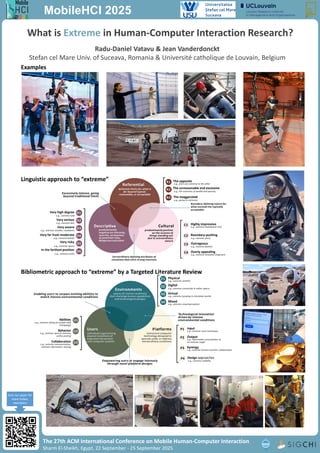

Poster presented at MobileHCI '25. See https://dl.acm.org/doi/10.1145/3737821.3749561 Researchers in human-computer interaction have often approached interactive system design and engineering involving atypical users, novel technological advancements, and unconventional environments that deviate from the average, moderate, or standardized. This paper examines the extent to which researchers characterize their work as extreme, through a targeted literature review and an analysis of the linguistic connotations of the term. We emphasize extreme users, who display exaggerated behaviors, acquire extraordinary abilities, and engage in high-stakes, high-performing collaborations. We also highlight extreme platforms that facilitate input and output modalities surpassing conventional limits, foster intense synergy between users and machines, and employ boundary-pushing design approaches. Lastly, we discuss extreme environments, whether physical, digital, virtual, or mixed, which pose very serious, severe, and potentially risky conditions. We conclude with the benefits for the HCI field of engaging in more scientific and technical explorations driven by “extreme” interaction elements.


