International Research Journal of Engineering and Technology (IRJET) e-ISSN: 2395 -0056
Volume: 04 Issue: 06 | June -2017 www.irjet.net p-ISSN: 2395-0072
© 2017, IRJET | Impact Factor value: 5.181 | ISO 9001:2008 Certified Journal | Page 2607
Gesture Human-Machine Interface (GHMI) in Home Automation
Krishna Rathi1, Dinesh Patil2, Sayli Bhavsar3, Ketaki Jadhav4, Prof. Saurabh V. Thakur 5
1, 2, 3, 4 Department of Electronics and Telecommunication, SAE, Savitribai Phule Pune University, Pune, India
5 Assistant Professor, Department of Electronics and Telecommunication, SAE, Savitribai Phule Pune University,
Pune, India
---------------------------------------------------------------------***---------------------------------------------------------------------
Abstract - Hand gesture based electronic device control is
gaining more importance now days. Mostofelectronicdevices
focus on the hand gesture recognition algorithm and the
corresponding user interface. Gesture Human-Machine
Interface (GHMI) uses an accelerometer and flexsensor. GHMI
mostly based on hand gesture recognition algorithm which is
used to control electronic/electrical devices. The hardware
module consists of an accelerometer, flex sensor, Bluetooth
model, raspberry pi and Arduino kit. The hand gestures are
determined by the accelerometer & flex sensor. These signals
are wirelessly transmitted to Raspberry pi using Bluetooth
model HC-05.The raspberry pi receives and process data send
by the Bluetooth model. It also consists of relay and breakup
boards to support the hardware.
For Home automation, when the switch at door is
pressed the end user will receive a text message to inform
him/her that someone is at the door. With the help of the
camera installed at the door, image capturedfromthecamera
is compared with the image stored in the data base of home
authorized persons. After processing and comparing the
image, authorized person is given access and message is been
forwarded to updated owner about the presence of person at
door. The email containing the photo, fixed format SMS and a
personal phone call is generated by the system to inform the
switch is pressed. For the security reason unauthorizedperson
photo is captured and send to owner via email.
Key Words: Accelerometer, Flex sensor, Bluetooth
model, Raspberry pi and Arduino.
1. INTRODUCTION
Gesture is defined as a motion of limbs or any other
body part which are made to emphasize speech. It can also
be defined as an act or a remark made as a sign of attitude. A
gesture is scientifically categorized into two distinctive
categories: dynamic and static. A waving hand means
goodbye is an example of dynamic gesture and the stop sign
is an example of static gesture. It is necessary to explain all
the static and dynamic gestures over a period of time in
order to understand full message. Gesture recognition is
interpretation of human motion by computing device. Hand
gesture can be detected by controller that contains
accelerometers & flex to sense tilting and acceleration of
movement.
The basic purpose of Gesture Human-Machine
Interface (GHMI) is to provide a means to control electronic
devices using hand gestures. The GHMI will act likea remote
control for operating all the consumer electronic devices
present in a house, but this will be achieved through hand
gestures instead of pushing buttons. Gestures can be
recognized by using sensors i.e. accelerometer, flex etc.
Accelerometer-basedgesturerecognition performsmatching
or modeling in time domain. The detected and recognized
hand gestures are used as the command signals for
controlling devices.
GHMI is a device to replace all other hand held
remotes used in households and perform all their functions.
Normally in homes, remotes are used for appliances like TV,
CD player, Air Conditioner, DVD Player and Music System.
GHMI can be used as a remote for lights ON/OFF control,
Door Opener etc. All these devices can be controlled by
GHMI.
The wireless technology used in GHMI is set to
revolutionize the way people perceive digital devices in our
homes and office environment. This wireless technology is
useful in home environment, where there exists an
infrastructure to interconnect home appliances. This
technology is suitably used for home automation in a cost-
effective manner.
2. LITERATURE SERVAY
Home automation means control of home
applications and other systems to provide efficiency and
security. Home automation provides the good quality of life
for the handicapped persons.
For controlling the home applications android
software is used. Using Android software we can control the
applications such as light, fan, TV and other applications.[1]
In GHMI hand gesture is used instead of Android software.
The VPL DataGlove was built by Thomas Zimmerman, who
also patented the optical flex sensor used by gloves. The
DataGlove was a fabric glove with two fiber optic loop on
each finger. If a user had extra large or small hand, the loop
will not correspond very well to actual position and the user
will not be able to produce accurate gesture. At one end of
each loop there is LED and at other end there is photo
sensor.[2]
International Research Journal of Engineering and Technology (IRJET) e-ISSN: 2395 -0056
Volume: 04 Issue: 06 | June -2017 www.irjet.net p-ISSN: 2395-0072
© 2017, IRJET | Impact Factor value: 5.181 | ISO 9001:2008 Certified Journal | Page 2608
When finger is bent, the light escapefromfiberoptic
cable. The amount of light reaching the photo sensor was
measured and converted into a measure of how much finger
was bent.
Valdimir Vujoic explains the implementofsensoras
Internet of Things (IOT) using Raspberry Pi. The IOT
technology provides various advantages such as security,
safety, cost saving etc. In this project IOT is used for door
security such that if door bell is pressed the message will
send to owners mobile that someone is at the door.[3]
To control the home automation GSM modem is
used. The security is controlled by text message i.e. SMS. For
GSM communication and status of device the AT commands
is used where we know that the device is switch ON or
OFF.[4]
CCTV (Closed Circuit Television) plays a important
role for safety of public and also helps the police for
investigation of certain crime. CCTV was basically designed
in 1965 to record the video signal, but now it is used for
security purpose. [5]
The main limitations of CCTV system are high
maintenance, difficult to edit, low quality video etc. It is very
costly to implement the CCTV camera andhasdrawback that
it require constant monitoring of every activity. In GHMI
OV7670 camera is used which has a resolution of 640x480
and pixel size is 3.6µm x 3. 6µm.
3. OBJECTIVES
Main objective of this project are as follows:
1. Detection of simple hand gesture using various sensors
modules.
2. Design and implement of smart gloves to detect hand
movement.
3. Face Recognization for door unlocking system.
4. Updating the end user by sending a message using Wi-Fi
transmission.
4. DESIGN OF SYSTEM
Fig 1: Transmitter section of GHMI
In Transmitter section Arduino Uno is used as the
main controller i.e. the heart of the transmitter. There are
various sensors such as Flexsensor,Accelerometersensorto
generate the gesture. With the help of these sensors the
gesture are detected. TheOccurrenceofthiseventisupdated
from transmitter side to the receiver side.
The accelerometer sensor is used to select the
device which is need to power and the flex sensor is used to
turn ON and OFF the device.
In transmitter section Bluetooth HC-05 module is
used for serial communication, which is used to send the
movement of the hand which is detected by flex and
accelerometer is send to receiver section.
Fig 2: Receiver section of GHMI
In Receiver section Bluetooth is used to receive
message packets about occurrence of event at the
transmitter side.
At the receiver module the device which is needed to be
controlled are physically connected. There are various
devices such s light, fan, window are controlled wirelessly
without buttons. In this section various relay boards are
used. This relay board is used to control the devices.
Door security for home automation is provided by usingIOT
concepts and powerful Image processing algorithms for
authentication and authorization.
5. ALGORITHMS
The algorithm is divided into two parts as
Transmitter algorithm and Receiver algorithm.
5.1 Transmitter Algorithm:
1) Start.
2) Generate the gestures throw Flex and
accelerometer sensors.
International Research Journal of Engineering and Technology (IRJET) e-ISSN: 2395 -0056
Volume: 04 Issue: 06 | June -2017 www.irjet.net p-ISSN: 2395-0072
© 2017, IRJET | Impact Factor value: 5.181 | ISO 9001:2008 Certified Journal | Page 2609
3) Combine both gestures values.
4) Press switch in case when flex fails.
5) Initialize the Bluetooth HC-05.
6) Transmit the raw co-ordinate using Bluetooth HC-
05.
7) End.
5.2 Receiver Algorithm:
1) Start.
2) Pair HC-05 with the In-build BluetoothofRaspberry
pi.
3) Control (ON/OFF) fan, light, window etc.
4) Connect with android application.
5) Training of images.
6) Waiting for switch pressed.
7) Switch pressed.
8) Image capture by camera module.
9) Image compare by PCA algorithm.
10) Text message & email will be send to the end user.
11) Call will get to the end user.
12) System waits for switch to be pressed again.
13) End
6. FLOWCHARTS
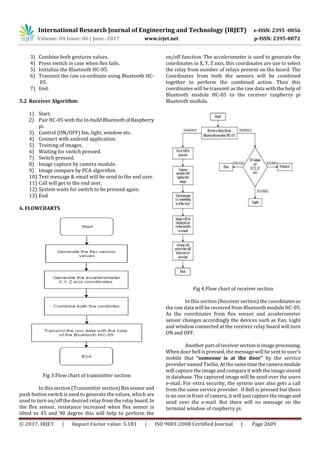
Fig 3:Flow chart of transmitter section
In this section (Transmitter section)flexsensorand
push button switch is used to generate the values, which are
used to turn on/off the desired relay from therelayboard.In
the flex sensor, resistance increased when flex sensor is
tilted to 45 and 90 degree this will help to perform the
on/off function. The accelerometer is used to generate the
coordinates in X, Y, Z axis, this coordinates are use to select
the relay from number of relays present on the board. The
Coordinates from both the sensors will be combined
together to perform the combined action. Then this
coordinates will be transmit as the raw data with the help of
Bluetooth module HC-05 to the receiver raspberry pi
Bluetooth module.
Fig 4:Flow chart of receiver section
In this section (Receiver section) the coordinatesas
the raw data will be received from Bluetooth module HC-05.
As the coordinates from flex sensor and accelerometer
sensor changes accordingly the devices such as Fan, Light
and window connected at the receiver relay board will turn
ON and OFF.
Another part ofreceiversectionisimage processing.
When door bell is pressed, the message will be sent to user’s
mobile that “someone is at the door” by the service
provider named Twilio. At the sametimethecamera module
will capture the image and compare it with the image stored
in database. The captured image will be send over the users
e-mail. For extra security, the system user also gets a call
from the same service provider. If Bell is pressed but there
is no one in front of camera, it will just capturetheimageand
send over the e-mail. But there will no message on the
terminal window of raspberry pi.
International Research Journal of Engineering and Technology (IRJET) e-ISSN: 2395 -0056
Volume: 04 Issue: 06 | June -2017 www.irjet.net p-ISSN: 2395-0072
© 2017, IRJET | Impact Factor value: 5.181 | ISO 9001:2008 Certified Journal | Page 2610
7. RESULTS
Fig 5: Result of transmitter section
This is the transmitter section in which the flex
sensor and accelerometer sensor is providing the values
which is transmitted through Bluetooth module to receiver
section.
When the switch (Door Bell) at the Receiver side is pressed
by the user
Fig 6: No person in front of the door
Fig 7: Person is present in front of the door
8. CONCLUSION
The Gesture Home Machine Interface (GHMI) is
mainly used to help physical impaired people forcontrolling
their home application by hand gestures using flex and the
accelerometer sensor. The proposed system provides high
comfort and convenience to the disable people by using
GHMI system.
GHMI is implemented by using concept of IOT and
Image processing. GHMI is also able to provide home
security by authenticating person identity. The proposed
systems facilitate the wireless gesture based system for
controlling home devices which can also be used for
Industrial applications.
REFERENCES
[1] Deepali Javale,Mohd Mohsin,Shreerang Nandanvar,
Mayur Shingate,”Home automation&securityusingAndroid
ADK”,International Journal of CommunicationandComputer
Technology (IJECCT) Volume 3 Issue 2 ,March 2013.
[2] Shiguo Lian,Wei Hu, Kai Wang, “Automatic User State
Recognition for Hand Gesture Based Low-Cost Control
System”,IEEE,2014
[3] Valdimir Vujoic, MirjanaMakshimovic, “Raspberry Pi a
sensor Web node for home automation” Elsevier on
Computer and Engineering 42(2015).
[4] Rajeev Piyare “Internet of Things: Ubiquitous Home and
Monitoring System using Android based Smart phone.
[5] Gantt, Charles. “Raspberry Pi Camera Module Review
Tutorial Guide” TweakTown News. Tweak Town, 2 2013.
Web. Oct. 2013
BIOGRAPHIES
Krishna A. Rathi has Complicated
Bachelors degree in the field of
Electronic andTelecommunication
from SAE Savitribai Phule Pune
University, Pune and Diploma in
same from P. R. Patil Institute of
Polytechnic Amravati.
Dinesh S. Patil has Complicated
Bachelors degree in the field of
Electronic andTelecommunication
from SAE Savitribai Phule Pune
University, Pune and Diploma in
same from Sou. Venutai Chavan
Polytechnic Pune.
International Research Journal of Engineering and Technology (IRJET) e-ISSN: 2395 -0056
Volume: 04 Issue: 06 | June -2017 www.irjet.net p-ISSN: 2395-0072
© 2017, IRJET | Impact Factor value: 5.181 | ISO 9001:2008 Certified Journal | Page 2611
Sayli P. Bhavsar has Complicated
Bachelors degree in the field of
Electronic andTelecommunication
from SAE Savitribai Phule Pune
University, Pune and Diploma in
same from K. K. Wagh Polytechnic
Nashik.
Ketaki M. Jadhav hasComplicated
Bachelors degree in the field of
Electronic andTelecommunication
from SAE Savitribai Phule Pune
University, Pune and Diploma in
same from MIT Kothrud
Polytechnic Pune.
Saurabh Thakur has completed
Bachelors and Masters from SSPU
and presently workingasAssistant
Professor in University of Pune.He
has worked as SRF on SAR Image
processing using NVIDIA CUDA
platform. Also worked as Research
and Development Engineering in
NBRC, Manesar in
Neurospectroscopy for detection
of Alzheimer detection. His areas
of interest include Image
Processing and EmbeddedSystem.

Gesture Human-Machine Interface (GHMI) in Home Automation

  • 1.
    International Research Journalof Engineering and Technology (IRJET) e-ISSN: 2395 -0056 Volume: 04 Issue: 06 | June -2017 www.irjet.net p-ISSN: 2395-0072 © 2017, IRJET | Impact Factor value: 5.181 | ISO 9001:2008 Certified Journal | Page 2607 Gesture Human-Machine Interface (GHMI) in Home Automation Krishna Rathi1, Dinesh Patil2, Sayli Bhavsar3, Ketaki Jadhav4, Prof. Saurabh V. Thakur 5 1, 2, 3, 4 Department of Electronics and Telecommunication, SAE, Savitribai Phule Pune University, Pune, India 5 Assistant Professor, Department of Electronics and Telecommunication, SAE, Savitribai Phule Pune University, Pune, India ---------------------------------------------------------------------***--------------------------------------------------------------------- Abstract - Hand gesture based electronic device control is gaining more importance now days. Mostofelectronicdevices focus on the hand gesture recognition algorithm and the corresponding user interface. Gesture Human-Machine Interface (GHMI) uses an accelerometer and flexsensor. GHMI mostly based on hand gesture recognition algorithm which is used to control electronic/electrical devices. The hardware module consists of an accelerometer, flex sensor, Bluetooth model, raspberry pi and Arduino kit. The hand gestures are determined by the accelerometer & flex sensor. These signals are wirelessly transmitted to Raspberry pi using Bluetooth model HC-05.The raspberry pi receives and process data send by the Bluetooth model. It also consists of relay and breakup boards to support the hardware. For Home automation, when the switch at door is pressed the end user will receive a text message to inform him/her that someone is at the door. With the help of the camera installed at the door, image capturedfromthecamera is compared with the image stored in the data base of home authorized persons. After processing and comparing the image, authorized person is given access and message is been forwarded to updated owner about the presence of person at door. The email containing the photo, fixed format SMS and a personal phone call is generated by the system to inform the switch is pressed. For the security reason unauthorizedperson photo is captured and send to owner via email. Key Words: Accelerometer, Flex sensor, Bluetooth model, Raspberry pi and Arduino. 1. INTRODUCTION Gesture is defined as a motion of limbs or any other body part which are made to emphasize speech. It can also be defined as an act or a remark made as a sign of attitude. A gesture is scientifically categorized into two distinctive categories: dynamic and static. A waving hand means goodbye is an example of dynamic gesture and the stop sign is an example of static gesture. It is necessary to explain all the static and dynamic gestures over a period of time in order to understand full message. Gesture recognition is interpretation of human motion by computing device. Hand gesture can be detected by controller that contains accelerometers & flex to sense tilting and acceleration of movement. The basic purpose of Gesture Human-Machine Interface (GHMI) is to provide a means to control electronic devices using hand gestures. The GHMI will act likea remote control for operating all the consumer electronic devices present in a house, but this will be achieved through hand gestures instead of pushing buttons. Gestures can be recognized by using sensors i.e. accelerometer, flex etc. Accelerometer-basedgesturerecognition performsmatching or modeling in time domain. The detected and recognized hand gestures are used as the command signals for controlling devices. GHMI is a device to replace all other hand held remotes used in households and perform all their functions. Normally in homes, remotes are used for appliances like TV, CD player, Air Conditioner, DVD Player and Music System. GHMI can be used as a remote for lights ON/OFF control, Door Opener etc. All these devices can be controlled by GHMI. The wireless technology used in GHMI is set to revolutionize the way people perceive digital devices in our homes and office environment. This wireless technology is useful in home environment, where there exists an infrastructure to interconnect home appliances. This technology is suitably used for home automation in a cost- effective manner. 2. LITERATURE SERVAY Home automation means control of home applications and other systems to provide efficiency and security. Home automation provides the good quality of life for the handicapped persons. For controlling the home applications android software is used. Using Android software we can control the applications such as light, fan, TV and other applications.[1] In GHMI hand gesture is used instead of Android software. The VPL DataGlove was built by Thomas Zimmerman, who also patented the optical flex sensor used by gloves. The DataGlove was a fabric glove with two fiber optic loop on each finger. If a user had extra large or small hand, the loop will not correspond very well to actual position and the user will not be able to produce accurate gesture. At one end of each loop there is LED and at other end there is photo sensor.[2]
  • 2.
    International Research Journalof Engineering and Technology (IRJET) e-ISSN: 2395 -0056 Volume: 04 Issue: 06 | June -2017 www.irjet.net p-ISSN: 2395-0072 © 2017, IRJET | Impact Factor value: 5.181 | ISO 9001:2008 Certified Journal | Page 2608 When finger is bent, the light escapefromfiberoptic cable. The amount of light reaching the photo sensor was measured and converted into a measure of how much finger was bent. Valdimir Vujoic explains the implementofsensoras Internet of Things (IOT) using Raspberry Pi. The IOT technology provides various advantages such as security, safety, cost saving etc. In this project IOT is used for door security such that if door bell is pressed the message will send to owners mobile that someone is at the door.[3] To control the home automation GSM modem is used. The security is controlled by text message i.e. SMS. For GSM communication and status of device the AT commands is used where we know that the device is switch ON or OFF.[4] CCTV (Closed Circuit Television) plays a important role for safety of public and also helps the police for investigation of certain crime. CCTV was basically designed in 1965 to record the video signal, but now it is used for security purpose. [5] The main limitations of CCTV system are high maintenance, difficult to edit, low quality video etc. It is very costly to implement the CCTV camera andhasdrawback that it require constant monitoring of every activity. In GHMI OV7670 camera is used which has a resolution of 640x480 and pixel size is 3.6µm x 3. 6µm. 3. OBJECTIVES Main objective of this project are as follows: 1. Detection of simple hand gesture using various sensors modules. 2. Design and implement of smart gloves to detect hand movement. 3. Face Recognization for door unlocking system. 4. Updating the end user by sending a message using Wi-Fi transmission. 4. DESIGN OF SYSTEM Fig 1: Transmitter section of GHMI In Transmitter section Arduino Uno is used as the main controller i.e. the heart of the transmitter. There are various sensors such as Flexsensor,Accelerometersensorto generate the gesture. With the help of these sensors the gesture are detected. TheOccurrenceofthiseventisupdated from transmitter side to the receiver side. The accelerometer sensor is used to select the device which is need to power and the flex sensor is used to turn ON and OFF the device. In transmitter section Bluetooth HC-05 module is used for serial communication, which is used to send the movement of the hand which is detected by flex and accelerometer is send to receiver section. Fig 2: Receiver section of GHMI In Receiver section Bluetooth is used to receive message packets about occurrence of event at the transmitter side. At the receiver module the device which is needed to be controlled are physically connected. There are various devices such s light, fan, window are controlled wirelessly without buttons. In this section various relay boards are used. This relay board is used to control the devices. Door security for home automation is provided by usingIOT concepts and powerful Image processing algorithms for authentication and authorization. 5. ALGORITHMS The algorithm is divided into two parts as Transmitter algorithm and Receiver algorithm. 5.1 Transmitter Algorithm: 1) Start. 2) Generate the gestures throw Flex and accelerometer sensors.
  • 3.
    International Research Journalof Engineering and Technology (IRJET) e-ISSN: 2395 -0056 Volume: 04 Issue: 06 | June -2017 www.irjet.net p-ISSN: 2395-0072 © 2017, IRJET | Impact Factor value: 5.181 | ISO 9001:2008 Certified Journal | Page 2609 3) Combine both gestures values. 4) Press switch in case when flex fails. 5) Initialize the Bluetooth HC-05. 6) Transmit the raw co-ordinate using Bluetooth HC- 05. 7) End. 5.2 Receiver Algorithm: 1) Start. 2) Pair HC-05 with the In-build BluetoothofRaspberry pi. 3) Control (ON/OFF) fan, light, window etc. 4) Connect with android application. 5) Training of images. 6) Waiting for switch pressed. 7) Switch pressed. 8) Image capture by camera module. 9) Image compare by PCA algorithm. 10) Text message & email will be send to the end user. 11) Call will get to the end user. 12) System waits for switch to be pressed again. 13) End 6. FLOWCHARTS Fig 3:Flow chart of transmitter section In this section (Transmitter section)flexsensorand push button switch is used to generate the values, which are used to turn on/off the desired relay from therelayboard.In the flex sensor, resistance increased when flex sensor is tilted to 45 and 90 degree this will help to perform the on/off function. The accelerometer is used to generate the coordinates in X, Y, Z axis, this coordinates are use to select the relay from number of relays present on the board. The Coordinates from both the sensors will be combined together to perform the combined action. Then this coordinates will be transmit as the raw data with the help of Bluetooth module HC-05 to the receiver raspberry pi Bluetooth module. Fig 4:Flow chart of receiver section In this section (Receiver section) the coordinatesas the raw data will be received from Bluetooth module HC-05. As the coordinates from flex sensor and accelerometer sensor changes accordingly the devices such as Fan, Light and window connected at the receiver relay board will turn ON and OFF. Another part ofreceiversectionisimage processing. When door bell is pressed, the message will be sent to user’s mobile that “someone is at the door” by the service provider named Twilio. At the sametimethecamera module will capture the image and compare it with the image stored in database. The captured image will be send over the users e-mail. For extra security, the system user also gets a call from the same service provider. If Bell is pressed but there is no one in front of camera, it will just capturetheimageand send over the e-mail. But there will no message on the terminal window of raspberry pi.
  • 4.
    International Research Journalof Engineering and Technology (IRJET) e-ISSN: 2395 -0056 Volume: 04 Issue: 06 | June -2017 www.irjet.net p-ISSN: 2395-0072 © 2017, IRJET | Impact Factor value: 5.181 | ISO 9001:2008 Certified Journal | Page 2610 7. RESULTS Fig 5: Result of transmitter section This is the transmitter section in which the flex sensor and accelerometer sensor is providing the values which is transmitted through Bluetooth module to receiver section. When the switch (Door Bell) at the Receiver side is pressed by the user Fig 6: No person in front of the door Fig 7: Person is present in front of the door 8. CONCLUSION The Gesture Home Machine Interface (GHMI) is mainly used to help physical impaired people forcontrolling their home application by hand gestures using flex and the accelerometer sensor. The proposed system provides high comfort and convenience to the disable people by using GHMI system. GHMI is implemented by using concept of IOT and Image processing. GHMI is also able to provide home security by authenticating person identity. The proposed systems facilitate the wireless gesture based system for controlling home devices which can also be used for Industrial applications. REFERENCES [1] Deepali Javale,Mohd Mohsin,Shreerang Nandanvar, Mayur Shingate,”Home automation&securityusingAndroid ADK”,International Journal of CommunicationandComputer Technology (IJECCT) Volume 3 Issue 2 ,March 2013. [2] Shiguo Lian,Wei Hu, Kai Wang, “Automatic User State Recognition for Hand Gesture Based Low-Cost Control System”,IEEE,2014 [3] Valdimir Vujoic, MirjanaMakshimovic, “Raspberry Pi a sensor Web node for home automation” Elsevier on Computer and Engineering 42(2015). [4] Rajeev Piyare “Internet of Things: Ubiquitous Home and Monitoring System using Android based Smart phone. [5] Gantt, Charles. “Raspberry Pi Camera Module Review Tutorial Guide” TweakTown News. Tweak Town, 2 2013. Web. Oct. 2013 BIOGRAPHIES Krishna A. Rathi has Complicated Bachelors degree in the field of Electronic andTelecommunication from SAE Savitribai Phule Pune University, Pune and Diploma in same from P. R. Patil Institute of Polytechnic Amravati. Dinesh S. Patil has Complicated Bachelors degree in the field of Electronic andTelecommunication from SAE Savitribai Phule Pune University, Pune and Diploma in same from Sou. Venutai Chavan Polytechnic Pune.
  • 5.
    International Research Journalof Engineering and Technology (IRJET) e-ISSN: 2395 -0056 Volume: 04 Issue: 06 | June -2017 www.irjet.net p-ISSN: 2395-0072 © 2017, IRJET | Impact Factor value: 5.181 | ISO 9001:2008 Certified Journal | Page 2611 Sayli P. Bhavsar has Complicated Bachelors degree in the field of Electronic andTelecommunication from SAE Savitribai Phule Pune University, Pune and Diploma in same from K. K. Wagh Polytechnic Nashik. Ketaki M. Jadhav hasComplicated Bachelors degree in the field of Electronic andTelecommunication from SAE Savitribai Phule Pune University, Pune and Diploma in same from MIT Kothrud Polytechnic Pune. Saurabh Thakur has completed Bachelors and Masters from SSPU and presently workingasAssistant Professor in University of Pune.He has worked as SRF on SAR Image processing using NVIDIA CUDA platform. Also worked as Research and Development Engineering in NBRC, Manesar in Neurospectroscopy for detection of Alzheimer detection. His areas of interest include Image Processing and EmbeddedSystem.